TUNED UP – with Sound Engineer, Stu Keeble

Dingwalls was a live venue in Newcastle operating in the early ‘80s and many signed and unsigned bands played there. Pages from a 1983 diary and booking list for the venue were posted on-line and some of those pages are pictured here.

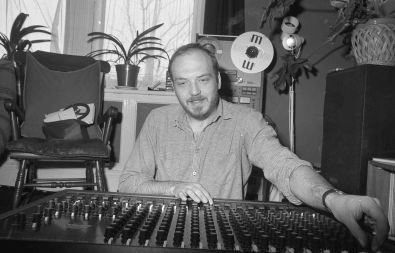
I got in touch with Stu Keeble who was sound engineer at the Newcastle venue at that time….

I think my first gig at Dingwalls was John Martyn in 1983. After the venue closed and re-opened as the Bear Pit I was still the engineer. I then did three years with the Bay City Rollers!

Have you any road stories with the Rollers?

Apart from the sex, drugs and rock and roll plus the large amount of whisky they consumed, I’ve lots of stories but I’m not sure how many are fit for public consumption (laughs).

The story we remember was a nightmare journey. The van broke down on the way to Ayr in Scotland, we were about 10 miles away from the gig. We had AA cover so they came and towed us to the venue and we did the show. That wasn’t too bad but now the big problem was getting back.

I phoned my mate Barry Hodgson from Stanley in County Durham, Barry hired a 7.5-ton Ford Cargo which he drove all the way up to Ayr and towed the van back – a nightmare journey as the engine had blown up in the Transit.

We hadn’t thought that the battery wouldn’t last the return trip – the lights died as we passed Carlisle.

I had to call on a friend in Haltwhistle to borrow the battery out of his Mini which just got us back. Unfortunately, this was in the days before cameras in the mobile phone so there are no photos of the nightmare!
How did you get interested in sound engineering?

I was a Hi-Fi nut and loved music. I used to go to a lot of gigs, mostly names like Sabbath and The Who, but I was also into west coast American acts so bands like CSNY, Poco, America and Jackson Browne.

1979 was my first paid sound engineering job with a band called 747 in the North East workingmen’s clubs. I’d only done amateur stuff before that.

Did you engineer for any North East bands?

My first tour was with Tysondog, I also mixed for Warrior, there is a live record – For Europe Only.  I worked with Danceclass and did a few shows with the Toy Dolls in fact most North East bands even Prefab Sprout.

When you were at Dingwalls what was the plan for your day?

A day at Dingwalls would start around 11-12noon depending on the band’s arrival time and how much gear they had. We would load them in – I had a stage tech called Kremen, who’s sadly no longer with us.

Then sound check them once the offices upstairs in the building had finished work. We would have something to eat before it would be time for the doors to open, can’t remember when that was maybe 7.30/8.00 pm.

The gig would happen and when it finished, we would get ready to pack up and load out. It would take us another hour or so to get the band out. We would get a taxi so maybe get home by 2am.

What are your highlights from your career?

As for highlights I have a few, a couple at Dingwalls/Bear Pit where Man – what a band, they were awesome, and the time Roy Harper came in with a young girl looking like he had slept in a shop doorway.

He proceeded to give the young house engineer a lesson in compression, when the song is quiet it’s meant to be quiet ‘DO NOT COMPRESS MY SOUND’. That was easy to do as in the early ’80s compressors weren’t as common as they are now and we didn’t have any!

I got the call to do a Christmas party for TV show The Tube at the Jewish Mother pub in Newcastle and after setting up the system Joe Cocker turned up to sound check – that was a gig to remember.

I had the contract for the Northumbria Uni/Poly for the best part of 30 years and I was house engineer at the Astoria in London for a couple of years too.

I did playback for Wet Wet Wet’s first Tube video, and I appeared in Crocodile Shoes (TV drama with Jimmy Nail) as the sound engineer at the live show.

There have been a few gigs to remember over the 40 odd years but they all sort of merge into one. Friends of Harry at the Radio One roadshow in Exhibition Park, Newcastle when the mixing desk was behind the stage and I had to produce a PA mix, five monitor mixes and a broadcast mix was a lot of fun !

The bands single that I had mixed at High Level Studio, Newcastle was the record of the week.

Doing PA for the Queen Mother at Team Valley Trading Estate, Gateshead in 1986 was an eye opener when Special Branch wanted to look inside the speaker cabinets or Alexi Sayle at Newcastle City Hall for the miners’ strike in ‘84 was a laugh when he walked on stage and said hello you c@#*s and half the audience left.

But two great moments were at The London Astoria meeting and mixing for Bruce Willis and Mike and the Mechanics.

What are you doing now?

I’m still working, currently doing the Northumberland Live festival in Blyth. I’m really enjoying helping to bring quality acts to Blyth for a free festival.

I’ve really enjoyed my time as a sound engineer, and I wouldn’t have been happy doing anything else.

Alikivi  June 2020.

EARTH WORKS for Teeside artist Andrew McKeown.

A current photography job I’m working on is documenting the regeneration project near the seafront in the North Marine Park, South Shields – really handy because I only live two minutes away.

Within the building and restoration work pieces of public art are planned so I got in touch with the artist commissioned for the work…..

I am currently working on designs for a large contemporary steel Beacon in North Marine Park, South Shields. The Beacon takes inspiration from the Lawe Top Beacons built in 1832.

The words on the Beacon preserve maritime trade names and celebrate the character of the people of South Shields. The words and trade names have been suggested by the local community.

Do you always involve the community in a project ?

Involving local communities is an essential part of my working practice. I have over 25 years of experience and knowledge in this area.

For previous projects I have devised a wide range of community consultation programs involving local people and schoolchildren, from presentations through to hands on practical sculpture workshops and longer artist in residence programs.

This work helps me refine ideas and sometimes new ideas are formed which develop into final sculptures.

It’s also equally important that local people have an opportunity to work together and create something positive for their community, to gain a sense of pride and ownership in the process and the final artwork.

The processes involved in the engagement work is as important as the resulting artwork.

An interesting example of this approach can be seen in the sculpture ‘Breaking the Mould’ which takes the form of a giant seed which has emerged from an old industrial mould.

The mould is broken and no longer useful but the last cast to be made is a new natural life form. The symbolism creates a striking resonance with the former and future uses of many of the 21 regeneration sites across England and Wales called Changing Places.

The £60 million Changing Places program transformed 1,000 hectares of post-industrial derelict land into parks and open spaces.

Where did the idea come from ?

During dialogue with East Manchester Ladies knitting group, I distinctly remember writing some of the things they were saying to me, like ‘turning over a new leaf’, and ‘Breaking the Mould’ as we discussed their desire to move on and leave behind the scarred industrial landscape, changing it into an urban park and community facility through the Changing Places project.

What got you interested in art, was there a ‘wow’ moment when you saw something ?

Not really, my upbringing was probably the biggest influence on that. It was a very creative upbringing.

McKeown grew up in a working-class area of Middlesbrough, Teesside, UK, as the youngest in a family of four children….

We had a large garden where my father, a lifelong steelworker grew an abundance of fruit and veg. My mother was a primary school teacher and we were always building, making, cooking and exploring.

The family lived only a couple of miles away from the shipyards, coke ovens, blast furnaces and rolling mills of British Steel and the chemical plants of ICI…

If we were feeling energetic, we would walk or cycle to Redcar beach or Eston Hills where iron ore was mined to fuel the industrial revolution.

At school, art was always my favourite subject, and this inspired me to attend art college and then a Fine Art degree in sculpture at Coventry Polytechnic.

Following education, Andrew worked as a community artist delivering school and community-based workshops and small art projects…

These were low budget projects such as one-off workshop days and artist in residence projects. Gradually larger projects became available and I was able to create my own artwork with the involvement of local communities, rather than solely community generated art.

What inspires you ?

The industrial processes of casting and mould making influence my work in both a practical and conceptual way. I often create multiple cast sculptures in iron, steel, bronze, aluminium and stone – these are very durable materials for external artworks.

McKeown uses recurring themes within his work of growth, change and renewal….

I like to work within the environment, and this often means I have to build identity and add character to a space that has very little.

Often, I am working in empty fields or urban parks that only have a few shrubs and paths or working off landscape plans while looking at building sites and piles or earth.

Rather than creating one giant sculpture I often use the available budget to create a family of related sculptures that link to each other and draw your eye to the environment they are in.

Other times I create entrance features that hope to draw people into a space. I prefer that people can engage with my sculptures becoming almost part of them for a brief moment.

On average how long do you work on a project for a client ?

This is very hard to answer but the larger projects can be spread out over years to plan and develop. Then when it comes to manufacturing this can take as little as two months or if I am making patterns and moulds for casting this might take six to eight months.

Is there a satisfying moment during the art process ?

I think the most satisfying time is when I have the right idea for a project. One that I know that I like and know the client and the community are going to like and buy into.

This can often be the most draining and difficult process and it can take a lot of research and community work similar to the Breaking the Mould idea which came after maybe eight months of research and community engagement.

What else are you working on ?

I am currently finalizing designs for a Teeside Retail Park called ‘Rolled into One’. For this project I am engaging the local community to provide colloquial job or occupation names from the local iron and steel industry.

Up to one hundred of these names will be applied to the outsides of the steel box section arms of the sculpture.

There are many unique and interesting names such as Welder, Plater, Catcher, Striker, Roller, Breaker, Burner that will be used and many more. I am currently consulting the local community including my family and friends.

I’m also working on a few other projects, one called ‘Crossing Points’ for Groundwork North East River Tees Rediscovered project, another project is for Middlesbrough Council within its Creative Factory artistic interventions project – my pieces are called ‘Endless Convenience’.

Andrew lives and works in the North East of England and is available for public and private commissions throughout the U.K. and internationally.

For more information and images for previous artwork visit:

www.andrewmckeown.com

https://www.facebook.com/andrewmckeownsculptor/

Interview by Alikivi  June 2020.

TALL STORIES – painting with L. S. Lowry (1887-1976)

Hanging on my wall is a fairly large (27 x 22inch) painting printed on wood – Industrial Landscape, Ashton under Lyme 1952 by L. S. Lowry. The original is in Bradford Art Gallery and Museum.

I bought it in a charity shop a couple of years ago, the colours are faded as the previous owner must have placed it in direct sunlight, but still a bargain at £7.

When I first saw it I recognised the style as a Lowry – I like how he stretches everything – chimneys, buildings and people, the flat look with no shadows and how the factories fade in the background – capturing the heart and scale of industry.

Industrial Landscape by L.S. Lowry (1952).

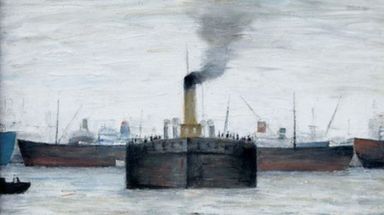
During the ‘60s Lowry visited Sunderland and surrounding areas where he produced a number of oil paintings and sketches. In South Shields he produced The Ferry in 1967. After his visit the painting went on display in the art gallery in Sunderland.

Bill Clark, owner of the Clark Art gallery in Cheshire, bought the painting in 2010. He said: ‘Lowry was entranced by the North East and particularly by South Shields. ’The Ferry’ is one of the stand-out pieces he produced of the area in the 1960s’.

The Ferry by L.S. Lowry (1967).

Lowry used to spend short breaks at the Seaburn Hotel near Sunderland, painting and sketching scenes of the beach and nearby ports.

The River Wear would be the closest to his hotel but in one sketch Tanker Entering the Tyne is a ship sailing around what could be the view from Comical Corner on the riverside near the boat builder’s yards on Wapping Street, South Shields.

If Lowry was in Shields, is there a record of his visit ?

Born on 1st November 1887 Lawrence Stephen Lowry is on the 1911 census living at 119a Station Road, Pendlebury, Lancashire with his parents Robert, an estate agents’ clerk, and Elizabeth.

Lucy England, and a few years later 23-year-old Alice Powell were employed by the family as domestic servants to help around the house as his mother Elizabeth had become bed ridden and dependent on her son. His father Robert died in 1932.

Lawrence worked through the day as a rent collector, then when he got home cared for his mother, only leaving time to paint through the night.

Lowry painted everyday scenes that he saw around him in England’s industrial North. ‘I never worked in a mill, it wasn’t a job I would of liked. Starting at 6 in the morning and finishing half past 5 at night. But I wanted to put the industrial scene on the map’ he said in a BBC interview in 1975.

He spent about ten years in Art schools in Salford learning classical techniques, and though he focused on industrial scenes he produced a number of seascapes and portraits using simple materials and colours.

He had small exhibitions, and his work was being noticed, but it wasn’t until aged 52 that his work was acclaimed. His mother never saw his success as she died in 1939, it deeply affected him and his work.

The scenes he painted where full of people haunted with anger and pain.

Due to class snobbery his work wasn’t recognised by the self-appointed art elite in the south. The Tate Gallery held some of his work in their basement for decades, but it wasn’t until 2013 when they eventually held a Lowry exhibition.

Lowry turned down honours, O.B.E, C.B.E and a knighthood – ‘meaningless in the absence of mother’. He retired from being a rent collector at 65 and during this time visited the North East still making sketches of what he could see around him.

On 23rd February 1976 Lowry died of pneumonia at the age of 88. He had produced over 1,000 paintings and drawings and today there is an art gallery in Salford named after him housing the largest collection of his work.

The world record sale for one of his paintings was for over £5 million paid for The Football Match.

Sources: Ancestry family search.

BBC News 2012 & 2013.

L.S.Lowry BBC film The Industrial Artist 1975.

 Alikivi  May 2020.

SONGS OF ISOLATION – Emma ‘Velvet Tones of Teesside’ Wilson contributes track.

Noted members of the UK Blues and Roots community have come together to produce Songs of Isolation. A fabulous one-off 17 track compilation in aid of NHS Charity + Heroes.

Mike Rivers, promoter at The Crawdaddy Club, Richmond, London, famous for its connection to early gigs by the Rolling Stones and the Yardbirds…

Everyone involved has generously donated their songs in aid of the charity, + Heroes. A small charity set up by NHS staff helping them obtain much needed PPE, childcare, food, financial and emotional support.

In the early days of Covid 19 and the lockdown I had the idea inspired by musician Adam Norsworthy for our musician friends to create a virtual album. We asked contacts in our music community to write and record a song related to the lockdown.

To work his mastering magic, we asked music producer/engineer Jon Astley (The Who, Eric Clapton, The Rolling Stones, Tom Jones, Jools Holland) who kindly volunteered his time. The result is an album that digs deep in the sadness that we all face during these uncertain times’.

UK Blues siren Emma Wilson.

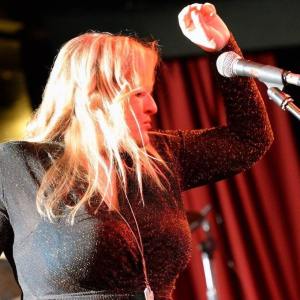
UK blues and soul siren, Emma Wilson from Teeside who has featured twice on this blog, has contributed to the album

‘I performed at The Crawdaddy a few times and promoter Mike Rivers invited me to add one of my songs. I wrote ‘Hold On’ especially for this compilation – it’s about missing my band and friends.

The musicians recorded from home and the lyrics mention all the names of Club promoters where I gig, like Mike Pendergrast from Darlington, Saltburn Blues Club Harry Simpson, Pete Rafferty from Eaglescliffe and from Guisborough, Kathleen Whinyates.

The collective has zero costs so every penny will go to the charity, + Heroes. Mike explains…

‘We ask for a minimum donation of £8.00 but hope that those of you who can afford it will give more generously. The music mirrors the feelings that only excellent musicians and songwriters can express in song. It is a present-day history of our times’.

The album is officially released on Friday 12th June 2020, and will be available to purchase via bandcamp HERE. A limited-edition physical CD version is also planned.

Featured artists on the album are:
The Della Grants , Ash Wilson, Georgia Van Etten, Adam Norsworthy, Rick Cassman,
Frank Collins, Emma Wilson, Peter Harris, Sonja Allen, Ben Hemming, Mike Ross, Marcus Lazarus, Grange McKenna, Ian McHugh, Staff & Stew, Gareth Huggett and The Surreal Lockdown Experience. 

Alikivi   June 2020

PIT CHORUS – interview with County Durham singer & songwriter Peter Lee Hammond.

The Queen, Margaret Thatcher and Paul McCartney walk into a bar in Easington mining town in the North East – sounds like an opening line of a joke but it’s a link to a song from deep down in the coal pits of the North East.

I asked the songwriter and ex-miner of 11 years, Pete Hammond, how did the single Living in a Mining Town come about ?

Easington in County Durham used to hold a carnival every year to commemorate the mining community and I was asked to write a song in 1989.

A lot of people got on board when they heard the rough version of the song, and the Easington council committee wanted it to be made into a single for the town.

The song was originally recorded in The Studio in Hartlepool then mixed at Abbey Road studios in London. I went down and met Paul and Linda McCartney and was given a tour around the studio by Paul. He also showed me an easy way to play his song Blackbird.

Metro Radio, Radio Tees, Radio One and many others played the song and I done a few interviews for them.

The proceeds were to raise money for a local handicapped school, so they could get a hydro pool for the residents. The money from the song also went towards launching a music collective in the area for musicians.

Many businesses donated money and it was supported by celebrities like Prince Charles, Her Royal Highness the Queen, Neil Kinnock MP and the Prime Minister Maggie Thatcher.

The Queen asked for a copy of the single to be sent to her and Maggie Thatcher sent me a signed photo of herself to auction and raise money. But no-one wanted to bid given the feelings the miners had for her, so I still have the photo at home.

Were you in a band then ?

Yes, at the time I was in a band called Just Us. I have won many song writing contests and awards over the years and cut album and cd’s.

One prize for winning a contest was song writing lessons from the lead singer of the Strawbs, Dave Cousins, and guitarist Brian Willoughby.

What studios did you record in ?

I recorded at Guardian Studios in Durham run by Terry Gavaghan. The studio was just in a normal street, it was two houses knocked together with no big sign saying recording studio, I thought I was at the wrong place at first until Terry answered the door.

What were your memories of the studio ?

Terry was a great, down to earth kind of guy always made you feel at ease, which was good as it was my first time in a studio or recording a song for that matter.

I remember the mixing room being very cramped full of equipment and a large mixing desk. But the session went smooth and the songs sounded great, Terry really knew what he was doing. We recorded three tracks there, Name on a Stone, Thomas Watson and I’m a Loner.

Terry was full of jokes and stories, one was that the studio was haunted by the ghost of a child that had been run over on the road outside the house. He also showed me a fur coat belonging to John Lennon,

Terry said when he first started out, he worked at Abbey Road studios, he let me take a piece of the lining and a clip of the fur as a keepsake. I have them in a frame at home.

Looking back what does the song mean to you ?

The song gave the community a sense of pride when the single came out, I was very proud and honoured to have been asked to do this for the place where I was born and raised.

What are you doing now ?

I still write songs and have over 1,000 up to now and record them on my own home studio. They can be heard on YouTube and my song writing Facebook page, you can find it by putting Hammy in the search bar.

Interview by Alikivi  June 2020

BROTHERS IN ARMS with North East songwriter Phil Caffrey

I have been so fortunate to play with not only great musicians but great people. The icing on my musical cake has been sharing the stage with my two brothers Pete and Paul said Phil.

Newcastle based The Caffreys create an original mix of rock, roots and folk. They have earned a formidable reputation based on uplifting original songs and great musicianship.

The full band or the smaller acoustic set up consist of some of the North East’s most respected musicians.

Recent live performances include Newcastle’s Live Theatre, The Mouth of The Tyne Festival, Durham Gala Theatre, The Pickering Engine Rally and The Sage in Gateshead.

I caught up with Phil who looked back on his early days in music….

We had many high points on stage, playing Newcastle City Hall was always great, gigs in Paris, Domefest in Durham and many great UK theatres.

In the early ‘70s we were trying to get a recording deal and in those days you had to gig in London to get record companies to come and see you. They would write to let you know if they were interested or not.

We had a wooden partition in the van and we would pin up the refusals from record companies on it, this made us more determined to get a deal which we did in 1975 with DJM. We released two albums and 4 singles over the next three years, but not much success to be honest.

When did you first get interested in music ?

We used to listen to our older brothers records in the late ‘50s early ‘60s – Buddy Holly, Fats Domino, Little Richard and many others.

My maiden performance was when I was 7 in 1959. It was in our parent’s front garden with my two brothers Pete 10, and Paul who was 5. Pete strummed the guitar and we all sang, we loved singing in harmony.

Our older brother Gerard who also played helped us. Other children would come and watch us and that gave us a good grounding and enhanced our childhood.

On 17th December 1964 we did a 30 minute performance at school and I still have the letter the headmaster sent our parents congratulating us on our performance. I have been so fortunate to make music with my brothers, this is my 8th decade making music from the late 1950’s to 2020.

What was your experience of being in a band in the beginning and when was your first time in a recording studio ?

I was in local bands and school bands until we formed Arbre in 1971. We played a gig on July 11th 1971 at Change night club in Newcastle. We invited loads of friends and made £25, this allowed us to go into Impulse Studio to record an album of original songs.

It was a sunny Sunday in August, we rehearsed the songs to the point that we recorded everything in one take. It was our first experience in a studio and we really enjoyed it. I still have the only copy of that album, it’s where it all started.

Another time in the studio was in 1980 where Pete, Paul and myself had a single released on Phonogram records. The song was written by local song writer Steve Thompson and produced by the late great Gus Dudgeon (Elton John).

Some great local musicians played on it including Alan Clark, Barry Spence and Paul Smith.

Did you support any name bands ?

In 1972 we played in Tynemouth Priory with another North East band, Prelude, on a rainy July day, we all got on well. Then we supported Fairport Convention and Jim Capaldi on nationwide UK tours playing in Scotland right down to Brighton.

We also supported Martha Reeves and the Vandellas at Blackpool Tiffanys, Sutherland Brothers and Quiver at Liverpool boxing stadium, where the ring was the actual stage. From ‘75 to ‘78 we played mainly colleges and universities as well as City Halls.

The Caffrey Brothers played the Mouth of the Tyne festival in Tynemouth Priory and Bents Park in South Shields where we supported The Hollies and Lindisfarne.

What other musicians have you worked with ?

In 1985 local musician and great friend George Lamb and I signed a publishing deal with Axis Music. Over the next three years we wrote songs with Keith Emerson and for Kiki Dee.

We also sang backing vocals on Saxon’s Destiny album. I also sang backing vocals on albums by Vow Wow and Onslaught.

In 1987 George and I sang backing vocals for a Steve Thompson song called I Want You. This was one of ten songs entered into a competition to see which one would represent the UK in the Eurovision Song Contest.

Sadly we didn’t win but it was another episode in my musical journey.

In 1989 I went to Miami to work with Yngwie Malmsteen (Swedish guitarist/song writer). We worked on some songs but nothing came of them.

Have you any road stories ?

We went to Paris in ‘77 and played the Nashville Rooms. Steve Marriott of The Small Faces came along on two nights, we chatted with him and he seemed to like the band. One of the nights was the day Elvis died, I will never forget it.

On one occasion we were going on a tour to Germany and set off to drive for the ferry. We stopped on our way for a cuppa and Roger our lead guitarist made a quick phone call to make sure everything was ok.

He came back to the van to tell us the tour was off, there was a problem with the tour organiser, that was a bit of a downer to say the least.

What are you doing now ?

Now to 2020 the journey continues. I am still in a band called The Caffreys and we still perform original songs. We only play gigs we want to, we don’t play many gigs as there are not many opportunities out there at the moment.

In 2016 we entered UK’s Best Part Time band competition. It was great fun and out of 1200 bands we made the final six in Manchester.

What does music mean to you ?

Music means more than I can put into words to be honest. The fact that I am still teaching and playing is testament to that. I never get tired of it and I feel really fortunate to still be part of it after all these years.

My son said that I live in a musical bubble, I think he’s right, how lucky I am.

 The Caffreys line up:

Phil Caffrey: vocals, guitar
Michael Bailey: bass, vocals
Rachael Bailey: violin, accordion, vocals
Mark Anderson: guitar, vocals.

Interview by Alikivi  May 2020  

‘IN 1971 WE SIGNED TO THE BEATLES COMPANY, APPLE RECORDS’ – interview with former Halfbreed guitarist Pete Dodds

I first picked up a guitar when I was twelve years old. My influences were Lonnie Donegan, Buddy Holly, Beatles, Bob Dylan and Leonard Cohen.

My first gig was in 1964 at The Portland Hotel in Ashington, Northumberland. After that it was gigs in clubs, pubs and village halls.

What band were you playing in then ?

Played in a band called Halfbreed and the line-up was Bill Elliot, Colin Mason, Les Connolly, Tom Farrier and Bob Purvis – who was a non- playing songwriter.

I was a member of the band until 1974 when things happened, but unfortunately the group split. Bob and Billy went on to become Splinter who were famous for the single Costafine Town that was on George Harrison’s label Dark Horse Records.

What was your experiences in a recording studio ?

In 1971 we had signed to Apple records and the first time in a studio we recorded demos for The Beatles company. We did an eight track demo with George Martin and Mal Evans as producers. I have a copy of the tracks, they have been cleaned up ready for further work.

My first album was recorded in 1987, that was Full Circle. The studio was Baker Street in Jarrow. It was run by Howard Baker who used to be vocalist with Warbeck.

I’ve recorded a couple more albums in various North East studio’s since then, like The Cluny. The latest was in 2016.

Have you any road stories ?

I was playing a gig when my guitar touched the mic stand, next thing I knew I woke up in the hospital. There was a fault in the electrical system – I must have lit up like a Christmas tree.

We were rehearsing for a gig at the Marquee club in London when my amp blew up. The Beatles roadie Mal Evans sent our roadies round to Apple to pick up an amp. They came back with John Lennon’s gear – a 200 watt Marshal amp and two Sunn cabinets. One of the cabinets had a revolving speaker, that was an insight into John’s sound.

What are you doing now ?

After my mother’s death I came out to Spain to clear my head, write a book and record a new album which I have now finished. My book is finished and is now being proofread and checked for grammar plus just waiting on the artwork.

What does music mean to you ?

Music has been with me most of my life I hope it will still be there after everything and everyone has gone.

 Interview by  Alikivi  April 2020.

‘ROCK AT THE SHARP END’ – highlights from the book by Sunderland author Geoff Docherty.

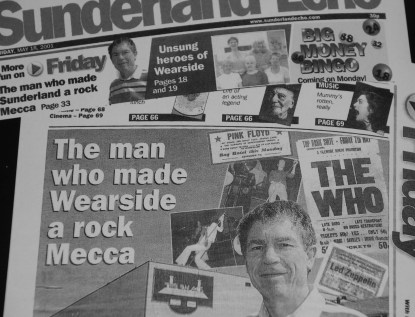
Docherty talks about his life from being doorman, club promoter and band manager. He remembers some of the big names that he attracted to Sunderland’s Bay Hotel

’The door leading to Marc Bolan’s dressing room was jammed with female admirers desperate to meet him. Some were crying with emotion. Others waited to meet their new heroes, Free, especially Paul Rodgers.

I’d never experienced female adulation of this intensity and found it impossible to empty The Bay that night’.

Docherty fills the book with stories about bands on their way to making it, and groups already there, but next he needed a bigger venue….

’During negotiations involved in moving to The Locarno, there were important hurdles to overcome. The first was the name. Over in the States were two highly respected venues called Filmore West and East.

I unashamedly plagiarised the name by renaming the Sunderland Locarno, The Fillmore North, on the night I hired it. Whether I could persuade the best groups to appear was in the lap of the Gods’.

He did – and the book contains a chronology of gigs that Geoff promoted from the Bay Hotel – Pink Floyd, Black Sabbath and The Who – to the Locarno – T.Rex, Mott the Hoople, Kinks and Bowie – admission and price paid for the act are included in the details, £150 for Bowie and 10 shilling to get in.

After a visit to a local nightclub, Annabels, he spotted a band who were playing and ended up being their manager…

’In the three years I managed them, Beckett did two John Peel radio shows, 33 dates supporting The Sensational Alex Harvey Band, 19 dates supporting Captain Beefheart, 22 dates supporting Slade, five supporting Wizzard, three supporting Ten Years After and countless University and College gigs. They also made an appearance on The Old Grey Whistle Test’.

Docherty gives great detail of the meeting with Peter Grant and the subsequent Newcastle Mayfair booking of Led Zeppelin on the 18th March 1971.

Not short on anecdotes and how the music world affected his personal life, Rock at the Sharp End is a must read for any fan of North East music.

Alikivi  May 2020