TON OF TUNES – musician Barry Lamb talks about his latest project, Miniatures 2020.

Barry has lived in Woodford Green, Essex for 25 years but originally lived in South Shields….

My grandparents lived their entire lives on Quarry Lane. I have often thought about writing a song called Quarry Lane but have shied away from it due to the similarity with Penny Lane.

I have so many memories of long walks with my grandfather along the cliff tops from Souter lighthouse to Shields pier and walking across Cleadon Hills. My album Dusk features a picture of Cleadon mill.

Barry left the town in 1966…

It is an area I have a strong affinity with. I would have loved to have been part of the punk/New Wave scene as Shields is very much my spiritual home, but I was in Essex at that time.

Along with experimental progressive rock band Two Headed Emperor, Barry is presently involved with Miniatures 2020….

It’s a tribute project to former Mott the Hoople keyboardist, Morgan Fisher’s original Miniatures album from 1980. It was such an inspiration to me personally and was very much connected to the post punk DIY ethic of the period.

I also discovered as I made contact with other musicians about the project that there is a tremendous amount of goodwill, affection and respect for the original album. 

On the original record Fisher invited 50 musicians to send in tracks of up to one minute long.

They included an eclectic mix of Robert Wyatt singing a Frank Sinatra song, Robert Fripp playing keyboard, Andy Partridge (XTC) offering the history of rock’n’roll in 20 seconds and Pete Seeger playing Beethoven on the banjo plus many others contributing to the album which is regarded as a cult classic.

Who is on the album this time around ?

We have over 100 artists contributing a track of a minute or less. Jake Burns of Stiff Little Fingers, Billy Bragg, Terry Riley, Tim Jones is on – he was in North East bands Neon and had a spell with Punishment of Luxury. Wavis O’Shave has contributed a track.

It also features Toyah, Tom Robinson, David Cross (King Crimson), Ric Sanders (Soft Machine, Fairport Convention), and a handful of old prog rockers, also celebrated experimental music pioneers, new wave and post punk legends – there are plenty of surprises.

Did the musicians involved in the project jump on board easily ?

It was really easy to persuade people to get on board. Very few people said no and nobody that I approached was negative about it at all. Even those that said no were intrigued and curious about it. 

When did you first come across the Miniatures?

It was1980, one of the staff in Parrot Record shop in Colchester recommended it to me knowing my taste for the unusual and more adventurous end of the musical spectrum.

Parrot Records was a treasure trove of discovery and especially good for those obscure new wave singles released on independent and home-made labels. I bought it on the strength of the sleeve notes and a number of the artists involved. 

http://morgan-fisher.com/images/m1back.jpg 

What got you interested in music and are you from a musical family?  

My family are not especially musical but my dad played trombone in a jazz orchestra. His love of jazz and the more adventurous end of rock music stirred my own interest in music.

My grandfather was from New York and he got me interested in protest folk and the blues. But most of my musical influence came about in secondary school on the Essex coast.

Can you remember your first gigs ?

My first gig was at the Golf Green Hall in Jaywick, Essex, I didn’t really enjoy it. I wasn’t that confident, we were under rehearsed, and the audience were not that interested.

Then we played mostly small venues in and around Essex, later played in Reading, Oxford and London. The usual stuff of people setting off fire extinguishers, a couple of fights and hecklers would go on.

I am sad to say that I was so drunk on one occasion I could barely function. I ended up falling off stage and being pushed back up by my brother. The sound engineer walked out and the support band asked, “what is your singer taking …I want some”. 

Did you record any of your music then?

In the ‘80s the Insane Picnic recorded at Sea Level studio which was a small studio in Jaywick, Essex. Prior to that we just recorded on tape recorders at home and released stuff as part of the DIY cassette scene.

After the Insane Picnic we built our own rudimentary studios and now have a studio in my loft.

I have recorded with a lot of different people over the years including fellow ‘Shieldsian’ Wavis O’Shave, also Keith Levene (PIL), Jasun Martz (Frank Zappa), Isatta Sheriff (Mongrel). I am still making music with Two Headed Emperor along with my own experimental sound dabblings.

What are your hopes for the Miniatures project and will it be available to buy ?
My main hope with Miniatures is that it will be a fitting, honouring of Morgan Fisher that it will introduce Miniatures to another generation and will stand up as a great legacy project. I am proud of how it is shaping up.

It should be available late December early January on CD and will be available in the usual digital formats.

More info here: https://www.barrylamb.com/miniatures-2020.html

Interview by Alikivi  November 2020.

ON THE STREETS with crime writer, Trevor Wood

I first came across the work of Trevor Wood around 2002 when I watched ‘Dirty Dusting’, which became a very successful play he wrote with Ed Waugh.

The show performed in front of packed houses at The Customs House, South Shields before going to play to audiences in Ireland and Australia, as well as a UK tour.

The North East based writing duo went on to write several more hit plays, including ‘Waiting for Gateaux’ which toured New Zealand as well as the UK.

‘Maggie’s End’ commemorated the 25th anniversary of the Miners strike and ‘Alf Ramsey Knew My Grandfather’ which told the true story of the West Auckland Football Team who won the first World Cup.

After leaving school, Trevor joined the Royal Navy where he stayed for 16 years before retraining as a journalist. He worked on various newspapers in the North East including the Evening Chronicle…..

‘Then after a brief spell at Newcastle City Council as press officer, then Head of Communications, I teamed up with Ed Waugh, who I’d met on my journalism course, and we wrote a very successful series of comedy plays’.

What inspired you to write?

Originally the comedy plays came about because Ed and I didn’t think there was anything out there that we wanted to see so decided to try and write something ourselves. Our first play was an immediate success, so we just kept going!

The crime writing was a much longer process – I’ve always been a huge reader and it’s the genre that I nearly always turn to so five years ago I decided to give it a go.

I enrolled on the inaugural MA in Crime Writing at the University of East Anglia and The Man on the Street was developed on that course.

It took quite a while to find the right publisher, but it was worth the wait as my publishers, Quercus, which is part of the huge Hachette publishing group, have been incredibly supportive.

How was your debut received ?

The Man on the Street was published in March 2020, just before they closed all the bookshops. Despite this it has done very well, winning the Crime Writer’s Association’s New Blood Dagger for the best debut crime novel of the year and being chosen by Val McDermid for the prestigious New Blood panel at the Harrogate Crime Festival.

It’s also received praise from leading crime writers like Lee Child, Mari Hannah and Elly Griffiths as well as great reviews in the Guardian and Sunday Times. It’s also been optioned for TV by World Productions, who made Line of Duty and Bodyguard.

What is your latest project?

One Way Street is set in and amongst the North East’s homeless community. A series of bizarre drug-related deaths among runaway teenagers has set the community on edge.

The word on the street is that a rogue batch of Spice – the zombie drug sweeping the inner cities – is to blame, but when one of Jimmy’s few close friends is caught up in the carnage, loyalty compels him to find out what’s really going on.

One Way Street sees the welcome return of Jimmy Mullen, the homeless, PTSD-suffering, veteran as he attempts to rebuild his life following the events in The Man on the Street.

As well as writing I volunteer one afternoon at the People’s Kitchen in Newcastle, where I help cook meals for the city’s homeless population.

Have you got a file full of ideas for new projects ?

I wish!  I’m currently writing the third in the Jimmy Mullen series which is provisionally called Dead End Street and have a publishing deal for a fourth book which will be a standalone novel.

As yet, I have no idea whatsoever what that will be so if anyone has any great ideas! 

My wife has come up with a brilliant idea for a Christmas rom-com but I’m not sure my publishers will be happy with a sudden switch from gritty crime thriller to that.

Where are your books available to buy?

It’s available from all the usual outlets but I’ve had great support from all the local bookshops so would always say Forum Books in Corbridge or Waterstones in either Newcastle or Durham for The Man on the Street.

Although the shops are closed again now – temporarily I hope – you can order online from any of them.

One Way Street is only out in ebook and audio at the moment – the hardback isn’t published until March 2021 – so you may have to go to Amazon for that.

For more info and up to date news check out the official website:

http://www.edwaughandtrevorwood.co.uk

Interview by Alikivi  November 2020.
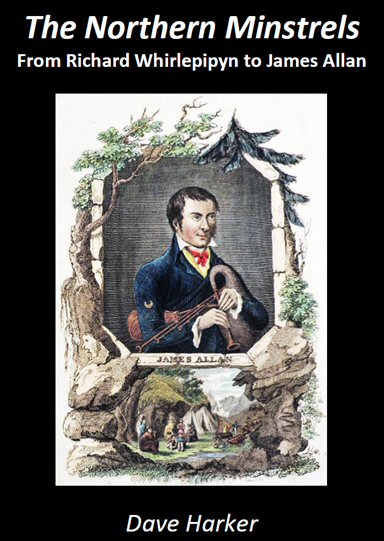
NORTHERN MINSTRELS – with Historian Dave Harker.

Dave talks about his new book which tracks the history of North East popular music and song. 

“The Northern Minstrels draws on a wealth of research to tell the story of North East pipers, minstrels, choristers, street singers and dancing masters, covering the duels, disputes and riots”.

Newcastle based Dave, who turned 74 on November 5, has previously published 16 books, eight of which cover the history of North East music, including biographies of Geordie Ridley, Blind Willie Purvis, Joe Wilson and Ned Corvan.

Joe and Ned were used by playwrite Ed Waugh for successful plays Mr Corvan’s Music Hall and The Great Joe Wilson.

What inspired you to write The Northern Minstrels ?  

This is the richest region in England in terms of singers and songwriters whose audiences were predominantly working-class.

Terms like ‘North-Eastern’ ‘English’, ‘Scottish’ and so on to describe songs ignore the fact that while what survive today may have been sung in a given region or country, that does not mean that they originated there.  

I had to put the musicians in a social context to show the ways in which music making and printed balladry helped shape the politics of their day.

This included general literacy, printing presses, religious upheavals, employment of official minstrels, as well as laws relating to vagrancy.

Did you have any challenges when writing the book ?

The book is by far the most challenging I have ever written because there are so few sources and I had to research what was happening all over England and southern Scotland.

I felt it was important to collate the information that survives so others can expand on my work in the future.

What is your background Dave ?

I was born in Guisborough in what was then the North Riding of Yorkshire on 5 November 1946. I won a scholarship to Guisborough Grammar School in 1958.

In 1966 I went to Jesus College, Cambridge, which seemed like a good idea at the time. I was awarded a BA in 1969, and in 1970 became a senior scholar at University College.  

I later declined the offer of a fellowship at a Cambridge college and accepted a temporary lectureship at Manchester Polytechnic, since I wanted to give something back to students less privileged than myself.

I joined the Labour Party in 1975 but left in disgust and joined the International Socialists. In 1976, to my surprise, Cambridge University accepted my PhD thesis, ‘Popular Song and Working-Class Consciousness in North East England’.

In 1977 as a member of the Socialist Workers’ Party I organised buses to both Anti-Nazi League carnivals in London.

The ‘80s saw more academic work for Dave including the Trades Union Council, Senior Lecturer in Trade Union Studies and building miners’ support groups in 1984-85….

But by then I was thoroughly disgusted with my colleagues’ careerism. By the early ‘90s I built the largest travelling stall of second-hand socialist books in Britain, and probably in Europe, for Manchester district Socialist Workers Party, and supplied Bookmarks bookshop in London.

I drifted away from the SWP, though I became the founding secretary of the North West Retired Members’ Branch and an officer of Manchester Trades Union Council.

In 2015 I moved back to Newcastle, and in 2017 I received the Robert Tressell Award ‘For Services to Working People’.

What does the North East mean to you ?  

A few years ago, I researched the history of the word ‘Geordie’ and discovered that it had been used to patronise working people on Tyneside for over 200 years.

Virtually all ‘definitions’ had no historical accuracy or conceptual content, and the best one I know was that ‘Geordie’ was the name by which Tynesiders are known outside the district, either geographically, or culturally, even if they live there.

What bothered me was the tribalism in the region – Mackems (from Sunderland), Smoggies (from Teeside) and so on – not least because it did not serve the interests of working people, but on the contrary helped to divide them.

Only 100 copies of The Northern Minstrels have been printed.

They are available for £25 (plus £5 p&p) per copy from Dave at d1harker@btinternet.com

Interview by Alikivi  November 2020.

LIGHT UP THE LAWE with UK artist, Andrew McKeown.

Part of the renovation of the North Marine Park in South Shields is a new sculpture placed on the Lawe Top.

The artist, Andrew McKeown, specialises in Public Sculpture and has completed many large-scale commissions throughout the UK and Internationally.

In an earlier interview on the blog in June, Andrew talked about his work…..

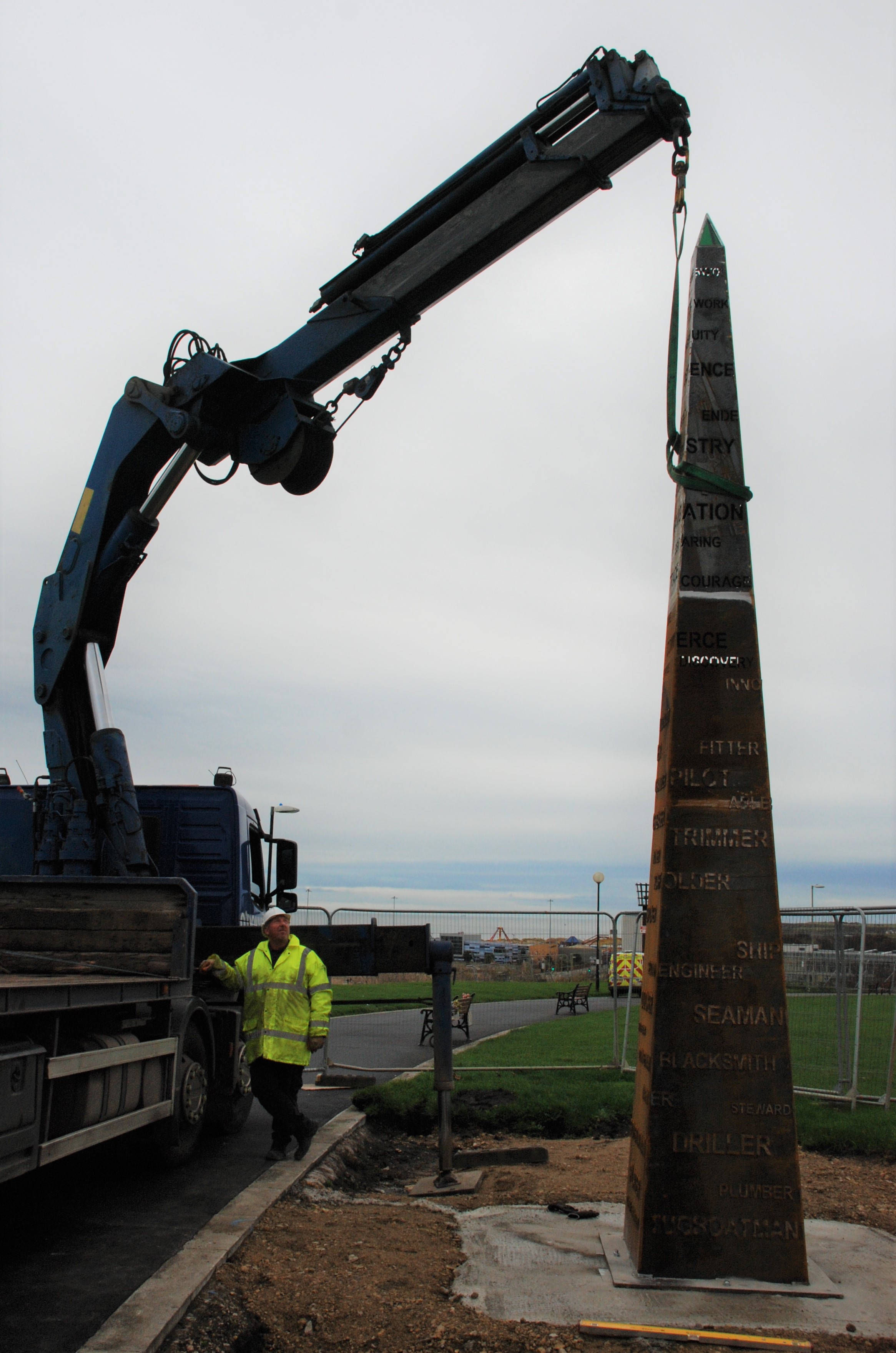
I am working on designs for a large contemporary steel Beacon in the North Marine Park. The Beacon takes its inspiration from the Lawe Top Beacons built in 1832.

The installation of his new work was on the morning of 31st October 2020, and I managed to grab a few words with Andrew….

Today I’m supervising the installation of the new Beacon sculpture. The blacksmiths are just fixing the bolts down now, it’s pretty much all installed.

Has it been a hectic day ?

Yeah, just a bit (laughs). We started at 9am, the blacksmith got loaded up earlier than expected but we got up here and got on with it.

What does it feel like seeing your work finally put in place ?

Fantastic. I’ve been working on this project since January after getting the commission. It was applying first, then getting selected then there was all the planning to do with the designs.

The brief asked for it to be between 4-6 metres high. I went for 6 metres and that feels about right.

The original Victorian Beacons were a lot taller than that so I know it’s not meant to be a navigational aid as such, it’s a decorative piece with a nod and towards the Victorian Beacons.

I think when the block paving is around, the lighting added and when it’s rusted after about 3-4 weeks it’ll develop a stronger rusty colour. It’s core ten steel and rusts so much it’s almost like a protective layer.

It’s the same steel as the Angel of the North (sculpture in Gateshead by Antony Gormley). It’s just nice to finally be the day when it all comes together, and it looks like what I wanted it to look like.

What is the idea behind the words that are on the sculpture ?

Yeah well, it’s already happened hasn’t it. This morning within half an hour of it going up a Grandad and his Grandson walked past, and the Grandson asked what is a Foyboatman? The Grandad explained and then added that his dad was a riveter.

That’s what type of conversations I really intended from the piece to happen. It keeps the sculpture alive and all those historical trades and occupations alive.

It refers to the community of South Shields and the words at the top refer to the character of the area, the history and the aspirations.

Words like exploration, wisdom, work, toil and adventure, words that make people think that yeah we have got this background as well as the shipping industry that pioneered the way for a lot of things

Can you see it being here for a long time ?

The way it has been made and the materials it has been made with, it can be there for years until someone wants to move it. Maybe in a renovation of North Marine Park in another 100 years, but I’ll be long gone by then.

Interview by Alikivi  October 2020.

LOOKING FOR AMERICA with American Jazz Guitarist & Composer, Jon Dalton.

Sometimes a piece of music drops and fits neatly onto your latest playlist.

In the past week I’ve been listening to Jackson Browne and Buffalo Springfield after watching a documentary about the musicians who lived in Laurel Canyon on the American west coast during ‘60s/’70s.

Recently, Los Angeles based musician Jon Dalton sent a link to his latest track ‘Out of the River’ featuring vocals by Sheila Ellis.

Dalton first appeared on the blog in October 2017 talking about his journey from Bristol playing in rock band Gold, then moving to California as a professional musician signing to Innervision Records.

I got in touch with Jon and asked him how did the song come about ?

I was sitting around late one night doodling on my guitar – something I do a lot – and it occurred to me, with all that’s been going on this year, now might be a good time to write about how that’s affected my view of the world.

What were you looking to say in the lyrics ?

I hadn’t written a song with lyrics for decades – I mostly write jazz instrumentals – but this one seemed almost to write itself.

Some might see that as the land speaking through them or perhaps it’s a collection of memories and experiences that one day well up and form a cogent whole.

America has certainly seen its share of turmoil recently coupled with much division and fear but that isn’t my America. I have roots in this country going back a long way. Long before the US was even a country the land was here.

Even though I grew up in the UK and didn’t set foot in America until I was in my mid 30’s, I felt a connection to the land the instant I arrived and that’s never gone away.

For me, it was always a foregone conclusion that I would eventually ‘return’. I sense that connection everywhere I go from oceans to deserts to the mountains and rivers, it’s always there and I’m always home.

I’m sure others have similar feelings about their countries of origin. This is a song that tries to explore and explain that connection.

How did you end up working with Sheila ?

I met Sheila Ellis several years back while we were both working in a volunteer jazz band playing for seniors in L.A. County. We hit it off instantly. Sheila seems to just get what I’m trying to say musically which is a tall order since I often don’t get it myself.

Sheila is a brilliant vocalist, she has a deep knowledge of jazz and other genres. Originally from L.A. she also lived and worked in Paris plus New York and London – her husband and our shared producer Richard E is originally from the UK.

She’s also an actress and performance artist who has appeared in places like the prestigious Getty Centre here in Los Angeles.

Richard and Sheila are the core group members of Annabel (lee) who have recorded albums on the UK Ninja Tune label – which won the 2015 Dead Albatross Music Prize – and more recently here in the US on the Youngbloods label.

Who else worked on the song ?

The final piece of the puzzle was my friend UK organist John-Paul Gard. I knew with his extensive knowledge of the instrument, he’d be able to convey the exact sentiment I was trying to express, and he nailed it from 5000 miles away.

With the USA Presidential election only hours away what are your feelings about the future?

Whatever is happening right now and whatever is around the corner, in this song I wanted to express the sense of strength and permanence I get from being surrounded by nature, though we could arguably take better care of it.

We may create what seem like big problems for ourselves but, for the land, it just sits and watches and waits.

Listen to ‘Out of the River’ at:

https://jondalton.bandcamp.com/track/out-of-the-river

https://annabel-lee.bandcamp.com/

Interview by Alikivi  October 2020.