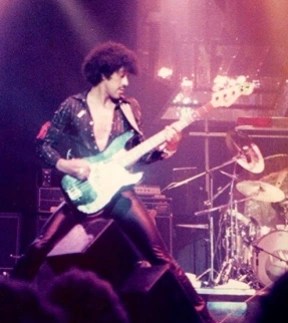
Phil Lynott played the cool, sexy, rock star. The hot shot gunslinger with studded wrist band and clenched fist. The Rocker. But he was dead by 36. What happened in the last few years of his life?
Thin Lizzy had been around since the early seventies releasing a number of successful singles including Whisky in the Jar, Rosalie and Waiting for an Alibi, and top 30 chart albums including Black Rose, Renegade and the imperious, Live and Dangerous.
The double album produced by Tony Visconti (Bolan/Bowie/Morrissey) in 1978 reached number 2, staying in the UK charts for over a year. Many critics label the record as one of the greatest live albums.

Although I never saw them in concert, I was in the Newcastle audience when they appeared live on Channel Four’s music show The Tube on 28th January 1983.
I remember watching a blistering version of Cold Sweat from the Thunder and Lightning album. The boys were back in town and at the top of their game. Or so I thought.
In comparison, I later watched a videotape of the show and thought the dressing room interview with Lynott was awkward and dull, he looked fragile. Was this the beginning of the slow decline for the Irish rock legend?
The TV show was only the second appearance of new guitarist John Sykes, formerly of Whitley Bay heavy metal band, Tygers of Pan Tang. His first gig was a few days earlier on BBC’s Sight & Sound concert – talk about being hoyed in at the deep end!
Lynott was more than happy with Sykes. He could see a new future for Lizzy. Cold Sweat entered the UK charts and another TV slot was scheduled for Top of the Pops.
But the band were dropped from the running order after a drunken Lynott was reported to have told the producer to ‘fuck off’ – twice.
Morale was low and cracks appeared amongst the team. Lizzy found themselves slowly falling apart through health and personal reasons. Eventually a split was announced.

So what was left ? The Thunder and Lightning UK tour included two dates at Newcastle City Hall, with a night at London’s Hammersmith Odeon and a reunion of past Lizzy guitarists, Brian Robertson, Gary Moore and Eric Bell.
“It was chaos” said Bell. “A mess if you listened to what was being played. It was a turning point in my life, after that I never wanted to hear those songs again. I suppose it was a good way of burying Thin Lizzy forever”.
Roadie for the band Peter Eustace explained “On the crew we all thought Phil was scared of success. Once you’ve arrived where do you go? And all you know is that these young guns are breathing down your neck”.
The future, well the ‘80s, belonged to the new chart soundz ! from the likes of Depeche Mode and Duran Duran. While a rejuvenated Queen, and soon to be Irish legends, U2, both benefited from Live Aid. Meanwhile, Lizzy struggled to play a few more dates in Ireland and Japan.

Their last UK show was headlining the Reading festival in August ‘83. The curtain came down on their final live performance in Nuremburg, Germany on 4th September, sharing a bill with Saxon, Motorhead and Whitesnake.
Fellow Irishman and Boomtown Rat songwriter Bob Geldof said “Phil couldn’t imagine a life not in leather trousers, with a limousine taking him to work every day”.

In 1984 a zoned out Lynott appeared on ITV’s Breakfast Show talking about his new band, Grand Slam, but also about his problems as a heroin addict.
He resolved to work hard, in rehearsals he drilled the band for eight hours a day earning him the nickname ‘Sergeant Rock’. Had the thunder returned?
The band toured extensively throughout the UK and what seemed like victory soon turned into disaster as no major label offered them a recording contract. The industry was backing off.
In 1985 old friend Huey Lewis – from the News – spent time with Lynott recording in a San Francisco studio, but the old swagger wasn’t there. A delicate and tired Lynott only managed a couple of vocal tracks.
Although he did manage a UK chart hit in June ‘85 with Out in the Fields when he paired up with another old friend and former Lizzy guitarist Gary Moore. Cutting out management, Lynott made a direct deal with the label and received £5,000 in cash for being on the record.
But his darkest days were ahead with long days and weeks spent at his London home in dressing gown and slippers not answering calls or seeing friends.
Then out of the blue a charity concert was arranged to be played in front of a world-wide TV audience, it was made for the return of Thin Lizzy.
Live Aid saw The Who, Black Sabbath and Led Zeppelin reforming for a one off gig. But Lynott wasn’t asked. Did fellow Irishman and organiser Bob Geldof stay away knowing of his problems?
Co-organiser, songwriter & former Lizzy touring guitarist, Midge Ure said…
”To our dying shame neither Bob nor I even thought about asking Phil to put Lizzy together for Live Aid. If he had been in a healthy state that could have been the Queen moment for them – ‘The Boys are Back in Town’ – at Wembley? Jesus, can you imagine?“
“Why didn’t we do it? Was it that psychologically we had already given Phil up as gone? It’s something that will stay with me for the rest of my life’.
There were rumours that Lynott was to play Jimi Hendrix in a biopic of the guitarists life, but nothing came of it. In the studio he was working on recording solo material.
Phil Lynott’s final public appearance was in December 1985 when he travelled to Tyne Tees TV studio in Newcastle to record a Christmas special for pop programme Razzmatazz, he performed his solo single Nineteen.
Ironically the presenter was David ‘Kid’ Jensen, the DJ who had championed the band in the early seventies. Also on the programme were Slade, who Lizzy had opened for back in the early days. Back when the fight was being won.
At home Lynott was visited by hangers on, pushers and gofers. He ended up surrounded by people, but very alone. In court on a drugs charge he was called ‘a drugs victim and a trajedy’ by his own solicitor. His close friends wondered where did he go? The musician, the poet, the man they loved.
Sadly, on 4th January 1986, Phil Lynott died of kidney, liver and heart failure. One of his close friends said “Phil didn’t die of a heart attack, he died of a lifestyle”.
Alikivi July 2023
Research:
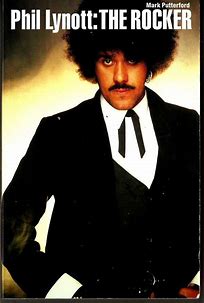
Phil Lynott: The Rocker by Mark Putterford.
Cowboy Song: The authorised biography of Philip Lynott by Graeme Thomson.
Thin Lizzy official website.
 ALIKIVI UK : NORTH EAST MUSIC & CULTURE