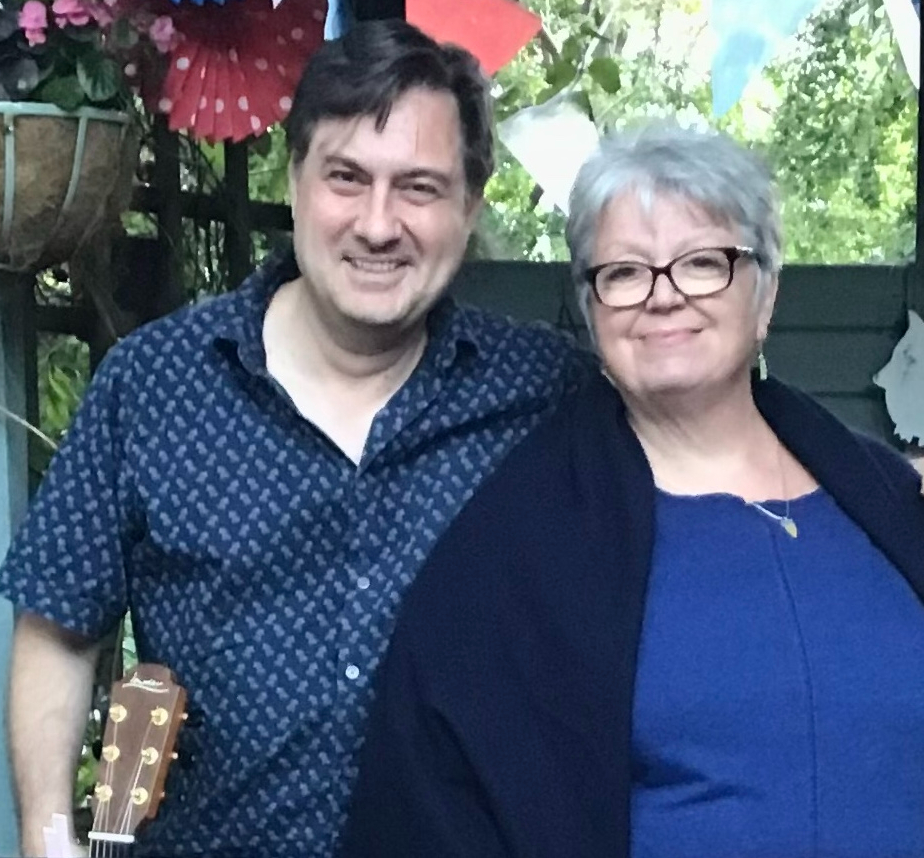
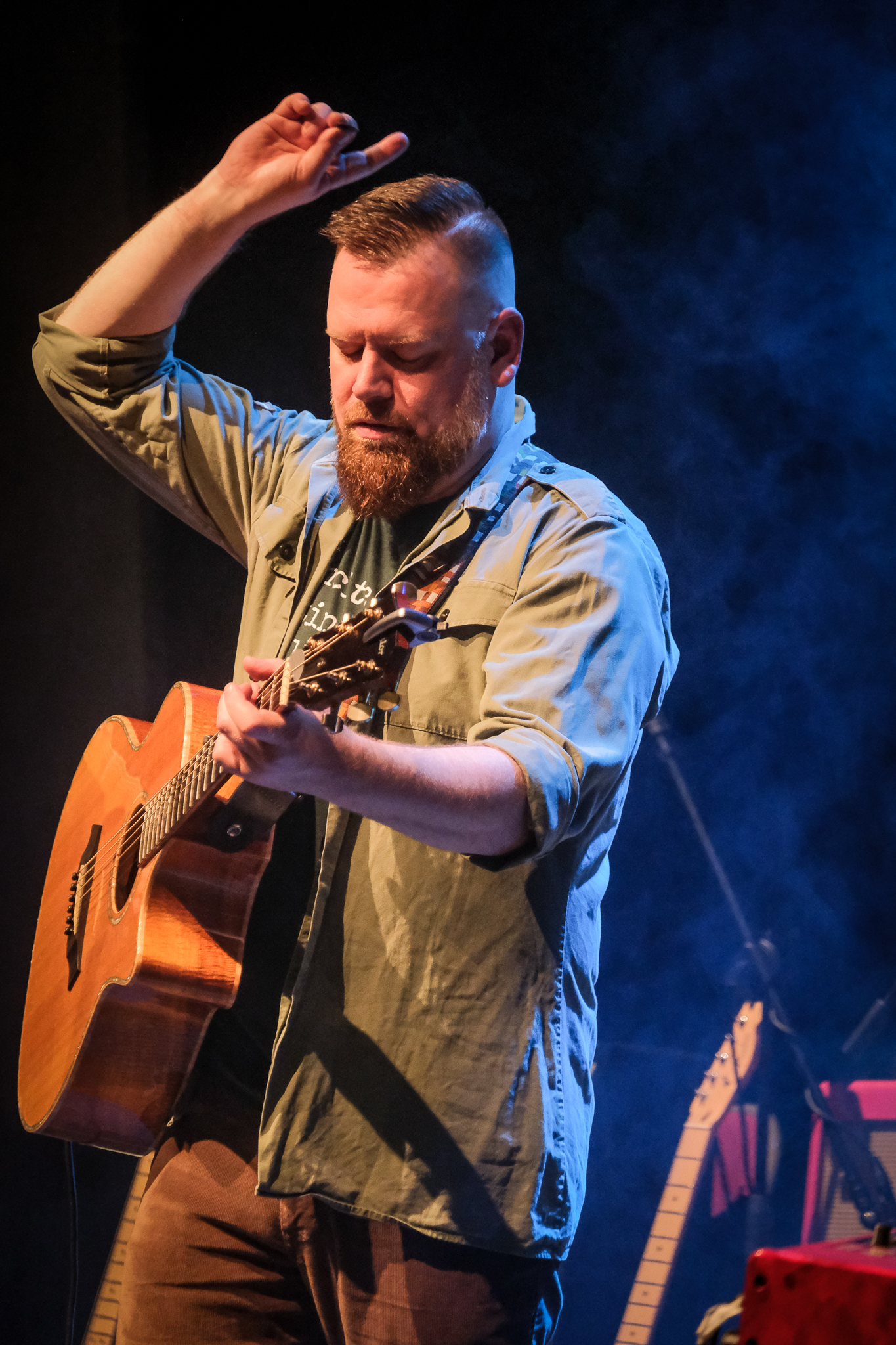
FOLK GATHERING in conversation with Wearside folk song collector Eileen Richardson

After a career lecturing in Psychology for over 30 years, Eileen is now retired from Sunderland College. Throughout the years she has researched her ancestry and in turn became absorbed with local history.

My ancestors were Sunderland keel men in the 1600s, there were a few miners among them but mainly trades associated with the River Wear. My grandmother played the organ at her local church and her sisters sang in a local concert party. When she retired my mother went to evening classes and taught herself piano, she also wrote pantomimes and songs for the local community centre. When she was in her ‘80s she organised singing groups at her local ‘natter’ club.

About 15 years ago I started collecting Wearside folk songs from the 1800s. For me words are the most important thing. I don’t like the music overpowering what the song is about because the most important thing is what the song is telling you. I prefer unaccompanied singing and the harmonies.

I used to sing at events with the Tyneside Maritime Chorus which was run by folk singer/songwriter Benny Graham. We mainly sang songs from Tyneside like Keep Yer Feet Still Geordie Hinny and The Blaydon Races which are widely known. This set me off wondering whether there were any equivalent songs from Wearside apart from The Lambton Worm – although that was originally written for a Tyneside pantomime.

Sunderland Antiquarian Society which has been going since 1899, has a lovely archive mostly donations from local people. I research there and the local studies library in Sunderland.

The first song I found was The Old Wife’s Lament to the Keel Men of the Wear and it was all around historical events about the keel men and it was written in dialect. That set me on the road to researching the history that went with the song and there’s a bit where it talks about them fighting the French. But did the French ever invade the North East coast?

I found an article about the Battle of Hendon in 1799 where local volunteers staged a mock invasion because they thought a French invasion was imminent. The song has historical references but some humour also.

There a lot of songs about death and tragedy, mining disasters and shipwrecks but there are songs that tell light hearted stories. The Durham Militia pokes fun at things, it’s like the 1800s version of Dad’s Army, with lyrics like ‘You’ll march away like heroes – just to make the lasses stare’ and suggesting that the only battles they will fight will be in the pub.

During covid I gave a presentation online to the Traditional Song Forum about my research and was asked to write a paper which was published in a book of folk song research in 2022 entitled Thirsty Work and Other Legacies of Folk Song.

Ed Pickford, Ingrid & Barrie Temple, Tony Wilson performing at the Stumble Inn Folk & Acoustic Afternoon, Sunderland, February 2024.

The folk world is a small world, you get to see the same faces at the clubs and you get to know people from all over the North East. I first went to folk clubs in the late 60s and early 70s when virtually every pub had a folk club. I also used to go to The Bay in Seaburn to see bands like The Who, Free, Jethro Tull, there were loads coming to Sunderland then.

In about 2000 my husband and I began to go regularly to folk clubs in the area such as South Shields, Birtley, Tynefolk in Ryton and The Welly Folk Club in Wolviston.

When you say you live in the North East to other folk people they are jealous because of the amount of clubs and events up here. If you are prepared to travel half an hour you can go to a folk club most nights of the week.

There are venues like The Central Bar in Gateshead, South Shields Jack Clark Park, Croxdale in Durham, the Collingwood Arms and The Bridge in Newcastle which has been going 60 years. Saltburn, Whitby and Hartlepool also have annual folk festivals.
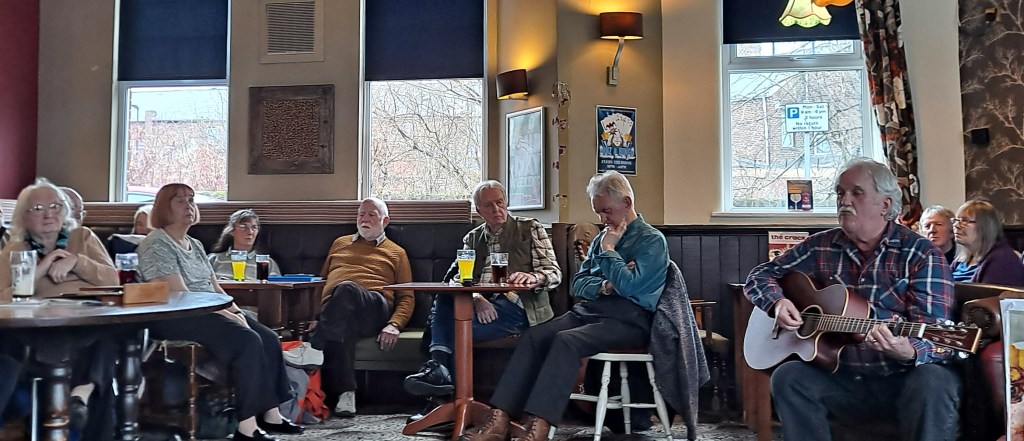
Keith Gregson performing at the Stumble Inn Folk & Acoustic Afternoon, March 2024

I also arrange a monthly folk afternoon at The Stumble Inn on Chester Road, Sunderland. We get around 30 – 50 people coming to our sing around and we are keeping the tradition going because in the 60s the pub was formerly The Royalty and had a very popular folk and blues club called The Glebe.

The pub is near Sunderland University metro so we have people coming in from Newcastle, Cullercoats and South Shields. Some come from further afield like Chester le Street and Teesside. Being on from 1-4pm people are happy to travel on public transport at that time – on the night they are not so keen.

Our folk gatherings at The Stumble Inn are on the 4th Tuesday of the month. All are welcome to sing a song, play a tune or just listen to the songs its very informal and free. We are based downstairs so the room is easier to access with your pints of beer and musical instruments.

We have singers from all over the region like Barrie and Ingrid Temple, Ed Pickford, Tony Wilson, Anne Lamb, Keith Gregson, Brian Hunt, Ken Hamer and others who all perform in a range of styles.

It’s an old genre but people still write songs now in the folk tradition about current events keeping the music alive. Music and song are so fundamental to our lives.

Alikivi   October 2024
NE tour for new play – THE CRAMLINGTON TRAIN WRECKERS starring Alexandra Tahnee

‘When I was young I watched a production of Blood Brothers and it just blew me away, I was so engrossed and moved – from that day I was hooked’.

Alex Tahnee from Newcastle has been acting since she was 11 year old…

‘I fell in love with theatre playing Young Catherine in Tom and Catherine, a musical about Catherine Cookson’s life at The Custom’s House, South Shields. I love the idea of telling stories and love the feeling of being on stage’.

‘Since then, I’ve worked with many brilliant people in the North East including various shows playing Alice in Alice in Wonderland at Northern Stage, playing a military wife in Magnolia Walls, and most recently playing a female Marc Antony in Julius Caesar, an absolute bucket list role’.

Next up for Alex is a play by South Shields writer Ed Waugh (Dirty Dusting, Wor Bella, Hadaway Harry, Carrying David). The Cramlington Train Wreckers is another forgotten story about the North East.

‘I play Erica, she’s a journalist interviewing Bill Muckle, one of the eight men imprisoned for derailing a train in the 1926 general strike. Bill has a fascinating tale to tell, and it resonates eerily with political issues we face today’.

‘Bill is played by the wonderful Micky Cochrane (I, Daniel Blake, Carrying David, Billy Elliot), and the piece is directed by Russell Floyd (The Bill, Eastenders, London’s West End), who also multiroles throughout as various characters in some glorious buffoonery’.

‘Bill tells the story of the general strike, how it came about, who was involved, the lies and propaganda that were spread and how it ended after only 9 days. Also, how it came to be that 8 young men from a mining town in Northumberland were imprisoned 100’s of miles away from their families and hailed as heroes upon their return’.

‘People are fascinating to me and theatre is like putting them under a microscope. Like Bill in this play, he was a real person who was so gregarious and engaging you can’t help but listen to him. There are incredible stories in every nook and cranny and theatre lets you explore them, what better job is out there?’

‘My hopes for this play is that this piece of local history is known by new generations for not only its regional importance but also how politics has a profound impact on individuals and communities across the world’.

‘I believe by using the first-hand account of one person in the past we can highlight the relevance of the same messages and themes still affecting us today’.

The Cramlington Train Wreckers opens on 7th November at Cramlington Learning Village and continues around the North East until 16th November 2024.

For tickets & full list of venues contact the official website >>>

www.cramlingtontrainwreckers.co.uk

Interview with Ed Waugh >>>

WHO WERE THE CRAMLINGTON TRAIN WRECKERS? | ALIKIVI UK : NORTH EAST CULTURE

Alikivi   October 2024

LISTEN TO YOUR HEART in conversation with Tyneside songwriter Rosie Anderson

Now living in South Shields, retired teacher Rosie Anderson still feels there is work to do and more stories to tell.

‘Sometimes I feel as though I’m just getting started. I sing whenever I can. This year my musical partner Adam Holden and I have played at The Watch House in Cullercoats, The White Room in Stanley and Cockermouth Festival which were all great. I’m determined not to just bow out because I’m getting older’.

‘I grew up in Wylam in the Tyne Valley, in a house full of music. Both my Grandparents played piano. My dad listened to The Beatles, both parents loved the theatre and musicals and they took me and my brother there – I still love all that’.

‘When I was a kid I told my parents I wanted to be a performer but they were worried I wouldn’t be able to afford a home like them, they wanted me to have a ‘proper’ job. They wouldn’t let me study performing arts so I trained as a teacher’.

‘My first job was in Benwell, Newcastle. Then I went to the Middle East where I spent 10 years teaching in Kuwait and Qatar, before returning to Newcastle. I taught at Walkergate Primary School where I would do all the music shows and drama productions. Loved doing the shows there, I never gave lyric sheets out to the kids, they learned by listening and singing the songs back’.

‘When I left teaching I saw an advert for facilitators for  Singing for the Brain with the Alzheimers Society. I really loved doing that. I did that for six years until covid hit. Singing on-line with people on the screen in front of you didn’t work really’.

‘People love stories in whatever form, be it a book, a film or a song. Some people write songs about being in love, and about their feelings. My songs are mostly about people and places. I find stories present themselves to me and I take them and turn them into a song’.

‘There are two songs that I have written that stand out for me. Sally Smiths Lament was written after my husband Chris and I worked on a film about soldiers from County Durham during World War One’.

‘Sally was the wife of miner Fred Smith, who featured in our film. They lived in a tiny terraced house and every day Fred and his sons needed a bath, a clean shirt, a clean bed and a dinner. The kids needed to get to school – how did she cope with all that, especially when Fred was away at war. I wanted to give Sally, and all the women like her, a voice.’

‘When I wrote it the song just seemed to be presented to me, her whole life. I got to sing it at a celebration in West Auckland and her family came to hear it – it was very moving. It travelled well and won three competitions – the Newcastle Folk Club, Rothbury Traditional Music Festival and first prize at Morpeth Gathering’.

‘I can’t just decide to sit down and write a song – some people do and I applaud them for the discipline but I have to wait until they come. Three things happened to me in my life that I put together in a song called Breakdown’.

‘When I was a kid I lived at Chapel House Estate in the west end of Newcastle. One night me, my mother and a friend went for a walk. This woman came out of her house in her dressing gown, she wasn’t in control of herself, didn’t know what time or day it was. I had never seen that behaviour in an adult before. Now I believe she was having a nervous breakdown’.

‘That always stayed in my head and another one was when I was living in Fenham. I went to the shops with my children who were only small then, and a woman came out of her house with a letter and asked if I would read it to her as she was confused and couldn’t understand it’.

‘Then about 30 years ago I went on a blind date in Newcastle with this very nice bloke. He said I need to tell you something before we go any further ‘When I was working in Canada I had a nervous breakdown in the car park of a Burger King’. It was hard to concentrate on anything else after that’.

‘But I remembered those incidents and those three individual people are lodged in my heart for their own traumas. They gave me that song’.

‘This year we went to Kjerringoy a former trading post in the Norwegian Arctic Circle, out in the middle of nowhere, it was beautiful. A family ran it in the 19th century and had 3000 fishermen working for them, catching and processing thousands of tons of cod’.

‘The father and husband died and the wife continued to run it single-handed for many years until she eventually remarried. I asked the locals if there was a song about her and there isn’t. So that’s my next song – Annalisa from Kjerringoy. Her story needs to be told’.

‘I’m also aware we need to start telling more stories about people and their lives and jobs today otherwise in 100 years time there will be no one singing about us!‘

‘What does music mean to me? It’s hard to describe it, it’s so deeply embedded, there’s no life without it. Music is at the core of my being, there is no day without singing and because I have grandchildren now I have a new audience! We sing folk songs and songs from musicals, they’re word perfect when they sing them back’.

‘Music gives such joy, when I was singing with the Alzheimers Society the collective joy and reminiscences of songs from the past and enjoying it together was just so valuable for the families’.

‘We had people who wouldn’t sing at all but liked being there and that was fine. Once, two women brought their mother to a session and she sat between them. She didn’t communicate at all, had her head down, closed off you know. But when we started singing a song, I can’t remember which one, she lifted her head up and actually got up and started moving around in the middle of the circle’.

‘One daughter got up and started dancing with her. When we got to the end of the song the daughter turned round and said to me ‘She’s just said my name for the first time in years’.

‘Music gets right in there (pointing at heart) we’ve got to keep it going and expose our youngest children and oldest adults to music because it really does reach parts that others can’t reach. It’s like hearing the heartbeat in your mother’s womb’.

‘As a child I wanted to do music, as an adult I taught it with kids then people with dementia, despite my age I’m still committed to what I always wanted to do. Women who’ve had careers and families can still chase their dreams’.

Alikivi   September  2024

BANJO IN BOGOTA – in conversation with Tyneside storyteller & folk musician Tony Wilson

Tyne Dock in South Shields was an interesting part of the town to live, with its churches, terraced houses and huge industrial Victorian arches next to the river. It was in the early 80s when a lot of the old housing stock was being demolished and in Porchester Street I watched Ascendency being filmed. Julie Covington of hit TV show Rock Follies was the star, not long after that The Machine Gunners was set in Porchester and filmed for BBC TV.

‘Up to when I was 7 year old I lived in Porchester Street. It’s not there now but St Mary’s Church around the corner is where I used to sing in the choir and the scouts’ said Tony.

‘Now I live on the Lawe Top beside the roman fort. It’s almost aspirational for someone who comes from Tyne Dock to wind up being a skuetender’ (native to the Lawe Top).

‘I’m proud of coming from South Shields and when you were young trips to the fort were absolutely mind blowing. The area it’s in is incredible, with the whole vista of the river and parks and beach nearby – we’re lucky here’.

Being a former Tyne Docker now Skuetender he’s not wrong there. Tony featured on the site back in May 2018 talking about storytelling and songwriting and what music means to him.

‘I turned back to folk singing in 2017 after the government education cuts made it too expensive for schools to have extra-curricular practitioners, like me, to come in. Before that I was storytelling in schools for 20 years covering hundreds of issues such as the steelworks when I was in Ebbw Vale, the Romans here in South Shields, the coal industry and iron stone mining in Teesside and Northumberland. It was an extremely successful time’.

‘Storytelling is very important, its communication, social history, emotional control, drama, its use of vocabulary. For me it was learning how to be a performer and developing stamina to be able to do four hour sets a day, then drive 100 miles to go to a hotel, get up next day and do it again’.

‘Cities like Manchester, Oxford, Cambridge, all over the UK. I’d stay in these areas year after year for a fortnight at a time and, unlike a music tour where you could be in Aberdeen one day and Bournemouth the next, I’d plan easy distances to plan a route back home – loved the life.’

‘Then around 2009 I got an email. The message was ‘would you like to tell stories in Argentina?’ I wasn’t sure it was kosher at first but I received a phone call a few weeks later confirming it was. I was given contacts of previous storytellers who recommended it’.

‘Me and my wife went out and ended up over the years going to about 15 countries for six weeks at a time. They were international schools where the kids had already learnt English but mostly from American cartoon shows and they wanted them to hear colloquial language, more English. With my accent, I knew I would have to speak a bit slower – and there’s nothing worse than a posh Geordie!’

‘When we were in a Spanish speaking country, for the youngest ones, you’d have someone to explain the context of the story and then I’d still tell the story in English. Half of their lessons were in English, to make it an immersive experience’.

‘To accompany the lessons it was helpful to use British sign language, or borrow a guitar. I always took a banjo with me as it was such a different instrument for them to hear. Once the banjo was broken en-route and we found the only banjo repairman in Bogota in Colombia’.

‘It was hard work getting up at 5am, into a taxi for a two hour drive to tell stories to 3-400 children in ampitheatres – but what an experience! The last time we went over was Peru in 2016. We’d been to Uruguay, China, South Korea, all over – loved it. Sometimes I look back and think how did that happen – you’ve got to seize every opportunity’.

‘I’ve been songwriting for years and always have a songwriting project on the go. I write about 15 songs per year. Ideas can come from a book, a documentary or what someone says in a street… then I do a lot of research and add some ‘meat’ to the story. Songwriting can possess and obsess you’.

‘Recently I wrote a number of songs about Iron Stone Mining, the workers and how dangerous it was working there, although I do try to stay away from disaster. It’s not all ‘Grim up North’.

‘A friend of mine gave me a diary about his distant relation who had been captured by the Portugese and transported to Portchester Castle in Hampshire! Having lived in Porchester Street I didn’t know about this place. The songs can take you anywhere!’

‘I wrote a song with local playwright Tom Kelly about ‘the seven lads of Jarrow’ who, in the 1830s worked in the mines under diabolical conditions so tried to form a union with union organiser Tomas Hepburn. They ended up being brought up on jumped up charges – 10 were captured 3 escaped. 7 ended up in a kangaroo court and were transported to Australia never to return. It’s such an emotional subject’.

‘In 2019 I was planning to write autobiographical songs, one was about the day they tarmacked the cobbles in Porchester Street and as kids we could roller skate across the street. Another was the times walking through Tyne Dock arches with my dad and me being on his shoulders. Or another about my sister playing with her friends in the backyard in Porchester Street – then covid came along’.

‘I didn’t want to write about the pandemic or what happened around it, like being scared or having a feeling of waiting for death to come. I wrote nothing about that. I just wanted to write about the one’s I love and keep sane’.

‘All the performances I did in South America and all of the daily storytelling work I did in schools I now channel into what I present now as a musician. I still do regular open mics, folk club spots and am a paid guest in clubs and festivals throughout the UK’.

‘I love performing, it’s like an out of body experience. I’m not hippy dippy, mystical or spiritual but enjoy giving people enjoyment, sharing moments with people…and it beats the hell out of singing in the bathroom!’

Tony has placed all of the stories, CPD and instructional DVDs for parents and children on You Tube at ‘Tony Wilson Storyteller.

For further information contact the official website > http://www.tonywilsonfolksinger.co.uk

Alikivi   September 2024

THE BAND PLAY ON – in conversation with Tyneside musician Tony Bengtsson

Music is a massive part of our lives. Not only do we want to listen to it, but read about it and talk about it. Tony Bengtsson is no different.

‘Music was around the house when I was growing up. My Dad was a rock n roll fan of the ‘60s, we had the sound of Creedence Clearwater Revival in common. My Mam was a massive Elvis fan and encouraged us to listen to music’.

‘My Mam worked in a news agents shop in South Shields where they had a stack of old jukebox 45’s for sale. One of them was Wages Day by Deacon Blue which I loved. I played it many times – still got it now, although it has a little chip in the record’.

‘One day I walked past Music Maker shop in South Shields with all its instruments and speakers displayed in the window and saw a set of harmonicas. I was around 13 when my parents bought me them. I was just trying to make sounds out of them, plus my Nana had a small Casio keyboard that I played little tunes on, I liked experimenting’.

When he was younger Tony had his eye on being a journalist so he went down to local newspaper, The Shields Gazette.

‘One of their top journalists, Janis Blower, looked after me when I was there on work experience. She got me searching through the microfiche with its old stories from the Gazette, the history of South Shields was all there. Loved it’.

‘I love studying local and family history, my ancestor came over from Helsingborg in Sweden around 1850. He was a merchant seaman who lived in Orange Street, South Shields. My grandfather passed on a family tree which I’ve updated with recent family additions’.

After leaving school and enrolling on a Music Production course at Newcastle College, then slogging away for hours in a factory, Tony saved up enough dosh for a set of drums.

‘I made a good living playing in club bands for a while. There was a Bryan Adams tribute and a punk band called Sound of the Suburbs. Then I played in original band Poker Face who played 80s melodic pop rock around Durham’.

Listening to a wide range of sounds and improving on his songwriting Tony made the move from the back of the stage to upfront – drums to guitar.

‘The UK had such a diverse range of music from different parts of the country, there was Liverpool, there was Manchester, and here on the Tyne we had the blues with bands like The Animals. Unashamedly I’m a bit of a country and western fan and love the Scottish/Irish folk sound, that’s why I like the acoustic music we play’.

A decision to play cover gigs helped finance Tony’s musical career. He also has the small matter of a wedding coming up in October so every little helps.

‘Yeah, at the minute I’m doing a lot of cover gigs cos that’s where the money is and this is my full-time job. At a booking I do two 45- minute sets with a break in between’.

‘Recently I played a wine bar where they talked all through the first half, so if the gig’s going bad like that, I have a shorter break between sets and get on with the second one. But the good gigs are when you get to talk to people beforehand and after’.

‘Having work organised by an agent is great, he just phones me up ‘Can you do this gig’. That’s it, I don’t have to organise anything just make sure I turn up on time’.

‘With the original band I have to decide a lot like where we are playing and how much for, organising transport if it’s outside the North East. There’s a lot of extra logistics and admin to do that people don’t see’.

The single Sometimes a Man from 2020.

‘I started writing my own songs around 2006, I’ve a recent song called These Wars which is anti-war and highlights the problems we have today. Why are we spending money on wars when people at home are struggling to eat, heat and get a job?’

‘If you do have a job like the nurses, who after all they’d done for us during covid, when they decided to strike hoping for a pay rise, they got attacked by the media for being greedy. It’s an unfair situation’.

For a hard-working full-time creative professional isn’t the saying ‘do what you love and you never work a day?’

‘Yep! I also gig with the original band. This August we supported Martin Stephenson & the Daintees at Falloden Hall near Alnwick – that was brilliant. It was a lovely sunny day, we played in a court yard with hay bales, a little festival vibe, and I sold out on cd’s’.

‘It can be hard to keep the band all together in one place.  There is violinist and guitarist Niles Kreger who is living here but is originally from Connecticut, USA, and there’s Liam Fender (Sam’s brother) on keys who has his own band so there’s other stuff going on, we’re all busy’.

‘We’ve played a couple of gigs outside the North East – in London and Manchester but would love to play in Ireland. My partners family live in Waterford so when we visit them I take my guitar cos there’s plenty of places to play every day. Live music is in their culture – I love Ireland’.

‘You know I consider myself an introvert, I like staying at home but once I’m out there I love it. I’d be worried if I didn’t get nervous or anxious butterflies before a gig’.

‘I’m now at the stage where if anything goes wrong like a speaker going off well that just happens, can’t do anything about it, just sort it out and play on’.

Gig dates until December 2024 >
https://www.insangel.co.uk/bands/tony-bengtsson
 

For further information contact > Facebook > Tony Bengtsson Music

Alikivi   September 2024

WHO WERE THE CRAMLINGTON TRAIN WRECKERS?

New play by writer Ed Waugh (Dirty Dusting, Wor Bella) & directed by Russell Floyd (The Bill, Eastenders).

Royalties from over 20 professionally produced plays including Dirty Dusting, Wor Bella, Hadaway Harry, Carrying David and The Great Joe Wilson, plus financial support from Arts Council England allows playwright Ed Waugh to focus on what he loves best: working class history, in particular forgotten North East working class history.

South Shields-based Ed and the team behind this important work have unearthed another forgotten story about the North East.

“This is an incredible story, full of drama and tension, an almost forgotten story, despite the incident making headlines nationally and internationally.” explained Ed. The subject of the new play is The Cramlington Train Wreckers which premieres in November and tours the region.

To maintain their profits, coal owners told miners they had to take a 40 per cent cut in wages. Stanley Baldwin, Conservative prime minister in 1926, also said every other section of the working class had to take pay cuts ‘in the national interest’. A General Strike was called and Northumberland miners were ready to challenge the establishment.

Ed explained “The intention was to stop a blackleg coal train that the miners felt was undermining the strike. Unfortunately for the perpetrators, they accidentally derailed a passenger train, the carriages were part of the Flying Scotsman”.

“The upshot was eight Cramlington miners were sentenced to a total of 48 years’ imprisonment for their part in the derailment”.

Most of the 281 passengers were treated for shock and bruises with only one person slightly injured, fortunately there were no deaths.

“Although largely forgotten, the story is an important part of British history. With the centenary of the General Strike rapidly approaching I felt it was important to assess the events in an informed, dramatic and entertaining manner. Were they terrorists or workers defending their jobs and communities?”

A North East tour in November 2024 includes South Shields Westovian Theatre, Gosforth Civic Theatre, Alnwick Playhouse, Hexham Queen’s Hall, Cramlington Learning Village Theatre, The Glasshouse Gateshead, Playhouse Whitley Bay, Bishop Auckland Town Hall and Barnard Castle Witham.

The Cramlington Train Wreckers is supported by Arts Council England.

For further details visit http://www.cramlingtontrainwreckers.co.uk

August 2024

HOME GROWN with Newcastle songwriter Bill Dodds

Bill Dodds (pic. Sean O’Driscoll)

Hard working Bill spent 34 years as a railway driver and 20 years on Newcastle City Council. Being a keen cyclist, he is one of the few people to have completed an around the world bike ride.

“The highlight had to be the scenery in the Rocky Mountains, USA, the geysers, hot pools and volcanic activity in Yellowstone Park. I followed the Rockies for over 1,000 miles through Colorado, Wyoming, Montana, Idaho and Oregon with much of this being wilderness area”.

When the pandemic hit in 2020 Bill took solace in the music he loved. He attended songwriting workshops with artists he had been a fan of such as Beth Nielsen Chapman, Mary Gauthier, Gretchen Peters and Dan Whitehouse. When folk clubs opened back up after lockdown Bill stepped out to perform.

“I really enjoy playing local folk clubs where audiences are always attentive and often sing along. My favourite folk club is The Bridge Hotel in Newcastle which is the longest running folk club in England on the same premises. They’re a great crowd”.

Encouraged by this warm welcome, he spent 2023 honing his work with producer Dan Whitehouse and then recorded his debut album. ‘Closer’ is a delicate collection of heartwarming folk songs that tell political and historical stories as well as tales of love and loss.

We recorded all the foundation tracks of vocals and guitars live in my living room in Gosforth”.

As well as producing Bill’s debut album, Dan also played lead guitar and added backing vocals plus several of Bill’s friends and family contributed to this intimate collection of songs.

French speaking Christine Durand reads poetry, Kathy Wesolowsk lends operatic vocals, Bill’s grand-daughter Chloe Weston is the lead voice on a song written by Bill on a songwriting retreat lead by Gretchen Peters and Mary Gauthier.

The recordings were shared with Gustaf Lljunggren (John Grant/Eddi Reader) who added Pedal Steel, Accordion and Rhodes Electric Piano from his Copenhagen studio.

“Dan Whitehouse had worked with Gustaf before. He introduced me to Gustaf’s music and once I heard him, I knew that he was the musician I wanted to have playing on a number of my songs”.

“Gustaf is experienced in working remotely – adding delicate overdubs, without overcrowding the musical landscape of my record”.

Cover art by Ruth Bond.

Next stop on the album’s journey was London…

“I’d a longing to add strings to ‘Fools and Princes’ – with it being based on Romeo and Juliet, I had a vision of a romantic string arrangement being effective, Dan suggested Alison D’Souza (The Little Unsaid) in London as he’d worked with her previously and what she played really brought my dream into reality”.

“Harriet Harkcom’s voice I knew from Dan’s own releases as she has sung on most of his albums, I was pleased when she accepted my invitation to sing on ‘Goodnight Vin’. I’d like to think if Vin was around he would love her voice on this song too”.

With recording completed, final mixing and mastering of the album was by John Elliott.

“My hopes for the album are that it will allow me to reach a wider audience, commercial success has never been my main aim. Like any other singer-songwriter I just love sharing my songs with people”.

For the near future Bill has no plans to tour the album…

I sing in local folk clubs twice a week and I’m happy being involved in this local musical community. I prefer small intimate venues packed with friends and other singers”.


The album is available to order now on CD and digital via bandcamp >

https://billdodds.bandcamp.com/album/closer

March 15th is the release date for Spotify /Apple / Amazon.

Contact Bill on his facebook artist page >

https://www.facebook.com/people/Bill-Dodds-Music/61555902894513

Alikivi   February 2024

WOR BELLA HITS LONDON – the incredible story of heroic North East women footballers during WW1.

Catherine Dryden as ‘Wor Bella’.

Wor Bella, a tribute to the heroic North East women who played football during World War 1 is transferring to London. The play will be staged at the Bread and Roses Theatre, Clapham, before coming back up North to the prestigious 1200-seat Newcastle Theatre Royal in April. The play features a to-camera cameo by former Newcastle United footballer Alan Shearer.

Wor Bella is named after the show’s lead character Bella Reay who played centre forward for Blyth Spartans Ladies and scored 33 goals in 30 matches. She was the “Alan Shearer of her day”.

Wor Bella will star Catherine Dryden, who is currently performing with Jimmy Nail at Newcastle’s Live Theatre. Catherine, who hails from Chester le Street, is a RADA graduate and has toured number one venues nationally with The Pitman Painters and The Play That Goes Wrong.

Catherine explained “The play is a tribute to the million-plus women who stepped into exhausting and dangerous industrial work when men were conscripted in 1916”.

“They were selfless people who not only saved the war effort but raised money to support injured soldiers, widows, orphans and other charities by playing football.”

She continued “Factory teams of munitionettes formed on Teesside, County Durham, Wearside, Tyneside and Northumberland to raise money for wartime charities. I’m delighted to be playing “Wor Bella.” 

It was an incredible time for women’s football, Blyth Spartans Ladies played Bolcklow Vaughan (Middlesbrough) in front of 18,000 people at the inaugural 1918 Munitionettes Cup final at St James’ Park, Newcastle, and later 22,000 at Ayresome Park, Middlesbrough.

“Unfortunately, the FA scandalously banned women’s football in December 1921. It wasn’t unbanned until 1971!” added Catherine.

Written by Ed Waugh, (Dirty Dusting, Waiting For Gateaux and Alf Ramsay Knew My Grandfather – all co-written with Trevor Wood and the self-penned Hadaway Harry).

Ed added “We’ve had tremendous support for our talks from the likes of history societies, WI’s, U3As, libraries, football clubs and cultural groups. The response has been incredible.”

The play toured the North East in 2022 and received a number of reviews….
“A rollercoaster ride of laughter and euphoria to sadness and anger… mesmerising” said The Journal.
 

Kyle Crook, Blyth Phoenix Theatre Operational Manager, added “Rave reviews with both staff and customers. A must see!” and Katy Taylor, Artistic Director at Hexham Queen’s Hall Arts Centre “Brilliant…went down a storm with the audience”.

Any groups interested in hearing a talk are asked to contact Ed via the official website > http://www.worbella.co.uk

For Theatre Royal tickets google > ‘Theatre Royal Wor Bella’ for London tickets visit > www.worbella.co.uk

Alikivi   February 2024

BARK AT THE MOON  – with Hexham musicians, Slobo & Azere

24 year olds Slobo and Azere from Hexham, Northumberland will be releasing Moonbeams, the lead single from their new EP Open & Endless on 16th June.

It’s an indie-folk/experimental electronic project, we are looking to arrange some gigs this year to promote it explained Slobo.

Slobo taking a break from recording outside Planet Telex, Northumberland.

The biggest influences on my playing style are Nick Drake, John Martyn and Joni Mitchell. I also love some other artists that are not quite as obvious in my sound like D’Angelo, Earl Sweatshirt and War on Drugs.

The last band I saw was The Bagdhaddies in York, a wicked Geordie ska group. Had a proper good wiggle to them with some mates.

Azere

After years of trading ideas, the two friends were looking for somewhere peaceful and quiet to record their songs, they found a place in the wilds of Northumberland.

Azere and I went to an old telecommunication station called Planet Telex in Great Whittington, it’s been converted into an Air BnB. It functioned as a brilliant escape to the countryside for the recording process.

It was the climax of many years of song ideas then finally getting to experiment and smash them all out. Old ideas were sharpened and new potions were put into motion, the perfect blend of two crazy visions. The guitars barely left our hands.

Slobo recording in Planet Telex, Northumberland.

Slobo added…Traces of indie, folk, downtempo, breakbeat, and Indian ragas can be found across the seven tracks. The EP Open & Endless is due to be released on July 21st.

I hope the songs can be listened to around the world, personally I like the idea of them bringing comfort and meaning to people in every quiet nook and cranny of the world.

Further info contact:

https://www.instagram.com/__slobo/

https://www.instagram.com/rowanlees/

Alikivi   May 2023