Follow up to debut album ‘All the Rage’, post punk three piece Heed Case release new album ‘Mongo’ on Friday 31st October 2025.
Heed Case are former Angelic Upstart guitarist on vocals Newts Newton, bass Si Cadelik and drums Mr Dusty. They squeeze between the bubbling volcanic crack where The Fall and Killing Joke lie.
And who doesn’t love a solid thunderous drum intro? Infectious album track ‘ADHD’ crunches and buzzes in yer ear…. ‘Impulsive can’t sit still, Destructive, too many pills, Can’t sit still for meditation, too much pressure and medication’.
The sheer anthemic guitar calls out…. ‘Cast adrift in a sea of challenges with a feeling of being left to drown. Frantically waving to be rescued. But all the lifeboats have run aground’.
Where did the album title come from?
‘The title ‘Mongo’ comes from a phrase the three of us use to describe our autism and adhd. Example, I have to everything in order. You open a cupboard in my kitchen and all the tins face forward and stacked alphabetically. Instead of saying “Oh that’s just a trait of autism, I’m neurodivergent don’t you know”. I’d simply say that’s just my mongo!’
‘However, it’s original source came from Si’s bass audition. I’d asked people to learn two tracks video themselves playing them and send it within 5 days. Si was the only one who followed the instructions to the letter – his mongo made sure of that.’
‘But when I watched the video he was concentrating so hard he was quite stiff and cumbersome. So much so that he reminded me of Mongo from the film ‘Blazing Saddles’. Hence Mongo became a word our traits and mannerisms associated with being neurodivergent.’
You are open about various medical conditions within the band….
’The broad theme of ‘All the Rage’ was about narcissism and entitlement in modern society. For ‘Mongo’ we chose to write about our experiences of living with autism and adhd whilst using different samples and FX to create soundscapes that reflected what the inside of our head often feels like – at times fecking scary!’
‘The song ‘Manic’ for example, is about how dealing with everyday tasks often feels like being hit with a tornado. A visual representation would be the swirl of colours you see when Henry the mild mannered janitors car, turns him into Hong Kong Phooey in the TV cartoon – and that’s what we tried to recreate with the audio.’
‘You may notice that the guitar isn’t as prominent through the tracks, its being used more as a texture rather than a traditional role in a guitar band. ‘All the Rage’ was a transitional album, ‘Mongo’ goes further down that road towards our aim of broadening our horizons beyond the punk genre.’
With the album in the bag are any live dates planned?
‘Yes, we’ve already played about 17 gigs thus far, including Rebellion Festival, Punk on the Peninsula, Punk & Disorderly Festivals and our last gig was at the Dublin Castle in Camden a few weeks ago. We’ve got a few more coming up and adding dates all the time as we want to keep busy’.
New 10 track album ‘Mongo’ release date Friday 31st October on all platforms, vinyl & CD format.
Musicians, writers and actors have contributed stories to the site for over 8 years now resulting in world wide views totalling over 430,000. A big thank you to all the readers – much appreciated.
The site also has local and social history posts. A contributor who goes under the pseudonym Tinwhistler sends in his recollections of characters in South Shields. The likes of Big Hec, Billy Meths and Wavis O’Shave have already featured and the number of views prove there is a thirst for these stories.
In his latest post he talks about how a myth can be cultivated to the point of belief.
‘Our heroes are due to legend created from what is said or written about them, however, they can become exaggerated when tales are passed down. The negative aspects are usually omitted so you might be left with a ‘Robin Hood’ tale bearing little resemblance to reality’.
‘Controversial characters become larger than life courtesy of Chinese whispers elevating the likes of small time hoodlum to status of master criminal.’
‘We have heard of individuals such as this with their names and gang titles posted via graffiti. Never in a position to place a face to any of the names sprayed out there, I often wondered if these characters did exist?’
‘What if they were simply the imaginings of a furtive mind creating a band of disciples who followed a not so large Mr. Big? Back in the 1980s in South Shields there was indeed a case of this.’
‘This originated in the realm of dreams that belonged to Wavis O’Shave and the title bestowed was ‘The Hard’ showcased by Tyne Tees television on their nationally networked UK live music show The Tube.’
‘The Hard was tough, a shaven headed individual with a pumped up upper torso (a little padding), wearing Dr Marten boots on hands as well as feet.’
‘The Hard was filmed completing stunts such as spreading out one of his hands on a brick wall and banging several digits with a claw hammer, his mantra was an unforgettable “Felt Nowt!”
‘So where and how did the Hard originate? The North East of England has had more than its fair share of this type over the years, some individuals, some gangs usually involved in some kind of turf war.’
‘Spotting them wouldn’t be too difficult, in fact take three or four and morph their assorted traits, qualities and characteristics and hey presto!’
‘Going back to the 1970s O’Shave was solely involved and directly responsible for the Hard’s precursor. Back in those days we would read the writings on the walls to see if we might discern who these characters were, what they might be about and wonder if they actually existed at all.’
‘And so it came to pass. Wavis cunningly wove a mental tapestry involving the adventures and exploits of one of these types, creating a legend that would expand over a period of time. A title was bestowed on the non-existent extra hard tyrant and it was ‘Big Moss’.
‘The somewhat susceptible youths who we spotted in our neighbourhoods were fair game to test out the believability of his creation. Several of us in the know would be dispatched to where they would assemble – street football, outside the chip shop or leaving a youth club.’
‘The message was that Big Moss had been seen in the area and he was big trouble, keep out of the way and avoid at all costs. We answered questions as best we could but there were inevitable distortions as a precise script had not been devised.’
‘If asked as to his South Shields origins one reply might be the notorious old Deans Estate, another might be Horsley Hill or possibly one of the town’s outlying estates such as Biddick Hall or Whiteleas.’
‘The general description given was – bigger than you can imagine, a mop of ginger red hair, Dr Marten boots, 60s style evaprest trousers that were worn too short for his long legs which left exposed ginger shin fur. An additional warning was issued, “whatever you do, do not laugh!”
‘The Big Moss wardrobe was somewhat random from charity shops and jumble sales married up with home made turtle neck knitwear topped off with a blazer or suit jacket as the pockets were useful for carrying tapes of preferred music.’
‘If you were stopped by Big Moss and asked what music you liked and your answer wasn’t what he happened to like then it was likely a case of seeing stars. If he motioned to place his cassette recorder (the size of a small suitcase) on the ground, then it was best to run as it meant he was going to fight you.’
‘As previously described, Big Moss wore a jacket with pockets where he kept tapes by Black Sabbath and Budgie who were a Welsh hard rocking trio.‘
‘He also carried cigarettes – unfiltered Capstan Full strength, a Ronson Varaflame lighter and in his inside pocket held close to his heart more tapes. These were of American band The Carpenters. It was strongly rumoured that Big Moss was secretly in love with Karen Carpenter.’
‘There were some agnostics who would only believe in him if they actually saw him and this was when the sightings were confirmed – up close and threateningly personal.’
‘The role of Big Moss was played by a Wavis acquaintance known as ‘HAT.’ Hat fitted the bill perfectly as Wavis had fashioned his mental prototype largely on his colleague, just a few tweaks were needed here and there.’
‘His hair was a natural ginger combed forward creating a fringe curling up at his forehead. His hairstyle was commented on by a local barber who asked “who the hell cuts his hair cos it looks like he’s wearing a cap or a hat”.
‘Hat’s wardrobe was what Big Moss’s apparel was based on and the crowning glory was an auburn curly wig was taken from the wardrobe of somebody’s mother (possibly mine) and though worn reluctantly it achieved the desired image.’
‘So, Hat played the role of Big Moss, the personification of mixed up violence/ hardness married to dodgy dressing. He was let loose during December 1977 until February 1978 and new believers arrived after a successful campaign.’
‘They were accosted several times, stared at, made to listen to his music via the cassette. One track enforced upon the poor unfortunates was self penned by Big Moss, rap in nature maybe pre dating what came out of the States. In fact, he may have been the first possessor of a ghetto blaster, who knows.’
‘His self penned ditty was played repeatedly to these new believers frightened to look at their companions as it may lead to triggering an unwanted reaction. Expressionless faces secured their safety. They were now believers, converts and fearful of the spectre that had descended upon their once safe neighbourhood.’
‘Wavis fielded their questions as best he could. One question was “is he called Big Moss because of his size?” Wavis replied that this was partially correct, it was also because there was another of that family, Little Moss. The new believers were told that if they thought Big Moss was hard then never ever get in the way of Little Moss.’
‘Twice as bad but only half the size. The new believers were told of the exploits of Little Moss such as how he had toppled opponents twice his size, taking them on frequently in pairs and sometimes their fathers as well.’
‘Little Moss was the absolute rock, the hardest individual in these parts. But this was wrong. Wavis informed them of another even more ferocious member of that clan. This individual was said to fight opponents in threes with their Staffordshire Bull Terriers as well. This was none other than Medium Moss. A new legend was born.’
If ya like ya lists these make for interesting reading. There’s been a new welcome addition to the back office stats from owners WordPress. Previously they’ve counted views from each country with the total to date 422,000.
Now they have drilled down further and added the number of views from what regions and cities where the posts are being read. These are from start date February 2017 – March 2025.
Top 10 countries >>>
UK
USA
Australia
Canada
Spain
Germany
Ireland
France
Netherlands
Italy
This list includes countries with ex pats who I think will add views from countries like Australia and Canada. European countries Germany, Spain, Italy, France etc might include followers of the New Wave Of British Heavy Metal – I’ve added many posts including North East bands Fist, Raven, Tygers of Pan Tang etc.
Top 10 regions >>>
England, UK
Scotland, UK
Virginia, USA
Wales, UK
California, USA
Northern Ireland
Dublin, Ireland
Limburg, Belgium
Texas, USA
Ontario, Canada
This list is harder to summarise – USA regions Virginia, California and Texas in the top ten are a surprise. I have added a few posts with musicians based in America so maybe that’s it really. I can speculate as much as I like about why people are attracted to the site but honestly, I’m just very grateful that people enjoy reading it.
Top 10 cities >>>
North Shields, England
London, England
Newcastle upon Tyne, England
Manchester, England
Edinburgh, Scotland
Washington, USA
New Silksworth, England
Sheffield, England
York, England
Birmingham, England
Few things popped out of that list – New Silksworth is only a small suburb of the city of Sunderland so a big shout out to the Silks whoever you are! Washington, the capital of America, is not to be confused with Washington near Sunderland because when I checked on the list the stars and stripes are next to the name.
Outside the top 10 the next most international cities viewed are Menlo Park in California, USA, Maasmechelen in Belgium, then Lincoln in Nebraska, USA, next is the Australian city of Perth and then Dallas in Texas, USA.
Big thanks to all the readers it’s much appreciated that you check in to the site from wherever in the world you are. New posts have slowed up lately so why not do a quick search on the archive to see who or what is there – you might be surprised – and why not pass the link on to a friend.
If you’ve got a story to add why not get in touch.
Big thanks to all the readers of the site with just over 4,000 for January and a total of 418,000 since the first post in February 2017. There was an extra push on social media for ‘The Butchers of Bolingbroke’ (Angelic Upstarts) and the punk band proved as popular now after first posting the interview in 2017.
January readers in UK & USA have contributed most views to the site, however there’s been a spike in numbers from Australia and Sweden after another social media push on ‘Ticket to Ride’ from promoter Julie Clay in 2021 and ‘Light ‘Em Up’ from stagehand & lighting technician Par Can in 2023.
Finishing with a big number crunch from the backroom statistics uncover the largest number of referrers to the site are from Google search then Facebook, with smaller numbers from Twitter, Bing and Yahoo.
Drilling down into the count for daily views reveal a rise from the first year (2017) of 46 to 219 in 2020 and 212 the next year, with a slight drop to 147 in 2024. Average views per day in the first month of this year are at 130.
Well, it’s just about the end of the eighth year of the site, loved every minute of working on it and meeting everyone I’ve interviewed over the years. I look forward to seeing who or what will turn up in 2025. If you’vegot a story to add, just get in touch.
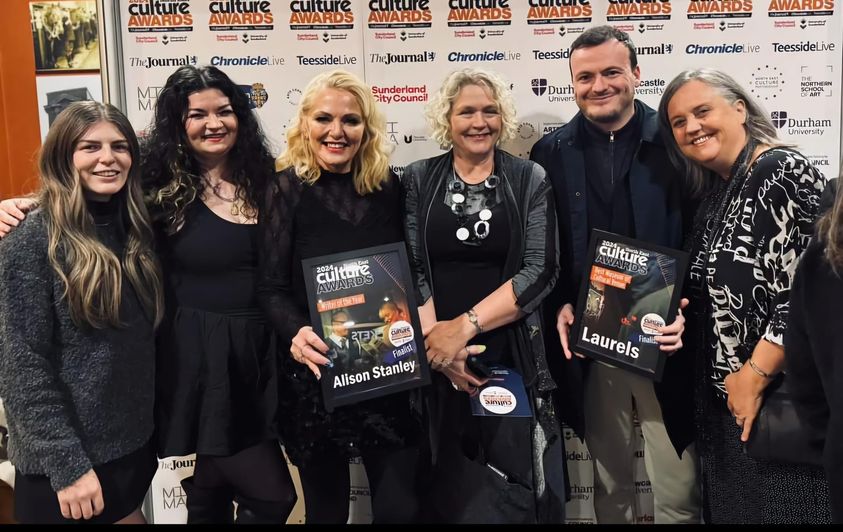
‘2024 has been an absolute rollercoaster. I’ve met and worked with some truly amazing people and for that I’m very grateful’ said Alison as she reflects on a productive year.
Alison (3rd from left) nominated at the North East Culture Awards 2024.
‘I started working with Laurels Theatre in Whitley Bay as their Director of Participation and that has brought new opportunities and challenges. Based on the Glasgow version, I started a new initiative called ‘Play & Pasty’ – it’s really took off’.
‘It was to encourage people to walk through theatre doors and see new writing. Every week actors have a script in hand reading and everyone gets a drink and a pasty from our favourite bakers Greggs’.
New writing is important to keep theatre fresh and encourage new audiences. Also, in these times when people are looking to come together the Play and Pasty initiative is providing an important and vital service.
‘These events have become firm favourites with people meeting friends and seeing theatre. This project is really helping not only increase theatre footfall but also combat social isolation and provide a safe, warm space’.
Dealing with challenging subjects is something Alison doesn’t shy away from to a point where her work has been recognised by the North East Culture Awards and organisations in the public sector.
‘I’ve been proud that my play ‘You Need to Say Sorry’ is being used by Social Services and the Police in their domestic abuse training. It’s amazing that something I wrote is in a small way helping in the fight against domestic abuse. I’ve also made the Culture Award’s 2024 finals as writer of the year with this’.
‘With fellow directors Maggie Martin and Polly Brennan I’ve also set up a community interest theatre company called Stanley Creatives. This has enabled us to produce theatre and music events bringing productions into the heart of the community’.
‘Stanley Creatives are also launching the Women We Are project. It’s a great project where we go into community centres and use drama as therapy with women who have experienced trauma through domestic abuse or cancer’.
Alison is fully determined to bring people together and use creativity as a positive driving force, with that she feel’s next year is shaping up to be a big year on the Stanley calendar.
‘I’ve some amazing stuff lined up. ‘Living the Life of Riley’ written by myself and Leah Bell is doing a UK national tour. I’m really looking forward to touring with this as we have former Coronation Street actress Vicky Entwistle starring plus my son is in the play. I also have my new play ‘Tits Up’ debuting February 18th to March 1st at Laurels Theatre, Whitley Bay’.
‘Film production is another avenue I’m interested in getting into so we’ve been working on a short film for a festival entry, it’s based on my stage play ‘Hard’ – I’m really looking forward to doing this’.
‘Our film ‘Bonny Chip’ with Lesley Saint John (Auf Wiedersehen, Pet) Deboa Meki and Rosie Fox – is still sweeping the boards at film festivals, we’ve had great nights at the film awards, plus of course the ABBA Girls with Kelly Lofthouse is going well – that train is still rolling’.
How’s the stats so far this year? Numbers from the UK and USA with regular hits from the European block of Spain, Italy and Germany plus a sudden spike from Ireland.
So, it’s big thanks to readers taking the total views over 410,000 since knocking out the first post in February 2017 which was an interview with one of the original New Wave of British Heavy Metal bands Mythra.
This post features another batch of North East stories from this year with links to the full interviews at the end. First up are Hartlepool based VaingloriousUK who got in touch in July.
‘We began seeking out, tidying up and uploading historic – and sometimes hysterical – video footage of music associated with the North East. The VainGloriousUK channel currently has up to 170 videos uploaded’.
‘One of these was the appearance of Brian Johnson’s first group Geordie. Recently we learned that our copy appears to be the only one still in existence when we were contacted about it being used in a forthcoming documentary about Brian’.
‘Most musicians are flattered that we care so much about their music, some are a bit wary about how their historical musical legacy may now be viewed – what you thought was important at 16 is not the same when you are 66!’
North Tyneside Actor & Theatre Producer Alison Stanley got in touch and talked about her latest project ‘Tits Up’.
‘A couple of years ago a young friend of mine was diagnosed with breast cancer, people think it’s older people who develop this disease, so I wanted to raise awareness of this’.
‘Last year I found a lump and experienced the process of going to the breast clinic. Fortunately, my lump wasn’t anything of concern but it did make me think’.
‘Even though I was fine I began questioning my own mortality and spent nights wondering what would happen if I had cancer? What would’ve happened to my son who is autistic?’
‘I went along to Live Well with Cancer in North Shields where the ladies were kind enough to share their stories with me.’
In June we had a severe Heed Case – musicians Newts Newton (ex Angelic Upstarts guitarist) and Si Cadelik (Northumbrian Psych rock bassist) filled yer in about their new album.
‘The new album explores gaslighting, narcissism and entitlement. All three elements feature heavily in populism and identity politics. Social media allows this to flourish, elbowing aside balance, objectivity and critical thinking. This emboldens extremists and those who seek to radicalise people with their brand of hateful rhetoric’.
‘Rather than tackle the causes of problems, the trend is to scapegoat. This should be a worry and concern for everyone, not just two people in a band. One day, that scapegoat might be you!’
‘We’ve been involved in music since our late teens, so that’s approximately 40 years and counting. In some ways it feels like forever, in others, like only yesterday’.
In July playwright Tom Kelly talked about writing a number of musicals including the work of Tyne Dock born author Catherine Cookson.
‘Tom & Catherine had its premier at South Shields Customs House, it was really exciting. All the team were really nervous on the opening night but when the overture began, we all felt it was going to be a success. And it was. It had a ‘sold out’ run. A measure of its success was that me mam wanted to go every night! And she was not a theatre-goer. She loved ‘Tom & Catherine.’
‘The play was first produced in 1999, and again 2001. In 2006 there was an outdoor performance at Bents Park, South Shields in which Jade Thirlwall (Little Mix) appeared, and most recently in 2019’.
Following on from the last post here’s another batch of North East stories this time featuring music, books, TV, boxing and the police. First up is former White Heat & Loud Guitars frontman Bob Smeaton.
‘If you asked me to list what gave me the biggest buzz I would say playing live top of the list, writing songs in second and recording in third. One thing I did learn is that playing songs live and recording them in a studio are two different animals’.
‘I love performing in front of an audience and felt that I was a much better frontman than I was a singer, so studio work for me back in the early days was not always an enjoyable experience. Also, the vocals were always done last, so the rest of the band were able to relax and the pressure was on me to deliver’.
‘What did I do after White Heat and Loud Guitars split? I pretty much stopped performing gigs as my career went down a different path’.
In August award-winning author & freelance journalist Terry Wilkinson talked about his new book…
‘At midnight on 3 May 1941, the factory and Head Office of Wilkinson’s Mineral Water Manufacturers in North Shields was hit by a single German bomb. It went through the roof, descending through all three floors, taking all the heavy bottling machinery and chemicals down to the basement – which was in use as a public air raid shelter. 107 died, 43 of which were children. Whole families were wiped out.’
‘Nothing is known of the identity of the plane which dropped the bomb – type, squadron, mission etc – as German records were mostly destroyed in the closing stages of the war’.
‘I wanted to write a story that answered all these questions and create a fictional alternative. Having said that, nobody could say with any conviction this is not what happened’.
Also in August former boxer Terry Patterson remembers his time boxing in the North East…
‘Over the years I fought a few Sunderland lads. Derek Nelson was a classy boxer who turned pro. I fought two ABA finalists in Gordon Pedro Philips and Willie Neil. I fought Pedro in the North Eastern Counties final but lost. Both lads were well schooled’.
‘Willie Neil’s coach asked if I’d fight him because his opponent hadn’t turned up. I weighed in at 10st 6lbs (welterweight), he was heavier than me by 6lbs. I knew his reputation for knocking people out. £50 was slipped into my hand for taking the fight’.
‘Willie could bang a bit – so could I – but he had me down three times during our bout. We set about each other unleashing all hell for three fierce rounds. I had him going at one point after landing a good left hook but the bell sounded and my chance to finish him had gone’.
‘Gordon and Willie are still good to this day – it’s been 36 years since we shared a ring but I see them at boxing dinners and club reunions’.
Former police detective & writer Arthur McKenzie talked about his work…
‘There was a police section house near Newcastle’s Exhibition Park, in it was a bait room, just a pokey little room with a table to play cards on. If you’re on night shift you’d take sandwiches and a flask of tea in. That’s where you gathered around 1am where the events of the night would unfold’.
‘You would get advice on how to deal with someone, it was a good place to sort things out like the older cops would tell you how to deal with a death, how to deliver a death message to the unfortunate family. It was a sort of meeting of minds over a game of cards. Aye the bait room was a good place to vent your spleen so to speak’.
‘So, I went away and wrote about the bait room. Tom Hadaway (writer for episodes When the Boat Comes In) read the play and was laughing at it ‘Yeah, you know how to write dialogue son’. He gave me pointers, when I finished it landed on two desks. One was the BBC in Manchester where it ended up on the Saturday Night Theatre radio show, which was a big thing’.
‘The other was the script reader for David Puttnam (producer Chariots of Fire, Local Hero, Midnight Express) who hated it at first but won her round in the end. She said she couldn’t do anything with it but put me in touch with an agent who was looking for writers for a tv show called The Bill. That’s where the writing started’.
TV actor & musician Michael McNally got in touch and talked about his time in ground breaking BBC TV drama The Cops…
‘I’d watched the first two series and it was my favourite programme on TV. When I started watching it, I thought it was a fly on the wall documentary it took me 10 minutes before I realised it was a drama. I was totally hooked’.
‘One of my first scenes was I was sat in a police van at 11pm on a Friday night on Bolton High Street. The general public were walking up and down the street they knew nothing of this, it wasn’t a closed set like on some programmes and we had to go and arrest someone’.
‘Two actors were having a fight then we got the message to go, so on with the blue flashing lights, we pulled up and jumped out of the van. Some people were trying to defend the actors and some were encouraging us to get in there and sort it out’.
‘We didn’t know where the cameras were we just heard someone say stop. We got back in the van, re-set and done the scene about four or five times’.
‘Same happened when responding to a fight in a bar, we had to pull people out and the general public in the bar didn’t know what was going on. There was an element of choreography for the fight, we didn’t want anyone to get hurt’.
‘After that first night the cast got together afterwards for some pub grub and a karaoke. Most of us were unknown actors so mixed in with the general public without any hassle. Every member of the cast got up and sang, mine was Should I Stay or Should I Go by The Clash – it was a really good night’.
Since starting in February 2017 hundreds of stories have been posted on this site. The last few months has seen a mix from the navy, radio, folk singers and a magician. Here’s a taste.
First up is Tyneside comedian & magician Robert Reed…
‘Being an outcast gave me more time to focus on myself, to perfect my act. I’m glad I never fitted in at school, cos this has worked out well for me in the long run’.
‘A person to take me under his wing was a teacher called Mr Obee at St Joseph’s. Every break time we would talk about magic and jokes, he would loan me magic books, then he would show me a different trick each time which I would perform for the other kids’.
‘His motto was ‘work hard and be nice’ which I’ve always followed. It was helpful propaganda about putting the hard work in. He told me that every hour you aren’t working on your dream someone else out there is’.
‘I stopped sleeping 8 hours a day and cut it to 6 so I could get extra hours at work. It became all about maximising the time I could work it out. I became obsessed with it, it’s the most important thing in my life – I want to be entertaining people’.
Northumberland Radio presenter Keith Newman talked about his passion for music…
‘The show not only gives me the chance to play the music I love but to meet my heroes. The one that got me really nervous was with Marky Ramone. I first saw the Ramones in 1980 at Newcastle City Hall and bought the t-shirt from the gig which I never took off’.
‘Next day I was going to a corner shop to get me ma’s tabs – yep we could in those days – and I could see a coach outside. As I got near it pulled away. I went in the shop and the assistant said ‘eeh see those lads on your t-shirt – they’ve just been in here. They were Americans asking for milk and cookies’. I couldn’t believe it I ran outside but the coach was away up the street’.
‘For years I wondered if it really was them so when I talked to Marky I asked him about it and he told me Johnny Ramone had OCD and after every gig he had to have milk and cookies’.
Another story came from Tyneside based Karen Taylor who remembers her time in the Royal Navy…
’The Falklands war was on when I was based at HMS Vernon in Portsmouth in 1982. I remember when the first ship was hit on 4th May. We were in a disco and everybody was up dancing when the music suddenly stopped and an announcement was made’.
‘I knew one of the chef’s whose ship was one of the first hit and sunk. He told me afterwards they were getting in the lifeboat and someone shouted ‘that’s typical, it was a really good scran tonight’. The Navy use humour to get out of any situation’.
‘The fact of not knowing who was alive or dead brought on a lot of mental health problems after that war. It must have been really scary what they went through’.
This from Wearside folk song collector Eileen Richardson…
‘The first song I found was The Old Wife’s Lament to the Keel Men of the Wear and it was all around historical events about the keel men and it was written in dialect. That set me on the road to researching the history that went with the song’.
‘There a lot of songs about death and tragedy, mining disasters and shipwrecks but there are songs that tell light hearted stories. The Durham Militia pokes fun at things, it’s like the 1800s version of Dad’s Army, with lyrics like ‘You’ll march away like heroes – just to make the lasses stare’ and suggesting that the only battles they will fight will be in the pub’.
Tyneside songwriter Rosie Anderson dropped in to tell a few stories. Here’s one…
‘I can’t just decide to sit down and write a song – some people do and I applaud them for the discipline but I have to wait until they come’.
‘When I was a kid I lived at Chapel House Estate in the west end of Newcastle. One night me, my mother and a friend went for a walk. This woman came out of her house in her dressing gown, she wasn’t in control of herself, didn’t know what time or day it was. I had never seen that behaviour in an adult before. Now I believe she was having a nervous breakdown’.
‘That always stayed in my head and another one was about 30 years ago I went on a blind date in Newcastle with this very nice bloke. He said I need to tell you something before we go any further… ‘When I was working in Canada I had a nervous breakdown in the car park of a Burger King’. It was hard to concentrate on anything else after that’.
‘But I remembered those incidents and those people are lodged in my heart for their own traumas. They gave me the song’.
Tyneside storyteller & folk singer Tony Wilson talked being a professional musician and how far it’s taken him…
‘Around 2009 I got an email. The message was ‘would you like to tell stories in Argentina?’ I wasn’t sure it was kosher at first but I received a phone call a few weeks later confirming it was. I was given contacts of previous storytellers who recommended it’.
‘Me and my wife went out and ended up over the years going to about 15 countries for six weeks at a time. They were international schools where the kids had already learnt English but mostly from American cartoon shows and they wanted them to hear colloquial language, more English. With my accent, I knew I would have to speak a bit slower – and there’s nothing worse than a posh Geordie!’
‘To accompany the lessons it was helpful to use British sign language or borrow a guitar. I always took a banjo with me as it was such a different instrument for them to hear. Once the banjo was broken en-route but we found the only banjo repairman in Bogota in Colombia’.
‘We’ve been to Uruguay, China, South Korea, all over – loved it. Sometimes I look back and think how did that happen – you’ve got to seize every opportunity’.
Now living in South Shields, retired teacher Rosie Anderson still feels there is work to do and more stories to tell.
‘Sometimes I feel as though I’m just getting started. I sing whenever I can. This year my musical partner Adam Holden and I have played at The Watch House in Cullercoats, The White Room in Stanley and Cockermouth Festival which were all great. I’m determined not to just bow out because I’m getting older’.
‘I grew up in Wylam in the Tyne Valley, in a house full of music. Both my Grandparents played piano. My dad listened to The Beatles, both parents loved the theatre and musicals and they took me and my brother there – I still love all that’.
‘When I was a kid I told my parents I wanted to be a performer but they were worried I wouldn’t be able to afford a home like them, they wanted me to have a ‘proper’ job. They wouldn’t let me study performing arts so I trained as a teacher’.
‘My first job was in Benwell, Newcastle. Then I went to the Middle East where I spent 10 years teaching in Kuwait and Qatar, before returning to Newcastle. I taught at Walkergate Primary School where I would do all the music shows and drama productions. Loved doing the shows there, I never gave lyric sheets out to the kids, they learned by listening and singing the songs back’.
‘When I left teaching I saw an advert for facilitators for Singing for the Brain with the Alzheimers Society. I really loved doing that. I did that for six years until covid hit. Singing on-line with people on the screen in front of you didn’t work really’.
‘People love stories in whatever form, be it a book, a film or a song. Some people write songs about being in love, and about their feelings. My songs are mostly about people and places. I find stories present themselves to me and I take them and turn them into a song’.
‘There are two songs that I have written that stand out for me. Sally Smiths Lament was written after my husband Chris and I worked on a film about soldiers from County Durham during World War One’.
‘Sally was the wife of miner Fred Smith, who featured in our film. They lived in a tiny terraced house and every day Fred and his sons needed a bath, a clean shirt, a clean bed and a dinner. The kids needed to get to school – how did she cope with all that, especially when Fred was away at war. I wanted to give Sally, and all the women like her, a voice.’
‘When I wrote it the song just seemed to be presented to me, her whole life. I got to sing it at a celebration in West Auckland and her family came to hear it – it was very moving. It travelled well and won three competitions – the Newcastle Folk Club, Rothbury Traditional Music Festival and first prize at Morpeth Gathering’.
‘I can’t just decide to sit down and write a song – some people do and I applaud them for the discipline but I have to wait until they come. Three things happened to me in my life that I put together in a song called Breakdown’.
‘When I was a kid I lived at Chapel House Estate in the west end of Newcastle. One night me, my mother and a friend went for a walk. This woman came out of her house in her dressing gown, she wasn’t in control of herself, didn’t know what time or day it was. I had never seen that behaviour in an adult before. Now I believe she was having a nervous breakdown’.
‘That always stayed in my head and another one was when I was living in Fenham. I went to the shops with my children who were only small then, and a woman came out of her house with a letter and asked if I would read it to her as she was confused and couldn’t understand it’.
‘Then about 30 years ago I went on a blind date in Newcastle with this very nice bloke. He said I need to tell you something before we go any further ‘When I was working in Canada I had a nervous breakdown in the car park of a Burger King’. It was hard to concentrate on anything else after that’.
‘But I remembered those incidents and those three individual people are lodged in my heart for their own traumas. They gave me that song’.
‘This year we went to Kjerringoy a former trading post in the Norwegian Arctic Circle, out in the middle of nowhere, it was beautiful. A family ran it in the 19th century and had 3000 fishermen working for them, catching and processing thousands of tons of cod’.
‘The father and husband died and the wife continued to run it single-handed for many years until she eventually remarried. I asked the locals if there was a song about her and there isn’t. So that’s my next song – Annalisa from Kjerringoy. Her story needs to be told’.
‘I’m also aware we need to start telling more stories about people and their lives and jobs today otherwise in 100 years time there will be no one singing about us!‘
‘What does music mean to me? It’s hard to describe it, it’s so deeply embedded, there’s no life without it. Music is at the core of my being, there is no day without singing and because I have grandchildren now I have a new audience! We sing folk songs and songs from musicals, they’re word perfect when they sing them back’.
‘Music gives such joy, when I was singing with the Alzheimers Society the collective joy and reminiscences of songs from the past and enjoying it together was just so valuable for the families’.
‘We had people who wouldn’t sing at all but liked being there and that was fine. Once, two women brought their mother to a session and she sat between them. She didn’t communicate at all, had her head down, closed off you know. But when we started singing a song, I can’t remember which one, she lifted her head up and actually got up and started moving around in the middle of the circle’.
‘One daughter got up and started dancing with her. When we got to the end of the song the daughter turned round and said to me ‘She’s just said my name for the first time in years’.
‘Music gets right in there (pointing at heart) we’ve got to keep it going and expose our youngest children and oldest adults to music because it really does reach parts that others can’t reach. It’s like hearing the heartbeat in your mother’s womb’.
‘As a child I wanted to do music, as an adult I taught it with kids then people with dementia, despite my age I’m still committed to what I always wanted to do. Women who’ve had careers and families can still chase their dreams’.
Tyne Dock in South Shields was an interesting part of the town to live, with its churches, terraced houses and huge industrial Victorian arches next to the river. It was in the early 80s when a lot of the old housing stock was being demolished and in Porchester Street I watched Ascendency being filmed. Julie Covington of hit TV show RockFollies was the star, not long after that The Machine Gunners was set in Porchester and filmed for BBC TV.
‘Up to when I was 7 year old I lived in Porchester Street. It’s not there now but St Mary’s Church around the corner is where I used to sing in the choir and the scouts’ said Tony.
‘Now I live on the Lawe Top beside the roman fort. It’s almost aspirational for someone who comes from Tyne Dock to wind up being a skuetender’ (native to the Lawe Top).
‘I’m proud of coming from South Shields and when you were young trips to the fort were absolutely mind blowing. The area it’s in is incredible, with the whole vista of the river and parks and beach nearby – we’re lucky here’.
Being a former Tyne Docker now Skuetender he’snot wrong there. Tony featured on the site back in May 2018 talking about storytelling and songwriting and what music means to him.
‘I turned back to folk singing in 2017 after the government education cuts made it too expensive for schools to have extra-curricular practitioners, like me, to come in. Before that I was storytelling in schools for 20 years covering hundreds of issues such as the steelworks when I was in Ebbw Vale, the Romans here in South Shields, the coal industry and iron stone mining in Teesside and Northumberland. It was an extremely successful time’.
‘Storytelling is very important, its communication, social history, emotional control, drama, its use of vocabulary. For me it was learning how to be a performer and developing stamina to be able to do four hour sets a day, then drive 100 miles to go to a hotel, get up next day and do it again’.
‘Cities like Manchester, Oxford, Cambridge, all over the UK. I’d stay in these areas year after year for a fortnight at a time and, unlike a music tour where you could be in Aberdeen one day and Bournemouth the next, I’d plan easy distances to plan a route back home – loved the life.’
‘Then around 2009 I got an email. The message was ‘would you like to tell stories in Argentina?’ I wasn’t sure it was kosher at first but I received a phone call a few weeks later confirming it was. I was given contacts of previous storytellers who recommended it’.
‘Me and my wife went out and ended up over the years going to about 15 countries for six weeks at a time. They were international schools where the kids had already learnt English but mostly from American cartoon shows and they wanted them to hear colloquial language, more English. With my accent, I knew I would have to speak a bit slower – and there’s nothing worse than a posh Geordie!’
‘When we were in a Spanish speaking country, for the youngest ones, you’d have someone to explain the context of the story and then I’d still tell the story in English. Half of their lessons were in English, to make it an immersive experience’.
‘To accompany the lessons it was helpful to use British sign language, or borrow a guitar. I always took a banjo with me as it was such a different instrument for them to hear. Once the banjo was broken en-route and we found the only banjo repairman in Bogota in Colombia’.
‘It was hard work getting up at 5am, into a taxi for a two hour drive to tell stories to 3-400 children in ampitheatres – but what an experience! The last time we went over was Peru in 2016. We’d been to Uruguay, China, South Korea, all over – loved it. Sometimes I look back and think how did that happen – you’ve got to seize every opportunity’.
‘I’ve been songwriting for years and always have a songwriting project on the go. I write about 15 songs per year. Ideas can come from a book, a documentary or what someone says in a street… then I do a lot of research and add some ‘meat’ to the story. Songwriting can possess and obsess you’.
‘Recently I wrote a number of songs about Iron Stone Mining, the workers and how dangerous it was working there, although I do try to stay away from disaster. It’s not all ‘Grim up North’.
‘A friend of mine gave me a diary about his distant relation who had been captured by the Portugese and transported to Portchester Castle in Hampshire! Having lived in Porchester Street I didn’t know about this place. The songs can take you anywhere!’
‘I wrote a song with local playwright Tom Kelly about ‘the seven lads of Jarrow’ who, in the 1830s worked in the mines under diabolical conditions so tried to form a union with union organiser Tomas Hepburn. They ended up being brought up on jumped up charges – 10 were captured 3 escaped. 7 ended up in a kangaroo court and were transported to Australia never to return. It’s such an emotional subject’.
‘In 2019 I was planning to write autobiographical songs, one was about the day they tarmacked the cobbles in Porchester Street and as kids we could roller skate across the street. Another was the times walking through Tyne Dock arches with my dad and me being on his shoulders. Or another about my sister playing with her friends in the backyard in Porchester Street – then covid came along’.
‘I didn’t want to write about the pandemic or what happened around it, like being scared or having a feeling of waiting for death to come. I wrote nothing about that. I just wanted to write about the one’s I love and keep sane’.
‘All the performances I did in South America and all of the daily storytelling work I did in schools I now channel into what I present now as a musician. I still do regular open mics, folk club spots and am a paid guest in clubs and festivals throughout the UK’.
‘I love performing, it’s like an out of body experience. I’m not hippy dippy, mystical or spiritual but enjoy giving people enjoyment, sharing moments with people…and it beats the hell out of singing in the bathroom!’
Tony has placed all of the stories, CPD and instructional DVDs for parents and children on You Tube at ‘Tony Wilson Storyteller.








 ALIKIVI UK : NORTH EAST MUSIC & CULTURE