TOON TUNES – with former Newcastle Dingwalls manager Chris Murtagh

A booking list and diary from gigs at Newcastle Dingwalls in 1983 turned up on line. Entries included:

26.3.83 – Big Country Fee: £240 – 282 @ £1.50. Excellent band and performance. Perfect timing with release of single. Excellent debut in the North-East.

3.3.83 – Raven & Hellanbach Fee: Raven £300 – Hellanbach £60 – 269 @ £1.50 Terrific stage show. Very good heavy rock band with good repertoire. Good following.

Raven bassist John Gallagher told me about the night… ‘I just remember the place being chilly…at least until we got started! There was a decent turnout, and we were promoting the ‘All for One’ album. I don’t remember much more to be honest !’ …well it was nearly 40 years ago.

To find out more I contacted the manager at the time and owner of the book, Chris Murtagh….

I don’t have the diary now as I’ve sold it but have a digital copy of the acts who appeared. Like the other Bierkellers around the UK the entertainment promoter Harvey Goldsmith bought all the venues for £1 and re-christened them Dingwalls.

Yes, only a £1 but Harvey had to service their debts and running costs. They were in the basement of office blocks, mine was in Waterloo Street, Newcastle. It had a capacity of 1200.

I was manager of the venue during 1983, it was Dingwalls from January to June when it went into liquidation and reverted to Vaux Breweries, the biggest creditor.

Then from June to December Vaux changed the name to the Bear Pit but I was retained as manager.

How did you get the managers job ?

I’d done several promotions there and had threatened to sue Goldsmith for breach of a contract for cancelling one of them. Turned out his General Manager offered me the job instead. I was the only manager who was also a promoter.

All the other Bierkeller managers at Sheffield, Hull, Liverpool, Bristol and London were ex-Mecca managers and older than me. They got two for the price of one in me being manager/promoter and Chris Donald from very early Viz comics did all my publicity.

What was the Newcastle venue like ?

It was like being buried in a hole in the ground for months without seeing daylight. When we closed and tidied-up well after midnight, we’d go and chill out at Rockshots upstairs till about 3am. Then back at work about 4pm the same day.

My bar manager once dragged me to the city baths for a massage which connected me back to my body that I’d totally lost track of.

Martha Reeves was booked for May ’83 and your diary entry reads….

Martha chatted me up in the office. Didn’t know where to put myself. She could have eaten me for breakfast. Motown comes to Dingwalls. Brilliant professional show.

What can you remember from that day ?

Martha Reeves terrified me as I must have been the youngest manager she’d come across and she was a very experienced older woman.

In the diary for June, Murtagh booked female group Girlschool with support from North East heavy metal band Satan. His notes of the gig included…

Girlschool arrived for their first headline tour after supporting Motorhead. They didn’t have any money and asked if I could help them out which I did. Nice girls who put on a good show but treated rubbish by their record company.

Satan a good local heavy metal band with a good following. I’d previously promoted them, famously at the St James & St Basil’s Church in Fenham where the posters read ‘Appearing live on stage, Satan.’ That pulled in a good congregation.

Also, that month Dr Feelgood came to Newcastle with support from North East band R & B Spitfires….

Full on red-hot rock band with commitment and attitude. Real pros – no messing about with sound checks – Brilliant. Wilko went to college up here so he had his own following.  Local band Spitfires acquitted themselves well in such company.

More entries to the diary with some excellent comments about the bands and gigs….22.4.83 – Gun Club + Sisters of Mercy.

Fee: £511.25 – 548 @ £1.50. Sisters, good appreciative following, hypnotic beat with drum machine, bass and guitar. Led by Joey Ramone lookalike. Effective visual presence.

Gun Club, should have been called ‘Gin Club’, Jim Morrison just before he died. Good presence, good songs, terrible sound.

6.5.83 – Miami Steve. Brilliant American band. Shame about Steve and the material. Bruce Springsteen can keep him. Stayed in the tour bus only coming in to play the gig. Oh and don’t touch his bandana. Precious bastard, up his own arse.

10.5.83 – Bad Brains. Turned up 6 hours late so most of the audience left. Refused to pay them which set-up a stand-off between the band and my security. Lots of martial arts posturing until it finally dawned on them they would get severely plastered if they stayed. Bad brains indeed.  

16.5.83 – The Vibrators + Red Alert. Not overly impressed by the reformed Vibrators. Canny lads though. Their guitars were nicked before they went on, then retrieved by Red Alert, who were themselves a very impressive act.  

After you left what happened with the venue ?

Harvey Goldsmith owned Dingwalls but his CEO was Peter Gross, an accountant, who’d run a chain of restaurants called The Great American Disaster in London.

At each of the venues he’d bring a brewery in as sponsor. In Newcastle’s case it was Vaux Brewery who gave him three quarters of a million pounds.

When the receivers Ernst Whinney were brought in because Harvey was going into liquidation for about the seventh time, I talked to him on the phone. ‘You’ll be alright my boy’, were the last words he spoke to me.

The venue reverted to Vaux Breweries with them being the biggest creditor. When Paul Nicholson CEO of Vaux arrived, he asked what Harvey had done with all the money. I said he’d stuck a black plastic crow on the wall and extended the stage.

You’ll notice every poster advertising a Goldsmith promotion has a little fat man in the corner. That’s Harvey. He also used a black crow as the logo for Dingwalls. ‘I hope that bloody crow lays golden eggs’ was Paul’s reply.

Basically, Harvey used all the money for running costs. If he’d taken the time to run the venues himself it might have worked, but he was too busy touring the Stones, Dylan, Bowie etc and left the running to Peter Gross, who was clueless about the music industry.

Vaux wanted to appoint their own manager of what they now branded ‘The Bear Pit’. My staff refused to work for them, so I was retained as manager.

Murtagh came across North East manager and promoter Geoff Docherty

My first encounter with Geoff Docherty was when he was looking after Preacher, a band led by Tony Ions. I needed a rehearsal place for my new band Fan Heater and Tony who I’d played with in Slaughter House, suggested I approach Geoff to see if I could share their rehearsal rooms in the derelict Hydraulic Crane pub on Scotswood Road, Newcastle.

Not only did Geoff give us the pub but he said he’d get us a gig at the Marquee Club and Rock Garden in London supporting The Showbiz Kids who he also managed. ‘Oh yes, of course you will’ I thought being very sceptical.

I couldn’t believe it when he was as good as his word. Total respect.

What did you do after Dingwalls ?

After leaving there I continued promoting in Newcastle, Leeds and tours around the UK, including with my own band.

1994 I became a director of the pan-European touring organisation the Newcastle Free Festival Inaugurating Cities of Culture, including being the first festival to perform under the Berlin Wall when it came down in 1989.

That same year, as part of the festival, I brought over the Peruvian band APU. 30 years later I’m still their manager. This also drew me into World Music which I’ve promoted ever since.

As part of being a promoter, I worked as an A Level sponsor for the Home Office for over 25 years issuing visas for non-EEC artists to tour the UK. I still enjoy playing all over the world and organise festivals and events internationally.

Contact Chris on the official website:

www.line-up.co.uk

Interview by Alikivi   June 2020.

TALL STORIES – painting with L. S. Lowry (1887-1976)

Hanging on my wall is a fairly large (27 x 22inch) painting printed on wood – Industrial Landscape, Ashton under Lyme 1952 by L. S. Lowry. The original is in Bradford Art Gallery and Museum.

I bought it in a charity shop a couple of years ago, the colours are faded as the previous owner must have placed it in direct sunlight, but still a bargain at £7.

When I first saw it I recognised the style as a Lowry – I like how he stretches everything – chimneys, buildings and people, the flat look with no shadows and how the factories fade in the background – capturing the heart and scale of industry.

Industrial Landscape by L.S. Lowry (1952).

During the ‘60s Lowry visited Sunderland and surrounding areas where he produced a number of oil paintings and sketches. In South Shields he produced The Ferry in 1967. After his visit the painting went on display in the art gallery in Sunderland.

Bill Clark, owner of the Clark Art gallery in Cheshire, bought the painting in 2010. He said: ‘Lowry was entranced by the North East and particularly by South Shields. ’The Ferry’ is one of the stand-out pieces he produced of the area in the 1960s’.

The Ferry by L.S. Lowry (1967).

Lowry used to spend short breaks at the Seaburn Hotel near Sunderland, painting and sketching scenes of the beach and nearby ports.

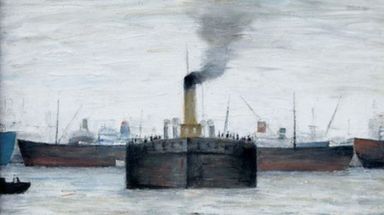
The River Wear would be the closest to his hotel but in one sketch Tanker Entering the Tyne is a ship sailing around what could be the view from Comical Corner on the riverside near the boat builder’s yards on Wapping Street, South Shields.

If Lowry was in Shields, is there a record of his visit ?

Born on 1st November 1887 Lawrence Stephen Lowry is on the 1911 census living at 119a Station Road, Pendlebury, Lancashire with his parents Robert, an estate agents’ clerk, and Elizabeth.

Lucy England, and a few years later 23-year-old Alice Powell were employed by the family as domestic servants to help around the house as his mother Elizabeth had become bed ridden and dependent on her son. His father Robert died in 1932.

Lawrence worked through the day as a rent collector, then when he got home cared for his mother, only leaving time to paint through the night.

Lowry painted everyday scenes that he saw around him in England’s industrial North. ‘I never worked in a mill, it wasn’t a job I would of liked. Starting at 6 in the morning and finishing half past 5 at night. But I wanted to put the industrial scene on the map’ he said in a BBC interview in 1975.

He spent about ten years in Art schools in Salford learning classical techniques, and though he focused on industrial scenes he produced a number of seascapes and portraits using simple materials and colours.

He had small exhibitions, and his work was being noticed, but it wasn’t until aged 52 that his work was acclaimed. His mother never saw his success as she died in 1939, it deeply affected him and his work.

The scenes he painted where full of people haunted with anger and pain.

Due to class snobbery his work wasn’t recognised by the self-appointed art elite in the south. The Tate Gallery held some of his work in their basement for decades, but it wasn’t until 2013 when they eventually held a Lowry exhibition.

Lowry turned down honours, O.B.E, C.B.E and a knighthood – ‘meaningless in the absence of mother’. He retired from being a rent collector at 65 and during this time visited the North East still making sketches of what he could see around him.

On 23rd February 1976 Lowry died of pneumonia at the age of 88. He had produced over 1,000 paintings and drawings and today there is an art gallery in Salford named after him housing the largest collection of his work.

The world record sale for one of his paintings was for over £5 million paid for The Football Match.

Sources: Ancestry family search.

BBC News 2012 & 2013.

L.S.Lowry BBC film The Industrial Artist 1975.

 Alikivi  May 2020.

LETTERS FROM JARROW (1) – The IRA on Tyneside

Recently I completed a DNA ancestry test which came back 14% Scottish and 86% Irish, a bigger percentage than I thought but not a surprise as in 2008 I had already researched the family tree through census’, birth, marriage and death records, plus visiting Ireland a few times.

My Irish family came to Tyneside in the North East of England around the late 1880’s and settled here – a long way from County Galway, Derry and Antrim.

Amongst old certificates, photos and letters, my grandfather wrote down memories of his mother and her family, plus describing where he used to live and play as a kid in Jarrow at the time of the First World War.

‘My mother’s family originated in Galway in the west of Ireland. She came from a big family, her brothers, uncles and cousins were all fishermen. I remember my mother as being a very hard-working woman.

She worked as a Stoker in the chemical works over the bridge in East Jarrow.  She worked there all through the 1914-18 war.

She was a very kind woman, strict but fair, and was very religious. The family were also involved with the IRA and Sinn Fein’.

These last remarks were very interesting because when researching my family history, I came across Donmouth, a North East local history website by Patrick Brennan (link at the bottom of the page).

In one of the sections, he covers the IRA in Jarrow which I have condensed here.

After being cruelly treated by England over the centuries – for example the Great Famine 1845-50 – Irish people were looking to create an Independent Irish Republic.

A British Volunteer force, known as ‘the Black and Tans’ landed in Dublin. The IRA operated a guerrilla campaign attacking small groups of Black and Tans and murdering informers. Out of control Tans went on an orgy of looting and arson.

By 1919 the Irish Self Determination League (ISDL) was formed, the purpose was to raise funds for Sinn Fein but some members decided to take direct action. Mainland Britain had its first arson attack in Liverpool Docks, days later, a large explosion near London Bridge.

On Tyneside, many men and women of Irish birth gave support to the Irish republican cause through membership of the ISDL or Irish Volunteers – better known as the IRA.

Since the 1880’s Jarrow had an active political organisation in the Irish National League and held an important role in the ISDL. They held political meetings, fund raisers and ceilidhs in Lockharts Cocoa Rooms and the Co Op Guild Hall in Jarrow. 

More direct action was called for resulting in more volunteers being recruited and by the end of 1920 six companies with a total of 160 men had been established:

A Company – Jarrow. B – Hebburn. C – Newcastle D – Wallsend. E – Bedlington. F – Consett.

Within a few months a further four companies were set up: Stockton, Chester-Le-Street, Thornley and Sunderland bringing the total to 480 men.

Arms, guns and explosives were either stolen from Army Drill Halls or obtained from foreign sailors. In Jarrow, baby’s prams were used as cover to transport weapons to and from an arms dump in St Pauls Road in East Jarrow.

March 1921 saw the first incendiary attack on a Newcastle warehouse and oil refinery, plus a timber yard at Tyne Dock. Largely unsuccessful, the second attack was more ambitious, 38 fires at 20 different farms were co-ordinated to be lit at 8pm throughout Durham and Northumberland. This demonstrated the extent of the I.R.A throughout the region. (Reports from the Evening Chronicle 1921).

A number of operations were planned and executed around Tyneside. Farm fires and attacks on oil works in Kenton, Wallsend, South Shields, and an aircraft shed in Gosforth was destroyed.

Also, the daring attack in Jarrow – a gas main blown up on the old Don Bridge (pics below).

This story featured in my documentary ‘Little Ireland’ (link at the bottom of the page).

Con Sheils speaking in the film said ‘They were just trying to make a point, that’s all they were trying to do. Not harm anybody, just trying to make a point that they wanted home rule for Ireland’.  

THE SINN FEIN OUTRAGES: GAS MAIN BLOWN UP  (report from the Evening Chronicle 23rd May 1921).

At 11.15pm on Saturday night there was a heavy explosion at the west end of the town, and it was discovered that a hole 18 inches by 18 had been made in the lower of two gas mains carried across the Don bridge at East Jarrow. The gas company’s workmen were soon on the spot, and the main was temporarily repaired.

The IRA on Tyneside were severely damaged when two of their top men were arrested in connection with the theft of explosives from a colliery in Blyth on the Northumberland coast.

They were sentenced to prison but released in 1922 as part of Truce arrangements made a year earlier.

But more trouble was on the horizon with pit strikes, mass unemployment and extreme poverty meant the Irish had another fight on their hands – by 1936 Jarrow was about to march onto London.

For further information:

https://garyalikivi.com/2018/08/22/little-ireland-documentary-on-irish-immigration-into-jarrow-uk/

http://www.donmouth.co.uk/

Alikivi   May 2020 

HELLO TOMORROW: Changing Face of South Shields in photographs (4)

For the past 10 years I’ve set myself a documentary project capturing the changing face of South Shields. Included are a small selection of the photographs.

This is the seafront harbour where the river Tyne meets the North Sea. The new Littlehaven Promenade replacing an old path and car park. Previous posts feature other area’s of the town.

In 2013 South Tyneside Council proposed a very bold £100 million regeneration project for the town, and public consultations were held. Progress on different phases of the regeneration is ongoing as more developments are planned.

So far the council have delivered – Hello Tomorrow is not just a slogan on the posters.

Gary Alikivi  April 2020.

HELLO TOMORROW: Changing Face of South Shields in photographs (3)

For the past 10 years I’ve set myself a documentary project capturing the changing face of South Shields. Included are a small selection of the photographs.

This is Harton Quay next to the river Tyne, the ferry landing, the BT building and The Customs House theatre & arts venue. It’s also next to The Word and the Market, two area’s that have benefited from the 365 Town Centre Vision regeneration. Following posts will feature other area’s of the town.

In 2013 South Tyneside Council proposed a very bold £100 million regeneration project for the town, and public consultations were held. Progress on different phases of the regeneration is ongoing as more developments are planned.

So far the council have delivered – Hello Tomorrow is not just a slogan on the posters.

Gary Alikivi  April 2020.

HELLO TOMORROW: Changing Face of South Shields in photographs (2)

For the past 10 years I’ve set myself a documentary project capturing the changing face of South Shields. Included are a small selection of the photographs. This is the 250 year old market at the top of King Street and next to The Word featured on the last post. Following posts will include other area’s of the town.

In 2013 South Tyneside Council proposed a very bold £100 million regeneration project for the town, and public consultations were held. Progress on different phases of the regeneration is ongoing as more developments are planned.

So far the council have delivered – Hello Tomorrow is not just a slogan on the posters.

Gary Alikivi  April 2020.

HELLO TOMORROW: Changing Face of South Shields in photographs (1)

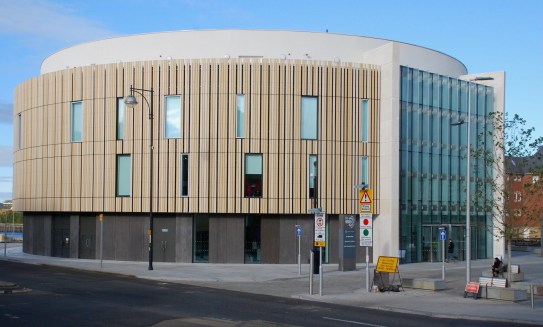
For the past 10 years I’ve set myself a documentary project capturing the changing face of South Shields. Included are a small selection of the photographs. These are from The Word which replaced the town centre public library. Following posts will feature other area’s of the town.

In 2013 South Tyneside Council proposed a very bold £100 million regeneration project for the town, the 365 Town Centre Vision, and public consultations were held. Progress on different phases of the regeneration is ongoing as more developments are planned.

So far the council have delivered – Hello Tomorrow is not just a slogan on the posters.

The Word, National Centre for the Written Word. October 2016

Alikivi  April 2020.

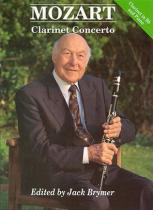
BLOWIN’ IN THE WIND – snapshot of musician & teacher Jack Brymer (1915–2003)

A post last summer featured professional jazz musician Kathy Stobart (link below).

The post highlighted her link from being born in South Shields to playing residencies in London, New York and Los Angeles to sharing a bill with Radiohead. But what about a link from South Shields to The Beatles via Dracula ?

A few weeks ago, I received a message from a friend ‘Have you heard of Jack Brymer ? He used to live in South Shields. He was a famous musician’.

I hadn’t come across the name so checked him out and was surprised to find he was a session musician who played on Hammer horror movie soundtracks starring Christopher Lee and Peter Cushing.

I got a bigger surprise to find he appeared on The Beatles track A Day in the Life.

Unfortunately, due to the Coronavirus pandemic the Local History library in South Shields is closed, and I would usually check details there, but this is what I’ve found using Ancestry, Musicians Gallery, and various BBC interviews and video clips on You Tube. Facts were checked as much as possible.

In 1911 John and Mary Brymer lived at 92 South Woodbine Street, South Shields. They had two children, then on 27th January 1915, John was born, later to be known as Jack.

John senior was a house builder who played clarinet, and with no formal instruction, his young son attempted to play the wind instrument.

Throughout his young life Jack appreciated listening to a wide range of musical styles from jazz to brass-bands. He later insisted that all these genres had been of great value to him professionally.

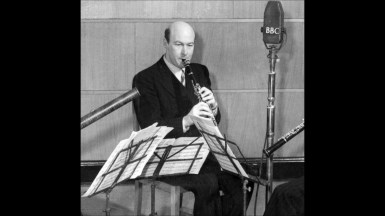
In a BBC interview he saidPlaying the clarinet was a natural thing because after all I can’t remember not playing it. From the age of 5 I can’t remember life without the clarinet’.

maxresdefault

Jack trained as a teacher and joined the teaching staff at a school in Croydon. He taught the odd combination of physical education and musical appreciation. In his spare time, he played in amateur musical ensembles.

During the Second World War Jack served in the Royal Air Force. After basic training he was promoted to corporal as a physical training instructor.

After the war he returned to his teaching post, and in 1947 on the recommendation of professional musicians, Jack received a surprise telephone call from the Royal Philharmonic Orchestra inviting him to audition.

At first Jack thought it was one of his friends winding him up. But he went along and after playing, badly he recalled, a call came in next day – and a contract.

Throughout his career Jack enjoyed an interest in mainstream jazz and performed as a soloist with many of the leading British and American jazz players.

A-267768-1471122392-3984.jpeg

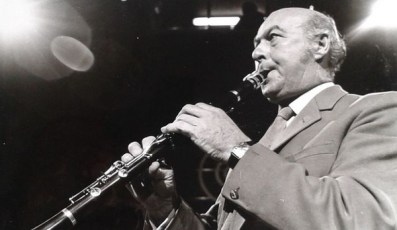
He said I don’t think musicians should just be musicians. I’m quite sure having a university degree in Physics is going to make you a better musician. You know more about life, it must make you a better musician. Admittedly academic knowledge is not the be all and end all, but it must have a reflection on your whole outlook on life’.

He was a frequent broadcaster, both as a player and presenter, and made recordings of solo works with orchestras.

He also played in both BBC and London Symphony Orchestra and was professor at the Royal Academy of Music, Guildhall School of Music and Drama and the Royal Military School of Music.

Now to the recording of A Day in the Life by The Beatles during January and February 1967. The song appeared on Sgt Pepper’s Lonely Hearts Club Band and was recorded in Abbey Road Studio.

I watched the music video for the song and there he was, at 13 seconds in, laughing with a colleague while putting his coat over a chair.

The song crescendo features forty musicians selected from the London and Royal Philharmonic Orchestras. Producer George Martin said that Lennon requestedA tremendous build-up, from nothing up to something like the end of the world’.

Martin addedWhen I went into the studio the sight was unbelievable. The orchestra leader, David McCallum, was sitting there in a bright red false nose. He looked up at me through paper glasses. Every member of the orchestra had a funny hat on above the evening dress, and the total effect was completely weird’.

The recording for Jack was surely a highlight from a very distinguished career, did he think it would be one of The Beatles greatest songs and still listened to over 50 years later ?

To celebrate his 70th birthday the LSO paid Brymer tribute with a special concert, and another to mark his 75th at the Barbican Hall, London. He published two volumes of memoirs and a book about the clarinet. Sadly, Jack died at the age of 88 in Redhill, Surrey.

He didn’t do too bad for a builder’s son from South Shields, who had many day’s in his life to remember.

 Link to Kathy Stobart feature:

https://garyalikivi.com/2019/06/25/all-that-jazz-snapshot-of-the-life-of-professional-musician-kathy-stobart-1925-2014/

 Alikivi   March 2020

HUMANITY & COURAGE – South Shields Historian & Photographer Amy Flagg (1893–1965)

The previous post was a snapshot of the life of Victorian photographer Frank Meadow Sutcliffe. Another photographer featured on the blog is South Shields Historian Amy Flagg (links below).

This post highlights the photograph’s Amy produced during the Second World War. She took some of the most devastating images of South Shields in the 20th century. When the bombs dropped, she captured the scars with her camera.

IMG_0979

Page from inside the pamphlet.

When researching a documentary about Amy (Westoe Rose, 2016) I came across detailed records that she had made of German air raids that revealed the amount of suffering the town endured. 

The Ministry of Information and the Chief Press Officer gave permission to produce Humanity & Courage, pamphlets featuring some photographs that Flagg had taken of war damage to her town.

IMG_0760

Detailed record of air raids over South Shields.

More images are available on the South Tyneside Library website

https://southtynesidehistory.co.uk/

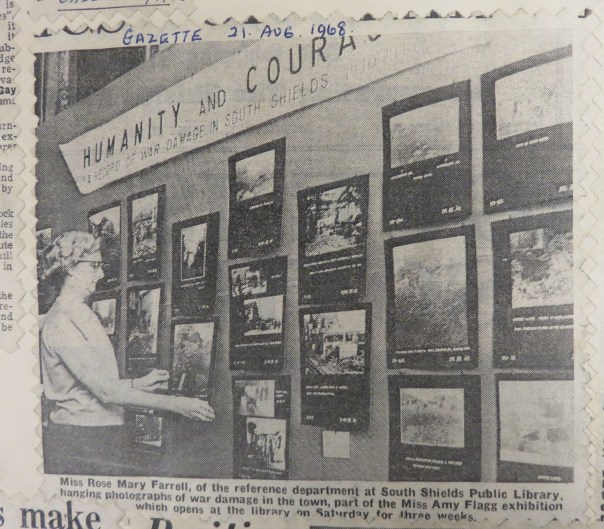
Included here is a picture story from The Shields Gazette showing her friend and Librarian Rose Mary Farrell standing next to a display of Amy’s photographs.

They were shown in an exhibition at South Shields Library. The report is dated August 1968, three years after Amy died.

IMG_0693

Links to previous Amy Flagg posts:

https://garyalikivi.com/2018/07/19/westoe-rose-making-the-documentary-about-historian-and-photographer-amy-flagg/

https://garyalikivi.com/2019/07/11/westoe-rose-the-story-of-amy-flagg-south-shields-historian-photographer-1893-1965/

https://garyalikivi.com/2019/12/21/history-lives-amy-c-flagg-south-shields-historian-photographer-1893-1965/

https://garyalikivi.com/2019/12/28/amy-flagg-holborn-the-mill-dam-valley/

Alikivi   March 2020

A LIFE IN PICTURES – Snapshot of Victorian Photographer, Frank Meadow Sutcliffe (1853-1941)

In October 2017 I was at the Goth weekender held in Whitby on the North East UK coast. The town was revelling in the darker side of life, people walking around in colourful costumes celebrating the dead.

The reason behind the spooky theme is the town’s connection to Dracula. In 1890 writer Bram Stoker stayed in the town where he was inspired to write his vampire novel. Another reason to visit the town was the Frank Sutcliffe gallery.

Frank Meadow Sutcliffe was born in Yorkshire on 6th October 1853. He came from a large family, his parents had six children and made the ancient port of Whitby their home. At 17 Sutcliffe was a photographer and assistant to his father Thomas, an Artist and lecturer.

By the time he was 35 he was married to Eliza, the couple had four girls, one son and were living at 9 Burrowfield Terrace. By 1901 the family had moved to Sleights Cottage in the town where his oldest daughter Kathleen was his photography assistant.

Sutcliffe paid the rent by taking studio portraits, but the main subject of his work was everyday working life, with the fishing community a main focus.

Capturing Victorian life brought him international recognition and an award from the Honorary Fellowship of the Royal Photographic Society in 1935.

Included are some of his photographs taken from a 1988 calendar I have called, ‘A Photographic Heritage’. One of the pictures features two of his children, Horace and Irene fishing for newts.

The naff quality copies here aren’t a patch on the images in the calendar, if you search out his pictures, they are worth spending time with.

On the Second World War register he is an 86-year-old widow, employed as Curator at Whitby Museum. His daughter Irene lived with him until he died on the 31st May 1941.

http://www.sutcliffe-gallery.co.uk/

Alikivi   March 2020.