NEVER MIND THE SEVENTIES – Book Planned on NE Punk Scene ’76-80

nepunk

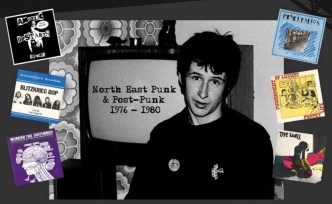
A group of music fans got together five years ago and planned to put together a book about the North East Punk/Post-Punk scene from 1976-80.

Bands featured will include not only big names like Penetration, Angelic Upstarts, Toy Dolls, Punishment of Luxury, The Wall, The Carpettes, Red Alert and Total Chaos but also bands who were only known in the North East.

‘Since we started on the book numerous folks have been involved in one way or another, with interviews and transcribing. There are approximately 300 bands on our list, and we’ve got all of them covered to one degree or another. It’s been quite a task’ said Martin Blank.

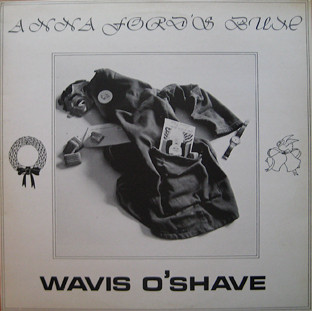
South Shields bands covered so far include Angelic Upstarts, The Fauves, The Letters, The Rigs, Next and of course, Wavis O’Shave….’Although Wavis was never a punk by any stretch of the imagination, due to his album ‘Anna Ford’s Bum’ being on the Anti-Pop label he became known as a sort of punk-cum-loonie-cum-prankster’.

Here’s an extract from Martins interview with Wavis…..

What is your first memory ? I think they told me it was only going to be a nice ride down a slide. Seriously tho’ it was ‘Who’s just kicked me out of this low flying UFO?’

What were your main interests when you were growing-up ? At my first school, the lad who sat in front of me calling Miss Bishop ‘Miss Fish Shop’. Another lad always wetting himself and having to dry his shorts on the radiators. They smelt like fish fingers.

Everybody including the bullies liked me, so I wasn’t getting my head shoved down the bogs and the toilet flushed or thrown over the high wall into the girls school or having crap shoved up my nose on a lolly stick or having ‘**** off’ written on the back of my neck. They had high hopes for me but in what way I don’t know.

Were you ever in a band ?
Yes and no. Around 1975 I formed The Borestiffers although we were never a band in the conventional meaning of the word. Our ‘instruments’ were a suitcase, a bullworker and a kitchen sink. We performed live only once, at a church hall in South Shields. The entry fee was a slice of bread, or a stick of celery. White bread by the way. Brown was a counterfeit ticket.

Kitchen sinks aside, can you play a ‘proper’ instrument ? I can only play the fool. I can play a few chords on a guitar, but who wants to listen to a bloke wearing corduroy trousers strumming his axe? Mind you, I am a dab hand at the Theremin.
annafordsbum

Do you know if Anna got to hear ‘Anna Ford’s Bum’? Yes, Anna listened to the album and she’s confirmed that she still has it safely in a cupboard. This was related back to me years ago when she was asked by Chris Donald (Viz mag.) when they all appeared on a panel show. A lovely lady, good sport and well out of my league.

Although Wavis was (and still is) well-known in the North East, did you receive much national coverage ? I was somewhat surprised when both ‘Sounds’ and ‘NME’ wanted to claim Wavis as their own and both gave him equal coverage for quite some time. There’d be the occasional mention here and there elsewhere but I was a stickler for refusing to make myself available.

The Clive Anderson show sent one of their team to my home and hauled me down for a meeting but when I found out the show was recorded  (I thought it was live) and they were telling me things that I would have to say, I left.

thehard
The Hard became a surprising overnight sensation on The Tube. How did he come about ?
The Hard was a lampoon of the North Eastern stereotypical hard man and I had to be very careful living amidst the real deal. The hardest man in the town was actually a fan of the Hard, which I can never work out especially when everybody swore I had styled The Hard on him. I’d never be that daft, unless of course I did. I do consider myself hard and I can prove it. I once lived off ten quid a week – now that’s hard. 

What was it like appearing on Stars In Their Eyes with your impression of Steve Harley ? 
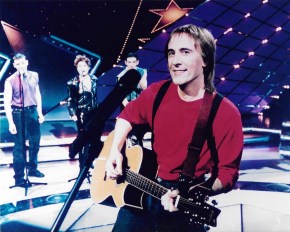
My wife tried to get me to audition for the show for years as I was both a fan and friend of Steve Harley from ‘74-‘77 and she knew I could do a good impersonation of him. I gave in one year when a bloke came on and did Benny Hill. He was atrocious and I thought, ‘Well I can’t do worse than that, pass me the phone’.
wavisstarsintheireyes

Were Wavis and The Hard really closet intellectuals merely poking fun at the absurdity of the world today ? There’s a side of me that very few people know of. One of those facets of the diamond is a very serious, and reasonably well known controversial author, broadcaster, researcher with a sizeable website and a lot of internet coverage. I doubt you’ll know him and only a very few Wavis people do. He’s a cross between a British Indie Jones and Poirot, and that’s the only clue you’ll get. I’ve/he’s been on Sky TV shows a few times, done a lot of USA radio shows and wrote for a high street national monthly mag for a few years.

The full interview with Wavis will be available in the book. The group are now planning to complete the project, but Martin told me there is still time for some bands to come forward…

‘We now have all the interviews in the can but if there are any other North East bands who were active circa 1976-80 who we don’t know about and who’d like to contribute they’re welcome to get in touch’.

Contact: gobonthetyne@hotmail.com

Gary Alikivi    August 2019.

TYNE DOCK BORDERS -stories from the documentary.

11880844_501112830048283_848214020_n

Looking down Slake Terrace, Tyne Dock. Photo by Amy C. Flagg.

It was a cold, damp, windy day. I could hear the foghorn. Looking out the window I didn’t fancy going outside. If it clears up, I’ll go out later. 

First, I’ll have something to eat and listen to the news. I heated up a tin of pea and ham soup and turned the TV on.

Flicking through the channels I came across When the Boat Comes In. Never seen it before but within minutes I’m hooked. The writing was sharp, the story was great and central character Jack Ford, was the man.

Also recognised a few locations around Tyneside so next time in the Local History library I’ll search and see if there is any reference to the program.

There was, not only was the writer, James Mitchell from the North East, he was born in Tyne Dock, South Shields. And this area featured heavily in his and his father’s story, who was also a local councillor for the Tyne Dock ward. 

This was the catalyst for making a documentary about the area. I rang up Jarrow playwright Tom Kelly, we had a get together, threw some ideas around and started work on a script.

Using archive material and personal interviews with people who lived there, we look at the changes made in Tyne Dock. These are short extracts from some of the interviews filmed in 2012.

Tyne Dock Arches….

Kennie Chow: One of the major dare’s that we had was that along the arches was a ledge and above the arches was several little arches which you can get inside. But the only way you could actually get inside was to actually physically shimmy across the ledge.

Stephen Wilson: Used to play in the arches a lot. Was a great playground, very dangerous. We used to climb to the top and go into the little arches at the top. Which were yer access point, you could climb and go down but was quite a big drop. And inside it was chocka block with bricks and rubble.

Sheila Ross: The arches we thought were exciting cos you could get an echo in them. They were long, dark, very dingy. I mean they went for quite a distance. That distance from where Jarrow and Tyne Dock are, is quite a distance.

Paul Freeman: They were quite busy cos they were for taking the railways in and out of the docks. So, the road went through the arches and the railways went over the top, so they were filthy. But as children they were fantastic things to play in.

Olive Pinkney: As you get older you tend to reminisce about when you were young and of course Tyne Dock was a very close-knit community. And the arches were always our familiar focal point. If we had any family come from all over, we used to say you come through the arches and you are at Tyne Dock.

When I retired, I started doing watercolours and painted places of Tyne Dock where I remembered, and the arches was one of the main one’s.

Slake Terrace….

Alex Donaldson: For all the old, dilapidated houses, no bathrooms and outside toilets I think there was still a comradeship, a friendliness about the place. People were very close then, you knew who your neighbours where they were just next door living on top of each other (laughs).

In the ‘60s the River Tyne was still quite as busy as when I lived in Hudson Street. I can remember foreign seaman coming out of the dock’s during the day or later in the evening. They used to board the trolley bus that was stood there. I’ve still got happy memories of old Tyne Dock.

Sheila Ross: But it was all pubs. And they were not pub’s we would go into. Me motha’ wouldn’t even go into them, they were men’s pubs. For the dockers and the sailors who would come from all over the world.

Derek Pinkney: Well, Slake Terrace was one of the busy roads at the edge of Tyne Dock. Actually, it was full of public houses, that was its mainstay. There were pubs like the Green Bar, The Empress Hotel, The Banks of Tyne, The North Eastern. The Grapes which was on the corner of Hudson Street. And then round the corner was The Dock.

The best place where we used to get a good laugh when we were boys was a café called the Café Norge. And it was supposedly a place of ill repute. Because in those days there was lots of Norwegian and Swedish ships used to come into Tyne Dock and the crew’s used to frequent that place.

Paul Freeman: Now if you carried on up Hudson Street you came to another boarded out shop and a house where all these ladies used to live. Me sister Sheila and me used to get pennies off them, they were a lovely set of lasses.

Sheila Ross: So, we used to sit on the step at the bottom of the flat and there was some ladies used to come past, always very nice, give us sixpence each.

Paul Freeman: Just up Dock Street one of the first buildings was the spiritualists.

Sheila Ross: That was a big meeting place on a Saturday night because they used to faint and pass out with all these messages they were getting. And they used to lay them out in the street. Just lay them on the pavements ‘till they come round.

Paul Freeman: You had a right mixture of the one’s that had been talking to the dead and glory to God on high and the other’s stinking of the other spirit’s and beer then you had the other ones who had been looking after more than the spiritual welfare round the corner at the brothel. It was quite a place to be actually.

James Mitchell and When the Boat Comes In….. 

Roz Bailey: I don’t remember meeting him when I was first cast as Sarah Headly. I didn’t think I was going to be in When the Boat Comes In because I remember when they were first casting it, I was going to go up for the part of Jessie. Obviously didn’t get that but a year later my agent rang me up and said there’s a part that they are casting for. I got it but didn’t know how it was going to colour my life.

I remember filming outside The Customs House which is now a theatre it must have been derelict then. They had set it up with the old cobble stones. The characters were so well written by James Mitchell, particularly for the women. Which you don’t often get now. And the attention to detail. Looking at them the great humour in his writing, the calibre of it. Very, very special.

Second Time Around Record Shop…

Alistair Robinson: Shields in the late ‘70s and ‘80s was well off for second hand and collector’s record shops. There was one halfway down Imeary Street in Westoe in the ‘70s, there was the Handy Shop just off Frederick Street in Laygate and there was Second Time Around in Tyne Dock. I didn’t know the guys who run it cos they maybe had a deal somewhere where they could get some quite rare material.

Stewart Cambell: I opened the shop in 1975 until 1985. We sold loads of Jazz in French and German imports. We had big Elvis fans come to the shop, we had imports from the States, Uruguay, most countries. Some people bought the same Elvis album with five different covers.

Tyne Dock Youth Club…

Stephen Wilson: We would play on the railway line from Tyne Dock until it crossed Eldon Street, then all the way up to Trinity High Shields. We played in the old shed’s when it closed down. We used to walk along the lines and play on the lines behind Tyne Dock Youth Club. We used to put screws, nuts and bolts, two pences on the lines and when the trains went past, they flattened them.

Kennie Chow: Tyne Dock Youth Club was a massive part of my life. Through personal reasons my family were split up at the time and I managed to join the youth club and I must have spent about 10 years of my life there. It really helped us pull through the bad times I was going through, and I became club DJ.

Paul Dix: I was a bit nervous coming to the club, but we were welcomed by Jack and Betty Inkster who ran the club then. We knew Kennie he was a great lad, he done the club discos.

I think the French trip was one of the biggest things that the club had done for years. We went in the minibus and piled it with kid’s, tents and sleeping bags and as many tins of beans and sausages as you can get in the back of a van.  Drove off down the motorway, down to Dover and on the ferry. We drove from the top of France through to Paris and Jack was using his cine camera and documenting the whole of the trip from start to finish.

Jack and Betty on the trip were fantastic. They done everything for us, Jack helping putting the tents up and Betty all those sausages and beans. We washed up and everybody chipped in. When you look back at the cine footage you can see how great a care they took of the kids. It was a real privilege to have been on that trip.

DVD copies of Tyne Dock Borders (70mins £10) are available to buy from The Word, South Shields. A short version is available to watch on the ALIKIVI You Tube channel.

Gary Alikivi    August 2019.

WAR STORIES – experiences of World War Two on Tyneside

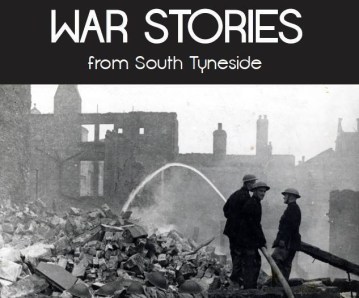
During spring 2012, Jarrow playwright Tom Kelly and I made a short film about the impact of World War Two on South Tyneside, North East England.

Using archive material and personal interviews we revisited the past and spoke with people who shared their memories and experiences of war. These extracts are taken from some of the interviews.

12004062_975203375871747_1592481803776567623_n

Photograph by Amy C. Flagg

In the air raid shelters….

Doreen Purvis: My cousin Anne who was 3 or 4 year old used to insist on being taken outside to look at the stars in the middle of bombs dropping around and German planes overhead. This child would have to be taken to the door of the shelter and shown the stars to stop her crying.

Derek Hutchinson: We were all sitting in the air raid shelter and the bombs were coming down and everybody’s ducking from the bomb blasts, but I’m rubbing my hand’s thinking well if this air raid goes on after 3 o’clock I won’t have to go to school. If it stay’s this side of 3 o’clock I’ll have to go to school.

Doris Johnson: I was at the Glebe Church and the siren went. So my friend Jean and I decided we’d run home to Hyde Street just a short distance away. So we ran and went into our respective homes and my parents said we would go into the shelter. My neighbour called out to me did I have anything to read. So I ran round into my neighbours shelter and the man of the house moved to let me sit down.

Then the bombs started to fall and I was blown out of the doorway. My mam and dad who I loved dearly, were killed. My dad was found later that night, then died. But my mam didn’t survive at all. That was a day, a night, that I’ll never ever forget.

Derek Hutchinson: The last bomb of the raid was a whoosh, then a (whistle noise) louder and louder. Louder than I’ve ever heard before and then…bam. The wall’s of the shelter shook, the ceiling shook, bit’s of dust came down, the candle fell of it’s rack and went out. Then the all clear went.

So we clambered out the back door, forced it open cos there was stones in front, the air raid shelter was actually in the backyard. We went through the house, through the kitchen, as we walked along the passage a big wall of dust came along the passage. When we finally got to the front door it was leaning off it’s hinges.

Outside where there had been houses there was now a hole. It was a bomb crater, they had bombed our street and six houses had gone. We went into our front room and on the mantelpiece were two ornaments, very delicate. My grandmother’s pride and joy. She was really horrified ‘Oh my God, my ornaments’. She was clutching the ornaments saying they were alright ‘apart from a little strap on one of them was broken by Hitler’.

So these figures survived the war and I went on the Antiques Roadshow with them and I showed them a picture of the bombing which was horrifying. He valued them which wasn’t very much and then said ‘Well you know why they survived don’t you’. I said I had no idea. Well he said ‘They are made in Germany. If you look on the bottom you can see the makers mark’.

Maureen McLaughlin: We were at school and the teachers were trying to persuade everybody to go onto evacuation. But I didn’t want to go and leave my mam cos I was the only daughter and just had one brother. But my friends were all going so I said yes I’ll go.

They gave us a list to get, my mother had a job to get them because you had coupons. I had to have new pyjamas, jumper, skirt, shoes, wellies, slippers, yer case had to be full of these new things. But when it came to going I wouldn’t go, I started crying so she took me home.

Memories of food rationing…

Doris Johnson: My dad was a grocer and food started to get scarcer, you got your ration book and you had to abide by that. There were queues for anything which wasn’t rationed. Then sweets were rationed you were very lucky if a shop had a bar of chocolate in.

Maureen McLaughlin: I’ve been asked where you hungry during the war well I wasn’t as the rations were enough for us. Then again if we were short of butter or sugar some of these people in the street with big families would sell you their coupons. You’d take it to the corner shop and they’d sell you the butter, sugar, meat or cheese.

Doreen Purvis: In those day’s everybody took two or three spoonful’s of sugar in their tea so sugar was a very precious commodity. My mother said a cup of tea got knocked over into a sugar bowl and they were so concerned that they actually dried the sugar out on the top of the stove so they could use it again.

Dave Bell: During the war when there were shortages my Granda loved pea’s pudding and found out there was some available in Ferry Street in Jarrow. Now he lived in Nixon Street which is two or three street’s away and he sent my Aunt Joyce, his youngest daughter to go and get him a bowl of this pea’s pudding.

Well she got it and coming back she was just crossing the square in front of the Empire cinema when a dog fight broke out overhead. A German plane was being attacked by a spitfire and the two of them were swirling about and opened fire.

As the bullets were overhead, in fear she threw herself down onto the cobbles and the pea’s pudding went flying amongst all the horse muck. So that was the finish of me Granda’s pea’s pudding.

Picking up shrapnel…

Maureen McLaughlin: We used to go around in the morning after the air raids had been, that was our past time. All the young ‘uns hunting for bit’s of shrapnel in the street’s. We all had a tin and collected bit’s of shrapnel to see who had got the most, bit’s of bombs and aeroplane an’ that.

Derek Hutchinson: Of course it really was called looting. All the thing’s we picked up off the bombed street’s had presumably belonged to somebody. We had photographs and ornaments, it was stealing but we didn’t know. So a lot of my time was spent running away from long legged policemen.

Doreen Purvis: My Grandmother lived in Thornton Avenue just beside the dock gates and of course there was lot’s of bombing raids during that time. Under the cover of the bombing the docker’s would often liberate various items from the docks, climb over the wall with them and stash them in my Grandmothers house. Usually as a reward she might get a bottle of whiskey or something similar.

One night a German war plane came down over the South Marine Park and lake in South Shields…..

Bob Robertson: My parents then lived in Eleanor Street. One of the plane’s I believe came down in one of the parks. But on it’s way it jettisoned two or three 500lb bombs and did an awful lot of damage.

Derek Hutchinson: A plane flew very close overhead on fire. It crashed at the right hand side at the bottom of Beach Road and blew up. Killed the airmen, blew down the building that houses the little boats. And just created mayhem.

If you could grapple in the lake with bent coat hanger’s and pull something out with German writing on this was a swappable article – well I pulled out a flying boot. ‘I’ve got a flying boot’ I shouted’. So they all came running along ‘Hey that’s great’. Then I put my hand inside the flying boot and pulled out what appeared to be cooked tripe. This wobbly, jellified, whitey creamy skin.

Of course it was the poor man’s foot – it had been blown off. ‘You’ll never do any swaps with that it’ll stink. Chuck it back in’ they said. So I threw it back in the lake.

Doreen Purvis: The radio was a great source of information during the war but the Germans also used it for propaganda purposes. And there was a broadcaster called Lord Haw-Haw who used to home in when there had been a raid the night before.

On one occasion he was talking about South Shields and he was talking about people in the ruins of their houses starving to death, well just at that point me Grandma was dishing up stew. So she thrust a plate of stew in front of the radio and said have a smell of that ya’ bugga’.

I am looking to add to these stories so if anyone would like to share their experience of that time just get in touch at     garyalikivi@yahoo.com

A short version of the film is available on the ALIKIVI You Tube channel.

 Gary Alikivi   August 2019.

ZAMYATIN The Russia – Tyneside Connection film research & script

On the 7th & 21st August 2018 research for a short film about Yevgeny Zamyatin (1884-1937) is featured on this blog. On today’s post I’ve added the script from the film I made about his life.

The narrators were North East actor’s Iain Cunningham and Jonathan Cash. Recorded by Martin Francis Trollope at Customs Space studio in South Shields and excellent soundtrack from North East musician John Clavering.

Yevgeny Ivanovich Zamyatin

Start.

Russian born Yevgeny Zamyatin lived with his wife in Paris until his death in March 1937. Their last few years were lived in poverty and only a small group of friends were present at his burial. His death was not mentioned in the Soviet press.

Zamyatin was an author of science fiction and political satire. Famous for his 1921 novel ’We’ – a story set in a dystopian future – the book was banned in Russia. In his novel ‘1984’ George Orwell acknowledged his debt to Zamyatin.

But how does Tyneside fit in this story ?

Zamyatin was born in a small town 200 miles south of Moscow on 19th January 1884. He had an educated middle-class background, his father was a teacher and his mother a musician.

Zamyatin studied Naval engineering at the St Petersburg Polytechnic Institute. He spent winters in the city and summers enjoying practical work in shipyards and at sea. The Middle East being one destination – a rich experience for the future writer.

He was a supporter of the revolution and joined the Bolsheviks, attending demonstrations and meetings. But he was arrested during the 1905 Revolution – for this he was sent to prison for several months. His time there was spent learning shorthand and writing poems.

He completed his course in Naval Engineering and was employed as a college tutor. He was also writing short stories and essays – his first published in 1908. Zamyatin immersed himself in the bohemian life of St Petersburg and was an important part of the cultural scene in Russia.

At the time of the First World War Russia were having ice breakers built in UK shipyards. Zamyatin was sent to North East England in 1916 to work as a Naval engineer for the Russian Empire.

He supervised the construction of the ships on the River Tyne. While there he lived in Jesmond near Newcastle and during his eighteen months stay, he was reported to travel around Tyneside and improve his knowledge of the language.

“In England I built icebreakers in Glasgow, Newcastle, Sunderland, South Shields, and looked at ruined castles. The Germans showered us with bombs from airplanes. I listened to the thud of bombs dropped by Zeppelins”.

ophn16w copy

Laurence O’Shaughnessy lived in South Shields and worked there as Customs Collector on the River Tyne. His daughter Eileen married the author, George Orwell. Was there a connection to Zamyatin ? Leslie Hurst from The Orwell Society looked at the possibility.

‘Would the Russian ships have been checked by customs before leaving the Tyne ? When Orwell learned of the existence of ‘We’ he might have discussed it with Eileen and heard her say that her father had met its author. When Orwell died, Eileen’s library was found mixed with his.

Might Eileen have read Orwell’s copy of ’25 Years of Soviet Russian Literature’  and mentioned the Russian engineer who visited South Shields in her childhood? It is an intriguing possibility’.

When living on Tyneside, Zamyatin wrote two short stories ’The Fisher of Men’ and ’Islanders’. After a day at the shipyards, he would sit at his desk and write about the blinkered and pretentious world of the middle class.

‘By Sunday the stone steps of the houses in Jesmond had as usual been scrubbed to a dazzling whiteness, like the Sunday gentlemen’s false teeth.

The Sunday gentlemen were of course manufactured at a factory in Jesmond, and thousands of copies appeared on the streets. Carrying identical canes and wearing identical top hats, the respectable Sunday gentlemen in their false teeth strolled down the street and greeted their doubles’.

Both stories were published on his return to Russia. But by then, the 1917 revolution was burning. He regretted not witnessing the start of it.

“I returned to Petersburg, past German submarines, in a ship with lights out, wearing a life belt the whole time. This is the same as never having been in love and waking up one morning already married for ten years or so”.

The famine, war and economic collapse of the country had a major influence on his literary career.

“If I had not returned home, if I had not spent all these years with Russia, I don’t think I would have been able to write anymore. True literature can only exist when it is created, not by diligent and reliable officials, but by madmen, hermits, heretics, dreamers, rebels and skeptics”.

In 1921, ‘We’ became the first work banned by the Soviet censorship board. In 1923, he arranged for the manuscript to be smuggled to a publisher in New York. After being translated into English the novel was published.

With his political satire, a number of essays that criticised the Communist ideology and dealing with Western publishers, Zamyatin has been referred to as one of the first Soviet dissidents. As a result, he was blacklisted from publishing anything in his homeland.

The English writer Harold Heslop had seven books published and his first was in the Soviet Union. In 1930 he was invited to the Ukraine to speak at the Revolutionary Writers Conference. While there he also travelled to Leningrad to meet Zamyatin who he wanted to help promote his latest book.

Harold was born in Durham but for many years lived in South Shields. He was a miner at Harton Colliery before winning a scholarship to Central Labour College in London.

 (Zamyatin to Heslop) “I cannot quite place you. Are you a Geordie may I ask. I catch the Tyneside dialect in your speech. Am I right ? I know Tyneside well. I liked the people very much. I also liked their strange, musical dialect.

Often, I found it most amusing. South Shields… Sooth Sheels! I never learned to sing the Tyneside speech!”

Zamyatin read lectures on Russian literature, served on boards with some of the most famous figures in Russian literature, but by 1931 he was experiencing difficulties.

Under the ever-tightening censorship and becoming unpopular with critics who branded him a traitor, he appealed directly to Joseph Stalin requesting permission to leave the Soviet Union – a voluntary exile.

“I do not wish to conceal that the basic reason for my request for permission to go abroad with my wife is my hopeless position here as a writer, the death sentence that has been pronounced upon me as a writer here at home”.

Eventually Stalin agreed to Zamyatin’s request, and he and his wife left for Paris, where there was already a small Russian community.

While there he wrote new stories, most of his earlier work was translated around Europe, but a notable piece of work was his co-writing of a film with French director Jean Renoir.

Just before his death he had told a friend…“I had to leave Soviet Russia as a dangerous counter revolutionary and abroad I hesitate to approach the Russian community, while they treat me coldly and suspiciously”.

He lived out his last years with his wife until his death from a heart attack in 1937, and a final resting place for Zamyatin can be found in a cemetery south of Paris.

End.

Research:

Zamyatin – A Soviet Heretic by D.J. Richards.

Islanders/The Fishers of Men – Salamander press Fiction.

We – Yvegney Zamyatin.

Out of the Old Earth – Harold Heslop.

 Gary Alikivi  2018.

RUSSIA’S GEORDIE SPY with author & TV researcher Vin Arthey

Searching your family history can throw up a few surprises. My Great Uncle Alexander Allikivi was born in Russia at a time of political and social unrest resulting in two revolutions, the abolition of the monarchy and the establishment of the Soviet Union by the Bolsheviks. Have you ever wondered why some awkward people are called bolshy ? Was it Bolshy Alex ? A name passed round the family so who knows. 

Little is known about the life of Allikivi pictured below. He lived in South Shields during the ‘20s married my Great Aunt Lavinia Ewart and died in 1933. We know he received two Mercantile Marine and British Medal ribbons by 1921, where these from the First World War? Did he first arrive in the UK between 1914-18 and why did he leave Russia ? Was it because of the revolution?

In the search for some clues I read the excellent book The Kremlin’s Geordie Spy the story about father and son Heinrich and William Fisher by Vin Arthey.

Heinrich was born in Russia in 1871 and William was born in 1903 in Newcastle. In 1921 the Fishers were in Moscow. The Spielberg film Bridge of Spies starring Tom Hanks features what happened to William.

Reading Vin’s book I came across this…

’He (Heinrich Fischer) maintained all his political links. He remained a member of the Russian Socialist Democratic Workers Party and in UK politics aligned himself with the Social Democratic Federation members who seceded to found the British Socialist Party, working for the party south of the Tyne, in South Shields, rather than in Newcastle’.

Was Allikivi involved in politics? Were other Russians attending the meetings in South Shields and would he be attracted to gatherings with people who spoke the same language as him? He would look forward to having conversations rather than using a few words or short phrases when meeting friends and family.

Edinburgh-based author Vin Arthey on Fri 12 January 2018.

Vin Arthey photograph by Andy Catlin.

I decided to contact Vin and asked him what was the inspiration behind writing ‘The Kremlin’s Geordie Spy’ ?

When I was freelancing in the ‘90s I was offered an Associate Producer role by Trevor Hearing who’d just had his series, Stranger Than Fiction commissioned by Tyne Tees TV.

This was a series of six half-hour dramas and drama documentaries covering true regional stories such as those of the Darlington MP who turned out to be an international outlaw and leader of an obscure Chinese cult, and the Newcastle auction mart owner and television hypnotist who was jailed for swindling his mother out of thousands of pounds.

Also, the County Durham relief bank manager who correctly foretold that his bank would be robbed and that he would be killed during the robbery.

Another story I researched was of Newcastle born William Fisher who turned out to be a KGB spy, used the name Rudolf Abel and was jailed for espionage in the United States in 1957. Five year later he was exchanged across Berlin’s Glienicke Bridge for the American U-2 pilot, Francis Gary Powers.

Fisher’s birth in Newcastle had been ascertained by Newcastle University historian David Saunders, and I had a number of meetings with David during the pre-production phase.

Trevor Hearing and I were convinced that the story was worthy of a network production, but it was turned down by BBC 2’s Timewatch and Channel 4’s Secret History. However, I kept on researching and writing, because I was absolutely hooked by the story.

You see, I could remember when I was 12 year old watching the news story on my family’s first, rented, TV set, of the KGB spy Rudolf Abel, who was arrested, tried and jailed in New York in 1957. The Cold War was very real to me as a teenager in East Anglia.

My home was close to a number of United States airbases, and there were regular sightings of USAF Sabre, Phantom and Voodoo jet fighters and fighter-bombers.

I remember well the shooting down over the Soviet Union in May 1960 of Gary Powers high flying ‘weather reconnaissance’ aircraft, the ‘U-2’.

As one of our teachers put it the day the news broke, ‘Awfully high weather we’re having these days,’.  Also I was still at school when the famous exchange of Powers and Abel took place.

You might imagine my excitement when I discovered that the Soviet spy at the centre of perhaps the greatest Cold War drama, the man who featured so strikingly in my school years, was a British subject, Newcastle born, at that. I couldn’t let the story go, and when I was approached by St Ermin’s Press to write a book I jumped at the chance.

St Ermin’s published it as a hardback with the title Like Father Like Son: A Dynasty of Spies. Later, Biteback Publishing bought the paperback rights and repackaged it as The Kremlin’s Geordie Spy: The Man They Swapped for Gary Powers.

When the Spielberg movie Bridge of Spies was released in 2015, Biteback reprinted with yet another title, Abel: The True Story of the Spy They Traded for Gary Powers.

Did you do any readings or tour with the book ?

The book or should I say books! have been well received, although I have to be realistic – Fisher was our enemy during the Cold War, a villain of the piece – a villain of the peace even!

Over the last dozen years I’ve given talks on the Fisher story in various places and at a range of venues in Newcastle, North Shields, South Shields, Middlesbrough, Edinburgh, Reading, and there has been great interest in the United States, where the books have been reviewed for the CIA’s ‘Intelligence Officer’s Bookshelf’.

I visited the USA for research and subsequently got to speak at the Brooklyn Historical Society and at the International Spy Museum in Washington DC.

What is your background Vin ?

I was born, brought up and spent my early adult years in Ipswich, and although most of my life has now been spent in the North of England and in Scotland, I still regard myself as an East Anglian.

I follow Ipswich Town football team through thick and thin – thin at the moment as we’ve just been relegated to what I still call the Third Division, and our arch rivals Norwich City have just made it back to the Premiership.

I’ve had a dual career, in education and the media, teaching in schools and a college of education then, when the birth rate dropped and the colleges were closing and merging, I was at Newcastle Polytechnic where I taught drama and media studies.

While this was happening, I started freelance scripting and reviewing for BBC Radio Newcastle and Tyne Tees. In the early ‘80s an opportunity arose to work fulltime at Tyne Tees, so I took it.

Researching and producing across the whole range of the station’s output – current affairs, religious programmes, comedy, arts and features.

I went freelance again in the mid ‘90s, but at the end of the decade went back into university teaching and to heading up the TV Production degrees at Teesside University.

Now, I’m settled in Edinburgh and supplement my pension with income from writing and speaking.

What are you working on now ?

I review books about espionage, the Cold War and Russia for newspapers The Scotsman and Scotland on Sunday. I’ve just finished a piece of ghost writing – a privately commissioned piece for a retired hydroelectric power engineer, and I’m currently clearing my desk, and my head with a view to tackling a new book – still nonfiction, but still under wraps.

To hear from Vin check this link to an interview with Spy historian Vince Houghton at Spycast

https://www.spymuseum.org/multimedia/spycast/episode/the-real-story-of-rudolph-abel-an-interview-with-vin-arthey/

As for my Great Uncle from Russia, Alexander Allikivi, I am still searching for some answers.

Interview by Gary Alikivi   July 2019

WILDFLOWER – South Shields born Eileen O’Shaughnessy 1905-45 timeline.

SEPT 25 1905 copy

In October 2018 I wrote about making a documentary on George Orwell’s first wife Eileen O’Shaughnessy. The short film had a real local interest as Eileen was born just two  minutes from where I live.

Little did I know when I started the search in 2012 that the film would be shown to the Orwell Society and Richard Blair, son of George Orwell, on the Isle of Jura where Orwell wrote the dystopian classic, Nineteen Eighty Four.

Timeline research 2012-13:

In a graveyard in Newcastle, you will find a headstone for Eileen Maud Blair who was married to George Orwell (real name Eric Blair), arguably one of the most controversial writers of the 20th century.

Books included The Road to Wigan Pier (1937), Homage to Catalonia (1938), Animal Farm (1945) and Nineteen Eighty Four (1949).

But who was Eileen?

Eileen’s story starts in Ireland where her father, Laurence O’Shaughnessey, was born in 1866 on the small island of Valencia and Portmagee in County Kerry. His father, Edward O’Shaughnessy was employed in the Royal Irish Constabulary.

Aged 25, Laurence moved to England and boarded at 19 East India Dock Road, Limehouse in London and found work as a clerk for His Majesty Customs.

Eileen’s mother Mary Westgate was born in 1866 in Hempnall, Norfolk, at 24, Mary moved south to Greenwich in London and worked as an Assistant Teacher at Lewisham Hill Road School.

Laurence and Mary met and eventually married in Holy Trinity Church, Gravesend, Kent in February 1900. The couple then travelled to the North East and made a home at 109 Cleveland Road next to the Union Workhouse in Sunderland.

Laurence continued working as a Tax Clerk for HM Customs at Custom House, based at 138 High Street, Sunderland. In 1901 they had a son Laurence who went on to become a distinguished Medical Surgeon.

Six years later the family moved to 3 Park Terrace (re-named Lawe Road) South Shields and Laurence senior was employed as Port Administrator, Collector of His Majesties Customs and had an office in Midland Bank Chambers, 65 King Street, South Shields.

Then on 25th September 1905, Eileen Maud O’Shaughnessey was born and baptised on 15th November in St Aiden’s Church.

After a short time, the family moved to 2 and a half Wellington Terrace, now known as Beach Road. They called the house ‘Westgate House’ after her mother’s maiden name and it’s still visible above the front door of 35 Beach Road.

Eileen was educated at the local Westoe School then attended Sunderland Church High School and finally in 1924 the family moved south when Eileen graduated to read English at St Hugh’s College in Oxford. Sadly, Eileen’s father Laurence died not long after, he was 62 years old.

After leaving education Eileen held various jobs including work as an English teacher and purchased a small secretarial agency. But she returned to education in 1934 for a Masters degree in Educational Psychology at the University College in London.

By 1935 Eileen was a graduate student and living with her widowed mother in Greenwich. One night she was invited to a house party at 77 Parliament Hill in Hampstead where she met the journalist and author George Orwell, real name Eric Blair.

Eric was born on 25th June 1903 in India. The Blair family had returned to the UK, settled in Oxfordshire and Eric received a scholarship to Eton College.

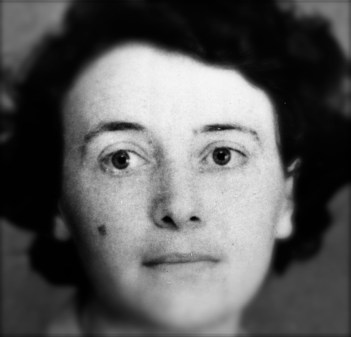
Over the months the couple found they had a great deal in common, a passion for poetry, literature and countryside walks. Eric was attracted to Eileen’s blue eyes, heart shaped face and wavy dark brown hair, her Irish looking features.

They married at Wallington Parish Church in Hertfordshire on the 9th of June 1936 and lived at The Stores, 2 Kits Lane, Wallington.

In Europe, a Civil war had broken out in Spain and in 1936 Eileen’s husband travelled to Barcelona and joined the militia of the Workers Party of Marxist Unification. Orwell wanted to help the revolt against Franco and the Fascists.

Eileen followed in early ‘37 where she stayed in the Hotel Continental on the Ramblas in Barcelona. She worked as a secretary for the New Leader which was a newspaper for the Independent Labour Party.

The party’s General Secretary was John McNair from Tyneside. Orwell was stationed at the front and in battle was shot through the throat. He recuperated in a sanatorium outside Barcelona.

The couple returned to the UK and by 1939 Eileen worked at the Censorship Department of the Ministry of Information. For a time, they lived with her brother Laurence and her sister-in-law Gwen, at their home in Greenwich Park.

Orwell worked at the Empire Department of the BBC as head of cultural programming for India and South East Asia. Unfortunately, during the Second World War Eileen’s brother was killed at Dunkirk while serving in the Army Medical Corp, and her mother died a year later – this was a very sad time for Eileen.

But good news was on the way as Eileen and George adopted a baby boy and named him Richard. Eileen by now had given up her job at the Ministry and taken well to motherhood. Orwell began writing ‘Animal Farm’.

Growing tired of London and feeling unwell for the last few months, Eileen travelled back to the North East with their son, Richard. They stayed with her sister-in-law Gwen at her home near Stockton and with the Second World War nearing its end Orwell was in Germany working as a War Correspondent.

Harvey Evers was a surgeon friend of her brother Laurence, he had a private clinic at Fernwood House in Newcastle a train ride away from where she was staying.

Eileen made an appointment to see him but after the examination tumours were found on her uterus and a hysterectomy operation was arranged for 29th March 1945.

Before the operation Eileen was aware that she might not survive and wrote long letters to Orwell. Sadly, under the anaesthetic Eileen died. Aged only 39, Eileen was buried on 3rd April in St Andrews Cemetery, Newcastle.

With Eileen’s death a deep sense of loneliness overwhelmed Orwell. He put off a return to the family home and went back to Germany to report on the end of the Second World War. Close friends looked after his son Richard at their flat in Canonbury Square, London.

His novel, Animal Farm was published in the summer and in it he credited Eileen with helping to plan the book. In May 1946 Orwell rented Barnhill, a farmhouse on the remote island of Jura in Scotland and wrote Nineteen Eighty Four, the book was published in 1949.

Sadly, on 21st January 1950 George Orwell died of tuberculosis in London aged 46. He is buried in the churchyard of All Saints in Sutton Courtenay, Oxfordshire.

Sources: George Orwell biographies by Gordon Bowker and Scott Lucas. Family history research on Ancestry website. Local Studies in South Shields, Newcastle and Sunderland City Libraries.

Thanks to David Harland present owner of Westgate House, South Shields.

 Gary Alikivi.

SECRETS & LIES – script of the film based on the life of Baron Avro Manhattan

A5

Sometimes it feels like they find you. I was in the local studies department of South Shields Library flicking through files containing information about local personalities and subjects of the North East.

I was looking for South Shields born Eileen O’Shaughnessy, as I was making a documentary about her life with the author George Orwell.

The files are in alphabetical order and before the O’s I landed on the M’s. I came across a file labelled Manhattan and thought that was a strange name to be connected to Tyneside.

From all the research that followed I wrote a script for the film Secrets & Lies (below). A blog in July 2018 adds details on how I put the film together.

If you want to check out the 12 min film, go to my You Tube channel at

https://www.youtube.com/watch?v=AITGzGiC-yU


START

Secrets & Lies

Have you heard about the devil having the best tunes ? Well, he also has the best stories. This is a story about my journey, my obsession… my destiny. You could say it was written in the stars.

It was 1990 when I died at our home in South Shields, my friends had a service for me at the local church, and they buried me in a cemetery in Durham. In my will I left over half a million pounds, with bank accounts in London, Switzerland and California.

I also had a few titles to my name, including a Baron and Knights Templar. I was an accomplished writer and artist; I have authored over 30 books. My first was published in 1934. My close friends included other artists, poets and a Princess. I had property in London and Spain and a plot of land in the Bahamas.

So, I hear you ask, why end my days in a small terraced house in a seaside town? Let me explain.

My name is Avro Manhattan I was born in Italy on 6th April 1910. My parents were wealthy and we travelled around Europe. I was educated at the Sorbonne in Paris, where as a student I met the artist, Picasso.

This was a great time in my formative years, I used to get, what I called little explosions in my head, idea’s, sounds and colours just popping in, and I knew I had to do something with them.

So in the 1930’s when I went back to Italy and rented an art studio at Lake Maggiore I started to put my idea’s down on canvas. But while there the authorities told me that I had to serve in Mussolini’s fascist army, I refused, so they put me in jail.

While imprisoned in the Alps I didn’t waste my time, in my small prison cell I learned to harness my little explosions and wrote a book on astronomy, a subject I was getting really interested in.

They say prison can break some people, but not me, after the experience it made me more determined to make something of my life. I left Italy behind and went to London.

During World War II, I worked in radio and was broadcasting to occupied Europe and also wrote political commentaries for the BBC, for this service two things happened, the British awarded me a Knight of Malta, and the Nazi’s put a price on my head. A feeling that would follow me all through my life, the feeling of dodging a bullet.

While in the UK I was living between London and the North East, where I was invited to important functions, foreign embassies, and film premiers. I worked with HG Wells and helped draw up a bill of human rights. I met with Ian Paisley, the loyalist politician from Northern Ireland.

I held an art exhibition on the riverside in South Shields attended by the very flamboyant son of the Marquis of Bath. The Viscount bought two of my paintings, but he confessed his only ambition was to try Newcastle Brown Ale.

I met Dr Thomas Paine, the head of NASA. As I’ve said it was a subject I was really interested in and became a passion of mine, I was very interested in space and what else was out there in our universe.

I was a very good friend with the scientist Marie Stopes. She had just read my latest book and came to an exhibition of some of my paintings in London. We got on well and our friendship grew, there were strong rumours of a love affair.  At the time I was thirty-nine, she was 72.

But my little explosions kept me really busy and by now my main work was writing. I talk of the obscenity of some very wealthy world organisations co-existing with poverty.

My titles deal with topical issues and are controversial; they deal with current religious and political problems affecting the USA and the Western world.

I researched the subjects thoroughly and my style is not to be judge or jury; but to be the prosecuting counsel. In the ‘Vatican Moscow Washington Alliance’ I talked with the Yugoslav General, Milkovich, himself an opponent of Nazism and Communism.

During research I came across a story of a squadron of bombers planning to flatten the Vatican, this was foiled only 24 hours before the attack was to take place.

Revealing this brought me many readers across the world, but also many enemies. Ozark Books, one of my publishers, said I risked my life daily to expose some of the darkest secrets of the Papacy.

Many of my books have been translated into a number of languages from French, German and Spanish, to Hebrew, Czech and Russian.

‘The Vatican in World Politics’ ran to fifty editions. One review said that a copy of ‘The Vatican’s Holocaust’ was hurled across St Pauls Cathedral in London, the book was criticised, condemned, banned, destroyed and even burned as frequently as it has been recommended and praised in many parts of the world.

In 1983 Chick Publications in America published ‘The Vatican Billions’ where I explain how the popes stole the wealth of the world through the centuries. I expose the incredible tricks played on kings, and papal involvement with the Bolsheviks. I reveal the story of how millions are missing from the Vatican Bank, the suicide of the banker Calvi under a London Bridge, and the jailed Vatican Bankers.

As I’ve said the subject matter of my writing had brought me many readers across the world but also people who would like to see me silenced.

In 1986 I was in America to deliver a speech and promote my book ‘The Vatican’s Holocaust’ when I was caught in the cross hairs of one organisation. The Ustasha was a revolutionary movement from Croatia, they specialised in the assassination of prominent people.

After my speech I was standing at the bar when I was approached by a man, and he whispered to me in a matter-of-fact tone of voice “I came to the convention to kill you”. He departed as other people came up to me for signed copies of my book.

One of these men was my bodyguard and when I told him of the incident he froze and told me that he recognised him as one of the most ruthless Usthasa killers. Something had changed his mind; you could say I had dodged a bullet – again.

But the love of my life and best friend was Anne Cunningham – Brown. She was very loving, caring and kind. We were never apart for more than a few days, it was like we were meant to be together.

I first met Anne at a cocktail party in London in 1963; she worked in a hospital there. She was originally from Shotley Bridge, a small town in the North East but her mother was living on the coast in South Shields and Anne invited me up there.

I was greatly surprised by it – especially the beauty of the parks and the seafront. It is a real pleasure to be able to look out and see the horizon. It is where I can work in peace and quiet, or just sit in the house that my dear wife decorated, with its heavy drapes, antiques, cherub figures and a piano in the corner, all very bohemian. Some days I just take our dog for a walk, buy fish and chips, and sip Newcastle Brown Ale.

I remember during the 1970’s Anne was commuting to work at a hospital in London. I used to phone and write to her.  

‘Dearest Love, I miss you very much after you left last week the house seemed so empty. It was a strange sense of absence and void. Which proves that when I’m near you I love you very much, and that you are part of my life and work. I love to hear your voice on the telephone. Somehow it completes my day’.

registry office nov 86

We were together nearly 30 years, and our life was fantastic, we loved to holiday, especially in the United States. We spent time in Los Angeles, California and Utah with its beautiful canyons.

From time to time, we stayed in Kensington and sometimes fly over to our flat in Sitges in Spain but lived mostly in South Shields.

We used to go to the local theatre and enjoy watching the shows and regularly hosted dinner parties and barbecues. As a couple we were always together, when my dear wife died in 2008, she was buried with me.

But there was a time in my life when I took a break from writing as I felt I had put myself under so much pressure with the amount of research I was doing plus trying to meet deadlines, it all got too much and I needed to stop, or at least slow down.

Anne gave me guidance, extra confidence in my writing, but I felt the work was getting to me, the stories that I was finding out and revealing to my readers were suffocating me, at times I felt that I couldn’t breathe.

I was carrying important information around with me, and it was getting heavier. It felt like my head was going to explode.

Ann was very worried about the effect it was having on my health, I always said it was the nurse in her, wanting to take care of me. I really needed to take a vacation, and recharge my batteries, but I felt compelled to look further, to progress and soak up more of the stories then let my readers know what is going on in the world around us.

I really felt I was doing the right thing by exposing all these secrets and lies.

A38

Since coming to Britain 40 years ago, I had been working on a book about an imaginary god invented by primitive man to give himself courage and hope in his struggle for survival, The Dawn of Man is better than the garden of Eden….my hero, Azor is better than Adam.

I talk about how a new world will emerge, and the start of a brighter future for mankind. I thought it was my finest work so I got in touch with Lyle Stuart one of my publishers in the USA asking if he would like to release it.

But the irony was that as soon as it was ready, to my surprise I had a heart attack on my 75th birthday. After a short stay in hospital, I made a recovery and was straight back to work, and we released the book.

To say the least, Anne was very disappointed in me putting my work, my passion ahead of my health. It will kill you in the end she used to say.

I was still working to my last days, I was planning a new book and my research was leading to a links with The Vatican, the CIA, and murders of very prominent people in the western world.

This was a conspiracy which would shake the foundations of these organisations. There is no proof – yet. But the truth will come out in the end, believe me my friend. Someday it will be known.

So that’s it, that’s my story. I ended my days here in South Shields where I produced my best work living close to the sea and where I could see the stars more clearly.

END.

That’s it, for now.  A story of a fascinating character who ended his days in a small seaside town. The research is on-going and new information has come to light.

Part two of his story is being written revealing more about the man who called himself Baron Avro Manhattan.

Further reading about Manhattan on earlier blogs:

https://garyalikivi.com/2018/07/17/secrets-lies-documentary-based-on-the-life-of-baron-avro-manhattan/

https://garyalikivi.com/2018/08/13/secrets-lies-new-documentary-about-baron-avro-manhattan/

Gary Alikivi  2019.
WESTOE ROSE – The story of Amy Flagg, South Shields Historian & Photographer 1893-1965

STH0001974

Research and script I wrote for the 2016 documentary ‘Westoe Rose’.

Amy Flagg is fondly remembered as the lady in a hat and trench coat, who quietly went about photographing buildings and recording the history of a town she loved. But who was Amy ?

This is a story of courage and determination of a very unique woman who captured some of the most devastating images of South Shields in the 20th century.

At the end of the nineteenth century the North East was the industrial heartland of the UK. Collieries, Shipyards and Steelworks covered the landscape. Small villages dotted around the area offered their residents some clear breathing space away from the hazy smog of the town.

Westoe Village in South Shields was home to many notable people of the town. The shipbuilding family the Readheads, Robert Ingham MP, and in Chapel House was the Flagg family. In this grand 20 roomed house was Ambrose, his wife Annie and their only child Amy who was born on 30th of September 1893.

Amy’s father originally came from South London, and was educated at Cambridge University. In 1889 he married Annie Broughton of Westoe and was appointed Headmaster of the Marine School in the town.

He was also member of the Ancient Vestry of St Hilda’s where he rubbed shoulders with influential people. He arranged for Amy’s private education.

The young Amy had a brief romance with a neighbour in the Village but sadly like many men from the town he went to fight in the First World War and never returned, throughout the rest of her life she never married.

There is no record of her being employed so what did she do with her education ? This was a time when women had just fought for the vote, was she involved in the Suffragette movement ? Reports describe Amy as a shy, quiet and gentle woman willing to help others.

There is accounts of her spending hours in the garden of Chapel House and having an active role volunteering in the local hospital and library. Whether helping someone find information about the town or reading to a patient in hospital, was Amy now becoming aware of her surroundings and her purpose in life ?

By 1930 she was a member of the local photographic society. At a time when only a few female photographers worked in the UK, a woman behind the camera was very unique.

This is the time when Amy blossomed and began to see the world around her in a different light. She was fascinated by the changing landscape of the town and photographed the housing clearances along the riverside.

But the camera techniques that she had been using were brought into sharp focus in a period that would be Amy’s defining moment in her creative life. She captured the town’s suffering through one of it’s most traumatic episodes: the Second World War.

When the bombs dropped, she captured the scars with her camera.

Amy’s father had died in 1936 and her mother died during the war, plus the town she loved was falling apart from the German air raids. Her life was crumbling around her. These were her darkest days.  

But Amy was determined that these events would not destroy her, having a purpose and remaining active helped strengthen her. She gained recognition for her work and became the town’s official photographer during the war.

After receiving permission from the Ministry of Information and the Chief Press Censor, Amy produced a series of booklets of the Air Raid Damage.

An intelligent, determined and very courageous woman, at nearly 50 years old, she was climbing into demolished houses and onto bomb sites to capture the photographs.

To accompany the photographs, she documented as much information as possible about the areas and streets which were hit by bombs. She also recorded in great detail the time of the air raids and if there were any casualties or deaths.

‘On January 11th 1940 shortly after 10.00 hours South Shields felt the first impact of warfare by the Luftwaffe. The Air Ministry announced: Enemy air craft crossed the coast near Newcastle today. No bombs were dropped. Fighter patrols were sent up and Anti-aircraft guns opened fire’.

The pictures are haunting and as time passes they take on a new meaning for a wider audience. It is as if she was aware of the effect and importance they would have in years to come.

In her dark room she printed every photograph herself of the devastation caused by air raids on the town. With the traumatic events revolving around her, Amy would go to the darkroom where she could feel warmth and security in her own home as images she had taken that day were revealed by the mix of the chemicals.

She would watch the magic happen in front of her eyes.

Even the Flagg family home didn’t escape from the German bombs.

‘At zero 45 hours on the 16th April four bombs fell in the grounds of residential property in Westoe. The first on the edge of a field at Seacroft failed to explode and was dealt with by the bomb disposal unit at a later date. The second and third fell in the gardens of Fairfield and Eastgarth respectively.

The last one on the lawn ten yards from Chapel House. No casualties were reported but considerable damage was done to a large number of houses in the neighbourhood, including over forty roofs of houses in Horsley Hill road which were penetrated by lumps of clay thrown up by the explosions’.

These incredible photographs are considered to be her most valued and precious legacy. In her very extensive diary notes of October 2nd 1941

‘At daylight on Friday morning the Market Place looked like the ruins of Ypres; nothing could be seen but broken buildings; the square was littered with debris and a tangle of fire hose; all the remaining windows in St Hilda’s Church were shattered, the roof dislodged and the old stone walls pitted and scarred with shrapnel.

The Old Town Hall suffered heavy interior harm and none of the business premises were left intact. All the overhead wires were down and it was not until the afternoon of October 9th that buses were able to pass along King Street’.

Experiencing the two world wars, a changing landscape to her town, and both parents recently deceased, creatively and emotionally events of this magnitude would have tested the resilience of most people.

But she picked herself up and threw herself into a frenzied period of her life.

Recording information from parish records, researching family tree’s from notable people in the town, collecting various reports and photographs from the local paper that she would then cut out and paste in scrap books.

She was continually surprising librarians by asking to see little known documents, and then by hand she would record facts then type them up at home.

Amy was tireless in her thirst for knowledge about the town she loved, and with a lot of buildings disappearing during the war she thought it important to record as much information as she could.

Sadly this lead her to the last piece of work which was published by South Tyneside Library Service in 1979. It took Amy eight painstaking years of research to produce the book ‘Notes on the History of Shipbuilding in South Shields 1746-1946’.

‘Shadwell Street and Pilot Street. It is very fitting that these two streets should be the first section in these notes; the eastern extremity of the old township of South Shields was the birthplace and for long the nursery of shipbuilding in our town.

John Readheads story is that of an extremely successful industrialist in South Shields, from being a practical blacksmith, he built up one of the most prosperous shipbuilding firms on Tyneside. He made his way from wood and iron tugboats to large steamers for every part of the world.

John Readhead died on the 9th March 1894 at his home Southgarth, in Westoe Village; he had been in failing health for some time but had visited the West Docks almost daily until the last few weeks’.

Amy also noted the huge effort by Readheads during the First World War. Amongst the constant procession of merchant vessels which needed repairing after being torpedoed or mined, they supplied 20 cargo vessels, 3 armoured patrol boats and one vessel which was converted into an oil tanker for the Admiralty.

Amy noted in the book that nothing better illustrates the importance of Readheads than the genuine rejoicing when local newspaper the Shields Gazette announces in large headlines ‘ANOTHER ORDER FOR READHEADS’.

In her later years it was reported that Amy put as much work into her garden as she did of her house. She spent countless hours planting unusual flowers and plants.

Family, friends and neighbours were constant visitors to it, and she delighted in showing them the statues and conservatories. Even turning the crater caused by a world war two bomb into an ornamental garden.

Amy lived in Chapel House until 1962 when she gave the house and grounds to South Shields Corporation to enable the expansion of the Marine College. This was a heart breaking decision as she lived there most of her life.

‘I have not the slightest idea about the value of the house, but I shall not leave yet. I intend to spend one more summer here’.

But it was something that would of pleased her father as he devoted his life to education in the town. The Marine and Technical College being the successor to the Marine School where he worked for most of his life.

Amy stayed in the village for another three years until her death from stomach cancer on the 22nd February 1965. Her body was cremated and the ashes buried in the family grave in Harton Cemetery.

Amy requested a quiet affair but her popularity meant her funeral was attended by over 200 people including the Mayor of South Shields, her close friend and Librarian Miss Rosemary Farrell and a contingent of medical staff and nurses from the Ingham Infirmary.

In a last generous gesture Amy left a substantial amount of money in her will to Ingham hospital. A small remembrance in the town is Flagg Court, and the local photographic society where she was a member hold a yearly competition where the winner receives the Flagg Cup.

Amy’s extensive papers, research and photographs were all placed with the local library and are still held there to this day. Amy Flagg will be remembered as one of the town’s most important photographers and local historians.

To watch the 12min film check the You Tube channel at https://www.youtube.com/watch?v=gB1a3Y-yFhM

 Gary Alikivi  2019.

HOME NEWCASTLE – snapshot from the life of musician, manager and record producer Chas Chandler 1938-96.

For many Tynesiders 1st February 1967 was a defining moment in music history. A packed New Cellar Club in South Shields saw the Jimi Hendrix Experience live on stage, a unique musician from New York who had been brought over to the UK by Chas.

An audience member told me ‘After watching Cream with Eric Clapton play the opening night at the Cellar people picked up the guitar, but after Hendrix played, loads of bands formed on Tyneside’.

Brian James Chandler was brought up in Heaton, Newcastle, and after leaving school he worked in the shipyards. His early years as a musician were spent playing bass in local bands like The Kon-Tors.

Another band on the scene were Kansas City Five, one of their member’s was Alan Price.

The Club a Go-Go in Newcastle was the venue, for bands like The Yardbirds, Rolling Stones and John Lee Hooker. Also getting regular gigs were the Alan Price Rhythm & Blues Combo formed by Chandler and Price.

They were joined by Eric Burdon on vocals. Three down two to go.

With regular gigs at The Old Vic in Whitley Bay and Club a Go-Go, Chas asked drummer John Steel to join… ‘You’ll make £14 per week’.

Next up was North Shields guitarist Hilton Valentine and finally by September ’63 the Animals line-up was complete – Burdon, Price, Chandler, Steel and Valentine.

In 1964 the band opened a UK tour for Chuck Berry and Carl Perkins. By the summer of ’66 The Animals were hugely popular after many TV appearances and hit’s including House of the Rising Sun and We Gotta Get Out of This Place.

‘We toured non-stop for three years but hardly got a penny’. But on their last American tour things were about to change.

Chas walked into a Greenwich Village club in New York to watch a young guitarist. It took one look for him to decide he wanted Jimi Hendrix to come to the UK.

After helping him arrange a passport Chas phoned the airline ‘I’d like two first class tickets to London. One way’.

The UK capital in 1966 was aptly called ‘Swinging London’ and Chas thought it was the perfect launch pad for Hendrix’ new career.

At his expense, Chas rushed the Jimi Hendrix Experience into a studio to record Hey Joe which opened the doors for them. Purple Haze followed and the rest is history.

Through the ’70s Chas bought Portland Studio in London and ran a number of record labels including Barn Records, Six of the Best and Cheapskate Records.

He was also very successful as manager and producer of ’70s chart regulars Slade who had a run of hit singles, before he briefly played in a reformed Animals.

By the 1980’s Chas was manager and producer of 21 Strangers, a North East band that had two UK singles on the Charisma label.

By the ’90s large entertainment centres were springing up around the UK where live music and sporting events were held in the same venue.

Chas and his business partner Nigel Stanger were the brains behind a new venture. They secured financial support and on the 18th November 1995 the 10,000 seater Newcastle Arena opened for business.

Sadly, on 17th July 1996 Chas died in Newcastle General Hospital. But he left behind a rich musical history including The Animals, Jimi Hendrix, Slade and Newcastle Arena.

Gary Alikivi    June 2019.

THE LAMPLIGHTER’S SON – Richard Ewart M.P. 1904-53. The long hard road from North East coal mines to the House of Commons.

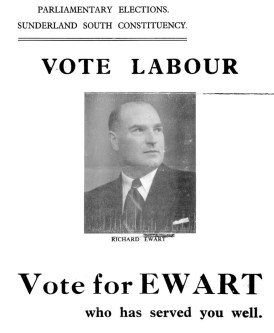
VOTE EWART copy

It’s a rare post when any politics touch this blog but this is about a relation of mine, so I’ll make an exception.

Watching news programs in 1984 about the miner’s strike brought politics to my attention. The Battle of Orgreave ? I knew whose side I was on. But this is a story about a young politician that asks, would he have got anywhere near the House of Commons today ?

My Great Uncle Richard Ewart was born on 15 September 1904 in Livingstone Street, South Shields, County Durham. He was the only son in a family of seven daughters.

His mother’s family were from County Derry, Ireland and his father’s family were from Longtown on the Scottish border.

His father worked as a fishmonger’s assistant, hawker, knocker-upper and lamplighter. The family also lived in the Holborn and Laygate area’s of the town.

Richard was educated at St Bede’s Roman Catholic School in South Shields. He left school at 14 and worked as a hewer in Whitburn Colliery. But at the age of 21 he suffered a back injury and left the mine.

During his employment at the Colliery, he was a member of the Durham Miner’s Association and when he left the pit, he immediately joined the National Union of General and Municipal Workers (NUGMW).

Unemployment was very high in South Shields in the 1920’s, and the only work he could find was a marker in a local billiards hall in Cuthbert Street, Laygate. He eventually became manager of the hall.

Richard joined the Labour Party in 1925 and on 1 November 1932 was elected to the South Shields Town Council for the Holborn Ward to become its youngest member at that time.

From 1936-39 he was Chairman of the Housing Committee and Vice Chairman of its Public Assistance Committee. In December ’36 he became full-time branch secretary of the NUGMW and in August ’38 was appointed Union Organiser.

Apart from his Trade Union and Council work Richard was a keen billiards player and a member of Robert Monteigle’s Studio Players who performed at the Alexandra Theatre in South Shields.

When the Second World War started he served on the South Shields Council until 1943 then transferred to the Cleveland District to help Union Officials cope with the wartime expansion of trade union work on Teesside.

In 1945 he successfully stood as Parliamentary Labour Candidate for the double member constituency of Sunderland as a sponsored candidate of the NUGMW. Along with his Labour partner F.T. Willey they defeated the two sitting members, a National Liberal and a Conservative.

Richard lived in Kensington, London and his first parliamentary duty after his election to the House of Commons was to join the British Parliamentary delegation to Germany in 1946. For most of his Parliamentary career he confined himself to regional and industrial affairs.

He also pressed in Parliament for the North East to be given it’s own radio service and urged the extension and completion of television services to the Pontop Pike transmitter.

On 8 June 1951 Richard was appointed parliamentary private secretary to Sir Hartley Shawcross, President of the Board of Trade.

Sadly at a young age, just 48, Richard died on 7 March 1953 in St Andrew’s Hospital, London. His death was announced on BBC radio.

In memory of his life there was a Dick Ewart reading room in Sunderland Labour Party Headquarters, also a street in his birth town of South Shields, Ewart Crescent.

Information taken from Hansard, Electoral Rolls, Sunderland Echo, The Shields Gazette and personal papers.

Gary Alikivi   July 2019.