THE GREAT GEORDIE SONGBOOK – in conversation with North East playwright Ed Waugh

poster web

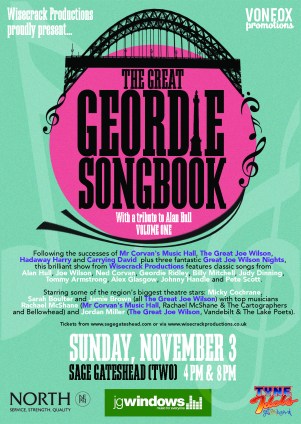
Ed’s company Wisecrack Productions have booked a November date at The Sage in Gateshead. The show features classic North East songs and comedy…

Not much working class history is documented so we try our best to help in a little way said Ed.

The Great Geordie Songbook is a celebration of local songwriters including Lindisfarne’s Alan Hull and Billy Mitchell, 19th century concert hall entertainers Joe Wilson and Ned Corvan…

Ned would have been great to talk to. I think I would of got on really well with him. In the 1800’s he had his music hall next to the old South Shields ferry landing on the river Tyne.

Apparently it was a den of iniquity and the magistrates were constantly trying to close him down (laughs). But yeah he was a fantastic singer-songwriter and it’s brilliant being in this game because you come across some great stories.

How did the songbook idea come about ?

I was approached by Ray Laidlaw of Lindisfarne and Brian Mawson boss of Windows music shop in Newcastle. Brian has a real passion for Geordie comedy and songs.

The Geordie heritage really comes across when you talk to him. He has recorded all the stand up comedians like the Little Waster himself, Bobby Thompson.

They had just seen my play Hadaway Harry about the rower Harry Clasper. After the show they asked if I’d heard of Ned Corvan and Joe Wilson, both singer-songwriters performing in the North East during Victorian times. Much to my shame I hadn’t and they asked would I write something about Ned.

How much research did you do for the project ?

For the Ned Covan play I done about 40 talk’s with Dave Harker, he’s a North East historian who wrote a book Catgut Jim. The play was based on that. I couldn’t have done it without him. His research was fantastic.

Ned’s songs had great lyrics like the Cullercoats Fish Lass and Mally by the Shore, these were testaments in the 19th century to working class women. He also wrote songs about workers on strike supporting seafarers.

Songs with lyrics about day to day working class life. The more research we done we found it was a good story and it’s all about the story isn’t it.

It was a huge success and got a fantastic response which led us onto a play about Joe Wilson. That toured last September and that also got a great response. Both Joe and Ned shows played at The Sage so after the success they asked us ‘what you got next ?’

The Great Geordie Songbook was put forward, along with a tribute to Alan Hull so there will be a few Lindisfarne songs.

The show features some of the region’s biggest theatre stars, Micky Cochrane, Sarah Boulter and Jamie Brown who all appeared in The Great Joe Wilson with Jordan Miller from Sunderland band The Lake Poets

Top musician Rachael McShane from English folk band Bellowhead who also appeared in Mr Corvan’s Music Hall plus musical comedy from Gavin Webster and Josh Daniels.

We work with top professionals, we have a really good team and work well together and enjoy it. To be fair we don’t have the time or the money to muck about. But yes it’s a laugh from start to finish.

Our last show was Carrying David about the boxer Glenn McCrory. I told him it was really good to work on a play about someone who isn’t dead (laughs).

Off the back of all this we worked with Newcastle Council and got some blue plaque’s put around Newcastle. They’re all about leaving a legacy for what was achieved.

There is one for Harry Clasper on the Guildhall over-looking the Tyne, one for Joe on Stowell Street where he was born and a plaque on the Central Station where 2,700 people came to see Ned at the Olympic Theatre. That was the venue where Joe saw Ned, where he was inspired to write about working class life.

When the chips were down they really nailed their colours to the mast. We want to keep their legacy going for young people and for the next generation to be inspired. I think for protest songs young songwriters will go and raid the songbooks of Alan Hull, Joe Wilson and Ned Corvan. And that’s what we want, we need to hear those great songs again.

Tickets for The Great Geordie Songbook are on sale now only £20. There are two performances on Sunday 3rd November 2019 with the first curtain up at 4pm and then 8pm.

Contact www.sagegateshead.com or

www.wisecrackproductions.co.uk

 Interview by Gary Alikivi July 2019.

ALL THAT JAZZ – snapshot from the life of professional musician Kathy Stobart (1925 – 2014).

kathy-stobart-1970s

What’s the connection between Radiohead and South Shields ? In 2001 at an outdoor concert held on Radiohead’s home turf of Oxford, the South Shields born jazz musician Kathy Stobart appeared on stage with the Humphrey Littleton band.

After opening the show, they were quickly followed by Iceland’s Sigur Ros, fellow Oxford band Supergrass, California’s Beck, before headliners Radiohead closed the show. Music throwing up some strange and fantastic surprises from around the world. Now back to Tyneside.

In 1925 Florence Kathleen Stobart was born into a musical family, both her brothers were saxophonists and her mother an experienced pianist. With music in the home, Kathy studied piano and learned how to play saxophone.

At the young age of just 14, Kathy started her musical career joining the Don Rico Swing band touring UK theatres. Along with playing saxophone she added singing, dancing and impressions to her act – Gracie Fields being one of them.

The air raids and bombings of the Second World War put an end to this, resulting in the closure of many theatres. But the show must go on, so she returned to Tyneside to entertain audiences in the Oxford Galleries in Newcastle.

Through the 1940’s Kathy moved to London and got regular gigs at the Embassy Club on Old Bond Street, guests included Bob Hope, Bing Crosby and Glenn Miller. She was the only female saxophonist in Art Thompson’s Swing band.

At the end of the war Kathy travelled to America and played in jazz clubs from New York to L.A. and had a residency in Palm Springs, establishing her international reputation.

By the ’50s Kathy had moved back to London and continued playing in the capital, for many years touring the UK extensively with the Humphrey Littleton and Vic Lewis big bands.

The ’70s saw the Kathy Stobart Quartet formed and a performance at the Nice jazz festival. Along with numerous solo gig’s she found time to teach saxophone and hold Big Band workshops.

By now living in Devon, the ’90s through to the noughties saw Kathy continuing her jazz teaching and re-joining the Humphrey Littleton Band, who she first joined in 1957. A gradual move into retirement followed, but sadly on 6th July 2014 Kathy died.

Starting her musical journey from a small coastal town in the North East of England, to keeping the show going as bombs dropped on England, extensive touring throughout the UK and finally sharing a stage with one of the most influential bands of our generation, this is a snapshot of the life of professional musician Kathy Stobart.

Gary Alikivi   June 2019.

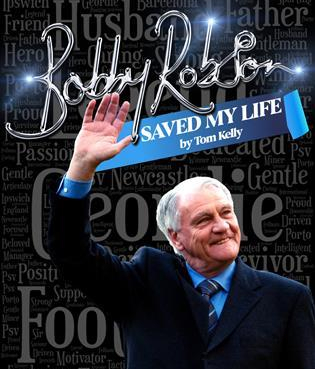
BOBBY ROBSON SAVED MY LIFE – a New Play by Tom Kelly

Theatre and football come together in a new play about the life of one of football’s most successful and well-known personalities. Sir Bobby Robson’s story has been written by North East playwright Tom Kelly (Geordie the Musical, The Dolly Mixtures, Nothing Like The Wooden Horse)….

‘The play looks at three characters and how Sir Bobby has had a real and lasting influence upon their lives’ explained Tom. ‘This is not only about football and Tyneside but hopefully underlines we each have a responsibility to care for one another.’

701a93cc-d214-436f-8f67-c3d3c2e1d686

Former Newcastle United number 9 and England international, now Match of the Day pundit, Alan Shearer has added his support. In a video message he is really looking forward to seeing the play’ and described Sir Bobby in three words ‘passionate, committed and professionalism’

A footballer who played for Sir Bobby at Ipswich Town was George Burley. The former Scotland international full back revealed in his message to describe Sir Bobby ‘Father-figure, determination and enthusiasm’.

I asked Tom what research he did for the play… ‘I read a great deal about Sir Bobby’s life and discovered he often sent messages of support to a wide variety of people which had a positive impact on their lives: It gave them hope. He had a real empathy for others. His life underlined, for me, the way we treat others is not just important but crucial.’  

Tickets are available for the play at South Shields’ favourite theatre, The Customs House. A portion of each ticket sold will go to the Sir Bobby Robson Foundation, a charity he and his wife, Lady Elsie, founded in 2008 to help find more effective ways to detect and treat cancer.

Curtain up on the first night is Tuesday 16th July at 7.30pm, running through to Saturday 20th with matinees at 2.30pm on Wednesday 17th and Saturday 20th.

Telephone 0191 454 1234 or check on-line for details https://www.customshouse.co.uk/theatre/bobby-robson-saved-my-life/

 Other shows are on July 31st at the Regent Theatre, Ipswich

https://apps.ipswich.gov.uk/en-GB/shows/bobby%20robson%20saved%20my%20life/events

And 2nd & 3rd August at the Tyne Theatre, Newcastle.

https://tynetheatreandoperahouse.uk/events/bobby-robson-saved-my-life/

 Interview by Gary Alikivi June 2019.

GATESHEAD GET RHYTHM with drummer Steve Laidlaw

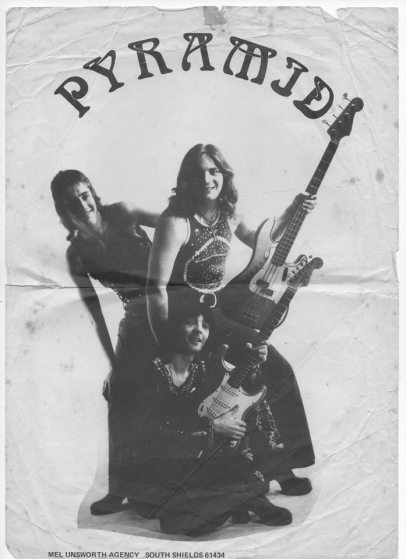
One of our strangest gigs was when Pyramid supported the Welsh heavy rock band Budgie at the Newcastle Guildhall. They and the crowd were all denim and long hair.

But we were playing Glam Rock, Bay City Rollers, Mud, that sort of stuff… but went down a bomb!

From the 1960’s to the late 80’s Steve played for many North East bands including Pyramid, Busker, Backshift, Flicks and Smokestack. Recently he has returned to the stool…

Last year I got back together with Chris Batty from one of my first band’s. We done some busker nights, got my mojo back, and we are getting a band going.

My son Andrew is a record producer and is signed to Slam Jam Records owned by Chuck D from Public Enemy. Chris and I are doing drum and bass tracks for his new album. Can you believe it. Talk about being down with the kids (laughs).

When did you first get interested in music ? 

My dad was a commercial artist who played guitar and piano at home, things like New Year parties. So, when growing up music was around the house.

When I was about 14 I got friendly with two lads who lived on the next Gateshead estate, Richie Close and Steve Davidson. Richie was already an accomplished musician playing piano and guitar. He later played with major bands such as Camel and was MD for Tony Christie.

We started messing around and Richie suggested I try drums. One day we went to his mate’s house and he had a kit. I got on and found I could separate my hands and feet and whack out a rhythm. We used to record little tapes, it was a hobby.

I remember being influenced by listening to straight four on the floor players like Mick Avory and Mick Fleetwood. No fancy complex stuff for me ! I was never technically gifted as a drummer.

I was influenced in my early days by watching the great John Woods from the Junco Partners, Ray Laidlaw (no relation) with Downtown Faction and Brian Gibson of Sneeze, later with Geordie.

Later I met a lad called Peter Chrisp who played bass. He was a blues man, and we formed a band with John Gormley (vocals), Ronnie Harris (guitar) and me on drums.

Can you remember your first gig ?

My first gig was at the Wesley Memorial Church Hall in Low Fell in 1967. Ronnie could play the John Mayall album ‘Beano’ note for note, so were ostensibly a blues band. We did The Quay Club, Bay Hotel in Sunderland loads of youth clubs and schools.

But the band sort of lost interest so I formed my own called Tycho Brahe, with my mate’s Chris Batty, George Curry and Stan Rankin. This was late 1969.

We did the Bowling Alley in Gateshead and the usual round of schools, but only lasted a few months. Then in 1970 I got a call from a guy called Jim Campbell. He was managing a club band which became The Paul Dene Set.

I got Chris Batty from my previous band in on bass, but we were only 19, and the other guys were 26/27, a lot older and very experienced. I went from playing Cream/Mayall to Tom Jones and Elvis with dickie bows and velvet jackets.

18012669_10154262986992085_2045594719_o

Did you have a manager or agent ?

Most of my time in bands we were managed by Ivan Birchall or Mel Unsworth who were always fair with us. We started getting regular work in the clubs, and had a van and good PA. We got gigs like the Airport Hotel, Top Hat, Guildhall, these were really decent clubs.

That lasted until ‘73 until I formed a band called Smokestack featuring Stu Burns and Steve Daggett. He played a blinder by stepping in at the last minute with no rehearsal, it worked out great.

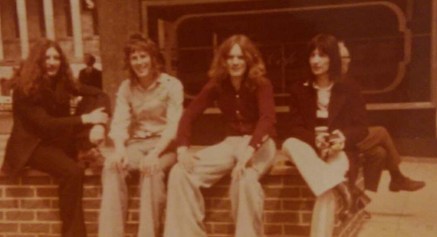
Then I answered an advert in local newspaper The Chronicle, that was for a band called Pyramid who had been on the go for a while.

At first, we just rehearsed in a basement in Gateshead as one of the members was ill, so the band were off the road. At first the agents didn’t want to know but eventually we got a couple of gigs and literally tore the places apart with comedy and chart music.

Straight away we got repeat bookings and our agent Mel Unsworth started giving us work. Subsequently we started to build up what became a huge following and some people had seen us a hundred times.

15894458_10153991538337085_7274884893360001968_n

Have you any stories from the road ?

We auditioned for TV talent show New Faces in 1974 – and got on. The panel were made up of Micky Most, Tony Hatch and Clifford Davis who were not keen on us. Arthur Askey was there, and he was a lovely gentleman.

I remember the night we were on. We recorded the show in Birmingham on a Tuesday and the night it was broadcast we were booked for a club in Ashington, The Central I think, and we watched the show before we went on stage.

There were no videos in those days. We got a load of gigs after that and the work went off the Richter scale, doubling our pay from £40 to £80 a night (laughs).

The band went full time but I continued to work. I was working in sales through the day and got very little sleep. We would be doing a club then maybe The Sands which was above the bus station in Whitley Bay or the Burgundy Cobbler also in Whitley Bay.

We’d get to Palace of Varieties over in Prudhoe, then a few places in Newcastle like the Cavendish, Stage Door and the Rainbow Rooms.

I’d fall into bed around 3 or 4am, then back up at 7 (laughs). We once did 93 consecutive one nighters, but by this time we had two full time roadies, and we went in our cars.

36711030_1311155892354062_5895211650234974208_n

In 1975 I got married so left the band as my new wife wanted to see me (laughs). But re-joined a couple of year later and did a tour of Germany with the comedian Chubby Brown.

I remember being stopped at the East German Checkpoint and they got really funny with us. To get to Berlin we were told to ask for a Russian Officer, who we had to pay off to get through (laughs).

A story from one night involved Allen Mechen, who was the front man and guitarist Brian Pick. We used to start the act with me and Brian on stage and Allen used to run out of the gents.

One night we started playing and were going over and over the song with no sign of Allen. After five minutes our roadie went to find him. He was asleep on the bog with the door jammed (laughs). John poured some water over him.

Incidentally Brian used to be in well known Tyneside band The Sundowners and Allen ended up playing the character Terry in the Tudor Crisps adverts. After recording an EP I left the band again, then went back for their last gigs in 1983.

What studio did you record in ?

We recorded the EP at Soundlink in Newcastle and sold it in the clubs, but I haven’t got one cos I gave my copy away.

We also recorded a couple of tracks at Impulse Studio in Wallsend. That was for North East TV show Geordie Scene, but in the end, they decided not to put us on. We recorded a new single at Impulse, but it was scrapped at the last minute for some legal issues.

Not long after Pyramid I played in a band called Flicks. Terry, the keyboard player, was asked to join another recording band called Busker who had a huge hit with Home Newcastle. The song was a massive hit locally and is still played at St. James’ Park.

The band didn’t really exist, but songwriter Ronnie Lambert wanted to put a band on the road. He also played guitar and harmonica. He asked us if we could get a few of our old mate’s in and do a few gigs, so we did.

We also recorded a new single, and a new version of Home Newcastle with a few different lyrics but the band drifted apart. I think Ronnie just wanted to be a recording entity.

After that I joined Backshift, who became an eight-piece soul band, fronted by legendary Junco Partner, Ronnie Barker. This went on for several years, we done some good gig’s and had a great laugh but finished about ‘88.

I always meant to go back to playing but had two kids and things just drifted. I had 23 years in bands by then.

What does music mean to you ?

I always felt music should entertain and not educate. The general public are bored shitless by drum solos. As Brian Gibson from Geordie always said, get the girls dancing then you are ok (laughs).

 Interview by Gary Alikivi    June 2019.

FOOTING IT TO EUROPE with Tyneside poet Keith Armstrong.

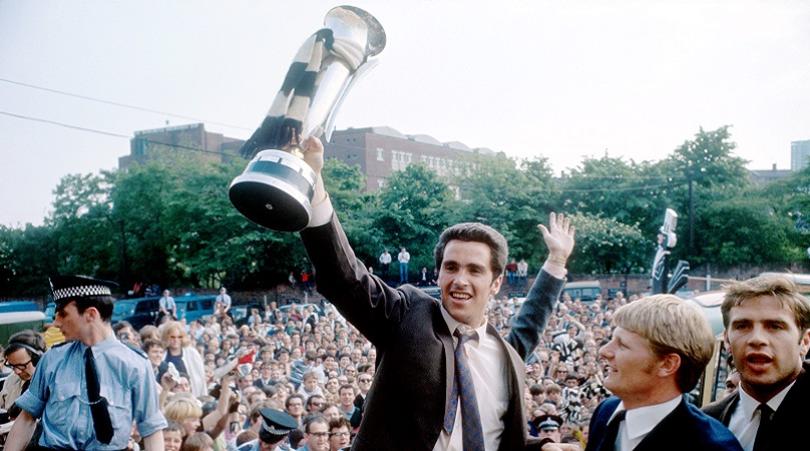
In the week of the 50th anniversary of Newcastle United’s victory in the Fairs Cup, a 6-2 win on aggregate against Ujpest Dozsa in the final. Tyneside poet and lifelong supporter of the Magpies, Keith Armstrong, reflects on their journeys through Europe.

Bobby Moncur, Newcastle United, with the Fairs Cup

I hate to give away my age, but my dad took me piggy-back to see Stanley Matthews play at St James’s Park in the days when peanuts were only a tanner a bag and the ground capacity was well over 60,000.

Since then, I’ve followed the lads through thick and thin, usually thin, across Europe and back home.

It might surprise you, but United in Europe isn’t new you know. They toured Italy, Czechoslovakia, Hungary, and Austria, in 1929 – just after the last time they won the League, with the legendary top-scoring Hughie Gallacher at number 9.

In Milan, full-back Tommy Lang had a nasty set of bite marks on his neck when he left the pitch and the club’s bus was hit with bottles and stones and the players had to barricade themselves in their hotel room.

Not to worry, the team was guarded by the stalwart men of Mussolini’s black shirts!

After an 8-1 defeat in Czechoslovakia, the lads were accused of not trying by the Czech officials and then it was off to Budapest for another ‘friendly’ where Gallacher was sent off after a punch-up and the locals spat and threw coins at him as he was escorted through the crowd by armed soldiers.

The Hungarians accused Gallacher and the rest of the team of being ‘drunk and disorderly’ on the field and withheld the guaranteed fee. United left the country quickly.

A Football Association enquiry exonerated the team after Gallacher had explained that he and some of his teammates had been so thirsty in the heat that they ‘rinsed their mouths out with a drop of Scotch’.

The Hungarians spotted them passing the bottle round and jumped to the surprising conclusion that the boys were on the piss! European sporting ambassadors, don’t you know!

1969-05-29

And, just so’s you really know how old I am, I have to say that I was ‘on the hoy’ as well in Hungary, with the Supporters’ Club back in 1969, belting out the ‘Blaydon Races’ on Budapest High Street when we last won a major trophy, the Inter-Cities Fairs Cup.

It never seemed to be part of a plan to win then, they just stumbled into the Final, and, with Wyn ‘The Leap’ Davies nodding the ball down to Bryan ‘Pop’ Robson, and no real midfield to speak of, we had those continentals, used to playing the ball on the ground (the mad fools!), completely baffled when faced with our Geordie ‘laeng baell’ game.

A one-off but the toon went crazy when the lads came back with that Fairs Cup.

It worries me a bit just how crazy the toon will gan should we ever bring another bit of silverware home – not that that’s likely, let’s be honest, a trophy is never on the packing list, if you’re following Newcastle United.

Soccer - Newcastle United Parade The Inter-Cities Fairs Cup

Captain Bobby Moncur with the cup in Newcastle.

Tyneside poet Keith Armstrong was born in Newcastle. He has travelled throughout Europe to read his poetry and is widely published and broadcast. He is available for events and functions.

tel: 0191 2529531.

Interview by Gary Alikivi    June 2019.

MOTLEY CREW – former stagehand Mark Johnson remembers the crazy Mayfair nights.

001

We all remember our first gigs. Sabbath, AC/DC, Motorhead, Ozzy and Judas Priest at Newcastle City Hall and at the Mayfair with it’s over 18 policy was Tygers of Pan Tang, Raven and Hanoi Rocks with my last one before it was demolished, were the Fun Lovin’ Criminals in ’98.

I remember the distinctive green and orange day glo posters advertising gigs at The Mayfair. Recently I talked with former stagehand Mark Johnson, who with his friends Dave Mitcheson and Steve Smith, have recently opened Bad Moon Prints and aim to reproduce those iconic posters….

Basically, we were reminiscing about all the great gigs we had seen at Newcastle Mayfair in its heyday. My first gig was the Pink Fairies in ‘76 and then I saw AC/DC, Judas Priest, Iron Maiden, Cheap Trick, there were loads. Every Friday we would be there.

We thought it would be a great idea if we could reproduce the gig posters from all the iconic acts that played the Mayfair including Zeppelin, Floyd, Sabbath, Queen, Bowie, The Who and Nirvana.

Very few, if any of the early originals are now in existence. We managed to get originals of the Led Zeppelin posters from both Sunderland and Newcastle in ’71. They were in very poor condition. But I have a few originals which I nicked off the wall from when I worked there (laughs).

When did you work at the Mayfair ?

I was on the stage crew for a couple of years. My first job was in November ‘78 when AC/DC played. Then it was every Friday with the likes of Judas Priest, The Clash, Police, Cheap Trick, Ramones and Journey to name a few.

I also worked at the Newcastle City Hall from summer ‘79 till around summer ‘81. I was in the same squad that also worked the Newcastle Polytechnic and Sunderland Mayfair which was a lot easier venue to load in.

How did you get on the crew ?

I was a student at Newcastle College and this guy I knew who already worked there just asked if I fancied earning £10, a cheeseburger, drinks tokens and seeing AC/DC ? (laughs).

We would start loading in from 11am and it ended up around ten to twelve of us long haired types unloading two articulated trucks and taking the gear down an old service lift and using the fire escape stairs.

How much gear are you talking about ?

Well, these were big bands, AC/DC, Journey, Sammy Hagar, The Police, with all their sound and lighting gear, tons really. The bands would have their own professional crew, we would just hump the gear in and out.

Their crew would be the drum and guitar techs, lighting and sound guy’s etc. Those guy’s would know where everything went while we were just a rabble of young daft music fan’s getting in the gig for nowt (laughs).

When would the band appear ?

They would rock up in the afternoon for the soundcheck, we would sit and watch them. Maybe hang around for a few drinks then go back to the hotel.

When the bands were on stage, we would either be tasked with doing follow spots, standing at the side of the stage or nicking their beer from the backstage area.

Some of them were really canny guy’s, usually the techs had more of an ego on them than the actual band members, but we had some great laughs.

After the gig we would bring all the equipment back up the stairs. The load out would take until around 4-5am. I think one night it was Molly Hatchett’s sound desk that went flying back down four flights of concrete stairs because the local crew were rather a bit too refreshed. Their tour Manager wasn’t chuffed.

We didn’t have any stage management or anything, half the time it was chaos, and we used some dodgy characters. We were on the 5am train going home once and one of the lads had nicked half a side of beef from the kitchens which raised a few eyebrows.

Are there any stand out gigs that you can remember ?

Yeah, the Two-Tone tour with The Specials, Selecter and Madness. Basically, there was a sea of skinheads, mods and punks and there was one big fight from start to finish. Tables chucked off balconies. Mayhem.

All of the stage crew had long hair, so we just stood at the side of the stage or backstage and kept out of it. Think it was the night when the police with dogs turned up – or was that The Clash ?

Can you remember your last gig working at the Mayfair ?

My last gig working there was The Clash. Around that time, I had done five or six crew gigs in a row to save money to see Pink Floyd on The Wall tour. To be honest it wasn’t the most professional set up compared to the set up at Newcastle City Hall.

They had a plan to work from, a Stage Manager for a start. No alcohol whilst working, a set time to be there. A guy called Colin Rowell ran it and it was very well run. We were the best stage crew in England.

You have to remember most of the Mayfair gigs would be on a Friday night, but there were concerts on at the City Hall every night.

One night you could be loading in Motorhead and the next night it would be The La Sagesse School Choir (laughs) and the next night it would be Queen for two nights.

By the end of the week there could have been a soul band on, an orchestra on, Shirley Bassey or someone like that and then back to a big act like the Jam or UFO.

So, you were there virtually every night. Sometimes we used to sleep on the stage or backstage for the early load in next morning –Which usually involved mischief.

Can you remember your last working gig at the City Hall ?

I think it may have been the Van Halen gig. They brought in enough gear to fill St James Park. It was ridiculous.

I think most of the Stage crew would not carry on doing it forever unless they get picked up by a band and go out on tour with them – which occasionally happened if they were crew down or get a job with a light or sound company.

Some of lads I know went on to work for various lighting or sound companies, I know other lads, and lasses who went on to work full time for Ozzy, Queen and The Tubes.

I eventually decided I needed a proper job (laughs) – with some regret later on when I heard their tales.

Now you’re involved in printing the posters of the bands that were on at The Mayfair…

Yeah, the main reason was to bring those long-forgotten nights back to life. Anyone who went to either Sunderland or Newcastle Mayfair between ‘67 and ‘97 will know where we are coming from.

These were great, great bands that defined a generation, whether you were a mod, punk, biker, rocker, hippie or whatever.

Producing these posters will hopefully keep those memories alive and the spirit of those fantastic nights going. They were great times for live music, and personally from a nostalgic point of view that variation and quality of artists will never be repeated.

I’m sure everyone has their favourite Mayfair gig…

Yes, for the folks in Sunderland it seems to be the Faces or Free, at Newcastle it seems to be one of the six or seven times when AC/DC played. Or the nights when the Specials and Selector came to town on their Two-Tone tour.

The most interesting gigs for me is finding Pink Floyd played there in 1968 and the fact that Led Zeppelin played their first ever UK gig at the Mayfair as The Yardbirds.

This was a fact unearthed by North East music historian Marshall Hall who was met with derision by the Zeppelin ‘academia’ when he first published his findings.

But they all had egg on their face once it was established as fact. This had been lost for years until Marshall’s discovery and now he has rewritten the Zeppelin history books.

Another little fact was Queen supporting Vinegar Joe in ‘73 and another piece of history was Bowie just before he hit the big time.

How do you produce the posters ?

The posters are produced to the exact original spec. It took painstaking research of the adverts in the British Newspaper Archives where we looked at dates, support acts, ticket prices and the promoters.

We also researched all of the original fonts used on the posters, a lot of them now defunct.

After a period of about six months we started to reproduce and build the original posters. We had to purchase the original fonts and source the original day-glow paper. Which wasn’t easy as it isn’t cheap and now not widely produced.

So, the whole job has become a bit of a labour of love. Some of the originals have imperfections because they were done cheaply so we’ve even reproduced them to be as authentic as possible.


How many posters have you produced ?

There is about 50 on the site with more to come. You have to remember at the time these posters were a minimal no frill affairs with only the band, date and price on. They were produced as cheaply as possible.

As it was left up to the Mecca to promote the gigs, very rarely were there any images on the posters compared to the bands that were playing at the City Hall up the road.

We really love these posters, we have enjoyed making sure they are spot on with regard to exact copies. Just great times. Great posters.

Check the official website at https://badmoonprints.com/

Interview by Gary Alikivi    May 2019.  
PRESSING ISSUES with Peter Dixon & Keith Armstrong

Peter Dixon & Keith Armstrong.

Northern Voices Community Projects were set up in 1986 to give people who are denied a voice, a platform to express their views and experiences of living in the North East.

Peter Dixon and Keith Armstrong are behind NVCP and we arranged to meet in a pub along the River Tyne to find out more. The Alum House sit’s next to South Shields ferry, a handy place to meet as they are both from the North side of the Tyne.

I recently talked to Keith and featured his interview on this blog, in it he talks about his writing and poetry. In this new blog Peter pick’s out some highlights and tells a few stories from his background.

I mentioned that the last time I interviewed anyone here it was Antony Bray, drummer of black metal band Venom…

I remember Tygers of Pan Tang and all that heavy metal said Peter. But I’ll tell you about the time I worked during the day’s of the last gasps of hot metal (laughs).

From 1975-80 I worked for Northern Press newspapers which included the Wallsend News, Whitley Bay Guardian, Blyth News and where I was based, The Shields Gazette art department.

We produced the graphics for adverts and things like that. This was in the day when old presses were still being used, it really was the last gasp of hot metal!

What people tend to forget is that in The Shields Gazette you had a major employer situated right in the town centre that produced the whole newspaper under one roof.

About 250 people were working there with proper jobs and getting proper money. All buying their sandwiches, birthday cards and whatever in the shop’s right there in the centre of town.

There was a little squad of us would regularly get in The Stags Head and the Dougie Vaults spending our money on a few beers. Sadly, all those workers have gone now.

Before Northern Press I done some stuff for Vince Rea at The Bede Art Gallery in Jarrow and also designed single and album record covers for the Newcastle band Punishment of Luxury.

How did you get involved with them ?

I was doing background scenery for The Mad Bongo Theatre Company and a member of the band, Brian Bond got in touch. Then I met Neville Luxury and the drummer Red Helmet.

They done a single called Puppet Life and Tony Visconti (Bowie, Bolan & Morrissey producer) reviewed it for Sounds newspaper. He described the sleeve that I done and said I was sick (laughs).

I also co-edited a monthly magazine called The Informer. That was distributed around the North East from Hexham, up to Blyth and down to Tyneside. We done around 10,000 copies a month and it ran from 2000-2010.

It was originally for The Tyne Theatre but it became too expensive to run so became a magazine in its own right. It was a What’s On and live performance mag. It was meant as a gig guide that you could roll up and put in your pocket.

I ran it with my co-editor. He collated the live dates and information where I designed and wrote the press releases and interviews. We both used to sell advertising. Again, running it became expensive, so it folded.

What is the background to the Northern Voices project ?

I worked with Keith who was a Community Arts worker in Peterlee, and we always had some kind of publishing activity going on. It was an end result to our work in design, poetry and writing.

Back in the ‘70s we were involved with Tyneside Street Press which was a bit radical. There was a whole collective of people working on it. A bit like your punk fanzines, printed on A4 but it was news stories we were doing.

Yeah, it was a time when people could make their own papers and booklets said Keith. The idea was we could control the whole process from writing, printing and publish it all ourselves.

It was a place where people could express themselves in their own words. We had connections with other city’s that were bringing out alternative newspapers.

Peter added A lot of poetry was going on then plus the art stuff. It was part of the pop culture, challenging the existing order and critical of what was happening. But there was always an interest of the indigenous population and what was going on.

Yeah, said Keith it was the spirit of the ‘60s and ‘70s, the alternative idea’s sprouting up a bit like the music that was around then. There was a distinct northern voice, we always had something to say. It’s a fundamental idea and very democratic.

Keith talked about an earlier version they produced called Strong Words he said it lasted a few years and done a number of publications…

It sold around 3,500 copies which was really good for us then, we sold it worldwide (laughs)…including South Shields. We used to go around interviewing people rather like what you are doing now for your blog.

Some people were quite chuffed you know…’Somebody’s bothered to knock on my door and asked about my life’. Otherwise, it would go unrecorded.

DSCF0918

Did you receive any funding ?

We didn’t go to funding bodies then, we were autonomous. It gave us a freedom. We put together a publication called Missile Village which was about Spadeadam, a military test base, and it’s impact on the village of Gilsland in Northumberland. The Blue Streak Missile was tested there and at Woomera in Australia during the ‘70s.

The general ethos is to give people a voice, so we talked to the local villagers about the idea that the Government had decided to have a missile on their doorsteps. A farmer told us that ‘it’s nowt but a puff of smoke’.

Peter brings the story up to date and talks about work they are doing now…

Mostly its history books funded by North Tyneside Council. Things on The Hartley Pit disaster, George Stephenson, the Wooden Dollie’s of North Shields and writer Jack Common.

To an extent it’s easier now to do the whole thing yourself rather than farming it out to someone else. Not like the old days of laying it out for typesetting.

The difference from the old days to now is that we are doing full colour. Back then a lot of it was single colour. To an extent there is a satisfaction of producing it yourself.

Keith checks his watch Well we’ve missed the ferry we’ll have to wait for the next one, might as well get another pint in. As for Northern Voices, yes, we’ll keep plugging away.

For further information contact

http://www.northernvoicescommunityprojects.co.uk/Northern_Voices_Community_Projects/Welcome.html

Interview by Gary Alikivi    May 2019.