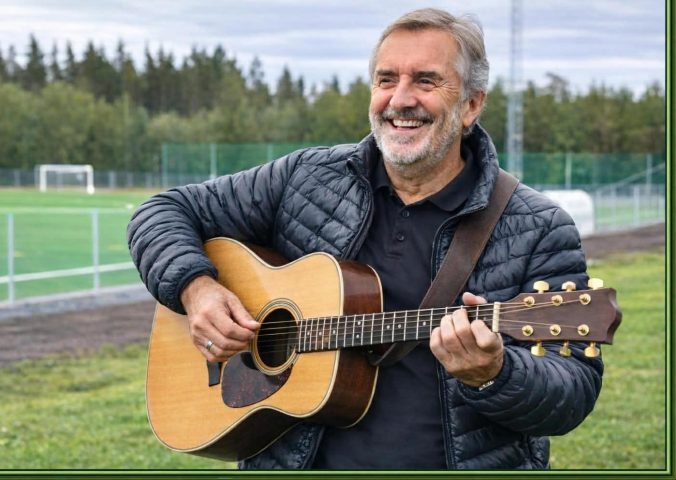
Originally from Middlesbrough, for the past 12 years 71 year old Alan has lived in Sweden with his wife Jude.
‘After school I went to train as a school teacher at Durham University then spent my first seven years in the workplace as a teacher then in business for several years in and around the Northeast.’ explained Alan.
‘The first business was an up market private health and fitness Centre in Yarm. It was called Gym and Tonic. My second business was a construction company renovating properties and building new houses’.
When did you first pick up a guitar?
‘When I was 12 year old and sang my first song at the school folk club. It was Bob Dylans Blowing in the Wind. Like everyone else at the time I joined a band at 16 and played a few gigs around the Teesside area particularly Redcar pubs. It didn’t last. We didn’t get a record deal. But I really did enjoy it.’
Was music in your family, did anyone play an instrument?
‘Yes, my mother. She played a mean piano but she had to have her arms twisted too actually do it. She was a musical one. Most family and friend’s parties ended up around the piano with her playing the hits of the day. So, I guess I got my performing bug from her and from her brother. My uncle was a professional singer all his working life.’
‘Fast forward five decades and songwriting has taken over. There was a song in me called Running Man. I wrote it quickly and we recorded it. Since then, I’ve just kept writing.’
‘Jude and I became involved with a professional football club In Sweden and formed a refugee team called The Mighty Cosmos. The original members of this team had all escaped the 2003 and still ongoing genocide with Sudan and Darfur and had an amazing story to tell.’
‘Over two years, they told me their personal stories and every line in Running Man was a part of one of those stories.
One night at the height of the refugee migration across Europe I saw the Hungarian foreign minister say we will build a fence and send them back and that became a line in the middle eight part of the song. The rest of the song came very quickly.’
Alan’s song has received radio airplay in Sweden and he has been interviewed on several radio stations across northern Sweden.
‘Songwriting came to me late, but I’ve really enjoyed it. I think the early protest singer songwriters of the 60s and 70s especially Dylan, Roy Harper, Tom Paxton, Loundon Wainright along with the amazing Leonard Cohen have influenced the way I write.’
‘There’s a rich pallet of subject matter in the world right now so plenty to go at. I have several songs on Spotify now and a whole load lined up ready to be recorded including an EP of four songs of nostalgia about my home town.’
Songs recorded in Studio 306, Ostersund, Sweden. Produced & engineered by Johan Arveli & Anders Lagroix Kronlund. Available to download on all music platforms.
Tracks include Jamtland County, Monster in the Water, War is Cancelled Today, Darfur Wind, Into the light and Lady Liberty.
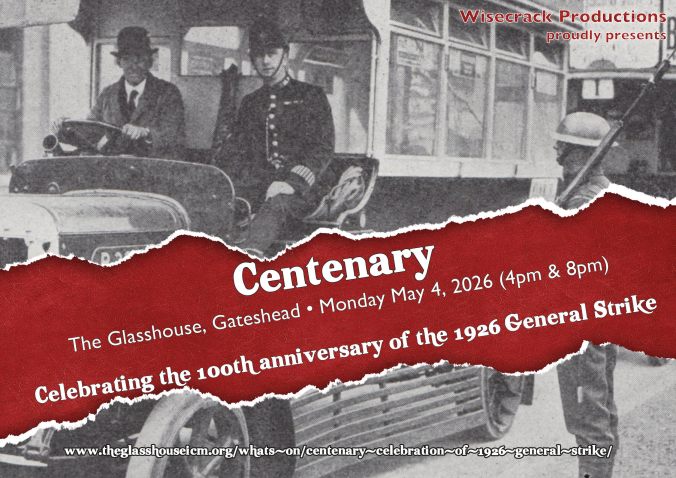
May 4, 2026, marks the centenary of the first full day of the 1926 General Strike where millions of British workers withdrew their labour and challenged the establishment. They believed a better world was possible.
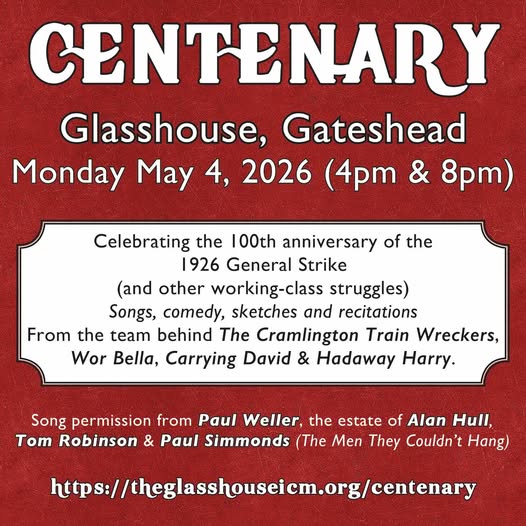
To mark this historical event the same team that brought successful plays Wor Bella, Carrying David and Hadaway Harry are staging Centenary at the Glasshouse.
“We have a great team and the show will be fantastic. We did a very popular show about four years ago called ‘Boris Out’, and look what happened to him!” said playwright and Theatre producer Ed Waugh
“One hundred years ago millions of workers and their families went on strike. A General Strike poses the question of state power, the 1 per cent – the privileged Establishment or the working class – those who actually create the wealth in society.”
“Despite the heroism and sacrifice of the trade union rank and file, the union leaders in the TUC realised the question of state power was at stake – the Russian Revolution nine years earlier had sent shockwaves throughout the world. These TUC cowards sold out the strike unconditionally after only nine days.”
Ed added “Their pusillanimity led to a carnival of reaction against the trade unions and workers by the Tory government. The miners continued their strike for another six months but were starved back to work. We haven’t had a general strike in this country since. But we’ve been close”.
“We have to learn the lessons of 1926 for the next time, which is on the horizon. The 1926 General Strike was a hugely important period in working class history.”
‘Centenary’ will include songs, comedy, stand up and recitations to celebrate the nine day strike. A big addition are musicians Paul Weller (The Jam) Alan Hull (Lindisfarne), Tom Robinson and Paul Simmonds (The Men They Couldn’t Hang) have personally given permission for their music to be played at the show.
“We are delighted to have been given personal permission from these great songwriters. It will be an evening of brilliant musical and comedic entertainment and inspiration.”added Ed.
Tickets are available for ‘Centenary’ at The Glasshouse, Gateshead at 4pm or 8pm on Monday May 4th 2026.
Singer/songwriter Terry Gorman Nov.25 pic. Alikivi
Now based in North Shields, Terry Gorman was born in Colne, Lancashire and has been playing guitar for over 50 years. Music has taken the 66 year old around the UK and Europe including Ireland, Amsterdam and Lanzarote.
I’ve done thousands of gigs maybe more than anyone you’ve met! said Terry after he had taken a short ferry journey over the river Tyne from North Shields to South Shields. We met in The Customs House for a cuppa and talked about music.
In North Shields there’s a nice music scene going on. We currently run a monthly ‘Songwriter Circle’ event every month in The Engine Room on Tanners Bank. It’s ran by myself and a few friends Steve McVay, Larry Page, Steve Rudd and Lyndon Phyliskirk.
You see live performance of singer songwriters all playing original songs. We encourage all levels of talent leading to paid gigs and possible festival spots. It’s been very successful so far and has been going since June said Terry.
Have I ever held down a proper job? I tried working 20 hours a week but found it hard working for idiotic managers. I thought I could earn enough money playing guitar and singing. I wasn’t interested in chasing fame.
I liked Ralph McTell, Alan Hull, James Taylor people like that telling a story. I watched Lindisfarne who were ordinary blokes, really down to earth but well known at the same time – that was for me. It was all about the music.
My introduction to music was my grandparents who had a piano in the front room. A lot of people did. I was around 10 year old when I picked up a guitar. It was a Hofner with a scratch plate. A Catholic priest who was a friend of the family knew I loved singing and writing poetry so he gave me his acoustic as he was off to the missions in Africa.
I lived in Brampton, Cumbria until I was 8 year old that’s where I saw the first singer who made an impact on me. It was Elvis when he sang on our black and white TV although I couldn’t make out the words or what he was singing about. The Beatles and Stones were good but I really liked storytellers, folk music where you could hear the words. I love lyrics.
Then I heard Lindisfarne and Isaac Guillory who made a G chord sound interesting. My first public gig performing was as a teenager in Durham I think, I was nervous and pretended to be confident.
Terry supporting the Devan Allman band at Newcastle Cluny.
North East venues Terry has played over the years include Bents Park and Amphitheatre in South Shields, Sunderland Empire, in Newcastle he performed at the Live Theatre, Journal Tyne Theatre and The Cluny. He also played in Durham City Hall and Gala Theatre, Washington Arts Centre and Darlington Arts Centre.
I won a songwriting competition in 1990 and thought it would lead to bigger things. A lot of radio play came off the back of that and a slot at the Cambridge Folk Festival and a headline at Dungeon Ghylls Music Festival in Cumbria. Again, I thought that would lead to more so I kept plodding along.
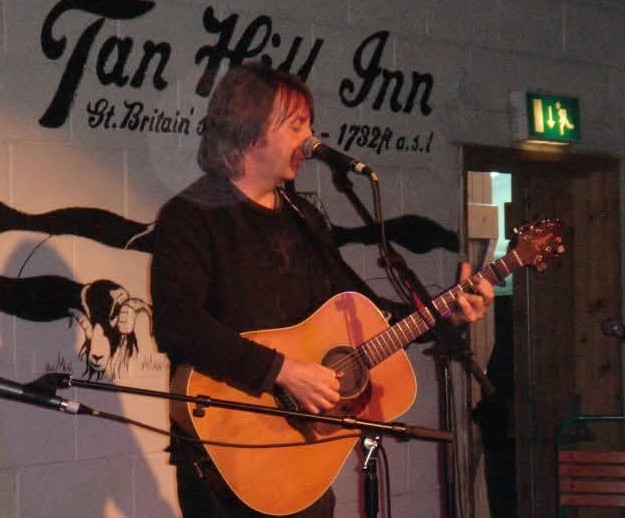
I played support to the Levellers at Tan Hill, Yorkshire, the highest venue in England. It went great playing my own songs, really grabbed the crowd by the scruff of the neck and went down well with an encore. The Levellers didn’t like that so I wasn’t asked back! Opening for Ralph McTell was a good gig and I’ve worked with Prelude a lot, I liked your interview with the singer Brian Hume earlier this year.
Terry supporting The Levellers at Tan Hill, Yorkshire.
I remember I played at a festival on the Isle of Bute, Scotland. I was the only one who wasn’t signed to a record company or connected to a famous band. There was Steve Daggett from Lindisfarne, Baz Warne out of the Stranglers, Martin Stephenson who was popular in the 1980s and others out of bands like The Pogues. I thought what am I doing here? I didn’t get signed but really, I never felt out of my depth.
I’ve wrote a few songs about getting knocked down and fighting back. When on stage I wouldn’t introduce the songs as if they were about depression or mental health. They are more about the power inside of you. It’s about dusting yourself off and going again.
I’ve recorded in Newcastle studios like The Cluny. Archie Brown from the Young Bucks was sound engineer. Then I went to Trinity Heights ran by Fred Purser. He was great, a really good lad, he used to be in North East bands Penetration and Tygers of Pan Tang.
What am I doing now? Well, it’s keeping the work rate up. In the last 12 months I released a single, ‘Only News Today,’ two albums and six professional music videos.
For 2026 I’ve got a folk album ready. One of the songs is ‘The Silent Shipyard’ about the closing of the shipyards and mines, all of the industry we have lost. I want a male voice choir on that one with a brass band and violins. Another song is ‘Beacon in the Dark’ about the whaling ships we had on the Tyne.
An idea floating about is a rock opera about John Lennon who was shot and killed in New York in 1980. In ‘Sgt Pepper Survived’ John Lennon gets shot and survives, lies in a coma for many years, wakes up and reveals his thoughts about world events today.
One scene is him sitting in a bar talking to Eric Clapton and Jimi Hendrix – yes, he lives as well. Lennon is also interviewed on stage where he is asked what he thinks about today’s shows like X-Factor, bands like Oasis and social media Spotify, Facebook and Instagram. I’m always thinking of these ideas.
If I have any advice to young musicians, it’s that if you enjoy your music, you’ve made it. If you don’t best just pack in and go do something else.
How’s the stats so far this year? Numbers from the UK and USA with regular hits from the European block of Spain, Italy and Germany plus a sudden spike from Ireland.
So, it’s big thanks to readers taking the total views over 410,000 since knocking out the first post in February 2017 which was an interview with one of the original New Wave of British Heavy Metal bands Mythra.
This post features another batch of North East stories from this year with links to the full interviews at the end. First up are Hartlepool based VaingloriousUK who got in touch in July.
‘We began seeking out, tidying up and uploading historic – and sometimes hysterical – video footage of music associated with the North East. The VainGloriousUK channel currently has up to 170 videos uploaded’.
‘One of these was the appearance of Brian Johnson’s first group Geordie. Recently we learned that our copy appears to be the only one still in existence when we were contacted about it being used in a forthcoming documentary about Brian’.
‘Most musicians are flattered that we care so much about their music, some are a bit wary about how their historical musical legacy may now be viewed – what you thought was important at 16 is not the same when you are 66!’
North Tyneside Actor & Theatre Producer Alison Stanley got in touch and talked about her latest project ‘Tits Up’.
‘A couple of years ago a young friend of mine was diagnosed with breast cancer, people think it’s older people who develop this disease, so I wanted to raise awareness of this’.
‘Last year I found a lump and experienced the process of going to the breast clinic. Fortunately, my lump wasn’t anything of concern but it did make me think’.
‘Even though I was fine I began questioning my own mortality and spent nights wondering what would happen if I had cancer? What would’ve happened to my son who is autistic?’
‘I went along to Live Well with Cancer in North Shields where the ladies were kind enough to share their stories with me.’
In June we had a severe Heed Case – musicians Newts Newton (ex Angelic Upstarts guitarist) and Si Cadelik (Northumbrian Psych rock bassist) filled yer in about their new album.
‘The new album explores gaslighting, narcissism and entitlement. All three elements feature heavily in populism and identity politics. Social media allows this to flourish, elbowing aside balance, objectivity and critical thinking. This emboldens extremists and those who seek to radicalise people with their brand of hateful rhetoric’.
‘Rather than tackle the causes of problems, the trend is to scapegoat. This should be a worry and concern for everyone, not just two people in a band. One day, that scapegoat might be you!’
‘We’ve been involved in music since our late teens, so that’s approximately 40 years and counting. In some ways it feels like forever, in others, like only yesterday’.
In July playwright Tom Kelly talked about writing a number of musicals including the work of Tyne Dock born author Catherine Cookson.
‘Tom & Catherine had its premier at South Shields Customs House, it was really exciting. All the team were really nervous on the opening night but when the overture began, we all felt it was going to be a success. And it was. It had a ‘sold out’ run. A measure of its success was that me mam wanted to go every night! And she was not a theatre-goer. She loved ‘Tom & Catherine.’
‘The play was first produced in 1999, and again 2001. In 2006 there was an outdoor performance at Bents Park, South Shields in which Jade Thirlwall (Little Mix) appeared, and most recently in 2019’.
Now living in South Shields, retired teacher Rosie Anderson still feels there is work to do and more stories to tell.
‘Sometimes I feel as though I’m just getting started. I sing whenever I can. This year my musical partner Adam Holden and I have played at The Watch House in Cullercoats, The White Room in Stanley and Cockermouth Festival which were all great. I’m determined not to just bow out because I’m getting older’.
‘I grew up in Wylam in the Tyne Valley, in a house full of music. Both my Grandparents played piano. My dad listened to The Beatles, both parents loved the theatre and musicals and they took me and my brother there – I still love all that’.
‘When I was a kid I told my parents I wanted to be a performer but they were worried I wouldn’t be able to afford a home like them, they wanted me to have a ‘proper’ job. They wouldn’t let me study performing arts so I trained as a teacher’.
‘My first job was in Benwell, Newcastle. Then I went to the Middle East where I spent 10 years teaching in Kuwait and Qatar, before returning to Newcastle. I taught at Walkergate Primary School where I would do all the music shows and drama productions. Loved doing the shows there, I never gave lyric sheets out to the kids, they learned by listening and singing the songs back’.
‘When I left teaching I saw an advert for facilitators for Singing for the Brain with the Alzheimers Society. I really loved doing that. I did that for six years until covid hit. Singing on-line with people on the screen in front of you didn’t work really’.
‘People love stories in whatever form, be it a book, a film or a song. Some people write songs about being in love, and about their feelings. My songs are mostly about people and places. I find stories present themselves to me and I take them and turn them into a song’.
‘There are two songs that I have written that stand out for me. Sally Smiths Lament was written after my husband Chris and I worked on a film about soldiers from County Durham during World War One’.
‘Sally was the wife of miner Fred Smith, who featured in our film. They lived in a tiny terraced house and every day Fred and his sons needed a bath, a clean shirt, a clean bed and a dinner. The kids needed to get to school – how did she cope with all that, especially when Fred was away at war. I wanted to give Sally, and all the women like her, a voice.’
‘When I wrote it the song just seemed to be presented to me, her whole life. I got to sing it at a celebration in West Auckland and her family came to hear it – it was very moving. It travelled well and won three competitions – the Newcastle Folk Club, Rothbury Traditional Music Festival and first prize at Morpeth Gathering’.
‘I can’t just decide to sit down and write a song – some people do and I applaud them for the discipline but I have to wait until they come. Three things happened to me in my life that I put together in a song called Breakdown’.
‘When I was a kid I lived at Chapel House Estate in the west end of Newcastle. One night me, my mother and a friend went for a walk. This woman came out of her house in her dressing gown, she wasn’t in control of herself, didn’t know what time or day it was. I had never seen that behaviour in an adult before. Now I believe she was having a nervous breakdown’.
‘That always stayed in my head and another one was when I was living in Fenham. I went to the shops with my children who were only small then, and a woman came out of her house with a letter and asked if I would read it to her as she was confused and couldn’t understand it’.
‘Then about 30 years ago I went on a blind date in Newcastle with this very nice bloke. He said I need to tell you something before we go any further ‘When I was working in Canada I had a nervous breakdown in the car park of a Burger King’. It was hard to concentrate on anything else after that’.
‘But I remembered those incidents and those three individual people are lodged in my heart for their own traumas. They gave me that song’.
‘This year we went to Kjerringoy a former trading post in the Norwegian Arctic Circle, out in the middle of nowhere, it was beautiful. A family ran it in the 19th century and had 3000 fishermen working for them, catching and processing thousands of tons of cod’.
‘The father and husband died and the wife continued to run it single-handed for many years until she eventually remarried. I asked the locals if there was a song about her and there isn’t. So that’s my next song – Annalisa from Kjerringoy. Her story needs to be told’.
‘I’m also aware we need to start telling more stories about people and their lives and jobs today otherwise in 100 years time there will be no one singing about us!‘
‘What does music mean to me? It’s hard to describe it, it’s so deeply embedded, there’s no life without it. Music is at the core of my being, there is no day without singing and because I have grandchildren now I have a new audience! We sing folk songs and songs from musicals, they’re word perfect when they sing them back’.
‘Music gives such joy, when I was singing with the Alzheimers Society the collective joy and reminiscences of songs from the past and enjoying it together was just so valuable for the families’.
‘We had people who wouldn’t sing at all but liked being there and that was fine. Once, two women brought their mother to a session and she sat between them. She didn’t communicate at all, had her head down, closed off you know. But when we started singing a song, I can’t remember which one, she lifted her head up and actually got up and started moving around in the middle of the circle’.
‘One daughter got up and started dancing with her. When we got to the end of the song the daughter turned round and said to me ‘She’s just said my name for the first time in years’.
‘Music gets right in there (pointing at heart) we’ve got to keep it going and expose our youngest children and oldest adults to music because it really does reach parts that others can’t reach. It’s like hearing the heartbeat in your mother’s womb’.
‘As a child I wanted to do music, as an adult I taught it with kids then people with dementia, despite my age I’m still committed to what I always wanted to do. Women who’ve had careers and families can still chase their dreams’.
Tyne Dock in South Shields was an interesting part of the town to live, with its churches, terraced houses and huge industrial Victorian arches next to the river. It was in the early 80s when a lot of the old housing stock was being demolished and in Porchester Street I watched Ascendency being filmed. Julie Covington of hit TV show RockFollies was the star, not long after that The Machine Gunners was set in Porchester and filmed for BBC TV.
‘Up to when I was 7 year old I lived in Porchester Street. It’s not there now but St Mary’s Church around the corner is where I used to sing in the choir and the scouts’ said Tony.
‘Now I live on the Lawe Top beside the roman fort. It’s almost aspirational for someone who comes from Tyne Dock to wind up being a skuetender’ (native to the Lawe Top).
‘I’m proud of coming from South Shields and when you were young trips to the fort were absolutely mind blowing. The area it’s in is incredible, with the whole vista of the river and parks and beach nearby – we’re lucky here’.
Being a former Tyne Docker now Skuetender he’snot wrong there. Tony featured on the site back in May 2018 talking about storytelling and songwriting and what music means to him.
‘I turned back to folk singing in 2017 after the government education cuts made it too expensive for schools to have extra-curricular practitioners, like me, to come in. Before that I was storytelling in schools for 20 years covering hundreds of issues such as the steelworks when I was in Ebbw Vale, the Romans here in South Shields, the coal industry and iron stone mining in Teesside and Northumberland. It was an extremely successful time’.
‘Storytelling is very important, its communication, social history, emotional control, drama, its use of vocabulary. For me it was learning how to be a performer and developing stamina to be able to do four hour sets a day, then drive 100 miles to go to a hotel, get up next day and do it again’.
‘Cities like Manchester, Oxford, Cambridge, all over the UK. I’d stay in these areas year after year for a fortnight at a time and, unlike a music tour where you could be in Aberdeen one day and Bournemouth the next, I’d plan easy distances to plan a route back home – loved the life.’
‘Then around 2009 I got an email. The message was ‘would you like to tell stories in Argentina?’ I wasn’t sure it was kosher at first but I received a phone call a few weeks later confirming it was. I was given contacts of previous storytellers who recommended it’.
‘Me and my wife went out and ended up over the years going to about 15 countries for six weeks at a time. They were international schools where the kids had already learnt English but mostly from American cartoon shows and they wanted them to hear colloquial language, more English. With my accent, I knew I would have to speak a bit slower – and there’s nothing worse than a posh Geordie!’
‘When we were in a Spanish speaking country, for the youngest ones, you’d have someone to explain the context of the story and then I’d still tell the story in English. Half of their lessons were in English, to make it an immersive experience’.
‘To accompany the lessons it was helpful to use British sign language, or borrow a guitar. I always took a banjo with me as it was such a different instrument for them to hear. Once the banjo was broken en-route and we found the only banjo repairman in Bogota in Colombia’.
‘It was hard work getting up at 5am, into a taxi for a two hour drive to tell stories to 3-400 children in ampitheatres – but what an experience! The last time we went over was Peru in 2016. We’d been to Uruguay, China, South Korea, all over – loved it. Sometimes I look back and think how did that happen – you’ve got to seize every opportunity’.
‘I’ve been songwriting for years and always have a songwriting project on the go. I write about 15 songs per year. Ideas can come from a book, a documentary or what someone says in a street… then I do a lot of research and add some ‘meat’ to the story. Songwriting can possess and obsess you’.
‘Recently I wrote a number of songs about Iron Stone Mining, the workers and how dangerous it was working there, although I do try to stay away from disaster. It’s not all ‘Grim up North’.
‘A friend of mine gave me a diary about his distant relation who had been captured by the Portugese and transported to Portchester Castle in Hampshire! Having lived in Porchester Street I didn’t know about this place. The songs can take you anywhere!’
‘I wrote a song with local playwright Tom Kelly about ‘the seven lads of Jarrow’ who, in the 1830s worked in the mines under diabolical conditions so tried to form a union with union organiser Tomas Hepburn. They ended up being brought up on jumped up charges – 10 were captured 3 escaped. 7 ended up in a kangaroo court and were transported to Australia never to return. It’s such an emotional subject’.
‘In 2019 I was planning to write autobiographical songs, one was about the day they tarmacked the cobbles in Porchester Street and as kids we could roller skate across the street. Another was the times walking through Tyne Dock arches with my dad and me being on his shoulders. Or another about my sister playing with her friends in the backyard in Porchester Street – then covid came along’.
‘I didn’t want to write about the pandemic or what happened around it, like being scared or having a feeling of waiting for death to come. I wrote nothing about that. I just wanted to write about the one’s I love and keep sane’.
‘All the performances I did in South America and all of the daily storytelling work I did in schools I now channel into what I present now as a musician. I still do regular open mics, folk club spots and am a paid guest in clubs and festivals throughout the UK’.
‘I love performing, it’s like an out of body experience. I’m not hippy dippy, mystical or spiritual but enjoy giving people enjoyment, sharing moments with people…and it beats the hell out of singing in the bathroom!’
Tony has placed all of the stories, CPD and instructional DVDs for parents and children on You Tube at ‘Tony Wilson Storyteller.
Terry Patterson had one foot considerably smaller than the other so wore a calliper.
“It’s known as a clawfoot. I was bullied by school gangs so decided to fight back”.
From gutting fish, to boxing to heartfelt poetry – this is Terry Patterson’s story.
Born in North Shields in 1956 Terry attended Ralph Gardiner Secondary modern school, he left with no qualifications but was taken on as an apprentice fish filleter at North Shields fish quay.
“Working on the fish quay was hard but good fun. Weighing, icing and boxing salmon to begin with, then learning how to fillet various types of fish and how to drive a popper lorry. I tell ya’ the smell took some getting used to”.
With school bullying still fresh in his mind, Terry joined North Shields Boys Boxing Club where he was taught by ex-professional Joe Myers.
His boxing career lasted a total of 22 years, in that time he worked in the shipyards and had been a school caretaker.
A couple of years ago I interviewed ex-boxer now coach Preston Brown from Sunderland.…”Yeah I know Pasty Brown very well” said Terry. “Over the years I fought a few Sunderland lads. Derek Nelson was a classy boxer who turned pro. I fought two ABA finalists in Gordon Pedro Philips and Willie Neil. I fought Pedro in the North Eastern Counties final but lost. Both lads were well schooled”.
“Willie’s coach asked if I’d fight him one evening because his opponent hadn’t turned up. I weighed in at 10st 6lbs (welterweight), he was heavier than me by 6lbs. I knew his reputation for knocking people out. Norman Fawcett negotiated with his team and £50 was slipped into my hand for taking the fight”.
“Willie could bang a bit – so could I – but he had me down three times during our bout. We set about each other unleashing hell for three fierce rounds. I had him going at one point after landing a good left hook but the bell sounded and my chance to finish him had gone”.
“Gordon and Willie are still good to this day – it’s been 36 years since we shared a ring. I see them at boxing dinners and Boxing Club Reunions. Both of them bought my novel ‘Like Mother Like Son’.
In over 200 bouts Terry won national honours and passed the advanced ABA coaching exam plus he was involved with coaching youngsters until 1986.
After an industrial accident left him unfit to continue his love of boxing, Terry was determined to focus on another sport and won the Disabled Sport England Snooker Championship five years in a row.
“I qualified as a UK professional snooker referee and got a call up to referee the Maltese open in 1997” said Terry.
In 2002 he became North Tyneside’s first World Professional Snooker Coach. He coached at Wallsend Supa Snooker for disabled and able-bodied youngsters, but after a fall on icy roads, not only had he injured his back, he suffered from a dark depression.
Terry added “I was diagnosed as clinically depressed. It’s something I just try to get on with. A surgeon advised me to take up knitting – no I didn’t – but I was determined to excel at something.”
Throwing himself into a number of academic courses at North Tyneside College Terry volunteered at Newcastle’s Percy Hedley training centre working for clients who had cerebral palsy.
He spent over five years working in various care homes until the injuries he sustained over the years got the better of him.
“Depression is something I’ve dealt with my whole lifebutI feel life still holds challenges for me”.
With an interest in poetry and short stories he began to spend his time writing. To date Terry has produced 46 novellas and three novels ‘Like Mother like Son’, ‘He Who Rides a Tiger’ and ‘Living with Grandpa’. His writing is free to read on Movellas.com.
“I’ve also written plays – two of which have been staged in various theatres. ‘Reaping the Benefits’ and ‘The Redundant Blade’ which was written as a tribute to Tom Hadaway”.
“We were only four days from staging ‘The House Across the Road’ when covid broke and we lost cast members. Eighteen months later we tried again and two days before the production two young cast members took ill. My producer and I lost a lot of money and we decided to walk away and the group disbanded.”
Prolific North East Writer and theatre producer Alison Stanley and cast will be reading one of Terry’s plays at Laurels in Whitley Bay, at 2pm on Thursday 22nd August. ‘A Home for Willie’ raises awareness of dementia.
Terry explains “At 68 years of age I’ve never done any for personal gain, never made anything from it butwould love to have one of my books or plays made into a television programme or series”.
“I would like to follow where Catherine Cookson and Tom Hadaway left off. I hope that one day when I’m no longer around I’ll be remembered like the people who inspired me”.
Tom Kelly is a short story writer, playwright and lyricist now living further up the Tyne in Blaydon. He’s written a number of musicals with the late John Miles that have been produced by The Customs House, South Shields, including the work of Tyne Dock born author Catherine Cookson.
‘Tom & Catherine had its premier at South Shields Customs House, it was really exciting. All the team were really nervous on the opening night but when the overture began, we all felt it was going to be a success. And it was. It had a ‘sold out’ run. A measure of its success was that me mam wanted to go every night! And she was not a theatre-goer. She loved ‘Tom & Catherine.’
“The play was first produced in 1999, and again 2001. In 2006 there was an outdoor performance at Bents Park, South Shields in which Jade Thirlwall (Little Mix) appeared, and most recently in 2019” said Tom.
His two football plays I Left My Heart in Roker Park (1997 & 98, 2004 & 2014)and Bobby Robson Saved My Life (2019) toured the North East and were well received by audiences and critics alike.
“I Left My Heart in Roker Park’ is a one-man play that looks at the life and football times of an avid Sunderland supporter. As more than one have said of the play, ‘it makes you laugh and cry” said Sunderland fan Tom.
His new book ‘Walking My Streets’ is his fourteenth and thirteenth published by Red Squirrel Press. Tom read at the Lit & Phil, Westgate Road, Newcastle, Cullercoats Library and The Word in South Shields to promote the book.
“I’ve already read at a number of venues and thankfully it’s gone down very well. As it says on the books cover, ‘Walking My Streets’ explores in prose and poems Kelly’s life and the changing face of his native north-east of England’.
Walking My Streets is available from Red Squirrel Press.
A North East icon will celebrate her 100th birthday with the launch of her new book of poetry at The Word, South Shields.
Helen is one of the few surviving ENSA (Entertainments National Service Association) members from WW2 – the elite troupe who entertained military personnel. She joined ENSA at 15-year-old and toured the UK singing and dancing.
Helen was born in London on May 30th 1924 near the London Palladium. “I was bitten by the showbiz bug as a young girl and fortunately I could sing and dance well, so I was able to follow my dreams”.
Helen started her career aged eight and at 14 performed in her first professional pantomime, Dick Whittington, at the Winter Gardens in Morecambe.
During the war Helen married Colin Hillcote, who ran a dance hall in Belfast. “It was an exciting time there, too”. At the end of the war the couple returned to South Shields, Colin’s home town, and she has been an adopted Sand-dancer since 1946.
In the 1950s Helen was singing at church events and played many roles as member of the South Shields Amateur Operatic Society. A friend who performed in working men’s clubs heard Helen sing and invited her to step up on stage.
“From there I became an artist in my own right, singing and dancing throughout the region” she said.
“We didn’t have a phone in the house so I’d take calls on the local public telephone box to tell me where I was playing that night! Sometimes it meant getting a bus to Newcastle and then catching another to Stanley in County Durham, or Ashington in Northumberland, then heading back after 10pm – all the time humping my guitar and other equipment. I had no helpers!”
“When guitar groups became popular in the 60s I had to stop dancing on stage because of all the leads and wires. That’s when I took up the guitar and later started writing my own songs.”
In 1965 a Vaux beers television advert came calling and a number of variety shows were filmed at Tyne Tees Television, including a double act with Bill Pertwee of Dad’s Army fame and working with Dick Emery. She was a contemporary of North East legends Bobby Thompson, Bobby Pattinson and Dick Irwin, all of whom she knew well and regularly worked with.
Her TV and film appearances include When the Boat Comes in, Supergran, Catherine Cookson adaptations, Highway (during which she sang with Harry Secombe), Emmerdale, The Fast Show and Billy Elliot.
On stage, Helen’s credits include performing in her self-penned plays Off the Shelf and Keep Calm and Carry On. She was also an original Dirty Duster, a play which transferred to Newcastle Theatre Royal and sold out twice. Helen was still performing in the Dirty Dusting tour until the age of 90!
She was also part of the hugely popular Angels of the North variety group with the two other original Dirty Dusters – Jean Southern and the late Gwen Doran. Their shows, mostly of original material, were self-written and performed to sell-out audiences all over the region.
Regular successful contributions to BBC Radio 4’s Poetry Corner sparked Helen’s creativity, she started writing in the 1970s and returned to poetry during the Covid lockdown.
Her new book of poems “Oh! Life is a Joy” will be launched at a free event in The Word, South Shields Market Place at 1pm Thursday, May 30th.
There will also be an ’in conversation’ with Helen to mark her remarkable life and career. All profits from the book will be donated to cancer charities. Helen successfully fought off breast cancer a decade ago.
Hard working Bill spent 34 years as a railway driver and 20 years on Newcastle City Council. Being a keen cyclist, he is one of the few people to have completed an around the world bike ride.
“The highlight had to be the scenery in the Rocky Mountains, USA, the geysers, hot pools and volcanic activity in Yellowstone Park. I followed the Rockies for over 1,000 miles through Colorado, Wyoming, Montana, Idaho and Oregon with much of this being wilderness area”.
When the pandemic hit in 2020 Bill took solace in the music he loved. He attended songwriting workshops with artists he had been a fan of such as Beth Nielsen Chapman, Mary Gauthier, Gretchen Peters and Dan Whitehouse. When folk clubs opened back up after lockdown Bill stepped out to perform.
“I really enjoy playing local folk clubs where audiences are always attentive and often sing along. My favourite folk club is The Bridge Hotel in Newcastle which is the longest running folk club in England on the same premises. They’re a great crowd”.
Encouraged by this warm welcome, he spent 2023 honing his work with producer Dan Whitehouse and then recorded his debut album. ‘Closer’ is a delicate collection of heartwarming folk songs that tell political and historical stories as well as tales of love and loss.
“We recorded all the foundation tracks of vocals and guitars live in my living room in Gosforth”.
As well as producing Bill’s debut album, Dan also played lead guitar and added backing vocals plus several of Bill’s friends and family contributed to this intimate collection of songs.
French speaking Christine Durand reads poetry, Kathy Wesolowsk lends operatic vocals, Bill’s grand-daughter Chloe Weston is the lead voice on a song written by Bill on a songwriting retreat lead by Gretchen Peters and Mary Gauthier.
The recordings were shared with Gustaf Lljunggren (John Grant/Eddi Reader) who added Pedal Steel, Accordion and Rhodes Electric Piano from his Copenhagen studio.
“Dan Whitehouse had worked with Gustaf before. He introduced me to Gustaf’s music and once I heard him, I knew that he was the musician I wanted to have playing on a number of my songs”.
“Gustaf is experienced in working remotely – adding delicate overdubs, without overcrowding the musical landscape of my record”.
Cover art by Ruth Bond.
Next stop on the album’s journey was London…
“I’d a longing to add strings to ‘Fools and Princes’ – with it being based on Romeo and Juliet, I had a vision of a romantic string arrangement being effective, Dan suggested Alison D’Souza (The Little Unsaid) in London as he’d worked with her previously and what she played really brought my dream into reality”.
“Harriet Harkcom’s voice I knew from Dan’s own releases as she has sung on most of his albums, I was pleased when she accepted my invitation to sing on ‘Goodnight Vin’. I’d like to think if Vin was around he would love her voice on this song too”.
With recording completed, final mixing and mastering of the album was by John Elliott.
“My hopes for the album are that it will allow me to reach a wider audience, commercial success has never been my main aim. Like any other singer-songwriter I just love sharing my songs with people”.
For the near future Bill has no plans to tour the album…
“I sing in local folk clubs twice a week and I’m happy being involved in this local musical community. I prefer small intimate venues packed with friends and other singers”.
The album is available to order now on CD and digital via bandcamp >








 ALIKIVI UK : NORTH EAST MUSIC & CULTURE