Newcastle band White Heat released three singles and recorded one album, signed for Virgin records in 1980, opened for Judas Priest and headlined London’s Marquee. People remark of a band that ‘shudda made it big’. They set alight to the Tyne but sadly not the Thames.
Previous interviews on this site with guitarist Alan and vocalist Bob Smeaton detail the journey of White Heat and The Loud Guitars who followed.
Bob went onto a successful career in TV & Film while Alan told me ‘The Attention Seekers were formed around 1999, our first album was released in 2002, we have released six albums and a seventh is in the final stages’.
For the past 10 years Alan has also toured as a session musician with American singer/songwriter Jesse Terry.
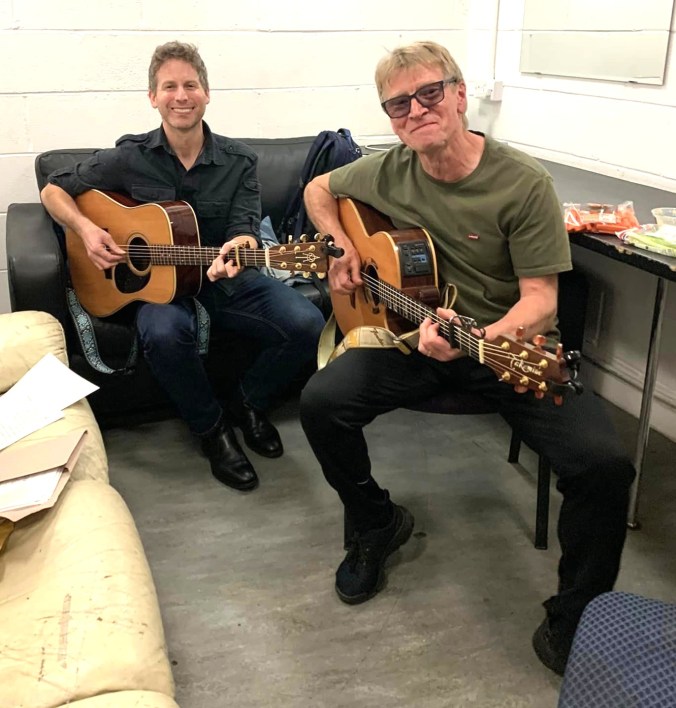
Alan and Jesse backstage Newcastle Cluny 2023.
‘However, to my surprise, at a number of gigs in the Netherlands audience members shouted out requests for White Heat songs. Nervous Breakdown and 21 and Wasted were hastily added to the set. Our songs had travelled far further than White Heat ever did.’
‘I look back on my time with White Heat and The Loud Guitars with great affection and have revisited and re-recorded a number of songs from those heady days. Promo videos are on You Tube for Chain Reaction, Is It Too Late?, A Long Way From Home, Do Me A Favour and Out Of Me.’
‘Recently I travelled even further back in time to the pre- White Heat days when we were playing under the name ‘Heartbreaker’. I always felt that the song Hard To Lose should have been recorded. My former band members were more than happy for me to reinvent this live favourite and Your Poster On My Wall is the result.
‘In 2017 I was approached by Newcastle Utd to develop a new version of anthemic song The Blaydon Races. My version The Fans – The Blaydon Races was accepted and I was informed they would be using it till the end of the season. It’s now 2026 and still being played at every home game. It’s now officially the most downloaded-streamed version in digital history. As a Newcastle supporter I am beyond proud.’
‘Pre 2017 Newcastle United were a club underperforming and floundering under a curse. A number of theories including ’The Gypsies Curse’, The Witches Curse’, ’The Burial Ground Curse’ were all to blame for this continuing pattern of failure. However, I think the problem lay closer to home.’
‘The version of The Blaydon Races the club were playing pre 2017 was recorded and performed by musician Alan Price (The Animals). I have it on good authority that Alan Price was an ardent Sunderland supporter. This was the problem hiding in plain sight.’
‘It’s no coincidence that since 2017 we have retained our Premier League status returned to the European Champions League and after 70 years in the wilderness have won silverware. Yes, indeed it’s all down to The Fans version of The Blaydon Races and not a Sunderland supporter within sight. That’s my theory and I’m sticking to it.’
‘The relative success of The Blaydon Races has allowed me to independently fund recording studios and top end musicians – who aren’t cheap. It gives my songs the best chance of having radio appeal. Iconic station Radio Caroline named The Attention Seekers track The Prudhoe Song, song of 2025. Many thanks to presenter Steve Anthony.’
Multiple media outlets have used recordings from The Blaydon Races sessions including Amazon Prime, BBC, ITV, The Bauer Media Group and the 2024 SELA Quayside 3D light show event. An unofficial Saudi version is on YouTube.
Both The Blaydon Races and the Carry me home outro from The Attention Seekers song Seven Bridges were used creatively on the Carabao Cup ITV video as the soundtrack to the historic Victory Parade.
‘This has raised the profile of the song and recently Newcastle United have asked me to develop a bespoke mix of Seven Bridges to integrate into their half time playlist. It’s now being played. As a lifelong Newcastle United supporter I’m on cloud 9!’
‘One of the highlights of 2025 was performing Seven Bridges with City Of Newcastle Male Voice Choir, Some Voices Choir and St. Teresa’s Primary School Choir as part of their Christmas Charity Concert.’
‘I’m presently working with City Of Newcastle Male Voice Choir, developing a choral arrangement of Seven Bridges to be included in their repertoire and to be recorded and released. It’s quite a departure from the days of White Heat.’
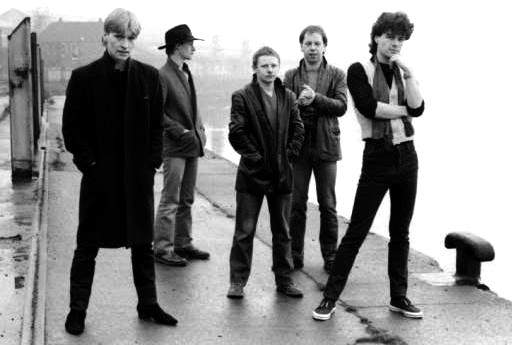
Promo shot of White Heat with Alan on the left and Bob Smeatonon right of picture.
‘The first release of 2026 for The Attention Seekers is Sweet Anna Brown. While unsuccessfully trying to track down an old friend and finding myself disappearing down numerous rabbit holes it occurred to me that this would make an interesting topic for a song.’
‘We step into the controversial world of social media and whether we like it or not it looks like it’s going to be with us for the foreseeable future. The character Anna Brown is one long mystery and doesn’t appear to have any social media presence.’
‘I’m rapidly closing in on a new album to be released later this year. Music continues to colour my life and long may it continue.’
Sweet Anna Brown is now available to stream-download via all usual platforms. The Attention Seekers – Alan Fish – Vocals, Guitars, Bass, Trevor Brewis – Drums, Tony Davis – Piano, Organ, backing vocals. Produced by Alan Fish, engineered by Tony Davis. Recorded at Cluny Studios, Newcastle.
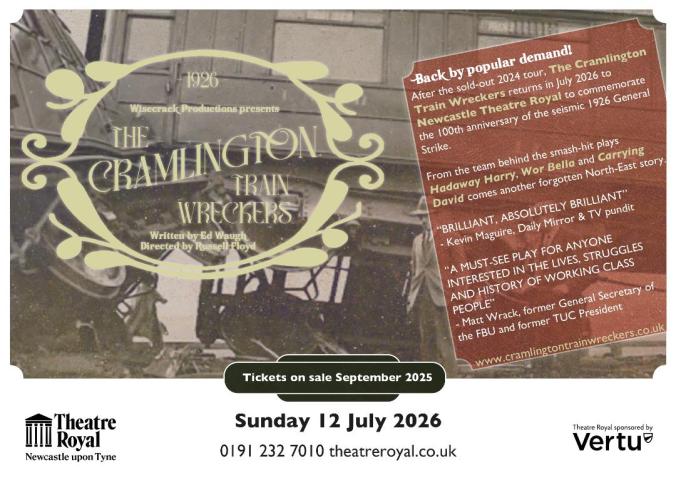
After a sold out stage tour in 2024 Cramlington Train Wreckers is back. The inspiring story of working class solidarity will be staged at Newcastle Theatre Royal on Sunday 12th July 2026to commemorate the 100th anniversary of the national strike in 1926.
The strike was the biggest rupture in society since the English civil war. Miners were asked to take a pay cut to ‘improve productivity’ – really just to maintain the profits of the bosses. North East actor Micky Cochrane played one of the main roles on the tour and is revisiting the play at Theatre Royal.
“The audiences were really good in ‘24. Lots of bums on seats and a great response. A lot of people come with high expectations for Ed’s plays and love what he does.”
Written by Ed Waugh (Wor Bella, Carrying David, Hadaway Harry) the story of the striking miners who accidently derailed the famous Flying Scotsman train in Northumberland is told by former actor and director Russell Floyd (The Bill, Eastenders), and after a very successful Carrying David and Billy Elliott the musical, the afore mentioned Micky Cochrane.
“I had worked with Russell on Carrying David and The Great Joe Wilson. I know how he works and what he brings out of actors. We work really well together.“
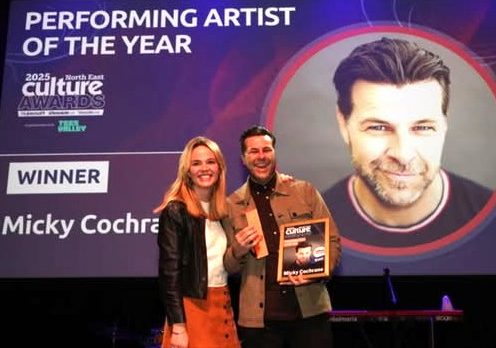
“I also won the North-East Culture Awards Performing Artist of the Year. It was a great reward for the fantastic plays and big roles I played last year” said Micky.
Also starring is Alex Tahnee who was in Romeo & Juliet and Alice in Wonderland “I knew Alex. She was great. The play has lots of information so we had to be on it. We had to help each other out”
“I had heard of the Cramlington Train Wreckers but I didn’t know the full story and main players so it was another chance to learn more about the history of the area.” explained Micky.
Tickets for Cramlington Train Wreckers at Newcastle Theatre Royal on Sunday 12th July 2026 available from >>>
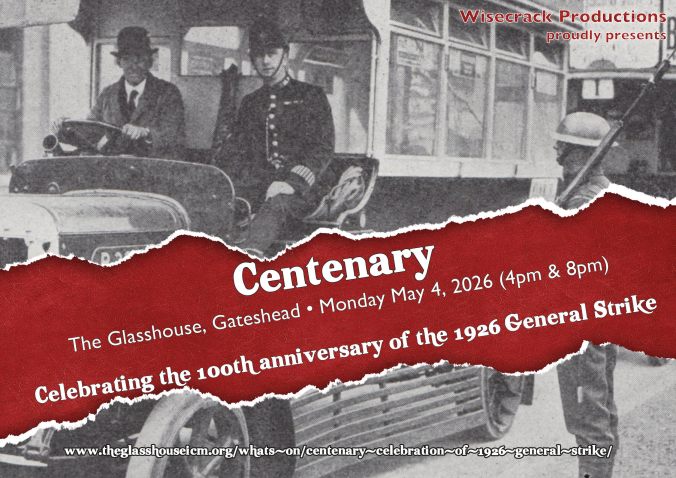
May 4, 2026, marks the centenary of the first full day of the 1926 General Strike where millions of British workers withdrew their labour and challenged the establishment. They believed a better world was possible.
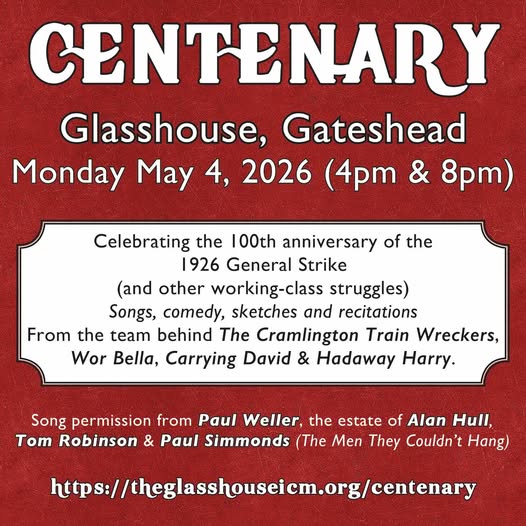
To mark this historical event the same team that brought successful plays Wor Bella, Carrying David and Hadaway Harry are staging Centenary at the Glasshouse.
“We have a great team and the show will be fantastic. We did a very popular show about four years ago called ‘Boris Out’, and look what happened to him!” said playwright and Theatre producer Ed Waugh
“One hundred years ago millions of workers and their families went on strike. A General Strike poses the question of state power, the 1 per cent – the privileged Establishment or the working class – those who actually create the wealth in society.”
“Despite the heroism and sacrifice of the trade union rank and file, the union leaders in the TUC realised the question of state power was at stake – the Russian Revolution nine years earlier had sent shockwaves throughout the world. These TUC cowards sold out the strike unconditionally after only nine days.”
Ed added “Their pusillanimity led to a carnival of reaction against the trade unions and workers by the Tory government. The miners continued their strike for another six months but were starved back to work. We haven’t had a general strike in this country since. But we’ve been close”.
“We have to learn the lessons of 1926 for the next time, which is on the horizon. The 1926 General Strike was a hugely important period in working class history.”
‘Centenary’ will include songs, comedy, stand up and recitations to celebrate the nine day strike. A big addition are musicians Paul Weller (The Jam) Alan Hull (Lindisfarne), Tom Robinson and Paul Simmonds (The Men They Couldn’t Hang) have personally given permission for their music to be played at the show.
“We are delighted to have been given personal permission from these great songwriters. It will be an evening of brilliant musical and comedic entertainment and inspiration.”added Ed.
Tickets are available for ‘Centenary’ at The Glasshouse, Gateshead at 4pm or 8pm on Monday May 4th 2026.
A lot is made of being in the right place at the right time to help bring success. But you can’t get past the sheer amount of hard work put in, every time giving 100% and never complaining. There is no substitute for rehearsal and when the opportunity presents itself you’ve got to be ready to take it. A snapshot of a story taken from Sting’s autobiography Broken Music hits the mark. This all happened within a few heady months during 1978.
The Police went out on a UK tour to open for Spirit led by guitarist Randy California. They won over a hippy audience and released their single Roxanne. Their record company A&M fully supported the record but money wasn’t rolling in yet.
To pay rent on his London flat Wallsend born Sting was still filming a few adverts and bit part in films. The Great Rock n Roll Swindle was one, although his scene ended up on the cutting room floor. ‘I was grateful, however, for the 125 quid at the end of the day’ said Sting.
He also went for a part in Quadrophenia filmed in Brighton. ‘I know that they’re seeing half of London for this role, but somehow I know it’s mine’.
After finishing on the film set in Brighton the record company hired a private car to whisk Sting off to Gatwick airport and jump on a flight to Manchester, finally arriving at the BBC TV studios where The Police were due to appear on the Old Grey Whistle Test. Sting remembers ‘It’s still raining when we land in Manchester. Yet another car and driver waiting to take me to the studio, where we have a sound check. The performance tonight is live’.
After a successful TV appearance a tour of the east coast of America was booked. Second night of the tour The Police are in Poughkeepsie theatre with only six people in the audience. Do they cancel? No. Sting brings the audience down to the front and introduces each other. Then ‘give a blistering set we will ever manage, encore after encore’.
The audience are invited back stage where it turns out three of them are DJ’s. The next day Roxanne makes its debut on USA radio. Within a couple years The Police are one of the biggest bands in the world. Now how did fellow Tynesider Mark Knopfler and Dire Straits knock them off their perch?
(pic. Gavin Webster, Centurion bar, Newcastle. Alikivi Sept. 2025)
I first met Gavin back in 2021 where we are today in the Centurion bar in Newcastle Central Station. He talked about being brought up in Blaydon during the 1960s and breaking into alternative comedy in the early 90s.
I missed out on the workingmen’s club circuit. But there was still a buzz for the whole comedy scene. I’ve been doing this for 33 years, I’m 56 now.
We talked about TV shows we watched as kids – Wheeltappers and Shunters Club, The Comedians and Minder.
It was great. It seemed there was chaos and a caper everyday down London. I wanted to move down there and get to know these types of people, hustling and bustling during the days, loved it.
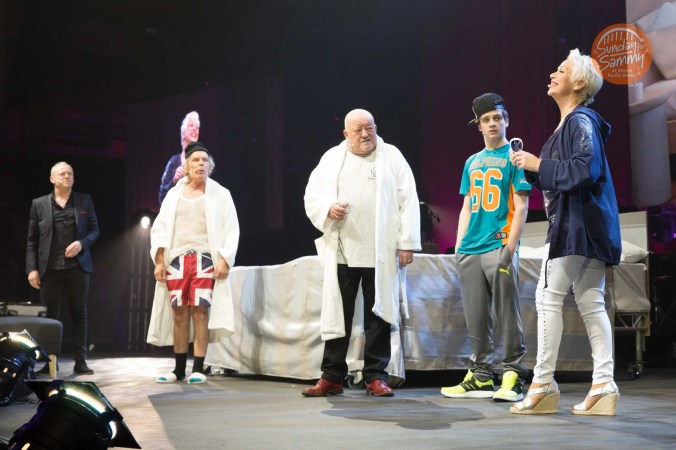
Scene from Sunday for Sammy in 2018.
In 2004 I was at Newcastle City Hall watching an afternoon of Geordie entertainment. Sunday for Sammy concert was organised by Auf Wiedersehen Pet stars Jimmy Nail, Tim Healy and Lindisfarne drummer Ray Laidlaw.
Among the TV, theatre and music talent on stage was AC/DC vocalist Brian Johnson ripping into Nutbush City Limits. A great afternoon. Played to packed houses the show returns to Newcastle every two years.
Yeah about 20 years ago I done a Sunday for Sammy show at Newcastle City Hall. Originally, I think Ray Laidlaw phoned me up about it. I really enjoyed it. In fact, I done it twice, the first time was with the lads from Viz. There was myself, Simon Donald, Simon Collier plus a couple of actors and I think the boxer Glenn McCrory done a part. We done a Sid the Sexist sketch. The next time I done my stand-up routine.
There were two shows. A matinee and a show in the evening. The matinee went well and at the later show I went on early because I had another show to do at The Stand in Newcastle. I had played the City Hall with 2,500 people there, a full house, but only about a dozen people turned up at The Stand. That has happened twice in my career.
At the Edinburgh Fringe in 2003. It was a benefit gig for an HIV/AIDS charity at the 3,000 seater Festival Theatre on Nicholson Street. It was a star studded line up and I did a 10 minute slot. My parents came up for the day. After the show I took them down to my other gig where only 11 people turned up. You get brought down to earth with a bump.
My agent at the time told me to go to the Oranji Boom Boom Club in London as it’s a good place to go, people get down there. I played the club on a Wednesday night and did a good decent job, worked hard, took it seriously. But in front of only a dozen people. However, a few year later I done some TV work on Channel Four and the producer came up to me and told me that he saw me at the Oranji Boom Boom Club.
During the past few interviews I’ve asked how do you survive in the arts?
Sometimes it’s been tough. I met a shock jock type of comedian from Australia his father was very rich. He was well supported. He would tell wild stories about how people walked out of his gigs. Now if I done that, I wouldn’t be able to pay my rent. It’s alright if you have unlimited funds coming in.
There has been times without work but I get by. I’ve done some voice over work, small comedy/drama parts. I’ve been in two Ken Loach films. I had speaking parts in I, Daniel Blake and Sorry I Missed You.
I done some of the animal voices on a children’s TV show called Walk on the Wild Side with Jason Mamford. We recorded that in a studio in Wardour Street, London. The set up is you watch the video on the big screen and read through the script. I got to write some of season three. Sarah Millican done it, Jon Richardson, Rob Gilbert, Mark Benton – loads of comics done voices on it.
I totally understand when some actors can end up working in shops and restaurants cos you need a regular income or you can end up skint. Actors need TV shows like Eastenders and Emmerdale. The films and voice overs don’t happen all the time – stand up has kept me going.
What am I doing now? I do a pod cast called Bazookaaah, small stand-up tours, regular gigs at Edinburgh Fringe and the Tyne Theatre in Newcastle. This new show on 21 November is called Glory Be its Gavin Webster. It’s stuff from Edinburgh with some new stuff that I’ve added. I always write a new show every 18 months or so.
Last time at Tyne Theatre was January 2024. For this show I arranged it and done a deal with them just for the one night so it’s not a massive commitment for them. Really looking forward to it.
We’re sitting in the Centurion bar at Newcastle’s Central Station where I first met Leah back in 2021 where she talked about learning her craft in North East workingmen’s clubs from the age of 15, working with Bobby Thompson, touring with Ken Dodd in the ‘70s and appearing in panto with David Jason.
Now, after nearly 60 years in the business I was interested to find out just how did you survive in the arts?
This industry has always been tough for working class. I do promotion and acting, I’ve been writing with Alison (Stanley who featured in previous post) I’m busy all the time. When you’ve asked me is there weeks when I have nothing on, well no, I’m always busy.
Like when I started a production company in Jersey about 30 year ago. We would do plays or musicals but if we went on tour I would always play a role in it keeping an eye on things making sure there were no issues. You take on a couple of roles. That’s how I survive.
You can never say I’ll be working 52 weeks a year. But there was a time you’d wonder where you’ll be for summer season. I remember going to Jersey in March and not coming back till October. Whereas now it’s I wonder if I’ll get a summer season.
Some people take shows out to Europe. My niece Hariet has her own production company and she does a lot of work abroad. Although you’ve got to be careful who you work for.
In the 1970s I took a contract for South Africa when apartheid was in full flight. When I look back, I didn’t understand what apartheid was all about then. You couldn’t pick your phone up and read about it.
It was a total culture shock at 19 year old – like wow here we are in Durban. Then I ended up working in Rhodesia – it’s not called that now. The agent asked me to drive from Rhodesia to Cape Town – a very long way and I did it by myself. My mother didn’t know. I look back and think how did I do that and why!
Comedy and singing musical theatre was what I was doing on the Crazy Horse saloon circuit. It was quite unique for a female to be performing on stage, plus there were plenty other English acts going out. I think some British guys had bought into the Crazy Horse clubs and subsequently tapped into the UK club market.
Back then there were hundreds of entertainers plus it was a real show it wasn’t just a few singers getting up we had all the costumes and gear for a proper show.But as I’ve said back then you couldn’t pick your phone up and read about apartheid. I mean, I lived in Benwell all me life.
I remember flying back home and me ma’ and da’ met me at Newcastle airport. ‘I’m home at last’ I said as I flung myself at them ‘You must be the only lass who’s happy to be in Benwell’ said me Da.
I travelled a fair bit. I went to Australia twice a year for six years in the 80s. I just loved their lifestyle. I also performed at the American military bases in Germany. I remember the agent John Rae from Spennymoor here in the North East organised one tour. There were a few of us and he drove us around in a mini bus. He had all the responsibility and the things we done he must have wanted to kill us sometimes.
All this experience of understanding an audience has helped when I’m putting a show together. You see the show differently from actors who only see it from their point of view.
I remember doing Catherine Cookson’s ‘The Cinder Path’. I had Nicky Cochrane in it who played Steve McDonalds brother in Coronation Street. He was playing Ginger Slater, essentially the baddie. I gave myself a character called the fishwife who kept the story going and throwing a few laughs in as it was heavy going.
One show we were doing a matinee at Billingham Forum. I was waiting with Nicky to go on stage for our scene when he turned to me ‘Leah, this is a tough crowd’. I replied ‘Farringdon Social Club was a tough crowd this is a walk over’. A bunch of pensioners on the front row who might nod off would not present a problem.
Club audiences had a reputation for being tough but that was only because they weren’t there prepared to put up with anything. You had to be good. You had to know your stuff. That’s been a great backbone for work that I do now. How to read an audience. They’ve paid their money and tickets can be pricey for a whole family so you have a responsibility. That crowd need to be entertained.
I was brought up in variety but now I only do one variety show a year that’s the Silver Bells Christmas variety show for three nights at the Phoenix Theatre in Blyth. Looking around there were a lot of young people coming up but their take on variety was different from mine. I was old school. I’m not saying it was better in my day just different. So, I thought to keep working I’d just change what I’m doing. I’m going to step up. I went and done panto as well that led me to acting which I really enjoyed.
For the Blyth variety show we do sketches and a few gags a typical show I really enjoy it. I use the pantomime cast so there’s a lot of us on stage and this year it’s with Tommy Cannon who is a good friend. The poster said Cannon & Bell but when it was done large the Bell looked like Ball!
Tommy and his wife were up recently and we got watching some of the old TV shows like Wheeltappers and Shunters Club and yes it was a laugh but we were saying we wouldn’t dare say that type of joke now. Time has moved on. And so it should.
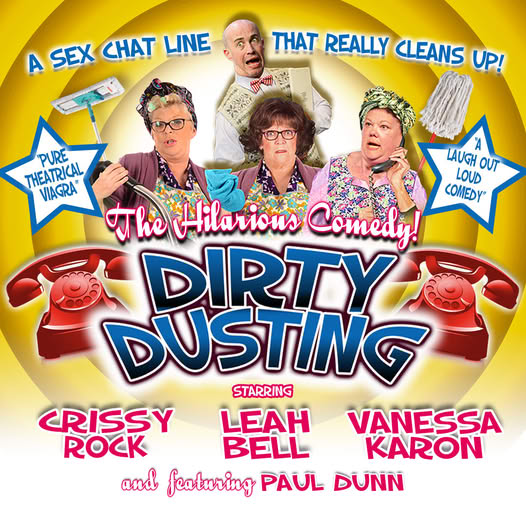
What am I doing now? ‘Dirty Dusting’ written by Ed Waugh is on tour in October. We’ve got my good friend Chrissy Rock (Benidorm) in it with Vanessa Karon and Paul Dunn. Can you believe the show still sells out. It was originally performed over 20 years ago. First time I did it was 12 years ago and it’s been on tour at least twice a year every year.
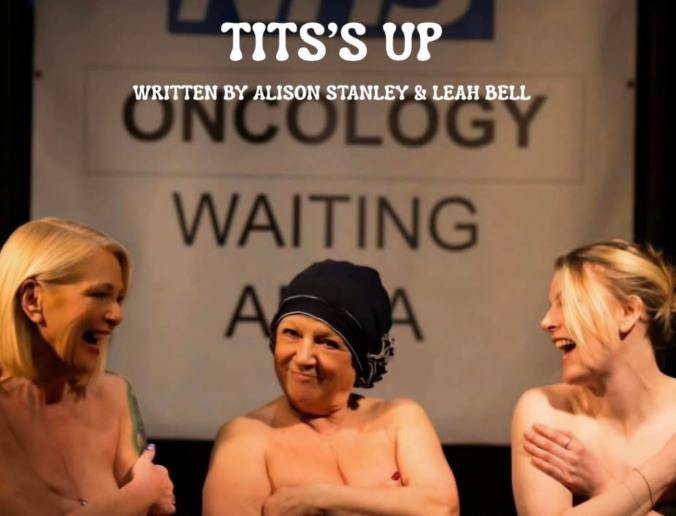
From late November through December, we have ‘Sleeping Beauty’ panto at Consett Empire with Marcus Collins from X Factor then next year Alison Stanley and I have ‘Tit’s Up’ going out on tour. That play is about the relationship between three ladies as they wait in the Oncology department in hospital.
It’s sharp, it’s funny, we wrote it together. Some of the shows funnier bits are added on the spur of the moment and Alison tells me to write them down for the next show cos ‘you might forget it’. My character is nosey she wants to know everybody’s business, she thinks she’s gone for a day out.
We’ve just done a short tour and it’s done well at the box office. On the first performance me and Alison were nervous because some ladies from the Cancer Society were in the audience.
Mentally and physicaly I feel better now than when I was 40. I’m 72 now but I’ve always been energetic and kept busy and turn up early for work. I’m happy to have made the move from variety to acting. The world has moved on and so it should. Would I ever retire? No chance.
South Shields born Vinny Edwards has featured on this site a few times. Type his name in the search bar for previous write ups about his time in the music biz including international chart hit Back Where We Started From which reached #2 in the USA and #8 in the UK. Recently he got in touch and told me another story about one of his songs.
I was living in a flat in Wandsworth in London when I wrote and recorded I Can’t Turn Back Time in 1967. It was my second solo single for United Artists after The Answers broke up. We recorded the A and B side The Lively One at Olympic studios within three hours can you believe!
The B side was used for a commercial for Texaco petrol in the UK and USA. I Can’t Turn Back Time was played mostly on the pirate radio stations London and Caroline. I believe it charted on both stations it also broke into some Northern Soul charts.
In America it was released under the name Tim Love on the Ascot label so I would not be confused with the American actor Vince Edwards who played Dr Ben Casey in the TV series. It was just after this I changed my name to J Vincent Edwards. The ‘J’ I took from Jarra or Jarrow if you were posh.
Later there were two more records on United Artists – County Durham Dream and Aquarius then along came the musical ‘Hair’ and a new record company CBS. They were crazy happy days for a 22year old lad from South Shields’ Ocean Road school.
Link to the American release on the Ascot record label of‘I Can’t Turn Back Time’
Have you ever wondered how working class people survive in the arts and creative industry? From my own experience I can tell you it’s hard. Very hard.
In the early days of the 1990s I had a weekly diet of baked tatties. I’d go to me ma’s for me Sunda’ dinna. I got by.
It’s surprisingly full for a Tuesday morning in Newcastle’s Central Station bar The Centurion when I spot Alison. Looking resplendent in her beret while finishing off a bacon sarnie we find a quieter place to talk. She throws back her head and laugh’s out loud when I ask her have you ever had a proper job?
Yes, I was at the Inland Revenue for years. When I was there, I thought of myself as a resting writer, a resting actor but really found it soul destroying.
Sometimes you have to take jobs that you wouldn’t choose to do to survive in the creative industry. You have to get by. I’ve been lucky that my husband who doesn’t work in the arts, has a full time job and supports me fully as do all my family.
An opportunity to work as a library assistant in North Tyneside Council came up. I love the smell of books so the idea of being surrounded by them was great. I loved being involved when schools came in, I would read stories for the kids and put on various events.
The job was part time so it gave me more time to focus on what I should be doing – writing. I became busier in my creative work and was being offered jobs that I couldn’t turn down so had to decide if I was working in a library or an actor. You have to take the leap, you have to believe in what you are.
I’ve been acting now for about ten years. A freelance creative has always been my career choice that’s in all of my disciplines that I’ve worked in from actor to writer to theatre producer now film making.
I decided years ago to go out and make my own work rather than wait for someone to knock on the door and offer something – that doesn’t happen. You’ve got to get your name out there to increase your network. That would be my advice to anyone starting in this business. You’ve got to take chances. This is what I do. It’s a mind set.
I consider myself as a socio-economic playwrite. I write about subjects that are relatable to people, quite pertinent and pushing boundaries seeing how far you can go. If it makes people laugh, cry or squirm I’ve done my job. It’s important to me to be challenging and turn a spotlight on real issues.
I’ve got a few projects that I’m working on now. Lately we’ve been touring ‘Living the Life of Riley’ around the North East which was great and that is going out again in February 2026. ‘Life of Riley’ has been in the works since 2016.
And another short North East tour for ‘Tits Up’ co-written with Leah Bell. That’s planned for another tour next year. Really pleased with that as it’s sold out now.
That’s a play about three women who meet when they are diagnosed with cancer and how it impacts on them and how they deal with it. Unfortunately, we live through a time where if it’s not breast cancer it’s some form of cancer that lives are touched by. The play is both heartwarming and heartbreaking.
In ‘Tits Up’ there is someone who is diagnosed with cancer and there is the carer who she couldn’t manage without. That is real stress. You’re worried about the situation and the endgame that might be coming.
Of course, we all fall off our seats laughing with the actor Leah Bell but there is a serious side which comes through. There is a balance we have to get right.
My ambition is to produce more plays outside the North East and tour nationally, which ‘Living the Life of Riley’ is already doing and we are working towards that with ‘Tits Up’. We have taken ‘Hard’ to London and it’s definitely something we want to pursue more.
Screenwriting is something else that I’m starting to do. I filmed a scene from ‘Hard’ over two days on a shoestring budget and I loved it plus it has been awarded three times in UK film festivals so that spurs you on.
I’m interested in using latest phone technology for film making and being creative with it, keeping it fresh. I roped in Leah Bell and Tony Hodge (Byker Grove) to be involved. Really looking forward to more. I’m excited about it.
Have I got time for anything else? Me mother Rose was a talented writer but didn’t have anything published. When she passed away last year, I started a writing competition for Working Class Women Over 35. The first winner is announced in October this year and next year the play is produced at Laurels in Whitley Bay.
Also, it’s early stages at the minute but I’m writing a few fictional stories about events that happen in a town. That’s maybe for a book. I’m really enjoying it there is no deadline so it’s sort of like a hobby but we’ll see where it goes. Owt really that stops me getting a proper job!
I met up with Gateshead born Brian Hume and he talked about his life in music and what it means to him now.
‘Music dominates your life. It can often exclude things that you should pay attention to. Personal relationships can suffer cos it takes over your life. All you wanna do is make that sound, make that music, at first you don’t care if you make any money you just do it for the love of it.’
‘Unless you’re all on the same page there’s always tension within bands. You’re living permanently on the idea that it will all come to an end tomorrow. If you’re a guitar player you could break a finger or get arthritis. Somebody might leave and your left high and dry. You might have an argument and everybody falls out, it’s a miracle they stay together. But it can be exciting not knowing what’s round the corner’.
78 year old Brian looks back to when and where he was first inspired.
‘Me mother was very musical she’d knock out a tune on the piano and a four string guitar – all self taught, amazing. That’s where I learnt to pick out a few tunes. Lot of houses had a room where no one went very often, that’s where the piano was.’
It was in Grammer school where Brian first met up with Ian Vardy, forming a duo to sing in Tyneside pubs and clubs.
‘One of the first gigs we played was the 99 club in Barrow in Furness. After two songs the chairman came up to the front of the stage “You’re not really right for this kind of environment”. He was nice about it but, yeah, we were paid off.’
‘The Everley Brothers songs were the go to sound, when we heard their two part harmonies we thought we could do that. We used to play the Bridge Hotel in Newcastle. The folk scene then was vibrant, clubs were always packed out people were singing sea shanties then Paul Simon came along.’
‘Then we’d try writing our own stuff. Our publisher wanted us to be called The Cobblers. You could see the first review – what a load of! We settled on The Carnival – a very 60s hippy name. We lasted for one record – a Paul Simon song called The Big Bright Green Pleasure Machine. The review in the NME read ‘social comment at breakneck speed!
‘Ian and I were singing in our flat in Gateshead. We had just bought the Crosby, Stills and Nash album trying out different songs like Sweet Judy Blue Eyes. My wife, Irene was singing in the kitchen with the door open. She was singing the third harmony. We were totally surprised as we didn’t know she could sing. We turned and said ‘sing that again’. It wsan’t long before we went out to folk clubs and started going down really well.’
‘We lived in School Street, Gateshead and nearby at the end of the Tyne bridge is an old toll booth. A big granite structure. It had a lovely echo. Some nights we’d go in there and sing. One night a policeman came in. He thought we were up to no good. Very officious. But he stuck around listening to a few songs then as he was leaving said “Carry on”.
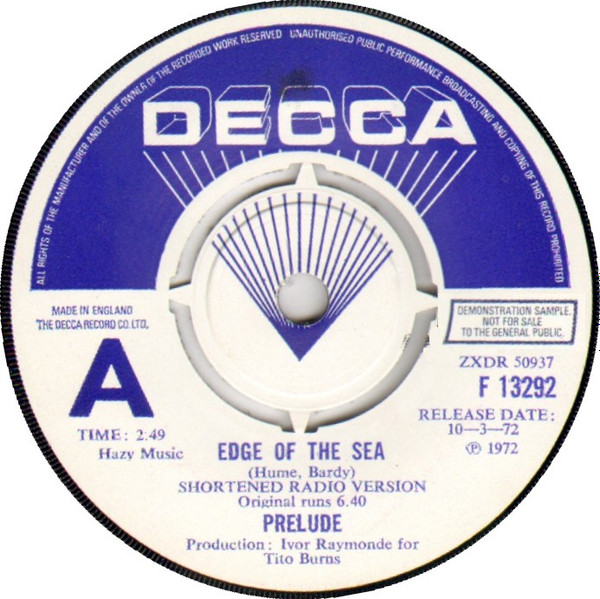
‘We got a deal with Decca Records and recorded a single The Edge of the Sea which had a strong hippy vibe to it. All during that period we were recording in Impulse Studio making demos courtesy of the owner, Dave Woods who soon after ‘discovered’ Alan Hull.’
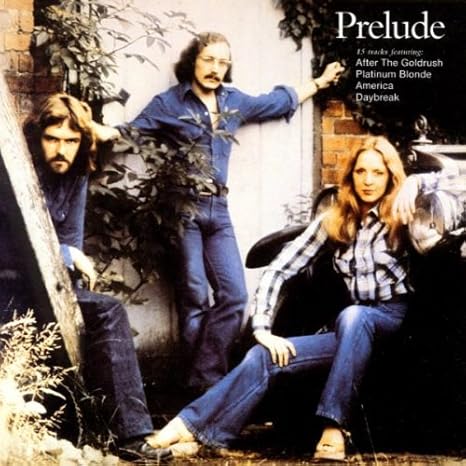
‘We were called Trilogy for a while but had to change it because there was an American band with the same name. It’s not easy choosing a name as any band will tell you. I came up with Prelude and that stuck. That was 1972.’
‘Three part harmonies had a big effect on musicians. A lot of bands had done it like The Lettermen and The Platters from way back, but Crosby, Stills and Nash were different, this was whack right in your face. Yeah, a big influence on us and many other bands including fellow Tyneside band, The Caffreys.’
‘Different members have come and gone but the band were Ian Vardy, me and my wife Irene. Ian and I got a song writing contract with ATV music which worked for us financially. We decided to put both our names on everything we wrote irrespective of who wrote it.’
‘We had a brilliant guitarist called Frank Usher. We parted company and and he went on to play guitar with Fish from Marillion as well as being a fine guitar maker.’
‘We played the North East club scene for a while and in between we’d do Durham College where we’d support artists like Gerry Rafferty, Mott the Hoople, Shaking Stevens and the Sunsets – that band were amazing. There was a hippy commune type band called Principle Edwards Magic Theatre who all dressed in white which looked cool so we copied that – it was a cheap uniform.’
‘Our manager George Carr got us a record deal with Pye who back then were dominated by Max Bygraves selling boatloads of Sing-a-Long-a-Max records. We were the token folk band, although we were never folk they just called us that cos we had acoustic guitars! You couldn’t say that Pye were part of the cultural vibe.’
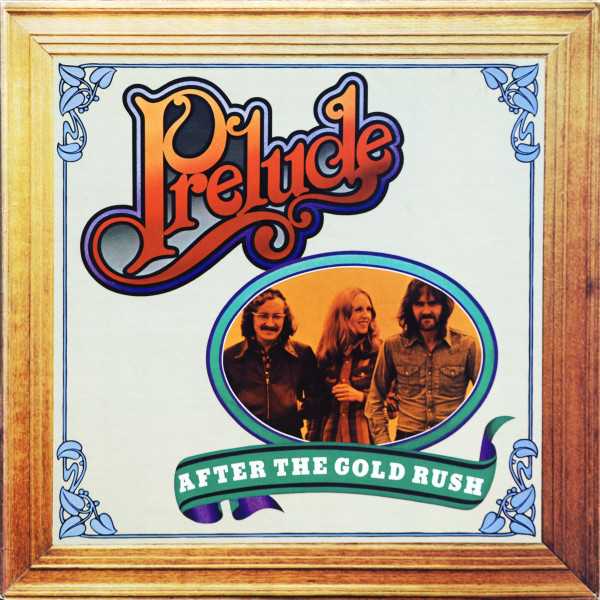
‘In 1973 we went to Rockfield Studio in Monmouth to record our first album How Long is Forever? produced by Fritz Fryer who was in a group called The Four Pennies. They had a number one with Juliet. A wistful ballad. On the final studio day Fritz asked if there was anything else we had. We used to sing a Neil Young song just for our own pleasure. That was After the Gold Rush.’
‘We recorded it and it sounded pretty good so we double tracked it. Overdubbed it fifteen times and it sounded massive. We never thought for a minute anyone would pick up on it. But John Peel at Capitol radio did. He got loads of calls ‘Who is this band?’ ‘Where can we buy the record’.
‘Next thing we know Pye put it out as a single and we’re on Top of the Pops. That was 1974. We ended up appearing twice the first time was with Marc Bolan. There was a succession of TV appearances. You had to do television because you are reaching a massive audience. We did a show for Tyne Tees called the Geordie Scene. We did the Basil Brush show for Pete’s sake.’
‘Most notably we went on the Vera Lynn show. During rehearsals she referred to us as The Prelude. Later she was walking towards us along the corridor when Ian stopped her and said “By the way Vera it’s not The Prelude it’s just Prelude”. Not skipping a beat she turned to him and said “If you don’t mind it’s not Vera…it’s Miss Lynn”.
Prelude were always based in their hometown Gateshead this meant constantly travelling up and down the M1 to television and recording studios in London.
‘It was every other week. We should have moved down there. But 1974 was a big year for us. We did the background vocals on Streets of London which was a hit for Ralph McTell. He asked us to go out on a UK tour with him.’
‘Ralph wanted to put our names on the record but our company wouldn’t allow it. For the next best thing Ralph put ‘background vocals by ‘The Gold Rushers’. It would have been a great advert for Prelude to have their name on the single but Pye were stupid on that.’
‘Ralph was so talented and generous to a fault. It was a big tour around the country then we played a venue where we’d seen Paul Simon, Crosby, Stills and Nash – here we were on the stage of the Royal Albert Hall. Amazing.’
‘After the McTell tour we went back to playing smaller venues but I’m getting the timeline mixed here because I remember before touring with Ralph was a UK tour with a singer and songwriter called Mike Chapman. He had a devoted following and used to live up the Tyne Valley in Haltwhistle.’
‘Then we went on the road with a great piano player called Peter Skellern who had a big hit with You’re a Lady. Meeting him he was rather quiet and reserved – he later became a priest. Then there was talk of America.’
‘This was 1976. What happened was Lindisfarne played the States. When Alun Hull came back, he’d tell us to get over there ‘Cos all ya’ hear is your bloody record ‘After the Gold Rush’ on the radio all the time.’
‘I always read the NME and Melody Maker, looking at American charts where like the Holy grail of music to me. To see Neil Sadaka, Beach Boys and bands like that we thought wouldn’t it be great to get in there. Our manager George Carr said ‘You’re in the American top 100’. We thought this is a dream come true.’ Then it went towards the top 20.’
‘We wanted to capitalise on the success but the record company didn’t want to pay for us to go to America they sent us to Amsterdam. We played the clubs and had a good time but we should have been in the States where we wouldn’t have even needed guitars as the song was acapella. We could have done the Johnny Carson show and the like and knocked that record up the charts.’
‘It wasn’t until 18 months later we got to the States. There were a few gigs on the West Coast in San Francisco where we supported Jerry Garcia in Berkley and met Nicky Hopkins who played piano on all Rolling Stones records. Then over to the East Coast and played The Bitter End in New York. When we came back to the UK Irene took a break when we had our second boy, Joel.’
‘Things moved on quickly until 1979 when our manager got us a deal with a new company called After Hours who were very forward thinking. We made an album at Abbey Road with The Hollies producer Ron Richards. His style was more towards lush strings and stuff like that. It didn’t really work for us.’
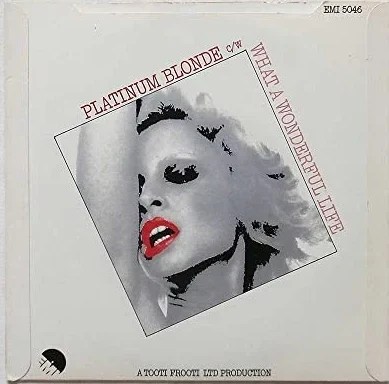
‘We also signed to EMI in 1980 and made an album in Portland Studios owned by Chas Chandler, charming fella. We had some great players on there but the only track that came out of it was Platinum Blonde. Our principal guys were Ian Green de facto producer of Platinum Blonde and Dave Wintour who was Neil Sadaka’s bass player. It was a minor hit which got to number 45 in the charts.’
‘We did a video for it in the old Battersea Power Station in London arranged by the head honcho at our record label, Richard Jacobowski. He was really on the ball, a hip guy. We crashed in his three storey flat in Hampstead and shared it with a band called The Regents who were very talented, like a proto-punk band. They had a hit song on Top of the Pops with Seventeen.’
‘For the single we did Top of the Pops and I remember on the same programme were Bay City Rollers. Platinum Blonde was good for us but afterwards we came back up North and played the folk clubs again.’
‘Ian Vardy was looking at doing something different so left the band around 1985 and became a social worker. We continued and got in ace guitar player Jim Hornsby who had been with a lot of country bands. Jim was very much in demand for session work.’
‘Country was labelled as redneck music then, it wasn’t cool – but it is now. Gram Parsons did a hell of a job making country hip. He influenced The Byrds and Keith Richards. Some clubs turned their nose up at country stuff but we had a great time doing clubs then. Unfortunately, as happens in bands Jim left.’
What did the new millennium bring?
‘From 2001 it was Irene, me and Chris Ringer who we brought in on bass and vocals and took Prelude on the circuit of country clubs and the whole scene. Through the years we have performed with countless numbers of musicians and loved every minute of it.’
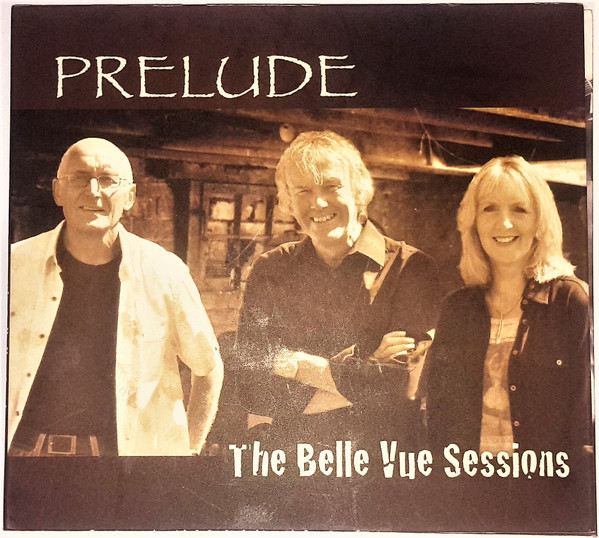
‘Our latest album The Belle Vue Sessions (2012) is all acoustic. It started in 2010 when Ian came round to our house, he had an appointment at his dentist round the corner. We got the guitars out, as you do,and it all went well so we asked him to do a gig with us. One turned into many.’
‘It was our manager Sue Brind who originally said ‘Why don’t you make a new Prelude album? We thought ‘why not?’ so we wrote some new songs and recorded them in Broadwater studios, Gateshead. Two lovely guys engineered, Gavin and Paul. We recruited Paul Hooper who was drummer for The Fortunes and again Chris Ringer played bass. We are very proud of the album.’
What does the future hold for Prelude?
‘We’re busy meeting with David Wood who used to run Impulse Studio in Wallsend. Impulse was a gateway for a lot of acts. He released a lot of Heavy Metal stuff like Venom and Raven from the North East, it was a big scene for him.’
‘David recently put out a CD box set of Alan Hull demos, he recognised Alan’s talent early on. Now he wants to do the same with us because he’s got a lot of tapes that have never seen the light of day. We’re looking to release something soon.’
After recalling a life spent with a multitude of musicians and the memories it triggers, Brian reveals that his ‘obsession’ holds a deeper meaning than just getting on stage and banging out a tune.
‘Your friends tend to be musicians and you share a common language which is almost secret amongst you. You know and experience things that nobody else has. There’s a bond between musicians which is friendship but sort of deeper. You know what the other is going to do, what they’re going to sing, – what they can and can’t do. Every successful band has to have that. It’s like brotherly love. It’s a wonderful feeling. It’s why people do music instead of opting for a ‘safer’ life.’
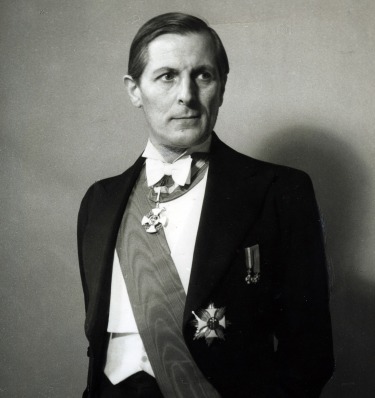
Since 2012 I’ve been researching the life of this fascinating character who was originally named Theophile Lucifer Gardini. He spent his last years living in a terraced house round the corner from where I live in South Shields.
In 2018 I produced a short documentary ‘Secrets & Lies’ based on what I found about his life so far, a link is at the end of the post.
I often mention him to neighbours and hear the odd story about Avro and his wife Anne. Recently an old friend got in touch and remembers the couple who lived at 45 Henry Nelson Street.
‘We moved into 32 Henry Nelson first week of June 1990, I think Avro died in the November so it was only a short time. I remember his wife used to have a little furry dog. She used to walk it out all the time.’ Recalled 60 year old Jeff Anderson now living in Washington, County Durham.
Jeff Anderson
‘I’d see them in the street. Always well dressed. Always smiling. I don’t think local people were aware of who he was to be honest.’
‘Actually, very first time I came across him and his wife was prior to moving into the same street. I saw them on the corner of King Street in the town centre. They really stood out, there was a real glow about them. They had a big smile on their faces. You couldn’t help but notice them’.
‘What they were wearing was very classy – not the type of clothes the everyday person of Shields would wear on a Saturday afternoon. They really stood out of the crowd just by their whole demeanour.’
‘But when Avro died I remember his wife was absolutely devastated. From the initial sighting in King Street and other times in Henry Nelson they had this glow about them but after Avro died that seemed to vanish from her. From what I can remember she was never quite the same’.
‘A strange thing happened to me on the night he died. I went to pick my wife up from work in the town centre but there was nowhere to park so I had to go back round the block. I went past St Hilda’s Church and as I went round the corner I had like a paranormal occurrence – the only way to describe it. I actually saw a vision of Avro on the ground reaching up to me. I was shocked, I thought what’s going on. This is a bit weird.’
‘I continued on and as I came back round the block again there was no sign of him. Gone. It really freaked me out as you can imagine. It wasn’t until a few days later that I learned he had died that night. So, you know what was going on there?’
‘I didn’t know anything about him having any health problems. He died at 76 you say? Doesn’t seem that old now does it?’
If you have any information about Italian born author & artist Baron Avro Manhattan (1914-90) please don’t hesitate to get in touch.











 ALIKIVI UK : NORTH EAST MUSIC & CULTURE