ROOT TWO AMPLIFICATION with owner and Geordie guitarist, Steve Dawson

‘The electric guitar is still the coolest instrument  and there will always be a market for amps, albeit boutique in my case as opposed to mass production, but who knows what might happen’.

IMG_0539 (1)

It’s a warm summer day and the town hall clock chimes as I enter a large terraced house (pre-Victorian) on Beach Road in South Shields. I’m here to meet Steve Dawson in his workshop and find out more about his business…

I’ve been working on amps for more than 40 years. I started tinkering with them in the ‘70s, then privately repairing and modifying them throughout the ‘80s and ‘90s.

I ended up working for Marshall from 2005-14 as an electronic design engineer. I designed and brought out some highly regarded amps in my time there, such as the ‘Astoria range’, ‘Class 5’, the ‘Vintage Modern’, ‘JMD range’ as well as various reissues from their back catalogue like the Hendrix ‘Super100JH’ and 2012 anniversary ‘Bluesbreaker’ and more.

When did you start Root Two ?

I started in August 2015. I believe it’s going to take a good four to five years to get properly established in repairing, servicing, modifying and upgrading amplifiers and working on the electronics in guitars. Many people still think I work for Marshall!

Are you happy with the way the business has developed so far?

I’ve clocked up over 300 customers in four years so I’m doing alright. It’s a sustainable business despite this current economic climate…although I won’t be taking any holidays in Hawaii just yet (laughs).

Have you got any future plans for Root Two?

When I’m up to altitude I’ll start producing new products I have already designed.

I’ve been talking to an OEM (original equipment manufacturer) who will build the design and take care of that side. I’m thinking of contacting a few other people who I hope will be interested in getting involved in the project, especially the promotion side.

That’s my goal, as well as repairing and servicing etc. because it’s a tough world out there and being able to offer a few things will work out better.

I’ve got a good reputation all over the world from my days at Marshall with a lot of people familiar with the amps I designed, which is worth its weight in gold when I bring out my own product.

Scrolling through the Root Two Facebook page I come across messages left by satisfied customers….

I have an old Watkins Westminster amp which was in need of some TLC. Steve serviced and repaired this amp and I was in contact every step of the way. I am extremely happy with the results and the costs were very reasonable. I fully recommend Steve and will contact him again if I have any problems with my electrical equipment. (Tommy Scott)

My Bugera amp went in dead and came back alive as a spring chicken. Steve is a very knowledgeable and amenable chap with a professionalism, heritage and CV that some can only dream about. I whole-heartedly recommend Root Two for any service/fix/mod/upgrade. (Andrew McCann)

A very fast and efficient service at a reasonable price. Steve understands the importance of getting your gear repaired as soon as possible for your gigs. His enthusiasm comes across about his passion for music and for this reason you’re guaranteed to get your equipment a full MOT before it leaves the workshop.

Can’t thank him enough for the excellent job he did on my gear and the professional service I received. (Chris Banderas)

We had a PA problem with our LD Maui 28 line array system. Took it to the Aladdin’s cave that is Root Two’s workshop. Steve worked his magic on what had been a manufacturing problem of several dry joints. He was meticulous, diligent, persistent and an all-round good guy.

I honestly don’t know what we would have done without him. Thanks also to Newcastle’s GuitarGuitar shop for their recommendation. It’s not until you get problems that you appreciate dealing with excellent local businesses. (Tim Brown)

Contact Steve at Root Two Amplification on 07931 359 364

Or on the official website: root-two.co.uk

email info@root-two.co.uk

facebook.com/root2two

 Interview by Gary Alikivi    August 2019.
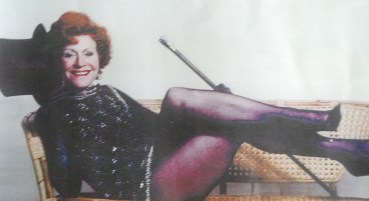
PUTTIN’ ON A SHOW – in conversation with North East entertainer Helen Russell

182

First time I worked with a stripper in the clubs. It was a Sunday morning. I walked into the club ‘Are ye’ the strippa or what ?’ said a bloke there. ‘I’m the what’ I replied (laughs).

The stripper walks into the dressing room with just a bag. I walked in with all my gear, microphone, speakers and stage costume. She did a five-minute act then taxi to her next gig. She did four clubs in a morning. Not bad work but I couldn’t do it. I’ll stick to singing.

A few week’s ago the blog featured stories from entertainer’s who performed in workingmen’s clubs. Ned Kelly, Jack Berry and a few more shared some great memories.

Carrying on that theme I spent time with Helen Russell at her home in South Shields. Helen hasn’t been feeling too well lately so I’m very grateful to her for taking the time to share her story….

As a kid I was an autograph hunter, all the stars like Laurence Olivier and John Mills. Great times. We weren’t a musical family but my dad could sing, he was in the Royal Navy.

You see I was born in the heart of London and when I was 15 I went into Entertainment National Service Association or otherwise known as Every Night Something Awful (laughs).

ENSA was an organisation set up in 1939 by Basil Dean to provide entertainment for British armed forces personnel during World War Two.

They held the auditions in the Theatre Royal on Drury Lane in London. They liked me and took me on. I toured all over the UK with ENSA. I was earning £7 per week and that was damn good money. Top act’s and names were getting £10 per week. It was a long time ago, I’m 95 now.

Where did you perform with ENSA ?

We played in the munitions factories when the workers were having their lunch breaks. We entertained in the theatres and clubs.

I sang Hey Neighbour and Sally that was a big number. I did imitations of Gracie Fields but never sang any Vera Lynn songs and I always finished my act with a tap routine.

I gave up when I got married. It was the done thing in those days. We met when I was entertaining in Belfast. Eventually we moved to England, and I got a job performing in the clubs.

The first club I played in South Shields was on Ocean Road which is long gone now.

At this time, we lived in South Frederick Street, and we had no telephone. I used to go down into the street to the telephone box and ring up the clubs to get gigs. I’d ask for the concert secretary, book the show and arrange the fee. I did that for years before the agent’s came in. Plus, we had no transport in those days.

For a show in Stanley, County Durham I’d pack my case with stage clothes, music sheets for the pianist, get the bus up from South Shields to Worswick Street in Newcastle, then carry my case across town to Marlborough Crescent bus station and go to a club in Stanley another 10 mile away. We had to be off stage and out by 10pm to get the last bus all the way back home.

A pianist joined us, he had a car. He charged us one and sixpence each for petrol. I also had to pay a babysitter seven and six a time. The first working man’s club I ever played was Windy Nook and we earned £1 each, there were seven of us.

Johnny Gaffney who wrote for The Shields Gazette, he had a great voice. No stage technique whatsoever but what a beautiful voice.

I went solo after that when agents came in and started working through the Beverly Agency. They got me lots of work around the North East and over to Carlisle a few times, lovely crowds there.

Money was coming through the clubs then, so concert chairman would only deal with agency’s. Which was great for me. No running around telephone boxes, made it much easier and as I was solo the money was much better.

181

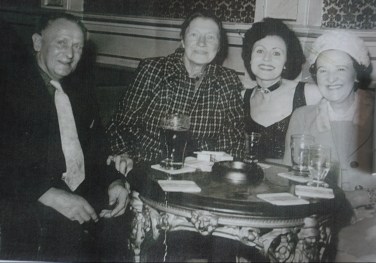
Helen second from right. in Balmbras, Newcastle.

Can you tell me about the photo above ?

Yes, that was in Balmbras old time music hall, Newcastle. I had been performing there. Bobby Thompson has played there, also Dick Urwin who was a good writer and great comedian.

You had to put him on in the first half because by the second he had too many drinks and would insult the audience. In Newcastle I also performed on stage at the Mayfair.

Can you remember the story behind this record ?

That was recorded in 1980 over the River Tyne in Impulse Studio, Wallsend. Corrinne Wilde had written a song about Bobby Thompson and she knew I could write, so I added a chorus. It was a lovely thing to do.

But selling records is a lot harder than making them. I sold a few at gigs. Bobby Thompson paid for the photographer which was nice.

Helen starts singing the chorus…..

Bobby T, Bobby T, you’re the Geordie lad for me

With yer ganzie hangin’ doon below yer knees,

You’re as Geordie as the Tyne, and for the sake of Auld Lang Syne,

We’ll tell the world we love you, Bobby T.

Did you record anymore of your work ?

I recorded voice overs for radio and appeared on TV a number of times. I remember a part on a show with Martin Clunes, he was only 18 or 19 playing the part of a punk.

I was in a lot of productions including Emmerdale, that was in 1993, also children’s television and the latest Comedy Playhouse. I also played somebody’s wife in Spender written by Jimmy Nail. It was a nice part and I get paid repeats on some of them.

I have a book full of work and gig’s I’ve done over the years plus the fees. There’s a Spender episode written down in it as a repeat in Sweden, I got £9.56 for it (laughs).

Were you working through an agent ?

Yes Janet Plater, she represents a lot of actors in the North East. The original fee for Spender was very good I remember. The last job I did for Janet was a Tesco advert.

You have appeared at your local theatre The Customs House in South Shields…

I’ve worked on a number of plays at The Customs House where Ray Spencer is now Director and an MBE. I got to know Ray in the ’80s when he was looking for a partner to work alongside him putting on some Geordie entertainment. Somebody recommended me and we worked together for a long time.

Our first gig was the Post House Hotel, Washington in 1988. I have my book here and for the Post House there is a note next to it ‘Ray has the receipts’ (laughs).

The writer Tom Kelly put me in a few shows and that got me and the same team work on Dirty Dusting written by Ed Waugh and Trevor Wood. That was very popular, we did it in about 2002. The show still sell’s today in different countries.

Helen recalls another memory from working in the clubs…

A lot of times I was the only woman because I was entertaining there and these were men’s clubs. I couldn’t get a drink at the bar. I had to give a man the money. He paid the man behind the bar, got the change and passed it to me with my drink !

Tell you what though, I never want to see another bingo card in my life (laughs).

Finally, what has working in entertainment meant to you ?

I wouldn’t still be doing it in my 90’s if it didn’t mean anything to me. I was born to do it.

Interview by Gary Alikivi   July 2019.

DEATH OR GLORY – interview with Danny McCormack bassist The Main Grains/The Wildhearts

First posted September 2017.

Alikivi's avatarALIKIVI UK : NORTH EAST MUSIC & CULTURE

I’m with Danny at his home in Newcastle and notice a black and white photo on the sitting room wall, it’s a picture of The Garricks Head pub in South Shields… ‘Yeah my Grandma Pat used to have it’. I remembered I had my first drink there when I was 16 year old. A pint of McKewan’s Scotch, after the first drink the froth covered the caterpillar growing on my top lip… ‘Yes it was a great pub sadly not there now. She used to have regular lock-in’s, the punters staying behind after hours for a few more drinks. A bloke with an accordian would be in, there was a piano player in the corner and we’d all be singing along with them. Smokey tunes, great times and wild night’s, yes, I can remember all that’.

21248455_865836183566147_6246856805401714556_oWhen living in London Danny McCormack was a member of The Wildhearts. During their…

View original post 2,394 more words

NIGHT OF THE TUBE with former TV music producer Chris Phipps

How Frankie Goes to Hollywood were discovered by default, why Tina Turner was nearly not on, what was a life changing career appearance for her. Also, what was Ozzy doing in a coffin on City Road ?

Hear all the backstage stories from ‘80s music show The Tube at a free talk by Chris Phipps.

The Tube was broadcast from Tyne Tees Television Studio 5 in Newcastle and hosted by Jools Holland and Paula Yates. It showcased everyone from Madonna, French and Saunders to Frankie Goes to Hollywood.

I was in the audience for the early shows and watched some great bands including Thin Lizzy, Big Country, The Alarm and American rock singer Pat Benatar.

Chris will be talking about the sights and sounds from behind the scenes when he worked on the show. ‘As an ex-BBC producer, I initially only signed up for three months on this unknown programme and it became five years! I was mainly hired because of my track record for producing rock and reggae shows in the Midlands. On the night I’ll be telling of my Jamaican exploits’.

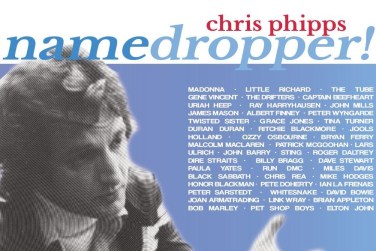
Chris will also have copies of his new book ‘Namedropper’ for sale at a special price.

Newcastle City Library (opposite Trillians Bar) 8pm Saturday 18th May 2019. Free entry.

Namedropper Cover

Interview by Gary Alikivi    April 2019.

SOME KIND OF MAGIC with Northumberland poet, writer & broadcaster Katrina Porteous

The poetry is part of me, I couldn’t do without it. It’s been with me all my life. It’s a sort of compulsion! It’s a basic human connection, we all play with the sound of words when we’re children.

I find art very mysterious. If you’re a writer, artist, musician or film maker, in the end what makes it work? You can’t teach it, you can’t explain it, it’s something mysterious. There’s something magic about it.

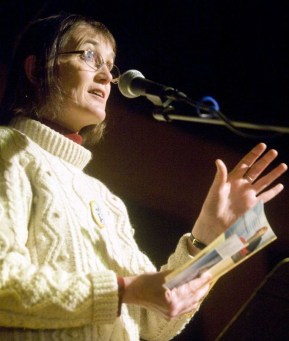
Katrina - credit The Daily Astorian

Pic by Daily Astorian.

When were you first interested in poetry and who were your influences?

Songwriters like Bob Dylan, Paul Simon, Leonard Cohen and Patti Smith were really important when I was in my teens.

Film was also influential, especially the 1982 cult film Koyaanisqatsi, with a soundtrack by Philip Glass. There were shots of wide-open American landscape. A lot was in timelapse, so the film was speeded up then slowed down.

It cut between close up microscopic to wide angle shots, it was playing with perspective and time. That was really influential on my way of seeing things.

Poets who influenced me included Geoffrey Hill, who I met when I was 18. Northern Arts paid for a three-day course in Ambleside, that was 1979.

In the early ‘80s I travelled around the west coast of America and saw the wide landscapes of the Arizona desert which were just beautiful. American poets like Robert Pinsky influenced me at that time, and the Irish poet Seamus Heaney, who taught at Harvard.

What is your background?

I studied History at Cambridge University and then gained a Harkness fellowship to the USA, where I studied in California then Boston.

In 1989 I won an Eric Gregory Award for poetry from the Society of Authors. It was £6,000, I’ve been very lucky. That started me on the road to working freelance.

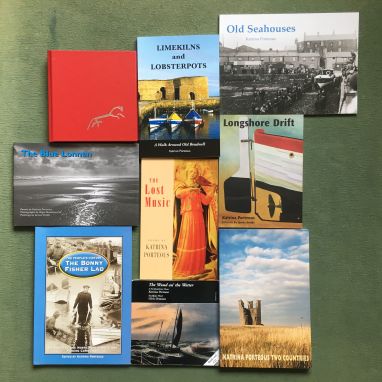
Katrina's books

You have written a number of local history books. How does that fit with your poetry?

I’ve lived on the Northumberland coast for over 30 years in the village where my Grandparents used to live. I wanted to write about the sea so the best way was to talk to the local fishermen.

They were a huge influence on me, some of them were in their 80s.

They knew so much and there was a sense that fishing was coming to an end. It was very difficult to earn a living and young people weren’t coming through.

All their stories, skill, knowledge, even their dialect was all going, so I spent many years spending as much time as I could with them, going to sea, in the huts talking to them. This was very formative to my poetry.

A whole series of work came from it. My first two poetry books with Bloodaxe and a series of local history books featuring Seahouses and Beadnell. I still have a load of material that I got from the fishermen, there’s still a lot of writing to do there.

I feel as though I could be doing this work for the rest of my life. And you come across some great names, like fishermen called Geordie Birdy, Bill Cloggy, Dobbin and Kelpy Jack (laughs).

I’m more driven to write poetry though. The local history informs the poetry, it gives me a subject.

In 1999 I was asked to write something in the Northumberland dialect and with me talking to the fishermen and writing down the phrases of their everyday speech, I tried to put them all in one poem.

I worked with musician Chris Ormston which resulted in a CD called The Wund an’ the Wetter. With it being 20 years old we are performing it soon at the Iron Press Festival. Chris plays the small pipes, and he is one of my longest standing music collaborators.

Do you perform your poetry at many live events?

We play various folk and poetry festivals around the country, church halls, schools and women’s institutes. I’m really interested in spoken word, perhaps even more than poetry in books. Although I have produced books, I have written a lot for BBC Radio 3 and 4.

How did work on the radio come about?

I’ve had work on the radio for about 20 years now and it first came about through my publisher Bloodaxe. Radio producers are looking around for poems about certain subjects.

Sometimes they get in touch with book publishers, tell them what they are after, and they get in touch with poets. It can be very competitive. But worth working on because you can bring other sounds to your work. It’s a lovely way of experimenting with sound.

Think of it as a piece of music. I wrote a half hour poem for Radio 3 about Holy Island where I worked with producer Julian May. We brought in sea sounds, the wind, all the different birds and the sound of the seals. Then you can layer the voices and make it more abstract, hearing sounds rather than words.

Artists are always looking to perform to a wider audience…

Poets are quite happy with six! (laughs). I’ve travelled to Festivals with musician Chris Ormston where we played to six people in one place and ten at another. But asking about reading to a wider audience is a serious point because I like to have my work in books, but there is a limited amount of people who will pick up a poetry book.

But like music, poetry is for everyone, and I would read my work to a general audience rather than just a poetry audience. I’ll read my work anywhere and working with musicians makes it more accessible to people.

Katrina with Peter Zinovieff at Sage Gateshead

Performing with Peter Zinovieff at The Sage, Gateshead.

I also work with electronic composer Peter Zinovieff. We’ve made five pieces and are going to be making another one next year. Peter was one of the first people in the world to have a computer in a private house.

He was making music with a computer from the mid ‘60s in his EMS studio in London, where he designed the VCS3 synthesiser.

This was one of the first commercially available synthesisers and used by all sorts of bands like Pink Floyd, The Who, Tangerine Dream and Roxy Music’s Brian Eno. At the same time, classical composers such as Harrison Birtwistle were working in Peter’s studio.

Where did you meet Zinovieff?

I met him in the mid ‘80s in Cambridge when I was studying there. The first piece we made was for Radio 3 in 2011, then we made a few pieces for Life Science Centre planetarium here in Newcastle. They were about astronomy and physics, the large and small, thinking about scale and perspective.

The text for those pieces is coming out in a book from Bloodaxe later this year called Edge. They are big performance pieces with visuals and made for surround sound but I’ve also got stereo recordings so can perform them anywhere.

We are working on another science-based piece with music and poetry with the NUSTEM Exploring Extreme Environments project at Northumbria University.

That will be around ice and glaciers and using some of the recordings the scientists have made in Antarctica. Peter will create a soundscape from that. We’ll have that ready next year.

What else have you got planned for this year?

On 24th May I’m going to be working with folk fiddler Alexis Bennett at a gig on The Cutty Sark in Greenwich, London. So really looking forward to that. Also the Iron Press Festival on 22nd June at St George’s Church, Cullercoats.

Contact Katrina on her website http://www.katrinaporteous.co.uk/

 Interview by Gary Alikivi    April 2019.

BOLD AS BRASS with North East musician and former Lindisfarne sax man Marty Craggs

When I first started playing sax there weren’t that many sax players on the Newcastle scene but now I think the sax has become more popular and it’s good to see and hear all these great young jazz musicians taking up the sax, they can really play!

36688181_2021340667899985_7487959388162883584_n

When did you first get interested in music and who were your influences ?

I was born in Newcastle on the banks of the River Tyne. My Grandma played the harmonica and the piano, rumour has it that she could rock!

I started piano lessons at the age of 9 but wasn’t until I was 15 when I really woke up to music. I saw the Rolling Stones on Top of the Pops. Blown away!

The first record I bought was Whatcha Gonna Do About It by the Small Faces then started listening to The Beatles and The Yardbirds until I discovered the blues with Muddy Waters, Howlin’ Wolf and John Mayall. By 1967 it was Motown and Junior Walker.

Then I got into the Stax sound with James Brown, Sam & Dave, Booker T & the MG’s, just all soul music and finally bought a saxophone.

When and where did you start gigging ?

I joined my first soul band at the age of 18, The Georgia Quintet. Got into their brass section of two saxes and a trumpet, great guys, still friends with them all today.

Those early years I gigged the local scene with many bands. We went to all the social clubs, school dances, universities. It was great fun learning the ropes and gathering experience.

In ‘75 I joined Harcourts Heroes with Ray Jackson and Charlie Harcourt. They were a crackin’ band. By ‘78 I had moved to London and formed a band called The Breakers with Charlie Foskett and Maggie Luckley.

We got a deal with MAM Records and recorded in Broadoak Studio in Brighton. We done a couple of tours, one supporting Darts. Great band, nice folk’s it was all good craic! But London got too big for me, so I came home to Newcastle.

I met up with Ray Laidlaw, Rod Clements, Jed Grimes, Billy Mitchell and Steve Cunningham who had a crackin’ band called Pacamax. I joined them and had so much fun, this was around 1980. We played all the festivals and folk clubs.

20190330_112834

How did the gig with Lindisfarne come about ?

The call from Ray Laidlaw to join Lindisfarne came in 1983. We spent many happy days touring the world and recording with the band.

I played sax, flute and vocals on the Amigos album and sung lead vocal on Roll on that Day, co-written with Rod Clements. I also co-wrote Everything Changes with Alan Hull. We used the Reel Time Studio in Newcastle.

Lindisfarne have a large back catalogue of recorded music…

Yes I was also on the Here Comes the Neighbourhood album in ‘98. We went into the Watercolour Studio, in Ardgour, Scotland to record that one.

Again I added whistle, harmonica, accordion and vocals. I also recorded lead vocal for one of my own songs Driftin’ Through. The album was produced by Sid Griffin.

Elvis Lives on the Moon was recorded in Newcastle’s High Level Studio by Kenny Craddock, he is sadly missed. Dance Your Life Away was recorded and produced by Steve Daggett at Impulse Studio in Wallsend. We also recorded Buried Treasures and Live and Acoustic.

In 1990 the band achieved a UK top 3 single with the most famous footballer at the time, former Newcastle & England player Paul Gascoigne….

We had great fun with Gazza and his version of Fog on the Tyne. I co-wrote that with Alan Hull. It was all good until the sad and untimely death of Alan in 1995. Alan was a big influence on me both as a friend and a song writer.

I was privileged to write a couple of songs with him, it was great to watch him work. He was a prolific songwriter, great performer and a cool guitar player too, just loved his Strat playing.

Looking back all the gigs and tours with Lindisfarne were memorable especially at Newcastle City Hall. But by 2000 I had left and with Les Dodd and Brian Duffy we formed a band called The Happy Cats.

After joining Lindisfarne I started touring and gigging the folk clubs and festivals discovering a whole new world of music on the folk scene. I did some gigs in Ireland and started listening to Irish Celtic music.

I loved the celtic sound of fiddles, flutes, accordion, acoustic guitars and whistle all taking the melody.

This got me listening to John Prine, Mary Black, Dalores Keen and of course the Saw Doctor’s. I joined an Irish band called the ShyTots based in North Shields where I learned to play the Bodhran, a great band full of fun.

This was the thinking behind The Happy Cats, a celtic sounding band, with a big emphasis on fun.

Over the years I have picked up new instruments as and when the songs required them. Now I’m playing sax, flute, harmonica, bodhran, accordion and whistle. Also found myself singing more these days and enjoying the music.

Did you record with The Happy Cats ?

Yeah, we made three albums and gigged for 17 years. Fans became our friends, the Toon to Tuam tours were infamous, mighty craic in County Galway (laughs).

We recorded our debut album Follow the Moon at Watercolour Music Studio, Ardgour, Scotland. It was produced and mixed by Micky Sweeney. I sang lead vocal on all tracks and played sax, whistle, harmonica and accordion. Rachael Bailey added fiddle and Michael Bailey was on bass guitar.

The Take my Hand album was recorded at Cluny Studio, Newcastle where I sang lead vocal on all tracks.

For Ten Years On we went into Charltons Studio in Cambois to record. That was mixed and mastered in Blast Studio here in Newcastle. I played sax, flute, whistle, harmonica, accordion and sang lead vocal on all tracks.

Again, Mickey Sweeney produced that record. But sadly, The Happy Cats split up in December 2017.

LBJAM

Marty Craggs Little Band Jam.

What are you doing now ?

Paul Alex Campbell (ex Christian’s) and I have been writing and recording for our band the Unexpected Visitors. A fantastic six piece band, that rocks.

We’ve already done a few gigs and hope to release our debut album this year. Also been gigging with my old pal Trevor Sewell, an award winning guitar player. It’s 50 years since we were on stage together, it’s been a blast.

These are busy times because we, Steve Dolder (drums) Dave Whiffin (guitar) and Michael Bailey (bass) put together a celtic/Irish influenced four-piece band called Marty Craggs Little Band Jam. We are playing songs from the Lindisfarne and Happy Cats days, plus adding some good cover songs.

We guarantee 100% full on sing-along night out. The Lindisfarne Festival Thursday 29th July 2019 is a date for your diary. I would like to thank my right-hand man and Roadie No1, Alan Loughhead, for all his support and help. Top man.

What does music mean to you ?

Music is my life, it’s what makes me tick. I’m constantly writing songs and gigging. Still as enthusiastic about everything to do with the business as I was back in 1966. I’m so lucky and blessed to still be able to do it! Luckiest boy!

In 2016 I got together with my son Andrew and daughter Beverley, both great musicians and singers, and we realised that after all these years we hadn’t played or performed together. So, we wrote and recorded The Craggs Family Album recorded at Broadoak Studio in Brighton and Blueattic Studio in Hexham.

All mixed and mastered at Blast Studio,Newcastle. The project was a wonderful time and a great thing to do, a very proud Dad.

Interview by Gary Alikivi March 2019.

LOST IN THE SUPERMARKET – What price music ? ask North East musicians Carol Nichol, Paul Binyon & John Clavering.

What price music ? Is it just another product on the shelf ? Is the value of music being overlooked, and do we need to handle it with more care ?

Three North East musicians, Carol Nichol (Lowfeye/The Relitics), Paul Binyon (Mandora) and John Clavering (Cortney Dixon band) are passionate about music and reflect on what it means to them today.

Carol Nichol: Being creative, writing and recording your own material is worth nothing now in society. It’s a struggle for any working class artist or band to survive. Apart from middle class students from the Brit Acadamy and their connections in the music industry, does anyone have a voice now ?

Paul Binyon: Tyneside has always been a hot bed for musical creativity and over the years has produced some outstanding musicians/bands. I do however feel more concerned for originality these days. Original music has always been of the utmost importance to me.

Although I’ve been involved with cover bands too it’s always the shear buzz of creativity that excites me most. To see an audience enjoy and respond to songs that you’ve written is the ultimate reward and of course I thoroughly enjoy being in the audience appreciating other bands original music.

John Clavering: Up here in the North East you’ve got The Cluny, The Star and Shadow who promote original stuff. But there is hundreds of pubs who would only pay for a cover band. I’ve been offered gigs on keyboards with cover bands but I’m just not interested.

Bands playing Queen covers at a wedding – it’s an industry itself. That is ok there is a need for that but I don’t think it encourages creativity and new music. Pubs don’t want to take the risk of a band playing it’s own stuff.

Carol Nichol: When you hear of the venues closing which had character especially the decor of old ballrooms, it’s heart breaking.

The independent music scene is extremely important for the survival of original bands to exist and be discovered. For decade’s this has always been a great platform for a lot of bands. There is nothing more exciting than a small intimate venue when a band are level with a crowd.

Paul Binyon: My concern is the lack of independent venues. They seem few and far between these days. Even the few that we have tend to lean more toward the covers and tribute scene than original. I understand that there’s a risk involved with booking original bands for fear that there’ll be a small turn out and the venue won’t make any profit or lose money. But this is catch 22 because more venues need to support original bands so that they can build a following and fill rooms.

Carol Nichol: I think the future of independent venues looks very bleak especially with a younger generation who are more obsessed with social media and computer games. Kids don’t venture out as much and are too obsessed with reality music programmes on tv or should I say karaoke shows. People are more into mainstream and cover bands so aren’t willing to discover something new.

Paul Binyon: With it getting harder to secure gigs and with the amount of pub closures I’m afraid one day, originality on the local scene will become a thing of the past.

Without working together to try and fix the current situation, I gotta say it looks bleak. But I live in hope that sooner rather than later it goes back to somewhere close to what it was like in the mid 80’s where the choice was a difficult one to make as to which venue you went to, and to see which band because there was so many.

John Clavering: There are original bands out there who use the internet as their only outlet. A lot of niche stuff getting heard on Soundcloud and Spotify. But there is nothing like standing in the front row of a gig. You will never get that feeling from watching You Tube on your phone (laughs).

Got a music story to tell ? Get in touch and leave a message.

Interviews by Gary Alikivi January 2019.

DAMAGED GUITARS ON AIRLINES – UK Subs guitarist Steve Straughan

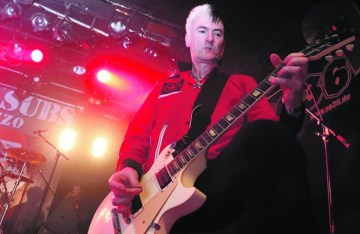
Steve Straughan guitarist with UK Subs got in touch about an ongoing problem of instruments damaged by airlines. An issue that he feels all touring musicians should be aware off…

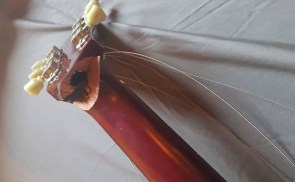
In 2015 the headstock on my Gibson Les Paul Classic was smashed off while in a hard, solid flight case. The guitar was actually in two pieces.

This was the second time it had happened on two different airlines. This was when I decided to take action.

50995032_2178191062202713_5128868048723247104_n

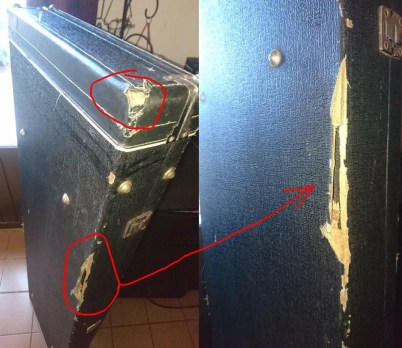
I took to social media and loads of people replied offering good advice. I got in touch with Air France and at first they told me they would not compensate me. Their reason being that the guitar case was not damaged but the guitar was.

So, I sent an email directly to the CEO of the airline and I started receiving offers of compensation from their staff. Eventually I was compensated but it took a long time.

But this was only due to all the good people out there. All the messages of support really helped. It felt like I wasn’t going through the whole process alone.

This is why I set up a facebook page to help others who find themselves in the same unfortunate position. We can take on the big companies if we stick together.

What do you think is the main problem in transporting your instruments ?

On top of the lack of storage issue there is the on-going problem of the instruments being smashed by the baggage handlers and left in the airport or even sent to the wrong airport.

It’s also a hard fight to get any compensation for damaged instruments. It’s becoming very difficult for musicians.

Airlines have lost my guitar twice. There was one concert in Budapest and another in Spain where I had to use another musician’s guitar. I often get messages saying it’s happened to them.

48386640_2470372222978243_3395874991332392960_n

Is this being addressed by the airlines and can you see it becoming a bigger problem ?

More airlines now are refusing to take guitars on board planes and store them in the overhead lockers, or any other lockers.

Some airlines are now even stating that you must give them advance warning for guitars to be stored even in the hold. It’s a big ongoing problem.

What do you think is the future for musicians who use airlines ?

I’m starting to think that it’s gonna have to be down to promoters to supply guitars and other instruments. A lot of musicians find it hard using guitars other than their own because most have them set up to the way they like them. The sound can also be quite different. The unfortunate thing is I see no other way.

39496777_670905779942649_8486989225256812544_n

If you are a touring musician that uses flights and your instrument has suffered damage or has been lost by an airline please share your story. I’m trying to get musicians from all over the world to act on this and voice their outrage and concerns. The more the better.

All of our voices could possibly help you get justice. It worked for me. Nothing is required apart from our anger, frustration and voices.

 If you have experienced any problems contact 

Airlines Smashed Or Lost Instruments group page on facebook.

Interview by Gary Alikivi    January 2019.

200 NOT OUT

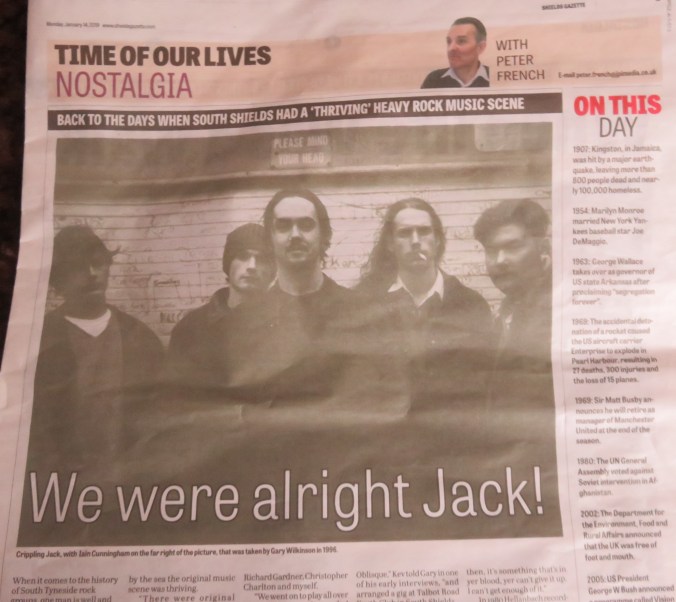
With the blog hitting over 50,000 views and 199 posts so far, a milestone 200th post comes from a piece in local newspaper The Shields Gazette. Journalist Peter French writes on his page about the post of 14th January 2019 where I featured the music scene in South Shields during the 90s.

002

The Shields Gazette 14th January 2019.

Link to full piece:……https://www.shieldsgazette.com/lifestyle/nostalgia/when-south-shields-had-a-thriving-rock-scene-1-9535098

Thanks to all readers of the blog so far I’m looking forward to adding more interviews  including former Tygers of Pan Tang vocalist Jon Deverill, Burnley blues/rock band Cloverhill and a feature on the issue of instruments damaged on airlines with UK Subs guitarist Steve Straughan.

Gary Alikivi January 2019.