SEE YOU IN THE MORNING – with singer & songwriters Emma Wilson & Terry Reid

During the past year Emma ‘Velvet Tones of Teeside’ Wilson has produced her EP ‘Loveheart’ and featured on a compilation album in aid of the NHS, ‘Songs of Isolation’.

Other highlights were an interview on American radio and Cerys Mathews BBC Radio 2 Blues show playing her track ‘Wish Her Well’.

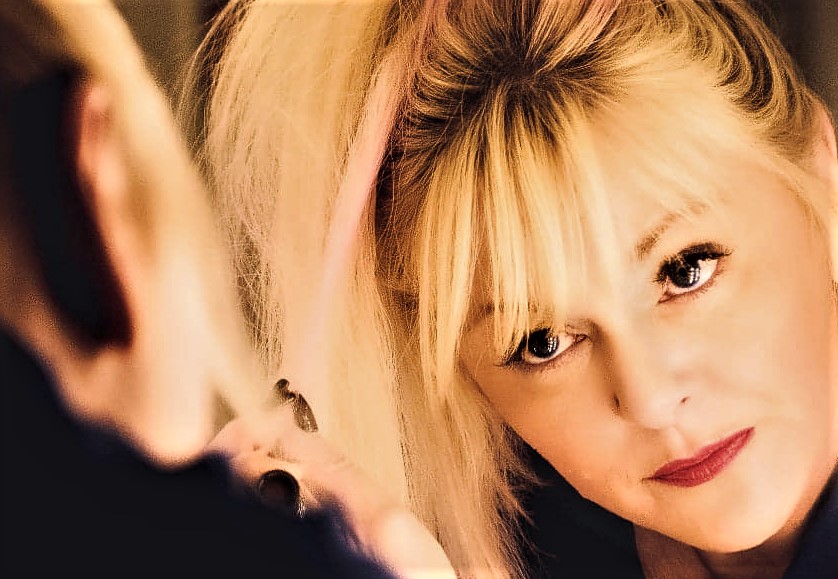
Emma & Terry Reid.

Her new project is a double A side single released 10 June 2021, and it features one of her vocal hero’s.

‘I’m a fan of Terry Reid full stop. I just love his tone and style – it’s a dream come true’ said Emma.

Affectionately known as ‘Superlungs’ Reid has enjoyed a long career in the music biz. He has recorded six albums, featured on film soundtracks and toured with Jethro Tull, Fleetwood Mac and Cream.

In 2016 I was asked by Malcolm Bruce and Pete Brown to sing in the ‘Evening for Jack Bruce’ house band at Shepherds Bush Empire, London. I jovially said that I’ll only do it if you get Terry Reid. Of course Terry was already on the bill’.

Reid lives in the United States so he flew into the UK for the gig.

‘He turned up at rehearsals straight off the plane looking resplendent in white trench coat and silk scarf. He chatted with everyone and then sat down to talk to Pete Brown.

Being a little star struck I walked over and told him we haven’t really met yet, but I did say hello outside the toilets at his gig in The Newcastle Cluny. Pete and Terry both laughed singing my clumsy words back to me saying that would make a great song’.

Wilson and Reid got on well, they chatted about music and the London gig. Emma recalls that night at Shepherds Bush.

‘Terry was lead on ‘White Room’ and I was on backing vocals. At first we (backing singers) weren’t initially on the song, I asked Terry if he thought we could be on it with him and he said ‘Let’s ask Mick Taylor’.

Terry asked me to sing the part to Mick and he said, ‘yeah ok, let’s do it’. We got on well and afterwards Terry and I kept in touch, I’m happy to say we’ve become good pals’.

Over the past year people have found lockdown pretty tough going but by keeping a positive outlook, Emma used the time sharpening her song writing.

‘I had a song ‘See You in the Morning’ and I thought Terry would sound great on it, so I sent it over and he loved it.

To my surprise he asked if I had anymore, and he liked ‘Nuthin’ which we worked on over facetime as he’s in California and I’m North Yorkshire. He’s totally transformed my demos by adding heart and soul – which is what he does best’.

‘I’ve loved the process of making music with Terry even though it was remotely. I hope people love the feel of the songs they are very different from each other.

I think Terry’s influence on the recordings gives them such a cool feel and his vocal and playing are just sublime. I am delighted with how the songs sound’.

The single is available to download from all sites or order your physical copy from:  www.emmawilsonbluesband.bigcartel.com

or www.emmawilson.net

‘See You in the Morning’ (Wilson) Vocals – Emma Wilson & Terry Reid.

Bass, acoustic & electric guitars – Terry Reid.

Keys – Alessandro Brunetta, Drums – Graeme Robinson.

‘Nuthin’ (Wilson) Vocals – Emma Wilson.

Bass, electric guitars, drums, cabassa – Terry Reid.

Keys – Alessandro Brunetta,

Both tracks produced by Terry Reid, mixed by Larry Pederson & mastered by James Arter.

Interview by Alikivi  June 2021
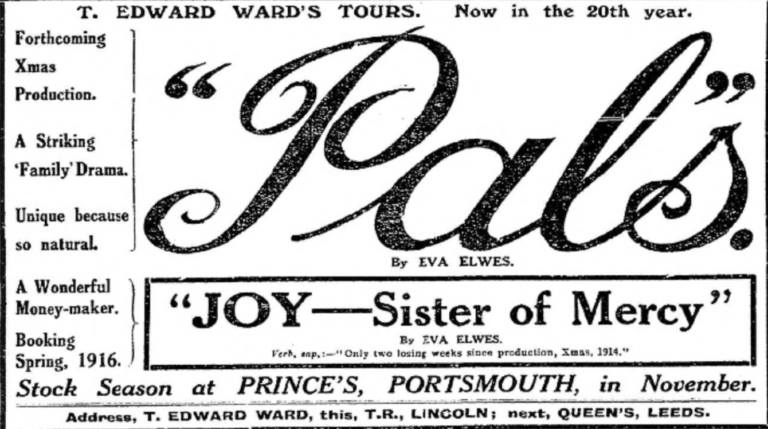
SNAPSHOT of English actress & playwright Eva Elwes (1876–1950).

Eva Elwes was born on 1 February 1876 in Somerset. A prolific playwright, she wrote over 50 plays with her first a musical drama His Sister’s Honour in 1907, her last being Rudge, Martin & Baker in 1938.

She married comedian Henry Gilpin in 1898, the couple were cast together in several stage productions but unfortunately her husband died young. Eva went on to become a successful touring actress performing in plays and variety shows around the North.

By 1911 she was living in Walsall, West Midlands with actor and scenic artist Llewellyn Eykyn. The couple lived in the market town for ten year as she regularly performed her own plays which were staged by William Glaze’s touring theatre company.

Applications were made to official Play Examiners to license Eva’s plays. They would check if any political, religious and moral issues went over the line, if the Examiners showed any concerns the famous ‘blue pencil’ was in force to amend or cut scenes.

In a report about one of Eva’s plays the Examiner commented…..‘The plot of this melodrama is disgusting. It involves incest and rape, its chief scenes are in a brothel and two of the characters are the keeper of the brothel and her assistant. Its appeal is simply morbid and disgusting sensationalism’.

Although primarily seen in the Midlands and Northern England, her plays were performed in Birmingham, Leeds, Bradford, Manchester, and Newcastle, as well as in smaller towns – Eastleigh, Lowestoft, Falkirk and Ushaw Moor to name a few.

In 1921 the couple moved to South Shields in the North East where Glaze took on the lease of the town’s Alexandra Theatre. Eykyn became the theatre’s stage manager and artist, and Elwes performed in the Alexandra Players. 

Eva wrote two plays on local Tyneside characters in Dolly Peel and Fifty Fafty. Dolly Peel (1782-1857), was a South Shields fishwife and smuggler and the play premiered in 1923 with Will Glaze and Elwes in the cast, the scenery was designed and painted by Ernest Eykyn. Also that year Fifty Fafty was staged by the Alexandra Players, the play was about an old North Shields sailor.

After marrying in 1925, Eva and Llewyllen continued to perform in her plays and in 1930, Elwes began co-managing the Alexandra Theatre with Ethel Hird.

Eva wrote mainly melodramas with several plays having wartime themes, such as Joy – Sister of Mercy and Billy’s Mother. While Heaven at the Helm featured German spies and a U boat.

In 1925, Edith Cavell, Nurse and Martyr, a story of the British nurse who was shot by the Germans in 1915 after being suspected of spying, was submitted to Lord Chamberlain for a licence. Cavell’s sisters were consulted but didn’t feel the play was accurate.

In 1927 they resubmitted its application, initially it was refused, but when Elwes changed the title to The Price She Paid and changed names of characters a licence was granted. 

But in 1940 during the Second World War the German Luftwaffe targeted the docks of South Shields, and sadly the town centre theatre was forced to close due to the blackouts.

This forced Eva and Llewyllen to retire and sadly on 16 June 1950 she died in Cleckheaton, south of Bradford, West Yorkshire. Her husband died in 1956.

Gary Alikivi  June 2021

STUDIO WORKS with Martin Trollope, from Harbourmaster Productions

START ME UP

I’ve been involved in music since I was 6 or 7 years old when I demanded piano lessons because I was a classic younger brother, and therefore a bit jealous that my older brother was getting them. A few years later I started playing the drums and performing in bands, which was the first time I’d played with other musicians and in front of audiences.

It’s safe to say I loved it, and it really cemented my love of music, to the point that when I was offered guitar lessons as part of an A Level Music Technology course, I snapped them up and never looked back.

I can pinpoint that particular moment in time as it really changed everything, especially as I became a guitarist and song writer in a band which naturally led us needing to record our music.


We were really lucky in those days that Tyne Dock youth centre in South Shields had a rehearsal space and recording studio inside, and as young people we were able to access their services for the absolute bargain price of 50p each.

When we started recording, it was like a whole new world was opened up to me and I had to learn more, so I persuaded the manager of the centre to teach me how to use the gear and then persuaded him to give me a job. And that was it really. I was hooked.

MUSIC FOR THE MASSES

I spent as much of my time in the studio as possible, and when I wasn’t there I was recording at home trying to hone my skills as much as I could. Alongside this, my core musical values were developing and I was realising how important it is for the arts to be as accessible as possible to as many people as possible.

I was lucky enough to work with a range of people from experienced professionals to first time hobbyists and realised how important it is to treat everyone equally give everyone the same amount of respect regardless of their background or experiences. Which leads to now.

DOCKED & LOADED

I’ve tried to take all my beliefs, values, knowledge and experiences and bring them all together into my new recording studio which is based in Prospect House, Simonside, South Shields. I offer recording, mixing, mastering, session guitar and bass, all for £15 per hour – which is basically the cheapest price I can manage.

Again, I’m lucky that my overheads are fairly low and only have to pay myself so I’m able to offer high quality services for this affordable fee. I really put as much of myself as I can into every project and very grateful to receive amazing feedback from everyone I work with. Head to my website for more info and just get in touch if you need anything at all.

harbourmasterproductions.co.uk

Interview by Gary Alikivi   June 2021

DREAM CATCHER #2 in conversation with Alison Stanley from Newcastle based theatre company, Life of Riley.

In the last post Alison talked about her latest play Sex is Hard Work. Here she talks about her singing career and writing a play last year The Life of Riley.

My thing when I was young was Musical Theatre then I went onto work in pubs and workingmen’s clubs – which are grand places to cut your teeth. Yes it’s ‘Don’t you dare put your speakers where the bingo machine goes’ (laughs).

Still play them now as an ABBA tribute which works out great cos the punters know what they are going to get. An AC/DC fan isn’t gonna rock up to the club and say ‘these are crap they want paid off’.

DON’T MENTION THE WAR

But I also used to go into the care homes and entertain. Now they are really hard audiences, that’s where I got material for a play I wrote Bedsocks & Secrets which tackled dementia, it went really well and got to Edinburgh.

But there was some really funny and sad moments in the care home. I remember a woman came up to me as I was singing, she lifted her dress and shouted ‘Pet did I put my drawers on today’. Well no, she didn’t as I tried to keep on singing.

I would vary the show and do music hall stuff, 60’s & 70’s and a wartime show with a uniform on, a union jack behind us and its Vera Lynn ‘We’ll Meet Again’. One time the head carer came up to me and said ‘Do you mind not singing anything that references the Germans or the war cos we’ve got a new resident who is German’ (laughs).

KNOCK ‘EM DEAD KID

Years ago I used to work as a celebrant for a funeral company, I would give the eulogy at a funeral. When lockdown hit all of our theatre in education work, gigs, plays went out the window, that whole income stream was cut just like that.

But in a way it was a very creative time for me not having to rehearse or deliver Theatre in Education in schools. So I went back to doing the eulogies because it got me work. It also combines two of my loves, writing and performance.

I go to the family first get all of the information, I’m genuinely interested in people so that helps. Then write it to deliver it like a performance on the day. I find it fascinating and it plays to my strengths entirely, you have to be respectful and professional.

Alison with Cameron Frazer in ‘Life of Riley’ at Northern Stage 2020.

LIFE OF RILEY

The first play I wrote was The Birthday Party which only played a few small fringe theatres in London. Next year is a national tour of Life of Riley and it’s the third play I’ve wrote. Predominantly, it’s about autism, but it’s a mainstream play and accessible to everyone.

It’s family drama entertainment and educational. The feedback and revues from people who’ve been entertained by it are now more aware of autism.

When I wrote it, it was a cathartic process because my youngest son is autistic. Jay is 20 and high functioning autistic so a lot of themes in there is our lives when he was younger and when he was diagnosed. The title is tongue in cheek because this family have anything but the life of riley.

It’s about a man who is looking back over his life and experiences as an autistic child, and how the dynamics of the family changed with his diagnosis. It’s funny and can be moving in parts, I also add the shock factor, which I like writing – like the Granny who thinks he just needs a smacked backside.

There is the scenes with the mam and dad’s relationship breakdown because of it, and she nearly goes off with someone else.

There is also a scene where he is a teenager and he is beaten up and says to his mother ‘Mam what’s a spacka ?’ You can feel the audience drawing in breath, it’s the shock factor of a rarely used word now. The audience are torn hearing the term, but unfortunately it still happens.

SELL OUT

The play has had some good reviews and in 2019 we took it to Edinburgh Fringe where it sold out. I was surprised to get a standing ovation where the audiences can be quite hit or miss about it because the number of plays that they see during the week.

We played shows on a Northern tour of the Exchange in North Shields, Blyth, Stockton and just before lockdown last year at Newcastle’s Northern Stage 500 seater who sold it out and we got a standing ovation.

Through the Riley play we offer a Theatre in Education where we deliver an autism awareness and acceptance play in primary schools.  That has opened up to more people asking when is the main play being staged again, we will be working on that this Autumn towards putting on a full national tour next year.

NORTHERN FILM

A spin off from the play is we made a short film clip of it with Chrissy Rock (Benidorm, Ladybird Ladybird) and Charlie Price (The Great). Now with BFI funding we are looking to make a feature film with Try Hard Films and Opus Films – all very exciting.

The play and film are very northern, it will be a look of The Full Monty crossed with Shameless, that type of real gritty humour.

They have taken my stage script and Debbie Owen who writes for BBC programme Casualty has rewritten it into a screen play. I’ll be a sort of consultant when they are making the film, I will be there somewhere, because I’m not just a writer, theatre maker, I’m also a jobbing actress.

DANCE IN THE DARK

For the future I’m hoping we can have a creative hub with a 60-100 seat black box theatre – just a bare stage with black curtains, no red velvets or plush surroundings. We could hire it out to other companies to help sustain it and encourage new writing, experimental stuff.

Plus we can have a small cinema screening room, rehearsal and meeting space with a café or bar, it would create jobs and work experience – that’s not too much to ask.

We just need someone to come and say you can have this building because I know you will make a cracking job of it. If I want to try something new I just go for it, I’ve never been frightened of failure I’m just frightened of regret. I don’t want to get to a point in life where I say if I had done that or tried that.

Alison’s latest play ‘Sex is Hard Work’ plays six nights at Newcastle’s Cluny from 28 June 2021.

Advance tickets £10. Doors open 6pm.

The Cluny, 36 Lime St, Ouseburn, Newcastle, NE1 2PQ.  (0191 230 44 74)

Interview by Gary Alikivi  May 2021.                    

DREAM CATCHER – in conversation with writer & performer Alison Stanley from Newcastle based theatre company, Life of Riley.

I’ve always loved singing, acting, performing – just something I’ve always done. I’ve been doing this since I was 4.

Nobody in my family sings or entertains, so you know bit of a freak really, the family think I’m a total exhibitionist – I just liked showing off (laughs).

GYPSY SPIRIT

If I go further back my ancestry is German and Romany and in our family my Great Grandfather was the last of the travelling gypsies, he settled into a house and family when he met my Great Grandmother.

A family name was the German, Fischer, they weren’t popular due to the war so the name spelling was changed by dropping the ‘c’. Maybe there was a German Gypsy treading the boards (laughs).

The whole process of theatre making for me is exciting, I don’t want to lie, it is challenging at times and some days I think is this the day I’m gonna throw the towel in. I’ve definitely got a bit of a strong spirit in me to keep going because hearing the word ‘no’ is not what I want to hear. If there is an obstacle in the way I’ll find a way round it.

NEVER LOST FOR WORDS

When an idea comes it niggles in the back of my head, then I sleep on it, it works its way to the front of my brain so in the morning it reveals itself and I think about how to develop the idea.

Some writers say it’s a lonely time but when I’m writing I’m with all of the characters, I’ve worked out who they are and then they talk to me. Fictional characters just exist in my head where they are acting out their daily lives.

The whole rehearsal period can be frustrating but it’s good to hear your words brought to life. In rehearsals it’s mainly all there on script but sometimes I come in with a killer line. I add in a line if I’ve heard someone say it during the day or how some words sound – I’ll remember that and use it.

On the first night in front of an audience it’s good feeling to see the initial idea from conception being brought to fruition.

BACK ON BOARD

I’m really keen on theatre being accessible to everybody so we can put a show on anywhere. Northern Stage have been supportive of my writing so I’ve had nights there, the Phoenix, The Arc in Stockton, Queens Hall in Hexham, I like mainstream theatres but I also like to take it to intimate audiences.

I’ve had three of my plays in Edinburgh, but beforehand I like to try them out to smaller audiences before they are unleashed on the scathing critics of Edinburgh Fringe. Getting any support is good because its hard getting your shows in any theatre because of the Covid backlog, so The Newcastle Cluny are preparing to show Sex is Hard Work from 28th June.

SEX IS HARD WORK

The show is based on a prostitute from South Shields who started work on the sex phone lines then ended up as an escort. When I first started rehearsing and writing the play I though I was a woman of the world, now I know I’m next to Mother Theresa (laughs).

The play isn’t just titillation or a biography of her life it’s mainstream entertainment. I’ve took the character and added more depth. There is the part of life as a sex worker paired with being a carer for her father who’s had a stroke.

You know a lot of women are in the sex industry because of varying circumstances like debt, drugs and being coerced into it, or like the woman I spoke to just not fancying a 9 to 5 job and wanting to make lots of money. It may not be everybody’s career choice – but that’s hers.

I like to challenge the audiences pre-conceived notions about a subject, and after the play they have taken a battering.

Sex is Hard Work plays six nights in The Cluny, Newcastle with the last night being a Thank You to NHS with some of their staff coming. We’ll see how the show is received then hopefully next year tour it and take it to Edinburgh Fringe.

‘Sex is Hard Work’ plays six nights from 28 June 2021. Advance tickets £10. Doors open 6pm.

The Cluny, 36 Lime St, Ouseburn, Newcastle, NE1 2PQ.  (0191 230 44 74)

Interview by Gary Alikivi  May 2021.

LOOKING FOR LUCIFER #3 – Art for Sale.

The continuing search for author & artist, Baron Avro Manhattan (1914-90).

Over a number of years I’ve researched the life of Italian born author & artist Baron Avro Manhattan, who spent his last years living in a terraced house in my hometown of South Shields. In 2018 a short documentary ‘Secrets & Lies’ was produced focusing on what I’ve found about his life so far. The link is at the end of this post.

Avro was originally called Theophile Lucifer Gardini, the name change is looked at in post #2. Looking for Lucifer #3 includes research used to script a second documentary about this fascinating character.

Lately I’ve come across some of his books and art being sold on EBay which includes a 1947 edition of ‘The Catholic Church Against the Twentieth Century’. The book is up for sale from Liberty Collectibles on Merseyside. I got in touch with Sean at Liberty and asked if he had more information about the book.

‘I have a number of these books for sale. I discovered them during a house clearance at Neston on the Wirral. The deceased owner was an avid collector of religious books, he had over 1,000, and had multiple copies of this book. I have sold some of them. They all appear to be unread as they are in excellent structural condition with some minor foxing to the edges of the pages. All still have their dust jacket but some of these have minor tears from storage and handling’.

Also for sale on EBay is a watercolour of a skeleton put up for sale from Planet Antiques based in Shipley, Derbyshire. I got in touch and asked if they had more information about the painting. Manager of the antique firm, Michelle Edge, replied

We bought the painting from an auction house local to us. As antique dealers it was something that just took my partners eye and something he loves. I can’t really tell you an awful lot more than that really. We researched the artist for the listing and he does indeed sound very interesting.

Superb watercolour, unframed, depicts a sitting skeleton which will appeal to a range of collectors, a fantastic painting done by a talented hand’.

If you have any information about Italian born artist & author Baron Avro Manhattan (1914-90) please don’t hesitate to get in touch.

Link to documentary:

The Life of Baron Avro Manhattan – SECRETS & LIES – documentary (Alikivi,12 mins 2018). – YouTube

Gary Alikivi  April 2021

LOOKING FOR LUCIFER #2 – Ciao, Avro.

The continuing search for author & artist, Baron Avro Manhattan (1914-90).

Over a number of years I’ve researched the life of Italian born author & artist Baron Avro Manhattan, who spent his last years living in a terraced house in my hometown of South Shields. In 2018 a short documentary ‘Secrets & Lies’ was produced focusing on what I’ve found about his life so far. The link is at the end of this post.

Looking for Lucifer #2 includes research used to script a second documentary about this fascinating character. Avro was originally called Theophile Lucifer Gardini and the change of name plus a press cutting from 1938 is looked at in this post.

Daily Herald November 21, 1938.

As well as Theophile Lucifer Gardini, Avro used the name Teofilo Angelo Mario Gardini. In my correspondence with his nephew in Italy, he refers to him as Teofilo. Angelo is also the name of his brother. A childhood friend in Italy where Avro grew up, told me his second name Lucifer was given to him by his father as his mother had given their other son an ‘angelic’ name in Angelo.

A lot of artists have used pen and stage names – musicians Farrokh Bulsara to Freddie Mercury, Mary O’Brien switched to Dusty Springfield and writer Eric Blair becoming George Orwell. In 1953 Teofilo Gardini changed his name by Deed Poll to Avro Manhattan. Why did he change his name making him sound like a rock star ?

One suggestion is that post war his art or book publisher might have suggested Manhattan would be an easier sell than Gardini on the European and American market. Or more likely he wanted a clean break away from Italy and the Fascist regime who still had followers in the UK.

This press cutting above is dated November 1938 and is about an art exhibition held in Mayfair, London.   

At the Bloomsbury Galleries this week there will be an interesting one-man show by a young Italian painter. This artist is Theophile Gardini and the exhibition was to have been opened by Dr Jane Walker, believed to have been the oldest woman doctor in this country, whose death occurred a few days ago. This clever woman doctor was keenly interested in art, and was known as a discerning collector.

The newspaper article doesn’t give the doctor the credit she deserves. Dr Jane Harriet Walker (1859-1938) was a big wig of the medical profession – establishing a private practice in London’s Harley Street, and was first doctor to use the open air method of treating tuberculosis.

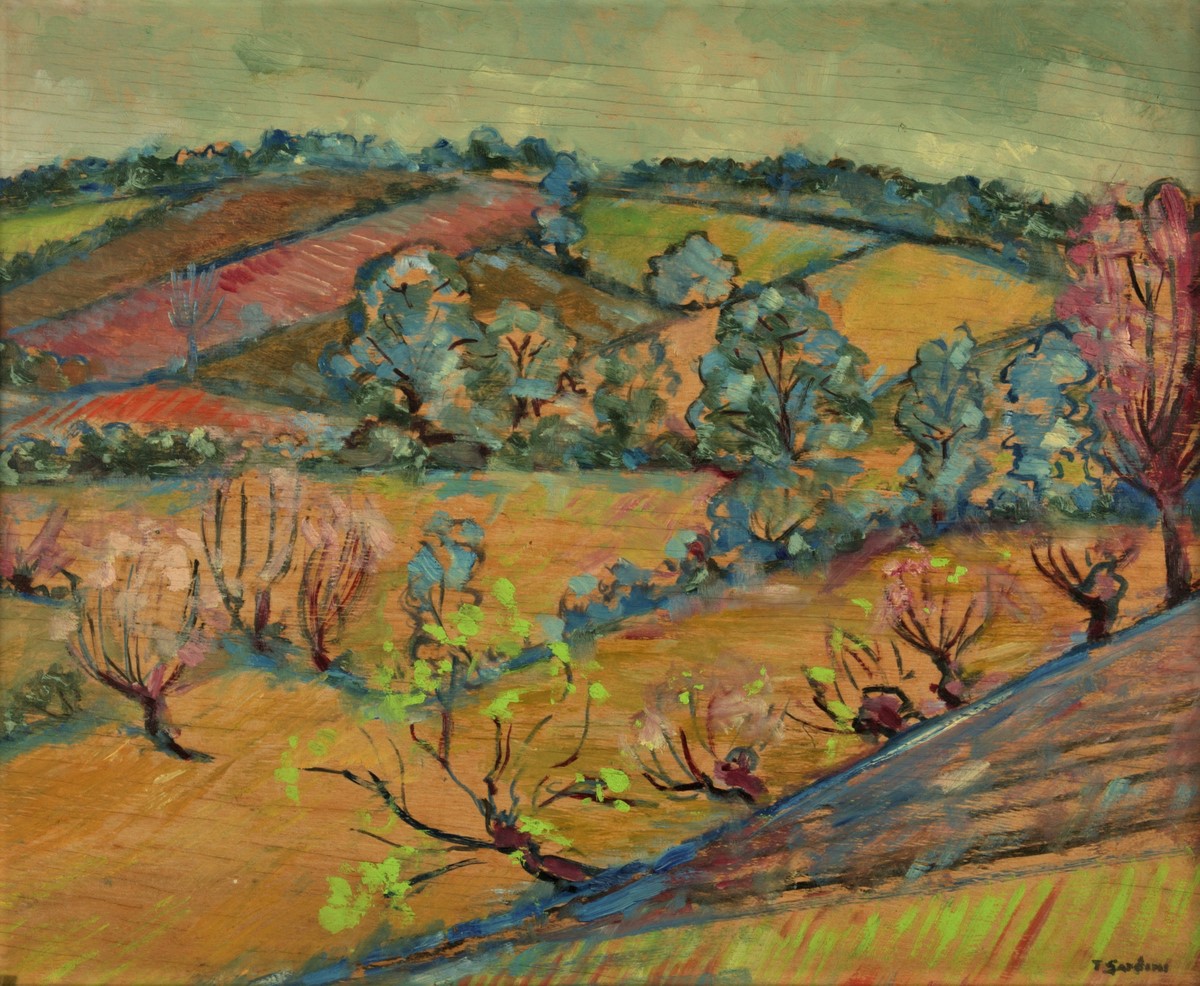
A recent search found the Manchester Art Gallery have a 1938 painting by Theophile Gardini titled Spring at Nayland, Suffolk. Why would he be in Suffolk ? The link is Dr Walker, who in 1901 opened a sanitorium to treat tuberculosis in Nayland, Suffolk.

Spring at Nayland, 1938

Back to the newspaper report:

Young Gardini’s art career has been rather unusual. His father, who had artistic as well as literary gifts, was a political prisoner under the Blackshirt regime and sent to a disciplinary regiment to do his military term.

The Blackshirts were the paramilitary wing of Fascist Italy led by Mussolini, and like his father, Avro despised them. In 1928 he was called up for military service, refused to swear to the Fascist oath and was imprisoned in a fortress on Lake Como. As mentioned earlier, he wanted a clean break from Italy.

The closing paragraph of the article revealed:

His son, whose work London is now to have the opportunity of appraising, was designed for the Church and went into a seminary. But his artistic proclivities, especially a facility for drawing nude figures, was judged inappropriate to seminary atmosphere, and young Theophile became a painter.

Avro would have attended the Priest training centre in Monza, Milan, where he was born. But why would the Church protest against his style of painting, understanding this form of art he would have been an asset to the Church as most are covered in paintings and sculptures of people. Surely they can’t have expelled him for a few drawings ?

He might have uncovered secrets and was dismissed because of what he discovered ? In later years Avro wrote many books against the Vatican and the Catholic Church and their position in world politics. A topic he became well known for in religious circles.

If you have information about Italian born artist & author Baron Avro Manhattan (1914-90) please don’t hesitate to get in touch.

Gary Alikivi  April 2021

Link to documentary film:

The Life of Baron Avro Manhattan – SECRETS & LIES – documentary (Alikivi,12 mins 2018). – YouTube

LOST INDUSTRIES on TYNESIDE

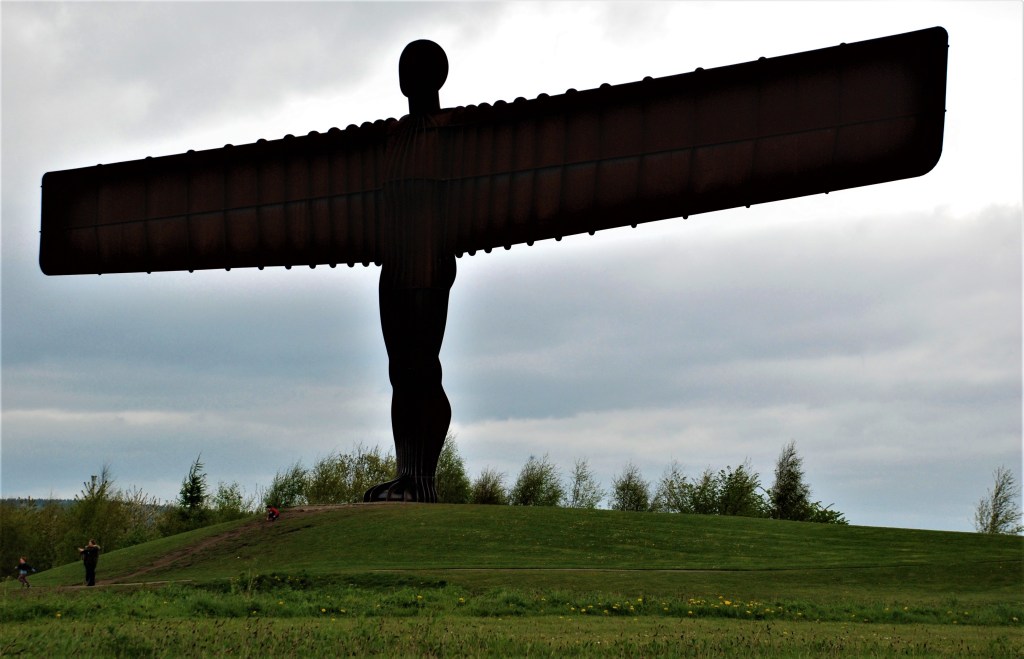
Angel of the North (Alikivi pic May 2015).

Between 2009 and 2016 I made over 20 Tyneside films which are available on the Alikivi You Tube channel.

In 2012 Vanished was a documentary about the lost heavy industry on Tyneside now commemorated by pieces of public art along the riverside.

They reflected the past of coal, steel and shipyards which dominated our landscape. In 2004 when I was making a video about art on the riverside I filmed some of them from a helicopter capturing the location of the piece.

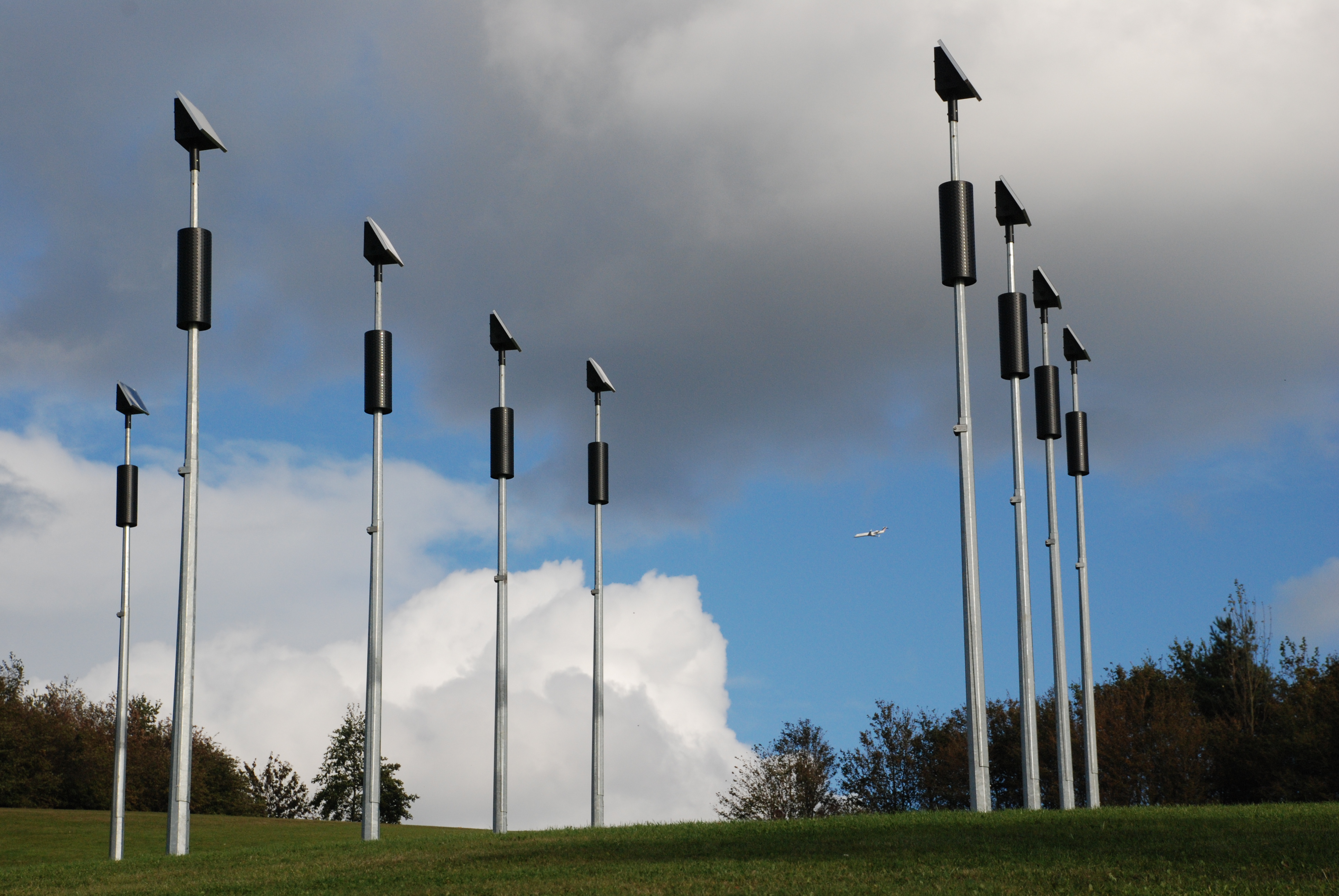
On the seafront in South Shields is the Conversation Piece with Tyne Anew on the north side of the river, and on the banks of the Tyne at Hebburn I talked to artist, Charles Quick, who designed Flash.

In 2002 I was invited to put a proposal in for a piece of artwork for Hebburn Riverside park. After talking to people in the area and doing some research about the history of the area I discovered there were lots of industries in Hebburn, but not so evident anymore – shipbuilding, coalmining, cokeworks and electrical engineering.

One thing that would link all those together was industrial flashes of light from the arc welding or the cokeworks.

I worked with many different communities to design flashes of light and these were orchestrated through a number of LED’s on the top, it was all solar powered so it really was looking to the future.

There was no cabling linking any of the columns, it was all radio controlled. There was a radio receiver that tells all the columns when to come on and off.

They can come on at night and there’s a timetable so they always come on in the dark, and also 30 second flashes of light every 15 minutes during the day. So it was a piece that would work in the day and at night.

Also featured in the film was former Whitburn colliery miner, now artist, Bob Olley.

Well I worked at Whitburn Colliery from 1957 till the colliery closed in ’68. Whitburn was a wet pit mostly and I was working in the east yard seam three miles out under the North Sea.

It took us three quarters of an hour to get in and three quarters of an hour to get out. I think it’s because it’s such an adverse industry, danger, and whatever else, a sense of humour developed.

When the colliery closed it was the push I needed to get out. When I first went into the artistic side of my life the stuff I did was very dour, mostly pen and ink work.

Then I moved away from coal mining for about 15 years then suddenly I got this urge to go back to the subject.

Up to about 15 years ago I would say most people in the North East their lives were influenced by the coal industry. The amount of people that were involved with the transportation of coal, the winning of the coal, the processing of the coal, everybody’s life was touched by coal.

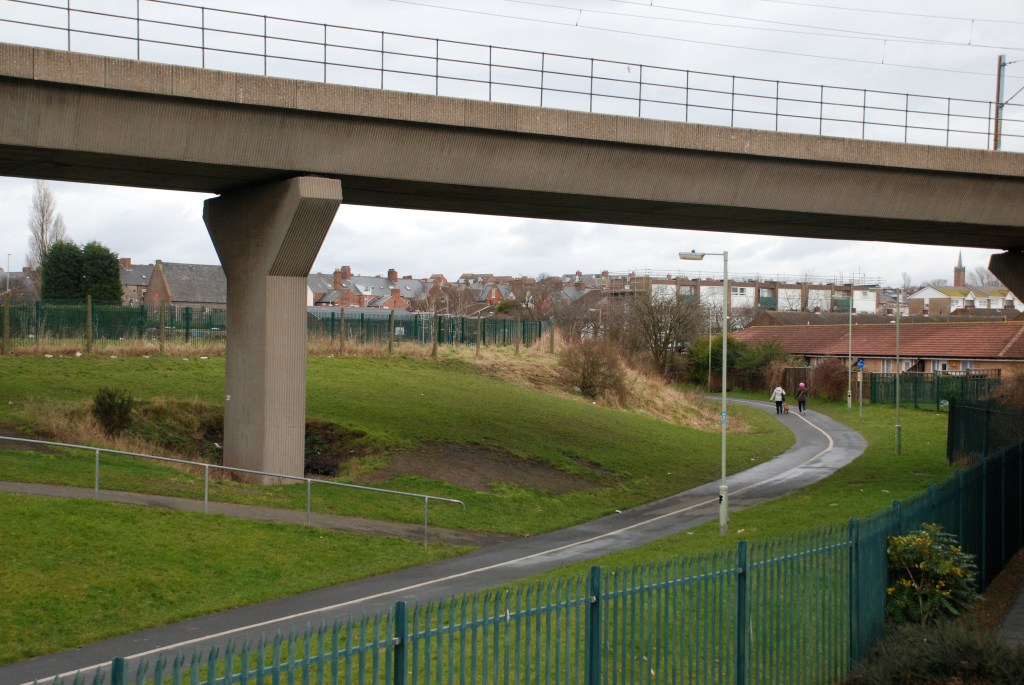
Metro bridge at Crossgate, South Shields over former railway line leading to Westoe Colliery. (Alikivi pic February 2013).

There was a lot of railway lines which used to criss-cross around South Tyneside, now they are used for walking and cycle paths. One man who remembers what it was like was John Cuddihy.

Well I was 40 years on the railway I worked at Sunderland, up to Consett, Darlington and over to Durham. Mostly worked South Shields station, High Shields station and Harton Junction.

You had a Harton railway system, and you could see the trains coming from Hilda Yard and through the tunnel under where the La Strada nightclub was, then up to Harton low staithes and then we’d run the wagons back.

Then under the British rail system you had the huge system at Green Lane, a massive system at Tyne Dock bottom where you used to get these big nine ’F’ engines hauling these ore trains all the way to Consett.

They would haul through Green Lane at high speed. The fireman used to be really fit to haul all the way up a bank to Consett.

If you were on the Marsden Rattler you could travel from Westoe Lane, a huge station with a signal box there an’ al – it was very impressive. You could travel through from Westoe to Whitburn and travel back it was only a short distance done on an aged rolling stock.

After that they pulled it all down, done away with it all together, there’s photographs of how it was and I took one in 1995 of the station. After that they built flats on it you wouldn’t think there’d been anything there – it’s a shame.

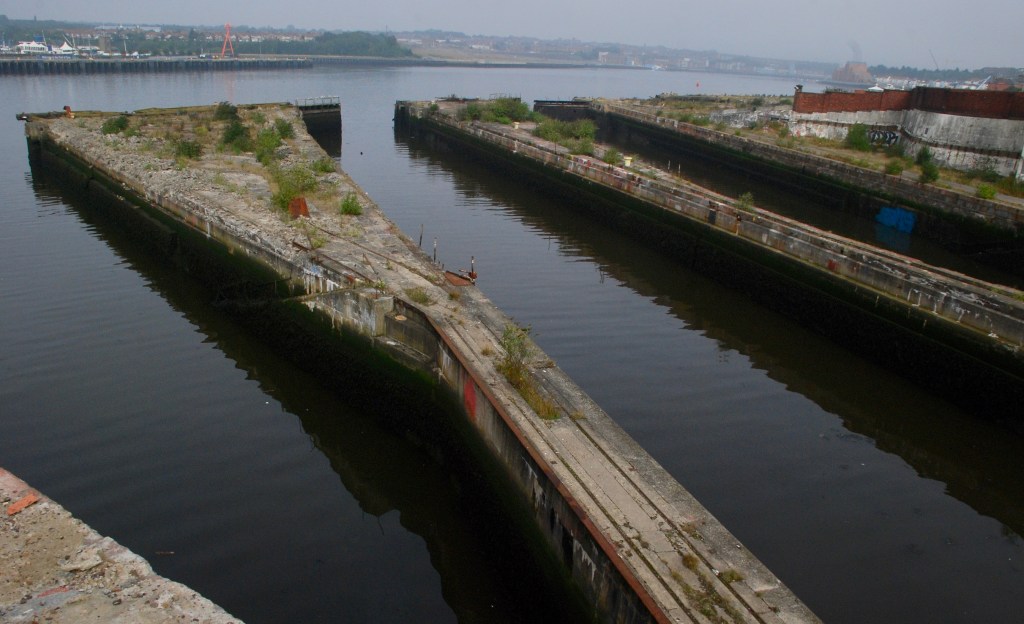
Holborn docks, South Shields (Alikivi pic. September 2016).

By the mid 1980’s there was virtually no shipbuilding on the Tyne, but one man who spent the early years of his working life there, was Vince High.

I started working in the shipyards when I left school in 1975. My Grandad had been a welder, also my uncle. So it was a natural thing for me to aspire to be the same as them, the fact that they were welders was a no brainer for me – I wanted to be like them.

A lot of the guys prided on the fact that they never lost anytime at all. I have visions coming back of the time there was a roller shutter that used to come down dead on 7.30am.

So if you were at the top of the bank and the shutter was coming down, myself and my mate would saunter down happy to lose a quarter hours pay, but you’d see some guys running down, throwing their haversacks under the shutter just before it hit the ground and doing a commando roll into the yard just to save a quarter hours pay.

Looking at the river now compared to say 20 years ago it’s actually incredible. Clearly the shipyards to all intents and purposes are gone, that high employment is gone, but what I think is happening is we’re trying to make an alternative use for the river now.

Whereas at one time it was about industry, work and employment, now it seems to be about improving the housing and getting people actually living near the river again.

Watch the film here:

Tyneside Lost Industry – VANISHED (Alikivi 9mins 2012) – YouTube

Alikivi  May 2021.

FAMILY TIES #3: JARROW SLAKE & THE GALWAY HOOKER

Fishwives by the river Corrib, returning from Galway’s fish market.

In 2007 I was over in Ireland researching my family tree when I picked up a book ‘Old Irish Country Life’ by Hugh Oram.

It was packed with photographs taken at the beginning of the 20th century of people working on the land, some I’ve included here along with text by Oram.

From fishwives to seaweed harvesting, weaving and cutting turf, the wonderful black & white pictures illustrated a harsh life – and these were similar scenes to what my ancestors lived through.

A branch of my family came from Galway so I was drawn to a picture that features fishwives by the river Corrib, returning from Galway’s fish market.

I was also interested in the photograph of a couple of fishermen’s wives repairing nets – as faint as a pencil drawing.

Galway fishwives repairing fishing nets.

The Claddagh, meaning ‘stoney foreshaw’ in old Irish, was one of Ireland’s oldest fishing villages on the western shoreline of Galway city.

The sea off Galway was rich in cod, herring and mackerel. The boats would all go out in the evening, drifting overnight and bring in hundreds of mackerel by dawn.

In the 19th century over two thousand people fished the bay using the traditional boat with its red sails – the Galway Hooker.

Galway fish market which stood across the river Corrib from The Claddagh where fishermen lived.

In 1985 my Grandfather wrote his memories of an Irish family living in Jarrow, North East England.

I suppose when they were built they would be a hamlet outside of Jarrow. There were three communities like this at the time; the Old Church at Jarrow Slake, pronounced ‘Slacks’, where we lived, Quay Corner at the riverside, and East Jarrow over the Don Bridge. The Don was the river that ran past our house.

My mother’s family the Joyce’s, originated in Galway in the west of Ireland. She came from a big family, her brothers, uncles and cousins were all fishermen.

I remember her one day telling me about the night they went out fishing in Galway Bay and a big gale blew up. Most of them were lost.

I remember my mother being a very hard working woman. She worked as a stoker in the chemical works over the bridge in East Jarrow. She worked there all through the 1914-18 war, and I remember taking her bait over at dinner time and getting half of it for myself.

Two World Wars happened in my life. The Great War of 1914-18 was on when I started school. We heard the Germans firing their guns on Sunderland. One day we saw a Zeppelin pass over, and I believe it dropped a bomb on Sunderland Docks.

We also went to Quay Corner to watch the Royal Navy ships come in after being in battle. I remember one, HMS Lion, her mast and bridge were all broken up and she had a big hole in her side.

Also, some tugs towed a great big ‘thing’ upriver and moored it at the Slakes. It was like a great big house, and my mother said it was a Royal Naval hospital for sailors wounded in battle. It later became known locally as the Floating Hospital.

The old Jarrow bridge over the river Don at low tide. The slake was over the bridge.

Looking back the things I used to get wrong for seem trivial. Such as playing in the Slakes at low tide and coming in with my feet full of mud or playing on the timbers at high tide.

We all did that, we would cut four or five timbers adrift and use them as a raft. But sometimes Mr Beauly the river policeman would catch us and tell our parents.

The slake was also our swimming pool, we all learned to swim there from about the age of six. By the time we were ten or eleven we were swimming in the Don and the Tyne.

At high tide the Don was about twelve feet deep and we would dive off the bridge into the river.

When my Grandfather died and was cremated in 1986, his ashes were thrown into the river Don from the old bridge. Sometimes we go back to where we started.

Hugh Oram book published in 2007 by Stenlake Publishing Limited.

Alikivi   May 2021.

FAMILY TIES #2: A FULL MOON & AN IRISH WAKE

In 2007 I was over in Ireland researching my family tree when I picked up a book ‘Old Irish Country Life’ by Hugh Oram.

It was packed with photographs taken at the beginning of the 20th century of people working on the land, some I have included here along with the text by Oram.

From fishwives to seaweed harvesting, weaving and cutting turf, the wonderful black & white pictures illustrated a harsh life – and these were similar scenes to what my ancestors lived through.

Seaweed harvesting was an industry along the coastlines of Mayo, Galway, Donegal and Kerry.

Work on farmland and fishing were major occupations in Ireland and after a long day’s work people would organise entertainment – there was no radio, TV or cinema in those days.

Relatives, friends and neighbours would enjoy endless singing and storytelling, the tradition of seanchaí – a teller of traditional stories – was hugely popular in rural households.

Killing the pig was an important ceremony and social occasion with neighbours lending a hand. Tea and the odd whiskey or two were shared afterwards, plus the latest neighbourhood news and gossip.

Superstition played a part – a pig was never killed during a month containing the letter ‘R’ and if it was done on a full moon the meat increased in size.

The Bothan Scoir, a labourers cottage, west Ireland.

Ancient customs and traditions were a big part of Irish life – and death. The wake was a send-off by family and friends in the house of the deceased before the body was handed over to the church.

My Grandfather wrote of his experience as an Irish family living in Jarrow, North East England.

You know looking back on my younger days, knowing the bit about my father and the more I knew about my mother, she was a very kind woman, strict but fair, and very religious.

She must have been a strong woman to work the way she did and to put up with the life she had with my father.

I often wonder how they came together as they had nothing in common with each other. One was always in the pub, the other in the church.

Still, I suppose there must have been some feeling between them as she had five children to him, three sons and two daughters. As they say, there’s nothing as queer as folk.  

In 1920 I started at St Bede’s Senior School, Low Jarrow. I was eleven years old and quite a lot happened to make me grow up quickly. I detested school and did everything I could to make sure I seldom went.

The only time I was ever happy at school was during the winter because each classroom had a big open coal fire and it was lovely and warm. But in the summer I would go to school in the morning and if it was a sunny day I would go to Shields beach in the afternoon.

When my father died my mother insisted on an Irish wake, where the deceased is put on display in the front room so that family and friends can pay their respects. They all sat at a table where there was snuff, cigarettes, clay pipes and ‘baccy.

Later on the men brought in the beer and to my young mind everybody seemed to be enjoying themselves except for my father who was stuck in the corner.

Then the final touch the night before the funeral, the priest came down at 7pm to say prayers as there was no taking the coffin to the church the night before the funeral as there is now.

More Irish family ties and images from ‘Old Irish Country Life’ on the next post.

Hugh Oram book published in 2007 by Stenlake Publishing Limited.

Alikivi  May 2021