WIRED FOR SOUND with Hartlepool musician, Jimmy McKenna

Hartlepool musician Jimmy McKenna has over 50 years in the business and in that time has released 14 albums. In the first part he looks into his musical memory box and digs out stories about auditioning for White Spirit, playing for Hell’s Angels, and does he still listen to Cliff Richard?  Read on….

The legend in our family is that my Dad went out to buy a washing machine and came back with a radiogram. As a small child I would play all the family records, A and B sides, digesting the labels as to who wrote the songs etc.

The radiogram did really well up until 1970 when it struggled trying to play my Deep Purple in Rock LP – it jumped all the time – by that time stereo was the big thing.

Jimmy was a child of the 50’s and his home was full of the top musicals of the day, Carousel, South Pacific, Carmen Jones, West Side Story, as well as current pop songs.

My all-time favourite was The Wanderer by Dion. My first love was Cliff Richard and I remember arguing in school with older kids who were trying to tell me that Elvis was better than Cliff – I just wouldn’t have it. Mam and Dad dutifully bought me all the early Cliff singles. Then of course came the Beatles, writing their own songs, the Merseybeat explosion and all that followed.

Jimmy in Iron Cross, 1973.

Jimmy’s big present for Christmas 1967 was a Magnus chord organ – a small keyboard with buttons to play chords.

I wanted to play the big hit of the time A Whiter Shade of Pale, but instead learned to play Silent Night and Londonderry Air. By now I was making up tunes in my head, including putting a couple to poems I found in a book about the 1745 Scottish rebellion!

By the time I was 14 my friends and I all received our first guitars, and suddenly we were a group. Within weeks we went from being The String Vest to Black Canyon to Iron Cross and later as pretentious 17 year olds we became Hansard. Also, within weeks I was relegated to bass as I was the last to master that pesky F chord.

As Iron Cross we played our one gig at a Boys and Girls Brigade party, performing My Generation and easy bits from ‘Live at Leeds’ when I was suddenly promoted to lead singer. My sister Margaret had been knitting a quilted bed spread, but converted it into a Roger Daltrey type coat for me!

After appreciating other people’s music, Jimmy started spending time writing his own songs.

We had a piano at home on which I spent hours doodling and making up quasi classical tunes, not even understanding what key I was playing – most of these have still to be completed/recorded, but they are on the list.

My friends and I were also diverging in our tastes, I discovered the ambitious music of Van der Graaf Generator and Peter Hammill. When I later heard the Sex Pistols I noted that a rock group had a singer with the same passion in his voice as Peter Hammill. I later learned that John Lydon was a Hammill fan also.

I then connected with Peter Scott of Hartlepool – not to be confused with Newcastle folk songwriter Pete Scott or that bloke who went to the Antarctic. Peter was an intuitive and aggressive guitar player. He was impressed that I was writing songs which encouraged him.  

Our first club group was Silver and our singer was Geoff Grange who would later sing, blow harmonica and record for Bill Wyman’s Rhythm Kings and Thomas Dolby.

After a gig one cold night the van’s windscreen was completely frozen over and our roadie Peter ‘Dock’ Oliver had the perfect solution and stood on top of the van to pee over the windscreen. It worked well.

Link to Silver playing intro to Purple Haze (Jimi Hendrix).

By 1975 Jimmy had an electric piano…Still only able to play my little quasi classical tunes, but I answered an advert for keyboard player for local rockers White Spirit. I blew it as soon as I got into their van, when I exclaimed that they were a bit young. I was 19 and they were just 17. After extensive jamming on the main riff of Jethro Tull’s Locomotive Breath their manager Sandy gave me the ‘we’ll let me know’ speech.

So back to bass guitar, around 1975/76 Peter Scott began backing popular Country and Western singer Mick Layton. There was a nightclub gig in Scarborough, the manager was desperate. A group of Hells Angels had arrived for a weekend of fun but it had rained nonstop and their weekend had fallen flat.

The manager was worried they would take their disappointment out on his premises so he begged us to do what we could to entertain them. This was Peter’s cue to turn up his guitar and we spent two hours doing extended Status Quo, Jimi Hendrix and Chuck Berry songs. At the end the biker lads were on their knees giving us the ‘we are not worthy’ hails and everyone went home happy.

At this gig Peter did a little trick with his wah-wah pedal, placing his guitar against his amp to make it feedback, then balancing one foot on his wah-wah to change the notes of the feedback  – noisy but dead good. This was while we were playing Ghost Riders in the Sky.

The Mick Layton Trio would often get booked into cowboy clubs…

I remember the audience all dressed up with names like Diamond Lil and Big Jim Bowie. It would get hectic when in moments of excitement they would start firing their pretend guns.

We once had a polite gig in a posh Newcastle Hotel. The manager came up to us at half time, a little excited. Cliff Richard was performing one of his Gospel Shows that night, and was staying at the hotel. The manager said he would ask Cliff on his return if he would sing a couple of songs with us – we had already played Apache.

Unfortunately, Cliff was a little tired and just wanted a nice cup of tea, so declined the invitation. Then Summer ‘76 we heard The Ramones and everything changed.

DisGuise in 1978, Jimmy McKenna, Alan Sculley & Pete Scott.

Next up read part two of Jimmy’s story including his close brush with fame with punky pop group DisGuise opening for AC/DC, Glen Matlock and The Rick Kids, and on the bill at the Newcastle Bedrock Festival with White Heat.

Alikivi   June 2024

MORE THAN WORDS: with Chief music writer, Phil Sutcliffe

The blog has featured some people who stuck a flag in the ground for the North East – Chris Phipps, Chris Cowey, David Wood, Colin Rowell, Ian Penman and Rik Walton for the pix.

The latest addition to the squad is a man who used words to create a colourful landscape and painted pictures in the minds of thousands of teenage music lovers.

London born Phil Sutcliffe, looks back on 40 years of music journalism for Sounds, Q, Mojo and The Face.

He interviewed a world of musicians including Stewart Copeland, Joni Mitchell, Nick Cave, Sheryl Crow, Eric Clapton…

Thom Yorke for Los Angeles Times and for Mojo, 15 minutes on the phone with Dolly Parton, truly that can set you up for a year or two.

Where did Sutcliffe find his love for words, and what’s his connection to the North East ?

I always wanted to be a journalist so in 1969 when I finished my A-levels and had a degree in English & American Literature from Manchester University, I applied for journo jobs and got a training course followed by an apprenticeship at Newcastle Evening Chronicle.

That was in the new training centre in an office above the Bigg Market doing just about everything – local councils, sports desk, feature writing, a spell as a columnist, the subs desk, and in court where the 15-year-old kid who pleaded guilty to burglary and asked for 153 other offences to be taken into account.

There was stints in district offices – Gateshead, Consett and North Shields – ah, the morning fishing report of how much, by weight and type of fish each boat had landed! From the outset writing heaps, hard, fast and fascinating all the time.

How did the job with Sounds come about ?

I’d always said I wanted to work freelance but it happened sooner than intended. After three years mainly on the Chronicle I did the usual thing of trying to get my second job, 175 rejections later I went freelance.

September 1974 I was 27 my first marriage had just broken up, a bit late to start writing about rock’n’pop so not much in the way of a plan, but thought maybe I could earn part of a living on one of the five weekly rock/pop papers – as ‘our man in the North East’.

While still doing a bit of local news for Newcastle papers and Radio Newcastle, plus a couple of non-musical feature items for Woman’s Hour! I wrote off to NME, Melody Maker, Sounds and Record Mirror.

With so many band tours starting in the North East you could get the first review in, and I got a sniff from Melody Maker, but really hit it off with Sounds.

Within the next year I started doing feature interviews and making a slightly more decent living – Gentle Giant might have been the first as I tended to get ecstatic about their wild prog adventures.

But my first rock interview I think was Sparks backstage at Newcastle City Hall for Radio Newcastle’s late-night programme, Bedrock.

The show was DJ’d by my friend Dick Godfrey with a strictly non-rowdy zoo of other voices – Ian Penman/Ravendale, Arthur Hills, the Out Now fanzine team, me, and other enthusiasts, all of us unpaid but enjoying ourselves meeting stars.

Also dozens of local bands from Sting’s Last Exit to Bob Smeaton’s White Heat, the veteran Junco Partners, Southbound, Gale Force Ten (with singer-saxist Joy Askew) and Wavis O’Shave.

There was a lot of local stuff about and loads of it good in what might well have been a culture – Tyneside pub rock. Very diverse, and not what Londoners called pub rock – Ducks Deluxe, Chilli Willy and such, Brit R&B-rooted – but it did happen in pubs quite a bit.

The Cooperage, The Bridge, The Gosforth – Last Exit every Weds if I recall. That one out in Heaton, Andy Hudson’s wine bar for a bit, a cellar near the Civic Centre – he played trumpet for the Grimethorpe Colliery Band when he were a lad you know, and then the more obviously culture-centred Jesmond Theatre.

We met on a Saturday lunchtime in a pub near the Tyne River and chatted and plotted, me and Dick Godfrey, promoter-musos like Chris Murtagh and Angus, er, sorry lost his surname but nice bloke with a moustache.

Even the odd sympathetic older star like Hilton Valentine from The Animals who could show us all a thing or two, though I can’t remember what. It was good.

Angelic Upstarts pic. Rik Walton.

Once in a while the Guildhall down by the Tyne River, scene of the Bedrock festival that spun off from the radio programme – all of this encouraged by a loose collective of bands and fans.

Putting the Angelic Upstarts on before Neon at the Bedrock festival proved to be a misjudgment as a huge fight ensued, a rather one-sided affair given Neon fans were student’ish and Upstarts fans were from South Shields.

I jest in retrospect, but it was a shame and in part my fault thinking in a hippie way that music brought us all together. We didn’t do that again.

However, the Upstarts – and their fans – were fine on their own territory, which is where I met them generally, starting with a gig at Jarrow Town Hall when punk had reached the North East and they’d released their single, Who Killed Liddle Towers?

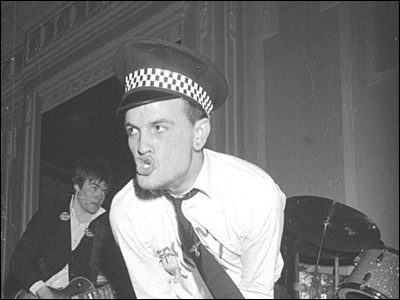
Which was a drama and a campaign in itself, with police brutality played out by cop-hatted singer Mensi, going at a real pig’s head fresh from the butcher with a bloody great axe. That was a night.

Also, a double page spread in Sounds, Mensi and Mond had plenty to say for themselves and we got on, up to some point where me coming from another planet got unfeasibly less brotherly. I always liked them.

My Sounds colleague Dave McCullough didn’t though, and he invented a great word for the rolling profanity Mensi deployed – fuckverballing.

What came in between worked pretty well though, speaking for a life much harder that most rock writers knew anything about.

I did cover heavy metal/hard rock quite a lot, but missed the North East bands, but pretty sure Ian Penman did a feature.

(Penman writing as Ian Ravendale in Sounds, May 1980, featured the North East New Wave of British Heavy Metal with interviews from Mythra, Fist, Raven, White Spirit, Tygers of Pan Tang).

Penetration feature in Sounds 18/6/77

My other ‘discoveries’, as we used to say were Penetration, a quite brilliant sophistopunk band from Ferryhill, dazzling in every way with a natural star singer, Pauline Murray.

Great ideas men in Gary Chaplin and Robert Blamire, plus drummer Gary Smallman and out-there’ish guitarist Fred Purser. They almost made it.

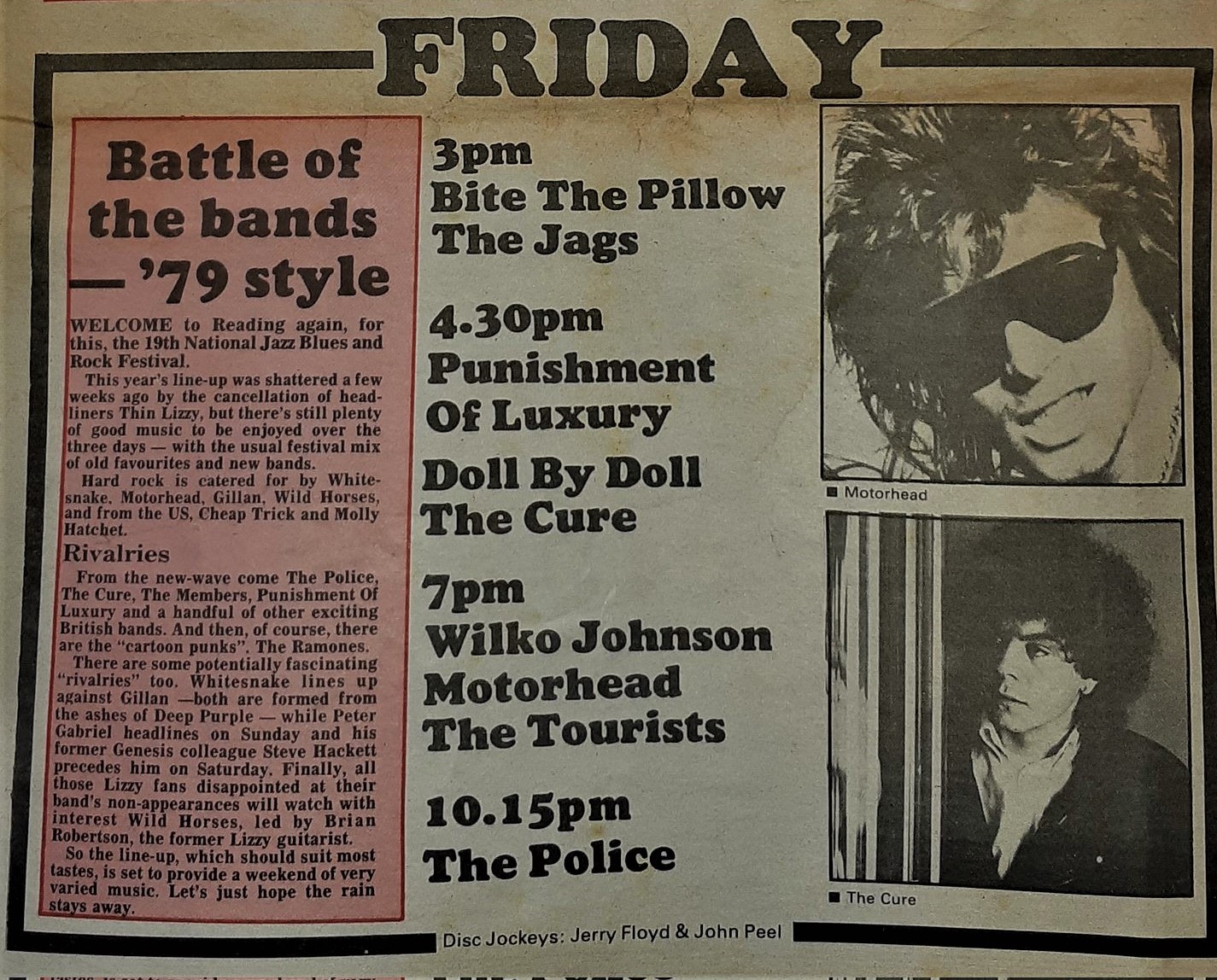
As did the rude theatricals, Punishment Of Luxury, with their panto villain frontman Brian Rapkin and his small band of wild-witty anarchs.

Reading festival 1979 line-up with Punishment of Luxury and headliners, The Police.

Meanwhile, I loved Last Exit to bits, jazz-rock and soul and their own stuff, often saw them twice a week, and eventually got them in Sounds.

A big feature on Geordie boys trying the London move – and this despite editor Alan Lewis saying “God that singer’s awful” when I played him a cassette.

But this was just after I happened to introduce Sting to Stewart Copeland, passing through as Curved Air played the Poly in ’76 – he had a lightbulb moment all right and somehow persuaded Sting to give up the music he loved, come to London and play the music he hated – punk – until it freed him to find reggae and write, Roxanne onwards.

Stewart and Andy Summers played to their optimum pop potential, and they become the biggest band in the world for quite a while.

Read part two featuring Phil’s memorable interviews, books on The Police and AC/DC and a Springsteen biography.

Thanks to ‘Soundclips’ on twitter for the articles from Sounds Magazine 1975 – 1980, archivist, Steve ‘Stig’ Chivers.

Interview by Alikivi  September 2021