A NIGHT WITH JETHRO TULL – with former Pirahna Brothers drummer, Tony Hodge

In previous posts Tony has talked about the influence Ginger Baker had on his drumming, and the many nights with friends going to watch bands like The Nice, Tina Turner, Jimi Hendrix and The Animals at Newcastle’s Club a’Gogo.

Before joining the Pirahna Brothers, Tony drummed for North East band Turm with Micky Balls (lead guitar), George Sturrock (guitar), Alf Passmore (bass) and the late John Lawton (vocals). He remembers the night they got a gig opening for Jethro Tull in a County Durham club.

‘It was an amazing experience to play on the same bill as the legendary Jethro Tull, unfortunately, the venue we were booked in was the Argus Butterfly in Peterlee. I say unfortunately because The Argus Butterfly was and still is a difficult venue for two bands to play as the stage and concert room are really small and there was an even smaller dressing room at the back of the stage’.

‘We arrived first and set our gear up  and heard that Jethro Tull and all their equipment were travelling up from London in a small Thames van’.

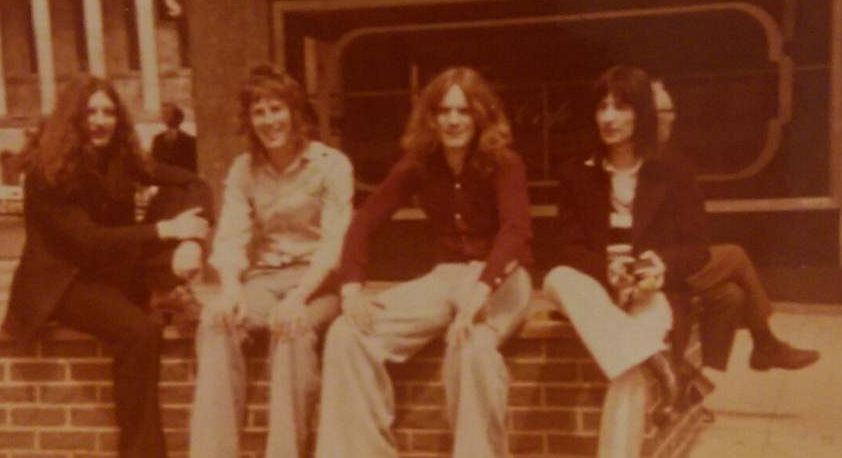
Turm at the Cellar Club, South Shields

Before big names including Cream, Pink Floyd, Deep Purple, Jimi Hendrix and Led Zeppelin packed out halls around the UK, they built their reputation playing smaller venues including Bay Hotel in Sunderland, Club a’Gogo in Newcastle, Cellar Club in South Shields,  Kirklevington Country Club in Yarm and Argus Butterfly in Peterlee.

‘When we got the booking I hadn’t heard of them as they were yet to hit the big time but when they entered the club, we were all fascinated by the lead singer. He was very thin, wore unusual hippy type clothes and had very long hair. This was becoming the fashion in London but was yet to be a fashion on Tyneside. Here was Micky and me wearing brightly coloured satin shirts in pale blue and fluorescent pink – so last year darling!’

‘All the guys were very friendly and were taken by our Geordie accents. They piled their equipment out of this small van, we wondered just how all their gear, four band members and a roadie got in the van – never mind drive 200 miles up the A1 dual carriageway. Note – there were no motorways yet’.

‘We were ready to play our set. Our fourth song in was a rousing number called Amen which had three or four sing along choruses with clapping to accompany it. This was a perfect song for John’s voice and the girls loved it’.

‘Each time the chorus started I would jump off the drums and go back stage clapping as I did. It sounds ridiculous, and it probably was, but it seemed to work well for the show’.

‘However, Mick Abrahams, the lead guitarist of Jethro Tull, was in the dressing room catching a well-deserved snooze on top of several amp covers. The first time I rushed in he jumped up in shock but then he saw the funny side when I ran back on stage for the opening riff after the sing along chorus. The next time I did it, Mick was laughing a lot as he had watched me returning just in time to start up after the chorus. The third time however he was ready. He grabbed me by the arms and didn’t let me return at the end of the chorus’.

‘The looks on the rest of my groups faces was a picture when they started with no drums. I can still see the vision in my mind today. Fortunately, he let go of me and it didn’t ruin the whole song, great guy, and a great laugh’.

‘After our opening set it was time for Jethro Tull to go on and they just couldn’t have been more different to us and were truly mesmerising. Their music was unlike anything I had heard before and their style was far away from anything I had seen before on the various stages in the North of England’. 

‘Another first for me was that Ian Anderson, the main vocalist and front man, played a flute that was a huge surprise. He also played harmonicas which he kept in small leather pouches around his waist and there was a funny side to this. He also kept his cigarette tobacco in these pouches and this meant he had to knock the tobacco out of each harmonica each time he was about to play them which was really very funny to watch’.

‘The visuals of the band were like nothing I had seen before and Ian sang many of his songs on one leg. This became his trademark as time went on and still is today. The drummer and bass players were very solid, had a great sound and the band was well received’.

‘Turm and Tull had a great time together as fellow musicians even if we probably looked a bit out of the current fashions in London. After this meeting they released Living in the Past a song that started my romance with my wife Jane many years later’.

‘They became rock superstars filling massive stadiums all around the world to thousands of people. I wonder if they ever thought back to the good old Argus Butterfly in Peterlee, the Turm and the 200 plus audience – somehow, I doubt it’.

Words: Tony Hodge

Edited: Alikivi   May 2025

More stories on the site from Tony Hodge including Jimi Hendrix, Cream, Tina Turner and Club a’Gogo.

Link to previous interview with Tony >>>

LUCKY MAN – part one, with North Shields actor & musician Tony Hodge. | ALIKIVI : NORTH EAST UK CULTURE

AN ANIMAL IS BORN with former Piranha Brothers drummer Tony Hodge

On 1st February 1967 on his way to becoming one of the most influential guitarists of the 1960s, Jimi Hendrix played the Cellar Club in South Shields.

A previous post (19 March 2025) looked at the impact this gig had, also mentioned was the opening of the new Cellar Club in December 1966 by Cream.

Reading the article stirred up some memories for North East musician and actor Tony Hodge, he recalled the time he was introduced to the band and in particular the drummer Ginger Baker and how influential he became in his life.

‘In the sixties my good friend Ray Laidlaw played in Downtown Faction along with Rod Clements and Simon Cowe – all three became famous in the amazing band Lindisfarne. Ray and Rod had an excellent bass and drums connection, driving the band’s music with real power – I loved to hear them play’.

‘On many occasions we went to see each other’s bands play at various venues including the Briar Dene Tavern in Whitley Bay and The Nautilus Pub, a short walk from my house that became a regular haunt from 1964 onwards.’

‘I would often go with Micky Balls and meet Ray and other likeminded musicians like Billy Mitchel, Will Browell and Billy Dunn. We always had great meetups and all types of music were discussed’.

Micky Balls and Tony in Newcastle.

‘One night near Christmas 1966 Ray mentioned he had heard of a drummer that played with two bass drums. This drummer apparently could play a drum roll with his feet!’

‘A drum roll is hard enough to play with your hands using sticks, never mind with your feet using foot pedals. I found it hard to do a fast double beat that was required in some pop songs of the time never mind a full drum roll. I said I couldn’t see that it was possible and we had quite a heated discussion about how impossible it would be’.

Fortunately, the band were due to play at Newcastle Club a’Gogo and Ray saw this as a chance to convince Tony. The Club a’Gogo was a popular venue housed in two upstairs rooms above Handyside Arcade in Newcastle.

It opened in 1962 as a jazz club but broadened its musical style and became better known as a Soul, Rhythm n Blues and Rock venue attracting big stars like The Who, The Rolling Stones, Jeff Beck and local stars The Animals.

Tony explained ‘It was split into two separate rooms each with its own stage three feet up from the floor. One room was called ‘The young set’ for under eighteens and the other was called ‘The jazz lounge’ for everyone young and not so young’.

‘When the big stars played there, they would play a set in each room. This must have been a nightmare for the road crew as during the interval everything needed to be set up in one room then taken down and set up in the other’.

‘If you got in early, you could be right at the front and literally a couple of feet from the stars. That was amazing for a fan. On every visit I always got to the front and had the most amazing view of people who were to become megastars’.

‘We had come to see the band that we had discussed in the pub with this special drummer. It was a newly formed band from London. Unusually they were just a three-piece group, lead guitar, bass guitar and drums and had no separate singer as was the popular set up of the time’.

‘The club had an amazing atmosphere, it was dark and you were all packed in together. Small lights lit the stage which was only big enough for artists to play and not a lot of extra room for big theatrics. The stage was absolutely packed with equipment’.

‘To each corner were two sets of PA speakers and on the right-hand side were four Marshall 4×12 cabinets and the same on the left-hand side. In the middle was a set of Ludwig drums with two tom toms, two floor toms and two bass drums showing the name Ginger on one drum and Baker on the other. Yes, this band was Cream and the amazing drummer Ginger Baker. At this time of course, I had no idea who he was – but that was about to change’.

‘On came a man dressed in a long purple Teddy boy jacket and a ginger quiff with a half pint glass of rum (I think) in his hand. He sat down picked up his sticks and hit all four tom-toms then did an amazing roll on the two bass drums. He stood up and left through the back door of the stage, his sound check completed. This was the one and only Ginger Baker’.

‘Both Ray and I just stood and looked at each other in amazement. The speed and technique were just amazing and so different to us two young drummers, I heard nothing like it before’.

‘I was still recovering when two other guys entered the stage and came to the microphone. Ginger came through and sat down behind this huge kit. They started to play with no count in just heavy tom-tom beats, then guitar, then the man in front of me who was Jack Bruce started to sing ‘Driving in my car, smoking a cigar, the only time I’m happy is when I play my guitar’.

‘The opening to N.S.U. was like nothing I had heard or played – ever! The drums rolled around the kit the volume was deafening and when the guitar solo came in by Eric Clapton the hairs on my neck stood up. It was loud, very loud. It was something you never forget’.

‘The rest of the set was also amazing playing in a style I could never have imagined. Ginger played a drum solo that was again long and loud but it ended with him playing the two bass drums and his tom toms in a chest thumping roll that went on for several minutes.

That was the famous twin bass drum roll Ray had been talking about, it was true, a drummer could play a drum roll with his feet. I had to learn that, I had to be able to play drum rolls with my feet. I was hooked’.

‘The trip back on the bus was all about the miracle we had just seen, a drummer like no other. I was changed overnight, by this one-man, Ginger Baker. Without my friend Ray persuading me to go to the Gogo to see him I would not have become the mad drummer I became. That night ‘Animal’ was born’.

‘I had to have a double bass drum kit and if possible, a Ludwig one. Off again to the music shop and more debt but I got a lovely Ludwig drum kit with a pearl finish just like Ringo Starr. It looked and sounded fantastic’.

‘Once I got this kit my whole style changed. I was more brash and started playing a drum solo at the end of The Pirahna Brothers first half. It was long, loud and not very technical but this new style and the notoriety it brought with it opened many doors. My nickname was ‘Animal’ and people shouted it out at venues’.

More stories from Tony Hodge coming soon including Jimi Hendrix, The Nice, Jethro Tull and Tina Turner.

Edited: Alikivi   May 2025

Link to previous interview with Tony from February 2021 >>>

LUCKY MAN – part one, with North Shields actor & musician Tony Hodge. | ALIKIVI : NORTH EAST UK CULTURE

THE FIXER – in conversation with former Impulse Studio and Neat Records owner David Wood

The next person to feature on this blog was owner of probably the most influential independent heavy metal record label in the 1980’s, a label that spawned Chief Headbangers Raven and Venom, who were major influences on the multi-million selling Americans, Metallica, Anthrax and Megadeath.

So, what was he like? Was he the Don Arden of Tyneside? Am I to be flown out by private jet to a yacht on the French Riviera or picked up by a chauffeur driven Rolls Royce and driven off to an exclusive restaurant?

Sadly no, it was just a misty September morning when I nipped on a ferry, crossed the River Tyne and taken to a café in North Tyneside by a man wearing a fez.

What or who inspired you to start Impulse Studio ?

When I left school, I ended up as a Park Keeper in Wallsend Park then found a half decent job as a Technical Assistant at Proctor and Gamble. I was there for three years, it was well paid at £11 a week so I had a few quid to go out on a Friday night with me mates, but I couldn’t see myself staying there.

For a 21st birthday present off my parents I was given a ticket to go to America on the Queen Mary.

While sightseeing in New York I came across this recording studio called Talent Masters. I went in and got talking to a guy who worked there called Chris Huston. I found out he used to be guitarist in The Undertakers from Liverpool. They had a hit record, but he left the UK to be a tape technician in the studio.

I’d always liked music, my instrument is the piano while not much of a player but was really interested in this studio.

So, when I returned home on the Queen Elizabeth ship, I began to play around with a bit of sound recording. At that time a teenager’s club was open in The Borough Theatre in Wallsend called The Manhole. This was around 1966 and people were listening to The Beatles and locally The Animals had made their name.

It was a great meeting place was The Manhole, graphics painted on the walls, flower power you know, and a lot of good bands played there.

That’s where I really got interested in the music scene. There was a similar place in Tynemouth called The Cave which was underneath The Gate of India Restaurant.

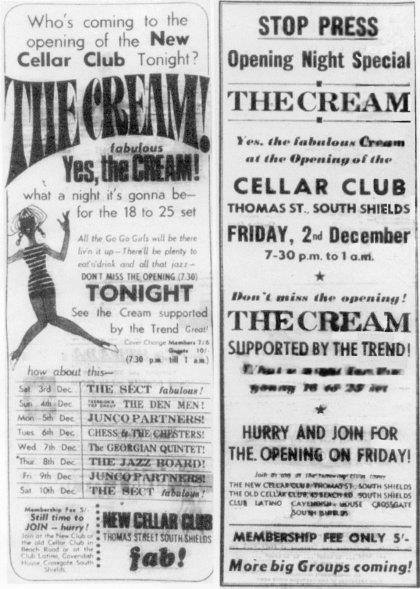
There was also a teenagers club in Beach Road, South Shields called The Cellar Club run by Stan Henry and his mother. Stan later opened The Latino and The New Cellar Club where Cream and Jimi Hendrix played.
cellaradvert

Advert for the opening of The New Cellar Club, South Shields. Taken from The Shields Gazette December 1967.

Yes, I used to go to The Cellar. I’d drive to the ferry at Howdon, get on there with my car, you could in them days, then get off at Jarrow. It was a great building I think it was in the basement of their house where Stan’s mother ran the club.

South Shields and Sunderland had their own places to run music from, it was great. I ended up doing some work for Stan, we ended up doing his sound equipment and for a lot of other people to keep the business ticking over.

In the Manhole club I met a band called The Chosen Few, and in them were Alan Hull, Alan ‘Bumper’ Brown on bass, singer was Rod Hood, guitarist I think was John Gibson and keyboards was Micky Gallagher who eventually played for The Blockheads, and he’d also played in The Animals when Alan Price left.

They were really good and had a recording contract with PYE records. They recorded down in the West End of London at Radio Luxembourg studios. They put a couple of singles out.

Going back to The Manhole Club, that just shut one day and never reopened. I don’t know why maybe someone out there knows something about that.

The Borough Theatre was built in 1906, it was a music hall at first, then a cinema, then a bingo hall. I got to know the manager and asked him for some space to run a studio.

The studio was in the dressing room and the entrance to the studio was through the old stage door. There was a little booth where the doorman would have sat, well before our time (laughs).

How did you develop the space into a recording studio ?

Literally built it up from scratch Gary, it took years to get it all done. At first we used egg boxes for sound proofing then bricked up all the windows. Anything was used for padding because we never had enough money then and at first we only had a mono then a stereo studio.

We then purchased a 4 track, then an 8 track, eventually a 24-track machine but this was done over ten or twelve years.

This was all by the 1980’s and by then we had the run of all the building and moved the studio to the top floor, which wasn’t very popular with the bands as we had no lift. Eventually Impulse Studios were on all three floors.

What bands did you record and who did you get in as sound engineer ?

One day I bumped into Alan Hull (Lindisfarne) by then The Chosen Few had split up, he was working as a nurse at St Nicholas Mental Hospital and still writing songs so I invited him down to record some. Impulse at that time recorded local bands.

We were a progressive studio and probably recorded most people in the region who sang and played at one time in their careers. Everything then was recorded onto quarter inch tape. At that time, we started to organise pressing records.

Sound engineer was Micky Sweeney, a great character, really popular with everyone. I used to do some recording as well. Micky ended up working with Lindisfarne who were born in the studio because it was there that Alan Hull got together with various members of Downtown Faction. They played together and got to know each other and it all came together.

You recorded an album with North East comedian Bobby Thompson, how did that come about ?

I knew his manager Brian Shelley and he said Bobby is doing really well around the clubs do you fancy recording him ? I thought yeah, we’ll give it a go.

So, we recorded him in Rhyope Poplars Club and Newcastle Mayfair. This was around 1978. It was around an hours recording that we put out and got Vaux breweries to sponsor it, ironically Bobby didn’t drink then and there he was on a promo poster with a pint of beer.

Soon as we put the record out it took off, they couldn’t get enough off it, straight to number one in the local charts. Every shop was selling bucket loads. It was phenomenal.

Nobody could have appreciated the way it took off like it did, he even appeared on the Wogan show. But his humour didn’t travel well, he was shy of being in other places but up here in the North East he was absolutely fantastic.

He could relate to the man in the street up here – the debt, the poverty, the wife and the war, he was incredible really.

With the label doing well, was Bobby responsible for Neat records ?

Ha ha well with the profits from Bobby the studio came on in leaps and bounds in no time at all, so yeah, we’ve got to thank him for it.

We started Neat records as an alternative to what we were doing. A couple of early singles and one by a band called Motorway which was pop, not heavy metal, then a song by Jayne McKenzie written and engineered by Steve Thompson.

Then Tygers of Pan Tang, Raven and Fist came along and suddenly we’ve got what became a New Wave of British Heavy Metal. Venom added to that and before we knew it we’ve built up a library of metal records.

Was there any rivalry between the top four North East metal bands – Fist, Raven, Venom and the Tygers ?

Ha ha yeah they probably hated each other. No, listen, musicians are very much their own people you know. I don’t blame them.

If they are the guitarist they are a ‘great guitarist’, you can’t perform in front of a dozen, hundreds, or thousands of people if you haven’t got an ego. You couldn’t stand on stage if you are a wimp, you’ve got to have something about ya – and they all do.

For Venom, first gig they played was at a church hall in Wallsend and they decided to have pyrotechnics and smoke. That all went off at the start and that’s the last we saw of the band for the whole set – they were playing behind a screen of smoke.

Did you deal with any managers or did the bands represent themselves ?

I dealt with Raven directly but some of the bands had managers. One of them was a butcher (laughs) then Venom ended up with Eric Cook who really worked hard for them. He was very enthusiastic and got a lot of things going for them.

Thing was he had no experience but nobody else did really with this New Wave of Heavy Metal, it was all new. And that is something to remember about that whole scene, they were trying to play and we were trying to market, we (Neat) were all on the same level.

We were balancing the recording, arranging tours, marketing, it was all interesting times, sort of in development, and some nightmare situations.

How did recording on the Neat label work for bands ?

We did singles at first and they were tasters trying to get some interest, get picked up by bigger labels, that sort of thing. Some of them would end up on compilation lp’s later and some of the early Neat stuff were the demos.

The first Raven album went into the national charts which was a surprise to all of us. But that was the progress we were trying to make.

How did Tygers of Pan Tang end up on MCA record label ?

MCA were interested in the Tygers first single and put it out on their label which put the Tygers in a position to sign an album deal. Through their enquiries I got to know Stuart Watson who was head of A&R so I took the whole Neat project to MCA.

They ended up recording albums by Fist and White Spirit. But MCA didn’t get their teeth into what we were doing so it all came back to us.

It could have gone further but major companies are looking for big numbers, they didn’t want to sell 5,000 albums they wanted to sell 50,000 albums. We would have been happy to sell 1,000!

If you did sell that many how would the profit be used ?

It would all go in the kitty, we wanted to progress the studio and the label – but we didn’t have any Lamborghini’s you know.

How did the label work for Raven ?

We ended up doing three albums with them and took them to America and worked with Johnny Z at Megaforce Records based in New Jersey. They did some touring over there and Neat were managing the band at the time, paying them a retainer every week.

When they came back the band had signed with the Americans. ‘Thanks for telling us’ I said, but hey that’s all in the past and we came to an agreement to release I think a live album over there.

Was that the bands natural progression to go to a bigger label ?

Yes, I suppose that’s fair comment to say that. We had gone as far as we could as basically a smaller outfit. I liked the band, I liked the idea of a three piece because it makes it easier to ship around.

A five piece band can be much more challenging to get around on tour and in the studio.

Did the label have contacts to sell records in other countries ?

We tried to get like-minded people in European countries, Holland, Italy etc, to do that but sometimes it was hard. A lot of time was spent trying to get it up and running but perhaps the label never reached it’s full potential.

We sold to local record shops in the North East but a good outlet was actually mail order.

How does it work for a band if they released a single in say 1980 and the track ends up on a compilation album years later ?

All the contracts were given over to Sanctuary and they had a section to deal with all the necessary releases.

What were Neat paying for as in terms of recording and tours ?

We would put money up for tours and we once bought a tour bus for Fist, which was a big mistake cos it got wrecked inside. Their first single was ‘Name, Rank & Serial Number’ and ‘The Wanderer’ came much later, Status Quo ended up doing that, sounding very similar.

Doing a more commercial song is a way in. Again I liked Fist and thought they had great potential, Keith Satchfield is a great singer and songwriter.

But just managing it all, controlling it all was a nightmare. There wasn’t a bottomless pit to fund it and you just try your best with the resources.

What was surprising about bands playing in the UK was there wasn’t many chances to play on the big festivals, England was a hard place to play. America and Europe was mainly where the market was. I remember Holland was a good place for the bands to go.

Neat released a lot of singles would that have put the label in a good position ?

Yes, it helped the studio, marketing etc when the next single or album come along to record and promote.

Was there a time when Neat wasn’t in a good position ?

Yes often, I remember one time a band wanted to go on tour, and it was £4,000. A lot to lay out because you don’t get it back cos the band don’t make much playing live. There was a lot of costs involved with going on the road.

When did Neat records fold ?

Jess Cox (former Tygers of Pan Tang vocalist) got involved and we set up a separate label called Neat Metal, we put a different catalogue together, started licencing from different labels – a different approach to it.

At one time we didn’t have any of the original Neat stuff on the catalogue. Eventually Sanctuary Records came in for the label and did some re-releases. A lot of independent labels have been moved around over the years.

With that I checked my watch and time was getting on so we agreed to meet up again soon where Dave will tell more stories about Impulse Studio including Cilla Black, Joan Armatrading and Sir Lawrence Olivier.

Interview by Gary Alikivi    September 2019.

GATESHEAD GET RHYTHM with drummer Steve Laidlaw

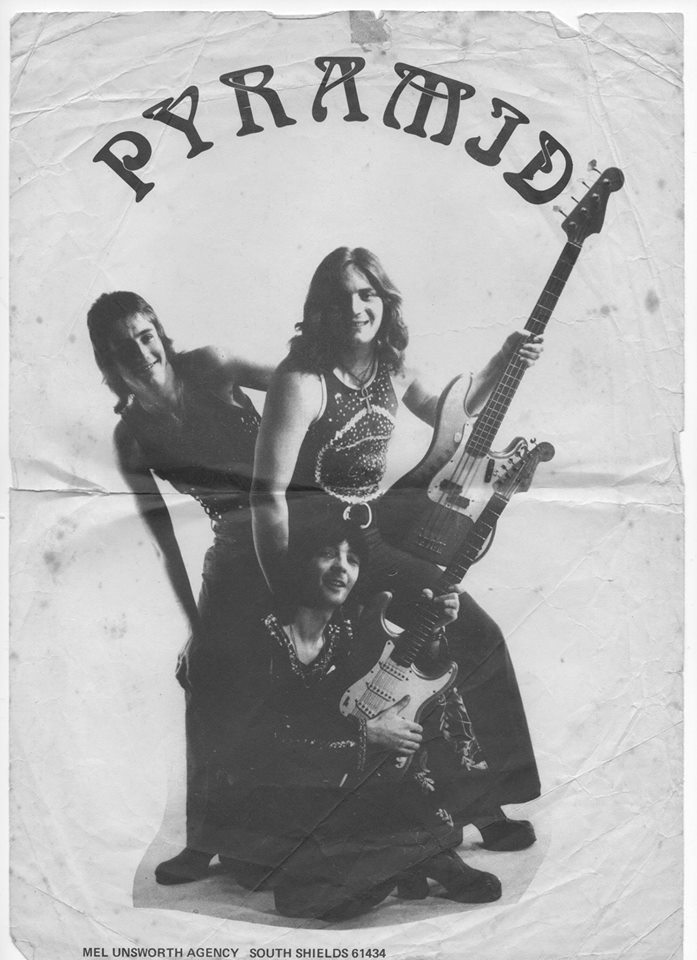
One of our strangest gigs was when Pyramid supported the Welsh heavy rock band Budgie at the Newcastle Guildhall. They and the crowd were all denim and long hair.

But we were playing Glam Rock, Bay City Rollers, Mud, that sort of stuff… but went down a bomb!

From the 1960’s to the late 80’s Steve played for many North East bands including Pyramid, Busker, Backshift, Flicks and Smokestack. Recently he has returned to the stool…

Last year I got back together with Chris Batty from one of my first band’s. We done some busker nights, got my mojo back, and we are getting a band going.

My son Andrew is a record producer and is signed to Slam Jam Records owned by Chuck D from Public Enemy. Chris and I are doing drum and bass tracks for his new album. Can you believe it. Talk about being down with the kids (laughs).

When did you first get interested in music ? 

My dad was a commercial artist who played guitar and piano at home, things like New Year parties. So, when growing up music was around the house.

When I was about 14 I got friendly with two lads who lived on the next Gateshead estate, Richie Close and Steve Davidson. Richie was already an accomplished musician playing piano and guitar. He later played with major bands such as Camel and was MD for Tony Christie.

We started messing around and Richie suggested I try drums. One day we went to his mate’s house and he had a kit. I got on and found I could separate my hands and feet and whack out a rhythm. We used to record little tapes, it was a hobby.

I remember being influenced by listening to straight four on the floor players like Mick Avory and Mick Fleetwood. No fancy complex stuff for me ! I was never technically gifted as a drummer.

I was influenced in my early days by watching the great John Woods from the Junco Partners, Ray Laidlaw (no relation) with Downtown Faction and Brian Gibson of Sneeze, later with Geordie.

Later I met a lad called Peter Chrisp who played bass. He was a blues man, and we formed a band with John Gormley (vocals), Ronnie Harris (guitar) and me on drums.

Can you remember your first gig ?

My first gig was at the Wesley Memorial Church Hall in Low Fell in 1967. Ronnie could play the John Mayall album ‘Beano’ note for note, so were ostensibly a blues band. We did The Quay Club, Bay Hotel in Sunderland loads of youth clubs and schools.

But the band sort of lost interest so I formed my own called Tycho Brahe, with my mate’s Chris Batty, George Curry and Stan Rankin. This was late 1969.

We did the Bowling Alley in Gateshead and the usual round of schools, but only lasted a few months. Then in 1970 I got a call from a guy called Jim Campbell. He was managing a club band which became The Paul Dene Set.

I got Chris Batty from my previous band in on bass, but we were only 19, and the other guys were 26/27, a lot older and very experienced. I went from playing Cream/Mayall to Tom Jones and Elvis with dickie bows and velvet jackets.

18012669_10154262986992085_2045594719_o

Did you have a manager or agent ?

Most of my time in bands we were managed by Ivan Birchall or Mel Unsworth who were always fair with us. We started getting regular work in the clubs, and had a van and good PA. We got gigs like the Airport Hotel, Top Hat, Guildhall, these were really decent clubs.

That lasted until ‘73 until I formed a band called Smokestack featuring Stu Burns and Steve Daggett. He played a blinder by stepping in at the last minute with no rehearsal, it worked out great.

Then I answered an advert in local newspaper The Chronicle, that was for a band called Pyramid who had been on the go for a while.

At first, we just rehearsed in a basement in Gateshead as one of the members was ill, so the band were off the road. At first the agents didn’t want to know but eventually we got a couple of gigs and literally tore the places apart with comedy and chart music.

Straight away we got repeat bookings and our agent Mel Unsworth started giving us work. Subsequently we started to build up what became a huge following and some people had seen us a hundred times.

15894458_10153991538337085_7274884893360001968_n

Have you any stories from the road ?

We auditioned for TV talent show New Faces in 1974 – and got on. The panel were made up of Micky Most, Tony Hatch and Clifford Davis who were not keen on us. Arthur Askey was there, and he was a lovely gentleman.

I remember the night we were on. We recorded the show in Birmingham on a Tuesday and the night it was broadcast we were booked for a club in Ashington, The Central I think, and we watched the show before we went on stage.

There were no videos in those days. We got a load of gigs after that and the work went off the Richter scale, doubling our pay from £40 to £80 a night (laughs).

The band went full time but I continued to work. I was working in sales through the day and got very little sleep. We would be doing a club then maybe The Sands which was above the bus station in Whitley Bay or the Burgundy Cobbler also in Whitley Bay.

We’d get to Palace of Varieties over in Prudhoe, then a few places in Newcastle like the Cavendish, Stage Door and the Rainbow Rooms.

I’d fall into bed around 3 or 4am, then back up at 7 (laughs). We once did 93 consecutive one nighters, but by this time we had two full time roadies, and we went in our cars.

36711030_1311155892354062_5895211650234974208_n

In 1975 I got married so left the band as my new wife wanted to see me (laughs). But re-joined a couple of year later and did a tour of Germany with the comedian Chubby Brown.

I remember being stopped at the East German Checkpoint and they got really funny with us. To get to Berlin we were told to ask for a Russian Officer, who we had to pay off to get through (laughs).

A story from one night involved Allen Mechen, who was the front man and guitarist Brian Pick. We used to start the act with me and Brian on stage and Allen used to run out of the gents.

One night we started playing and were going over and over the song with no sign of Allen. After five minutes our roadie went to find him. He was asleep on the bog with the door jammed (laughs). John poured some water over him.

Incidentally Brian used to be in well known Tyneside band The Sundowners and Allen ended up playing the character Terry in the Tudor Crisps adverts. After recording an EP I left the band again, then went back for their last gigs in 1983.

What studio did you record in ?

We recorded the EP at Soundlink in Newcastle and sold it in the clubs, but I haven’t got one cos I gave my copy away.

We also recorded a couple of tracks at Impulse Studio in Wallsend. That was for North East TV show Geordie Scene, but in the end, they decided not to put us on. We recorded a new single at Impulse, but it was scrapped at the last minute for some legal issues.

Not long after Pyramid I played in a band called Flicks. Terry, the keyboard player, was asked to join another recording band called Busker who had a huge hit with Home Newcastle. The song was a massive hit locally and is still played at St. James’ Park.

The band didn’t really exist, but songwriter Ronnie Lambert wanted to put a band on the road. He also played guitar and harmonica. He asked us if we could get a few of our old mate’s in and do a few gigs, so we did.

We also recorded a new single, and a new version of Home Newcastle with a few different lyrics but the band drifted apart. I think Ronnie just wanted to be a recording entity.

After that I joined Backshift, who became an eight-piece soul band, fronted by legendary Junco Partner, Ronnie Barker. This went on for several years, we done some good gig’s and had a great laugh but finished about ‘88.

I always meant to go back to playing but had two kids and things just drifted. I had 23 years in bands by then.

What does music mean to you ?

I always felt music should entertain and not educate. The general public are bored shitless by drum solos. As Brian Gibson from Geordie always said, get the girls dancing then you are ok (laughs).

 Interview by Gary Alikivi    June 2019.