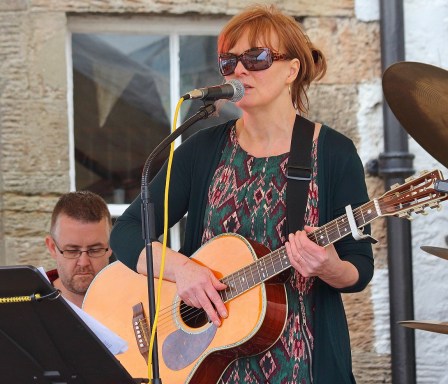
FOLK LAW – interview with Northern songwriter & folk musician Celia Bryce

Celia & Lee

What are your current projects ? 

I’m singing and writing songs, mainly for the band but also for children in schools and the occasional folk hymn. The Celia Bryce Band does mainly original numbers and plays at Roots Clubs, folk clubs and festivals.

The line up is me on vocals, rhythm guitar and accordion. Colin Bradshaw on harmony vocals, bass and occasional acoustic guitar. Lee Cramman on keyboards. Eddie Harris drums/cajon and harmony vocals. James Palmer lead guitar and harmony vocals. Mike Swindale appears with us at some acoustic gigs playing violin.

We can be a 3, 4 or 5 piece band according to venue’s requirements. The songs come from both albums and we’re now working on material for a third, some of which is co-written with band members.

There’s a mixture of folk, blues, country and almost anything that takes our fancy really. My songs tend to tell melancholic stories but they’re balanced out with more upbeat numbers. which we tend to work on as a band.

We nearly always inject a traditional song plus my favourite songs by Kevin Montgomery and Gretchen Peters.

Last year I did a couple of interesting sessions called ‘Women On Song’ with Chloe Chadwick (Americana/country/folk singer-song writer from UK). We both explored our songs, how they came about, the themes behind them and then performed them with a backing band with Colin Bradshaw, Eddie Harris and Chloe’s guitarist Mark Bushell.

It was really nice to have the time to talk about the process of song-writing at a gig. At around the same time along with Colin Bradshaw I supported Tia McGraff an Americana/Country singer from Canada, when she performed at the Old Low Light in North Shields. That was such a special evening. Tia’s a wonderful singer and songwriter’.
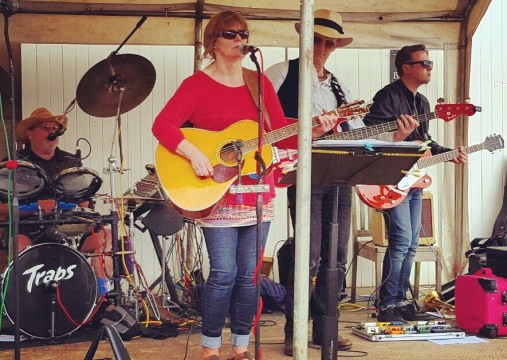
image2

Who were your influences in music ? 

‘They go back to when I was a kid singing in school performances of church music – mainly in Latin – and Gilbert and Sullivan. But I was heavily influenced by the music played at home by my father on piano and various stringed instruments and even Scottish Half Long pipes at one time.

My mother was very keen on singing and listening to opera and particularly Puccini. It was a musical household.

As a teenager playing in a folk band I loved The Bothy Band, Planxty, Moving Hearts and Clannad. I always loved country music and jazz standards too.

So very mixed influences and new ones come along every now and then. If there’s something I’ve heard and liked then often I’ll try to emulate the style in a song’.

How did you get interested in playing music. Was there a defining moment when you said “I want to do that” ?

‘I don’t think there was a ‘defining moment’ except maybe when my cousin next door started having piano lessons and I wanted to do the same.

Actually, I hated those lessons but carried on for at least a few years, learning more than I probably deserved, because I rarely practised and told my teacher that I wasn’t taking any of the exams.

My parents paid for those lessons, and it was only years later when I realised that it was money they could little afford.

The only thing I really enjoyed was trying to play like my father who was brilliant. Dad played an awful lot at home. We had a grand piano and when the house was empty I would lift the lid and play stuff I’d heard him play in my own way. Very loudly and incompetently, but I knew the tunes well enough in my head.

I loved the freedom of producing something which bore nothing more than a faint resemblance to the real thing but was identifiable, at least to my ears!

I was in sixth form when I met Benny Hudson who with his brother Gerard wanted to start a folk group. It coincided with me being given a 12-string guitar from a friend of one of my brothers. It only had six strings – I knew nothing about buying strings – and I could only play three chords. It had no case, so I carried it around in a black plastic bag to rehearsals.

I then bought an accordion from a Scottish family member, which also didn’t have a case. I managed to find one, donated to me by a member of a folk band I’d gone to see. He was sitting on an empty accordion case. Why I don’t know. He didn’t play accordion.

Can’t remember if I bought it or just smiled winningly. It fitted my 120 bass Baile accordion perfectly’.

band

When did you start playing gigs and what venues did you play ? 

‘Gigs as a teenager were in church halls but mainly, they seemed to be just getting together to play. We did a lot of Saturday afternoon ‘sessions’ at Jarrow Hall before it became the centre it is now. We’d play Irish tunes with the likes of George Welch, Jez Lowe, Ged Foley, Paul Dickman.

Those sessions developed my love of Irish and to a lesser extent Scottish tunes. By then I was only playing the accordion with Benny and Gerard playing bouzouki, mandolin, bodhran and bones.

It was through Paul Dickman and George Welch that Benny and I began to play with the Trent House Ceilidh Band led by Norman Bell. This was a 16-piece band which practised in the Trent House pub in Newcastle.

We played for dances, mainly in the Tyneside area but did travel to the borders, to Arran and Yorkshire. We didn’t support anyone.

I did play regularly at the Irish Club in Newcastle and played at a Fleadh Cheoil in Leicester with the Irish Club Band which won first prize in one of the competitions. I had never seen so many startlingly good musicians all gathered together. It was great.

I began to sing songs in folk clubs when I was about 18 with Benny and Gerard but found the whole thing horribly nerve wracking. I’d forget words with incredible ease!

To celebrate the 50th anniversary of the NHS in 1998 The Katy Freeway, a country rock band we had going before we decided to do original material, performed at the Drury Lane Theatre in London along with lots of other acts who had connections with the Health Service.

At the time three of us were working in the health service. The main act was David Essex.

The audience seemed to be all women who patiently put up with the many preceding acts, gearing up to go absolutely wild when he took to the stage! It’s a long time ago. The NHS is coming up to its 70th birthday!

What were your experiences of recording ? 

‘My first ever recording in a professional studio was at Ruby Fruit Studio in Newcastle and I recorded a song called Don’t Need You Woman commissioned for a TV drama written by local playwright Alex Ferguson – of  Pineapple King of Jarrow fame. The drama didn’t actually hit the screens.

In the first non-folk band I played in The Bill Stickers Band, where I was now singing and playing saxophone – we recorded some songs in a Wallsend studio called Red Nose.

The next band I sang in was The Katy Freeway and we recorded at home a CD simply for the joy of it.

The next recordings, for my CDs No Deals, No Promises and Links, were at Cluny Studios in Newcastle with Tony Davis. I found the first experience with Ruby Fruit quite unnerving and was rather star-struck to be honest.

Basically I did what they told me to, didn’t question anything much and knew that they were the experts. I was truly amazed by the technology applied to my words and music. The production was fantastic.

To be part of that was just great and it opened my eyes to what was out there in the world of recording.

I was a bit miffed that the sound engineer wouldn’t put many effects on my voice. I wanted reverb and all my errors smoothed over. He said it didn’t need it. I suppose I should have been pleased at the compliment but still felt short changed!

My experience at The Cluny with the first CD, No Deals, No Promises was much more involved and I was less starry eyed and spoke up a bit more. Jim Hornsby, Rob Tickell, Doug Morgan and Stuart Hardy played on that CD.

With the second, Links we mainly played with the band members of that time including the guitarist and song-writer Tony Schofield’. 

newton 2

Did you record any TV appearances or film any music videos ?

’I’d like to say no way, not at all, but we did do a video for one of our numbers The Workers’ Song and it’s hilarious but for all the wrong reasons.

The lads in the band look like they’ve just been released, after a very long time from somewhere very secure. Not our finest moment’.

Have you any funny stories from playing gigs ? 

Over so many years and so many bands there are lots of funny stories and one always sticks in my mind. It was while I was in the Bill Stickers Band. There I am, singing a song which requires me to play saxophone so I’m holding it ready to play between verses.

This drunk guy comes up and wants to take the thing from me and play. He’s very slurred and doesn’t take no for an answer. While I’m struggling to sing and keep hold of the saxophone and fend him off I’m getting absolutely no help from the rest of the band who, like true professionals just carry on playing.

Only things is ‘true pros’ have some crew somewhere don’t they. Bouncers, anything to take the guy out, in the nicest possible way. But no. I can tell you they got an earful from me at the interval ! 

Another time with the same band we were playing at a well known pub in Wallsend which had lunchtime entertainments  –strippers to be exact – and we played on the same stage at night.

There always seemed to be talcum powder on the floor – though we were never sure what part that played in the proceedings – and interesting ‘art’ work on the walls’. 

Interview by Gary Alikivi May 2018.

Upcoming gigs for the Celia Bryce band:

Fri 13th July Blackfriars, The Ouseburn, Newcastle

Thurs 19th July Guy’s Bistro, York

Sun 29th July Music at the Ship, Low Newton by the sea Music Festival

Sat 8th September The Barrels, Berwick on Tweed

Recommended:

Trevor Sewell, Still Got the Blues, 21st June 2017.

Tony Wilson, For Folks Sake, 10th May 2018.

Ben Hudson, Bees & Bouzoukis, 24th May 2018.
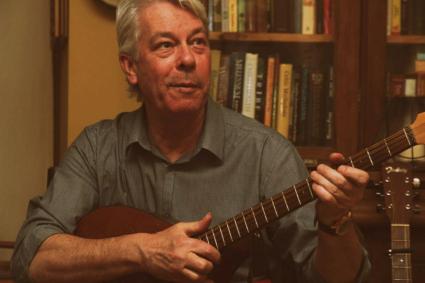
BEES & BOUZOUKIS – with Northern Folk musician and radio broadcaster Ben Hudson

71533_474243505955290_1955203027_n

What got you interested in music ?

‘I’ve always been interested in music. My mam used to be singing all of the time, so I know the chorus’ to thousands of songs.

I’ve got a vague memory of when I was very small, and my parents had the radio on. Glen Miller’s String of Pearls came on.

I was just mesmerised by it. Music always moved me. Not necessarily folk music because that came later’. 

When did you first pick up an instrument ?

‘When I was 10-year-old my brother Gerard and I got guitars for Christmas. We, and I use the term loosely, rehearsed for a few hours.

My Nanna and Granda were over for Christmas dinner and Ged and I came flying downstairs with this song we had just written. We played it and Granda said ’That’s just the kind of noise to set my head off’ ha ha’. 

What type of background did you have ? 

‘Both sides of the family had Irish connections and my uncle from Ireland was a Melodia player. My Nanna was from County Mayo and any Irish music would get her up dancing.

Her sister Bridget played harmonica so there was a bit of music in the family’. 

What venues did you play ?

‘With my brother Ged and a few friends, we played a school concert in St Josephs in Hebburn. I was a rock fan of Zeppelin and Genesis but got into folk when I was around 17.

That led onto playing the sessions in folk clubs like The Viking pub in Jarrow with Ed Pickford and Mick Elliott. Also further afield in Sunderland and Newcastle.

I was a singer playing a bit guitar. It was English folk at first but then the Irish and Scottish really captured my imagination. Then we used to go all over the country for sessions.

Scotland and into the Shetlands, that was the early ’70s’. 

10371568_709142762465362_3357988306619279868_n

What other bands were around at that time ?

‘Hedgehog Pie and The Doonans would play The Cricketers in Bill Quay. We’d see Northern Front who were great and very funny with it. George Welsh who is still kicking about, a really good friend of mine.

We used to go and see a few bands from Scotland who were and still are an influence on me, like The Bothy Band who changed my life !

They came over from Ireland to Blackfriars in Newcastle in 1975 they were absolutely incredible, playing rock music on Irish instruments. I was blown away. It was the first time I’d heard a Bouzouki guitar played and had to get one.

My first was an eight string ball back. Originally, they were a ball back guitar from Greece and Turkey. Because the ball back didn’t sit comfortably in yer stomach you had to hold it in a certain way. But now you can get a flat backed from Ireland.

Musicians like Christy Moore brought it back from Greece and Johnny Moynihan used it for the Irish folk band Planxty’. 

What are you doing now in music ?

‘I play in two bands. The Deadly Erneast Ceilidh band who I’ve been with for 30 years. We used to play regular but not as much now.

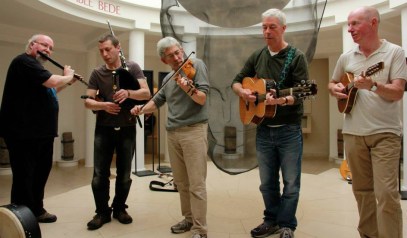
Also play in the folk band Lowp with Iain Gelston on bagpipes, Stephen Pratt on flute and whistles, Peter Brown on fiddle and David Harrison on mandola and mandolin. I sing, play guitar and bouzouki.

I also produce a Folk show on Hive Radio on a Saturday morning. I’ve done that for four years, when it was first based in Bede’s World in Jarrow.

I talk about and play all types of folk music, our audience are mostly UK, USA and worldwide as its internet based. The definition of folk music has massively broadened so I do like to listen to what other people are doing.

I also work alongside Diane Gray at Community Arts Project North East. We are always looking for new programmes and would like anyone with an idea for a programme to get in touch with Hive radio’.

What does music mean to you ?

‘When things are getting stressfull or hectic it keeps me grounded. It helps focus on the good things in life and you can really lose yourself in it.

I try to play something every day and I’m a terrible collector of instruments, guitars, bouzoukis drives my wife mad ! Really, I just love music’.

Interview by Gary Alikivi May 2018.

For further information contact http://www.capne.org

Recommended:

Trevor Sewell, Still Got the Blues, 21st June 2017.

Tony Wilson, For Folks Sake, 10th May 2018.

FOR FOLKS SAKE – with North East songwriter & storyteller Tony Wilson

‘Folk music for me is about the human condition and being able to express it without any classical training. The songs can be stories like Shakespeare, but condensed into four verses. They are very emotionally driven’.

31784322_10156388483067070_8534182708157349888_n copy

What got you interested in music and was there a moment when you said ‘I want to do that’ ?

‘I think I was always a singer. I sang in the church choir and at school. There was a ‘Time and Tune’ lesson where I’d be the kid who sang really loudly…and in tune.

I was brought up on Gene Autry and Johnny Mathis records but with regards to folk music there was a lot on television in the late ’50s,’ 60s, and was very popular.

There was a feeling in the air that there was something other than Americanisation of folk music. There was a very influential radio programme called Folk on Two with Jim Lloyd which featured live artists.

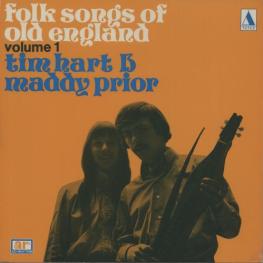
There was Tim Hart and Maddy Prior who later went on to be part of Steeleye Span. They were young, vibrant and sang traditional songs so it was a big leap from the Beverly Hillbillies on tv to finding out about my own culture.

Also Shirley Collins who played a folk opera Anthems in Eden, which was a celebration of everything within folk music. Yes, all that was very influential’.

TIM_HART_&_MADDY_PRIOR_FOLK+SONGS+OF+OLD+ENGLAND+-+VOLUMES+1+&+2-657259

Was there anyone in your family background who had a musical instrument ?

‘I lived in Tyne Dock, South Shields until I was 7 year old. I was very outgoing, singing a solo in churches that sort of thing but my parents were very quiet, conservative and an attitude of don’t draw any attention you know? Completely opposite to me, was I really their child ha ha?

But there was no music in the family apart from a Sunday night when we’d get around the radiogram and play our 78 records. There were folk songs at school we’d sing Scarboro Fair so there was a burgeoning folk scene coming on. You’d hear Bob Dylan, Julie Felix and Donovan on the radio, they were the acceptable face of folk.

I used to try and play loads of instruments. I was given a tin whistle, a harmonica and a jaw harp but I couldn’t get on with them. The Spinners were on the television and The Dubliners were in the charts’.

‘I’d heard this music and it triggered something inside, it was almost primeval. To be honest it was unlike anything I’d ever heard before and I was very curious about it. Also, at 15, it was a chance to sing rude words.

But the thing that really got me going was a folk club at school. I had a five-string banjo like The Dubliners who we went to see at Newcastle City Hall, and that was ‘wow this is amazing’. So, at school I was into the music that was more unpolished, out of tune almost.

There was a great wave of making music yourself which was appealing. At the school folk club musicians used to come and play for us, Jim Irvine, Jim Sharp, Jimmy Boyles and world renowned performers like Ed Pickford and Bob Davenport would come. Some of them ran a well established folk club at the Marsden Inn, South Shields.

There was also another at The County where we used to go sometimes when there was a performer on. They would get around £10 or something. The MC, Bob ‘the gob’ Gilroy, would let us in as the underage drinkers helped make up the fee for the performers.

We would also go out to other folk music clubs so that would broaden our spectrum of what we’d see and hear. Places like The Glebe in Sunderland’.

31946517_10156390061007070_2755255798517989376_n

What was your experience of recording ?

‘I only had a reel-to-reel Ferrograph which was guaranteed mono. You had one microphone and placed it almost like the His Master’s Voice dog kind of thing. You didn’t make that many albums because it was a very costly process.

We recorded in about ’74 or ’75 made an album and toured Germany. It was with a band called IONA on Celtic Music here on Tyneside and I was very nervous. We had eight tracks I think and did everything live in the studio which was a small room about 12ft x 12ft as I remember. It sold well in Germany, but I didn’t make any money from it.

I’d played music properly from 1968, joined bands and busked then went to Leeds University and refined the way I played. I qualified from university as an agricultural zoologist.

I started playing a lot of Irish music and met up with a load of old Irish guys in Leeds and learnt from them. If you weren’t good enough, they would make a point of telling you. So, you would practice, practice and practice. These guys were maestros of their time, in their 70s and 80s with this wealth of experience and dry wit.

The German folk scene looked toward Ireland as this Utopia of being folk you know, because the music was suppressed by Hitler. So, when they took folk on board it almost became more Irish. Why was it supressed?

I suppose, at that time, it wasn’t German music for German people. They eventually found their own folk music and the Irish traditional music sort of went lower in want’.

Did you have a manager or agency ?

‘No it was very low key. In Belgium there was a manager Leon Lamall who ran a music venue called The Mallemolem (Crazy Windmill). He would organise tours in France, Belgium and Holland. I was with IONA 1975-79 and there was a lot of touring, 2-3 month at a time. We had a van to get around, have somewhere to stop and people are always willing to feed you but all the money went into the p.a. and promotion.

People would always offer to buy you a drink. You would get money at the end of the tour, but people abroad would ask ‘what is your real job ?’ ha ha’ 

MCCONVILLE

Where did you go next ?

‘I had done some solo stuff when I met up with a Tyneside bagpipe and flute player from Jarrow called Mick Doonan. We did a lot of touring in 1980/81, every place we could around the UK.

We ended up forming a band with The Mathews Brothers and did really well, incredibly popular but then they had a family argument and split up. After that some money went missing and that soured the whole thing. It left a bad taste.

Then I went solo and because I had family by then I stopped touring and stayed closer to home in Leeds and played the workingmen’s clubs. That was the early 80’s before backing tracks came in.

My agent used to say ‘Will you play Batley Democratic Irish League Club’…’But last time they paid me off’ I replied…’Doesn’t matter… they’d take anybody. How much do you want Tony’….’£89.50’ I said…’Bloody hell why do you want that’…’Because that’s how much the shower costs to install at home’.

Every song was another part of the shower. Just getting on with it you know. I was doing the folk clubs myself but when backing tracks came into the working men’s clubs I was redundant overnight.

A guitar and voice were seen as very old hat. But to keep my hand in I worked on a BBC Leeds folk radio show plus I played at Whitby Festival for 17 years on the trot and compered at folk festivals during school holidays as I was teaching by then’. 

What was your experience of working on radio ?

‘I was there around three years, and the show was 45 minutes every week interviewing so many of my heroes. Loved it! At that time, I was also writing a lot of my own songs. But as I say I started teaching a lot, still doing bits and pieces with the folk but really it wasn’t until 1999 when I got back playing and singing in folk clubs again.

I was offered to join a band again, go on tour, play at the Millennium Dome in London. It sounded so good. I checked the contracts and away we went. The first year was incredible, tour dates, hotels, theatres, festivals, everything fine… even got a bit of money. But unfortunately another family bust up and I found I was only getting a small percentage of the money. But hey that’s just the way it goes sometimes.

I’d been burned in the past now I’d been left high and dry just before an American tour was planned. But through a contact I got some storytelling work in schools and I took that around the country’.

10005892_10152827224132070_6410402771909671676_o

What are you doing now ?

‘Well at the start of 2017 I started doing floor spots at Buskers nights and Open Mic’s around the North East. Last year I did around 150-180 spots.

Nobody owes me a living… doesn’t matter whether I’ve played that club 25 years ago I’ll still play the floor spot. It’s about how to get the best out of the song. Where’s the light, where’s the shade, where’s the point where I can emphasise?

I recorded every song that I wrote onto cassettes so I can always refer back to them, as you do with video now. When I play I also drag out all of these songs I wrote 30 years ago and they pass the old grey whistle test! People hum and whistle to some of my songs.

In 2009 in Whitby I met up – again – with a folk musician from Scotswood, Tom McConville. We had lived in a house together in the mid ’70s and played as a duo. We got on really well and a year ago we got up and played as a duo.

It’s a shame that there’s not as many folk clubs as there used to be. Sunderland had a few, Newcastle about four, it’s a contracted scene now’.

What does music mean to you ?

‘I think any musician might say, ‘I feel as if I’ve lived three lives. The places I’ve been, the things that I’ve done and the things I’ve experienced.’ It was like opening a door to the world – I’ve travelled, met good and bad people.

Coming back to the folk scene I’m flattered that people remember me. There’s still some fantastic people who put you up, give you meals, drive you places…just the most incredible thing ever….really….that’s music’.

Interview by Gary Alikiv  May 2018.