THE HISTORY OF ROADRUNNER RECORDS – with Film Maker Bill Saxton

Launched in Holland in 1981 and focused on releasing  Heavy Metal records, the label then expanded and opened offices around the world including UK, USA, Germany, Japan and Australia.

A documentary about the company is currently in production, the idea for the project started during lockdown when 34 year old Bill and his friend from Leeds started a podcast called Temple of Bleh.

The idea for the podcast was for the pair of us to reconnect with heavy music in a more meaningful way explained Bill.

This would be done through projects such as The Hunt for the Secret Channel 4 Metalhead, then we finally arrived at looking at The History of Roadrunner Records.

Being a metal guy of my age, I noticed a thread that connected my favourite bands – Trivium, Killswitch Engage, Sepultura, then the likes of Mercyful Fate and Type O Negative. So I toyed with the idea of a book on the subject.

After writing a brief report on the topic for the podcast, by complete chance, I crossed paths with former PR for Roadrunner UK, Michelle Kerr. She told me she’d like to see the finished product.

This was a sign to take this project to an academically accurate standard – so as not to look a complete twat in front of Michelle, who had kindly taken an interest.

I spent about a month creating a monster spreadsheet, detailing every original Roadrunner release since its formation in 1981 – conventional wisdom says Roadrunner formed in 1980, this is a lie.

After finishing this, I set about contacting every band, with mixed success, for a Zoom interview – which would be put up on the Temple of Bleh podcast and You Tube channel.

Then the idea was to roll them up into three documentaries of 60-75 mins each and detailing the three core ‘eras’ of the record label – 1981-1986, 1987-2001 and 2002-2012 explained Bill.

Andreas Kisser of Sepultura, pic Bill Saxton, 4th November 2022, at KK’s Steel Mill, Wolverhampton.

Research can always bring up a number of unusual stories, and Bill found a few about Roadrunner.

A good story I found is that Roadrunner’s first Gold single wasn’t metal at all – it was a 1995 gabba song called I Wanna Be a Hippie by Technohead. 

Also, in this period Roadrunner was trying to edge away from heavy metal, and in the UK specifically were trying its hand at Britpop.

If you were to ask Franz Ferdinand singer Alex Kapranos who first signed him, he’d say Roadrunner, with his early outfit The Karelia.

Another story is the range of artists Roadrunner licensed to Europe from the rest of the world. There are albums from Sinead O’Connor and Cliff Richard bearing the Roadrunner label.

Bill emphasised that the main point of the documentary is to illustrate that once upon a time, death metal hit the top of the Billboard charts, and had a seat at the table with the perceived top industry ‘players’.

It’s important to my generation to understand exactly how that came about. Who better to ask than those responsible at Roadrunner Records.

It’s also insanely convenient that you can’t answer the ‘how’ question without showcasing the stories and legacies of the key artists on the label such as Mercyful Fate, Type O Negative, and Slipknot – as well as the less mainstream bands like Deicide, Gruntruck and Blue Mountain.

Madball being interviewed, pic by TheFinalCut, 7th February 2023, at Manchester Club Academy.

After six months, 150 hours of interviews, one mini and one full documentary complete, Bill was contacted by Mrs X – who would prefer to remain anonymous.

She favoured the project so much she came up with the finance to form a production company and elevate the quality to broadcast standard.

Big thanks to our Mrs X where would I be without her! said Bill. So far I’ve filmed 32 interviews for the project, across six countries, both artist and Roadrunner personnel alike. I’ve still got a lot to go before I can call this thing even close to complete.

Bands from North East UK are represented by stories from Battleaxe and Dark Heart. It’s a dense mix of music business learnings, interwoven with rock n roll regalia.

As it stands at this moment, ‘The History of Roadrunner Records’ has no distributor or broadcaster interest as yet– so this will likely be hitting YouTube.

The documentary is being exclusively filmed in the UK and I’m managing the time with my day job, so I can’t put a final deadline on the production. I’m considering crowdfunding to quicken it up.

For more info or if you dealt with the Roadrunner label contact Bill at templeofbleh@gmail.com or @HistoryOfRoadrunnerRecords on Instagram.

Alikivi   July 2023
GUARDIAN RECORDING STUDIO #6: Ghost in the Machines

Guardian Sound Studios were based in a small village called Pity Me in County Durham, North East UK.

There are various theories on the origin of the unusual name of the village – a desolate area, exposed and difficult to cultivate or a place where monks sang ‘Pity me o God’ as they were chased by the Vikings.

Whatever is behind the name it was what happened in two terraced houses over 30 years ago that is the focus of this blog – they were home to a well-known recording studio.

From 1978 some of the bands who recorded in Guardian were: Neon, Deep Freeze and Mike Mason & the Little People.

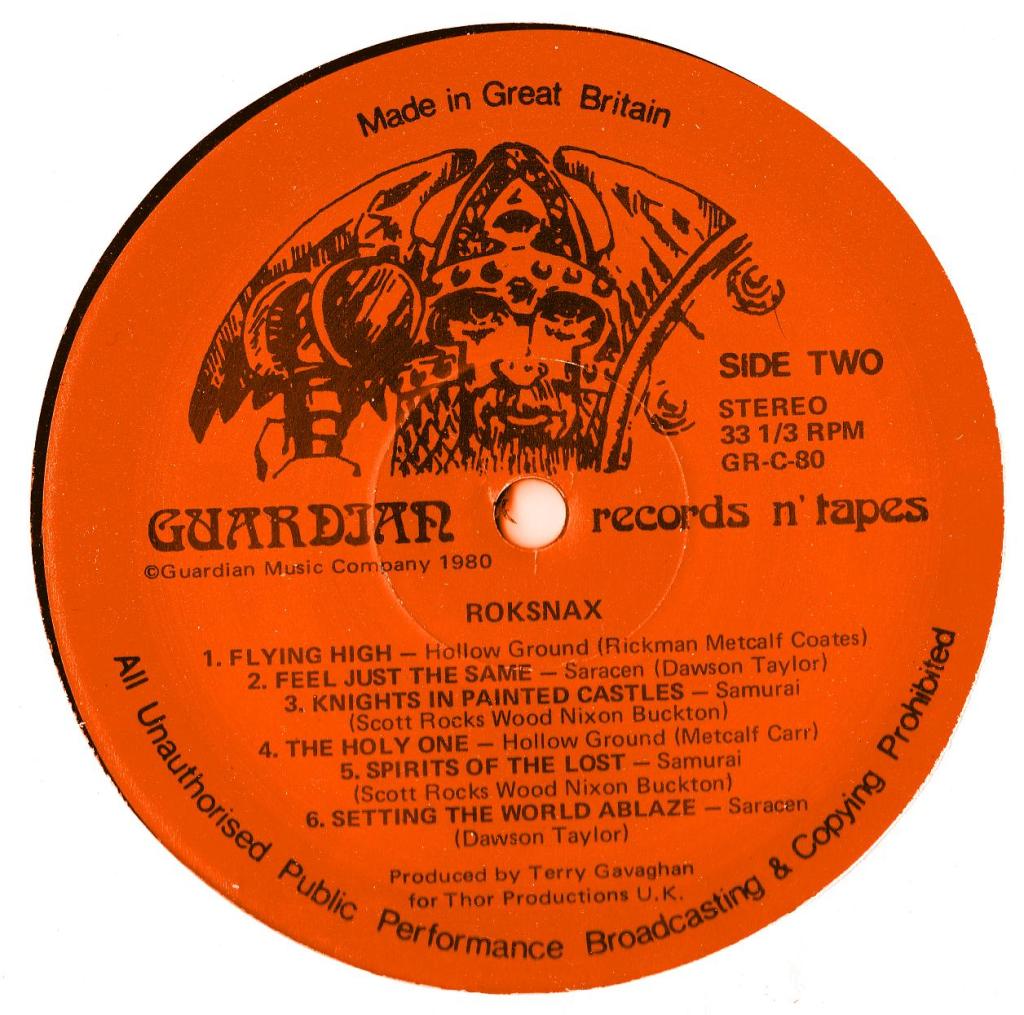
A year later The Pirahna Brothers recorded a 7”. 1979 saw an E.P from Mythra and releases in 1980 from Hollow Ground, Hellanbach and a compilation album, Roksnax.

From 1982 to 85 bands including Red Alert, Toy Dolls, Prefab Sprout, Satan, Battleaxe and Spartan Warrior made singles or albums.

On this blog there is a number of musicians who have memories of recording in Guardian and there has also been stories of a ghost of a young girl who was knocked down outside the studio.

Dave Wilkinson (Spartan Warrior): We recorded at Guardian Studio in ‘83/’84. My abiding memory of recording there is that the studio was said to be haunted.

There were occasions when although we’d been booked into the studio during the daytime, the producer Terry Gavaghan, would often have us recording throughout the evening and into the early hours of the following morning.

Terry would tell us about various sightings of the ghost of a little girl and there had been occasions when peoples headphones had inexplicably flown off across the room during a take.

On one occasion we were recording a track called Witchfinder for the Steel n’ Chains album and Terry thought that it would be cool for the five of us to record a satanic chant at the opening of the track.

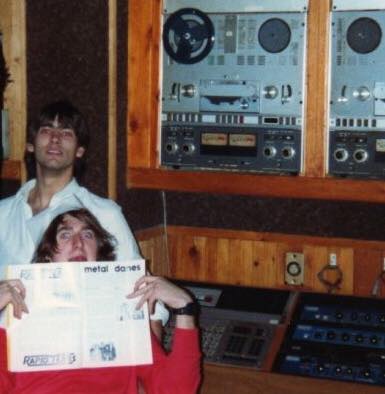
The control room had a large glass window next to the mixing desk and from there you could see into the room in which the band was set up to record. It was quite dark in that room and I think it was only dimly lit with a red light. 

So after a lot of the usual ghostly tales we all went around the vocal microphone while Terry remained in the control room with a lad who was helping him in the studio. We had a few runs through this chant and it was an unrehearsed shambles, but he called us back in to the control room to have a listen.

Terry set the analogue recordings running and we listened back. Then the tape machine just ground to a halt and he pointed at the digital clock which measured the length of the track and it came up as six minutes and sixty six seconds… 666.

Terry looked really worried and said you can’t have a clock showing 666 seconds and he was telling us something sinister was at work probably brought on by the satanic chant.

He said that we ought to abandon the idea before anything horrendous happened. He said the chant could bring about terrible things if blood was spilled. I think he actually said ‘all you need is blood’. 

Then the lad helping Terry got up to go into the kitchen to make us all a cup of tea and he banged his head off one of the monitors and split his head open. That was it – blood was spilled and we were all terrified.

It was almost certainly a wind up. I’m pretty sure Terry could have done something to make the clock show 666 but the lad did actually split his head open. The chant never made the album.

Read the full interview with Dave Wilkinson here:

Guardian Recording Studio stories #2 with Sunderland metal band, Spartan Warrior | ALIKIVI (garyalikivi.com)

Glenn Coates (Hollow Ground): When we were recording the tracks for a compilation album, Roksnax. We stayed overnight but if I knew what was there I wouldn’t of stayed.

One night the lads were in the kitchen making coffee and Terry Gavaghan and myself were sitting at the mixing desk in the control room of the studio.

We looked through the glass partition and seen a sort of electric blue figure that came right up to the glass in front of me, its face didn’t have any features, no face, no mouth, nothing.

Then it moved back and turned to the side revealing its shape of an old woman with a stooped shoulders and back.

I felt pretty calm watching this go on in front of us, then suddenly it floated across the room and stopped at the wall. Then it turned back and floated back across the room and through the drum booth and finally disappearing through the wall.

Terry looked at me and said ‘Did you see that’ my hair just stood on end. The whole episode lasted about a minute.

Terry has been known to set up a few pranks for other bands but how could you set that up ? I know what I saw. I’ve heard that the ghost was an old woman who tried to help the young girl that was knocked over. I don’t know if you believe things like that but I certainly saw it.

Read the full interview with Glenn Coates here:

ROCK OF AGES | ALIKIVI (garyalikivi.com)

Read more Guardian stories here:

Guardian Recording Studio stories #4 Metal on Tyne with Mythra, Saracen & Hollow Ground | ALIKIVI (garyalikivi.com)

If anyone has any information about Guardian or recorded in the studios get in touch.

Interviews by Alikivi