STROKE OF LUCK in conversation with Durham musician Stuart Willis

Sitting in the Littlehaven Hotel on a sunny autumn day in South Shields I’m listening to a familiar story which I’ve heard a lot since starting this site in 2017.

59 year old Durham musician Stuart Willis told me ‘I was in a band for a short space of time and got a taste of the music business. Although we weren’t a success commercially, we played gigs and got attention from record labels but didn’t quite get it over the line’. This is Stuart’s story.
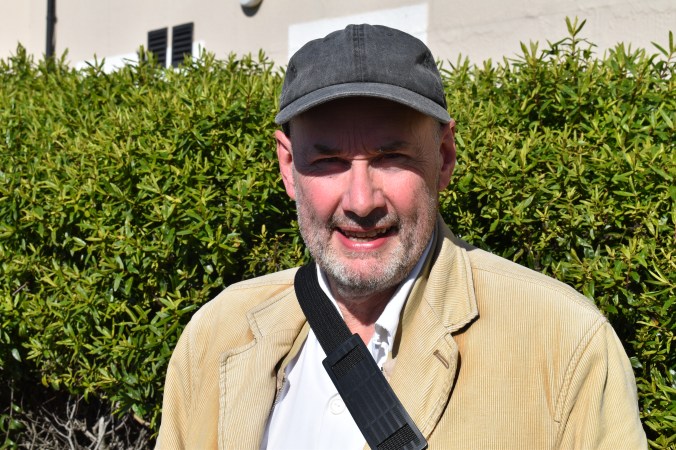
(Stuart Willis outside Littlehaven Hotel, South Shields September 2025. pic. Alikivi).

Older generations of the family originally came down from Scotland to the North East to work in chemical factories and the mines. My father was first in the family to go to grammar school and became an accountant. He was the one who bucked the trend.

I remember my mam brought a classical guitar record into the house. I absolutely loved it. I was around 11 year old when I got a cheap guitar and music book for Christmas. I picked it up very quickly. There wasn’t anyone else in the family who played and the school I went to didn’t even do music lessons.

My first influences were The Jam and Specials the whole Two-Tone and post punk scene with bands like Television, Magazine and Gang of Four who I saw at the Gateshead Festival in 1982 (The Police headlined with U2, The Beat and Lords of the New Church on the bill).

On the North East music scene was a band I liked called Neon. Tim Jones was in them and he went on to play fascinating music. I first played in a punk band in the local community centre when I was 16. Then I met Michael Salmon in 1985.
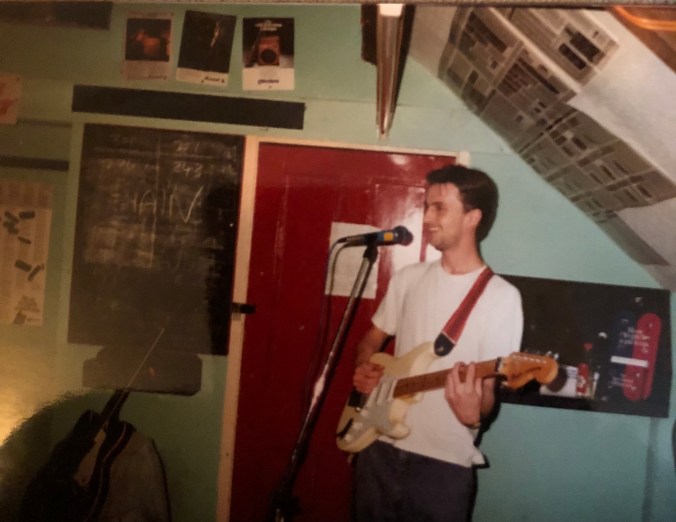
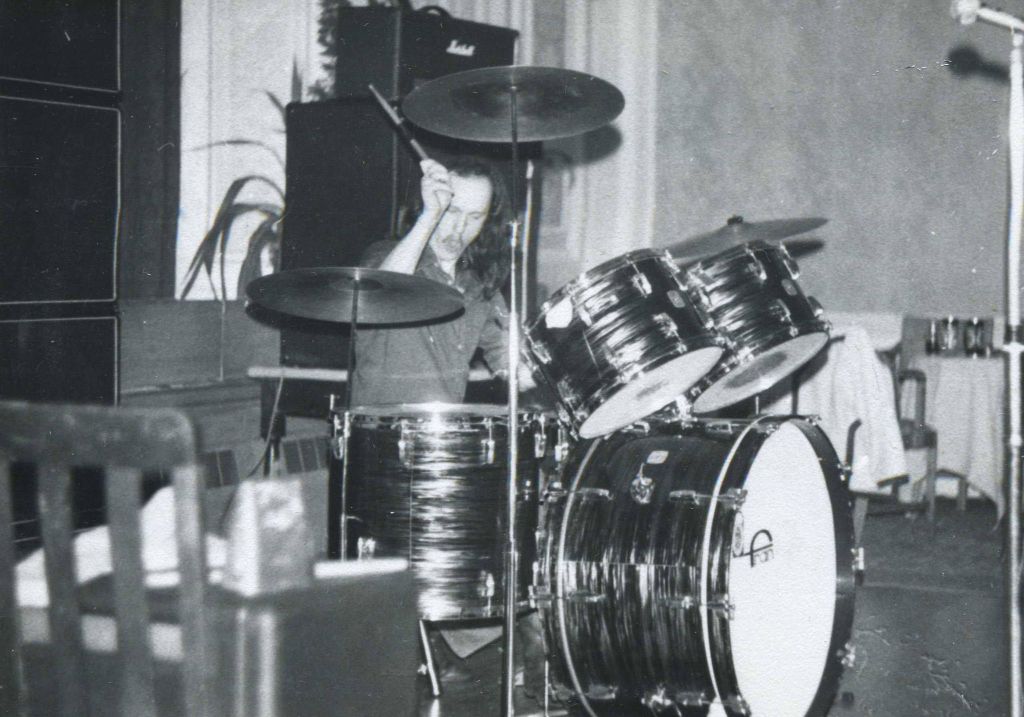
(Michael Salmon in rehearsal 1980s)

He was a drummer in Prefab Sprout with Paddy McAloon the main songwriter. When Michael left Prefab it was purely amicable. He wanted to realise his ambition of being a songwriter.

I was 18 playing in a duo in a pub in Witton Gilbert, County Durham. Michael was there that night. He liked what we were playing. I was playing classical guitar with Mark Wiles on bass.

Michael was a charismatic guy, excellent guitarist, singer and songwriter almost a teacher to me. Michael had a phenomenal record collection and I was introduced to all these amazing sounds.

We got in a drummer who was playing on the Durham scene and we called ourselves Swimmer Leon. Rehearsals were in Fowler’s Yard in Durham a lot of bands rehearsed there. We practised in there every week. The room itself almost became another member of the band. The sound was born in that room. We had about three albums worth of great songs that Michael had written.

The first place we recorded in was Consett Music project. We were all nervous. We recorded three tracks live and added a few overdubs. We took the songs out to play a few gigs.

(Swimmer Leon 1985)

We were mainly playing live around 1985 we got on well and had a cracking time. We supported a few big bands mainly playing University gigs. One night we supported the Ronnie Scott Quartet, he had a jazz group who had the club in London. Then there was ex Waterboy Karl Wallinger and World Party.

There were loads of times we met different musicians at these gigs who knew Michael from his Prefab days. There was the drummer from The Ruts who gave us some insightful advice about the record industry. He told us not be in a band because you can get lumbered with huge debts. Best to play for other people and get paid. Wise words.

For me the quality of any live work or recording we done was so important. Sometimes playing smaller gigs is a cacophony of sound but when we played the Students Union in Durham that gig was recorded straight off the mixing desk and we loved that sound.

After gigs other guitar players want to speak to you. That’s really great we appreciated all the attention but we thought where’s the women! We didn’t play ordinary chords so a few times they’d ask ‘At the beginning of that song what’s that chord’? and ‘Can I look at yer Gretch’. We were a quirky band and got a lot of press.

(Swimmer Leon 1986)

We also recorded in the Cluny Warehouse in Newcastle with John Silvester. Michael’s songs had jazzy elements too them, complicated chord progressions with complicated lyrics – it was like post punk jazz. With all the obscure influences we weren’t your run of the mill band. We were an arty band. We thought yeah, we’re great we’ll get a record deal!

Did you know we ended up with a development deal with CBS? Thing was we never sent a tape to them, strangely Michael thought it should come to us! The only thing we did was send tapes with the band name and telephone number to the local press to get reviewed.

All the major labels had regional scouts who would pick up on the music section in the local papers then come to gigs and take it from there. This is what happened to us and led us to recording in Guardian studio in a little village called Pity Me in County Durham. It was a really good studio.

Guardian was two houses knocked together with a large console and a piano at the side. The owner Terry Gavaghan was very professional about the work and we got on well with him. He wanted to know the structure of the songs, so we played them through sitting near the console.

Michael played drums on that recording his first time since leaving the Sprouts. I played guitars, bass and all the keyboards. Terry recorded it separately with a guide vocal, guitar, drums, bass and put stuff on top. He produced both tracks which still sound good today.
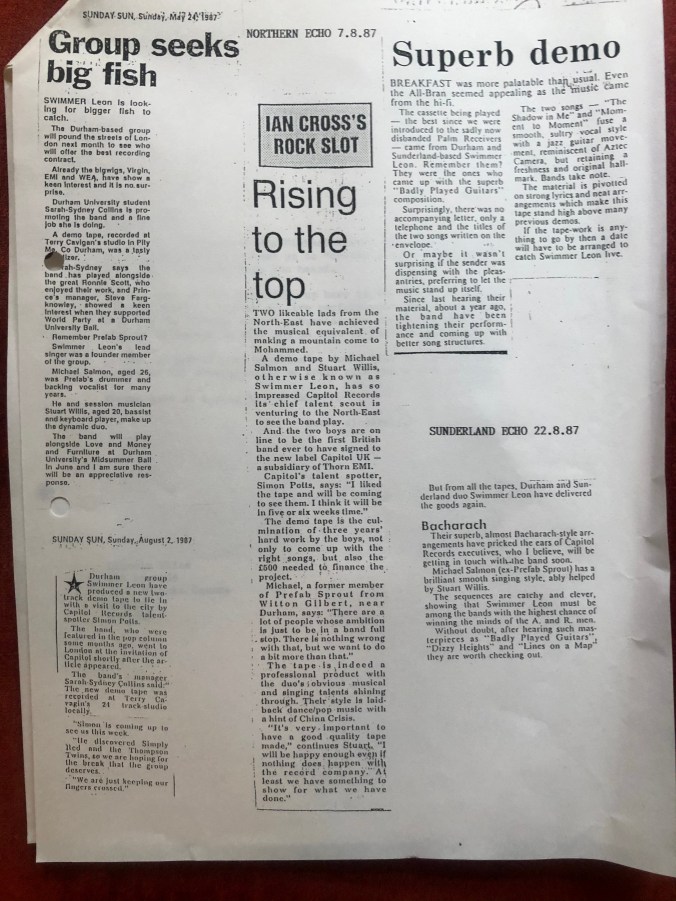
I was working in Windows musical instruments and record shop in Newcastle so I put their telephone number on our demo tape. A local reporter wrote a review of the tape. At work I got a call telling me it was Simon Potts at Capital Records and he was phoning from L.A. Yes Los Angeles! He asked if we had many songs so I told him about three albums worth. ‘OK I’m sending someone up to see you.

Research has found an interesting story about Simon. He was originally from Newcastle and lives in Hawaii now. With a great pedigree within the music industry he signed The Beat, Simply Red, Thompson Twins, Stray Cats, all selling in huge numbers having massive hits. Last band he reportedly signed were Radiohead.

This guy came up to Witton Gilbert from London and liked what he heard. We quickly arranged a showcase gig in Newcastle pub Slones. Actually, Brian Mawson, my manager at Windows music shop arranged the gig for us.

I loved working in Windows. It was a great place surrounded by people with aspirations to become musicians. There were new instruments on sale, latest records, local releases also a wall full of wanted musicians and bands advertising gigs – a great atmosphere. Darren Stewart who played bass for a few years in Swimmer Leon worked there. Dave Brewis also worked there he was in The Kane Gang.

The night of our gig London record label were having a promotion so a lot of artists were there and ended up at our gig. It was mad. Simon Potts from Capital flew in from L.A. We had Bananarama dancing down at the front, I think the Kane Gang were there. The head of A&R at Capital records told us ‘We’re giving you some money to record, just as long as you don’t go to Montserrat with George Martin!’ So, we went back to Pity Me and Terry Gavaghan!

We were in Guardian for three days and recorded three songs. By then GO Discs were interested in us, Warners were interested in us, Phonogram were interested in us. We were going up and down to London for meetings but we couldn’t get it over the line. It was just two kids really, me and Michael Salmon. The thing was we didn’t have a manager.
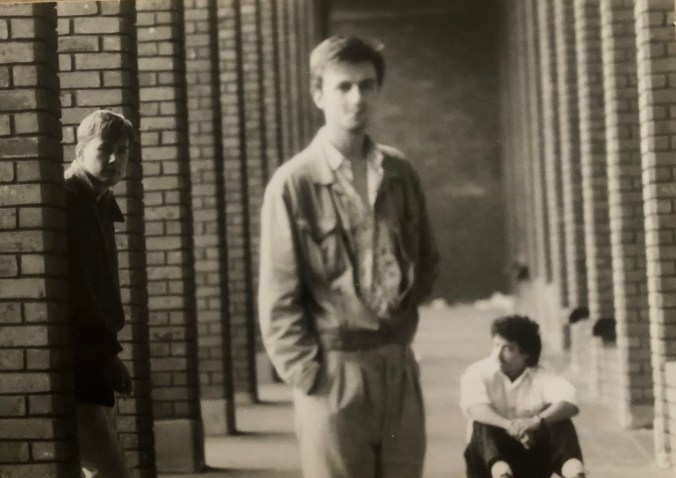
(Swimmer Leon promo shot 1987)

I remember going to CBS for a meeting. We were in a lift and there was Mick Jones from The Clash. I thought what’s going on here? From being a 16 year old punk playing gigs in Grindon Community Centre to meetings, gigs, studios and all this record label stuff without us really trying.

But life caught up with us. There was a time we thought is this gonna work? We didn’t want to move from Durham. I was from Sunderland so was Terence the drummer, Michael was from Witton Gilbert, Mark was living in Durham. The irony is when the band split up in 1989 we all moved.

I lived in London in the early 90s and worked in marketing for Virgin records. It wasn’t a glamorous lifestyle. I was living in a dingy flat in Blackheath. I saw the inner workings of the record business and couldn’t wait to leave. Richard Branson had sold the label by then to EMI and everybody was losing their jobs. I handed my car keys in went to Kings Cross train station and couldn’t wait to get back to Sunderland.

What am I doing now? My ambition was to study music properly so I done a music degree at Newcastle University from 1993-95 and ever since then I’ve been a teacher at Durham University in the music department, performer in classical guitar and specialise in historical music performance where I play the lute. I’ve also got a publishing deal for Schott, publishing guitar books.

Don’t want to come across like a moaning old bloke but young people today don’t understand what a band is. To get four or five like minded people trying to evolve a sound and make it into something special for you – that happened for us. We were lucky to be able to do what we done in the 80s. Today I still listen to all the bands I listened to back then. I’m still passionate about music.  

Alikivi   October 2025

HAVE YOU HEARD THIS ONE? #8

How’s it gaan? After sharing stories first posted here in 2018 about the New Wave of British Heavy Metal there’s been a welcome spike in views from Poland, Slovakia and the Netherlands.

NWOBHM has always been popular since the first posts in 2017 which featured Fist, Raven, Mythra, Satan, Hollow Ground and Tygers of Pan Tang, plus stories from Impulse Studio big wig David Woods and producer Steve Thompson who brought the hammer down on seminal recordings on the Neat label. Also posted are stories from Durham’s Guardian Studio, although producer Terry Gavaghan has remained elusive. So far.

While new interviews are being lined up to take the site to the end of 2024, November has featured a compilation of stories from this year – and here’s another batch.

First up is a regular to the site, songwriter & vocalist Emma ‘Velvet Tones of Teesside’ Wilson. Emma first appeared back in 2019 talking about her influences in music…

‘Aretha Now’ and ‘Aretha Sings the Blues’ were both records that shaped my development as a singer. I used to sit for hours listening to the songs on vinyl’.

Emma kick started 2024 being pictured on the cover of Blues Matters magazine featuring her new album ‘Memphis Calling’ recorded in Sam Phillips studio, USA.

‘The studio breathes, it has an immense presence. The live room is awesome, beautifully designed. I let my emotions out on the recording’.

Full story >>> EMMA SINGS THE BLUES – with Emma ‘Velvet Tones of Teesside’ Wilson | ALIKIVI UK : NORTH EAST CULTURE

100 year old actress and entertainer Helen Russell sadly passed away this year. She will be missed. In May, Helen featured on the site looking back at the start of her career.

‘We didn’t have a phone in the house so I’d take calls on the local public telephone box outside to tell me where I was playing that night. Sometimes it meant getting a bus to Newcastle and then catching another to Stanley in County Durham, or Ashington in Northumberland, then heading back after 10pm – all the time humping my guitar and other equipment. I had no helpers.’

‘When guitar groups became popular in the ‘60s I had to stop dancing on stage because of all the leads and wires. That’s when I took up the guitar and later started writing my own songs.’

Full interview >>> TON UP for North East actress and entertainer Helen Russell  | ALIKIVI UK : NORTH EAST CULTURE

Another regular to the site is songwriter and former Neat records producer Steve Thompson, he got in touch in May.

‘I was 24 year old at the time and just quit a waged job to live on fresh air and follow a dream. I was either very brave, very stupid, or both. I quickly began knocking out songs and pitching them all over the place. I knew I needed some action or I was going to starve’.

‘One day I was at the dentist in Wallsend. I’d been called upstairs to the surgery when the receptionist called me back down. It was my publisher on the phone they tracked me down to tell me ‘Hurry Home just entered the charts at 63’. You could’ve knocked me down with a feather, that was the break I was looking for’.

‘From there on in incredible things happened it climbed the charts over a period of three months and peaked at 17. Here I am top 20, I had arrived! Then all sorts of things started to happen, the lyrics were printed in pop magazine Smash Hits, all the airplay on Radio One, name checks from DJ Mike Read on the Breakfast show, and of course Top of the Pops. All this was happening but I was still broke’.

Full interview >>> I WILL GO BACK– with songwriter & former Neat records producer Steve Thompson | ALIKIVI UK : NORTH EAST CULTURE

In February former entertainer Peter Embleton recalled his time in clubland.

‘I had a marvellous time working the North East, the greatest training ground for anyone, my job was to put on a show not just be a singer of songs’.

‘As well as all over the North East I worked in Australia and the cruise lines, I was voted male vocalist of the year twice in the ‘80s in the National Club Mirror awards’.

‘I look at some of the talent now and feel sorry that they never experienced the Saturday night atmosphere of say the King Street club in North Shields. The club full at 7pm, great musicians to play for you led by the inimitable Micky Watson, what a buzz.’

‘Yes of course there were poor nights when it didn’t all go according to plan, but hey the good times by far outweighed the bad times. I feel lucky to have experienced the golden age of clubland, there were some brilliant acts and musicians’.

Full interview >>> GOLDEN AGE OF CLUBLAND with entertainer, Peter Embleton. | ALIKIVI UK : NORTH EAST CULTURE

Got a story to add to the site? Just get in touch >>>

Contact | ALIKIVI UK : NORTH EAST CULTURE

Full list of hundreds of interviews >>>

About | ALIKIVI UK : NORTH EAST CULTURE

Alikivi   November 2024

GOLDEN AGE OF CLUBLAND with entertainer, Peter Embleton.

‘I’m originally from Teesside but have lived South of York for 10 years now. I had a marvellous time working the North East, the greatest training ground for anyone, but retired from the business when live backing started to be replaced with self-contained acts, my job was always to put on a show not just be a singer of songs’.

‘As well as all over the North East I worked in Australia and the cruise lines, I was voted male vocalist of the year twice in the ‘80s in the National Club Mirror awards’ said Peter.

‘I look at some of the talent now and feel sorry that they never experienced the Saturday night atmosphere of say, King Street club, North Shields. The club full at 7pm, great musicians to play for you led by the inimitable Micky Watson, what a buzz!’

‘Yes of course, there were poor nights when it didn’t all go according to plan, but hey the good times by far outweighed the bad times. I feel lucky to have experienced the golden age of clubland, there were some brilliant acts and musicians’.

Peter at the back on the left in one of his club bands.

Did you appear on radio or TV?

I did regular radio broadcasts from Manchester with the Northern Radio Orchestra, for TV, I was the first act to appear on London Weekend Television’s ‘Search for a Star’, there were more TV including two appearances on ATV’s ‘Starburst’, also two appearances on Granada’s ‘The Video Entertainers’ and a guest spot on ‘The Cannon and Ball show’ for London Weekend.

I did a national tour and two summer seasons with Cannon and Ball when they were at the height of their fame playing to thousands at Bournemouth and Scarborough.

There was lots of radio jingles at Metro radio and TFM (radio Tees) plus I wrote and recorded ‘Up the Boro’ for Middlesbrough football club which is still played 50 years later at the stadium!

Peter first got in touch after reading the recent Guardian Studio post (14 Feb 2024).

I first became aware of Guardian studios in the late ‘70s, I had been working at the Club Fiesta in Stockton as resident singer/compere and had just left to become ‘Peter Saint’ and start a solo career in the North East workingmen’s clubs.

One night I worked with a young band who began telling me about their recent experience at Guardian, they had just finished an album in there and were singing the praises of producer Terry Gavagahn.

I’d been doing some writing with the keyboard player at the Fiesta club, Pete Jackson, and we were looking for somewhere to do some demos so I gave Terry a ring and booked some dates.

Pity Me in Durham was a typical pit village, blink and you’d miss it. Basically, it was a row of terraced cottages and in the middle was Terry’s house – Guardian studios! The most unlikely place you could ever imagine a studio to be.

But inside it was like the Tardis, walls had been knocked down to make a decent sized recording area, there was a glass fronted control room at the back with an excellent recording desk and pro reel to reel machine.

Terry seemed like a nice guy and was very welcoming, more importantly he seemed to know what he was doing. If I remember correctly, he was quite an accomplished Rock guitarist and that was his main love, but he did a good job for us.

I think we had about three days there and ended up with some decent demos. Shortly after that I was told by my agency that Tyne Tees TV were looking for a theme tune for a new show called ‘Friday Live’. I put something together and sent it to them and was as surprised as anyone when they said “yes, we like it.”

I assumed they would organise the recording of it but they handed it all over to me and said “there’s a budget, go and do it”. I relied heavily on Peter Jackson as it needed arranging for a seven-piece band, that’s when we made the decision to go back to Guardian.

I think a few of the more seasoned session players were surprised when they pulled up at the terrace in Pity Me, but it didn’t get too cramped because we recorded the rhythm section first then overdubbed the brass, and finally layered the vocals.

Terry did a fine job and Tyne Tees were very happy with the finished track. I think he got some more work from them after that session. ‘Friday Live’ ran for nearly a year, I even got a guest spot on it.

I’ve since worked in many studios including Strawberry and A.I.R studios – George Martin’s place in London, but I’ll never forget Guardian.

What are you up to now Peter?

Right now, I sing for fun, I have taken a huge interest in guitar, play in a few different bands and enjoy singing in a local choir which performs an eclectic mix of music.

Alikivi   February 2024

Drop me a line at garyalikivi@yahoo.com if you have any workingmen’s club or Guardian Studio stories.

LOOKING FOR LIZZY – Search on for Guardian demo tapes info.

An interesting message has been sent in by Douglas Sharp from Hanover in the north of Germany…

“I have a demo tape with the song ‘Doot Doot’ recorded by the band Freur at Guardian studios in 1983 for Tyne Tees TV. Producer and Engineer T. Gav. 15ips master with the note RESTRICTED”.

“Do you know anything about the session? It would be interesting to find out more about the demo tape”.

Douglas Sharp was born in 1952 in Leeds, Yorkshire, and started out as a trainee geophysicist for a German company in London in 1972 when the North Sea oil boom was in full swing. He moved back with them to their German headquarters in Hanover in July 1974.


The firm closed down in 2004, after that I decided to start up my own translation business here, which is still going strong”.

Guardian Studio was based in the Durham village Pity Me, and features heavily on this site. In the 80s cult NWOBHM compilation album Roksnax was recorded there along with a host of North East bands including Spartan Warrior, Mythra, Hollow Ground, Saracen, Battleaxe, Toy Dolls and Satan.

Tygers of Pan Tang recorded demo tapes for their record company MCA, plus ‘The Audition Tapes’ with guitarist John Sykes and vocalist Jon Deverill.

Where did you come across the Guardian tape?
“It was sometime around the late 90s when I found it in a skip just down the road from Tyne Tees TV – along with a Thin Lizzy demo – while I was on holiday in Cullercoats where my sister used to live. I hope no one accuses me of nicking them!” explained Douglas.

Have you found any info on the Lizzy tape?
“The tape was recorded at Wessex Sound Studios in London, and is now in the hands of the Thin Lizzy fan club in Oswestry. They are trying to find someone with a reel-to-reel tape deck to play it on and discover whether it’s a “legendary lost recording!”

Douglas added “My sister worked as a researcher at Tyne Tees TV, her boyfriend was a film maker, Derek Smith, I helped him out with the German end of researching and translating bits and pieces for one of his films about artists interned on the Isle of Man 1940. It won RTS best documentary award 1990”.

The research sounds interesting…

To be honest – I love it! Derek asked me to see what I could find out about the exiled Germans, so I started trawling all the sources I could find here. He said he was going to mention me by name in the credits, but maybe he forgot!

Any other projects that you are working on?
“Together with a retired miner and dowser from Huddersfield, I worked for a couple of years on finding locations of all the former fireclay and coal mines, pits and shafts in the West Riding of Yorkshire and turned the data into a map, which has since been shown during presentations at places like the National Coal Mining Museum”.

“In the same vein I’m currently helping a YouTuber in the Leeds area who’s working on the history of a no longer existent late 19th early 20th century mineral railway in the village of New Farnley, near Leeds, where I was born. Digging out old photos, maps – including my own and family histories”.

“But yeah It would be interesting to find out about the Tyne Tees demo tapes. I’ll get back to you if I hear anything new”.

If you have any info on the tapes leave a message on here or drop a line to garyalikivi@yahoo.com and I’ll pass it on to Douglas.

Alikivi   February 2024

CHOPPER ATTACK – with Dave King, vocalist from Durham band Battleaxe 

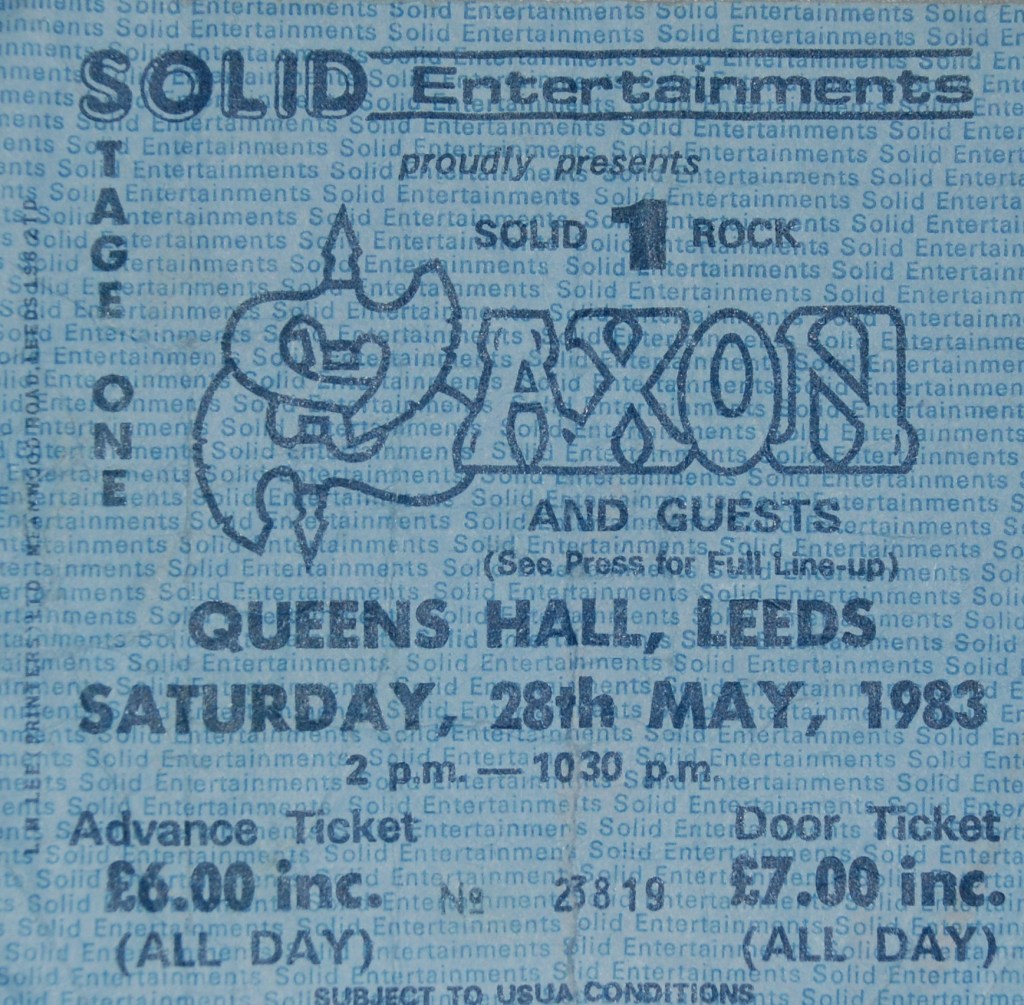
On 28 May 1983 two car loads of hairy teenage metallers left South Shields and travelled down the M1 to see an all-day gig at Leeds. I remember we arrived in the city and the first thing I saw was massive blue posters for the gig.

For me Anvil stole the day, and a month later confirmed their metal credentials when the Canadian band supported Motorhead at Newcastle City Hall. Still got my ticket from Leeds.

Also on the bill were Twisted Sister, Girlschool, Anvil & Spider.

One of the bands playing that day were Battleaxe from the North East. Vocalist Dave King remembers the time….

We supported Saxon as special guests on their Crusader tour in 1983/4, and again at the Leeds Queens Hall Festival with Saxon, Twisted Sister, Girlschool, Anvil and more. Good old Noddy Holder from Slade was presenting the show. 

I remember after the show Dee Snyder and Mark Mendoza from Twisted Sister came on board the Battleaxe bus to have a look around and thought it was fantastic. They saw a large cooking pan in the compartment under the stairs and asked what it was for.

Brian the bass player told them it was for making vegetable broths in the kitchen on the bus cos we don’t wanna get scurvy on tour – that’s the god damned truth. We really did stop off near farmer’s fields to dig out potatoes, cabbages and carrots to make food on the tour bus – it saved us a fortune (laughs).

In 1981 the King family from Sunderland were restoring an old empty pub they owned called The Albert Inn, in Shotton Colliery, Durham.

A local band called Warrior, not to be confused with the NWOBHM band from Newcastle, used to rehearse in the ground floor room of the pub. A young Dave King was roadie and driver for the band.

When Warrior broke up there was a vacancy for a singer, and Dave hoys his hat in the ring – after an audition, he gets the job.The band changed the name and Battleaxe was born.

With help from Dave’s father Derek and promotion manager Rob Stuart, within a year Battleaxe had signed a deal with Roadrunner Records and Music for Nations, plus Tommy Vance invited the band to record a session on Radio One’s Friday Night Rock show.

Dave takes up the story…..

BATTLE BUS

The first gig Battleaxe performed was Heighington Village Hall in Bishop Auckland in 1981, then we played venues like Thirsk Town Hall, Spennymoor Recreation, Country club in Saltburn and Leeds polytechnic.

Sunderland Mayfair is probably the best gig we played back then and the only time we ever got paid to cover the costs of the massive show we carried with us.

Back then we used a double decker bus to travel about in. A week before the Radio One session with Tommy Vance we had bought the bus and I remember parking up in BBC Maida Vale studio car park with ten of us on board – and all the p.a. plus backline equipment loaded on because at the time we were doing a UK tour with Madame X (American hard rock band).

The bus had accommodation upstairs with the stage gear down stairs. We carried an 8k rig with loads of lights, pyros, smoke machine, the lot. Plus a four stack Marshall wall and a two stack Trace Elliot bass rig for Hardies and Brian’s backline, with full double drum kit and riser for Ian.

Unbeknown to us the bus was actually a classic from the Ribble coach company on a Leyland chassis. One of the first double decker bus models to have the front cabin built over the engine creating a flat front like all double decker buses are now.

We sold it to Leeds Bus Preservation Society, and I’ve been told it’s now in a museum somewhere.

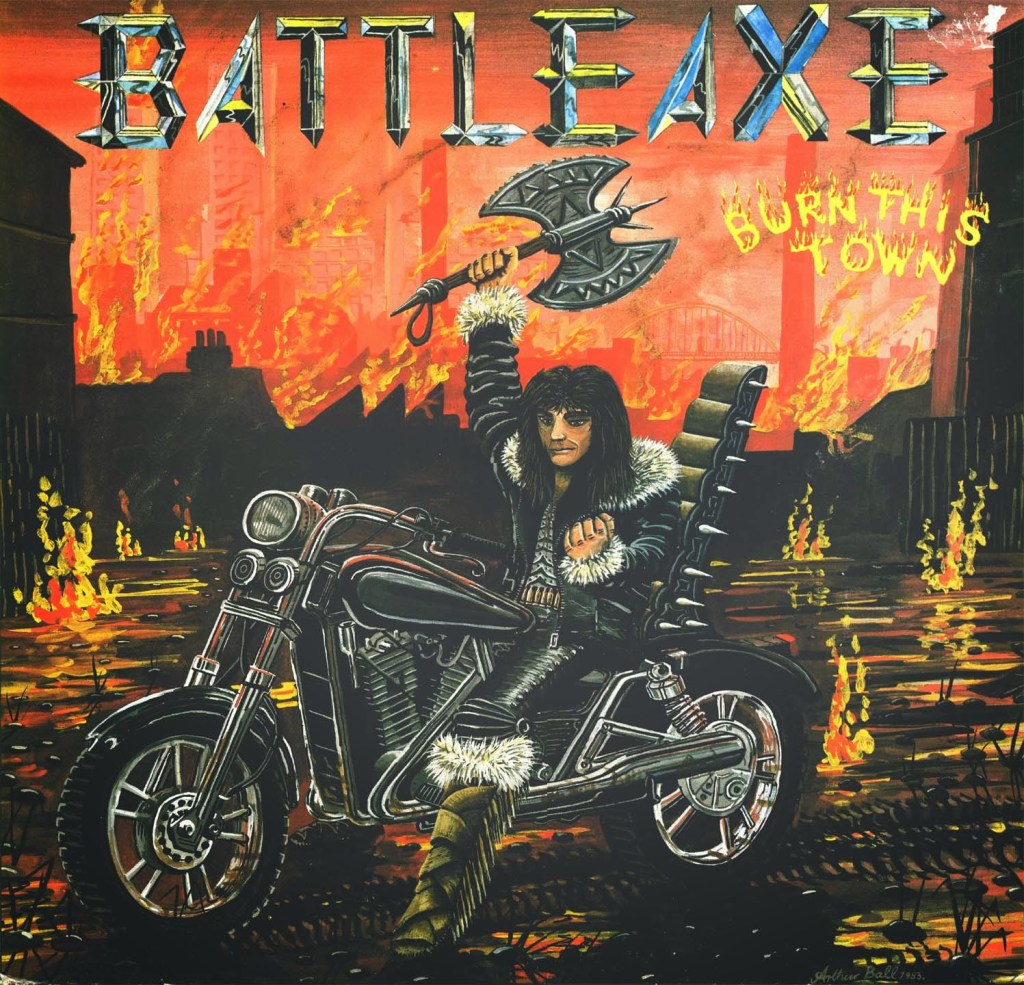
‘Burn This Town’ album cover.

BURN THIS TOWN

Our first recording was in Guardian Studios in a village called Pity Me, County Durham. Terry Gavaghan was the producer and owner of the studio. We recorded two tracks – Burn This Town and Battleaxe. We self-released them on a single on the Guardian record label.

500 units were pressed which are now very rare and quite valuable in record collectors guides. The quality of the tracks were very basic but they got us a deal with Roadrunner Records and we recorded an album for them called, Burn This Town.

I remember we were sent the contract to sign at our base in Kensington Hall in Sunderland. The original member’s were me, Brian Smith (bass) Steve Hardy (guitar) and Ian Thompson drums.

A year after recording Burn This Town in Guardian studio, Ian was attacked by a thug and obtained a serious injury. He couldn’t carry on, so Ian McCormack came in who recorded the next album with us.

SO BAD IT’S GOOD

Cees Wessels, the record company boss, asked us what we wanted for the art work on the album cover.

We had a friend and local artist called Arthur Ball who come up with a basic idea of a biker on his motorbike wielding an axe with a town in the background burning down – it looked like Sunderland (laughs). We sent that off in the mail to head office at Roadrunner in Holland.

You’ve got to remember there was no internet or social media at that time and things took a bit longer to arrange. We waited weeks and really needed to know from Cees Wessels what his thoughts were on the idea that Arthur had come up with.

Two months later the album was released worldwide, we couldn’t believe they had gone and used the draft cover idea as the finished art work. Since then there has been constant comments in media articles as it being one of the worst Heavy Metal album covers – ever.

Yet even today after 39 years, metal fans and journalists are still talking about it. Personally, it’s worked out as a marketing marvel. Over the years the Burn This Town cover has had a face lift four times and we are very happy with the latest upgrade drawn by Louise Limb. 

AUTUMN ATTACK

Now we are really looking forward to getting out on tour and the Halloween date in Newcastle, but more so the release of our fourth album Rezonator.

We have a great new set of songs for the upcoming October dates including many from our back catalogue. It shouldn’t be too long now before the new material gets to be heard as tasters before the big release.

We really hope some of the metal followers and Battleaxe fans reading this can get out and see us play in October, we are looking forward to seeing some of your there.

Battleaxe are: Dave King (vocals) Brian Smith (bass) Mick Percy (guitar) & session drummer from Colombia Mauricio Chamucero (drums).

Interview by Alikivi  May 2021

LUCKY MAN – part one, with North Shields actor & musician Tony Hodge.

Leaving school and taking up a job as a Chef led Tony Hodge down a path that he couldn’t imagine

I’ve been very lucky as a chef, drummer, actor and company director plus a rocker in the famous ‘60s era of mods and rockers. Looking back they were great years, it’s been a blast. I’ve been a lucky man said 75 year old Tony.

Did you come from a musical family ?

My family weren’t musical as such, although my parents sang in the church choir and my brother plays guitar.

When I was a chef in 1961 at the Park Hotel in Tynemouth, the hotel had a resident band with a drum kit. I had an urge to play and that started a career that spanned over 30 years. Mind you many wouldn’t class my drumming as musical.

Then I went with Ray Laidlaw (Lindisfarne) to see Ginger Baker and Cream at the Club A Go-Go in Newcastle, that changed my style of playing – I became known as Animal.

Can you remember your first bands and gigs?

My first band, I was 16, we only played a few gigs then I joined Dominion Aces, then Turm with John Lawton singing, he later sang for Uriah Heep.

Next was Arctic Rainbow with Kenny Mountain (Beckett) and Micky Balls on guitar. Venues included the famous Rex Hotel, Whitley Bay and the Cellar Club in South Shields.

Then there was Tex Leon and the Tynesiders and finally The Piranha Brothers who had a huge following and never stopped filling clubs for the 10 years we played in the North East.

We had a four-part singing line up in many songs and some of a set at the Birtley Rex is on my You Tube page.

The Pirahna Brothers line up was two lead vocalists in Geordie Scott and Allen Matthews, lead guitar & vocals from both Paul Simmons & Mac Norris.

During their time they had three bass players – founder Bill French, then Paul Allen and finally Dave Wightman. On drums was Tony Hodge.

Where did The Piranha Brothers play ?

Venues were mainly social clubs as they were hundreds around then and all the agents used them. We weren’t a typical social club band though, as our act was largely made up from our own songs written by Paul Simmons our lead guitarist.

Most bands played covers as I had in the Tynesiders, but we had an act that worked in clubs and other venues.

One night we played Newcastle Mayfair with three other bands to a 3000 plus audience and The Piranhas played several open air concerts in the early ‘80s at Gypsies Green stadium in South Shields.

The most popular Piranhas venue was Heaton Buffs in Newcastle. Our Christmas concerts sold out the year previous. The original single night ended up as three nights, and we had guest bands playing along with the brilliant resident band Burlesque.

The Christmas nights were themed with ideas being thought up by our singers… ‘St Trinians’, ‘The Young Ones’, ‘WWII’ and the final one ‘The Nativity’ and Burlesque always joined in the game. I still wonder though how some of the guys always thought women’s nylons had to be included.

The guest bands never knew what to expect and one time a guest band was 747 with the late brilliant musician Dave Black. This band was really cool, all good looking and right up to date. We hired a topless dancer to come on stage mid set and serve drinks on a tray to the band.

Dave was singing in full swing and she was out of his eyesight. The rest of the band saw her and were laughing but Dave was oblivious. When she stood in front of him he was speechless – literally – and his face was a picture. The audience loved it though.

We often had many famous faces in the audience such as John Miles, Brian Johnston (Geordie) and Hylton Valentine (The Animals) so it must have had some appeal.

Pictured above is the Newcastle Mayfair competition final. The room was packed with over 3000 people. Two bands had the biggest following, that was Burlesque and us.

All bands were great on the night but the audience were very unhappy when neither won. A riot erupted with plastic glasses being thrown and Alan Hull (Lindisfarne) could not provide the prize.

Alan and Brian, the Mayfair manager, asked if anyone from the Piranhas or Burlesque could try and do something. Paul from Burlesque and I went on stage to try and calm the audience down and the anger turned to cheers.

Alan Hull presented the prize with a bowl on his head to everyone’s delight. One of the judges, Chas Chandler (The Animals), invited us to go to Abbey Road studios and record our songs which we did.

Have you any memories from those North East gigs ?

Piranhas were known for the two main singers in Geordie Scott and Alan Mathews, pulling many stunts like pretend fights and blood capsules. They had funny routines without in any way being a comic band.

This night to a packed room we counted four beats and the usual very loud intro to First Bite powered out. As always Geordie jumped up fists in the air and hit the deck, Alan started to dart around the stage.

This time however Geordie didn’t get up. This seemed ok, these guys were up for anything after all, however the intro was over and Alan wasn’t joined by Geordie. We played on but after a few more bars we realised something was wrong.

It was…Geordie had dislocated his knee and ended up being taken to hospital in an ambulance. In the true showbiz style of the show must go on, Alan and the rest of us finished the night.

Another night at the Birtley Rex. A guy called Liddle Towers had recently died in police custody in Birtley and the police were none too popular.

Liddle Towers was an amateur boxing coach who died in police custody, in 1978 South Shields punk band The Angelic Upstarts wrote a song about the incident The Murder of Liddle Towers.

This night our first set was our own material only, but second set we were finishing our final set with a couple of punk covers. A wedding party had been trouble through the night and a fight broke out.

The police were called and a young Police Constable plus an overweight Sergeant arrived. When they entered the whole club erupted against them, chairs, tables, glasses all went flying.

A roadie got cut and I ran from the dressing room to the stage yelling to the police to run to the dressing room. The guys dragged them in and the glasses hitting the doors sounded like a battlefield.

Suddenly there was silence and out of the tiny window was a wall of blue lights as far as you could see, police were everywhere.

Eventually, I ventured to the stage and the club was empty. Wrecked but empty. Never have I ever seen a club clear so fast.

Did you record any of your material ?

Yes I have a couple of singles they are in the attic collecting dust, unfortunately no turntable. I last heard one of them on You Tube as a fan must have uploaded it.

In 1979 The Piranha Brothers had a single on the Durham record label, Guardian. The song was called Too Much of Wanting You and studio owner Terry Gavaghan wrote that and Paul Simmons and Iwrote the b-side Dancing Time.

At one point Brian Johnston (Geordie/AC/DC) was a big fan. We recorded a single in his Newcastle studio Lynx, the song was called A Woman Like You. But it went to the USA and nothing happened. Chas Chandler (The Animals) got us recording in Abbey Road studio – but major fame alluded us.

Next time on the blog read the second part of Tony’s story, where he sees an opportunity to prolong his career in entertainment.

I didn’t think I could be playing drums in my 40s and 50s and I thought I would have a longer career in acting than music. It was a surprise because I never thought I would get as far as I did.

Interview by Alikivi   February 2021.

ROCK OF AGES with Fist vocalist, Glenn Coates

I was reminded of the night the New Wave of British Heavy Metal came in to South Shields. What happened was I was flicking through my records and I come across the Hollow Ground EP which was kindly given to me by Lou Taylor (Satan/Blind Fury) after I lost my copy.

I originally bought one from Second Time Around Record Shop in South Shields after watching Hollow Ground play live at Tyne Dock Youth Club in 1980 – my very first LOUD gig.

They certainly gave the place some welly and was one of the first NWOBHM gigs I went to – Hellanbach and Satan followed over the years.

Glenn Coates was vocalist that night, but later he left the rock hard granite sound of Hollow Ground, and became frontman for another South Shields plug in an’ play no frills outfit, Fist…

Yeah, we used to play so loud, one gig I jumped onto the drum riser at the very same time that the drummer hit his crash cymbal and I nearly lost my balance, I think I have tinnitus now (laughs).

I saw Fist at venues like South Shields British Legion, and Newcastle Mayfair on 4 June 1982 on the Y & T Earthshaker tour….

I remember they brought all their gear in flight cases. One of the cases was like a very tall chest, and when they opened it, it was full of cans of beer. We had a great time opening for them, good memories.

Later that year I saw Y & T again, this time opening for AC/DC in Newcastle. The Americans warmed up the City Hall enough for DC to land on stage with their huge backline.

They were fronted by ex-Geordie singer Brian Johnson. During the ‘70s & ‘80s a lot of rock/metal bands came from the North East – The Animals, Geordie, Raven and the Tygers of Pan Tang….

I remember Fist supported the Tygers at Warrington Park Hall, which is the same set up as Newcastle City Hall…said Glenn.

The Tygers were doing well at the time with arctic’s full of sound gear parked outside. But our van with all our gear decides to pack up on the M62. We eventually got to the hall just in time – we pulled up outside at 6pm with our backline in a horsebox (laughs). 

If we go back to the start, how did the job in Hollow Ground come about ?

You mentioned that Tyne Dock gig, well we have fond memories of playing there because before Hollow Ground I was in a band that used to rehearse in that youth club.

There was Brian Rickman (bass) and myself in a band with guitarist Steve Dawson (Saracen/The Animals/Geordie). That fizzled out around ’78 so Brian and me got together with Martin Metcalf (guitar) and John Lockney (drums), that was the beginning of Hollow Ground.

We also rehearsed in a backroom at the Adam & Eve pub in South Shields and all day on a Sunday in a hut in West Park. We used to give the caretaker a fiver and he’d let us in.

We’d always record our rehearsals then listen to it back during the week, then rearrange the songs.We had started to write our own stuff and went in a studio to get it down on tape.

Studio work was financed by playing covers in pubs and working men’s clubs around the North East. The first studio we went into was Impulse Studio where Neat records were based, and we recorded an hour long live demo.

It turned out quite good, I thought the vocals and drum sound was better there than at our other recording for the EP at Guardian Studio in Durham.

What was your experience of Guardian studio ?

Terry Gavaghan was owner and producer there and it was exciting to make a record at Guardian. We were still pretty naïve about it all you know – making a record to get noticed by a record company.

Then we put some tracks together for a compilation album called Roksnax. Other bands on the record were Saracen from South Shields and Samurai who I think were Newcastle based. We all contributed four tracks each.

How did joining Fist come about ?

At first Hollow Ground were like sponges taking everything in, playing gigs wherever and whenever we could, at pubs and clubs doing covers to pay for the studio time. Learning all the time, it was a great energy to write the songs and it came about quite easy and quickly.

But thing was Terry Gavaghan said EMI were interested in signing us so we were waiting for that, but really I didn’t believe it and I’ve heard he told lots of bands the same. The band had stopped playing live so with no gigs happening I wasn’t doing much.

Fist came along and asked about me joining, I took it because they had things to offer. This was around ’81 and in the summer we played the Rock on the Tyne festival at Gateshead Stadium with Rory Gallagher and a few others. U2 were on the day before us.

The night before we played in Manchester and someone had smashed the whole back window of our car. I remember being freezing cold travelling on the motorway finally getting back to the North East about four in the morning. Not the best preparation cos we had to do a soundcheck and the first band on stage at 12 noon.

With hindsight shouldn’t have played Manchester but had a good time the rest of the day playing to a very large audience at Gateshead stadium.

Did you go in the studio with Fist ?

Yes we recorded the Back With a Vengeance album and the feeling then around the band and the songs was great. There was magic in the air.

We also recorded a single on Neat records in 1982, it was an easy going pop song called The Wanderer with Too Hot on the b side. The Wanderer was just a laugh really, I don’t think we even played it live. But some people thought we had mellowed and gone poppy by releasing it, but no, it was never meant to be a serious record.

Then about a year later Status Quo recorded a version and got it in the charts. The picture on the front cover is me with my long hair – I haven’t got that now but I still think I’ve got that jacket (laughs).

When did Fist call it a day ?

We didn’t call it a day as such, it just kind of fizzled out. We were still rehearsing new stuff in Harry’s pub (Hill, drummer) as he had got into the pub game by then. But I don’t think any live dates were coming in. It’s a hard game to keep going.

But Fist played some memorable gigs. On 7 May 1984 we opened for Motorhead at Hammersmith Odeon on their No Remorse tour. It was great they had the Bomber lighting rig. I just remember seeing the first two or three rows singing along to songs we had wrote, it was such a buzz.

Afterwards we were upstairs in the Green Room drinking, Motorhead were there and Young Blood, the other band who were on. Lemmys son was also there, who is a good looking lad – all the lasses fancied him (laughs).

What are you doing now ?

Fist are still active. We’ve got Mark Jackson in on drums because unfortunately Harry Hill had to retire due to health problems. Last year we were still gigging and ready to go in the studio, but the March lockdown came so that put a stop to it.

We’ve got an albums worth of new material so when we can, Covid permitting, we will go in the studio and record the songs cos they can’t be left on the shelf.

Interview by Alikivi    February 2021.

TURNING JAPANESE – with Tokyo Rose songwriter Derek Buckham

I first started work in 1968 when I was 16, I worked with a guy who was in the Jasper Hart band here in the North East. I used to go around with them and decided I wanted to learn guitar and join a group.

Then one night at the Sunderland Monkwearmouth Club the singer asked how I was getting on with learning the bass guitar, he was very encouraging.

Then halfway through the set and totally out of the blue he asked if I wanted to join him on stage and do a couple of songs. Well, that was it, I got the bug. The singer was AC/DC’s Brian Johnson – and that’s my claim to fame (laughs).

Alcatraz Left to Right Micky Duncan, Mary Downing, Derek Buckham, Micky Fenwick

What band were you in and where did you play your first gigs ?

Me and some friends – Micky Duncan, Mary Downing and Micky Fenwick – took on Hire Purchase agreements to buy equipment for a band called Alcatraz. It was seven nights a week supporting the Bingo in working man’s clubs.

One night in Hartlepool the Concert Chairman knocked over an amplifier and didn’t apologise. The bass player Mick Fenwick said Don’t worry I’ve dealt with it.

The Concert Chairman used a Bingo machine, it was a big plastic see through box and inside were ping pong balls with the numbers on, when he switched it on the balls were blown to the top by air and he would pick one out.

Well, I looked over and could see them floating about in the box – Mick had filled the Bingo machine with beer! The Concert Chairman turned on the machine in front of the audience – I’ve never heard a club laugh so much.

In the end we were paid off and banned from Hartlepool (laughs). That band were out working a lot, and, in the end, Mary left so that was the finish of Alcatraz.

Did you record any of your songs ?

After the stint in the working man’s clubs, I got together with a musician called Colin Lumsden – we went under the name Queer Band who were active from 1974-76.

We played original music, just trying to do something really different from the club scene. The line-up was me on guitar, with bass/vocals and sax from Colin and Geoff Pybus on drums.

We recorded at Morton Sound Studios in Newcastle, it was a two-track studio, and we made acetates from the recording. Then played a showcase gig for EMI at the Chelsea Cat in South Shields, but unfortunately didn’t get signed.

Then Colin went on to better things when he fronted Radiation in Sheffield then went to South Africa.

I stayed in the North East, this was the late ‘70s, and recorded a track at Impulse Studios in Wallsend. The song was called Hang Jack about the Yorkshire Ripper who at the time was terrorising the country.

The track was played in clubs throughout the country and one day the Police turned up at my house. I was interviewed and had to give a handwriting sample.

My parents were also interviewed asking if I was ever away from home. ‘Yes, he plays in a band and if he was responsible, we would be the first to tell you’.

In the early ‘80s I formed Tokyo Rose – Me, Val Ophfield, Graham Bradley, Geoff Pybus. A gig was arranged at Annabels club in Sunderland and some reps from CBS came all the way up from London to see us play. But nerves got the better of us and they left without saying goodbye.

Before that Tokyo Rose had recorded a single called Dry Your Eyes at Guardian Studios in Durham. Noddy Holder from Slade reviewed it for the Record Mirror. He said we were a great band, but we should go to a bigger studio.

This upset the producer Terry Gavaghan and we felt it was unfair as Terry was heavily involved with the track and did a brilliant job playing and producing.

Years later I heard from Vinyl Dealers that the single was selling for £100 in Japan. This prompted me to dig out the music and video and put them on social media. In the meantime, I learned how to build websites, so I created www.tokyorose.biz

I realised my gigging days could no longer be funded so I built a studio with Pete Barclay who used to play for North East band Lucas Tyson.

We wrote and recorded songs under the name Tokyo Rose. We released them on the internet and also released a CD which featured all original songs. Our musician friends, Dave Ditchburn, Rob Foster and Dave Donaldson came in as guest vocalists.

What are you doing now ?

I still write and record songs under my name Derek Buckham AKA Tokyo Rose and thoroughly enjoy it. It’s not about the past it’s about what’s happening in your life right now.

I still enjoying writing hence my suite of Lockdown Songs – Angels in Blue, The Lady that Saved My Life and The Year That Never Was.

Would I do it again ? Don’t need too, I’m still doing it !

For more information check the official website:

www.tokyorose.biz

Interview by Alikivi  July 2020.

PIT CHORUS – interview with County Durham singer & songwriter Peter Lee Hammond.

The Queen, Margaret Thatcher and Paul McCartney walk into a bar in Easington mining town in the North East – sounds like an opening line of a joke but it’s a link to a song from deep down in the coal pits of the North East.

I asked the songwriter and ex-miner of 11 years, Pete Hammond, how did the single Living in a Mining Town come about ?

Easington in County Durham used to hold a carnival every year to commemorate the mining community and I was asked to write a song in 1989.

A lot of people got on board when they heard the rough version of the song, and the Easington council committee wanted it to be made into a single for the town.

The song was originally recorded in The Studio in Hartlepool then mixed at Abbey Road studios in London. I went down and met Paul and Linda McCartney and was given a tour around the studio by Paul. He also showed me an easy way to play his song Blackbird.

Metro Radio, Radio Tees, Radio One and many others played the song and I done a few interviews for them.

The proceeds were to raise money for a local handicapped school, so they could get a hydro pool for the residents. The money from the song also went towards launching a music collective in the area for musicians.

Many businesses donated money and it was supported by celebrities like Prince Charles, Her Royal Highness the Queen, Neil Kinnock MP and the Prime Minister Maggie Thatcher.

The Queen asked for a copy of the single to be sent to her and Maggie Thatcher sent me a signed photo of herself to auction and raise money. But no-one wanted to bid given the feelings the miners had for her, so I still have the photo at home.

Were you in a band then ?

Yes, at the time I was in a band called Just Us. I have won many song writing contests and awards over the years and cut album and cd’s.

One prize for winning a contest was song writing lessons from the lead singer of the Strawbs, Dave Cousins, and guitarist Brian Willoughby.

What studios did you record in ?

I recorded at Guardian Studios in Durham run by Terry Gavaghan. The studio was just in a normal street, it was two houses knocked together with no big sign saying recording studio, I thought I was at the wrong place at first until Terry answered the door.

What were your memories of the studio ?

Terry was a great, down to earth kind of guy always made you feel at ease, which was good as it was my first time in a studio or recording a song for that matter.

I remember the mixing room being very cramped full of equipment and a large mixing desk. But the session went smooth and the songs sounded great, Terry really knew what he was doing. We recorded three tracks there, Name on a Stone, Thomas Watson and I’m a Loner.

Terry was full of jokes and stories, one was that the studio was haunted by the ghost of a child that had been run over on the road outside the house. He also showed me a fur coat belonging to John Lennon,

Terry said when he first started out, he worked at Abbey Road studios, he let me take a piece of the lining and a clip of the fur as a keepsake. I have them in a frame at home.

Looking back what does the song mean to you ?

The song gave the community a sense of pride when the single came out, I was very proud and honoured to have been asked to do this for the place where I was born and raised.

What are you doing now ?

I still write songs and have over 1,000 up to now and record them on my own home studio. They can be heard on YouTube and my song writing Facebook page, you can find it by putting Hammy in the search bar.

Interview by Alikivi  June 2020