TIME TRAVELLER – in conversation with Local Historian, Luan Hanratty

46 year old Tynemouth resident Luan Hanratty has strong Celtic roots. His father was born in Jarrow with their family connections going back to Galway in Ireland and his mother originally from Rosyth on the east coast of Scotland.

Luan at Arbeia Roman Fort, South Shields.

‘Yes, the Hanratty name is Irish, however, a brief background to my employment story is that I worked the financial sector in Prague, Czech Republic, moved to Shanghai in China where I was employed as an English teacher. I even appeared on TV there and published some books. Education is strong in my background as my father was a Drama Teacher’.

‘After Covid in 2020 I came back to the UK and based myself in South Shields. I was looking for my next adventure when I came across some local history and got obsessed with reading the stories’.

‘With my business partner Gary Holland we put together a website called Penbal – which is a Celtic name for the Tynemouth headland – the site features articles on Tyneside local history, photographs, AI art, links to Maritime Trust, Lifeboats Brigade and Fishermen’s Heritage plus local products for sale – prints, postcards, mugs, t-shirts and more’.

The latest story has recently featured on BBC News >>>

Roman Stones Missing from Mill Dam Roundabout, South Shields – Penbal

Luan’s latest post on the site is about a long lost river which flowed from the Mill Dam in South Shields.

‘Beneath the busy modern landscape of South Shields lies a forgotten natural feature – a river called the Mill Dam Creek but also known as the Branin River. This flowed from Mill Dam, next to Customs House today, out to the sea near North Marine Park and the Pier. This effectively made the Lawe an island’.

‘The channel played a vital role in the development of the town, both as a waterway and a habour, and once it was dammed with ballast, the Mill Dam formed a bridge between the north and south reaches of the early town’.

‘So important then, was the creek as a resource that it forms the base of the first industrial activity in South Shields, with coal mining also evident on the south bank where the pit wheel now stands above Asda carpark in Coronation Street’.

‘If you stand on the long sloping escalator when exiting Asda and look out across the huge carpark, you really get a feel for the valley nature of the Mill Dam Pond. Imagine what it must have looked like all those centuries ago’.

‘Another twist to the story is that in the 19th century much of the eastern end of the creek was covered by Denmark Street, where the Denmark Centre is today. In the 1830s, while building the street, a Viking longboat was discovered beside what was originally the river bed’.

‘Maybe there is someone out there who has more information about this amazing find. We know it featured in The Shields Gazette in the 1980s’.
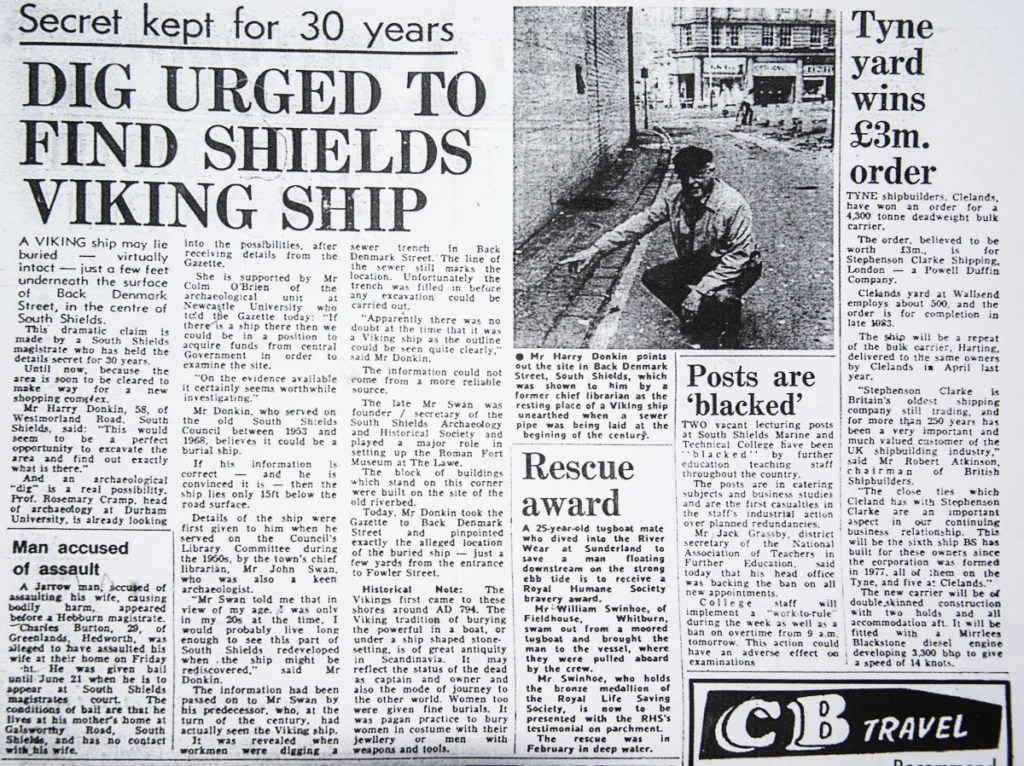
Viking ship article in The Shields Gazette 1980s.

Full story >>> The Lost Waterway of South Shields:  Mill Dam Creek – Penbal

Luan stresses that he has no plans to research any murders or the race riots that have happened on Tyneside.

‘So far, we have over 200 local history posts and we don’t look at any taboo subjects, I just like to paint a picture of our very rich heritage here on Tyneside’.

For further information contact Luan >>>>

Penbal – Messis ab Altis

Alikivi   January 2025

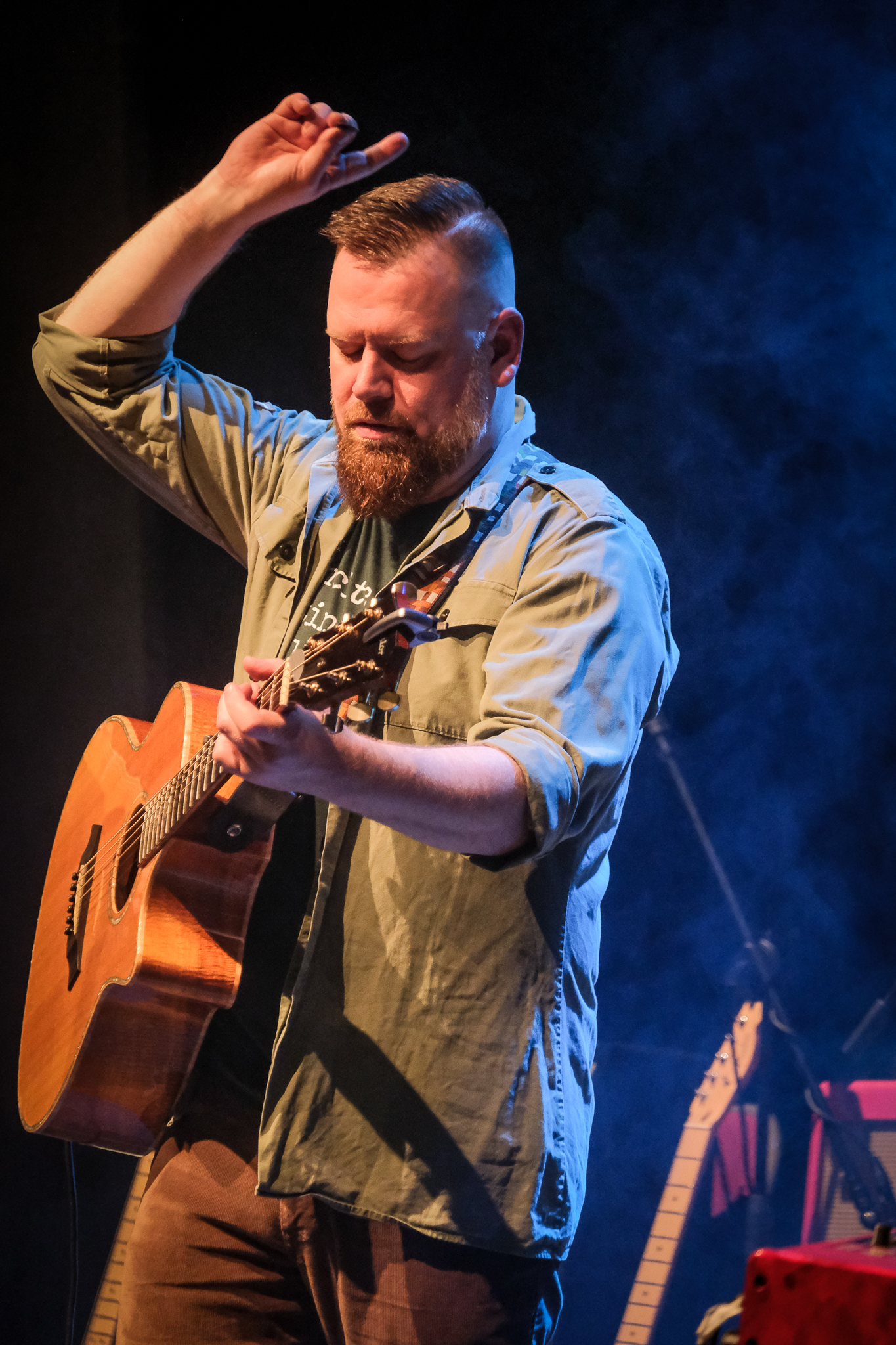
THE BAND PLAY ON – in conversation with Tyneside musician Tony Bengtsson

Music is a massive part of our lives. Not only do we want to listen to it, but read about it and talk about it. Tony Bengtsson is no different.

‘Music was around the house when I was growing up. My Dad was a rock n roll fan of the ‘60s, we had the sound of Creedence Clearwater Revival in common. My Mam was a massive Elvis fan and encouraged us to listen to music’.

‘My Mam worked in a news agents shop in South Shields where they had a stack of old jukebox 45’s for sale. One of them was Wages Day by Deacon Blue which I loved. I played it many times – still got it now, although it has a little chip in the record’.

‘One day I walked past Music Maker shop in South Shields with all its instruments and speakers displayed in the window and saw a set of harmonicas. I was around 13 when my parents bought me them. I was just trying to make sounds out of them, plus my Nana had a small Casio keyboard that I played little tunes on, I liked experimenting’.

When he was younger Tony had his eye on being a journalist so he went down to local newspaper, The Shields Gazette.

‘One of their top journalists, Janis Blower, looked after me when I was there on work experience. She got me searching through the microfiche with its old stories from the Gazette, the history of South Shields was all there. Loved it’.

‘I love studying local and family history, my ancestor came over from Helsingborg in Sweden around 1850. He was a merchant seaman who lived in Orange Street, South Shields. My grandfather passed on a family tree which I’ve updated with recent family additions’.

After leaving school and enrolling on a Music Production course at Newcastle College, then slogging away for hours in a factory, Tony saved up enough dosh for a set of drums.

‘I made a good living playing in club bands for a while. There was a Bryan Adams tribute and a punk band called Sound of the Suburbs. Then I played in original band Poker Face who played 80s melodic pop rock around Durham’.

Listening to a wide range of sounds and improving on his songwriting Tony made the move from the back of the stage to upfront – drums to guitar.

‘The UK had such a diverse range of music from different parts of the country, there was Liverpool, there was Manchester, and here on the Tyne we had the blues with bands like The Animals. Unashamedly I’m a bit of a country and western fan and love the Scottish/Irish folk sound, that’s why I like the acoustic music we play’.

A decision to play cover gigs helped finance Tony’s musical career. He also has the small matter of a wedding coming up in October so every little helps.

‘Yeah, at the minute I’m doing a lot of cover gigs cos that’s where the money is and this is my full-time job. At a booking I do two 45- minute sets with a break in between’.

‘Recently I played a wine bar where they talked all through the first half, so if the gig’s going bad like that, I have a shorter break between sets and get on with the second one. But the good gigs are when you get to talk to people beforehand and after’.

‘Having work organised by an agent is great, he just phones me up ‘Can you do this gig’. That’s it, I don’t have to organise anything just make sure I turn up on time’.

‘With the original band I have to decide a lot like where we are playing and how much for, organising transport if it’s outside the North East. There’s a lot of extra logistics and admin to do that people don’t see’.

The single Sometimes a Man from 2020.

‘I started writing my own songs around 2006, I’ve a recent song called These Wars which is anti-war and highlights the problems we have today. Why are we spending money on wars when people at home are struggling to eat, heat and get a job?’

‘If you do have a job like the nurses, who after all they’d done for us during covid, when they decided to strike hoping for a pay rise, they got attacked by the media for being greedy. It’s an unfair situation’.

For a hard-working full-time creative professional isn’t the saying ‘do what you love and you never work a day?’

‘Yep! I also gig with the original band. This August we supported Martin Stephenson & the Daintees at Falloden Hall near Alnwick – that was brilliant. It was a lovely sunny day, we played in a court yard with hay bales, a little festival vibe, and I sold out on cd’s’.

‘It can be hard to keep the band all together in one place.  There is violinist and guitarist Niles Kreger who is living here but is originally from Connecticut, USA, and there’s Liam Fender (Sam’s brother) on keys who has his own band so there’s other stuff going on, we’re all busy’.

‘We’ve played a couple of gigs outside the North East – in London and Manchester but would love to play in Ireland. My partners family live in Waterford so when we visit them I take my guitar cos there’s plenty of places to play every day. Live music is in their culture – I love Ireland’.

‘You know I consider myself an introvert, I like staying at home but once I’m out there I love it. I’d be worried if I didn’t get nervous or anxious butterflies before a gig’.

‘I’m now at the stage where if anything goes wrong like a speaker going off well that just happens, can’t do anything about it, just sort it out and play on’.

Gig dates until December 2024 >
https://www.insangel.co.uk/bands/tony-bengtsson
 

For further information contact > Facebook > Tony Bengtsson Music

Alikivi   September 2024

FAMILY TIES #3: JARROW SLAKE & THE GALWAY HOOKER

Fishwives by the river Corrib, returning from Galway’s fish market.

In 2007 I was over in Ireland researching my family tree when I picked up a book ‘Old Irish Country Life’ by Hugh Oram.

It was packed with photographs taken at the beginning of the 20th century of people working on the land, some I’ve included here along with text by Oram.

From fishwives to seaweed harvesting, weaving and cutting turf, the wonderful black & white pictures illustrated a harsh life – and these were similar scenes to what my ancestors lived through.

A branch of my family came from Galway so I was drawn to a picture that features fishwives by the river Corrib, returning from Galway’s fish market.

I was also interested in the photograph of a couple of fishermen’s wives repairing nets – as faint as a pencil drawing.

Galway fishwives repairing fishing nets.

The Claddagh, meaning ‘stoney foreshaw’ in old Irish, was one of Ireland’s oldest fishing villages on the western shoreline of Galway city.

The sea off Galway was rich in cod, herring and mackerel. The boats would all go out in the evening, drifting overnight and bring in hundreds of mackerel by dawn.

In the 19th century over two thousand people fished the bay using the traditional boat with its red sails – the Galway Hooker.

Galway fish market which stood across the river Corrib from The Claddagh where fishermen lived.

In 1985 my Grandfather wrote his memories of an Irish family living in Jarrow, North East England.

I suppose when they were built they would be a hamlet outside of Jarrow. There were three communities like this at the time; the Old Church at Jarrow Slake, pronounced ‘Slacks’, where we lived, Quay Corner at the riverside, and East Jarrow over the Don Bridge. The Don was the river that ran past our house.

My mother’s family the Joyce’s, originated in Galway in the west of Ireland. She came from a big family, her brothers, uncles and cousins were all fishermen.

I remember her one day telling me about the night they went out fishing in Galway Bay and a big gale blew up. Most of them were lost.

I remember my mother being a very hard working woman. She worked as a stoker in the chemical works over the bridge in East Jarrow. She worked there all through the 1914-18 war, and I remember taking her bait over at dinner time and getting half of it for myself.

Two World Wars happened in my life. The Great War of 1914-18 was on when I started school. We heard the Germans firing their guns on Sunderland. One day we saw a Zeppelin pass over, and I believe it dropped a bomb on Sunderland Docks.

We also went to Quay Corner to watch the Royal Navy ships come in after being in battle. I remember one, HMS Lion, her mast and bridge were all broken up and she had a big hole in her side.

Also, some tugs towed a great big ‘thing’ upriver and moored it at the Slakes. It was like a great big house, and my mother said it was a Royal Naval hospital for sailors wounded in battle. It later became known locally as the Floating Hospital.

The old Jarrow bridge over the river Don at low tide. The slake was over the bridge.

Looking back the things I used to get wrong for seem trivial. Such as playing in the Slakes at low tide and coming in with my feet full of mud or playing on the timbers at high tide.

We all did that, we would cut four or five timbers adrift and use them as a raft. But sometimes Mr Beauly the river policeman would catch us and tell our parents.

The slake was also our swimming pool, we all learned to swim there from about the age of six. By the time we were ten or eleven we were swimming in the Don and the Tyne.

At high tide the Don was about twelve feet deep and we would dive off the bridge into the river.

When my Grandfather died and was cremated in 1986, his ashes were thrown into the river Don from the old bridge. Sometimes we go back to where we started.

Hugh Oram book published in 2007 by Stenlake Publishing Limited.

Alikivi   May 2021.

FAMILY TIES #2: A FULL MOON & AN IRISH WAKE

In 2007 I was over in Ireland researching my family tree when I picked up a book ‘Old Irish Country Life’ by Hugh Oram.

It was packed with photographs taken at the beginning of the 20th century of people working on the land, some I have included here along with the text by Oram.

From fishwives to seaweed harvesting, weaving and cutting turf, the wonderful black & white pictures illustrated a harsh life – and these were similar scenes to what my ancestors lived through.

Seaweed harvesting was an industry along the coastlines of Mayo, Galway, Donegal and Kerry.

Work on farmland and fishing were major occupations in Ireland and after a long day’s work people would organise entertainment – there was no radio, TV or cinema in those days.

Relatives, friends and neighbours would enjoy endless singing and storytelling, the tradition of seanchaí – a teller of traditional stories – was hugely popular in rural households.

Killing the pig was an important ceremony and social occasion with neighbours lending a hand. Tea and the odd whiskey or two were shared afterwards, plus the latest neighbourhood news and gossip.

Superstition played a part – a pig was never killed during a month containing the letter ‘R’ and if it was done on a full moon the meat increased in size.

The Bothan Scoir, a labourers cottage, west Ireland.

Ancient customs and traditions were a big part of Irish life – and death. The wake was a send-off by family and friends in the house of the deceased before the body was handed over to the church.

My Grandfather wrote of his experience as an Irish family living in Jarrow, North East England.

You know looking back on my younger days, knowing the bit about my father and the more I knew about my mother, she was a very kind woman, strict but fair, and very religious.

She must have been a strong woman to work the way she did and to put up with the life she had with my father.

I often wonder how they came together as they had nothing in common with each other. One was always in the pub, the other in the church.

Still, I suppose there must have been some feeling between them as she had five children to him, three sons and two daughters. As they say, there’s nothing as queer as folk.  

In 1920 I started at St Bede’s Senior School, Low Jarrow. I was eleven years old and quite a lot happened to make me grow up quickly. I detested school and did everything I could to make sure I seldom went.

The only time I was ever happy at school was during the winter because each classroom had a big open coal fire and it was lovely and warm. But in the summer I would go to school in the morning and if it was a sunny day I would go to Shields beach in the afternoon.

When my father died my mother insisted on an Irish wake, where the deceased is put on display in the front room so that family and friends can pay their respects. They all sat at a table where there was snuff, cigarettes, clay pipes and ‘baccy.

Later on the men brought in the beer and to my young mind everybody seemed to be enjoying themselves except for my father who was stuck in the corner.

Then the final touch the night before the funeral, the priest came down at 7pm to say prayers as there was no taking the coffin to the church the night before the funeral as there is now.

More Irish family ties and images from ‘Old Irish Country Life’ on the next post.

Hugh Oram book published in 2007 by Stenlake Publishing Limited.

Alikivi  May 2021

FAMILY TIES #1 : THE GALWAY CLADDAGH & JARROW DON

Galway fish market 1905

In 2007 I was over in Ireland researching my family tree when I picked up a book ‘Old Irish Country Life’ by Hugh Oram.

It was packed with photographs taken at the beginning of the 20th century of people working on the land, some I have included here along with text by Oram.

From fishwives to seaweed harvesting, weaving and cutting turf, the wonderful black & white pictures illustrated a harsh life – and these were similar scenes to what my ancestors lived through.

The Claddagh, Galway City.

A branch of my family came from Galway so I was drawn to a picture that featured The Claddagh. The houses in the photo remind me of old black and white image’s I’ve seen of homes near St Paul’s Church and along the river Don in Jarrow.

Old pit cottages, Jarrow, 1897.

My grandfather lived in those white walled cottages, and before he died in 1986 wrote down his memories of Jarrow life growing up in an Irish family.

To begin with a word about the type of house I lived in and the surrounding area. I suppose when they were built they would be a hamlet outside of Jarrow.

There were three communities like this at the time; the Old Church at Jarrow Slake, pronounced ‘Slacks’, where we lived, Quay Corner at the riverside, and East Jarrow over the Don Bridge. The Don was the river that ran past our house.

The house itself was old it was one of the original pit cottages built when there was a pit in Jarrow. The pit itself was at the top of Queens Road and when I was young we had a fair there every year.

But back to the houses, they were white cottages, the walls would be about 8 feet high with a shallow sloping roof. They were two roomed, but the attic was turned into a bedroom for the children and there was room in it for two beds. To make it more comfortable we pasted layers of newspaper over the rafters.

More Irish family ties and images from ‘Old Irish Country Life’ on the next post.

Hugh Oram book published in 2007 by Stenlake Publishing Limited.

Alikivi   May 2021.