ART FOR ART’S SAKE in conversation with animator Sheila Graber

Meeting up with contributors to this site I’ve asked how they survive in the arts. Some talk of persistence and others simply being obsessed by it. I think to give yourself a good chance you’ve got to be prepared to work on it day in day out basically 24/7/365 days a year.

85 year old Sheila featured on this site in June 2018 where she talked about spending her life in art – so she was the perfect person to ask.

Surviving in the arts is for me going with the flow. I believe in my Mam’s saying ‘Every day in every way in everyday I’m getting better and better’ particularly when you are feeling crap or when things have gone wrong. In the arts you need this saying because there are times when things just don’t happen for you. Tempered with that my Dad used to say ‘worse things happen at sea’! So never, never, give up. Keep positive and keep going.

After attending Art College Sheila then went to Birmingham School for Training Art Teachers in 1961.

That was the best thing to happen to me. I was shown that everyone is an artist in their own way and it’s your job as an art teacher to bring it out. It’s about giving something positive to people in their lives.

I first taught art in comprehensive schools in South Shields and by 1970 I was divorced and had time to play so bought a super 8 cine camera. Play is very important plus having a messy room or studio where no one tidies up after you!

My first messy place was at home in South Shields working at a desk looking out onto our little garden. Later it was a studio in the Pilot Office overlooking the river Tyne. Then by the mid 70s I got a break in animation.

I was contacted by an agent for World TV who sold the short films I made globally. She later commissioned me to animate 10×10 minute ‘Just So Stories’. The actual process of animation can take a long time to produce minutes on video so the only way I could produce this was to give up teaching – which I did in 1980.
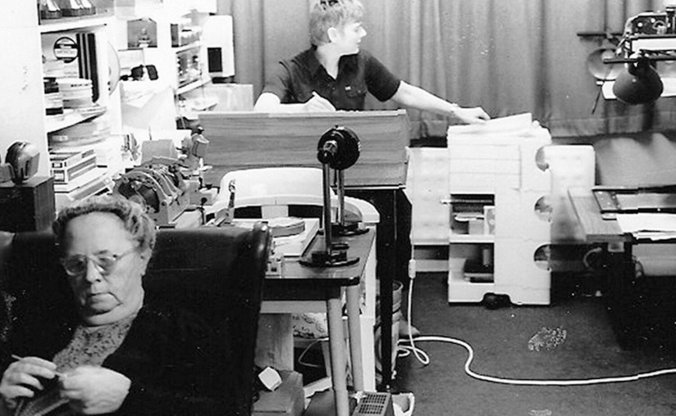
Sheila animating Frame by Frame for World TV and her Mam crocheting for a local shop – a true cottage industry.

Sheila also works with various charities, the last post features Anna Malia and North East Animal Rights, how did you get involved with them?

When I lived in Ireland I saw an incident, not to go into it here too much as it’s really upsetting, but there was a field of cows and a calf that broke free from the herd. It was about how it was dealt with by the farmer that really affected me. I thought if I get the chance I would do something for you – for that calf.

I heard a song by North East musician Jen Stevens, loved it, and thought that would really work with images. I asked Jen if I could use it and she said yes. We put it out and Anna Malia from North East Animal Rights got in touch and we took it from there.

Link to Jen Stevens song & video >>> https://www.youtube.com/watch?v=HMDkdZ3TaEk

Sheila is currently working on a book about George McVay, a little known artist who lived from 1902-1967. Former Shields Gazette journalist Janis Blower is in the process of editing it.

George was a very good photographer which accounts for the very large detail in his pictures. His style of painting was very photographic. When I was 8 my mam bought a set of his prints that the Gazette had commissioned and I loved looking at them like kids look at ipads now. For a long time I done plasticene models of them.

All his life he drew some amazing illustrations of Shields and surrounding areas. Some people may recognise his black and white drawings, very clear, very precise everything from the old Town Hall to the piers, the river and the Groyne. In the book Janis Blower will be adding underneath a description and history of George’s picture.
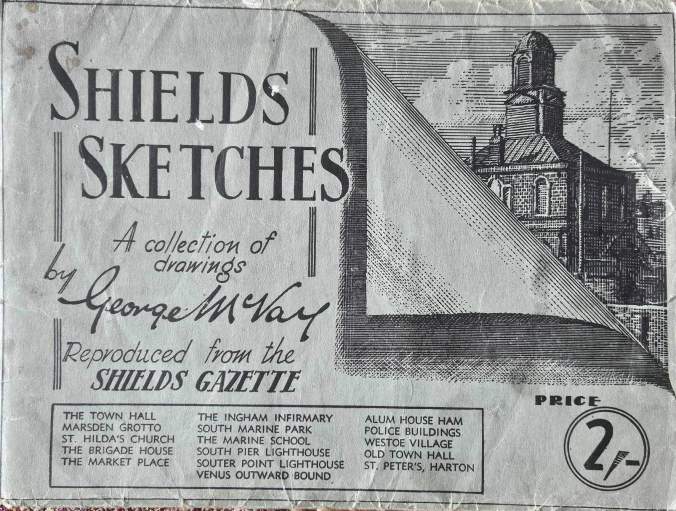
In his early days I gather he worked at Readhead Shipyard, he was studying planning, design and engineering. His Dad was mayors secretary at South Shields Town Hall and was a good photographer. It’s thought he said to his son that he should work in the Town Hall and he eventually did, he was employed in the ratings department.

Out of the goodness of his heart he’s done drawings for presentations at the town hall. There are some amazing manuscripts, whatever was required he could do it even when people leave. He also done commissions for the Shields Gazette.

The Shields museum have some in their store. He has stuff in the Hancock and Discovery museum, Newcastle. He did a showing at the Laing Art Gallery and down in London but all track of that is lost. Unfortunately, nobody has given him the recognition that he deserves.

What I’ve found over the years is that he and I have followed parallel tracks. We have both done a lot of work for charity and both drawn the most popular buildings and views in Shields because we love the place.

To contact Sheila check out her official site at >>>

Products — SHEILA GRABER ART

Alikivi  July 2025

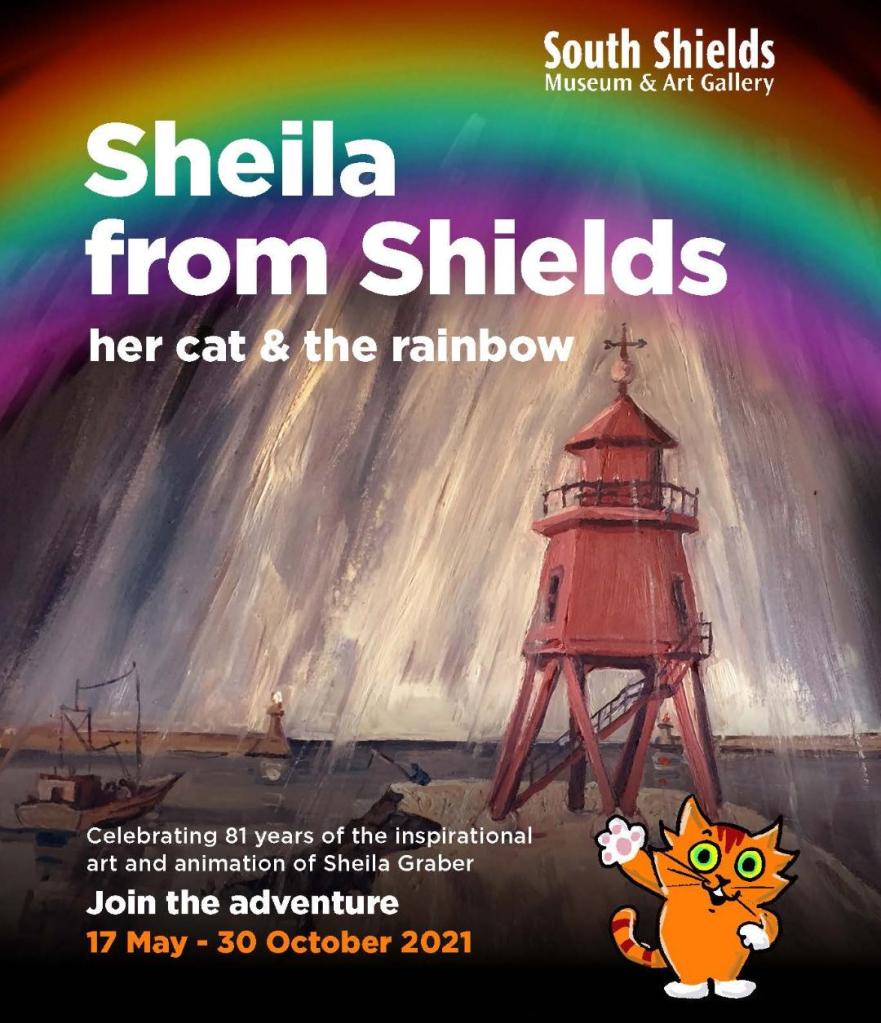
SHEILA from SHIELDS #2 – Exhibition at South Shields Museum & Art Gallery

An exhibition is being held in South Shields to celebrate the 81 years of inspirational art and animation of Sheila Graber. Invited to the exhibition was former pupil Allyson Stewart.

‘Sheila was my art teacher at the Grammar school and when I first went into the class I was thinking I don’t know what I’m doing here.

I can’t draw, I can’t paint, but over a period of weeks I think it was the way Sheila was teaching us without it feeling like she was teaching us’.

‘And I began to realise it wasn’t about how well you can paint it’s more about how you can be creative. When I started to learn about perspective that’s when it kicked in for me, I suddenly realised I could draw street scenes and buildings that actually looked like a building’.

‘That was quite a revelation and since then I’ve done a few bits and pieces that have been done with pen and ink, that’s my favourite medium. I can’t paint I’m useless with a paint brush, but with pen and ink it just feels right to me’.

‘But then I joined Sheila’s Cine Animation group and that was great, something completely different at the time at the Grammar school it was pretty radical. And I thoroughly enjoyed it.

That taught me all about timing, getting things right and putting them in the right order, keeping accurate records. I gather that the animation film that I made is now on You Tube thanks to Sheila – so hopefully I can live that down’.

‘First person that taught me that anything was possible was a teacher called Stan Coates at Stanhope Juniors.  The last thing he ever said to me when I left school was I expect to see your name in writing someday young lady. And then nothing ever fired me up until Sheila was teaching me.

And she taught me you haven’t got to be a brilliant painter, you haven’t got to be a great designer, you haven’t got to know how to structure a painting, it’s all about how you feel and how you can interpret it’.

‘And that was a revelation to me and I think that’s what rekindled the spark that you don’t have to paint you can write. You can find a creative outlet some other way, and that was really helpful for me.

Now I’m back into doing the writing, loving every minute, so thanks to Stan and thanks to Sheila I’m loving every minute, I’m living the life and love it’.

Also invited to the exhibition was writer and retired Shields Gazette journalist, Janis Blower, who started off with a piece of poetry by James Henry Lee Hunt.

Abou Ben Adhem may his tribe increase, awoke one night from a deep dream of peace.

And saw within the moonlight in his room, making it rich and like a lily in bloom,

An angel writing in a book of gold.

‘I have a love of angels as they are depicted in art and stained glass, and also in one of the loves of my creativity – which has been sewing. The angels started with my oldest sister Pam, who we lost in 2019 unfortunately.

As a child I used to share a bed with her in the attic bedroom. I was frightened of the dark so to comfort me she would sing songs and recite poems that she’d learned at school’.

‘One of the poems was Abuben Adden and that image of the angel writing in his book of gold really seized my imagination. The words seemed to come off the page already burnished and glowing and that struck me as the writer I’ve become – the power of words’.

‘Angels has become a favourite motif too stitch, I’ve had a lifelong love of sewing and embroidery going all the way back to the days when I first made a tea tray cloth at Ocean Road school when I was aged about 8 or 9 which I still have to this day.

It was the start of a lifelong love of sewing, embroidery and cross stich which has been a great comfort at times over the years’.

‘I’ve known Sheila for many years because she actually taught me art when I was a pupil at South Shields Girl’s Grammar School. I remember very vividly her enthusiasm and her belief that anybody could be creative.

I’m not sure that I believed it at the time, but I’ve come to realise that it’s true, and it’s something you pick up from this wonderful exhibition that she has of her life and art.

The message being that there is creativity in everybody if you know where to look for it’.

The exhibition runs from 17 May – 30 October 2021

Interviews by Alikivi  2021

TRADING PLACES – 250 years of South Shields Market

In September 2018 I made a short documentary about South Shields market with former Shields Gazette award winning journalist Janis Blower.

Janis has a wide knowledge of local history through producing the Cookson Country feature in The Shields Gazette and working on the books ‘Aall T’githor Like Folk O’ Shields’. An interview with Janis talking about her work featured in the blog ‘Have You Heard the News’  (27th January 2020).

We had previously worked together in 2016 on a film about South Shields Photographer and Historian Amy Flagg. Janis added the voice of Amy in the short film ‘Westoe Rose’.

Included here is the full script that Janis wrote about the 250 year old South Shields market, a link to the film is at the end.

Trading Places

Author Joseph Conrad is said to have refreshed himself in its ample public houses on his voyage from life before the mast to The Heart of Darkness. It has rung to the strident tones of politics and religion. Marked the coronations and deaths of monarchs; been a centre of commerce and conviviality.

A public forum one day, a fairground the next. War almost did for it. Peace would prove no less transformative.

Over the 250 years of its existence, the fortunes of South Shields’s historic Market Place have fluctuated with those of the wider town. Both have had to adjust to social and economic change. Within the lifetime of many townsfolk, that has included the decline of the market itself.

The rise of the discount retailer has seen a corresponding fall in the numbers of bargain hunters. Gone too is the tradition for Shields folk to put on their glad rags on a Saturday afternoon and go ‘down-street,’ to stroll up one side of King Street to the Market, and down the other.

For a post-war generation, this was the era of stalls piled high with crockery, pans and nylons – to be sifted through to find a matching pair, of reconditioned boiler suits and other stalls selling goldfish and rabbits. In winter the lamps would flare in the chilly dusk.

By then, the market was no longer open until 10 o’ clock at night, as it had been before the war when, the later the hour, the more the cost of Sunday’s joint fell.

In those days visitors would also have found Harry Randall’s toffee stand where homemade toffee, with a free bag of horehound candy, could be bought for sixpence.

Also, the stall piled high with assorted tripe into which the stall holder would shove his hands, shouting: “Come on, get amongst it!”

And there was the painless dentist, who guaranteed to pull a tooth with his finger and thumb for a shilling: This was the market as part-public service, part-spectacle, like the stocks that a century earlier had once stood opposite St Hilda’s Church.

Or the fairs that would visit, in spring and autumn, with their prancing horses and shuggy boat rides or, likewise, the travelling menageries that would also descend at regular intervals.

The Friday flea market has in recent years returned the square to aspects of what it was then, at least commercially, though the old clothes stalls are no longer confined to the side nearest the church. South Shields-born poet James Kirkup immortalised these in a poem, writing:

“The old jackets rub shoulders on the rack of life and death, the crumpled trousers all undone swing in a driving wind, a boneless abandon, soft-shoe shuffle in the sands of time. Laid away, the painter’s dungarees are dingy white, stained with forgotten schemes for houses decorated out of sight…”

Gone, though, is the fresh fish market: also, the groups of men who, hands cupped round their Woodbines or Capstan Full Strength, would gather around the Old Town Hall in the hope of being tapped for work on the river.

An old Shieldsman, writing of his Victorian childhood, remembered each trade having its own beat. “While the Church side was common to most parties”.

Men milled in this way, albeit in ever-decreasing numbers, until as late as the 1960s, before the skyline increasingly ceased to be criss-crossed by cranes.

The Market Place pulsed with life, not only in the numerous pubs – of which there were at least six before the First World War and as many again in the surrounding streets – but also in the shops.

Marks and Spencer started out in the town with a Penny Bazaar here. Barbour’s with a shop on the west side of the square, specialised in weatherproof clothes that would evolve into the garb of aristocrats.

Crofton’s, the legendary department store on the corner of King Street, would survive one disastrous fire early in its existence but not a second.

That catastrophe was visited one autumn night in 1941 when the town suffered the biggest air raid of the war. In a matter of hours two sides of the square had been reduced to smoking ruins.

The then-170-year-old Town Hall – miraculously stood firm, albeit not undamaged. The ‘Old Cross,’ as it was affectionately known was left looking out over a sea of devastation.

Over the next 20 years, new buildings would grow-up around it. There would be no attempt to reconstruct a square which had once been likened to the marketplace at Bruges.

Post-war modernity won the day, in keeping with a town which, under Borough Engineer John Reid, was sweeping away much of its Victorian housing and redrawing its commercial heart.

Concrete took the place of brick, with new pubs going up on the site of the old and the building of a new tax office, Wouldhave House, with shops adjacent.

Small thoroughfares which had run in and out of the square for much of its existence, like Thrift Street and little West Street, disappeared. East Street and Union Alley, became backwaters.

Today the square continues to evolve. Words remain its currency, – not those of the fairground barker, or the radical anymore, but as the home of the town’s main library, housed within an award-winning building dedicated to writing and creativity.

The Market Place own story, meanwhile, continues to unfold….

Alikivi   January 2020