KNOCKOUT with former boxer Terry Patterson

Terry Patterson had one foot considerably smaller than the other so wore a calliper.

“It’s known as a clawfoot. I was bullied by school gangs so decided to fight back”.

From gutting fish, to boxing to heartfelt poetry – this is Terry Patterson’s story.

Born in North Shields in 1956 Terry attended Ralph Gardiner Secondary modern school, he left with no qualifications but was taken on as an apprentice fish filleter at North Shields fish quay.

Working on the fish quay was hard but good fun. Weighing, icing and boxing salmon to begin with, then learning how to fillet various types of fish and how to drive a popper lorry. I tell ya’ the smell took some getting used to”.

With school bullying still fresh in his mind, Terry joined North Shields Boys Boxing Club where he was taught by ex-professional Joe Myers.

His boxing career lasted a total of 22 years, in that time he worked in the shipyards and had been a school caretaker.

A couple of years ago I interviewed ex-boxer now coach Preston Brown from Sunderland.…”Yeah I know Pasty Brown very well” said Terry. “Over the years I fought a few Sunderland lads. Derek Nelson was a classy boxer who turned pro. I fought two ABA finalists in Gordon Pedro Philips and Willie Neil. I fought Pedro in the North Eastern Counties final but lost. Both lads were well schooled”.

“Willie’s coach asked if I’d fight him one evening because his opponent hadn’t turned up. I weighed in at 10st 6lbs (welterweight), he was heavier than me by 6lbs. I knew his reputation for knocking people out. Norman Fawcett negotiated with his team and £50 was slipped into my hand for taking the fight”.

“Willie could bang a bit – so could I – but he had me down three times during our bout. We set about each other unleashing hell for three fierce rounds. I had him going at one point after landing a good left hook but the bell sounded and my chance to finish him had gone”.

“Gordon and Willie are still good to this day – it’s been 36 years since we shared a ring. I see them at boxing dinners and  Boxing Club Reunions. Both of them bought my novel ‘Like Mother Like Son’.

In over 200 bouts Terry won national honours and passed the advanced ABA coaching exam plus he was involved with coaching youngsters until 1986.

After an industrial accident left him unfit to continue his love of boxing, Terry was determined to focus on another sport and won the Disabled Sport England Snooker Championship five years in a row.

“I qualified as a UK professional snooker referee and got a call up to referee the Maltese open in 1997” said Terry.

In 2002 he became North Tyneside’s first World Professional Snooker Coach. He coached at Wallsend Supa Snooker for disabled and able-bodied youngsters, but after a fall on icy roads, not only had he injured his back, he suffered from a dark depression.  

Terry addedI was diagnosed as clinically depressed. It’s something I just try to get on with. A surgeon advised me to take up knitting – no I didn’t – but I was determined to excel at something.”

Throwing himself into a number of academic courses at North Tyneside College Terry volunteered at Newcastle’s Percy Hedley training centre working for clients who had cerebral palsy.

He spent over five years working in various care homes until the injuries he sustained over the years got the better of him.

“Depression is something I’ve dealt with my whole life but I feel life still holds challenges for me”.

With an interest in poetry and short stories he began to spend his time writing. To date Terry has produced 46 novellas and three novels ‘Like Mother like Son’, ‘He Who Rides a Tiger’ and ‘Living with Grandpa’. His writing is free to read on Movellas.com.

I’ve also written plays – two of which have been staged in various theatres. ‘Reaping the Benefits’ and ‘The Redundant Blade’ which was written as a tribute to Tom Hadaway”.

“We were only four days from staging ‘The House Across the Road’ when covid broke and we lost cast members. Eighteen months later we tried again and two days before the production two young cast members took ill. My producer and I lost a lot of money and we decided to walk away and the group disbanded.”

Prolific North East Writer and theatre producer Alison Stanley and cast will be reading one of Terry’s plays at Laurels in Whitley Bay, at 2pm on Thursday 22nd August. ‘A Home for Willie’ raises awareness of dementia.

Terry explains “At 68 years of age I’ve never done any for personal gain, never made anything from it but would love to have one of my books or plays made into a television programme or series”.

“I would like to follow where Catherine Cookson and Tom Hadaway left off. I hope that one day when I’m no longer around I’ll be remembered like the people who inspired me”.

Alikivi   August 2024


GROWING UP BIPOLAR with Scottish writer & musician Mark Fleming

Mark Fleming is based in Edinburgh, his work has appeared in a number of published books and magazines including the Big Issue.

He’s run workshops across Scotland and given talks on creative writing and mental health in schools and prisons.

After spending time in a Psychiatric Care Unit, Mark rediscovered his love for creative writing and music.

As well as documenting my experiences of mental illness in my 20s, my story focuses on the cathartic power of music – said Mark.

I write regular blogs about the revitalising impact of nature and music, the blog promotes positivity through writing about mental health, wellbeing and popular culture.

What is your experience of being in bands?

My first band The Seduced, were formed in 1979 at the tail end of the first wave of punk.

We mustered about three songs, including a passable version of X-Ray-Spex’s ‘Art-I-Ficial’ – chosen because we had a female singer called Pauline, just like Penetration. We never played live but did get as far as spray painting our name on our local launderette!

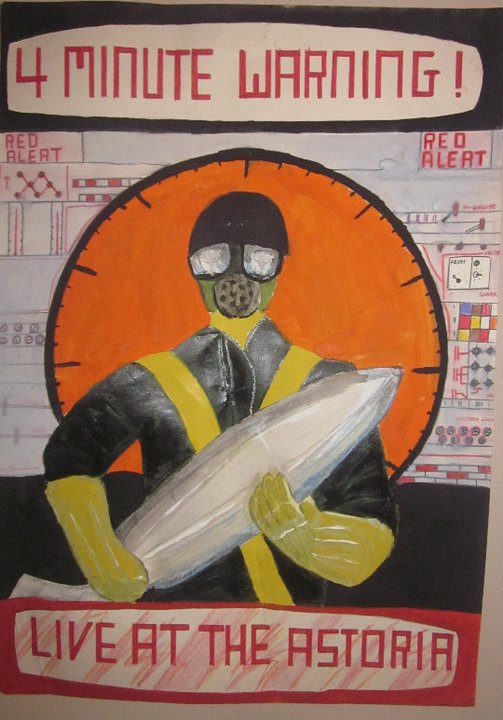
I joined my first ‘serious’ band a year later – 4 Minute Warning, named after a lyric by our biggest inspiration, Killing Joke, and outlining our anti-nuclear/pro-CND political stance.

4 Minute Warning

At the turn of the decade a far more interesting post-punk scene began emerging.

Many bands were breaking free of the three-chord, shout-along template – The Slits, Siouxsie and the Banshees, Wire, PiL, Punishment of Luxury, Gang of Four, Joy Division/New Order, Scars, A Certain Ratio, The Fall, et al – and using punk as a springboard into a whole new sonic universe.

As our music became more funk than punk we evolved into Desperation AM – named after a Gang of Four lyric. By the mid ‘80s my next band was Little Big Dig, melding post-punk, pop and Can, making it as far as a session on BBC Radio 1.

We never gigged beyond Edinburgh – and once in Glasgow, but did get a residency during the ‘85 Edinburgh Festival, in an ‘open until the wee small hours’ bar, La Sorbonne.

Gig poster for 4 Minute Warning

Mental health issues, recovery, marriage, and starting a family brought a lengthy hiatus until around 2002 when I reunited with mates from an old Edinburgh punk band, The Axidents.

We covered everyone from The Ruts to Magazine then started writing our own stuff, supporting UK Subs, 999, Eddie and the Hot Rods and Tenpole Tudor.

Desperation AM reformed and were joined by Paul Research (ex-Scars) on violin, leading to another post-punk band, Noniconic. Then Covid struck.

I’m currently mucking about with more ambient soundtracks under the moniker Giant Household Names – overheard in an interview with Wire.

Where did you grow up and what type of kid where you – playing football/in a gang/a member of a youth club ?

I grew up in Shandon on Edinburgh’s west side – traditionally the Hearts side of the capital although my dad was from Monaghan in Ireland, so I chose Hibernian. But I was always more into music than football.

In the late ‘70s uptown Edinburgh was a no-go zone, we were too young for pubs, and spiky hair/badges/ripped jeans were a red rag for ‘punk bashing’ by the far more prevalent ‘trendies’ who preferred disco music.

We’d stick to hanging around youth clubs where you could take your own records to pogo to. Youth was much more tribal back then, so if you were into punk, it was like being in a gang.

But nothing like the Edinburgh street gangs, with names like Young Leith Team and Gorgie Jungle, where the emphasis was on violent ‘turf wars’ – it was always about the music for us.

North East band Punishment of Luxury.

By the ‘80s the stubborn punks who refused to embrace post-punk did become much more aggressive. Sporting cockatoo hairstyles and studded biker jacket uniforms, the bands they were now listening to, typified by local exponents The Exploited, resembled heavy metal being played at 78 rpm.

By that time we were into Punishment of Luxury, the North East’s finest sons since Penetration, Angelic Upstarts and The Carpettes!

Check out the interviews with these bands on the Alikivi blog.

What does music mean to you?

Music means everything to me. In my 20s, I struggled with bipolar disorder, and was sectioned in 1987 spending time in intensive psychiatric care.

My wee sister Anne, bringing in cassettes of my John Peel recordings during visiting hours, was a pivotal moment in my recovery. I’ve only recently come off long-term medication (lithium) and music remains crucial to my wellbeing.

BBC Radio 6 presenters.

I’m an avid listener of BBC Radio 6 whose DJ’s include many long-standing musical heroes of mine – Iggy Pop, Marc Riley and Tom Robinson, along with a host of enthusiastic presenters like Craig Charles, Elbow’s Guy Garvey, Steve Lamacq, Mary Ann Hobbs, Stuart Maconie and others.

Although post-punk remains a major influence and I still love playing my now increasingly scratchy/jumpy 45s from 45 years ago, I prefer constructing playlists based on brand new songs introduced across the board on Radio 6.

Listening to these on headphones while strolling along the Firth of Forth on my doorstep, is wonderfully therapeutic.

Book cover for ‘1976 – Growing Up Bipolar‘.

What have you got planned for the Autumn ?

I’ve just completed a memoir that takes in my bipolar experiences of low manic depression to the high of mania and psych wards set against the backdrop of electrifying post-punk scene of the ‘80s that coaxed me back towards stable mental health.  

1976 – Growing Up Bipolar’ is based on a novel I wrote a while back called BrainBomb. The title is a homage to the massively underrated and still out there being creative and inspirational – Punishment of Luxury.

I’m being interviewed about my book at the Portobello Book Festival on October 1st. Gig-wise, I’ve got tickets booked for Public Service Broadcasting and Pale Blue Eyes at Edinburgh’s Usher Hall in September.

I’m also making the trip down to Middlesborough to catch Punishment of Luxury in December. I never saw Punilux first time round so immensely looking forward to that.

Paperback copies of ‘1976 – Growing Up Bipolar’ are available to buy from Waterstones and most retailers. The ebook can be downloaded from Kobo, Nook, Scribd and Hoopla.

For further info check the site:

MARK FLEMING – CREATIVE WRITING & MENTAL HEALTH // MUSIC & PHOTOS. – Home (markjfleming.net)

FUNK OFF – The Punishment of Luxury & further tales of musical adventures. | ALIKIVI : NORTH EAST UK (garyalikivi.com)

Alikivi   September 2022