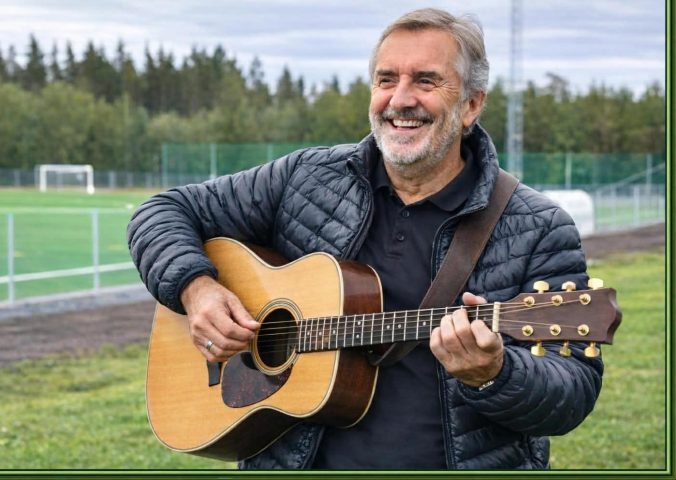
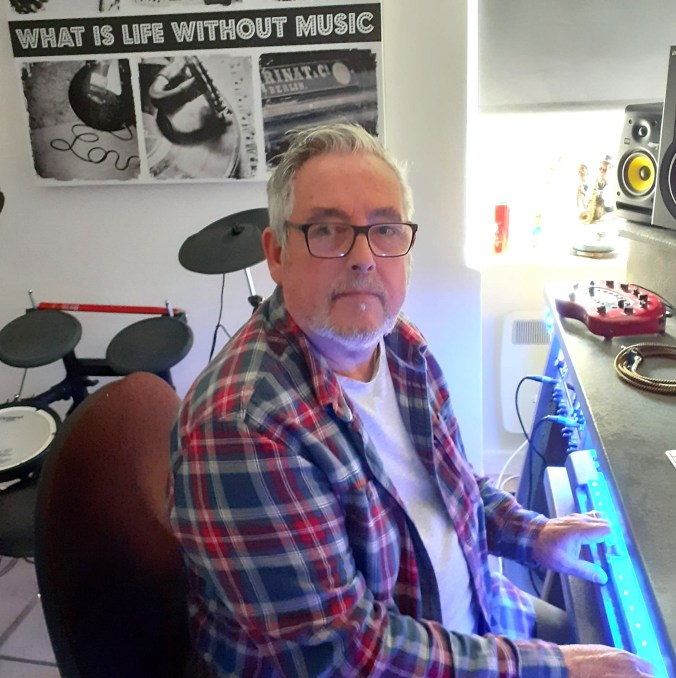
Originally from Middlesbrough, for the past 12 years 71 year old Alan has lived in Sweden with his wife Jude.
‘After school I went to train as a school teacher at Durham University then spent my first seven years in the workplace as a teacher then in business for several years in and around the Northeast.’ explained Alan.
‘The first business was an up market private health and fitness Centre in Yarm. It was called Gym and Tonic. My second business was a construction company renovating properties and building new houses’.
When did you first pick up a guitar?
‘When I was 12 year old and sang my first song at the school folk club. It was Bob Dylans Blowing in the Wind. Like everyone else at the time I joined a band at 16 and played a few gigs around the Teesside area particularly Redcar pubs. It didn’t last. We didn’t get a record deal. But I really did enjoy it.’
Was music in your family, did anyone play an instrument?
‘Yes, my mother. She played a mean piano but she had to have her arms twisted too actually do it. She was a musical one. Most family and friend’s parties ended up around the piano with her playing the hits of the day. So, I guess I got my performing bug from her and from her brother. My uncle was a professional singer all his working life.’
‘Fast forward five decades and songwriting has taken over. There was a song in me called Running Man. I wrote it quickly and we recorded it. Since then, I’ve just kept writing.’
‘Jude and I became involved with a professional football club In Sweden and formed a refugee team called The Mighty Cosmos. The original members of this team had all escaped the 2003 and still ongoing genocide with Sudan and Darfur and had an amazing story to tell.’
‘Over two years, they told me their personal stories and every line in Running Man was a part of one of those stories.
One night at the height of the refugee migration across Europe I saw the Hungarian foreign minister say we will build a fence and send them back and that became a line in the middle eight part of the song. The rest of the song came very quickly.’
Alan’s song has received radio airplay in Sweden and he has been interviewed on several radio stations across northern Sweden.
‘Songwriting came to me late, but I’ve really enjoyed it. I think the early protest singer songwriters of the 60s and 70s especially Dylan, Roy Harper, Tom Paxton, Loundon Wainright along with the amazing Leonard Cohen have influenced the way I write.’
‘There’s a rich pallet of subject matter in the world right now so plenty to go at. I have several songs on Spotify now and a whole load lined up ready to be recorded including an EP of four songs of nostalgia about my home town.’
Songs recorded in Studio 306, Ostersund, Sweden. Produced & engineered by Johan Arveli & Anders Lagroix Kronlund. Available to download on all music platforms.
Tracks include Jamtland County, Monster in the Water, War is Cancelled Today, Darfur Wind, Into the light and Lady Liberty.
Newcastle band White Heat released three singles and recorded one album, signed for Virgin records in 1980, opened for Judas Priest and headlined London’s Marquee. People remark of a band that ‘shudda made it big’. They set alight to the Tyne but sadly not the Thames.
Previous interviews on this site with guitarist Alan and vocalist Bob Smeaton detail the journey of White Heat and The Loud Guitars who followed.
Bob went onto a successful career in TV & Film while Alan told me ‘The Attention Seekers were formed around 1999, our first album was released in 2002, we have released six albums and a seventh is in the final stages’.
For the past 10 years Alan has also toured as a session musician with American singer/songwriter Jesse Terry.
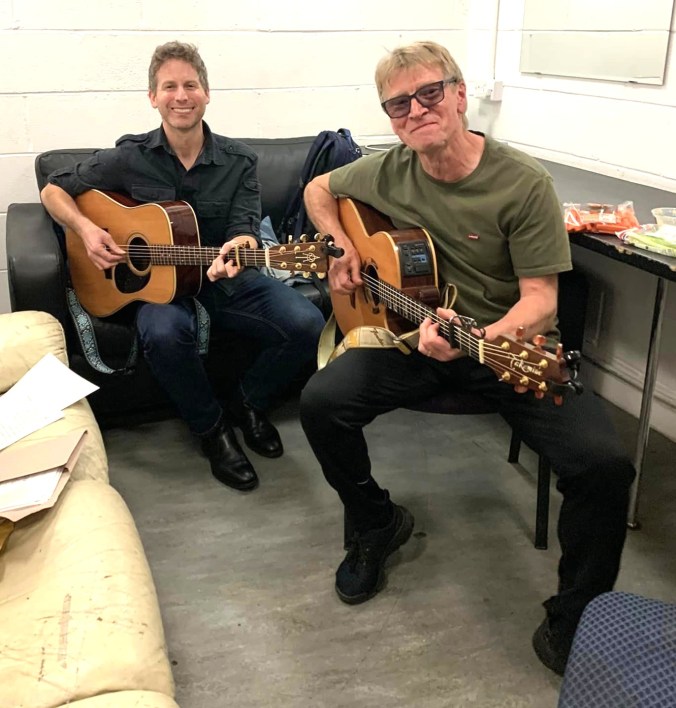
Alan and Jesse backstage Newcastle Cluny 2023.
‘However, to my surprise, at a number of gigs in the Netherlands audience members shouted out requests for White Heat songs. Nervous Breakdown and 21 and Wasted were hastily added to the set. Our songs had travelled far further than White Heat ever did.’
‘I look back on my time with White Heat and The Loud Guitars with great affection and have revisited and re-recorded a number of songs from those heady days. Promo videos are on You Tube for Chain Reaction, Is It Too Late?, A Long Way From Home, Do Me A Favour and Out Of Me.’
‘Recently I travelled even further back in time to the pre- White Heat days when we were playing under the name ‘Heartbreaker’. I always felt that the song Hard To Lose should have been recorded. My former band members were more than happy for me to reinvent this live favourite and Your Poster On My Wall is the result.
‘In 2017 I was approached by Newcastle Utd to develop a new version of anthemic song The Blaydon Races. My version The Fans – The Blaydon Races was accepted and I was informed they would be using it till the end of the season. It’s now 2026 and still being played at every home game. It’s now officially the most downloaded-streamed version in digital history. As a Newcastle supporter I am beyond proud.’
‘Pre 2017 Newcastle United were a club underperforming and floundering under a curse. A number of theories including ’The Gypsies Curse’, The Witches Curse’, ’The Burial Ground Curse’ were all to blame for this continuing pattern of failure. However, I think the problem lay closer to home.’
‘The version of The Blaydon Races the club were playing pre 2017 was recorded and performed by musician Alan Price (The Animals). I have it on good authority that Alan Price was an ardent Sunderland supporter. This was the problem hiding in plain sight.’
‘It’s no coincidence that since 2017 we have retained our Premier League status returned to the European Champions League and after 70 years in the wilderness have won silverware. Yes, indeed it’s all down to The Fans version of The Blaydon Races and not a Sunderland supporter within sight. That’s my theory and I’m sticking to it.’
‘The relative success of The Blaydon Races has allowed me to independently fund recording studios and top end musicians – who aren’t cheap. It gives my songs the best chance of having radio appeal. Iconic station Radio Caroline named The Attention Seekers track The Prudhoe Song, song of 2025. Many thanks to presenter Steve Anthony.’
Multiple media outlets have used recordings from The Blaydon Races sessions including Amazon Prime, BBC, ITV, The Bauer Media Group and the 2024 SELA Quayside 3D light show event. An unofficial Saudi version is on YouTube.
Both The Blaydon Races and the Carry me home outro from The Attention Seekers song Seven Bridges were used creatively on the Carabao Cup ITV video as the soundtrack to the historic Victory Parade.
‘This has raised the profile of the song and recently Newcastle United have asked me to develop a bespoke mix of Seven Bridges to integrate into their half time playlist. It’s now being played. As a lifelong Newcastle United supporter I’m on cloud 9!’
‘One of the highlights of 2025 was performing Seven Bridges with City Of Newcastle Male Voice Choir, Some Voices Choir and St. Teresa’s Primary School Choir as part of their Christmas Charity Concert.’
‘I’m presently working with City Of Newcastle Male Voice Choir, developing a choral arrangement of Seven Bridges to be included in their repertoire and to be recorded and released. It’s quite a departure from the days of White Heat.’
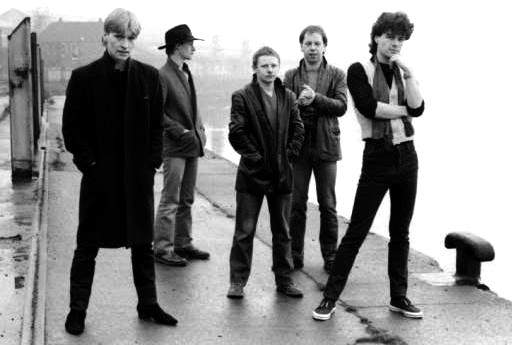
Promo shot of White Heat with Alan on the left and Bob Smeatonon right of picture.
‘The first release of 2026 for The Attention Seekers is Sweet Anna Brown. While unsuccessfully trying to track down an old friend and finding myself disappearing down numerous rabbit holes it occurred to me that this would make an interesting topic for a song.’
‘We step into the controversial world of social media and whether we like it or not it looks like it’s going to be with us for the foreseeable future. The character Anna Brown is one long mystery and doesn’t appear to have any social media presence.’
‘I’m rapidly closing in on a new album to be released later this year. Music continues to colour my life and long may it continue.’
Sweet Anna Brown is now available to stream-download via all usual platforms. The Attention Seekers – Alan Fish – Vocals, Guitars, Bass, Trevor Brewis – Drums, Tony Davis – Piano, Organ, backing vocals. Produced by Alan Fish, engineered by Tony Davis. Recorded at Cluny Studios, Newcastle.
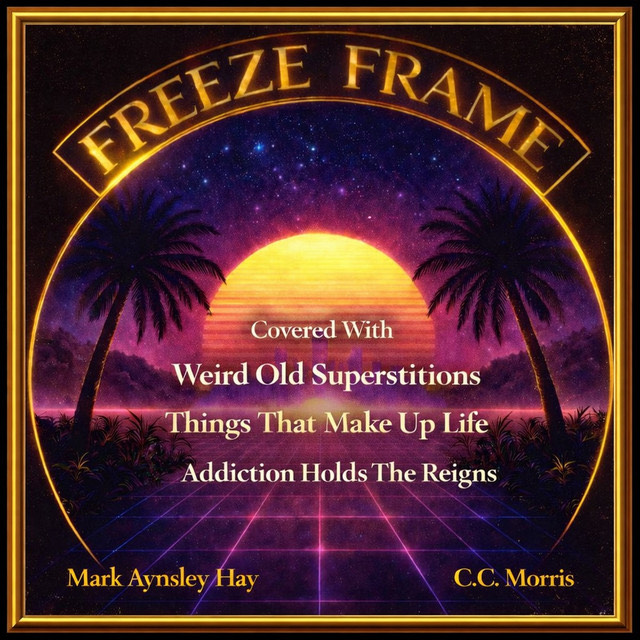
‘Freeze Frame’ is the new four-track album and first official release in 2026 by Mark Aynsley Hay and songwriting partner Chris Morris (ex Paper Lace guitarist). Both have featured on this site – Chris in May 2025 and Mark in March that year.
Chris Morris
‘Chris will be 72 this year and I recently reached the grand old age of 80. In my head I’m still 21, but a few health issues persuaded me I am really 80. I was diagnosed with osteoarthritis in my back and neck which – excuse the pun – can quite literally be a pain in the neck. Still, c’est la vie as they say in France.’
Explained former Teessider Mark who for the past 14 years has lived in the French town Pays De La Loire with his wife Alison.
‘We’ll have been together 50 years this June. We first met in 1976 in Aberdeen, Scotland, when I was performing in a cabaret club called Jay Jays. ‘76 was the height of the oil boom in Aberdeen and the nightclubs were thriving. Jay Jays had been the Gaiety Theatre and like many venues then was converted into a nightclub to suit the changing market particularly with the large number of American oil workers in the city.’
‘For album ideas my songwriting partner Chris suggested that we write a romantic ballad built around a theme called ‘Freeze Frame.’ Bringing those two ideas together gave us a broad and flexible creative direction.’
‘My thoughts immediately turned to early relationships and those first, overwhelming impressions—the wow! The one moment when I responded to attraction and sexuality. That realisation inspired the lyric “Love is not what we first see.”
‘The song centres on a couple navigating midlife crises that affect them in different ways. Although their love for each other remains strong, they decide to separate temporarily to give themselves space to breathe. The man longs to reunite, while the woman feels the timing isn’t right.’
‘In essence, he is writing a love letter in song expressing his devotion and vulnerability, yet at times he feels stuck—trapped in a kind of ‘Freeze Frame’, facing it alone.’
‘Things That Make Up Life was born from a conversation between Chris and myself. Chris mentioned he had an idea for a theme designed to embrace a wide range of life’s moments. That idea quickly sparked a flurry of rhymes and melody.’
‘As the lyrics evolved, so did the chord structure, and the song began to take shape. While the initial version showed promise, a change in tempo and a pop rock feel brought it fully to life — delivering the sound and feel we were aiming for.’
‘I delved into the myth of the three rabbits, a quest that led me to a very interesting discovery of facts on Google. I found fascinating facts about old folklore, superstitions, and myths, each with origins rooted in ancient beliefs, observations of nature, and attempts to explain the unexplainable.’
‘I mentioned to Chris that with such lot of material, we have enough to write another new song titled Weird Old Superstitions.’
‘Attentive observation of our everyday habits and dependencies became the inspiration for Addiction Holds the Reins. I’m referring to our daily reliance on laptops, tablets, and mobile phones.’
‘A few weeks ago, Alison and I were socialising with a group of friends. One of the younger people jokingly commented, “Older people are always criticising the young for constantly being on their phones—but look around. There are five older people here scrolling through their screens, completely unaware of what’s happening in this room.” Unfortunately, he was absolutely right—and I was one of the guilty ones.’
‘I became increasingly observant of how often people browse their phones—in hospitals, doctors’ surgeries, waiting rooms and even while walking down the street.’
‘We don’t converse to each other just text or message mainly irrelevant topics that have no real significance to personal or worldwide situations. This isn’t meant as criticism – I’m equally at fault.’
‘Recently the British government have been discussing whether schools should be mobile-phone-free by default, including the possibility of a complete ban for children under sixteen. This policy has already been implemented in Australia and is currently under consideration in Sweden.’
‘I also came across a report from the United States in which primary school teachers noted that many children are starting school unable to read or write their names, yet are already able to swipe on a phone. I’ve incorporated that observation into the song.’
‘While working on this song, I became more aware of my online habits and tried to scale them back, a difficult task when research plays such a big role in songwriting.’
‘As for our hopes for the album, they’re much the same as they’ve always been with our original music. We’d love for it to be picked up by a producer, a publishing company, or perhaps a well known artist who doesn’t write their own material. It’s not really about the financial side although a bit of extra income never hurts.’
‘More than anything it’s about having your work recognised and valued. I often find myself reading your North East Culture site and thinking that’s interesting or I’d never have considered that before – that kind of acknowledgement means a great deal.’
The four tracks are available to stream and download on most major online music platforms.
(John Heston in the Littlehaven Hotel, South ShieldsFeb. 2026. Pic. Alikivi.)
I’ve known John since 1970s living in South Shields and going to Tyne Dock youth club where rock music was blasted out of the disco.
‘Yeah, I was a bit of a rocker then. The first band I got a ticket for was Scorpions at Newcastle City Hall. I went on my own, I was only 11 – I’m 57 now. I had no concept of what a gig would be like’ said John.
‘When the band were on stage, I noticed something different. Was it an extra member? I didn’t recognise some of the songs. When they finished, I walked out when a bouncer on the doors stopped me “Hey son you not hanging around for the main band?” ‘I’d only watched the support band who happened to be Tygers of Pan Tang from Whitley Bay!’
‘Harry Hill the drummer of rock band Fist, his mother lived near me when I was a kid. When he used to come to see her, he’d drive into the street. A few times I would run over to get his autograph cos the band had just released a single. I met him years later he was really nice. We had a laugh when I told him about it. “What! You were that little squirt who used to come over all the time?”
‘Buddys nightclub in the town had an under 18’s disco and what caught me ear was bands like Stiff Little Fingers, The Jam and The Clash. Alternative Ulster from the Fingers blew us away. Unfortunately, as I was just getting into them these bands were starting to split up! I was a curse, too late for the party’.
One day in 1985 I was in Newcastle record shopping when I was surprised coming across a band busking at the Grey’s Monument. I wasn’t sure at first but it was The Clash.
‘Yeah, I’d been up Newcastle that day but missed them. The busking dates and locations were unannounced. I did meet Mick Jones’ band Big Audio Dynamite at the Mayfair – they handed out cans of Red Stripe. But we missed the last bus so had to walk home afterwards. About 10 mile!’
‘I’ve met Joe Strummer when he was on his solo tour. Had a smoke and drink with him backstage at Newcastle Uni. They say never meet your heroes but glad I did cos he talked patiently to us and answered our questions. I like that, open and relaxed not like now paying for a meet and greet.’
Since being a teenager John has been attracted to music.
‘I was never one who wanted to sound like Jimi Hendrix. The guitar was a songwriting tool for me. I remember when I was around 12 walking in the West Park, South Shields and this loud noise was coming from a distance. I followed the sound which led to a hut. I opened the door and there was a band inside rehearsing. It just hit me. I immediately thought I wouldn’t mind doing that.’
‘It was songs I was interested in, not just the guitar, I wondered how did they put them together? I was interested in the nuts and bolts of the song.’
We talked about great 80s music TV programmes like The Tube which I was lucky to get free tickets for to be in the studio audience. Watching rock bands like Thin Lizzy, Judas Priest and Gary Moore was great but this was the time that The Alarm, The Cult, Killing Joke and Big Country were making a different noise.
‘The first Big Country album really helped me learning guitar. It was a big influence.’
Previous interviews have revealed a family member who used to sing in the clubs or a granny who had a piano in the front room – but not in John’s case.
‘Me mam says I don’t know where it has come from cos there is no history in our family of any musical talent. I think it was just the generation I grew up in. I thought being in a band was beyond me. The punk attitude of going out to just do it made it more possible.’
‘Thing was there was no money around. I only had a cheap guitar from a shop in South Shields called Second Hand Rose. The scratch plate was made from the perspex from a bus shelter window. I don’t know what the strings were made of – possibly chicken wire – but they toughened my fingers up.’
‘It was just getting the feel of playing guitar along to records. I got a book out the library which showed me a few chords. I never got a proper guitar until I was 18. As I say writing songs was what I wanted to do and I started looking around to work on this with somebody.’
(Cloud 10, Laygate 1995 with John on the left pic. Alikivi)
‘I had a mate, Paul Stephenson, who wrote lyrics so we worked on them with some music for about two years. His brothers were a guitarist and drummer and we contacted Neil Newton to come in on bass so formed a band called Cloud 10. We found rehearsal rooms in South Shields this was around ’94.’
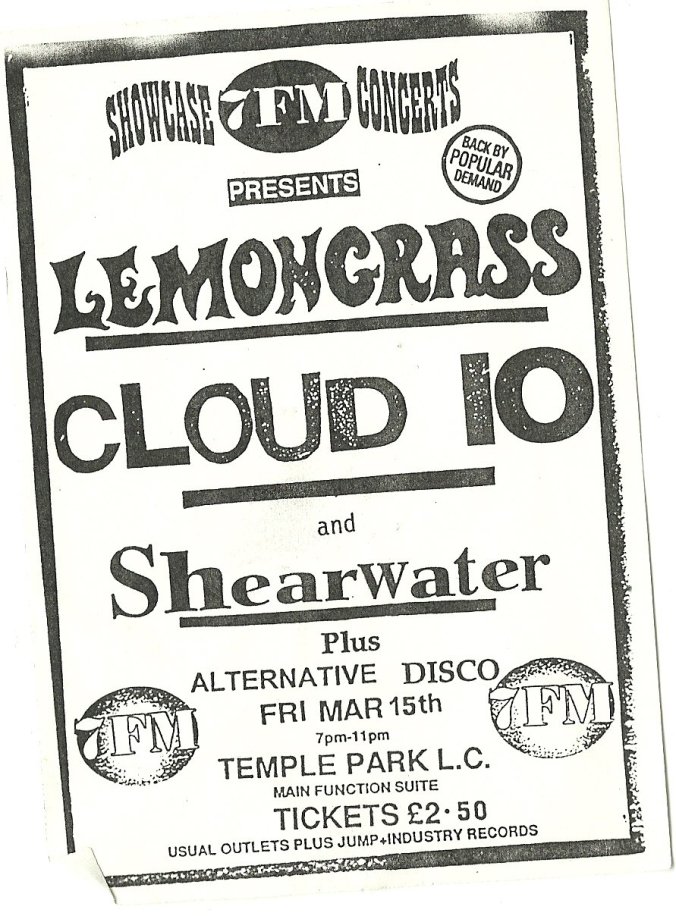
‘There was a good scene in Shields then. Plenty of bands like The Calm, January Blue, The Fad, Lemongrass and Nosh at venues like The Vic, the Amphitheatre and I remember playing a showcase gig for community radio station Seven FM at Temple Park Leisure Centre.’
‘After a few gigs we were getting noticed and a guy called Danilo Moscardini, who had a music page in the Sunday Sun newspaper, got in touch after hearing our demo tape. He managed Sunderland band Kenickie at the time who had a few hits. The singer/guitarist Lauren Lavern works on the BBC TV One show now. But after initial interest from record companies it faded away and me and Neil went our own way, forming a band called Speedster’
‘Pre-internet it was adverts in local music shops ‘looking for drummer’ that took ages. Then Neil left to join The Chasers with ex Wildheart Danny Mccormack and I joined The Last Men on Earth with Chris Wraith, Martin Payton and Wayne Burgess. We played around the pubs doing a mix of our own songs with a few covers which earned us enough money to buy new equipment and book in studio time.’
(The Last Men on Earthwith Chris Wraith, John Heston, Martin Payton, Wayne Burgess).
‘We were playing a few days a week around the North East and we got down to Camden in London. Again, this band fizzled out and me and drummer Martin Payton talked about getting something together.’
‘As Panic Report (Richy Harbison – keyboards, guitar & vocals, Steve Moore – bass & vocals) we went a similar route as Last Men on Earth by playing originals mixed with covers. From this we got ourselves a decent recorder where we got a few tracks down on CD. Obviously not as good a sound as studio but we spent more time on the tracks and didn’t worry about looking at the clock ticking. Studios are expensive.’
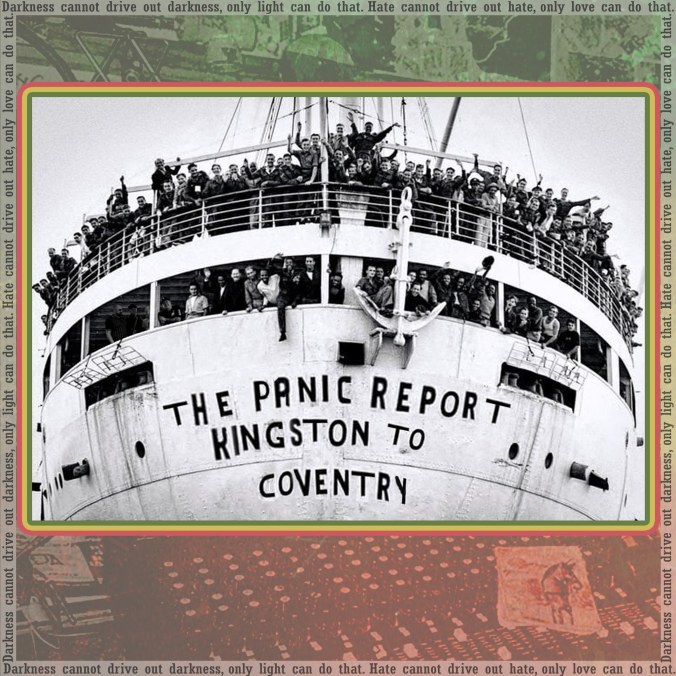
‘We did eventually book into a pro studio and have recorded two CD’s with our new one ‘Kingston to Coventry’ (pic below) which we are releasing on vinyl in a few months. The master tracks are sent away and the wheels are in motion. We will be arranging a launch party in the summer.’
‘For gigging the Panic Report have supported Toyah and Bad Manners at Newcastle Academy. We have played at Stone Valley festival (Bad Manners, From the Jam, Cast, The Professionals with Paul Cook, Bob Geldof). When I was 16 and people said you would have been in a band playing gigs alongside these people I wouldn’t have believed them.’
‘Although not long ago we done a gig down Bishop Aukland with only ten people in the audience, but you still play and just get on with it and enjoy it. We love what we are doing.’
‘A gig I enjoyed was when Angelic Upstarts supported us at Mensi’s 60th birthday at his pub the Alexandria in Jarrow. It was unbelievable. We couldn’t believe it when the big man asked us. Mensi wanted to go on before us then relax before the whole gig finished. It was a great night. The place was rammed’.
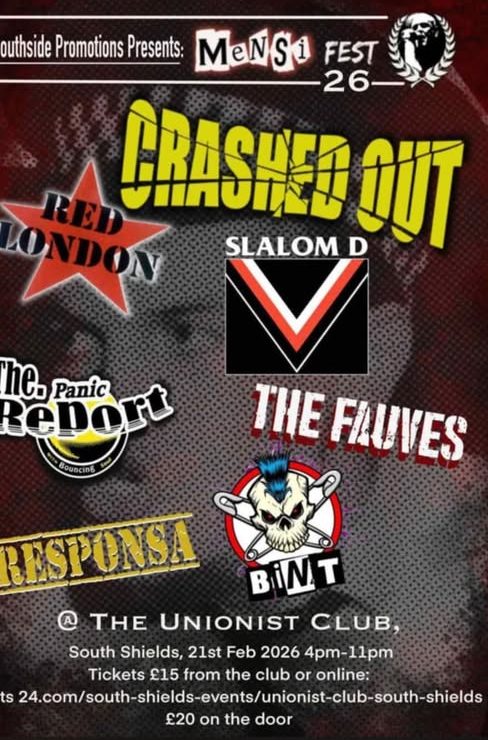
‘We’re playing on the Mensifest soon. The organisers are looking to get a festival in remembrance of the Upstarts singer who sadly died a couple of year ago. The gig will be at the Unionist Club, South Shields. There will be about seven bands on with Crashed Out headlining. The tickets are going well the organiser is hoping to make it an annual event.’
‘We’re more or less busy through the year with festival dates and there’s promoters still getting in touch to arrange more.’
Since he was a teenager playing music has been in John’s blood and being able to still be doing what he love’s for over 40 years, he says is a privilege.
‘I’ve done around 700 gigs since starting and I’m ready to keep going’.
‘Kingston to Coventry’ available on vinyl this summer. Check The Panic Report social media for details.
Southside Promotions present ‘Mensifest’ on 21st February 2026 at The Unionist Club, South Shields. Line up featuring Crashed Out, Red London, The Fauves, The Panic Report and more. Tickets £15. On the door £20.
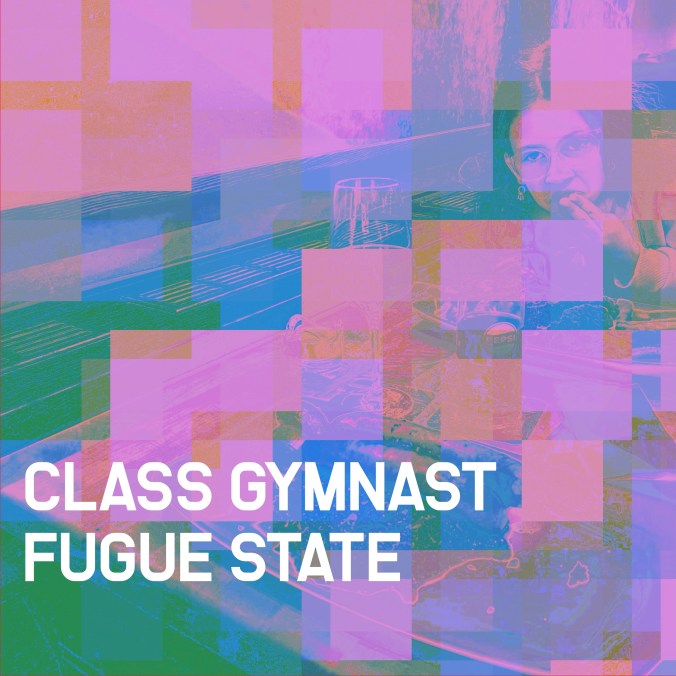
Class Gymnast are Jon Melvin (Vocals), Mark Cliff (Drums), Jordon Ridley (Bass), Andrew Yates (Guitars) and John Dempsey-Curry (Guitar).
“We’re mainly South Shields lads, although I suppose our spiritual home is Sunderland – we’ve rehearsed at The Bunker on and off for the best part of two decades” said guitarist John Dempsey-Curry.
What are your hopes for this single?
“I’ll be honest, it’s just nice to get some music out there. We started this ‘project’ in 2019 as a way of playing some older songs and ended up writing and recording new music. Right when we started trying to do anything of substance, the pandemic happened and we had to slow right down. We’re not fast at the best of times, but we ended up writing and recording around one song a year, and never really doing anything with it. This is us finally committing to something.”
How long have the band been playing music for?
“We’ve all been playing together in some form for a while. Three of us were in a band called The Volts in 2000 for a couple of years. Four of us were in The Broken Things back in the early 2000s. A few of us started a band called Maps Are Fiction / The Dead Generosities in the 2010s. A couple of us are in the going concern The Union Choir. I believe The Broken Things may be making a brief comeback as part of a charity gig alongside some other bands of that time shortly, which will be exciting.”
What do you think about the state of live music today?
“We’re all in our 40s and most of us have kid(s) so getting out to see gigs is hard. Playing them even harder. I know from other folks I’ve seen posting pictures (on social media) that there’s still a thriving small band scene, so I know there’s a scene out there, but it does feel very much like there’s a lack of venues dedicated to this kind of thing like there was ‘in my day’. I’m very probably wrong on that though!
Have the band planned any gigs soon?
“On the live music front we are playing the Ship Isis in Sunderland on 31st January with two other bands – American Wrestling and Becca Rubin.”
Produced by Martin Trollope – aka Harbourmaster – ‘Fugue State’ the debut single released 26/1/2026 and same day music video premiering on You Tube at 6pm. Pre-orders on Apple music 19/1/2026.
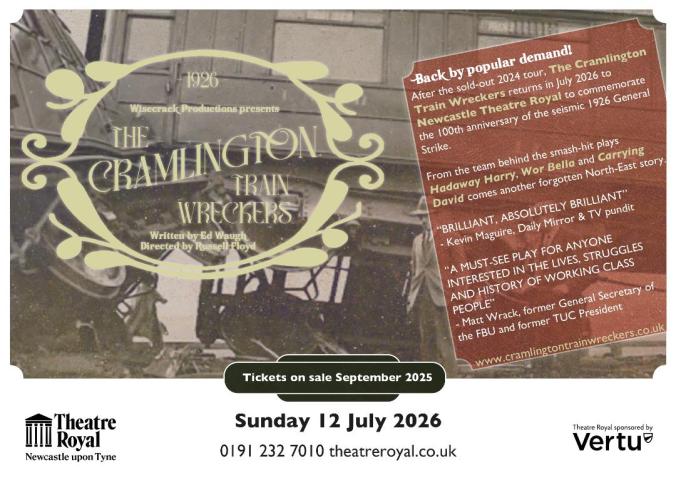
After a sold out stage tour in 2024 Cramlington Train Wreckers is back. The inspiring story of working class solidarity will be staged at Newcastle Theatre Royal on Sunday 12th July 2026to commemorate the 100th anniversary of the national strike in 1926.
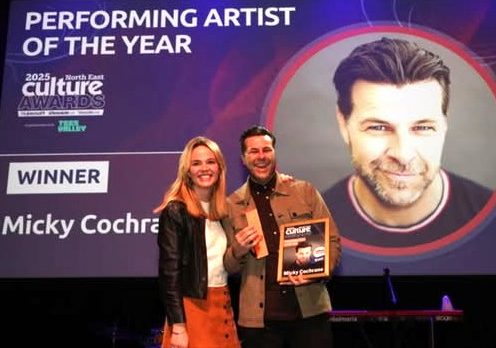
The strike was the biggest rupture in society since the English civil war. Miners were asked to take a pay cut to ‘improve productivity’ – really just to maintain the profits of the bosses. North East actor Micky Cochrane played one of the main roles on the tour and is revisiting the play at Theatre Royal.
“The audiences were really good in ‘24. Lots of bums on seats and a great response. A lot of people come with high expectations for Ed’s plays and love what he does.”
Written by Ed Waugh (Wor Bella, Carrying David, Hadaway Harry) the story of the striking miners who accidently derailed the famous Flying Scotsman train in Northumberland is told by former actor and director Russell Floyd (The Bill, Eastenders), and after a very successful Carrying David and Billy Elliott the musical, the afore mentioned Micky Cochrane.
“I had worked with Russell on Carrying David and The Great Joe Wilson. I know how he works and what he brings out of actors. We work really well together.“
“I also won the North-East Culture Awards Performing Artist of the Year. It was a great reward for the fantastic plays and big roles I played last year” said Micky.
Also starring is Alex Tahnee who was in Romeo & Juliet and Alice in Wonderland “I knew Alex. She was great. The play has lots of information so we had to be on it. We had to help each other out”
“I had heard of the Cramlington Train Wreckers but I didn’t know the full story and main players so it was another chance to learn more about the history of the area.” explained Micky.
Tickets for Cramlington Train Wreckers at Newcastle Theatre Royal on Sunday 12th July 2026 available from >>>
Neville’s music has attracted attention from the BBC and the specialist music press. Stuart Maconie featured him on BBC 6 Music’s Freak Zone, Electronic Sound magazine praised his debut album The Edge of Destruction which established Consett born Neville (53) as a distinctive voice in contemporary British music. The critically acclaimed debut featured on this site in July 2023.
“I’m hoping to build upon the success of the previous two albums, which certainly found an audience, at the same time this album has a different approach. I like the idea of doing something slightly out of the ordinary each time” explained Foster.
What or who was your inspiration when you were young?“As a child I’d a neighbour who had an old 78 gramophone. I still remember the smell of the thorn needles. That was my first musical experience, it seemed like another world with its own smells and sounds. My dad who like a lot of other men in the 1970s took up guitar so I recall him playing.”
“My first record I bought from Woolworths in Durham as a child was Mike Oldfield’s Blue Peter. My dad played Tubular Bells around the house so I’d have heard that and Oxygène by Jean-Michel Jarre. So, Oldfield and Jarre would be my earliest exposure to modern music.”
“Having played guitar myself for many years when I began making this kind of music I remembered Jarre and Oldfield but also discovered I had in my record collection the likes of Terry Riley, Hans-Joachim Roedelius and Michael Rother without really having ever joined up the dots of who these people were or what they were doing.”
Is music in your family? “Not at all. My grandfather was in the navy and played the accordian, he always told me as a child that if I wanted to be popular at parties I should learn to play the piano. My father had a few attempts at playing the guitar which didn’t work out, but it did mean there was a guitar around the house when I was growing up.”
“It’s important to remember, this period in time and in the north east, most families were not affluent enough to have the luxury of a musical instrument in the house let alone a musical education.”
Are you planning any live dates? “The nature of this album makes live dates challenging, I’m against the electronic approach that works with pre-recorded loops and is effectively only live mixing rather than a live show. In the case of this album a live show would mean running several old Windows 98 computers at once, working over the top of them and hoping the results resembled the album, but would in fact be a re-creation.”
“There’s certainly a half way house and I’ve done a few small scale live experiments with other material to test the waters which proved effective musically – which is the main thing, so you can expect more live works in the future.”
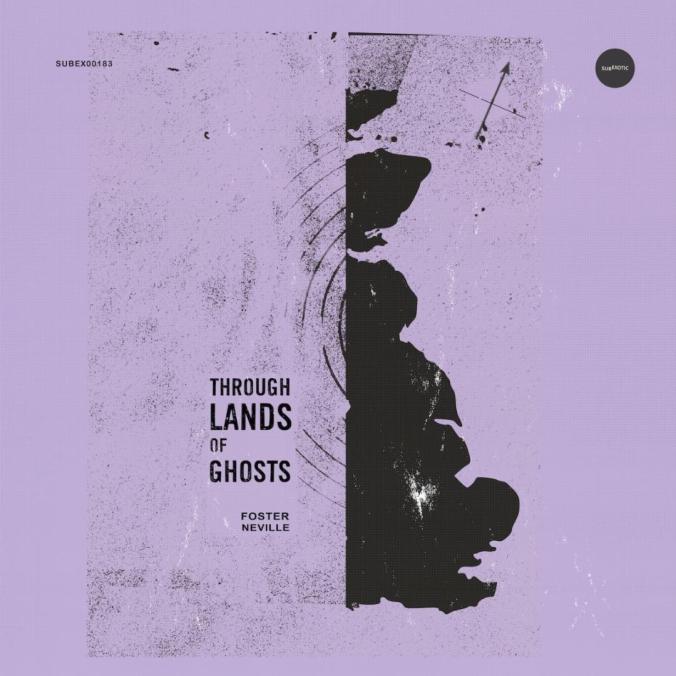
Produced by Ciarán Cahill (Van Morrison, Elvis Costello) and John Pilgrim and featuring an appreciation by writer and filmmaker Iain Sinclair ‘Through Lands of Ghosts’ will be released 16th January 2026 on Subexotic.
A lot is made of being in the right place at the right time to help bring success. But you can’t get past the sheer amount of hard work put in, every time giving 100% and never complaining. There is no substitute for rehearsal and when the opportunity presents itself you’ve got to be ready to take it. A snapshot of a story taken from Sting’s autobiography Broken Music hits the mark. This all happened within a few heady months during 1978.
The Police went out on a UK tour to open for Spirit led by guitarist Randy California. They won over a hippy audience and released their single Roxanne. Their record company A&M fully supported the record but money wasn’t rolling in yet.
To pay rent on his London flat Wallsend born Sting was still filming a few adverts and bit part in films. The Great Rock n Roll Swindle was one, although his scene ended up on the cutting room floor. ‘I was grateful, however, for the 125 quid at the end of the day’ said Sting.
He also went for a part in Quadrophenia filmed in Brighton. ‘I know that they’re seeing half of London for this role, but somehow I know it’s mine’.
After finishing on the film set in Brighton the record company hired a private car to whisk Sting off to Gatwick airport and jump on a flight to Manchester, finally arriving at the BBC TV studios where The Police were due to appear on the Old Grey Whistle Test. Sting remembers ‘It’s still raining when we land in Manchester. Yet another car and driver waiting to take me to the studio, where we have a sound check. The performance tonight is live’.
After a successful TV appearance a tour of the east coast of America was booked. Second night of the tour The Police are in Poughkeepsie theatre with only six people in the audience. Do they cancel? No. Sting brings the audience down to the front and introduces each other. Then ‘give a blistering set we will ever manage, encore after encore’.
The audience are invited back stage where it turns out three of them are DJ’s. The next day Roxanne makes its debut on USA radio. Within a couple years The Police are one of the biggest bands in the world. Now how did fellow Tynesider Mark Knopfler and Dire Straits knock them off their perch?
Singer/songwriter Terry Gorman Nov.25 pic. Alikivi
Now based in North Shields, Terry Gorman was born in Colne, Lancashire and has been playing guitar for over 50 years. Music has taken the 66 year old around the UK and Europe including Ireland, Amsterdam and Lanzarote.
I’ve done thousands of gigs maybe more than anyone you’ve met! said Terry after he had taken a short ferry journey over the river Tyne from North Shields to South Shields. We met in The Customs House for a cuppa and talked about music.
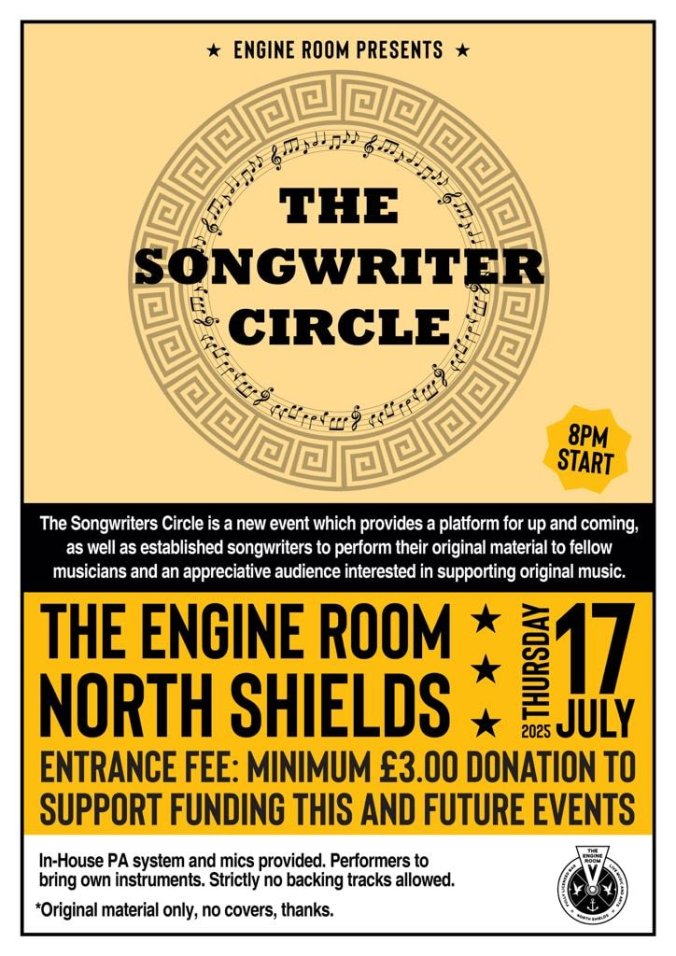
In North Shields there’s a nice music scene going on. We currently run a monthly ‘Songwriter Circle’ event every month in The Engine Room on Tanners Bank. It’s ran by myself and a few friends Steve McVay, Larry Page, Steve Rudd and Lyndon Phyliskirk.
You see live performance of singer songwriters all playing original songs. We encourage all levels of talent leading to paid gigs and possible festival spots. It’s been very successful so far and has been going since June said Terry.
Have I ever held down a proper job? I tried working 20 hours a week but found it hard working for idiotic managers. I thought I could earn enough money playing guitar and singing. I wasn’t interested in chasing fame.
I liked Ralph McTell, Alan Hull, James Taylor people like that telling a story. I watched Lindisfarne who were ordinary blokes, really down to earth but well known at the same time – that was for me. It was all about the music.
My introduction to music was my grandparents who had a piano in the front room. A lot of people did. I was around 10 year old when I picked up a guitar. It was a Hofner with a scratch plate. A Catholic priest who was a friend of the family knew I loved singing and writing poetry so he gave me his acoustic as he was off to the missions in Africa.
I lived in Brampton, Cumbria until I was 8 year old that’s where I saw the first singer who made an impact on me. It was Elvis when he sang on our black and white TV although I couldn’t make out the words or what he was singing about. The Beatles and Stones were good but I really liked storytellers, folk music where you could hear the words. I love lyrics.
Then I heard Lindisfarne and Isaac Guillory who made a G chord sound interesting. My first public gig performing was as a teenager in Durham I think, I was nervous and pretended to be confident.
Terry supporting the Devan Allman band at Newcastle Cluny.
North East venues Terry has played over the years include Bents Park and Amphitheatre in South Shields, Sunderland Empire, in Newcastle he performed at the Live Theatre, Journal Tyne Theatre and The Cluny. He also played in Durham City Hall and Gala Theatre, Washington Arts Centre and Darlington Arts Centre.
I won a songwriting competition in 1990 and thought it would lead to bigger things. A lot of radio play came off the back of that and a slot at the Cambridge Folk Festival and a headline at Dungeon Ghylls Music Festival in Cumbria. Again, I thought that would lead to more so I kept plodding along.
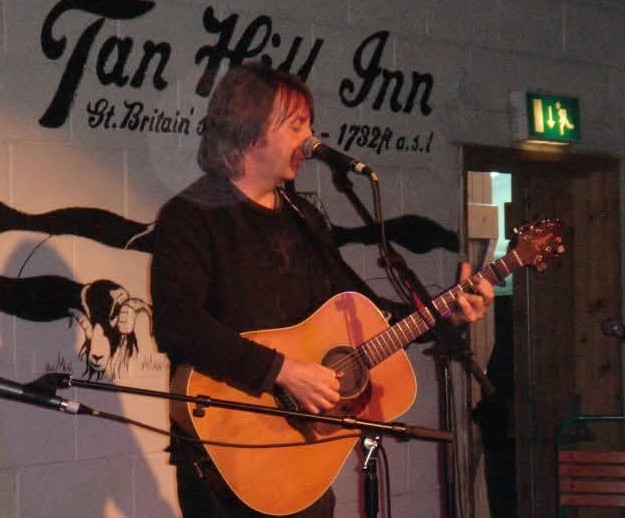
I played support to the Levellers at Tan Hill, Yorkshire, the highest venue in England. It went great playing my own songs, really grabbed the crowd by the scruff of the neck and went down well with an encore. The Levellers didn’t like that so I wasn’t asked back! Opening for Ralph McTell was a good gig and I’ve worked with Prelude a lot, I liked your interview with the singer Brian Hume earlier this year.
Terry supporting The Levellers at Tan Hill, Yorkshire.
I remember I played at a festival on the Isle of Bute, Scotland. I was the only one who wasn’t signed to a record company or connected to a famous band. There was Steve Daggett from Lindisfarne, Baz Warne out of the Stranglers, Martin Stephenson who was popular in the 1980s and others out of bands like The Pogues. I thought what am I doing here? I didn’t get signed but really, I never felt out of my depth.
I’ve wrote a few songs about getting knocked down and fighting back. When on stage I wouldn’t introduce the songs as if they were about depression or mental health. They are more about the power inside of you. It’s about dusting yourself off and going again.
I’ve recorded in Newcastle studios like The Cluny. Archie Brown from the Young Bucks was sound engineer. Then I went to Trinity Heights ran by Fred Purser. He was great, a really good lad, he used to be in North East bands Penetration and Tygers of Pan Tang.
What am I doing now? Well, it’s keeping the work rate up. In the last 12 months I released a single, ‘Only News Today,’ two albums and six professional music videos.
For 2026 I’ve got a folk album ready. One of the songs is ‘The Silent Shipyard’ about the closing of the shipyards and mines, all of the industry we have lost. I want a male voice choir on that one with a brass band and violins. Another song is ‘Beacon in the Dark’ about the whaling ships we had on the Tyne.
An idea floating about is a rock opera about John Lennon who was shot and killed in New York in 1980. In ‘Sgt Pepper Survived’ John Lennon gets shot and survives, lies in a coma for many years, wakes up and reveals his thoughts about world events today.
One scene is him sitting in a bar talking to Eric Clapton and Jimi Hendrix – yes, he lives as well. Lennon is also interviewed on stage where he is asked what he thinks about today’s shows like X-Factor, bands like Oasis and social media Spotify, Facebook and Instagram. I’m always thinking of these ideas.
If I have any advice to young musicians, it’s that if you enjoy your music, you’ve made it. If you don’t best just pack in and go do something else.
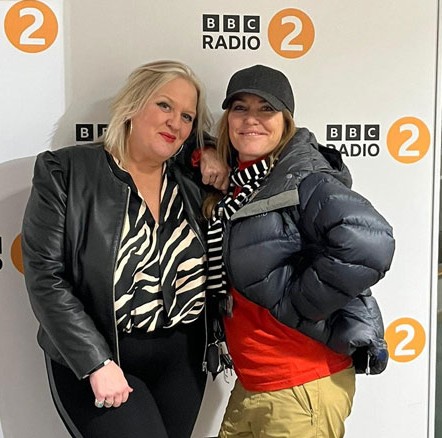
Emma at BBC Radio 2 with Cerys Mathews December 2023
Magazine front covers, BBC Radio 2, awards, tours, record releases – this past few year Emma has been prolific. In 2023 she released ‘Memphis Calling’ recorded in Sam Phillips studio in Memphis, USA, earlier this year she talked about her third album ‘A Spoonful of Willie Dixon’. Recently she got in touch about her latest single…
I’m stablemates with American band Chris Wyze and the Tellers. We’re both signed for distribution with ‘Select-O-Hits’ in Memphis. Chris found out I was in Tennessee for a few days in September so asked me to co-write and sing a duet with him. We recorded ‘Hearts Blue Christmas’ at Royal Studios in Memphis with the Hi Rhythm Section.
At the end of the recording session producer Boo Mitchell said ‘We have an hour left“. Chris turned to me and said ‘Do you want to do anything?’ I’ve previously recorded with pianist Charles Hodges (who is part of the Hi Rhythm Section) on my record ‘Memphis Calling’ and we have a good friendship and work well together.
I asked Charles if he knew the song “What are you doing New Years Eve”? The track was written by Frank Loesser in 1947. I think I must have first heard the Lena Horne’s 1966 version as my Mum played a lot of her music when I was little.
Charles strolled over and started playing it so beautifully on the grand piano. That piano has been in the same position at Royal studios for decades. Goodness knows how many iconic songs it has featured on!
Charles and I spent about ten minutes getting a key to suit and having a run through, then he called Steve Potts to play some lovely light drums and then we taped it.
L to R – Charles Hodges, Steve Potts, Hubbie Turner, Emma Wilson, BooMitchell, Lina Beach, Chris Wyze and Leroy Hodges at Royal Studio, Willie Mitchell Boulevard, Memphis on 25 September 2025.
Along with promoting the singlenowEmma is already looking forward to 2026…Recently I won the UK Blues Challenge at Marshall Studios which means I go to Memphis in January to represent the UK in the International Blues Challenge and for the European Blues Challenge I go to Poland.
‘What Are You Doing New Years Eve’ is out on 21st November 2025 as digital download and a very limited run of CDs which are available from the official website >>>




 ALIKIVI UK : NORTH EAST MUSIC & CULTURE