She died a forgotten hero in 1979, but WW1 women’s football superstar Mary Lyons is about to get the recognition she deserves when a headstone on her previously unmarked Jarrow grave is unveiled in April.
Mary was born in 1902 in Jarrow. In 1918 aged just 15 she became the youngest-ever England footballer and goal scorer when on her debut she scored in front of 20,000 people against Scotland at St James’ Park, Newcastle. It is a record that still stands today, and yet her achievements have been written out of history – until now!
Mary died in Primrose Hill hospital, Jarrow, in 1979, aged 76, and was laid to rest in an unmarked grave with three others. The Friends of Jarrow Cemetery have been at the forefront of getting recognition for the town’s forgotten football hero and, last year after discovering her final resting place, erected a 3ft wooden cross to mark the grave.
However, Mary features prominently in Wor Bella by South Tyneside-based playwright Ed Waugh (Dirty Dusting, Carrying David, Hadaway Harry). Bella Reay was played by North East actress Catherine Dryden.
Catherine Dryden (‘Wor Bella’)in Blyth football strip.
Due to the success of that play in the North East in 2022 and its hugely successful re-run in London and Newcastle Theatre Royal last year, the Friends of Jarrow Cemetery moved to get Mary a permanent headstone.
Jarrow amateur historian Stewart Hill, 73, and Tricia Vickers, 67, are members of the Friends and have led the way in getting recognition for Mary. Stewart explained “Mary was the youngest of eight siblings and she worked in Jarrow shipyard during WW1. She was a tremendous footballer by all accounts. She debuted for Jarrow Palmers when she was only 15 and quickly caught the eye. In May 1918, she was seconded to the mighty Blyth Spartans for the Munitionettes’ Cup final against Bolckow Vaughan of Middlesbrough”.
“Mary scored a goal in the 5-0 victory at Ayresome Park, in front of 22,000 spectators and was crowned ‘Player of the Match’. The following year Mary captained Jarrow Palmers to win the Munitionettes’ cup at St James’ Park, in front of 9,000 supporters.”
Stewart added “So by the age of 16, Mary had won two cup finals, scored in one, captained her team in the other and became the youngest-ever England player and goal scorer! What a brilliant achievement! Imagine what she would be like today, given the modern game and opportunities.”
Tricia, said “Our great friend George Le-Blond of Abbey Memorials in Jarrow has generously donated the beautiful marble headstone and genealogist Sam Nicol has been a great help trawling through hundreds of newspaper articles for information.”
She continued “Friends of Jarrow Cemetery work to keep the cemetery welcoming and clean, and make it safe for people and their loved ones. This is a tremendous development. Mary and the WW1 women footballers should be an inspiration to young women everywhere.”
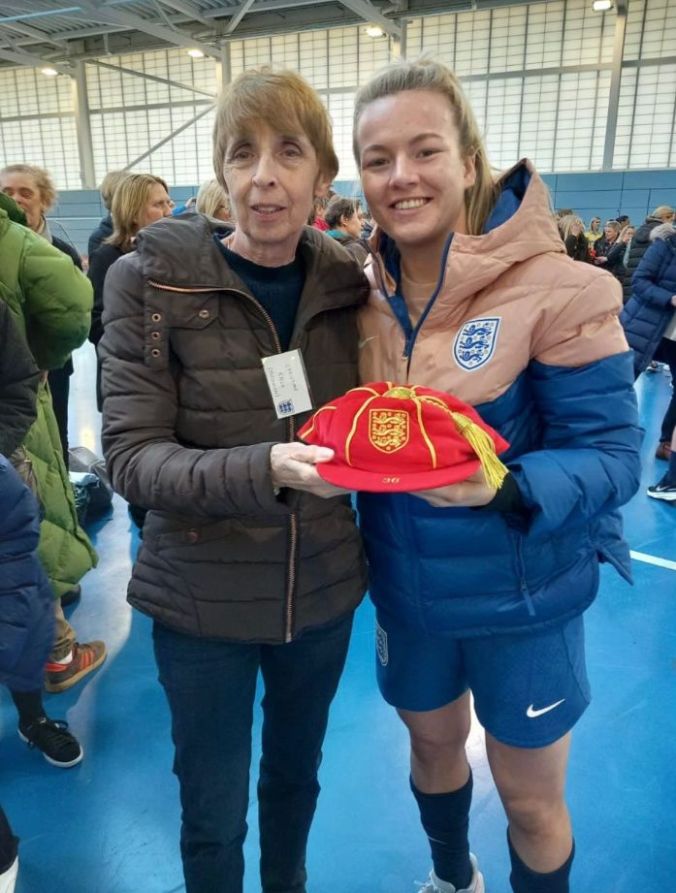
Christine Knox (on the left) being presented in 2024 with her red England Legacy Cap by Lioness Lauren Hemp. The cap is numbered 36 to mark Christine’s legacy number – the 36th women to play for England. The presentation took place at St. George’s Park, the national football centre, in Staffordshire.
The unveiling will take place at Jarrow Cemetery on Sunday, April 27, at 11.30am, everyone is welcome to attend. A brass band will lead the procession to the grave and ex-England Lionesses Christine Knox and Aran Embleton will perform the unveiling ceremony.
Christine, who won ten England caps in the 1970s and 1980s, played for Wallsend Ladies, Whitley Bay Ladies and North Shields Ladies.
Aran, the first millennial Geordie Lioness, gained four England caps and played for Blyth Spartans, Sunderland Ladies and Doncaster Belles in her illustrious career.
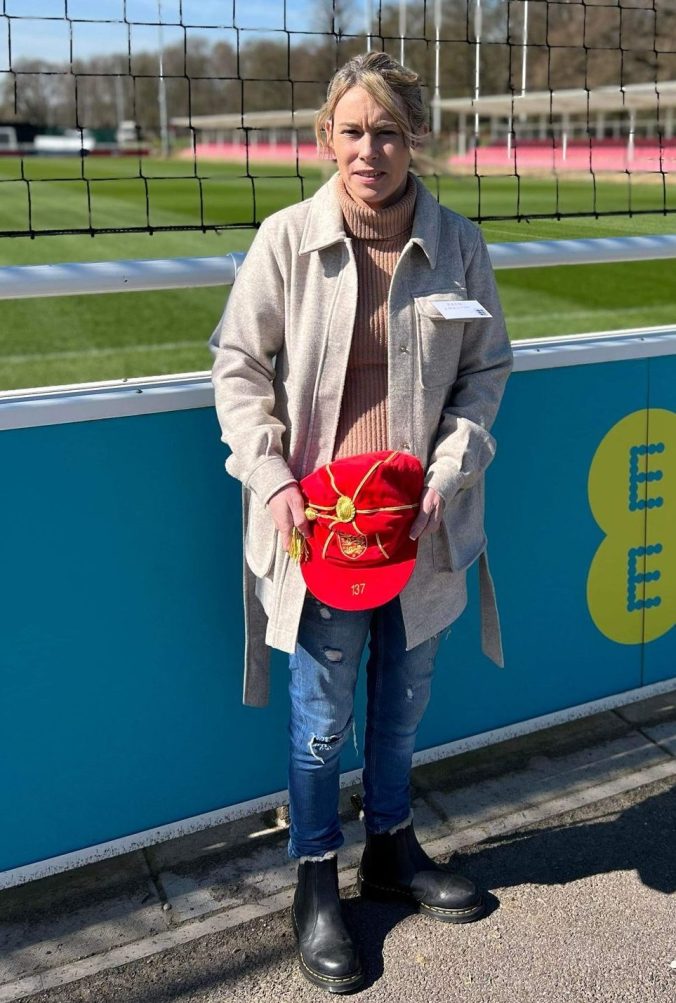
Aran Embletonholding an England cap.
Aran said “I am proud to have been invited to recognise Mary who, like the incredible Bella Reay of Blyth Spartans and other women of their generation, played women’s football until it was criminally banned by the FA in 1921.Players like Christine and I, and the current Lionesses, stand on the shoulders of these brilliant working class women from more than 100 years ago.”
Following the unveiling at Jarrow Cemetery, there will be refreshments and a celebration of Mary’s footballing achievements at the Iona Club, Hebburn. Due to start at noon, speakers at the event will be Wor Bella co-producer Jane Harker, Aran and Christine and Wor Bella actress Catherine Dryden. The event is public and entry is free.
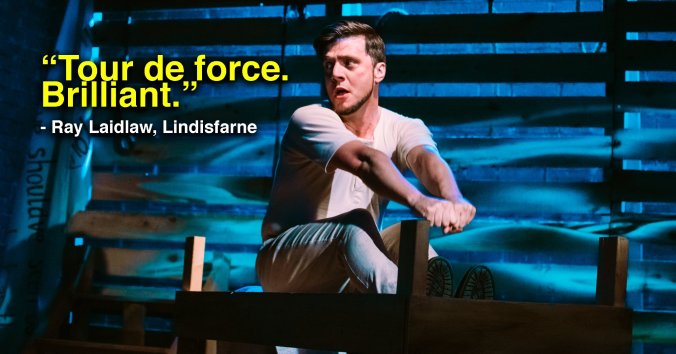
The incredible true story of Harry Clasper is set to tour the North East in February. The one man play ‘Hadaway Harry’ stars Jamie Brown who won a NE Culture Awards Performing Artist of the year.
Harry Clasper was born in 1812 in Dunston, Gateshead, at two year old he moved to Jarrow where he fell in love with the water watching ships coming up the Tyne. Education was limited for Harry, he couldn’t read or write and signed his marriage certificate with a cross. He started work at Jarrow Pit but unfortunately that didn’t work out so his next stop was an apprenticeship at Browns Boatyard.
‘That’s where he got clued up about boats. Harry revolutionized boat racing and boat design, innovations that became part of boat racing then are still employed in boat building today’ explained Jamie.
‘By shaving the boat they made a gun barrel shape instead of a square bottom and pointed the front of the boat. That increased the speed rather than drag through the water, and they made a scooped shape oar’.
‘It was like the time during the 2012 London Olympics when cycling became really popular, they had lightweight helmets, handlebars were shaped to create more speed – huge innovations just like Harry Clasper done for boating in the 1800s’.
‘Rowing was the main sport then, people would sit on the bank of the river and watch the race. Bets would be placed and there would be sponsors – even in those days. There would be stories of men employed to drill holes in the boats of opponents or tempt the oarsmen with alcohol the night before. There was even a case of someone’s food being poisoned. One of the first cases of boat tampering was with the part of the boat called the scull. The term skulduggery comes from that’.
‘The writer Ed Waugh has a desire to shine a light on people or events that have gone under the radar. We’ve done plays about North East musicians and singers Ned Corvan, Joe Wilson and Wor Bella about a ladies football team plus at the end of last year was The Cramlington Train Wreckers’.
‘These extraordinary stories about the working class, are told so they go unforgotten. There is a thirst for these stories, people responded well to them with standing ovations and sold out shows’.
pic. by Local Historian, Steve Ellwood
The Hadaway Harry shows in 2015 and 2017 eventually got Harry Clasper some recognition as a blue plaque was fixed onto the base of the High Level Bridge in Newcastle. There is also a pub called the Harry Clasper in Whickham, Gateshead.
‘He came from a big family – he was one of 14 and had 12 children himself. His ancestors are still around today, they’ve been to the shows and are very proud of his achievements’.
‘But his story wasn’t straight forward, it’s not looking back with rose tinted spectacles as he suffered personal tragedy and professional disappointments, there was plenty of hardship and personal dilemma’.
Later in life Harry became a publican in Newcastle but sadly died in 1870.
‘Over 120,000 people lined the streets for his funeral the procession was only a few miles but took over 12 hours. His coffin was put on a boat and sailed down the Tyne to Whickham where he was buried’.
The North East has stories of talented people achieving great things – we talked about the footballer Paul Gascoigne, coincidentally also born in Dunston where Harry came from.
‘Before Association football the sport of the people was rowing and Harry Clasper has been likened to the David Beckham of the day. I think, as many people do, he should have a statue next to the river Tyne. His achievements were fantastic. Do you know he won the world championship 8 times in 12 years’.
‘It’s been a privilege telling his story, but sadly this will be my last time on stage doing the Hadaway Harry show. I’ve loved doing the show but in the second half of the play it is hard rowing and narrating the story as a one man show plus I’m 40 in February so it can be a bit exhausting’.
‘So, this is me hanging up my oars but the play will go on and maybe a younger actor will take on the role. This is why on the tour schedule after about three nights we have a day or two off where there is time for rest and recovery and then for the next show I’m ready to be able to give 100%’.
For information about tour dates and venues contact the official website >>>
After a career in the Royal Navy which took her around the world, to managing pubs in the UK, plus running an island in the Falklands, now in her mid-60s Karen is back working on Tyneside where she fosters for people with learning disabilities.
I’ve always been in a job were your committed 24/7. When I look back the Falkland islands was a fascinating adventure but that story is for another day, this is about my time in the Royal Navy.
When I left school at 16 I didn’t have a clue what I was going to do but my parents were adamant I was going to get some kind of job and my mother knew someone who worked in an office in South Shields.
But I knew an office environment wouldn’t be any good for me because I struggled academically. I didn’t know it at the time but I was dyslexic.
I was out in Sunderland with a friend and he was talking about joining the army. This triggered a thought in the back of my mind as something maybe I could do.
I went to South Shields careers service, the only leaflet they had was about the Royal Navy. I applied and got an interview at Gunner House opposite the Central Station in Newcastle. I passed that and got offered a training place in Reading – joining on the 2nd October 1978.
It was scary travelling down south on the train but when I got there somebody was waiting and took me to HMS Dauntless where I started my provisional training.
Karen with new recruits (back row on left) at HMS Dauntless, Reading 1978.
HMS Dauntless is your basic training base. We had to prove we were physically fit, learn about teamwork, Navy values, how to respond to orders, the importance of ceremonial duties and drills then finally getting fitted for our uniform.
It was hard, I didn’t get the strictness of it all at first. When they say clean the floor with a toothbrush it really meant that and when they say get there at 10am it really means 9.55am because Navy time is always five minutes before. Once after turning up late, I had to clean every window in the dormitory using newspaper and vinegar. I shaped up after that.
I had lovely long dark hair but after they gave me all the injections my arms were really sore and I couldn’t lift them up to put my hair up in a bun. You always had to tie up your hair when on parade – so in the end I had it cut off.
After five weeks training, we had a passing out parade and I was sent to HMS Pembroke in Rochester as a WREN Catering Steward where I took more training.
HMS Pembroke was the place we went to learn how to be a good officer steward. We were shown different types of dinner service, bar work, how to clean the silverware, uniforms, shine shoes. We also learned first aid and basic fire training. We were often told ‘Leaning time is cleaning time’.
In the month when I joined there was about thirty of us and only two from the North. In the café one day some lads came in and heard I was a Geordie. They asked me to say things like motor boats and paper planes! They were fascinated with the Geordie accent.
While I was there a TV show was being made and we got to meet one of the actors. The local paper back in South Shields printed the photo with me and an actor dressed in German uniform.
For possible bomb threats we always done exercises and always warned beforehand. Late 70s the I.R.A bombing campaign was prolific and this time HMS Pembroke was threatened with a bomb.
We were in our barracks when everything went quiet and the siren went off. We were under threat. This wasn’t an exercise – it was real. We all hid under a table. Fortunately, nothing happened but it’s a scary feeling thinking we could all die here.
Then on 10th January 1979 I went to HMS Neptune the nuclear submarine base in Faslane, Scotland. It was a beautiful affluential area around Gare Loch. It was a good dorm with only four of us in, really good girls.
As a Steward we served meals to officers and guests at official receptions, operated the bar and looked after officers’ accommodation.
One time we went out on the submarine as it submerged in the loch it was doing angles and dangles, that’s basically moving up and down. Everything – even the tea urn had to be secured.
But this was the time of the start of nuclear protests, they were setting up camp outside the gates and chaining themselves to the fence. Before the protests it was pretty much easy going around the base we would go out on our bikes, now we couldn’t go out as much.
There was a chance of a four-month draft stewarding in the barracks in Northern Ireland. I was still 17 so the Navy had to ask my parent’s permission if I could go. ‘No chance’ they said. So that was that.
I was livid, more livid with the Navy that they had to ask. I was responsible enough to be part of their war team but had to ask me mam to go! Would love to have gone there.
The Falklands war was on when I was based at HMS Vernon in Portsmouth in 1982. I remember when the first ship was hit on 4th May. We were in a disco and everybody was dancing when the music suddenly stopped and an announcement was made about HMS Sheffield.
I knew one of the chef’s whose ship was one of the first hit and sunk. He told me afterwards they were getting in the lifeboat and someone shouted ‘that’s typical, it was a really good scran tonight’. The Navy use dark humour to get out of any situation.
The fact of not knowing who was alive or dead brought on a lot of mental health problems after that war. It must have been terrifying what they went through.
Morale during the war was to carry on as normal as you would expect. I’m sure there was a conscious effort from all ranks to keep morale up. The war lasted 74 days and when the fleet returned in 1982 huge crowds gathered on the quayside to welcome them back.
On ships they have what they call Sods Operas which is a show they put on with games, songs, jokes. Each mess has their own night like karaoke, darts or talent night. We all need to laugh to keep morale up and for letting off steam – but sometimes a laugh wasn’t enough.
The submarines would go away for three months underwater and the crew would need a release when they returned to shore. They’d choose a bar to go in all night to let off steam, get drunk and fights would break out. Some nights would get out of hand, but if you’d been cooped up after not seeing anyone else and not even being able to go for a walk to clear your head, how would you cope?
A fantastic opportunity come out of HMS Vernon. It was a four-month draft to Australia. A tri-service of Army, Navy and Air Force basically doing a swap with their forces.
It took around a week to get there – there were no commercial flights for us. First, we went out on a Hercules to Germany then stopped in Singapore for a few days. The Australians flew us into their country then down to Sydney. I went on to our accommodation near Canberra which was in the middle of nowhere.
The Australian Navy were lovely but this was a culture shock, kangaroos jumping all over when you’re going to work, a beautiful beach but couldn’t swim in it cos there’s sharks, there was no local buses, nothing to do really.
I wasn’t benefiting from being in Canberra so was fortunate with the help of an English officer to arrange a draft to Sydney. This was completely different. Accommodation was like American motels and based next to Bondi beach.
It was a lively place – I remember The Flying Pieman restaurant, the Aussies love their food – the barbies, fantastic meals. We had a week’s holiday and travelled up to the Gold Coast – I loved it there.
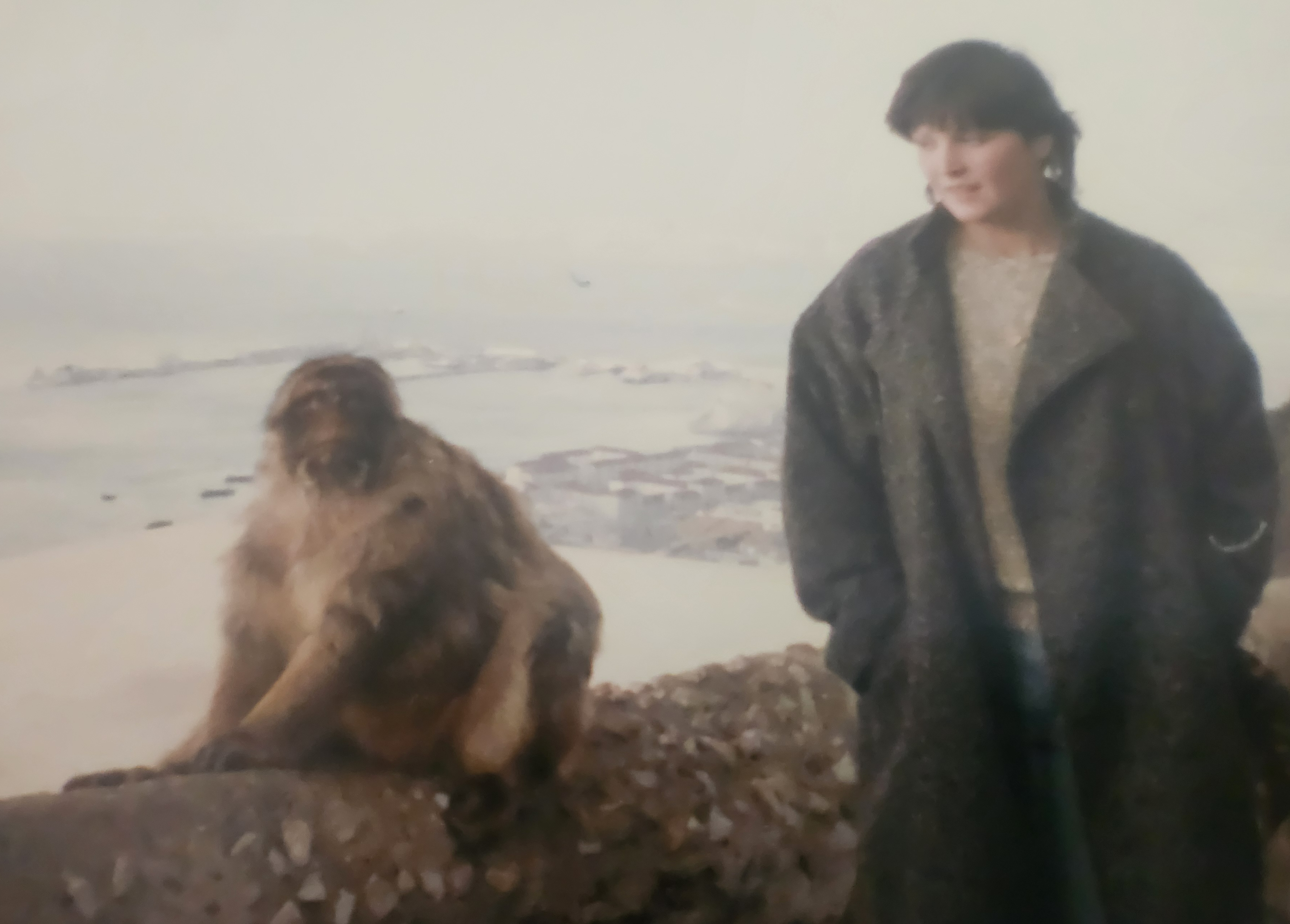
Gibraltar rock in 1985.
By 1985 I was based in Gibraltar at HMS Rooke as an Acting Leading Wren. We were contained on the rock because the border wasn’t open then. Gibraltar didn’t have much, there were dusty old streets and you couldn’t get things like fresh milk.
There was nowhere to go really. Instead of going stir crazy the Navy used to take us over to Morrocco. We’d get away for a weekend to Tangiers.
When I was there the border with Spain officially opened and we walked through to get our passports stamped, then we could go to have milky coffee or a few drinks in La Linea. With the border fully open now we went up the coast to enjoy seaside towns like Fuengirola, Marbella and Torremolinos.
Back to the UK and Portsmouth, or Pompey as it was known to the Royal Navy, the city had lively pubs and clubs used by the Navy, it was a good run ashore. Yes, we liked a drink, who doesn’t? But as I’ve said socialising was our way of letting off steam and relaxing after a hard day’s work.
At HMS Nelson we had summer and winter balls in massive marquees to organise. Big entertainers were booked, TV people and celebrities were invited. One year we had Kenny Ball and his Jazzmen playing, another Oliver Reed turned up but was kicked out for being drunk and offending people.
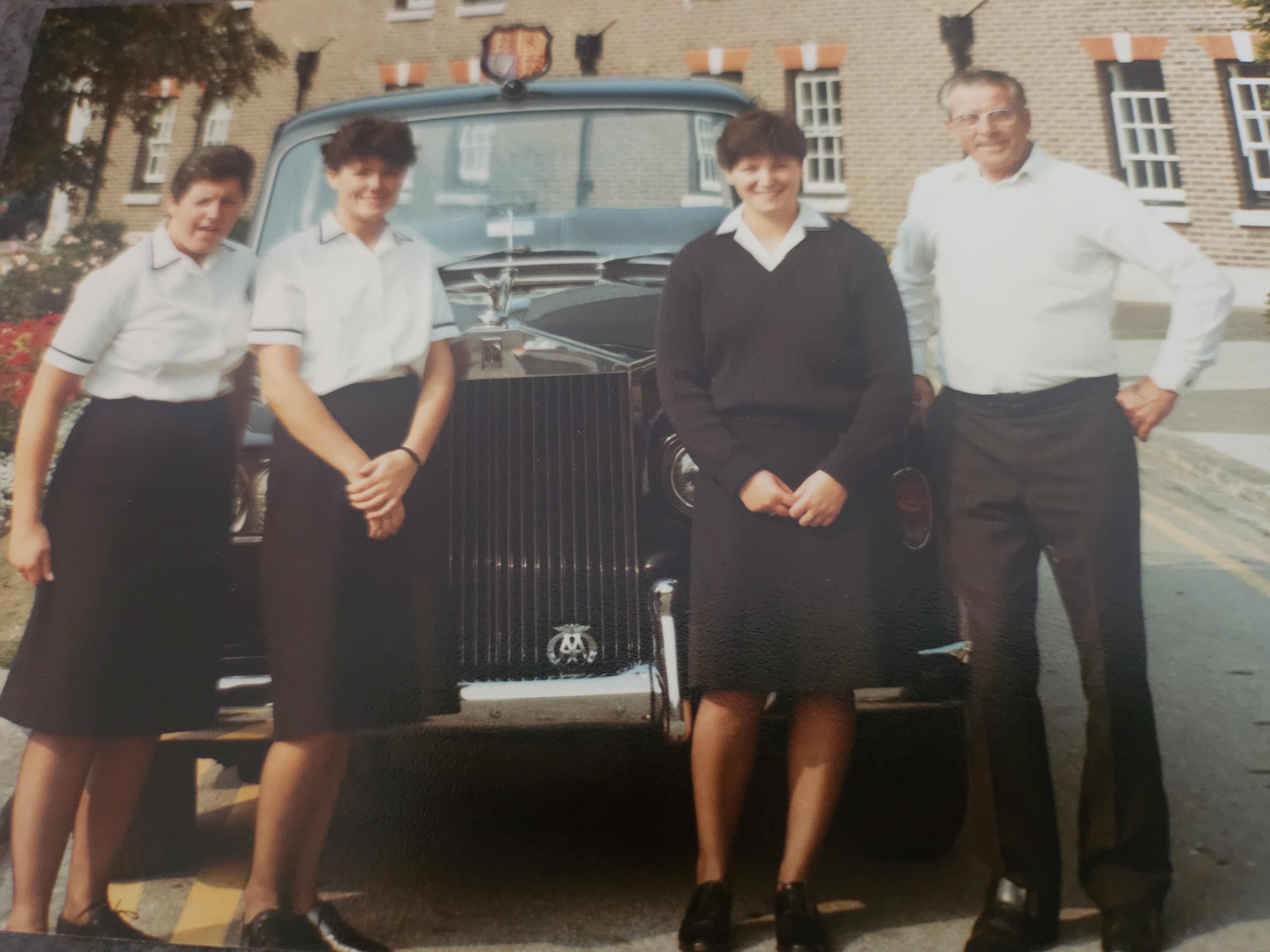
We had a really special visit one year from the Queen for a commemorative event. There were hundreds attending and sniffer dogs were brought in for security. A massive truck turned up a few days beforehand with the Royal’s own cutlery and plates.
To lay the table we had to get out a tape measure and length of string to make sure everything is straight and measured up. I’m sure she never says ‘that fork needs to be an inch over’. As I served her lunch she would say ‘Thank you for bringing that’. She was lovely, like a little nana, really nice.
From there I went to HMS Warrior in London working for the Flag officer of Submarines who worked out of a property in Rickmansworth. He had a team to look after him – chef, driver, chief steward, then me.
I wasn’t there long as I moved back to Portsmouth and HMS Dryard where I worked for the Captain. I loved my last years in Portsmouth but that’s where I finally left the Royal Navy for good on 5th March 1990.
What do I think of my time in the Navy? For someone from little South Shields not knowing much about the world and who had only been on a caravan holiday in Wales, to go to all these places, meet different people, experience different cultures and make life-long friends was fantastic.
The Navy teaches you to be self-sufficient, disciplined and learn valuable life skills like teamwork. It might be a good idea to bring back some sort of National service today, it’ll only be a good thing.
After a career lecturing in Psychology for over 30 years, Eileen is now retired from Sunderland College. Throughout the years she has researched her ancestry and in turn became absorbed with local history.
My ancestors were Sunderland keel men in the 1600s, there were a few miners among them but mainly trades associated with the River Wear. My grandmother played the organ at her local church and her sisters sang in a local concert party. When she retired my mother went to evening classes and taught herself piano, she also wrote pantomimes and songs for the local community centre. When she was in her ‘80s she organised singing groups at her local ‘natter’ club.
About 15 years ago I started collecting Wearside folk songs from the 1800s. For me words are the most important thing. I don’t like the music overpowering what the song is about because the most important thing is what the song is telling you. I prefer unaccompanied singing and the harmonies.
I used to sing at events with the Tyneside Maritime Chorus which was run by folk singer/songwriter Benny Graham. We mainly sang songs from Tyneside like Keep Yer Feet Still Geordie Hinny and TheBlaydon Races which are widely known. This set me off wondering whether there were any equivalent songs from Wearside apart from The Lambton Worm – although that was originally written for a Tyneside pantomime.
Sunderland Antiquarian Society which has been going since 1899, has a lovely archive mostly donations from local people. I research there and the local studies library in Sunderland.
The first song I found was The Old Wife’s Lament to the Keel Men of the Wear and it was all around historical events about the keel men and it was written in dialect. That set me on the road to researching the history that went with the song and there’s a bit where it talks about them fighting the French. But did the French ever invade the North East coast?
I found an article about the Battle of Hendon in 1799 where local volunteers staged a mock invasion because they thought a French invasion was imminent. The song has historical references but some humour also.
There a lot of songs about death and tragedy, mining disasters and shipwrecks but there are songs that tell light hearted stories. The Durham Militia pokes fun at things, it’s like the 1800s version of Dad’s Army, with lyrics like ‘You’ll march away like heroes – just to make the lasses stare’ and suggesting that the only battles they will fight will be in the pub.
During covid I gave a presentation online to the Traditional Song Forum about my research and was asked to write a paper which was published in a book of folk song research in 2022 entitled Thirsty Work and Other Legacies of Folk Song.
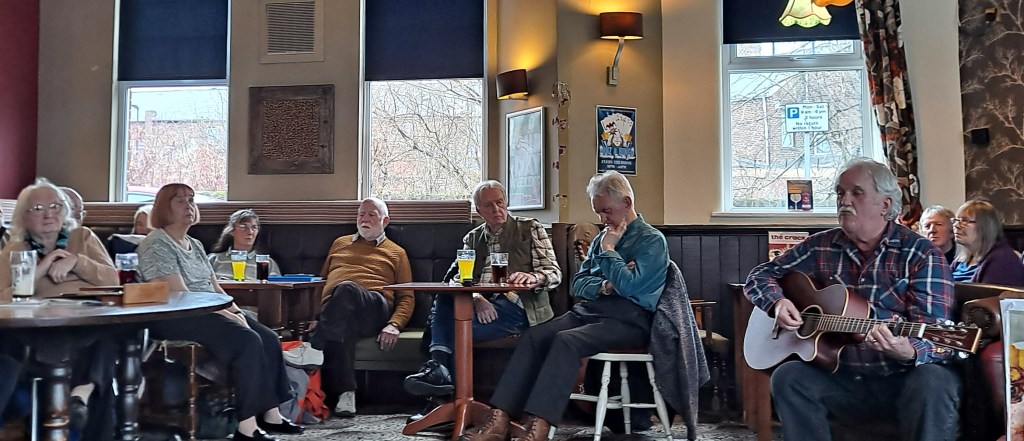
Ed Pickford, Ingrid & Barrie Temple, Tony Wilson performing at the Stumble Inn Folk & Acoustic Afternoon, Sunderland, February 2024.
The folk world is a small world, you get to see the same faces at the clubs and you get to know people from all over the North East. I first went to folk clubs in the late 60s and early 70s when virtually every pub had a folk club. I also used to go to The Bay in Seaburn to see bands like The Who, Free, Jethro Tull, there were loads coming to Sunderland then.
In about 2000 my husband and I began to go regularly to folk clubs in the area such as South Shields, Birtley, Tynefolk in Ryton and The Welly Folk Club in Wolviston.
When you say you live in the North East to other folk people they are jealous because of the amount of clubs and events up here. If you are prepared to travel half an hour you can go to a folk club most nights of the week.
There are venues like The Central Bar in Gateshead, South Shields Jack Clark Park, Croxdale in Durham, the Collingwood Arms and The Bridge in Newcastle which has been going 60 years. Saltburn, Whitby and Hartlepool also have annual folk festivals.
Keith Gregson performing at the Stumble Inn Folk & Acoustic Afternoon, March 2024
I also arrange a monthly folk afternoon at The Stumble Inn on Chester Road, Sunderland. We get around 30 – 50 people coming to our sing around and we are keeping the tradition going because in the 60s the pub was formerly The Royalty and had a very popular folk and blues club called The Glebe.
The pub is near Sunderland University metro so we have people coming in from Newcastle, Cullercoats and South Shields. Some come from further afield like Chester le Street and Teesside. Being on from 1-4pm people are happy to travel on public transport at that time – on the night they are not so keen.
Our folk gatherings at The Stumble Inn are on the 4th Tuesday of the month. All are welcome to sing a song, play a tune or just listen to the songs its very informal and free. We are based downstairs so the room is easier to access with your pints of beer and musical instruments.
We have singers from all over the region like Barrie and Ingrid Temple, Ed Pickford, Tony Wilson, Anne Lamb, Keith Gregson, Brian Hunt, Ken Hamer and others who all perform in a range of styles.
It’s an old genre but people still write songs now in the folk tradition about current events keeping the music alive. Music and song are so fundamental to our lives.
Now 85, Arthur talks about joining the police force as a cadet in 1955…
‘Yes, I was a polis in Newcastle, the city was a lot different then I’ll tell ya, it was still getting over the war to be fair. My first beat was Sandyford Road where the Civic Centre is now. That was all houses then’.
‘It was quite a tough beat, a rough area with pubs like The Lamberts Leap and another called The Sink near the Haymarket. You had to earn your corn, there were no radios or panda cars – you were just pushed out onto the beat and that was it, you had to get on with it’.
‘There was a police pillar (similar to a post box but with a telephone inside) on the corner of Sandyford Road. If you arrested anyone you hoped you could get the person to the pillar. It was difficult cos sometimes you had a couple of guys fighting…you had to get them there, it wasn’t easy’.
‘There was generally more respect for the police then, you would get more help from the public once you established yourself on the beat, which you had to do cos you were tested out straight away’.
‘Once they knew you were fair and straight you got a lot of help from them. You were on that same beat for years, you weren’t just passing through you got to know every shop keeper, every doctor, every villain…you got to know the whole community. But then the T. Dan Smith regeneration project of slum housing clearance began and the place changed completely’.
‘I always liked paper work, always took pride in my reports. A crime file for shoplifting or murder has a beginning, middle and end and you had to go to court and defend what you had written. In the end someone could go to prison so you’re under pressure, under scrutiny. That reality far exceeds any drama’.
‘I moved from department to department, CID, drug, vice, crime squad, then around 1978 I worked for the anti- corruption team in the Government based in Hong Kong. For the year I was there I would see people living in cages on roofs, people swapping babies in hospitals, it was a weird place. I wrote an article for the Police Review national magazine on what I saw, they paid me £25 for it. It was read all over the country’.
‘I didn’t start writing until I was 40 you know. When I came back to the UK, I worked in Washington Police Station, a young cop called Jeff Rudd came to see me ‘I used to be a musician in a band, I’ve still got all these tunes going round my head but can’t put words to them. I read your article and seen your reports, I wonder if you’d be interested in putting some words to my tunes?’
Well, I give it a go and then thought nothing of it until a few months later I was pleasantly surprised when he handed me a tape with the songs on. I really enjoyed my time with Jeff, he was a very accomplished guitarist. We ended up writing around 50 songs, one of them ‘Big Bren’ was about the athlete Brendan Forster, that was played on radio’.
‘That led us to doing an interview and playing some of our music on the Frank Wappat BBC Newcastle radio show, then we done a couple of gigs in Washington. Next thing my wife Irene said why not contact Tom Hadaway? (writer When the Boat Comes In, Newcastle Live Theatre).’
‘I wasn’t sure at first because I didn’t know him but as he was from North Shields we met and he told me to write a play. ‘What do I write about Tom?’ I asked ‘Write about what you know. What fires you up.’
‘So, I went away and wrote about the bait room. Tom read the play and was laughing at it ‘Yeah, you know how to write dialogue son’.
‘There was a police section house near Exhibition Park, in it was a bait room, just a pokey little room with a table to play cards on. If you’re on night shift you’d take sandwiches and a flask of tea in. That’s where you gathered around 1am where the events of the night would unfold’.
‘You would get advice on how to deal with someone, it was a good place to sort things out like the older cops would tell you how to deal with a death, how to deliver a death message to the unfortunate family. It was a sort of meeting of minds over a game of cards. Aye the bait room was a good place to vent your spleen so to speak.’
Running parallel with his police work Arthur was training in athletics at the running track at Ouseburn, Newcastle.
‘I was on shift in the Bigg Market from 5pm till 1am, that was rough, there was fighting most nights. After finishing I would grab a few hours sleep then go to court, then onto shot put training. I was in the British athletics team from 1962-71 and competed in the 1970 Commonwealth games in Edinburgh. I was very fortunate and saw the world with athletics’.
Arthur talked some more when the conversation turned to the present day and the riots that are happening this summer around England.He recalled a quieter time for the police.
‘I remember we had a huge kettle for the bait room. It was always on the stove. One day a big fish wagon went past the section house and dropped a fish out of one of the boxes. I picked it up brought it back into the station put it in the kettle and boiled it up. All day everybody was complaining about the smell from this mackerel…and no, we didn’t eat it!’
‘Another story was one night when I was up beside the Hancock Museum going to the section house at Park Terrace. Can you remember the litter bins that used to hang on a lamppost? Well, this one was upside down on the lawn outside the Hancock and it was moving around. I lifted it up and there was a hedgehog underneath it!’
‘So, I put it in my coat and took it up to the section station. Inside are lockers to put your bait in so I put the hedgehog inside one of them and waited for the copper to open it. He just about had a heart attack when he opened the locker!’
Hearing these innocent stories was a world away from watching how the police were dealing with the riots around the country, but then Arthur’s tone changed.
‘I remember it was winter time, snow piled up on the ground. I went in for my bait around 12.45am and heard a muffling sound, I opened the door and there was an older police officer trying to commit suicide with a plastic bag on his head. There was a scuffle as I grabbed hold of him but couldn’t get the bag off. I looked around found a fork and split the bag but caught his face at the same time’.
‘He was playing hell with me for saving his life ‘What right did I have’ and all the rest of it. As we were having this argument I could hear the other officers coming in for their bait so everything was put back right, we straightened up the chairs and table as if nothing had happened’.
‘That policeman only had a couple of year service left, he was very bitter, he didn’t thank me. Turned out he had a hell of a life with his wife and thing was he had seen action in the second world war’.
After writing about his experiences in The Bait Room, Arthur kept in touch with Tom Hadaway and wrote another play.
Tom looked at it and gave me pointers, when I finished it landed on two desks. One was the BBC in Manchester where I met them, it ended up on the Saturday Night Theatre radio show, which was a big thing’.
‘The other was the script reader for David Puttnam (producer Chariots of Fire, Local Hero, Midnight Express) who hated it at first but won her round in the end. She said she couldn’t do anything with it but put me in touch with an agent who was looking for writers for a tv show called The Bill. That’s where the writing started’.
Arthur being interviewed on BBC Breakfast about writing ‘Harrigan’.
In 1988 Arthur retired from the police force giving him more time to devote to his writing where over the next decade he delivered TV episodes for Wycliffe, The Bill, Casualty, Spender and Harrigan. The Bait Room was finally made in 2009.
‘I used the same discipline for writing as I did sport. Getting a focus, deciding what you want and going for it.’
‘What am I doing now? I’ve had a lot of my writing shown around the North East. ‘Pickets & Pigs’ was a story set to the background of the 1984 Miners strike’.
‘Later this year I’ve got a play on stage which I started writing in 2003 with Dave Whitaker. ‘Blackbird in the Snow’ is one of those that you leave on a shelf for a while then go back to’.
‘I worked with Dave on a musical about the Jarrow March called ‘Cuddy’s Miles’. John Miles wrote the music for it, Cuddy was a cook on the march, he was John’s relation. That was well received when it played The Customs House in 2004’.
‘Sadly, Dave passed away in 2021. He’ll be sorely missed so the new play is produced as a salute to Dave’s beautiful lasting memory’.
‘Blackbird in the Snow’ has a four night run with the premier on 5th November 2024 at Laurels, Whitley Bay. For more info and extra dates contact the official website >
Hard working Bill spent 34 years as a railway driver and 20 years on Newcastle City Council. Being a keen cyclist, he is one of the few people to have completed an around the world bike ride.
“The highlight had to be the scenery in the Rocky Mountains, USA, the geysers, hot pools and volcanic activity in Yellowstone Park. I followed the Rockies for over 1,000 miles through Colorado, Wyoming, Montana, Idaho and Oregon with much of this being wilderness area”.
When the pandemic hit in 2020 Bill took solace in the music he loved. He attended songwriting workshops with artists he had been a fan of such as Beth Nielsen Chapman, Mary Gauthier, Gretchen Peters and Dan Whitehouse. When folk clubs opened back up after lockdown Bill stepped out to perform.
“I really enjoy playing local folk clubs where audiences are always attentive and often sing along. My favourite folk club is The Bridge Hotel in Newcastle which is the longest running folk club in England on the same premises. They’re a great crowd”.
Encouraged by this warm welcome, he spent 2023 honing his work with producer Dan Whitehouse and then recorded his debut album. ‘Closer’ is a delicate collection of heartwarming folk songs that tell political and historical stories as well as tales of love and loss.
“We recorded all the foundation tracks of vocals and guitars live in my living room in Gosforth”.
As well as producing Bill’s debut album, Dan also played lead guitar and added backing vocals plus several of Bill’s friends and family contributed to this intimate collection of songs.
French speaking Christine Durand reads poetry, Kathy Wesolowsk lends operatic vocals, Bill’s grand-daughter Chloe Weston is the lead voice on a song written by Bill on a songwriting retreat lead by Gretchen Peters and Mary Gauthier.
The recordings were shared with Gustaf Lljunggren (John Grant/Eddi Reader) who added Pedal Steel, Accordion and Rhodes Electric Piano from his Copenhagen studio.
“Dan Whitehouse had worked with Gustaf before. He introduced me to Gustaf’s music and once I heard him, I knew that he was the musician I wanted to have playing on a number of my songs”.
“Gustaf is experienced in working remotely – adding delicate overdubs, without overcrowding the musical landscape of my record”.
Cover art by Ruth Bond.
Next stop on the album’s journey was London…
“I’d a longing to add strings to ‘Fools and Princes’ – with it being based on Romeo and Juliet, I had a vision of a romantic string arrangement being effective, Dan suggested Alison D’Souza (The Little Unsaid) in London as he’d worked with her previously and what she played really brought my dream into reality”.
“Harriet Harkcom’s voice I knew from Dan’s own releases as she has sung on most of his albums, I was pleased when she accepted my invitation to sing on ‘Goodnight Vin’. I’d like to think if Vin was around he would love her voice on this song too”.
With recording completed, final mixing and mastering of the album was by John Elliott.
“My hopes for the album are that it will allow me to reach a wider audience, commercial success has never been my main aim. Like any other singer-songwriter I just love sharing my songs with people”.
For the near future Bill has no plans to tour the album…
“I sing in local folk clubs twice a week and I’m happy being involved in this local musical community. I prefer small intimate venues packed with friends and other singers”.
The album is available to order now on CD and digital via bandcamp >
North East prog popsters Amateur Ornithologist release new album Hide on 19th January 2024, with the single Time To Talk out on Friday 12th Jan.
Amateur Ornithologist are a weird pop group. Starting as Daniel Clifford’s solo project, AO has grown to perform as anything from a five-piece to an octet. Due to their adventurous approach to densely-layered, harmony-filled pop the band have earned comparisons to Talking Heads, The Beach Boys and local heroes Field Music
Fusing pop, orchestral, jazz and rock influences to create a grand melodic sound, the band have found a home for their unique musical expressions.
The band have featured on the cover of NARC Magazine, sold-out live shows, BBC Introducing, Amazing Radio, Radio Wigwam and a host of radio stations.
Hide reveals ten adventurous songs they’ve crafted creating an album that’s “widescreen” and “richly melodic” (NARC Magazine) with “lush and varied instrumentation” (Dirge).
First single, If It Looks Like Magic, is a slice of gothic post-punk about the Cottingley Fairies and received airplay from BBC Introducing and Amazing Radio. Follow-up The Word is Love deals with deceivingly simple matters of the heart to an acoustic Latin backdrop. Third single Time To Talk (12th Jan) charts the difficulties of modern communication, reflected in sharp key and time changes, jerky rhythms and squealing sax.
Hide also features collaborations with musicians from across the North East scene. A Hidden Path, Hide and When They Fall feature cello by Marianne Kell (Belle Skies) and violins by Patrick Lawrence (Detroit Tourist Board). Drums were recorded by youngster Harrison Mitchell (The Strands), with rhythm guitar, percussion and backing vocals by regular collaborator Georgia Foster Adams.
AO’s successful crowdfunding campaign saw the band offer handmade crochet birds and avian Lino-prints in return for the money needed to make and release Hide.
In his South Shields studio, Harbourmaster co-produced the album with lead songwriter Daniel Clifford during summer 2023. Gravel footsteps, handclaps and percussion were recorded for a number of tracks by Crowdfunder supporters, who were treated to cups of tea and biscuits with the band as they worked.
Amateur Ornithologist release Hide on 19th January across all major digital platforms, and on limited edition cassette and CD from the AO Bandcamp. They play a sold out show at The Globe, Newcastle, on the same day with Marc Bird and This Little Bird.
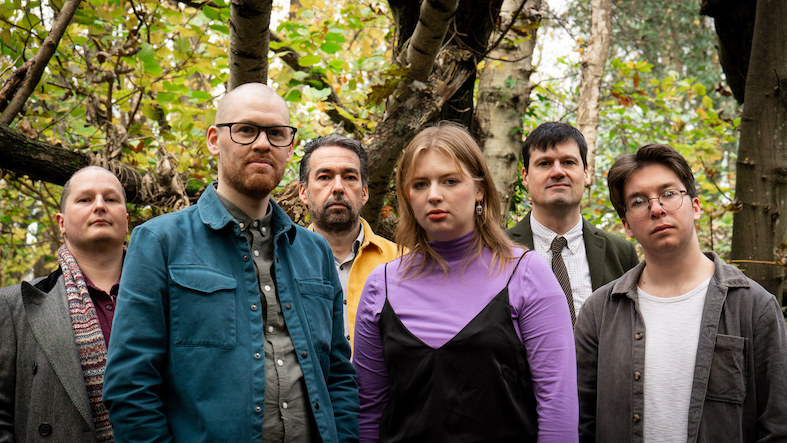
AO line up > Daniel Clifford – vocals, Liam Slack – keys & vocals, Maddie Smyth – viola & vocals, Chris Perriman – bass, Louis Young – guitar, Rob Bailey – saxophones, Theo Nolan – drums, Giovanni Onofri – guitar.
Link to interview in May 2021 with songwriter Daniel Clifford talking about the release of the debut album by Amateur Ornithologist >
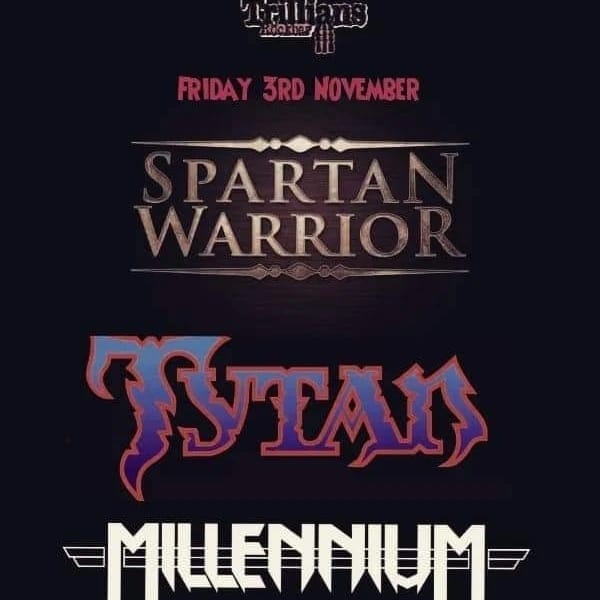
On Friday 13 October Newcastle Trillians Rock Bar host a deadly night of NWOBHM with Witchfynde and openers Millennium.
Also at Trillians on Friday 3 November a triple bill with Millennium, Spartan Warrior and bringing the flame in middle order are Tytan. This is gearing up to be one of those loud, hot metal nights that leave blood on the walls.
With fire still in his belly Chief Tytan Kev Riddles explains… “Have to say this is a gig we are really looking forward to as we always get a great reception at Trills, and as guests of Spartan Warrior it should make it a belter gig plus sharing the stage with Millennium should be a hell of a night”.
Later that month Tytan are paired on a double bill with fellow NWOBHM band Praying Mantis at the Black Box in Hastings on Wednesday 22 November.
But next up for Tytan is Poland this month (6th ) opening for Metal Church on their Annihilation world tour, a week later they are back in the UK at Leo’s Red Lion, Gravesend on Friday 13 October.
Kev Riddles’ Baphomet open the show followed by Tailgunner, then Tytan put the hammer down until the last shots ring out from closing headliners Trespass.
“2023 is shaping up to be our busiest ever year so far with over 25 festivals and gigs” added Kev.
”We start work on the third Tytan album soon. We’re in the studio in the coming weeks to knock the ideas into shape and hope to record before Christmas. A release in spring 2024 – that’s the plan. And we are booking for 2024 as well”
Already coming down the pipe is a triple bill of powerhouse metal monsters Tytan, Troyen and Trojan will be running amuck at Bradford’s Nightrain on Saturday 2 March 2024.
Gordon was born in Newcastle in 1940 ‘But I spent 22 years in Blyth before moving to Seaton Delaval’.
He was a big sci fi fan in his teenage years ‘I devoured any sci fi books or short stories. Time travel always fascinated me and astronomy was my fanatical hobby’.
‘My favourite novels of all time are ‘One Flew Over the Cuckoos Nest’ by Ken Kesey, ‘Catch 22’ by Joseph Heller which I’ve read about seven times, and met him a few months before he died’.
What drew you towards writing?
‘I always had an ambition to write but kept dismissing it as an unachievable pipe dream. I remember ‘Lassie’ films in the 1950’s and was envious of the people who wrote the scripts and could influence the feeling of the audience. I can never remember wanting to be an actor, just to write the words’.
‘Later I struggled with writers like F Scott Fitzgerald and Salinger but admired their ability with words and characters and plot’.
‘I enjoyed the short stories of Ambrose Bierce especially ‘An Occurrence at Owl Creek Bridge’. It has an amazing twist at the end, something I love’.
What do you consider your best work?
‘I think my first novel ‘The Darkness of the Morning’ gave me the greatest satisfaction and became a best seller. I now live a couple of miles from the site of the Hartley pit disaster that occurred in 1862 when 204 men and boys perished. The oldest was 70, the youngest 7’.
‘An old saying came to mind ‘It’s an ill wind that blows nobody any good’. I wanted to bring to life a host of fictional characters so the readers might be familiar with their lives, and their deaths would be all the more poignant. Also a smattering of good that came out of all the sorrow’.
What are you working on now?
‘My choice of subject is pretty eclectic. It depends on what suddenly fizzes in my mind. My latest novel, just published in softback and Kindle is called ‘The Priest and the Whistleblower’ and involves a Newcastle based detective sergeant, Jack Shaftoe – far removed from Vera!’
‘Having just finished my latest I’m back to searching for a subject and a plot. There’s a hint in me to write another historical novel, again based locally involving an armaments magnate and stretching from Victoria’s jubilee to about 1920 and takes in WW1’.
The Crack is a free culture magazine and website providing a valuable service to the North East. Reviews of books, film, stage and music are packed into each monthly edition.
To find out more about the people behind the magazine I got in touch with one of the writers, Rob Meddes.
‘Reading takes up a lot of my spare time now. I review between two and three new novels each month for The Crack. I also love old films, particularly black and white film noirs made between the 1940s and mid-1950s – The Maltese Falcon, The Postman Always Rings Twice, Double Indemnity’.
‘I never set out to be a writer, but stumbled into it through luck more than anything else. I was born in Newcastle and lived here all my life. I’m now 57. I didn’t go to university but on leaving school I did a Youth Training Scheme on computer programming’.
‘I got a job as a programmer but the company I worked for went bust – hopefully not because of my efforts. Then got a job as a civil servant, working at the big site at Longbenton for around four years. I became frustrated at having to do the same thing every day so thought I’d leave and go back to college. The aim? To become an artist’.
‘I did ‘A’ level art and then the Art Foundation course. I was accepted on the Fine Art course at Northumbria University but figured I didn’t want to do another three or more years of that because I really needed a job’.
‘I wrote to loads of different companies to ask if they would take me on, maybe in an admin capacity. The one company that got back to me was The Crack. I did a bit of everything at first – including selling adverts – before moving more onto the writing side of things. That was in 1994 and I’ve been here ever since’.
What changes have you seen since you started at The Crack?
‘What has actually changed most for me is how the magazine is put together. When I started there was no internet, certainly not in our office. Every image in the magazine had to be physically scanned in. Now they’re all digital’.
Have you seem many cultural changes in Newcastle since joining the team?
It’s Gateshead not Newcastle that has seen some of the most compelling big ticket items – Baltic, Sage Gateshead, Angel of the North, The Millennium Bridge. But Tyneside as a whole seems to have become more of a destination for people outside the area who want to sample cultural life in the region’.
What can you see for the cultural future of Tyneside?
‘After 13 years of Tory backed austerity, particularly for the arts, many of our cultural icons are struggling. We’ve already seen The Side Gallery close and The Tyneside Cinema has started to crowdfund. And they’re just the tip of the iceberg’.
‘But often in straightened times, art – in its myriad forms – manages to find a way to bubble to the fore. What hasn’t changed is people’s capacity to get out of the house and go and see stuff, whatever that stuff might be’.












 ALIKIVI UK : NORTH EAST MUSIC & CULTURE