The starting gun fires on Friday 4th August on old school NWOBHM at Trillians. They won’t be nights full of half arsed tunes. Expect red hot, heavy, driving sounds topped with power vocals – just the way you like it.
First up is Kev Riddles’ Baphomet, Kev was an original member of NWOBHM band Angel Witch who released their first album in 1980.
The record, along with the track Baphomet, always feature on any ‘Best of NWOBHM’ lists. On their last visit to Newcastle, Kev Riddles’ Baphomet played original Angel Witch classics to a packed house. Expect the same on a loud start to your weekend.
Another night of old school metal is a triple bill on Friday 1st September with Avenger, Abaddon and Spartan Warrior.
Spartan vocalist David Wilkinson explained“2023 has been a milestone year for Spartan Warrior as we celebrate 40 years since the release of our debut album, ‘Steel n Chains’, on the Guardian label”.
“We’ve played some well received anniversary shows where we’ve played our debut album live in its entirety”.
“As we have two shows at the same venue quite close together we want to give people something different each time. The 1st September set will be exclusively from the ‘Steel n Chains’ album and the second album only. November’s set will draw material from all four albums”.
That November date is set for Friday 3rd, a pre-Bonfire night with Kev Riddle’s other band Tytan. What to expect from Tytan? Chunks of melodic, epic rock with screaming riffs and Tony Coldham’s soaring voice. At the time of posting the band are on the road back from Germany after playing the Headbangers Open Air Festival.
Joining the bill are Millennium, frontman Mark Duffy explained“The first time Millennium played in Newcastle was when we were asked to do a reunion show for the Brofest festival in 2016 and we’ve played Newcastle a number of times since”.
“We know Spartan Warrior as they were on the Guardian records compilation ‘Pure Overkill’ along with Millennium. Although we didn’t get to meet them till around five years ago, we’ve since played gigs on the same events. Wehaven’t played any gigs with Tytan before so we’re looking forward to that”.
Spartan Warrior’s Wilkinson added“We’re very excited to be co headlining the November show with our dear friends Tytan. We’ve shared stages before and it’s going to be a great night for sure. We also have a long history with Millennium who were our Guardian label mates, so in our 40th Anniversary year that’s a bit special too”.
Millennium’s Duffy added “I think the NWOBHM scene has lasted so long because it has produced so many good bands who recorded some great records. There’s also a younger generation who are now listening and discovering these bands for the first time and appreciating their music”.
“We’re looking to do some gigs with other NWOBHM bands and hoping to play festivals in Europe having played in Athens this year. But it’s always good to play home shows at Trillians – really looking forward to it”.
If that isn’t enough for ya’ on Thursday 23rd November at Trillians is a hometown visit from the Tygers of Pan Tang. After trekking around mainland Europe during summer they have arranged extra dates to support new album Bloodlines.
Peter is employed by Gateshead Council teaching one to one lessons withpupils who don’t go to school.
He also goes into primary schools to teach aspects of local and regional history.
It’s a great feeling when a kid you have helped returns to school. One of the mothers got in touch saying two years after I stopped teaching her daughter to say that she had gone on to do A levels at Gateshead College.
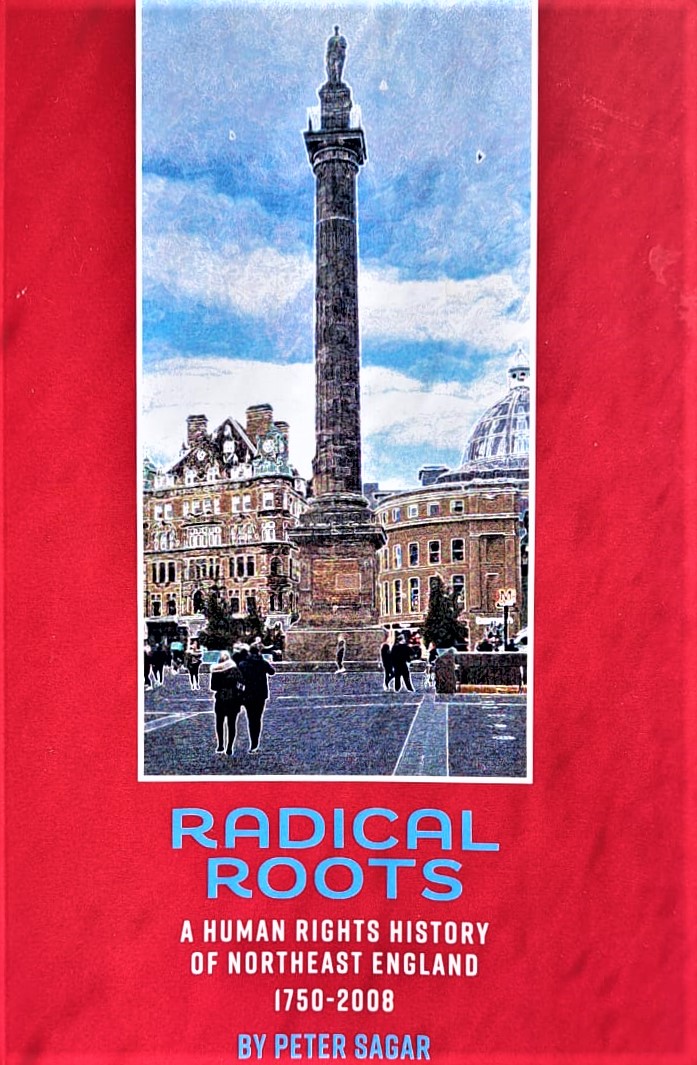
From his North East history research, Peter has collected many stories and compiled them together for a new book – Radical Roots – the Human RightsHistory in the North East.
There are many interesting, positive stories of how people struggled for their own rights and fought for the rights of others too.
On the front cover is a picture of the Earl Grey monument in Newcastle city centre….
The writing on it is not about tea! It signifies people getting more rights to vote and the abolition of slavery because North East people have always campaigned for their own rights and worked for people across the world to get their human rights.
The fight against slavery was strong, for example in 1792 down at Newcastle Guildhall there was a petition of 3,000 signatures against slavery, which was quite a large percentage of the people living in Newcastle at the time.
We can protest about what is happening thousands of miles away or about our neighbours having to use a food bank. I don’t see a division there, it’s about human dignity and decency, where ever the person lives and whoever they are.
We can’t just fight for the rights of one group and not the other, it’s about everybody having the same rights.
My mum brought me up right, she taught me about Human Rights and in Newcastle there is an Amnesty book shop that I helped set up on Westgate Road in 2002.
We talk about women’s rights but how many Northumberland kids are taken to see the suffragette Emily Davison’s grave in Morpeth? I think it should be mandatory to learn about our history.
Kids are taught art and music from around the world which is great don’t get me wrong, but if they don’t know culture and history from their own area first, how can they relate art and music from around the world to everyday life?
In Radical Roots there are stories I think we should all know, and I’m still learning about our North East history.
We teach pupils about the Holocaust, Anne Frank and what she wrote in her diaries. But we don’t teach about the connection to the Durham Light Infantry and their role in the Relief of the Belsen camp.
I went to Hartlepool and interviewed the son of a DLI soldier whose father was there at the time of the relief and just after Anne Frank’s passing.
During the First World War, footballer and munitions factory worker Bella Reay played for Blyth Spartans, her story also features in the book.
(Bella Reay features in a play by South Shields playwright Ed Waugh, post 3rd December 2021).
I also took the presentation to a school in Cramlington. The teacher linked in the work by the Pitmen Painters, who aren’t in the National Curriculum, but linked them to the work by the artist L.S. Lowry – who is in the National Curriculum, which I thought was great that they saw the connection.
Also featured in the book is the Yemeni community in South Shields and the riot that happened in August 1930, and we discover why it happened. It also mentions over a number of years the eventual assimilation of the Yeminis into South Shields, some through inter-marriages.
I have worked with the Roma community on Tyneside. There are around 6,000 in Newcastle. If you’re a community coming into a place you have to have something to offer, rightly so, and it’s usually through their music or food.
Look at the Chinese or Indian. Bringing something goes down well because they don’t have the language.
The Irish came over to Tyneside as early as the 1850s after the famine. Jarrow has a big population of Irish. I think the Roma can look at what the Irish did with their music, while keeping their own identity.
Some of the Roma musicians that we have on Tyneside today are amazing. Perhaps one day there will be a Roma centre on Tyneside like the Irish Centre in Newcastle.
When I do a presentation about the Roma in schools, I finish with a power point picture of TV entertainers Ant and Dec. I ask people how many of you would describe them as Irish superstars? No hands. Then I ask how many would describe them as Geordie superstars? All hands go up!
But both their surnames and background are Irish and who is to say that kids from Newcastle in thirty to forty year time with a Roma background won’t be doing the same on TV?
Now I’m working in schools talking about the North East mining heritage which I think is important to remember. It is important to remember the community spirit and the great innovations, but we’ve got to keep fossil fuels in the ground now and work towards green energy and get the kids to understand that.
Hopefully we can get them to stand up in the future and shout for the North East to get more green investment, after all 20,000 County Durham miners lost their lives providing energy in the past.
It’s quite moving talking about the mining heritage, and in County Durham it’s all documented about 8 or 9 year old kids losing their life down the pit and that brings it home to kids of the same age.
I’ll also be at the Durham Miners Gala talking about this, that there was a lot to be proud of, but certainly not pointing the finger saying you caused all the problems of Climate Change.
Although we know now we need to develop green energy, without coal in the past we might still be stuck with the same lifestyles as the 18th century.
To contact Peter and buy copies of Radical Roots – the Human RightsHistory in the North East
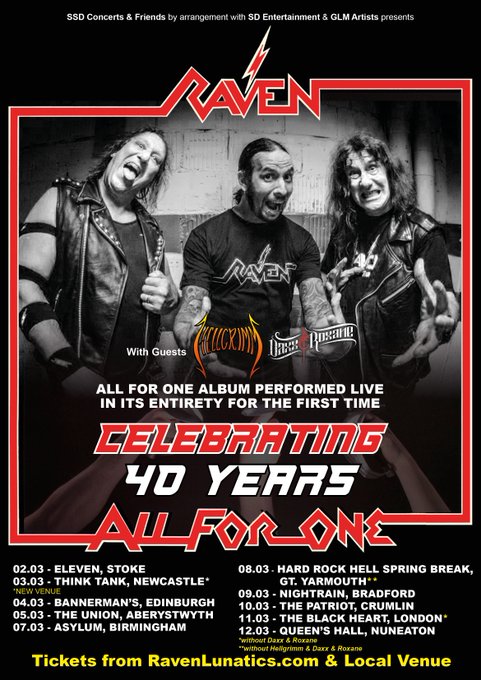
One of the most influential New Wave Of British Heavy Metal bands are heading out on a UK tour this March, but first, earlier this year there was the small matter of Raven being inducted into the Metal Hall of Fame alongside Twisted Sister and Foreigner vocalist and solo artist Lou Gramm.
Held at The Canyon Club in California on 26 January, this was the sixth annual gala, previous inductees include Dio, Lemmy and Judas Priest.
The award is for musicians and bands who have made an invaluable contribution to rock and metal and to keep inspiring fans throughout the world. I asked bassist and Chief Raven John Gallagher, how did it come about?
Bribery and corruption (laughs). It was nice to be recognized and was a really great event where we played a three song set – almost broke a sweat!
Did you ever think you would be in this position, a tour celebrating 40 years of an album ?
Of course not! That kind of long view, you just don’t have that when you start. It just kinda crept up on us over the years. It’s quite a milestone and we are very proud of it. That and good old Geordie stubbornness!
In the set are you playing the full track listing on All for One and have you played all the songs live before?
Yes indeed! There’s actually two songs from the album we’ve never played live before, so that’s going to be fun for sure and another two that Mikes never played.
Have you noticed any new faces at your concerts?
Oh definitely, there’s quite often three generations of fans at our shows – which is really great.
For a full list of tour dates & tickets, album releases, video, merch & more check the official website :
in conversation with ex Greedsville songwriter & guitarist Clive Jackson.
Clive is a singer/songwriter who released two solo albums, Life Off Line (2015) and Rocket Science in (2019). He is currently working on a new album for release this year.
A veteran of rock bands who were part of the Newcastle music scene in the 1990’s, he was a member of Greedsville who released an album in 1994.
Clive Jackson.
The main thing that motivated me to get a guitar and become a songwriter was when John Lennon died in 1980, they played tons of Beatles songs on T.V and Radio. I was already aware of a lot of it, but when I heard A Day in The Life on ITN news, I was hooked.
I joined various bands in the 80s, one being Twelve Angry Penguins – it was the era of daft band names! Then I was guitarist in a band called Dark Roads, and in 1991 we recorded a demo at Linx Studio with Mond Cowie (ex Angelic Upstarts) engineering. I was really pleased with my vocals, song writing and guitar work on that but unfortunately within six weeks everyone left Newcastle!
The drummer went to be a policeman in Leeds, the other guitarist went to live with his girlfriend in Wakefield and the bassist moved to Scotland to manage a hotel. In the midst of all that I got a phone call from Andy Carpenter who was bassist in Greedsville.
We sort of knew each other because we rehearsed in the same place, the 244 Rock club on Westgate Road here in Newcastle. There was a car repair shop in the back and in front was an old navy club, it was a very underground set up.
I handed Andy the Dark Roads demo and he asked me to join Greedsville as a song writer, that worked out and I became rhythm guitarist. Other bands on the scene were XLR8R, Strange Thing, 2000 and Roswell.
Greedsville promo pic.
We gigged a lot and played in Newcastle, Hull and Leeds, we went down to London Marquee seven times. I had a full-time job in the Civil Service so ended up using all my annual leave when we had to travel to gigs in London. We couldn’t knock back gigs in the capital.
Sometimes I had to arrange a half day here, and a full day there. For one London gig work wouldn’t give me a half day. I pleaded with them as we had reviewers from Kerrang and NME coming along, it was important, one gig could make all the difference.
So, I decided to get the train from Newcastle to Kings Cross, legged it to the Marquee, did the gig, ran off stage, missed the last train so jumped on the all-night bus from Victoria – still sweating and stinking with my stage clothes on. It was a long night as the bus stopped off everywhere.
Finally got home, showered, then made it to work just in time. But I was knackered, more of this wasn’t doing my health any good.
Greedsville live at London’s Marquee.
Around the early 90s we met a London guy called Sean Worrall who reviewed our demo, he ran a fanzine called The Organ and was connected to record companies. He would promote showcase gigs at the Marquee or Camden Monarch where A&R guys would turn up. Sean set up one for us.
There was Geffen records, EMI and MCA hanging at the back of the hall. It wasn’t like a gig more like a jury with them not clapping. Sadly, nothing came of it.
Then London Records saw us play in The Broken Doll, Newcastle and paid for a 4-track demo which we recorded in Hi Level studio. They asked us to ‘grunge’ the sound up.
Then we recorded a rough demo on a four track recorder in the Greedsville rehearsal room. Sean took it to MCA and the first song on it, one I’d written, was more like what they were looking for.
But the rest of the band didn’t want to go in that direction. At the time we were being compared to REM and Roxy Music – quite a wide spectrum.
The Greedsville manager was Sue Wilkinson, who has just retired from the BBC. In the 90s she was running Generator here in the North East, she got us loads of publicity, articles and reviews in the press, plus radio and TV slots on local and national TV.
She got us on Tyne Tees, you can watch it on You Tube, Greedsville – Local ITV News, UK (Tyne Tees Television) 21st June 1993. That’s footage from a showcase gig at Newcastle’s Riverside. Ian Penman (Ravendale, music journalist) is also on who was a really nice guy and supportive of the North East music scene. Sadly, he passed away not long ago.
One time we were on the bill at Camden Monarch with Skunk Anansie. There was a chalk board outside the venue with the bands names on – they were billed as Skunk and Nancy and we were Green Sleeves!
I was staring at the board when their singer Skin, she is beautiful by the way, came up to me and asked if I was in Green Sleeves. I said ‘it’s Greedsville’ we were both laughing at the mistakes. They got a record deal. We didn’t.
Our guy in London, Sean Worrall backed off in the end because he explained to us that he’d met the record companies, they’d sent A&R men, heard the demos, he felt that he’d done all he could. It was an amicable parting, no hard feelings he’d just run out of road for us.
There was still a lot of Newcastle connections around that time, like Kev Ridley, engineer at Linx Studio. There was a band I knew called For Gods Sake with guitarist Steve Wallace, there was Steve Charley the Canadian, he was studio engineer for a while. There were connections to the Music for Nations label with Venom and Skyclad.
Then Greedsville signed to North East independent record label Bleeding Hearts run by Eric Cook and Tony Bray, Eric was manager of Venom and Tony was the drummer.
What happened was Sue Wilkinson got a call from Eric Cook asking would Greedsville be interested in a deal? ‘Great’ we all said. At the time we were recording in Trinity Heights studio run by Fred Purser (ex Penetration and Tygers of Pan Tang).
The singer Pete Turner was involved in all the conversations between Eric Cook and Sue Wilkinson, and the rest of the band, including myself, were all present at meetings when major decisions were made. The contract was for distribution in Europe and Asia, we had it checked out and it was ok. We signed on the dotted line around 1994.
We had originally planned to record an EP with four songs but with the deal happening it turned into an album. We recorded in three studios – Linx, Trinity Heights and a place in Chester le Street with Frankie Gibbon. It was all mixed and mastered at Fred’s Trinity studio.
Eventually we released The Casino Royale Collection. We made 10,000 copies and it was on sale in shops like Our Price and Virgin stores.
Greedsville album released in 1994.
We were due to play in Middlesbrough, then onto the Heineken Music Festival in Gateshead Stadium. But a few weeks before that we played in London and on the way back in the van our drummer Doug Hayes said he was leaving.
So, we quickly had to get someone else in, that was Graham Hattam. We were really up against it, but Graham learned quick in a small time frame and the Heineken gig went well. The Stranglers and Jools Holland big band were also on, it was a great time and Sue got us lots of press.
But we started to lose momentum, Britpop had taken over, the band were falling apart. In 1996 it was all over for Greedsville.
Looking back the 90s had loads of different bands playing folk, blues, metal, psychedelia, it wasn’t just one genre. That’s one of the many reasons I think the A&R thing didn’t really happen here.
In one night, they would see a band dressed like they were in a pantomime, others playing Frank Zappa, and in the next pub there would be a full on metal band playing. There just wasn’t a load of bands playing one type of music where they could watch and give a definite yes or no, or maybe sign a band to a development deal.
Back then we sold around 5-6,000 albums but never received a penny. The Greedsville album is still on sale now through outlets like Amazon. If people are getting something out of listening to the songs that’s great – but did I make a living out of the music business? Absolutely not.
In the digital age copyright goes out the window. I do get royalty cheques now and then from my latest solo albums, the last was from Spotify for around $400.
There’s lots more to add to the Clive Jackson story, and that will be added to the blog later, but for more information check the official website:
Held on Saturday November 26th by North East playwright & theatre producer Ed Waugh (Dirty Dusting, Hadaway Harry, Sunday for Sammy), the event in Bewick Hall will be a celebration of fantastic stories about working class heroes from Tyneside.
“I’m really excited about this. It’ll rock. There’ll be Geordie songs, stories, and a video link – it’ll be great crack” said Ed
The Harry Clasper, David & Glenn McCrory and The Great Joe Wilson stories were successful stage plays in their own right, now the scripts have been compiled together and released into one book – Geordie Plays.
Harry Clasper’s story follows his journey from working class pitman in Jarrow to rowing Champion of the World.
North East singer and song writer Joe Wilson chronicled working class life in song including the Geordie classic Keep Yor Feet Still Geordie Hinny.
“North East actor Jamie Brown who starred in both plays Hadaway Harry and the Great Joe Wilson will be singing some Geordie songs at the event”.
“We have the top journalist and sportswriter John Gibson coming along, he will regale us with stories about Glenn McCrory’s rise to boxing world champion stardom and the inspiration he got from his severely disabled brother David”.
“We’ll also have a video link to the three plays’ director Russell Floyd” explained Ed.
Some may know of Russell from his time acting in UK theatres and TV shows including Eastenders and The Bill.
“There’s also a special 5-minute video by Canadian, Kas Wilson, talking about what it means to be Joe Wilson’s great-grand-daughter”.
“I would like to give my thanks for continued support to all audiences, supporters, organisers – everyone involved in making this happen”.
The launch is on Saturday, November 26th 6pm, Bewick Hall, Newcastle City Library.
I’ve always loved singing, acting, performing – just something I’ve always done. I’ve been doing this since I was 4.
Nobody in my family sings or entertains, so you know bit of a freak really, the family think I’m a total exhibitionist – I just liked showing off (laughs).
GYPSY SPIRIT
If I go further back my ancestry is German and Romany and in our family my Great Grandfather was the last of the travelling gypsies, he settled into a house and family when he met my Great Grandmother.
A family name was the German, Fischer, they weren’t popular due to the war so the name spelling was changed by dropping the ‘c’. Maybe there was a German Gypsy treading the boards (laughs).
The whole process of theatre making for me is exciting, I don’t want to lie, it is challenging at times and some days I think is this the day I’m gonna throw the towel in. I’ve definitely got a bit of a strong spirit in me to keep going because hearing the word ‘no’ is not what I want to hear. If there is an obstacle in the way I’ll find a way round it.
NEVER LOST FOR WORDS
When an idea comes it niggles in the back of my head, then I sleep on it, it works its way to the front of my brain so in the morning it reveals itself and I think about how to develop the idea.
Some writers say it’s a lonely time but when I’m writing I’m with all of the characters, I’ve worked out who they are and then they talk to me. Fictional characters just exist in my head where they are acting out their daily lives.
The whole rehearsal period can be frustrating but it’s good to hear your words brought to life. In rehearsals it’s mainly all there on script but sometimes I come in with a killer line. I add in a line if I’ve heard someone say it during the day or how some words sound – I’ll remember that and use it.
On the first night in front of an audience it’s good feeling to see the initial idea from conception being brought to fruition.
BACK ON BOARD
I’m really keen on theatre being accessible to everybody so we can put a show on anywhere. Northern Stage have been supportive of my writing so I’ve had nights there, the Phoenix, The Arc in Stockton, Queens Hall in Hexham, I like mainstream theatres but I also like to take it to intimate audiences.
I’ve had three of my plays in Edinburgh, but beforehand I like to try them out to smaller audiences before they are unleashed on the scathing critics of Edinburgh Fringe. Getting any support is good because its hard getting your shows in any theatre because of the Covid backlog, so The Newcastle Cluny are preparing to show Sex is Hard Work from 28th June.
SEX IS HARD WORK
The show is based on a prostitute from South Shields who started work on the sex phone lines then ended up as an escort. When I first started rehearsing and writing the play I though I was a woman of the world, now I know I’m next to Mother Theresa (laughs).
The play isn’t just titillation or a biography of her life it’s mainstream entertainment. I’ve took the character and added more depth. There is the part of life as a sex worker paired with being a carer for her father who’s had a stroke.
You know a lot of women are in the sex industry because of varying circumstances like debt, drugs and being coerced into it, or like the woman I spoke to just not fancying a 9 to 5 job and wanting to make lots of money. It may not be everybody’s career choice – but that’s hers.
I like to challenge the audiences pre-conceived notions about a subject, and after the play they have taken a battering.
Sex is Hard Work plays six nights in The Cluny, Newcastle with the last night being a Thank You to NHS with some of their staff coming. We’ll see how the show is received then hopefully next year tour it and take it to Edinburgh Fringe.
‘Sex is Hard Work’ plays six nights from 28 June 2021. Advance tickets £10. Doors open 6pm.
‘Research has found that women make up a very small percentage of artists, songwriters and producers. I want to address this imbalance.
This project is designed to support more women into the music industry by providing them with the opportunity to develop music production skills’
saidLisa Murphy, Studio Manager for Blast Recording Studios and Production Room in Newcastle.
A six month project for aspiring female music producers to further their career in the music industry is starting in November.
The application closing date for this exciting new opportunity in Newcastle is Sunday 25th October, so get in touch now.
Lisa added ‘Working as a female music producer in professional recording studios in the North East, I want to share my skills, experience and contacts to open the door to more women working as music producers.
The course will include working on projects in professional recording studios, masterclasses from professional music producers and individual time in the studio to complete your projects’.
What do you hope the course will achieve ?
‘The aim is to enable four emerging female music producers to develop skills, knowledge and contacts in order to further their career.
This will be achieved through weekly sessions with myself and other relevant guest speakers, hands on learning in a studio environment, and individual time for each participant in the studio on a weekly basis for them to practice their skills and produce work for their portfolio.
Also built into this programme will be a number of projects developed by myself to give the participants access to other studios, recording session musicians and selected bands in a larger setting with different equipment’.
What is the aim of the project ?
‘The overall aim is to enable the participants to gain their first important steps into a career in music production, an industry that is heavily influenced by a producer’s portfolio of prior work and contacts.
The use of teachers and music producers such as myself and other selected professionals – local songwriters, sound engineers and musicians – female, whenever possible, will support this aim, demonstrating that there is a place for women in the music industry – specifically in technical roles in which they are currently under-represented’.
Check the website for full details and how to apply:
On Tyneside during the ‘70s and ‘80s rock music was heard from Sunderland to South Shields, bounced over the river Tyne to Whitley Bay and Wallsend – the vibrations were felt in Newcastle. A North East New Wave of British Heavy Metal was coming in.
Riding the wave were Fist, Hellanbach, Mythra, Tygers of Pan Tang and Venom pushing metal to its limits and discovering a new energy. Another of those bands was Raven.
Now based Stateside, but originally formed in Newcastle in 1974, early gigs saw the trio cutting their teeth on North East live circuit of working mens clubs.
Headline gigs at Newcastle Mayfair and Dingwalls gained the band a solid live reputation. The gates were opened, and the band went onto UK support slots with Iron Maiden, Ozzy and Whitesnake.
By the early ‘80s two albums ‘Rock Until You Drop’ and ‘Wiped Out’ were recorded in Wallsend’s Impulse Studio on the Tyneside label, Neat Records. Then a call came in from America.
Raven were at the forefront of speed metal spawning the big four beasts from the United States – Megadeth, Slayer, Anthrax and dragging Metallica out on their first, and scorching, tour across the USA.
We know where they ended up. These were life changing moments. Raven knew their future was Stateside and subsequently signed to Megaforce and then major label, Atlantic.
Fast forward 40 plus years and the band are still hitting it hard with new single ‘Metal City’ from their forthcoming album. The music video was filmed on Tyneside capturing iconic structures like the Angel of the North, Tyne Bridge and even St James’ Park home of Newcastle United.
I asked bassist and vocalist John Gallagher did filming stir up any memories when you were at the locations ?
It definitely stirred up some memories especially with one part of the shoot. We were driving to one of the locations when I mentioned “I grew up down that street there” and our video guy Paul said “Then let’s check it out!”
So, the footage with me playing the bass is in the backlane in Benwell where we played football as kids.
After ‘Top of the Mountain’ this is the second track released and both are very strong opening singles, I asked John are the band putting down a marker for what the listeners can expect from the rest of the album ?
Very much so. Top was the perfect choice as the first song as it sounds like one of our early songs dragged kicking and screaming into the 21st century!! And Metal City is not only the title track but it’s a real anthem type song.
Yep, added to trademark Gallagher scream, check out the geet big chorus!
The rest of the album runs the gamut from crazy fast songs like The Power, and a tribute to Lemmy in Motorheadin’. Added to super aggressive tracks like Human Race and Break plus a bit of an epic in When Worlds Collide.
So, there’s variety, and all heavy with ‘all killer, no filler’.
How do you look at this album compared to previous releases ?
This one is a belta! We actually think this album is the best thing we’ve ever done, for a band that’s been around the block as long as we have that’s really a case of laying down the gauntlet to many of the other bands of our era who are putting out ‘ok’ albums.
The band have just released new European tour dates, when was your last gig pre – covid ?
Our last shows were on the Monsters of Rock cruise which departs from Florida. We did the pre-party show in Miami and a show on the cruise.
Always great fun, and we actually did Chainsaw for the first time in about 30 years. We can’t wait to test drive these new songs on stage!
A booking list and diary from gigs at Newcastle Dingwalls in 1983 turned up on line. Entries included:
26.3.83 – Big Country Fee: £240 – 282 @ £1.50. Excellent band and performance. Perfect timing with release of single. Excellent debut in the North-East.
3.3.83 – Raven & Hellanbach Fee: Raven £300 – Hellanbach £60 – 269 @ £1.50 Terrific stage show. Very good heavy rock band with good repertoire. Good following.
Raven bassist John Gallagher told me about the night…‘I just remember the place being chilly…at least until we got started! There was a decent turnout, and we were promoting the ‘All for One’ album. I don’t remember much more to be honest !’…well it was nearly 40 years ago.
To find out more I contacted the manager at the time and owner of the book, Chris Murtagh….
I don’t have the diary now as I’ve sold it but have a digital copy of the acts who appeared. Like the other Bierkellers around the UK the entertainment promoter Harvey Goldsmith bought all the venues for £1 and re-christened them Dingwalls.
Yes, only a £1 but Harvey had to service their debts and running costs. They were in the basement of office blocks, mine was in Waterloo Street, Newcastle. It had a capacity of 1200.
I was manager of the venue during 1983, it was Dingwalls from January to June when it went into liquidation and reverted to Vaux Breweries, the biggest creditor.
Then from June to December Vaux changed the name to the Bear Pit but I was retained as manager.
How did you get the managers job ?
I’d done several promotions there and had threatened to sue Goldsmith for breach of a contract for cancelling one of them. Turned out his General Manager offered me the job instead. I was the only manager who was also a promoter.
All the other Bierkeller managers at Sheffield, Hull, Liverpool, Bristol and London were ex-Mecca managers and older than me. They got two for the price of one in me being manager/promoter and Chris Donald from very early Viz comics did all my publicity.
What was the Newcastle venue like?
It was like being buried in a hole in the ground for months without seeing daylight. When we closed and tidied-up well after midnight, we’d go and chill out at Rockshots upstairs till about 3am. Then back at work about 4pm the same day.
My bar manager once dragged me to the city baths for a massage which connected me back to my body that I’d totally lost track of.
Martha Reeves was booked for May ’83 and your diary entry reads….
Martha chatted me up in the office. Didn’t know where to put myself. She could have eaten me for breakfast. Motown comes to Dingwalls. Brilliant professional show.
What can you remember from that day ?
Martha Reeves terrified me as I must have been the youngest manager she’d come across and she was a very experienced older woman.
In the diary for June, Murtagh booked female group Girlschool with support from North East heavy metal band Satan. His notes of the gig included…
Girlschool arrived for their first headline tour after supporting Motorhead. They didn’t have any money and asked if I could help them out which I did. Nice girls who put on a good show but treated rubbish by their record company.
Satan a good local heavy metal band with a good following. I’d previously promoted them, famously at the St James & St Basil’s Church in Fenham where the posters read ‘Appearing live on stage, Satan.’ That pulled in a good congregation.
Also, that month Dr Feelgood came to Newcastle with support from North East band R & B Spitfires….
Full on red-hot rock band with commitment and attitude. Real pros – no messing about with sound checks – Brilliant. Wilko went to college up here so he had his own following. Local band Spitfires acquitted themselves well in such company.
More entries to the diary with some excellent comments about the bands and gigs….22.4.83 – Gun Club + Sisters of Mercy.
Fee: £511.25 – 548 @ £1.50. Sisters, good appreciative following, hypnotic beat with drum machine, bass and guitar. Led by Joey Ramone lookalike. Effective visual presence.
Gun Club, should have been called ‘Gin Club’, Jim Morrison just before he died. Good presence, good songs, terrible sound.
6.5.83 – Miami Steve. Brilliant American band. Shame about Steve and the material. Bruce Springsteen can keep him. Stayed in the tour bus only coming in to play the gig. Oh and don’t touch his bandana. Precious bastard, up his own arse.
10.5.83 – Bad Brains. Turned up 6 hours late so most of the audience left. Refused to pay them which set-up a stand-off between the band and my security. Lots of martial arts posturing until it finally dawned on them they would get severely plastered if they stayed. Bad brains indeed.
16.5.83 – The Vibrators + Red Alert. Not overly impressed by the reformed Vibrators. Canny lads though. Their guitars were nicked before they went on, then retrieved by Red Alert, who were themselves a very impressive act.
After you left whathappened with the venue ?
Harvey Goldsmith owned Dingwalls but his CEO was Peter Gross, an accountant, who’d run a chain of restaurants called The Great American Disaster in London.
At each of the venues he’d bring a brewery in as sponsor. In Newcastle’s case it was Vaux Brewery who gave him three quarters of a million pounds.
When the receivers Ernst Whinney were brought in because Harvey was going into liquidation for about the seventh time, I talked to him on the phone. ‘You’ll be alright my boy’, were the last words he spoke to me.
Dingwalls Last Programme.
Dingwalls Last Programme.
The Journal report on Dingwalls closing in 1983.
The venue reverted to Vaux Breweries with them being the biggest creditor. When Paul Nicholson CEO of Vaux arrived, he asked what Harvey had done with all the money. I said he’d stuck a black plastic crow on the wall and extended the stage.
You’ll notice every poster advertising a Goldsmith promotion has a little fat man in the corner. That’s Harvey. He also used a black crow as the logo for Dingwalls. ‘I hope that bloody crow lays goldeneggs’ was Paul’s reply.
Basically, Harvey used all the money for running costs. If he’d taken the time to run the venues himself it might have worked, but he was too busy touring the Stones, Dylan, Bowie etc and left the running to Peter Gross, who was clueless about the music industry.
Vaux wanted to appoint their own manager of what they now branded ‘The Bear Pit’. My staff refused to work for them, so I was retained as manager.
Murtagh came across North East manager and promoter Geoff Docherty…
My first encounter with Geoff Docherty was when he was looking after Preacher, a band led by Tony Ions. I needed a rehearsal place for my new band Fan Heater and Tony who I’d played with in Slaughter House, suggested I approach Geoff to see if I could share their rehearsal rooms in the derelict Hydraulic Crane pub on Scotswood Road, Newcastle.
Not only did Geoff give us the pub but he said he’d get us a gig at the Marquee Club and Rock Garden in London supporting The Showbiz Kids who he also managed. ‘Oh yes, of course you will’ I thought being very sceptical.
I couldn’t believe it when he was as good as his word. Total respect.
What did you do after Dingwalls ?
After leaving there I continued promoting in Newcastle, Leeds and tours around the UK, including with my own band.
1994 I became a director of the pan-European touring organisation the Newcastle Free Festival Inaugurating Cities of Culture, including being the first festival to perform under the Berlin Wall when it came down in 1989.
That same year, as part of the festival, I brought over the Peruvian band APU. 30 years later I’m still their manager. This also drew me into World Music which I’ve promoted ever since.
As part of being a promoter, I worked as an A Level sponsor for the Home Office for over 25 years issuing visas for non-EEC artists to tour the UK. I still enjoy playing all over the world and organise festivals and events internationally.
In the North East of England, the Lawe Top is an area that runs parallel to the River Tyne and looks out to South Shields harbour and North Sea. It was once an island, and in some ways it still is.
Some residents I interviewed in summer 2011 were proud to talk about the Lawe being ‘a little village up on the hill’ away from the town of South Shields.
The documentary included narration by local historian and former museum worker Angus McDonald with music by North East musician Martin Francis Trollope.
This a short extract from some of the interview’s…
Janis Blower: It still has to a certain extent the same old identity that it had with the river and the sea, although the pilots have moved away from the area. It’s like a little village with its own unique identity.
Dave Slater: It’s an area which I’ve always liked and a lot of people living in Shields have this affinity with it. They think it’s like a special place. And the houses are nice they have their little quirks.
On Fort Street and the corner of Roman Road is Crawfords Newsagents….
Bob Crawford: (owner) I’ve been here 28 years it’s always been a newsagent’s, on the deed’s it say’s from 1920. Enjoy living on the Lawe Top. Made a lot of friends. Lot of nice people live on the Lawe Top. Hopefully be here a bit longer.
Jane Price: I’ve been working here about 10 years now and its quite handy cos I live on the street. Literally fall out the door into work. And it’s lovely living up here it’s like a village separate from Shields. Like a really close community. I also work in the pub at the end of the street. The Look Out pub. It’s really nice I enjoy it, my kid’s had a good upbringing here.
Living on The Lawe people are known as Skuetenders. But what is a Skuetender ?
Janis Blower: Well there is various theories to what a Skuetender is. One of them is that if you look down on the area from above the Lawe is in the shape of a skate. But probably the most reliable one is that this is the end of the river where the original fishing hut’s where, the fishing Shiels from which South Shields took its name. And it’s where they would salt the fish, and skuet is an old word for ‘to salt’. So if you were born at this end of the river, you were a Skuetender or it’s become Skitender over the years.
Ethne Brown: Well I’ve always lived on the Lawe Top, I was born on the Lawe Top in Trajan Avenue so I’m a Skitender born and bred.
Mel Douglas: Skitender is someone who has lived in this locality within a certain distance of the river. Yes I’ve always been one of them but not as much as Duncan Stephenson as he’s a proper Skitender.
Duncan Stephenson: A Skitender ? You’ve got to have a ring around your bottom end where you sat on a bucket when you were a kid. That’s where a proper Skitender came from, if ya’ haven’t got a ring round yer bottom end yer not a Lawe Topper.
Janis Blower: Well I was born and brought up in Woodlands Terrace so as a child you would just have to walk down Woodlands Terrace and you were straight on to the hilltop. If the weather was good, you literally spent all yer time out on the hilltop or down onto the beach. What our mothers didn’t see what we got up to was a good thing.
Mel Douglas: When I was young I lived in George Scott Street. That was my impressionable time, but we eventually moved up to this house (Lawe Road) which I’ve enjoyed. On the hilltop area when I was a boy there was the gun encampments and Trinity Towers – a sort of radar station which was all fenced off.
Janis Blower: Trinity Towers was a magical place to play because it was so much like a castle or a fort. It had been originally built in the 1830’s by Trinity House, as a pilot look out. It stayed that until the early part of last century when the new pilot house was built at the top end of the park. By the time we were playing in it, it was the radar station for the college. You couldn’t actually get in it but it had bushes around it and little nooks and crannies.
Mel Douglas: The encampment where the gun’s where for example a lot of people aren’t sure where they were. But looking out of my window if you catch the time of year when spring is starting to come through, realising that the guns and the fence had some sort of foundations, well there wasn’t much soil on top of that and the rest of the area in deep soil. So when the grass started to grow it would grow quickly where there was plenty of soil. But where the foundations of the encampment was, there was no soil to speak about.
Janis Blower: By the time I was a child playing on the hilltop the actual gun’s themselves had gone but you could still see where the gun emplacements had been the big round pits had been there. They had been fenced off originally but I’m sure that I can remember sitting on one of them dangling my leg’s inside. You were always being warned off them.
On the Lawe Top is Arbeia Roman Fort…
Dave Slater: I noticed when we moved here when we walked up Lawe Road is on the wall, name plaques of Roman emperors like Julian Street etc.. and the one round the corner is the name of his wife. So you can always learn something new as old as you are and as many times you been up here.
Janis Blower: The fort was very open in those days, and we used to play in it as children you wouldn’t think about doing that now. I don’t suppose as a child you really appreciated what a heritage monument it was.
There used to be a caretaker’s house attached to it which has been demolished long since, and when you used to play on the green between the hilltop and the pilot house, if ya dug around you could find bits of stoneware. I remember the red samian ware that you see in the fort, and we would find these bits of things and we would take them to the caretaker’s house and knock on the door ‘Is this a bit of roman pottery’ and he would say ‘Yes look’s like it is’. But I think after we had done it after the fifth or sixth time it was ‘No it’s a bit o’ brick’.
The Lawe Top used to be home to St Aidens and St Stephens Churches….
Joan Stephenson: When a lot of the houses were pulled down around this area and people moved to other parts of Shields and they want their children baptised or anything they still say St Stephen’s is their church and they come back.
Ethne Brown: I was born up here and I was christened at St Stephen’s Church and all my family and father’s brothers were in the church choir. My Grandma Whale on more than one occasion opened the fete at St Stephen’s church. It’s always been the pilot’s church and nice that they were in the choir. I was also married at St Stephen’s Church.
Mel Douglas: With respect to that I was very fortunate when sadly they pulled the church (St Aidens) down that I was in a position where I could buy the pew that I sat on as a boy and have in a room upstairs. The pew used by people getting married, my father, Grandfather, myself, all male members of the family had sat on that pew when getting married. Very proud of it.
Joan Stephenson: When St Aiden’s closed, they amalgamated with St Stephen’s, it was sad because St Aiden’s was a lovely church. In the 1970’s we decided to make this building into a multi-purpose building to make it more economic to run and it stayed up while unfortunately St Aiden’s closed. Once the chairs are put to the side we hold dances, mother and toddlers, young kids come into dance, social evenings, it’s a really good venue for anything like that.
The street that overlook’s the Tyne is Greens Place where I spoke to Karen Arthur and her father George…
Karen: When you were little what did you used to see around here ?
George: We used to go to the shop along there beside the Turks Head pub. Shrybos you called here. We nicknamed her Fanny Mossy. Everyone knew her around here. She was an eccentric, she was an old maid and owned that shop.
Karen: Did she only let one person in at a time Dad ?
George: Yes if two of you went in she would say ‘Get out one of ya’. Cos she knew if she was serving one the other one would be helpin’ themselves with the sweets an’ that.
Lenonard Smith: We moved to 23 Greens Place in 1947 and that was great because at one time 17 lived in four flats. There was one tap outside and one toilet. Me happy days of the Lawe Top was I used to go to the Corporation Quay and I spent all my school holiday’s going away with the inshore fishermen. With the net’s it was driving, then crab pots and longlines.
We used to bait up in the cabins on the Corporation Quay and the light was done by carbine. The only thing with carbine was that when you went home you had black tash’s where the smoke would get up your nostrils.
On Baring Street is the art shop Crafty Corner….
Trevor Dixon: We purchased this property eight years ago now and it used to be Crabtree’s the Bakers. Where I’m sitting now there used to be a massive oven that came right from the back of the shop. Took six months to cut it out and skip after skip. Our shop is a craft shop and ceramic studio.
It’s a very old building that we are in and it’s reckoned that we have ghosts. They’re all friendly. We’ve had a few local ghost groups bringing all their instruments in here and in the basement. They reckon we do have a lot of ghosts and we have things moved around now and then, disappear for a few days then turn up again.
I don’t think we could have picked a better place to be cos as you know The Lawe Top goes back in history as a creative place and I feel we’ve meant to be here.
Final words about The Lawe Top….
Mel Douglas: If it was up to me I would live in this house for the rest of my life. It’s a beautiful house and I love the community that I live in. Fantastic neighbours, nice people, I’d live nowhere else.
Ethne Brown: I just love living here on this Lawe Top. The house is a bit big nowadays, but I don’t know where else I would go in the town. This is the only place to live.
Janis Blower: Everybody knows everybody else, yeah, it’s a fabulous area to live. I can’t imagine to be living anywhere else to be honest.
Joan Stephenson: Just a lovely place to live.
Duncan Stephenson: Got everything here, beaches, parks. Home is where…
Joan: Your heart is.
To read more about the film go to the blog Skuetenders Aug.25th 2018.









 ALIKIVI UK : NORTH EAST MUSIC & CULTURE