WordPress, who run this publishing site have a statistics page where all the viewing numbers, countries, dates and comments are gathered and crunched. A new addition to the stats is the percentages from what device the site is being read from – currently it’s mobile 63%, desktop 32% and tablet 5%. We are entering nerdsville territory so some people’s eyes will glaze over but stick with it, the stats can bring up some interesting surprises.
I remember back in 2017 posting an interview with former Angelic Upstarts guitarist Mond Cowie and noticing views from the Bahamas – who’da thought punk would invade the tropical paradise!
The site kicked off in February 2017 with first year views of 15,478 quickly rising to 79,850 in 2020 with most people staying at home during the Covid pandemic. It was March of that year that hit the highest monthly views with 9,700.
2021 reached 77,259 with a high of 8,400 in February that year with a small dip back to a total of 51,482 in 2022. This year has experienced a sharp upturn in numbers, so after eight years you can say ‘it’s daein’ canny’. For non Geordies and Mackems that means ‘it’s doing fine thank you very much’.
2024 has hit over 53,000 views with nearly 3,000 this month. December readers from the UK and USA are high with an unexpected spike in numbers from Belgium. So, yep its daein’ canny. All the best for 2025!
“I’ve always been fascinated with everything World War Two related and RAF in particular. My grandfather was in the Royal Flying Corps, and both my father and my son were in the RAF” explained Terry.
“I was in the Air Training Corps in South Shields but then a medic came to school to test us all for colour-blindness. I failed the test miserably and was told I would never be accepted by the RAF. I was gutted, as you can imagine”.
Terry lives in Marske on Teesside, but was born in South Shields at midnight 21st– 22nd December 1948…“My mum asked the midwife which day was my birthday. She was told it was the 21st as my head came out on that day. That crosses the Winter Solstice, so my top half is Sagittarius and my bottom half Capricorn. I think this explains why I’ve done so many different jobs in my life”joked Terry.
Throughout his school years his parents moved around the country…
”We lived above a wallpaper shop in Stockton on Tees, then moved to Billingham and later down south to Reading and Mitcham”.
Finally, the Wilkinson family moved back to South Shields where Terry was a pupil at South Shields Grammar Technical School for Boys.
“After leaving school, I worked for the Crown Agents for Overseas Governments in London, thenWise Speke stockbrokers in Newcastle where I became a Member of the London Stock Exchange”.
“From 2000 I ran a successful Theatre in Education company touring schools for 15 years. It won a Best New Business Award but I gave it up in 2015 in order to write”.
When researching his family tree and local history Terry has always been fascinated by one event.
“At midnight on 3 May 1941, the factory and Head Office of Wilkinson’s Mineral Water Manufacturers in North Shields was hit by a single German bomb. It went through the roof, descending through all three floors, taking all the heavy bottling machinery and chemicals down to the basement – which was in use as a public air raid shelter. 107 died, 43 of which were children. Whole families were wiped out.”
“It is written by my good friend, Peter Bolger, who also manages a comprehensive website on the incident”>www.northshields173.org
“Because of censorship and the government’s desire not to damage public morale, little is known beyond Tyneside. It was, however, one of the largest loss of life incidents from a single bomb during the provincial Blitz”.
“Nothing is known of the identity of the plane which dropped the bomb – type, squadron, mission etc – as German records were mostly destroyed in the closing stages of the war”.
“I wanted to write a story that answered all these questions and create a fictional alternative. Having said that, nobody could say with any conviction this is not what happened”.
Terry started on a series of five espionage novels. ‘Handler’ is set in 1941, ‘Sleeper’ in 1942 and is currently working on the third ‘Chancer’ which covers 1943.
“They’re a mix of fact and fiction and trace through the war years of an English-born German spy, Howard Wesley, and his nemesis, MI5 agent Albert Stokes”.
“Wesley is a figment of my imagination. Stokes is based on a real character. And this is the pattern for the other books in the series. I also like to plunder WW2 history for little-known incidents and people who feature against the broader background of what was taking place in the war”.
‘Handler’ won a ‘Chill With A Book’ Premier Readers’ Award just a few months after publication. This spurred Terry on to get others in the series out there as quickly as possible.
“A few of those who have given good feedback have made the point that it would make a good series. I am convinced that it would. I certainly write with a film or TV series in mind”.
“In the shorter term I am hoping to record the whole series as audible books. I recorded an extract from the book that author John Orton is currently writing (link to interview below) and he was happy with it”.
“I’ve spoken to my publisher – UK Book Publishing – and offered them my services as a narrator for others. I’m also an actor, card-holding Equity member and very good at accents and dialects”.
‘The Sound of a Landscape’ is a new book by artist, author and sound recordist Mie Fielding, who co-authored ‘Closest Thing to Heaven’ about the Newcastle music scene, which featured on this site in December 2020.
In ‘Sound of a Landscape’ Fielding pictures the Northumberland coast in all its wild splendour. His unique artwork is complimented by Cullercoats poet Harry Gallagher.
“I got to know Harry as he played the late Tom Hadaway (My wife’s uncle) in a theatre production. As I’ve recorded bird sounds and produced avant-garde music for over 30 years, it was a natural idea to put these artistic elements together” explained Mie Fielding.
MiE Fielding
The book is further enhanced with sound recordings by scanning the accompanying QR code, bringing ‘The Sound of a landscape’.
“The book also gave me a chance to produce two specially written pieces of sound art. One portraying Storm Arwen and the other lamenting the demise of a way of life, once a common sight along the Northumberland coast – the Cullercoats Ghosts” addedFielding.
“As for the sounds in the book, they took nearly a year to capture using an ‘Ambisonic, microphone and other technical equipment”.
An exhibition about the book featuring its poetry, art and sound is held at Newcastle Central Library from 14 -20 December 2023.
The Crack is a free culture magazine and website providing a valuable service to the North East. Reviews of books, film, stage and music are packed into each monthly edition.
To find out more about the people behind the magazine I got in touch with one of the writers, Rob Meddes.
‘Reading takes up a lot of my spare time now. I review between two and three new novels each month for The Crack. I also love old films, particularly black and white film noirs made between the 1940s and mid-1950s – The Maltese Falcon, The Postman Always Rings Twice, Double Indemnity’.
‘I never set out to be a writer, but stumbled into it through luck more than anything else. I was born in Newcastle and lived here all my life. I’m now 57. I didn’t go to university but on leaving school I did a Youth Training Scheme on computer programming’.
‘I got a job as a programmer but the company I worked for went bust – hopefully not because of my efforts. Then got a job as a civil servant, working at the big site at Longbenton for around four years. I became frustrated at having to do the same thing every day so thought I’d leave and go back to college. The aim? To become an artist’.
‘I did ‘A’ level art and then the Art Foundation course. I was accepted on the Fine Art course at Northumbria University but figured I didn’t want to do another three or more years of that because I really needed a job’.
‘I wrote to loads of different companies to ask if they would take me on, maybe in an admin capacity. The one company that got back to me was The Crack. I did a bit of everything at first – including selling adverts – before moving more onto the writing side of things. That was in 1994 and I’ve been here ever since’.
What changes have you seen since you started at The Crack?
‘What has actually changed most for me is how the magazine is put together. When I started there was no internet, certainly not in our office. Every image in the magazine had to be physically scanned in. Now they’re all digital’.
Have you seem many cultural changes in Newcastle since joining the team?
It’s Gateshead not Newcastle that has seen some of the most compelling big ticket items – Baltic, Sage Gateshead, Angel of the North, The Millennium Bridge. But Tyneside as a whole seems to have become more of a destination for people outside the area who want to sample cultural life in the region’.
What can you see for the cultural future of Tyneside?
‘After 13 years of Tory backed austerity, particularly for the arts, many of our cultural icons are struggling. We’ve already seen The Side Gallery close and The Tyneside Cinema has started to crowdfund. And they’re just the tip of the iceberg’.
‘But often in straightened times, art – in its myriad forms – manages to find a way to bubble to the fore. What hasn’t changed is people’s capacity to get out of the house and go and see stuff, whatever that stuff might be’.
In an earlier post about L.S. Lowry (1887-1976) I talked about the artist frequently visiting the North East, especially Seaburn near Sunderland.
In later life did Lowry look upon the small coastal town as his sanctuary to sooth his aching bones?
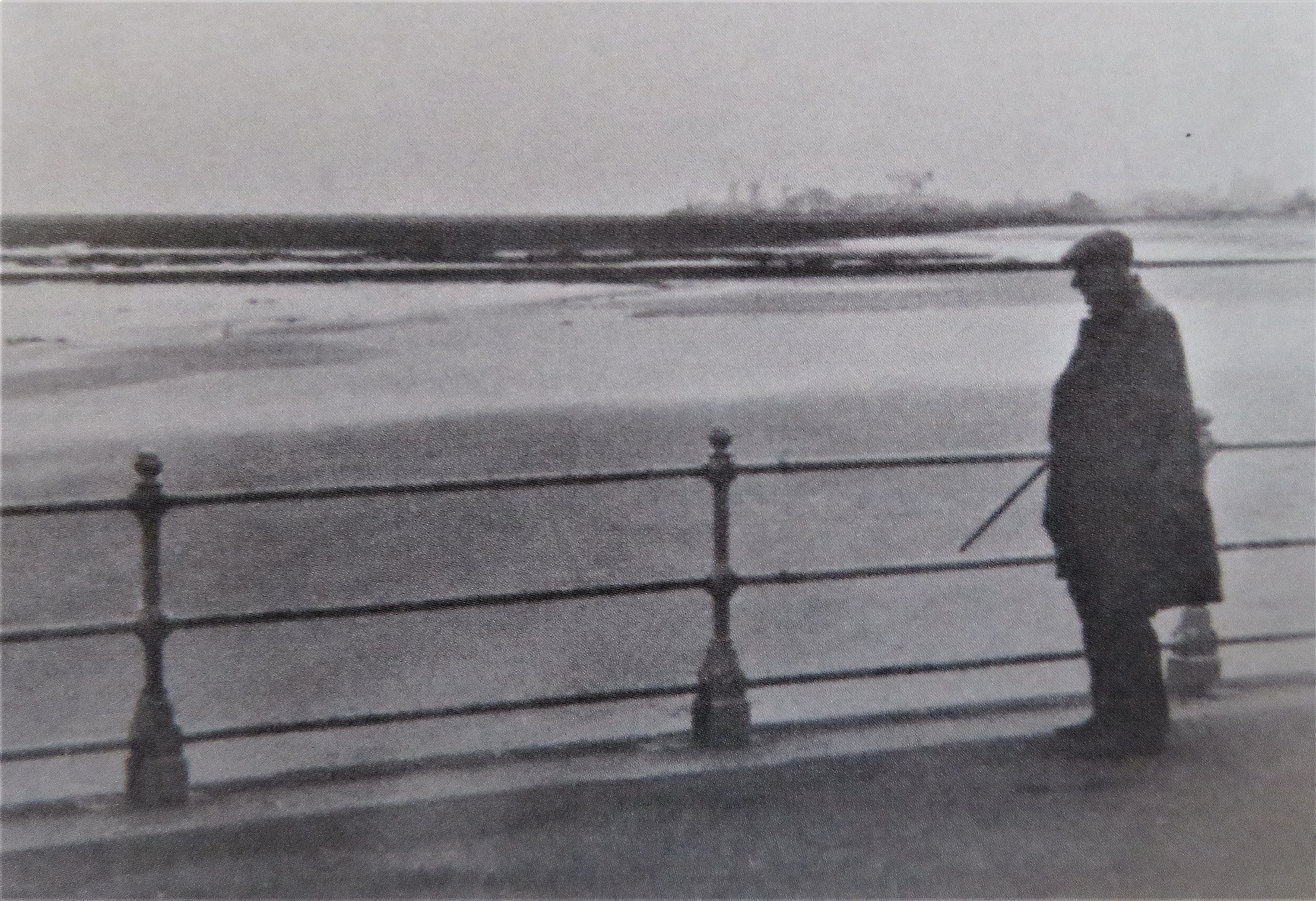
Lowry at Seaburn on the North East coast.
Day by day the big fella walked along the beach pausing every few moments to gaze at the sea as if the tide would reveal the answers he searched for. He tried hard to understand but received no answers ‘All I know is that I know nothing’.
He would say to friends ‘It’s all there. It’s all in the sea. The Battle of Life is there. And fate. And the inevitability of it all. And the purpose’.
He would watch the tide coming in ‘What if it doesn’t stop? What if it doesn’t turn? What if it goes on coming in and coming in and coming in’.
Sitting on the beach stirring gravel with his walking stick he would ask ‘We are like these pebbles. Each as important as each other. We all have a place in the pattern of things. What is it for? Why are we here? What is the purpose of it all?’
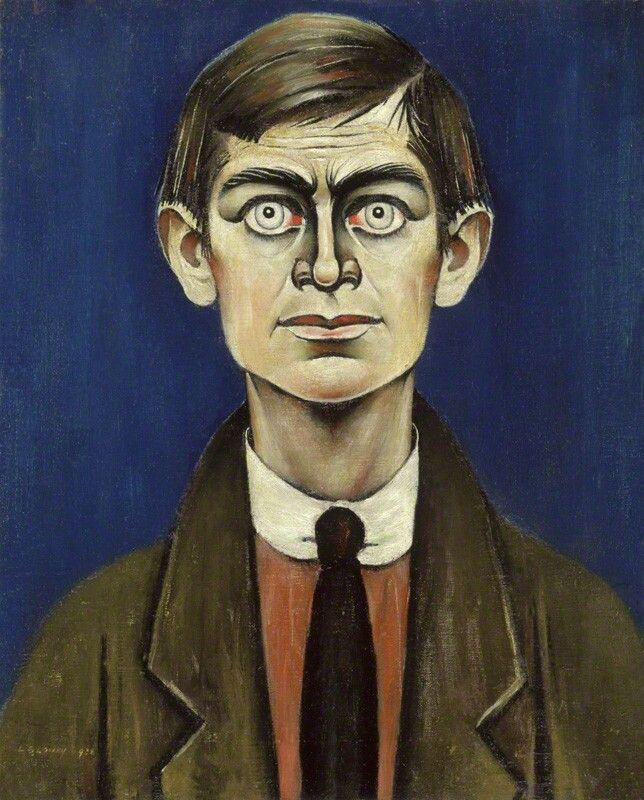
Self portrait 1938.
At nearly 80 years old Lowry was becoming frail and prone to suffer from shingles. Ironically a touring exhibition that put him on the artistic map was one which ‘nearly finished me off’.
More than 100 pictures were shown in the 1966 Arts Council Lowry Retrospective starting in Sunderland and taking in Northumberland, Manchester, Bristol, with London the closing venue.
The work was Lowry in all his glory, from a 1906 still life to a seascape drawn from the window of his room in Seaburn Hotel in 1966, he wrote to a friend about the opening in Sunderland.
‘I went in on the Saturday afternoon and a good many people were there and a gentleman wore his hat all the time who I thought was the man who comes in to see about the electricity lights but who proved to be the Lord Mayor. He was very interesting and did say they never had a show like this one before and my expressive face flushed with pleasure at that and we parted great friends’.
Far from being the shy recluse he was at home, at times on tour Lowry retained a sense of humour and played the celebrity, some friends were heard to remark on his character and particular his contrariness. But he still worried about the exhibition.
‘This show has put years on me. It is not painting so much as the thousand and one things attached to the job that is the awful thing’.
‘It takes a long time to paint a picture I get £360 for. After the taxman, dealers commission and framing costs I get £107. Like The Beatles what do they get net? Won’t be very fabulous when everyone’s had their shots at it’.
‘Now I’m alright I can sell the stuff. And the blighters won’t stop buying them, that’s the annoying thing. I will have the Official Receiver “To what do you attribute your failure Mr Lowry?” “The fact I’ve sold too many pictures your honour”. And he’d say “Give him twenty years for foolishness”.
Lowry in the 1960s.
Near the end of the exhibition he fled from his home in Cheshire to the Seaburn Hotel ‘to restore my shattered nerves’. Another journey North leading some journalists to speculate about a permanent move to the North East.
‘Journalists are queer creatures’ said Lowry. ‘At no time have I ever said I was going to give up my house in Mottram and migrate here to the North East’.
‘Mottram is getting uglier and uglier if that is possible, but from my point of view it is a convenient place to live in as any other’.
There had also been rumours of his retirement, in an interview with a Sunday Times journalist at home Lowry said ‘I might do the odd seascape or a little sketch but I’ll never hold another exhibition’.
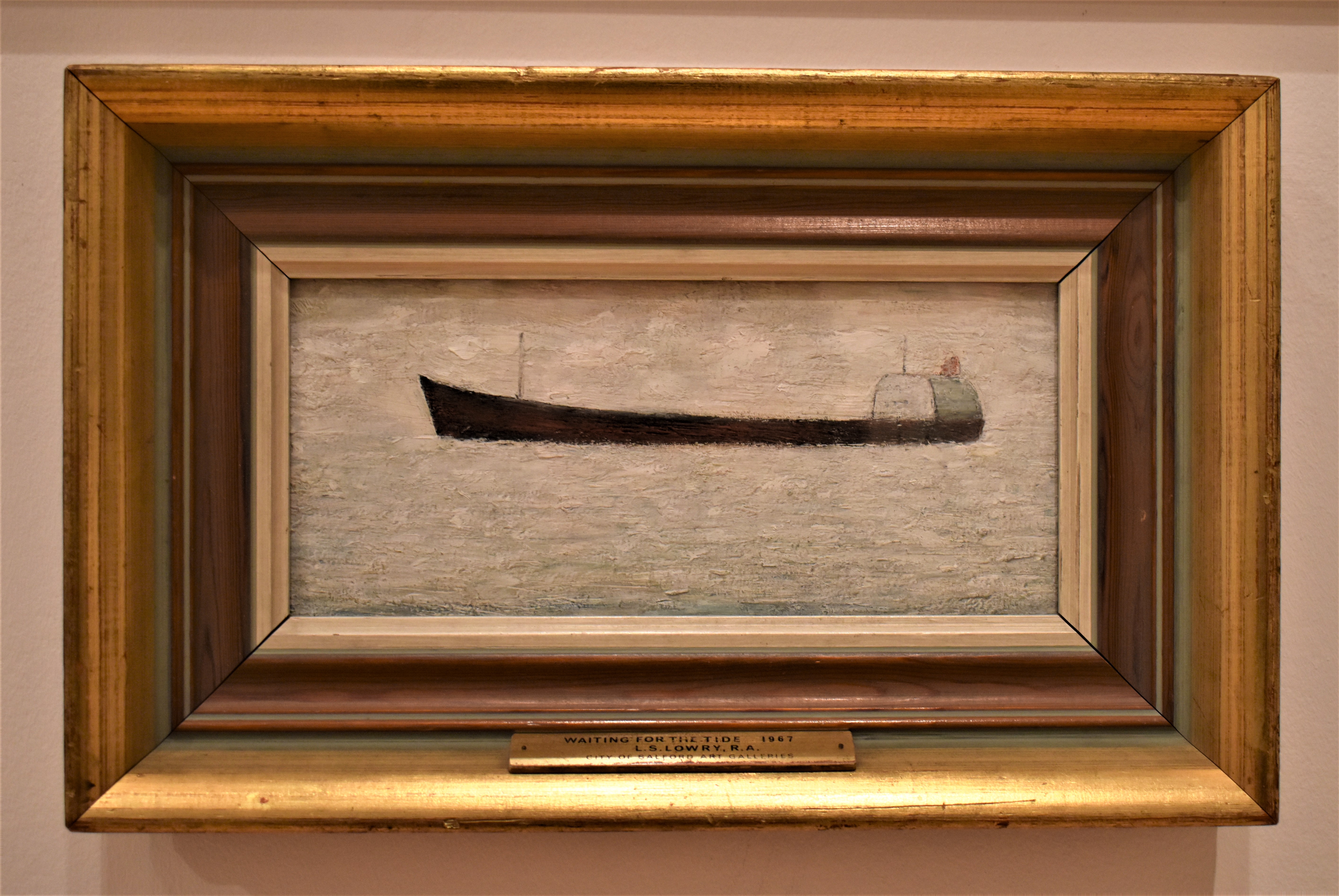
Waiting for the Tide, South Shields 1967. pic taken by Alikivi in The Lowry gallery, Salford.
The reporter was sceptical ‘He says he’s not going to paint, but in his back room there were some painted sketches which looked suspiciously like South Shields harbour and the stone piers. There’s also a white sea with a white sky, and a tanker waiting to come into harbour. Perhaps in his retirement Lowry will do for South Shields what Gaugin did for Tahiti’.
Another close North East link was Mick and Tilly Marshall who ran the Stone gallery in St Mary’s Place, Newcastle.
‘I have got used to this area – there is a very good gallery and they have some good shows. The Tyne is a very alive river with a lot of shipping on it and to watch the ships come in and go out keeps me out of mischief’.
In his later years he was quite happy making frequent visits along the North East coast and found a lot of comfort staring out to sea, again questioning himself ‘Will my pictures live after I am gone?’
Sadly, following a stroke at his home, Lowry died of pneumonia on 23rd February 1976 in Glossop hospital.
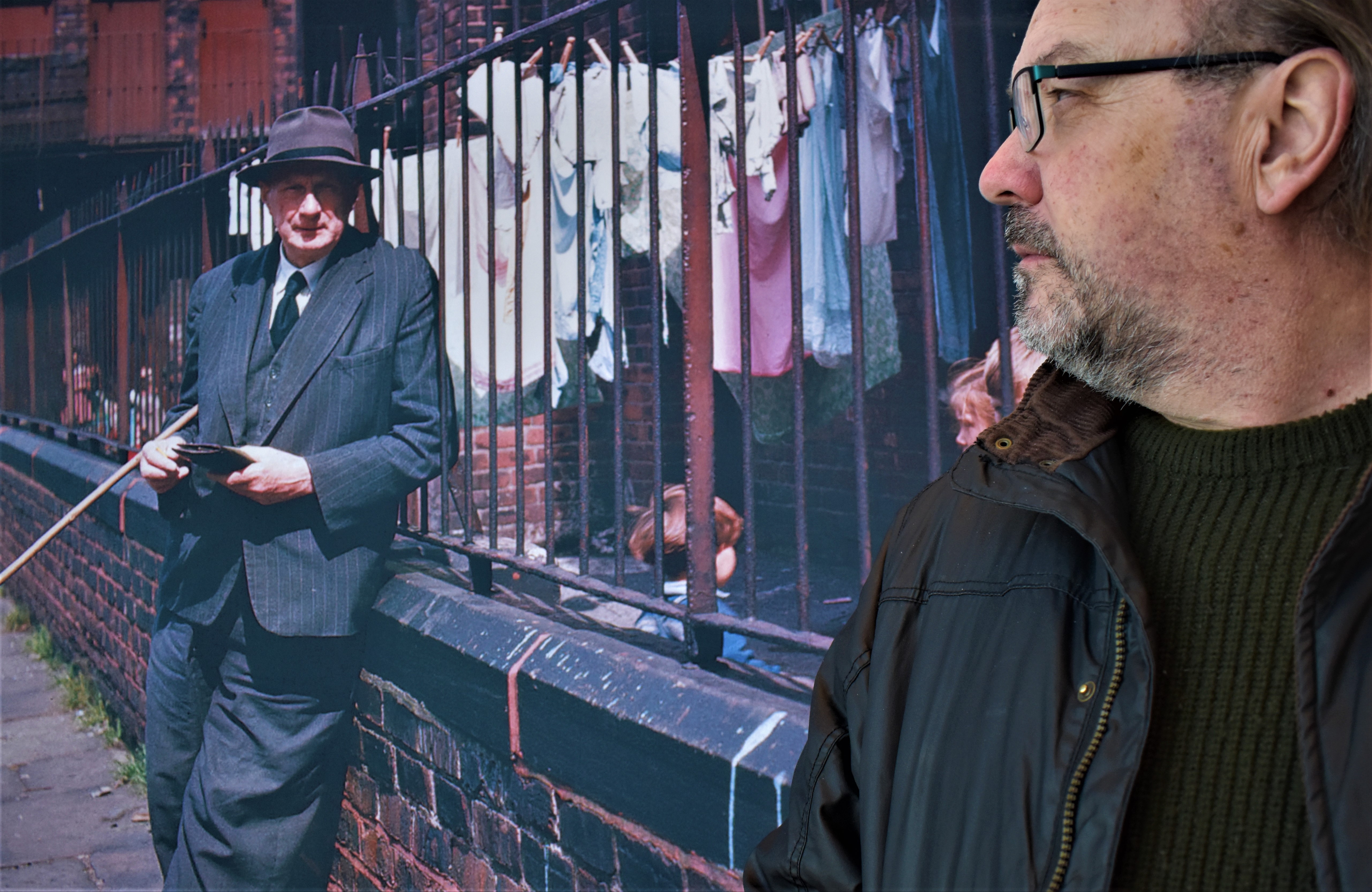
Looking for Lowry in Salford Quays 2022.
In the UK there are many opportunities to see the big fella’s work. Here in the North East you can find his pictures hanging in Newcastle’s Laing Art Gallery and Sunderland Museum. On the border with Scotland, Berwick has its picture boards on the Lowry Trail, which I visited a few year ago.
Last year I went to the excellent Lowry in Salford and the Manchester Art Gallery, both well worth a visit, and yes he certainly lives on, and on and on. What was he worried about.
After leaving school Bob worked in Whitburn Colliery from 1957 until he left in 1968, his love of everything Geordie inspired him to capture on canvas the heart and humour of the North East.
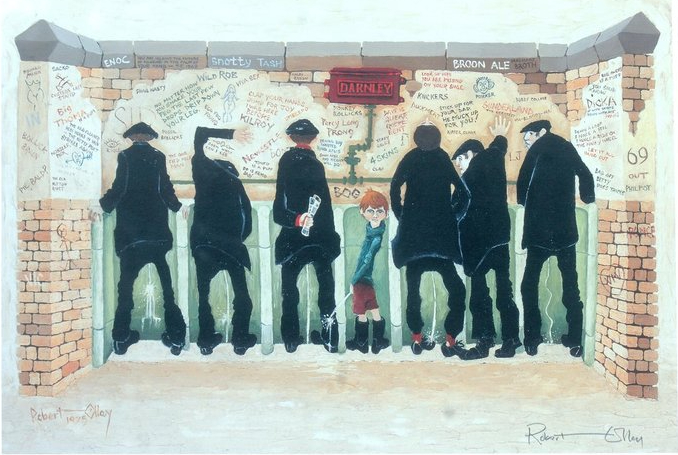
His first gallery showing was in Bede Gallery, Jarrow in 1971, he sold his first oil painting in Gosforth’s Novo Gallery and in South Shields Library in 1972 the painting Westoe Netty featured, it almost closed the exhibition down due to ‘indecency’ – amongst all of his work this has been the most popular.
Westoe Netty.
Somebody told me a few years ago they had been in America and were filling up at a petrol station. He was talking to his partner when the petrol attendant recognised the accent ‘Hey whereabouts in England are you from ?’ ‘We’re from the North East, South Shields’. ‘Do you know Westoe Netty?’ he replied. ‘I have a print from there’.
By the ‘70s Bob was a full time artist and sculptor and received commissions from a number of organisations including Tyne Tees programme What Fettle.
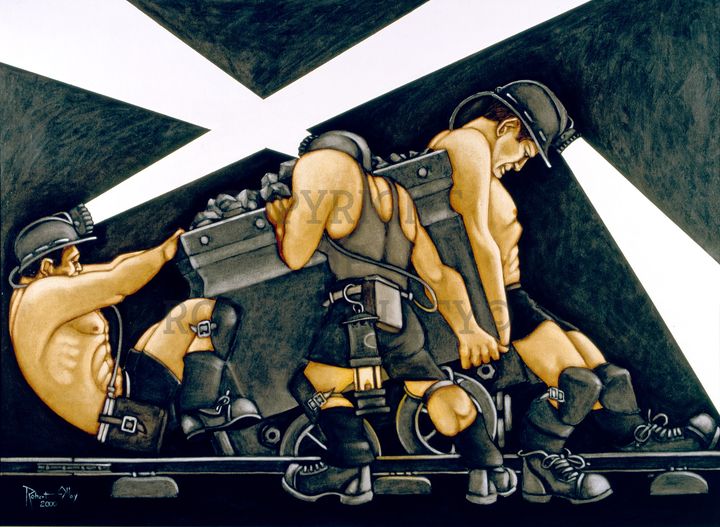
He also held a number of exhibitions around the North East displaying his oil paintings of the coalmining industry.
In the seventies all my work was about North East culture and I knew there were Geordies scattered all over the world but trying to contact this potential market by letter or telephone was impossible, that is until the internet came about.
But when I first kicked off I discovered the open air art market on the Armstrong Bridge at Newcastle where I sold my work every Sunday for almost 25 years. I was one of the first with prints which gave you the freedom to get on with new work as the prints sold.
The bridge was where I learnt how to handle people, you got good comments and some not so good. There was one guy who was looking at a painting, they’re all framed with glass in, he was staring closely at it and I was thinking I’m getting a sale here. ‘Can I help you?’ ‘No’ he replied. ‘I’m just combing my hair’(laughs).
Along with a number of statues around Tyneside – war hero John Kirkpatrick in South Shields and film actor Stan Laurel in North Shields – Olley drew caricatures of celebrity guest speakers including Tony Blair, Jo Brand, David Walliams and Alan Bennett at the David Miliband lectures in South Shields – David was former MP of the town.
What are you doing now ?
I’ve lived in the town most of my life but never took much interest in the shipyards although I knew a few people who worked there when I was a pitman at Whitburn Colliery.
So lately I’ve been working on paintings about the shipbuilding industry because I’ve moved away from the coalmining subject which I’ve done for many years plus I’ve been through a dry period where I was struggling to do something new which is rare for me.
I done a lot of research about the industry, photographs, old black and white film footage, and found it extremely interesting. What really caught my interest was how many trades there was in shipbuilding and finding the safety aspect was virtually non-existent. It was fascinating watching how they work.
Men were walking on a seven inch wide plank 80 feet in the air without a safety harness, or a rivet catcher armed with only a ladle to catch white hot rivets hurled at him from 15 or 20 meters. They’d have a flat cap on – not a hard hat, and clothes that look like they wear in the pub.
In the coal industry we were lucky because we had showers, they just walked straight out of the shipyard and went home. Loss of limbs and the mortality rate might have been higher than the coal industry, it’ll be interesting to find out.
It’s a fascinating subject for me, a totally new direction and I’m enjoying the challenge.
When I was in Whitburn Colliery we stayed with the same set of blokes working an area, you never went off and worked anywhere else in the pit, but in the shipyards once the ship had been built the workers split off into different areas of the yard.
As a coal miner you usually work with the same work mate or “Marrer” within a group of say twenty men on the same coal face in the same district for years at the same colliery.
But as one ship was launched many moved to another yard, the industry didn’t appear to have the same bonding that coal mining had.
In research the word oakum came to light. I found that the prison service in Victorian times used to buy miles of old rope from the shipyards and part of the prisoners punishment was to unravel it and then put it together with oakum.
They would then roll it up and sell it back to the shipyards – that’s where the saying ‘money for old rope’ came from. The yards would then use it to seal the joints on the deck planks.
You could have five trades working to get the deck laid – could you imagine the noise they made.
These paintings I’m working on now have a greater depth than the coalmining just because you are working in a smaller space down in the pit.
You have a much bigger background for shipbuilding, and I enjoy putting in the cranes and seagulls. The paintings become much busier.
In South Shields the yards around Commercial Road, Holborn and Laygate areas had a few pubs and small cafes for the workers. It’s amazing how an area of the town can change its use once the area gets taken over by new technology or housing.
In a matter of thirty years the industry and all the people who worked there were gone.
I’ve been working on these paintings around four months and for one of them it’s the longest I’ve worked on any one piece of work. There was a point you can get to where it isn’t working and to get over that I just push through, then it’s a downhill cruise to the finish of the painting.
The Museum and Art Gallery in South Shields got in touch about contributing to their new exhibition about Tyneside shipyards next year.
I’ll put in about half a dozen paintings and the museum staff are also on the hunt for items to display such as photographs, certificates, tools, workwear and any associated memorabilia.
Anyone who worked in South Tyneside’s yards, or individuals with something they could lend for display, should contact Adam Bell, adam.bell@twmuseums.org.uk or (0191) 211 5599 during museum opening hours.
For more information on the work of Bob Olley check the official website:




 ALIKIVI UK : NORTH EAST MUSIC & CULTURE