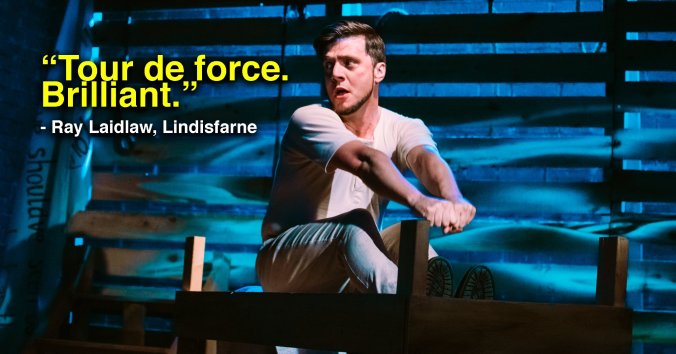
The incredible true story of Harry Clasper is set to tour the North East in February. The one man play ‘Hadaway Harry’ stars Jamie Brown who won a NE Culture Awards Performing Artist of the year.
Harry Clasper was born in 1812 in Dunston, Gateshead, at two year old he moved to Jarrow where he fell in love with the water watching ships coming up the Tyne. Education was limited for Harry, he couldn’t read or write and signed his marriage certificate with a cross. He started work at Jarrow Pit but unfortunately that didn’t work out so his next stop was an apprenticeship at Browns Boatyard.
‘That’s where he got clued up about boats. Harry revolutionized boat racing and boat design, innovations that became part of boat racing then are still employed in boat building today’ explained Jamie.
‘By shaving the boat they made a gun barrel shape instead of a square bottom and pointed the front of the boat. That increased the speed rather than drag through the water, and they made a scooped shape oar’.
‘It was like the time during the 2012 London Olympics when cycling became really popular, they had lightweight helmets, handlebars were shaped to create more speed – huge innovations just like Harry Clasper done for boating in the 1800s’.
‘Rowing was the main sport then, people would sit on the bank of the river and watch the race. Bets would be placed and there would be sponsors – even in those days. There would be stories of men employed to drill holes in the boats of opponents or tempt the oarsmen with alcohol the night before. There was even a case of someone’s food being poisoned. One of the first cases of boat tampering was with the part of the boat called the scull. The term skulduggery comes from that’.
‘The writer Ed Waugh has a desire to shine a light on people or events that have gone under the radar. We’ve done plays about North East musicians and singers Ned Corvan, Joe Wilson and Wor Bella about a ladies football team plus at the end of last year was The Cramlington Train Wreckers’.
‘These extraordinary stories about the working class, are told so they go unforgotten. There is a thirst for these stories, people responded well to them with standing ovations and sold out shows’.
pic. by Local Historian, Steve Ellwood
The Hadaway Harry shows in 2015 and 2017 eventually got Harry Clasper some recognition as a blue plaque was fixed onto the base of the High Level Bridge in Newcastle. There is also a pub called the Harry Clasper in Whickham, Gateshead.
‘He came from a big family – he was one of 14 and had 12 children himself. His ancestors are still around today, they’ve been to the shows and are very proud of his achievements’.
‘But his story wasn’t straight forward, it’s not looking back with rose tinted spectacles as he suffered personal tragedy and professional disappointments, there was plenty of hardship and personal dilemma’.
Later in life Harry became a publican in Newcastle but sadly died in 1870.
‘Over 120,000 people lined the streets for his funeral the procession was only a few miles but took over 12 hours. His coffin was put on a boat and sailed down the Tyne to Whickham where he was buried’.
The North East has stories of talented people achieving great things – we talked about the footballer Paul Gascoigne, coincidentally also born in Dunston where Harry came from.
‘Before Association football the sport of the people was rowing and Harry Clasper has been likened to the David Beckham of the day. I think, as many people do, he should have a statue next to the river Tyne. His achievements were fantastic. Do you know he won the world championship 8 times in 12 years’.
‘It’s been a privilege telling his story, but sadly this will be my last time on stage doing the Hadaway Harry show. I’ve loved doing the show but in the second half of the play it is hard rowing and narrating the story as a one man show plus I’m 40 in February so it can be a bit exhausting’.
‘So, this is me hanging up my oars but the play will go on and maybe a younger actor will take on the role. This is why on the tour schedule after about three nights we have a day or two off where there is time for rest and recovery and then for the next show I’m ready to be able to give 100%’.
For information about tour dates and venues contact the official website >>>
I listen to all styles of music it’s been a constant through my life. Even when you’re sad there are tunes that can pick you up. I’ve seen bands like Crass the more abrasive side of punk but I love the power pop as well. I may be a big punk rock fan but also love ABBA… explained Radio Northumberland presenter Keith Newman. We talked about his passion for music and the special moments when you are a teenager blown away watching your first concerts and meeting a band.
Thanks to local historian Steve Elwood for the advert taken from the Evening Chronicle.
It was May 79 and The Dickies were doing a signing session in HMV, Newcastle. Banana Splits was their latest single and they were signing copies. I nicked off school to get there it seemed like everybody else had the same idea cos it was rammed with queues of kids to see the band.
HMV had a big window at the front and with all the pressure of the kids pressed up against it, it smashed into the shop – and me with it.
Police were called, the kids scattered – I never got me autographs. But it was on the telly and my mother saw it and I got knacked. Years later when interviewing Stan Lee from The Dickies I mentioned the HMV incident and he couldn’t believe I was there. We got on great after that.
Actually, the first band I saw was The Dickies at Newcastle Mayfair, most anticipated gig was first time for the Ramones at Newcastle City Hall.
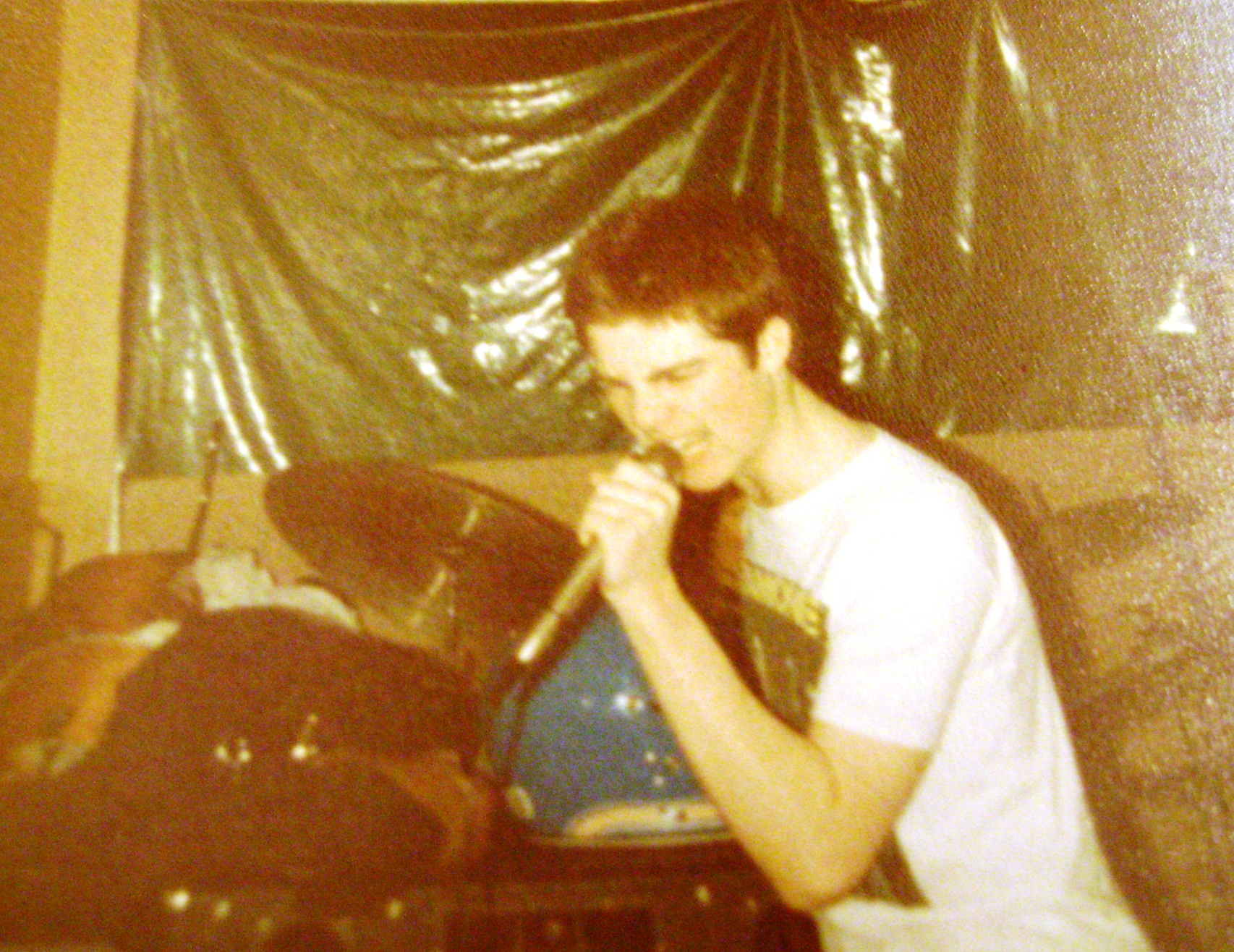
Keith on stage with the Village Idiots.
In 1980 we formed a punk band called The Village Idiots, we rehearsed in a portacabin in Leazes Park, Newcastle. We played three gigs in all, shouting and screaming, we couldn’t play – it was just noize.
Our first gig was on a bill with four other bands playing for the patients in Prudhoe Mental Hospital. Before going on we were interviewed live for Hospital radio. When I told the interviewer the name of the band his face dropped and quickly cut us off. Subsequently we were banned off the radio – a very punk thing to do.
We opened for Total Chaos at The Garage in Newcastle it was a real punk venue. Total Chaos were a proper band and we were on with them – couldn’t believe it! Thing is I remember we were bad but now I get some people saying yeah I was at that gig and The Village Idiots were great. I say no we weren’t. We were crap. Really we were.
It’s a strange thing…three gigs and immortality…we’re down in folklore! There’s even a photograph of us in the book about North East bands Closest Thing to Heaven. After the Idiots I joined a band called Damian – and they could play. Very goth, Iggy Pop – Lou Reed sounding – we also had two female backing singers.
I also run a PR company called Highlights PR and how I got started in radio was through a business contact. Ultra Radio were based in Ashington and I asked to be punk DJ. That went well until the licence ran out so myself and another DJ, Stewart Allen, formed Radio Northumberland 15 years ago.
It’s only on the internet at the minute although plans are to go DAB next year plus we’ve just moved into a new studio in Alnwick. We’re always looking for some sponsorship to help with the costs – anybody out there just get in touch.
The show New Wave with Newman has built up a decent following. It’s live every Monday night where I play Ramones, Undertones, Skids those types of bands. 1979 was my favourite year for music.
The show also showcases a lot of local bands, its great to see their development, Slalom D from Sunderland have done really well after releasing two albums and playing Rebellion Festival in Blackpool.
The show not only gives me the chance to play the music I love but to meet my heroes. The first interview I did was Jake Burns from Stiff Little Fingers, then The Dickies – I even took Stan Lee shopping in Newcastle for a new ipad.
Keith and Marky Ramone.
But the one that got me really nervous was with Marky Ramone. I found he was doing a DJ set in Newcastle. He was so cool and recorded a few spoken intro’s that I used on my show ‘Hi this is Marky Ramone from the Ramones and this is ‘Sheena is a Punk Rocker’. Fantastic.
I first saw them in 1980 at Newcastle City Hall and bought the t-shirt from the gig which I never took off. I remember next day I was going to a corner shop in Forest Hall to get me ma’s tabs – yep we could in those days – and I could see a coach outside. As I got near it pulled away.
I went in the shop and the assistant said ‘eeh see those lads on your t-shirt – they’ve just been in here. They were Americans asking for milk and cookies’. I couldn’t believe it I ran outside but the coach was away up the street.
For years I wondered if it really was them so when I talked to Marky I asked him about it and he told me Johnny Ramone had OCD and after every gig he had to have milk and cookies.
I also interviewed CJ Ramone on zoom and that was interesting how he talked about the legal wranglings about getting a percentage of the merchandise. Another Ramone drummer I talked to was Ritchie, I arranged to meet him before soundcheck and we caught up in an Italian restaurant. He was really nice we chatted for an hour. The kitchen staff and waitress were Ramones fans so they came over – yeah it was great he was really easy going and signed my albums.
Thing is I’ve interviewed Skids, Undertones and Baz Warne from The Stranglers – just loads of these supposed to be nasty punks – when they were all really nice to talk to. Martin Metcalfe from Goodbye Mr McKenzie was the latest. I rate them as a good band.
What does music mean to me? I just love music. I do the radio, I do the Tyne Idols Bus Tour, I do a lot of PR work with bands like Eddie and the Hot Rods and music festivals – that’s me bread and butter. Yes, music has been important in my life not just for relaxation but for work.
It’s also good to see when friendships are formed through the radio show. We have listeners in Scotland, Teesside and Cumbria, and strangely the most popular area is Sunderland. There are listeners now in USA and Canada – probably folk who used to live in the North East.
There are a lot of shows on Radio Northumberland where you hear the authentic Geordie voice which a lot of listeners like. Yes we’re really grateful to the people who tune in.
After a career in the Royal Navy which took her around the world, to managing pubs in the UK, plus running an island in the Falklands, now in her mid-60s Karen is back working on Tyneside where she fosters for people with learning disabilities.
I’ve always been in a job were your committed 24/7. When I look back the Falkland islands was a fascinating adventure but that story is for another day, this is about my time in the Royal Navy.
When I left school at 16 I didn’t have a clue what I was going to do but my parents were adamant I was going to get some kind of job and my mother knew someone who worked in an office in South Shields.
But I knew an office environment wouldn’t be any good for me because I struggled academically. I didn’t know it at the time but I was dyslexic.
I was out in Sunderland with a friend and he was talking about joining the army. This triggered a thought in the back of my mind as something maybe I could do.
I went to South Shields careers service, the only leaflet they had was about the Royal Navy. I applied and got an interview at Gunner House opposite the Central Station in Newcastle. I passed that and got offered a training place in Reading – joining on the 2nd October 1978.
It was scary travelling down south on the train but when I got there somebody was waiting and took me to HMS Dauntless where I started my provisional training.
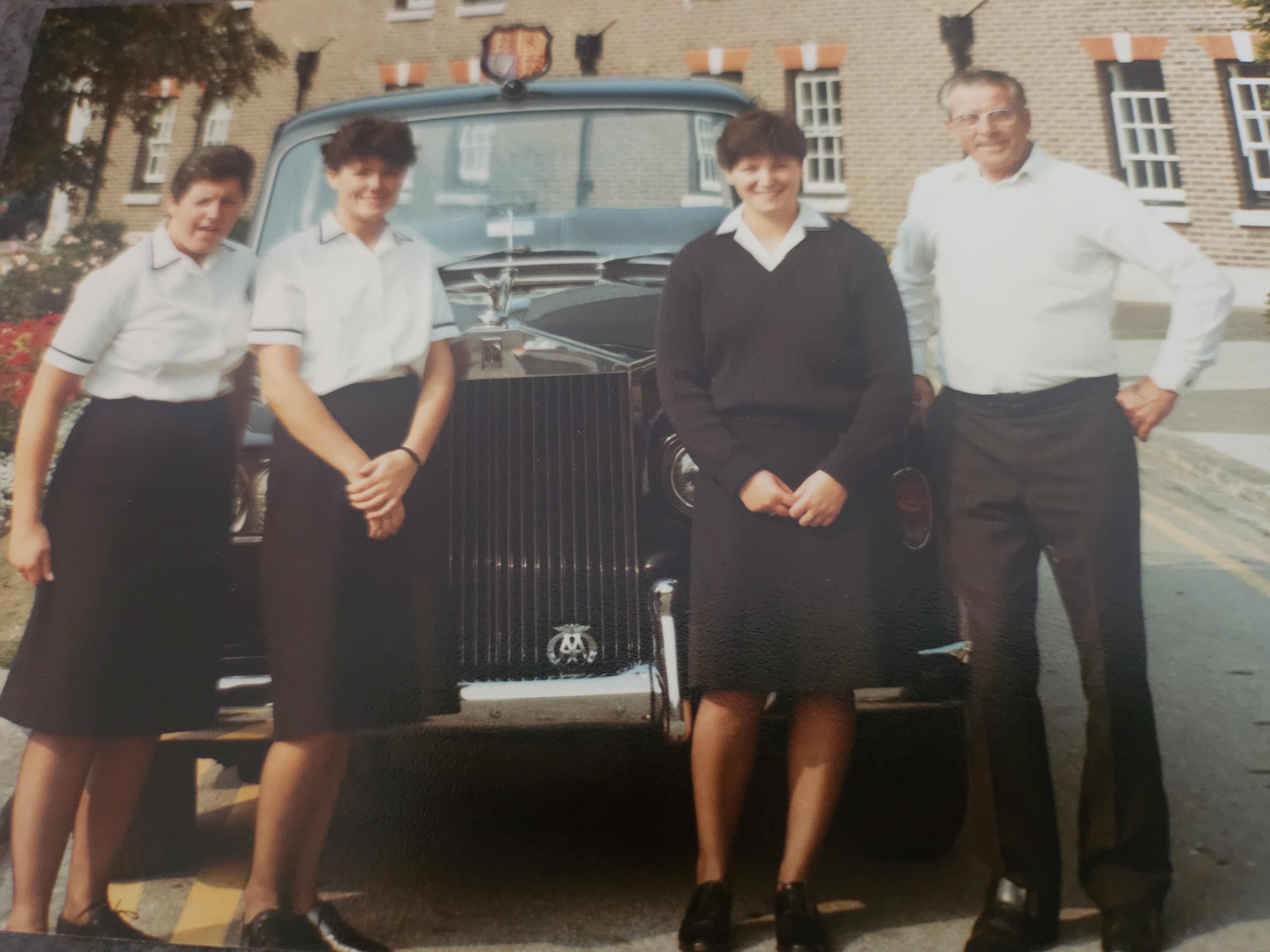
Karen with new recruits (back row on left) at HMS Dauntless, Reading 1978.
HMS Dauntless is your basic training base. We had to prove we were physically fit, learn about teamwork, Navy values, how to respond to orders, the importance of ceremonial duties and drills then finally getting fitted for our uniform.
It was hard, I didn’t get the strictness of it all at first. When they say clean the floor with a toothbrush it really meant that and when they say get there at 10am it really means 9.55am because Navy time is always five minutes before. Once after turning up late, I had to clean every window in the dormitory using newspaper and vinegar. I shaped up after that.
I had lovely long dark hair but after they gave me all the injections my arms were really sore and I couldn’t lift them up to put my hair up in a bun. You always had to tie up your hair when on parade – so in the end I had it cut off.
After five weeks training, we had a passing out parade and I was sent to HMS Pembroke in Rochester as a WREN Catering Steward where I took more training.
HMS Pembroke was the place we went to learn how to be a good officer steward. We were shown different types of dinner service, bar work, how to clean the silverware, uniforms, shine shoes. We also learned first aid and basic fire training. We were often told ‘Leaning time is cleaning time’.
In the month when I joined there was about thirty of us and only two from the North. In the café one day some lads came in and heard I was a Geordie. They asked me to say things like motor boats and paper planes! They were fascinated with the Geordie accent.
While I was there a TV show was being made and we got to meet one of the actors. The local paper back in South Shields printed the photo with me and an actor dressed in German uniform.
For possible bomb threats we always done exercises and always warned beforehand. Late 70s the I.R.A bombing campaign was prolific and this time HMS Pembroke was threatened with a bomb.
We were in our barracks when everything went quiet and the siren went off. We were under threat. This wasn’t an exercise – it was real. We all hid under a table. Fortunately, nothing happened but it’s a scary feeling thinking we could all die here.
Then on 10th January 1979 I went to HMS Neptune the nuclear submarine base in Faslane, Scotland. It was a beautiful affluential area around Gare Loch. It was a good dorm with only four of us in, really good girls.
As a Steward we served meals to officers and guests at official receptions, operated the bar and looked after officers’ accommodation.
One time we went out on the submarine as it submerged in the loch it was doing angles and dangles, that’s basically moving up and down. Everything – even the tea urn had to be secured.
But this was the time of the start of nuclear protests, they were setting up camp outside the gates and chaining themselves to the fence. Before the protests it was pretty much easy going around the base we would go out on our bikes, now we couldn’t go out as much.
There was a chance of a four-month draft stewarding in the barracks in Northern Ireland. I was still 17 so the Navy had to ask my parent’s permission if I could go. ‘No chance’ they said. So that was that.
I was livid, more livid with the Navy that they had to ask. I was responsible enough to be part of their war team but had to ask me mam to go! Would love to have gone there.
The Falklands war was on when I was based at HMS Vernon in Portsmouth in 1982. I remember when the first ship was hit on 4th May. We were in a disco and everybody was dancing when the music suddenly stopped and an announcement was made about HMS Sheffield.
I knew one of the chef’s whose ship was one of the first hit and sunk. He told me afterwards they were getting in the lifeboat and someone shouted ‘that’s typical, it was a really good scran tonight’. The Navy use dark humour to get out of any situation.
The fact of not knowing who was alive or dead brought on a lot of mental health problems after that war. It must have been terrifying what they went through.
Morale during the war was to carry on as normal as you would expect. I’m sure there was a conscious effort from all ranks to keep morale up. The war lasted 74 days and when the fleet returned in 1982 huge crowds gathered on the quayside to welcome them back.
On ships they have what they call Sods Operas which is a show they put on with games, songs, jokes. Each mess has their own night like karaoke, darts or talent night. We all need to laugh to keep morale up and for letting off steam – but sometimes a laugh wasn’t enough.
The submarines would go away for three months underwater and the crew would need a release when they returned to shore. They’d choose a bar to go in all night to let off steam, get drunk and fights would break out. Some nights would get out of hand, but if you’d been cooped up after not seeing anyone else and not even being able to go for a walk to clear your head, how would you cope?
A fantastic opportunity come out of HMS Vernon. It was a four-month draft to Australia. A tri-service of Army, Navy and Air Force basically doing a swap with their forces.
It took around a week to get there – there were no commercial flights for us. First, we went out on a Hercules to Germany then stopped in Singapore for a few days. The Australians flew us into their country then down to Sydney. I went on to our accommodation near Canberra which was in the middle of nowhere.
The Australian Navy were lovely but this was a culture shock, kangaroos jumping all over when you’re going to work, a beautiful beach but couldn’t swim in it cos there’s sharks, there was no local buses, nothing to do really.
I wasn’t benefiting from being in Canberra so was fortunate with the help of an English officer to arrange a draft to Sydney. This was completely different. Accommodation was like American motels and based next to Bondi beach.
It was a lively place – I remember The Flying Pieman restaurant, the Aussies love their food – the barbies, fantastic meals. We had a week’s holiday and travelled up to the Gold Coast – I loved it there.
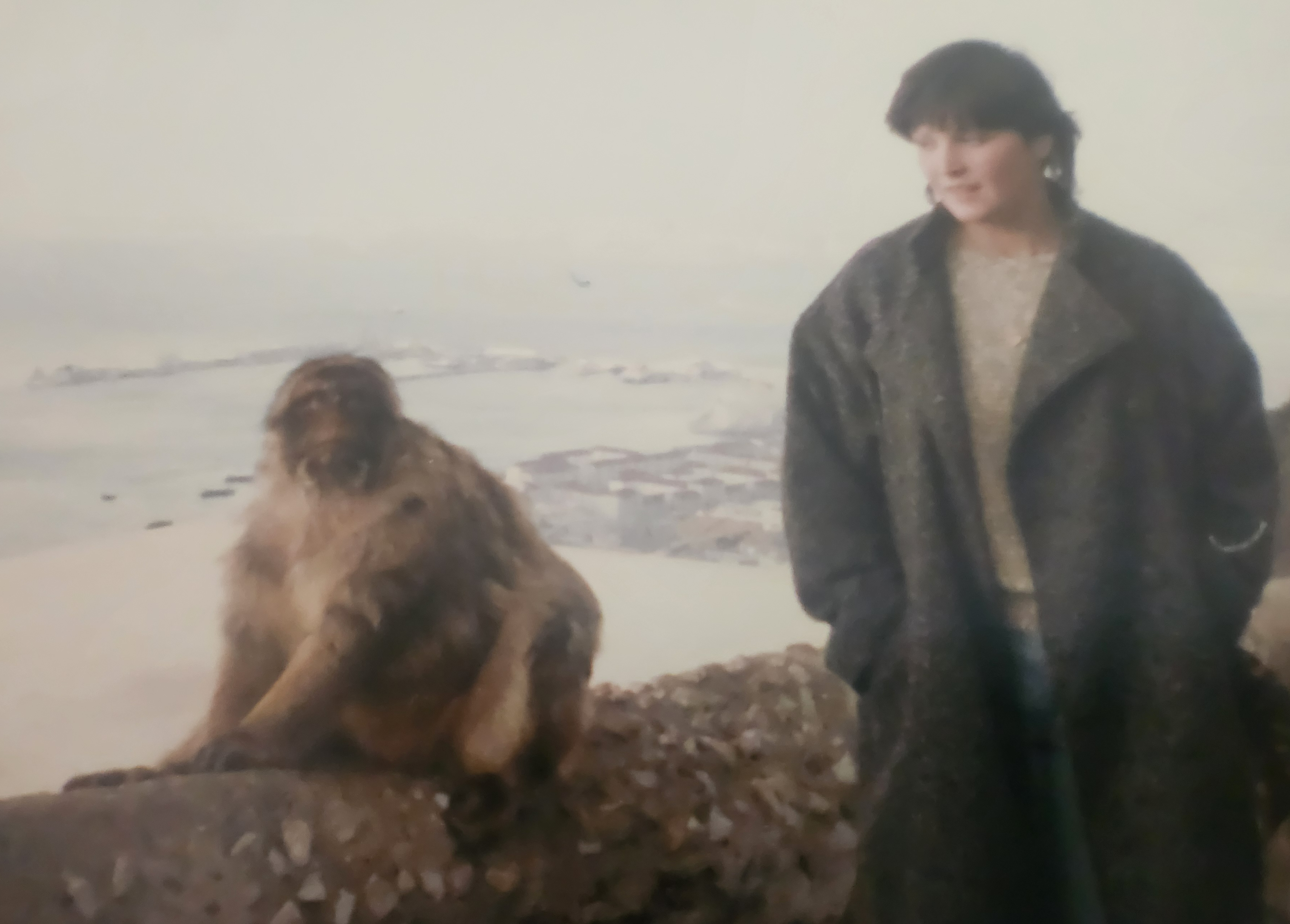
Gibraltar rock in 1985.
By 1985 I was based in Gibraltar at HMS Rooke as an Acting Leading Wren. We were contained on the rock because the border wasn’t open then. Gibraltar didn’t have much, there were dusty old streets and you couldn’t get things like fresh milk.
There was nowhere to go really. Instead of going stir crazy the Navy used to take us over to Morrocco. We’d get away for a weekend to Tangiers.
When I was there the border with Spain officially opened and we walked through to get our passports stamped, then we could go to have milky coffee or a few drinks in La Linea. With the border fully open now we went up the coast to enjoy seaside towns like Fuengirola, Marbella and Torremolinos.
Back to the UK and Portsmouth, or Pompey as it was known to the Royal Navy, the city had lively pubs and clubs used by the Navy, it was a good run ashore. Yes, we liked a drink, who doesn’t? But as I’ve said socialising was our way of letting off steam and relaxing after a hard day’s work.
At HMS Nelson we had summer and winter balls in massive marquees to organise. Big entertainers were booked, TV people and celebrities were invited. One year we had Kenny Ball and his Jazzmen playing, another Oliver Reed turned up but was kicked out for being drunk and offending people.
We had a really special visit one year from the Queen for a commemorative event. There were hundreds attending and sniffer dogs were brought in for security. A massive truck turned up a few days beforehand with the Royal’s own cutlery and plates.
To lay the table we had to get out a tape measure and length of string to make sure everything is straight and measured up. I’m sure she never says ‘that fork needs to be an inch over’. As I served her lunch she would say ‘Thank you for bringing that’. She was lovely, like a little nana, really nice.
From there I went to HMS Warrior in London working for the Flag officer of Submarines who worked out of a property in Rickmansworth. He had a team to look after him – chef, driver, chief steward, then me.
I wasn’t there long as I moved back to Portsmouth and HMS Dryard where I worked for the Captain. I loved my last years in Portsmouth but that’s where I finally left the Royal Navy for good on 5th March 1990.
What do I think of my time in the Navy? For someone from little South Shields not knowing much about the world and who had only been on a caravan holiday in Wales, to go to all these places, meet different people, experience different cultures and make life-long friends was fantastic.
The Navy teaches you to be self-sufficient, disciplined and learn valuable life skills like teamwork. It might be a good idea to bring back some sort of National service today, it’ll only be a good thing.
“I’ve always been fascinated with everything World War Two related and RAF in particular. My grandfather was in the Royal Flying Corps, and both my father and my son were in the RAF” explained Terry.
“I was in the Air Training Corps in South Shields but then a medic came to school to test us all for colour-blindness. I failed the test miserably and was told I would never be accepted by the RAF. I was gutted, as you can imagine”.
Terry lives in Marske on Teesside, but was born in South Shields at midnight 21st– 22nd December 1948…“My mum asked the midwife which day was my birthday. She was told it was the 21st as my head came out on that day. That crosses the Winter Solstice, so my top half is Sagittarius and my bottom half Capricorn. I think this explains why I’ve done so many different jobs in my life”joked Terry.
Throughout his school years his parents moved around the country…
”We lived above a wallpaper shop in Stockton on Tees, then moved to Billingham and later down south to Reading and Mitcham”.
Finally, the Wilkinson family moved back to South Shields where Terry was a pupil at South Shields Grammar Technical School for Boys.
“After leaving school, I worked for the Crown Agents for Overseas Governments in London, thenWise Speke stockbrokers in Newcastle where I became a Member of the London Stock Exchange”.
“From 2000 I ran a successful Theatre in Education company touring schools for 15 years. It won a Best New Business Award but I gave it up in 2015 in order to write”.
When researching his family tree and local history Terry has always been fascinated by one event.
“At midnight on 3 May 1941, the factory and Head Office of Wilkinson’s Mineral Water Manufacturers in North Shields was hit by a single German bomb. It went through the roof, descending through all three floors, taking all the heavy bottling machinery and chemicals down to the basement – which was in use as a public air raid shelter. 107 died, 43 of which were children. Whole families were wiped out.”
“It is written by my good friend, Peter Bolger, who also manages a comprehensive website on the incident”>www.northshields173.org
“Because of censorship and the government’s desire not to damage public morale, little is known beyond Tyneside. It was, however, one of the largest loss of life incidents from a single bomb during the provincial Blitz”.
“Nothing is known of the identity of the plane which dropped the bomb – type, squadron, mission etc – as German records were mostly destroyed in the closing stages of the war”.
“I wanted to write a story that answered all these questions and create a fictional alternative. Having said that, nobody could say with any conviction this is not what happened”.
Terry started on a series of five espionage novels. ‘Handler’ is set in 1941, ‘Sleeper’ in 1942 and is currently working on the third ‘Chancer’ which covers 1943.
“They’re a mix of fact and fiction and trace through the war years of an English-born German spy, Howard Wesley, and his nemesis, MI5 agent Albert Stokes”.
“Wesley is a figment of my imagination. Stokes is based on a real character. And this is the pattern for the other books in the series. I also like to plunder WW2 history for little-known incidents and people who feature against the broader background of what was taking place in the war”.
‘Handler’ won a ‘Chill With A Book’ Premier Readers’ Award just a few months after publication. This spurred Terry on to get others in the series out there as quickly as possible.
“A few of those who have given good feedback have made the point that it would make a good series. I am convinced that it would. I certainly write with a film or TV series in mind”.
“In the shorter term I am hoping to record the whole series as audible books. I recorded an extract from the book that author John Orton is currently writing (link to interview below) and he was happy with it”.
“I’ve spoken to my publisher – UK Book Publishing – and offered them my services as a narrator for others. I’m also an actor, card-holding Equity member and very good at accents and dialects”.
Now 85, Arthur talks about joining the police force as a cadet in 1955…
‘Yes, I was a polis in Newcastle, the city was a lot different then I’ll tell ya, it was still getting over the war to be fair. My first beat was Sandyford Road where the Civic Centre is now. That was all houses then’.
‘It was quite a tough beat, a rough area with pubs like The Lamberts Leap and another called The Sink near the Haymarket. You had to earn your corn, there were no radios or panda cars – you were just pushed out onto the beat and that was it, you had to get on with it’.
‘There was a police pillar (similar to a post box but with a telephone inside) on the corner of Sandyford Road. If you arrested anyone you hoped you could get the person to the pillar. It was difficult cos sometimes you had a couple of guys fighting…you had to get them there, it wasn’t easy’.
‘There was generally more respect for the police then, you would get more help from the public once you established yourself on the beat, which you had to do cos you were tested out straight away’.
‘Once they knew you were fair and straight you got a lot of help from them. You were on that same beat for years, you weren’t just passing through you got to know every shop keeper, every doctor, every villain…you got to know the whole community. But then the T. Dan Smith regeneration project of slum housing clearance began and the place changed completely’.
‘I always liked paper work, always took pride in my reports. A crime file for shoplifting or murder has a beginning, middle and end and you had to go to court and defend what you had written. In the end someone could go to prison so you’re under pressure, under scrutiny. That reality far exceeds any drama’.
‘I moved from department to department, CID, drug, vice, crime squad, then around 1978 I worked for the anti- corruption team in the Government based in Hong Kong. For the year I was there I would see people living in cages on roofs, people swapping babies in hospitals, it was a weird place. I wrote an article for the Police Review national magazine on what I saw, they paid me £25 for it. It was read all over the country’.
‘I didn’t start writing until I was 40 you know. When I came back to the UK, I worked in Washington Police Station, a young cop called Jeff Rudd came to see me ‘I used to be a musician in a band, I’ve still got all these tunes going round my head but can’t put words to them. I read your article and seen your reports, I wonder if you’d be interested in putting some words to my tunes?’
Well, I give it a go and then thought nothing of it until a few months later I was pleasantly surprised when he handed me a tape with the songs on. I really enjoyed my time with Jeff, he was a very accomplished guitarist. We ended up writing around 50 songs, one of them ‘Big Bren’ was about the athlete Brendan Forster, that was played on radio’.
‘That led us to doing an interview and playing some of our music on the Frank Wappat BBC Newcastle radio show, then we done a couple of gigs in Washington. Next thing my wife Irene said why not contact Tom Hadaway? (writer When the Boat Comes In, Newcastle Live Theatre).’
‘I wasn’t sure at first because I didn’t know him but as he was from North Shields we met and he told me to write a play. ‘What do I write about Tom?’ I asked ‘Write about what you know. What fires you up.’
‘So, I went away and wrote about the bait room. Tom read the play and was laughing at it ‘Yeah, you know how to write dialogue son’.
‘There was a police section house near Exhibition Park, in it was a bait room, just a pokey little room with a table to play cards on. If you’re on night shift you’d take sandwiches and a flask of tea in. That’s where you gathered around 1am where the events of the night would unfold’.
‘You would get advice on how to deal with someone, it was a good place to sort things out like the older cops would tell you how to deal with a death, how to deliver a death message to the unfortunate family. It was a sort of meeting of minds over a game of cards. Aye the bait room was a good place to vent your spleen so to speak.’
Running parallel with his police work Arthur was training in athletics at the running track at Ouseburn, Newcastle.
‘I was on shift in the Bigg Market from 5pm till 1am, that was rough, there was fighting most nights. After finishing I would grab a few hours sleep then go to court, then onto shot put training. I was in the British athletics team from 1962-71 and competed in the 1970 Commonwealth games in Edinburgh. I was very fortunate and saw the world with athletics’.
Arthur talked some more when the conversation turned to the present day and the riots that are happening this summer around England.He recalled a quieter time for the police.
‘I remember we had a huge kettle for the bait room. It was always on the stove. One day a big fish wagon went past the section house and dropped a fish out of one of the boxes. I picked it up brought it back into the station put it in the kettle and boiled it up. All day everybody was complaining about the smell from this mackerel…and no, we didn’t eat it!’
‘Another story was one night when I was up beside the Hancock Museum going to the section house at Park Terrace. Can you remember the litter bins that used to hang on a lamppost? Well, this one was upside down on the lawn outside the Hancock and it was moving around. I lifted it up and there was a hedgehog underneath it!’
‘So, I put it in my coat and took it up to the section station. Inside are lockers to put your bait in so I put the hedgehog inside one of them and waited for the copper to open it. He just about had a heart attack when he opened the locker!’
Hearing these innocent stories was a world away from watching how the police were dealing with the riots around the country, but then Arthur’s tone changed.
‘I remember it was winter time, snow piled up on the ground. I went in for my bait around 12.45am and heard a muffling sound, I opened the door and there was an older police officer trying to commit suicide with a plastic bag on his head. There was a scuffle as I grabbed hold of him but couldn’t get the bag off. I looked around found a fork and split the bag but caught his face at the same time’.
‘He was playing hell with me for saving his life ‘What right did I have’ and all the rest of it. As we were having this argument I could hear the other officers coming in for their bait so everything was put back right, we straightened up the chairs and table as if nothing had happened’.
‘That policeman only had a couple of year service left, he was very bitter, he didn’t thank me. Turned out he had a hell of a life with his wife and thing was he had seen action in the second world war’.
After writing about his experiences in The Bait Room, Arthur kept in touch with Tom Hadaway and wrote another play.
Tom looked at it and gave me pointers, when I finished it landed on two desks. One was the BBC in Manchester where I met them, it ended up on the Saturday Night Theatre radio show, which was a big thing’.
‘The other was the script reader for David Puttnam (producer Chariots of Fire, Local Hero, Midnight Express) who hated it at first but won her round in the end. She said she couldn’t do anything with it but put me in touch with an agent who was looking for writers for a tv show called The Bill. That’s where the writing started’.
Arthur being interviewed on BBC Breakfast about writing ‘Harrigan’.
In 1988 Arthur retired from the police force giving him more time to devote to his writing where over the next decade he delivered TV episodes for Wycliffe, The Bill, Casualty, Spender and Harrigan. The Bait Room was finally made in 2009.
‘I used the same discipline for writing as I did sport. Getting a focus, deciding what you want and going for it.’
‘What am I doing now? I’ve had a lot of my writing shown around the North East. ‘Pickets & Pigs’ was a story set to the background of the 1984 Miners strike’.
‘Later this year I’ve got a play on stage which I started writing in 2003 with Dave Whitaker. ‘Blackbird in the Snow’ is one of those that you leave on a shelf for a while then go back to’.
‘I worked with Dave on a musical about the Jarrow March called ‘Cuddy’s Miles’. John Miles wrote the music for it, Cuddy was a cook on the march, he was John’s relation. That was well received when it played The Customs House in 2004’.
‘Sadly, Dave passed away in 2021. He’ll be sorely missed so the new play is produced as a salute to Dave’s beautiful lasting memory’.
‘Blackbird in the Snow’ has a four night run with the premier on 5th November 2024 at Laurels, Whitley Bay. For more info and extra dates contact the official website >
During the 1926 General Strike miners in Cramlington derailed a train of Flying Scotsman carriages pulled by the Merry Hampton engine.
The miners thought the train on the Edinburgh to London mainline was full of blacklegs undermining the strike, unfortunately for them it was a passenger train, no one was killed with only one person injured.
Was it workers defending their jobs and communities, or terrorists? Eight Northumberland miners were sentenced to 48 years for their involvement.
To explain the near 100 year old story an event is booked on Tuesday, October 24 @ 2pm & 7pm, Tyneside Irish Centre, Newcastle.
This will include an illustrated talk by playwright Ed Waugh (Wor Bella, Hadaway Harry, Carrying David), recitations and songs plus a showing of the brilliant 30-minute BBC film (1970) The Cramlington Train Wreckers which features interviews with the surviving four “train wreckers”. It is a historical document and anyone interested in Geordie social history should not miss this.
The joint production between Westoe Miners Banner Group and Wisecrack Productions aims to tell the incredible story of The Cramlington Train Wreckers.
The Battery has stood guard at the mouth of the river Blyth in Northumberland for more than a century. It’s an impressive array of buildings that acted as a lookout, armaments, storage and an assembly point during World War 1, the Battery also boasted two six-inch guns for coastal defense.
This weekend, May 20 & 21, the Battery is hosting two days of exciting historical activities when it presents Blyth Battery Goes to War.
Lindsay Durward, secretary of Blyth Battery Volunteers, explained “We are delighted to announce our exciting activities for the weekend. There is something for people of all ages, from children to the older generation.”
Run by dedicated volunteers the weekend will involve a full programme of music, comedy, song and dance and re-enactments from 10am to 4pm each day. Top Northumberland folk combo Beeswing will close the weekend at 3pm on Sunday.
“We take the history of the battery very seriously. One of the main aims of Blyth Battery Goes to War is to put the battery plus Blyth on the map as well as enjoy ourselves.”
“It’s a free event but we would ask everyone to put a few coins in our donation buckets, buy a cuppa in our cafe, tell their friends to come back after the event and talkto us. We are always looking for volunteers to come along and see what we do”.
For further details about the Blyth Battery Goes to War weekend and summer visits, visit the Blyth Battery Facebook page, BlythBattery.org.uk or contact
Peter is employed by Gateshead Council teaching one to one lessons withpupils who don’t go to school.
He also goes into primary schools to teach aspects of local and regional history.
It’s a great feeling when a kid you have helped returns to school. One of the mothers got in touch saying two years after I stopped teaching her daughter to say that she had gone on to do A levels at Gateshead College.
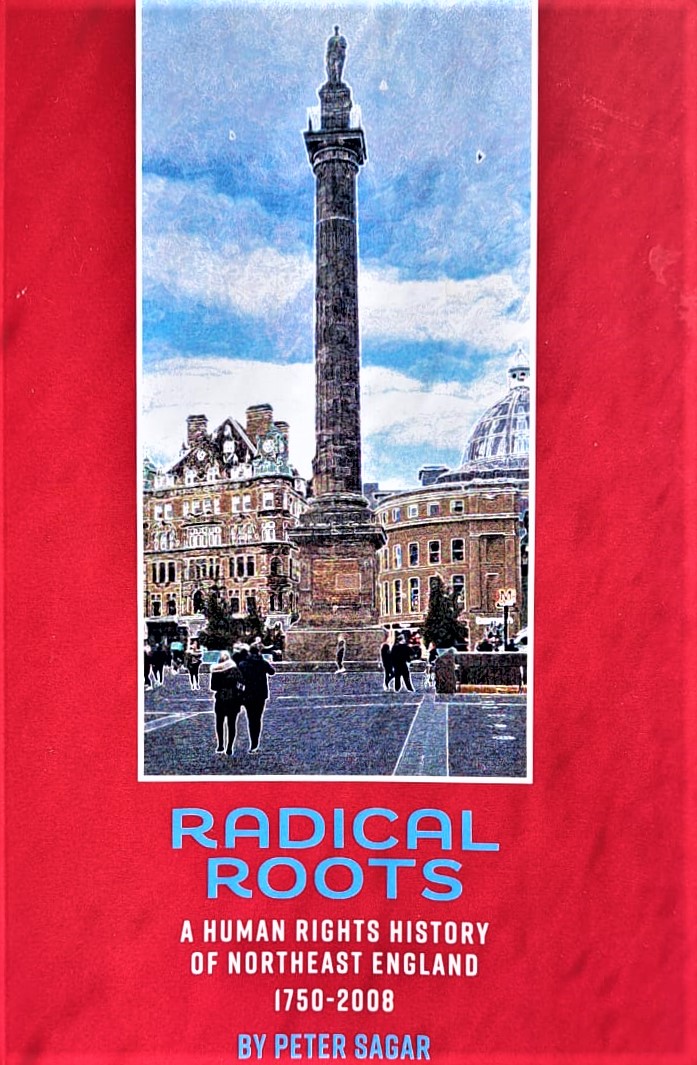
From his North East history research, Peter has collected many stories and compiled them together for a new book – Radical Roots – the Human RightsHistory in the North East.
There are many interesting, positive stories of how people struggled for their own rights and fought for the rights of others too.
On the front cover is a picture of the Earl Grey monument in Newcastle city centre….
The writing on it is not about tea! It signifies people getting more rights to vote and the abolition of slavery because North East people have always campaigned for their own rights and worked for people across the world to get their human rights.
The fight against slavery was strong, for example in 1792 down at Newcastle Guildhall there was a petition of 3,000 signatures against slavery, which was quite a large percentage of the people living in Newcastle at the time.
We can protest about what is happening thousands of miles away or about our neighbours having to use a food bank. I don’t see a division there, it’s about human dignity and decency, where ever the person lives and whoever they are.
We can’t just fight for the rights of one group and not the other, it’s about everybody having the same rights.
My mum brought me up right, she taught me about Human Rights and in Newcastle there is an Amnesty book shop that I helped set up on Westgate Road in 2002.
We talk about women’s rights but how many Northumberland kids are taken to see the suffragette Emily Davison’s grave in Morpeth? I think it should be mandatory to learn about our history.
Kids are taught art and music from around the world which is great don’t get me wrong, but if they don’t know culture and history from their own area first, how can they relate art and music from around the world to everyday life?
In Radical Roots there are stories I think we should all know, and I’m still learning about our North East history.
We teach pupils about the Holocaust, Anne Frank and what she wrote in her diaries. But we don’t teach about the connection to the Durham Light Infantry and their role in the Relief of the Belsen camp.
I went to Hartlepool and interviewed the son of a DLI soldier whose father was there at the time of the relief and just after Anne Frank’s passing.
During the First World War, footballer and munitions factory worker Bella Reay played for Blyth Spartans, her story also features in the book.
(Bella Reay features in a play by South Shields playwright Ed Waugh, post 3rd December 2021).
I also took the presentation to a school in Cramlington. The teacher linked in the work by the Pitmen Painters, who aren’t in the National Curriculum, but linked them to the work by the artist L.S. Lowry – who is in the National Curriculum, which I thought was great that they saw the connection.
Also featured in the book is the Yemeni community in South Shields and the riot that happened in August 1930, and we discover why it happened. It also mentions over a number of years the eventual assimilation of the Yeminis into South Shields, some through inter-marriages.
I have worked with the Roma community on Tyneside. There are around 6,000 in Newcastle. If you’re a community coming into a place you have to have something to offer, rightly so, and it’s usually through their music or food.
Look at the Chinese or Indian. Bringing something goes down well because they don’t have the language.
The Irish came over to Tyneside as early as the 1850s after the famine. Jarrow has a big population of Irish. I think the Roma can look at what the Irish did with their music, while keeping their own identity.
Some of the Roma musicians that we have on Tyneside today are amazing. Perhaps one day there will be a Roma centre on Tyneside like the Irish Centre in Newcastle.
When I do a presentation about the Roma in schools, I finish with a power point picture of TV entertainers Ant and Dec. I ask people how many of you would describe them as Irish superstars? No hands. Then I ask how many would describe them as Geordie superstars? All hands go up!
But both their surnames and background are Irish and who is to say that kids from Newcastle in thirty to forty year time with a Roma background won’t be doing the same on TV?
Now I’m working in schools talking about the North East mining heritage which I think is important to remember. It is important to remember the community spirit and the great innovations, but we’ve got to keep fossil fuels in the ground now and work towards green energy and get the kids to understand that.
Hopefully we can get them to stand up in the future and shout for the North East to get more green investment, after all 20,000 County Durham miners lost their lives providing energy in the past.
It’s quite moving talking about the mining heritage, and in County Durham it’s all documented about 8 or 9 year old kids losing their life down the pit and that brings it home to kids of the same age.
I’ll also be at the Durham Miners Gala talking about this, that there was a lot to be proud of, but certainly not pointing the finger saying you caused all the problems of Climate Change.
Although we know now we need to develop green energy, without coal in the past we might still be stuck with the same lifestyles as the 18th century.
To contact Peter and buy copies of Radical Roots – the Human RightsHistory in the North East
A talk about the Cramlington Train Wreckers was held last month at Cramlington Hub, Northumberland (see post 16th March 2023).
The Wreckers were a group of striking miners who uncoupled a train full of blackleg miners in the General Strike of 1926.
Organiser & South Shields playwright Ed Waugh got in touch about the talks…
“The Wreckers meetings went great, the support for the talk was overwhelming with more than 160 people turning up”.
“The latest news about the Cramlington Train Wreckers is that we’ve secured rights to the 30-minute BBC film ‘Yesterday’s Witness’ made in 1970. We’ll be showing it this summer on Wednesday, July 26 at 2pm and 6.30pm”.
“The event will also have a speaker and hopefully songs plus more recitations – it’ll rock. Due to demand for tickets to the March 30th talks, the events are guaranteed to sell out. So not to be disappointed, I’d advise you to get your tickets early, they are only £3 each”.
To purchase tickets forWednesday, July 26 @ 2pm or 6.30pm at The Hub, Cramlington contact:
Search the Alikivi photo archive on South Tyneside History website for nearly 2,000 images including Haven Point, Mill Dam, The Word, Seafront, Holborn, Market, North Marine Park & more of the changing face of South Tyneside 2010-20.
pic. taken August 2015 of The Word library being built in the market, South Shields.







 ALIKIVI UK : NORTH EAST MUSIC & CULTURE