HENDRIX IN SHIELDS

In December 1966 a brand new £50,000 club in South Shields was opened by Cream featuring Eric Clapton on guitar. Back in 2007 I interviewed businessman and owner Stan Henry.

“I used to run a school of dancing with my mother in Beach Road and we wanted to expand our facilities because it was limited in size. So, we went to the local authorities and they gave us a site in Thomas Street which we built the Cellar Club on. We had the Cream on and Jimi Hendrix was there”.
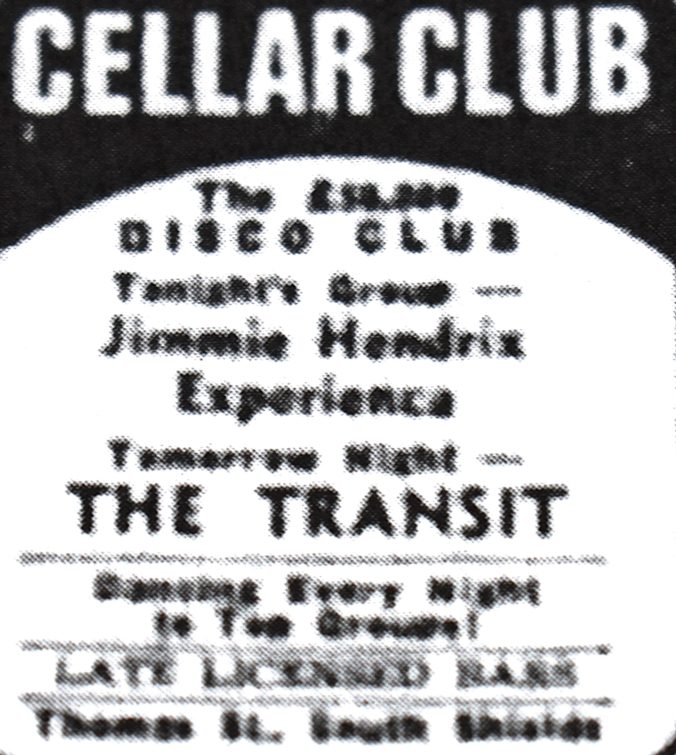
In the coming months Geno Washington, The Family and the John Mayall Blues Breakers were booked to appear, however on Wednesday 1st February 1967 the Jimi Hendrix Experience played The Cellar Club.

On the same night, entertainment in the town included local stage acts at various clubs including the Latino, La Strada, Ranch House and at the ABC cinema the main feature film was ‘One Million Years B.C.’ starring Raquel Welch – wey she was in technicolour!

But the big draw at the 200 capacity Cellar Club was Hendrix. Being just a bairn I wasn’t there but I did find two punters who were regulars at the club. Local musician and regular Rod Hall remembers…

“The Cellar Club was my second home you know. I remember walking down the street near the club and this van pulled up and a bloke popped his head out and asked in a deep voice “Where’s the Cellar Club?” I looked at him and it was Eric Clapton on Fowler Street in a van!”

Another regular was music fan David Robertson “My road to Damascus moment was seeing Jimi Hendrix at the Cellar Club. At first, we thought he better be good cos we’ve paid about ten bob to get in. After watching Eric Clapton everyone wanted to be a guitarist. After Hendrix everybody wanted to be in a band”.

On the off chance the local newspaper had written a review of the gig I recently popped into the local history section of The Word (library) and searched the archives. Luckily, I found this in the Shields Gazette by reporter David Jenkins, it was printed Thursday 9th February 1967. This picture needs to be credited but I think the photograph was taken in the Cellar Club by South Shields photographer Freddie Mudditt.

(Review start) Jimi will soon be ‘leading the fleet’ (headline)

Jimi Hendrix IS an experience. Like a drop of gin in a bucket of retired tonic, heady serum for post teen starvation (which, finger shakily on my own pulse, I diagnose these days).

The actual teen scene of the Cellar Club though like Madame Tussaud’s. The 23 year old next to me gasped “Go” and people turned to stare.

Playing his guitar with his teeth, his Indian head-dress tubes of hair flailing, he fixes a glorious enraptured grin on his face. Little spouts of sweat gloop from temples.

More important, the fiery body of sound, the completely original effect he squeezes out of his guitar. “Follow that” said Les Gofton, lead singer of The Bond, who were to take over later – make Hendrix the most exciting animal in the cage at the moment.

But the Cellar is inhabited by so many? (unreadable). A Wild Thing like you never heard it raises a small cheer, small beer. What on earth do you want?

Well, wait a couple of years, when you have heard another 10,000 discs, as I have, and you too will fall about a Hendrix. (He came up specially to South Shields for this one night appearance). Some day soon he will be the admiral-in-chief. Pipe him aboard somebody, for heavens sake. (Review end)

Little did they know the impact that Jimi Hendrix and his music would have. He has been described as one of the most influential guitarists of the 1960s, but sadly he died in London on 18 September 1970 aged just 27.

After being in business as a nightclub during the 80s and 90s the Cellar was revived as a live music venue until the club was sold and renovated into a dental practice in the 2000s.

If you have a story about the Cellar Club to add to the site just get in touch.

Alikivi   March 2025

HARD UP in HOLBORN – South Shields photographer James Henry Cleet 1876-1959.

During the 1930’s James Cleet was commissioned by South Shields Public Health Department to make a photographic record of ‘slum housing’ in the riverside area of the town – Holborn and Laygate.

Side Photographic Gallery in Newcastle produced a booklet in 1979 of some of the photos. Not sure if the term ‘slum’ was first used by Side Gallery or Public Health Department?

First time I came across James Cleet was when I was doing some family and history research in the Local History section of South Tyneside Library in 2007.

It gave me the idea to make a documentary highlighting Cleet’s work, and Holborn, the area once known as the industrial heartland of South Shields, plus the digitization project.

The Local History section had been awarded funding to digitize thousands of photographs they had in their archive and load them onto a new website. Volunteers were needed for this process and as I was self employed I could give a couple of hours a week to a worthwhile cause.

Spending time looking through photographs, some from the early 1900’s, of people, places and events around South Tyneside was a great way to spend a couple of hours.

It wasn’t long till I dropped in more frequently. Photographs by Emmett, Flagg and Cleet were an excellent record of the times.

Some images had familiar street names of area’s where my ancestors lived, mainly Tyne Dock, Holborn and Jarrow. Finding a family of photographers called Downey who had a studio in Eldon Street next door to where my great grandmother lived was an added bonus.

There was a small team of volunteers who recorded details of the images, scanned the photos, and uploaded them onto the website, this process features in the documentary.

Street names, buildings, shops and people were researched, as much information as possible was added. On the back of the pictures was nearly always a date or name of the photographer.

But unfortunately, some photographs were left blank and didn’t have any recognizable signs but were still uploaded.

After a few sessions I could recognize the styles of certain photographers and two of them stood out. Amy Flagg added extensive details to a lot of her work and covered some powerful subjects like the Second World War – climbing over bombed houses to get the shot won’t have been easy.

Some of her images became instantly recognisable, in her darkroom she stamped a date in Roman numerals on the bottom of the photo.

There were a load of photographs that were taken in Holborn by James Cleet, his style and composition was of a very high quality with clean, sharp images. Most of the images are taken on overcast, grey rainy days – is that a coincidence ? I doubt it.

The lighting gives the pictures a uniform look and add to the bleak, grim atmosphere of the housing clearance.

In research I found Cleet had regular work at ship launches, plus The Shields Gazette and Daily Mirror. While Flagg’s technique was more handheld, Cleet used a tripod in most if not all of his very sharp pictures. Both were passionate about their work.

Around that time an old guy used to come to the local history section and tell me a few stories about Tyne Dock and Holborn as his family lived in those areas.

Next time he brought in a booklet which he gave to me, it featured a collection of the Cleet housing clearance photographs I’d been looking at.

The booklet also included reports by the South Shields Medical Officer for Health talking about ‘rat repression’ and ‘eradication of bed bugs’. They reported….

’The women had a very hard life. They polished their steps, and the pavement was scrubbed. The backyard was washed regular. There was a question of pride. They had to keep them clean or they’d be overrun with vermin. No getting away with it. It had to be kept down’.

The report also included complaints from residents…

’A’ve seen some hard up times. Families of nine in one room. I knew a family, the father and mother had to gan ootside to do their business. Yes they used to do their courtin’ ootside. The mother used to stand at the telegraph pole on Johnsons Hill and have her love with the husband and then gan yem to bed. You couldn’t do nowt with all the family livin’ in one room’.

In a previous post I wrote about the important historical archive that Amy Flagg had left to the town: her Second World War photo’s plus the book ‘The History of Shipbuilding in South Shields’, the James Cleet housing clearance booklet is just as important a document of South Shields.

To check out the South Tyneside photographs featuring Amy Flagg and James Cleet go to :   https://www.southtynesidehistory.co.uk/

Gary Alikivi   December 2019.