As requested, readers of this site have contributed stories featuring supernatural phenomena. Actor and theatre producer Alison Stanley talked of her experiences. Featured in this story is a medieval castle in Chillingham, Northumberland which is reported to be one of the UK’s most haunted castles.
In the past I’ve been a celebrant at funerals and enjoy doing it. I’ve always been interested in spiritualism. I believe in a next life. We’ve talked about what happens when you die and we’ve mentioned ghosts, spirituality and the like people believe different things explained Alison.
Some say when you die you just die and there is no afterlife. But how do they know for sure? And by the laws of science we are a ball of energy and by those laws it doesn’t die so where does that energy go? The physical body dies and is buried or cremated but what happens to the energy? It’s an interesting subject.
A few years ago we went to Chillingham Castle on a day trip. There was me, my mother, my youngest son and my step dad. It was a grey dark day lashing down with rain. We were driving along the country roads getting near the castle. We turned a corner and saw an old woman in a red coat standing at the side of the road. She wasn’t old as somebody from the 1800s but there was something about her that didn’t look right. We all remarked about this woman who was in the middle of nowhere really.
I looked in my rear view mirror and she was standing looking at the car. Where did she come from as there were no houses around maybe she has dementia? I just wasn’t sure I couldn’t put my finger on it. What really was wrong was she didn’t look wet she was bone dry. But it was lashing down?
We get in to Chillingham Castle and looked at all the artefacts and stuff it’s quite cluttered. On one of the clothes dummies was a lady with a red coat and she had a hat on. It was from one of the women who had worked there as a housekeeper. I swear it was the same coat we had seen.
Another time was 10 years ago. We were sitting in a bar called the Pig & Whistle in Hollywood which is a very theatrical, grand sort of place. I went through a red velvet curtain to the toilet downstairs and after four steps I couldn’t go any further, I stopped because I froze and the hairs on the back of my neck stood up. There was no way I could go any further down the stairs.
I came straight back up and told my husband we’re going to another bar for a drink because there is no way on God’s earth I’m going to the toilet here. Later we found out there had been a fire there and there was strong spiritual activity in the pub.
I think if someone is in the next life and they visit you I think it’s a bit of an honour really. They might have plenty to do and they have taken time out of their day to see you – so yes, it’s an honour.
More revelations of supernatural phenomena will feature on this site. If you want to share your experience don’t hesitate to get in touch.
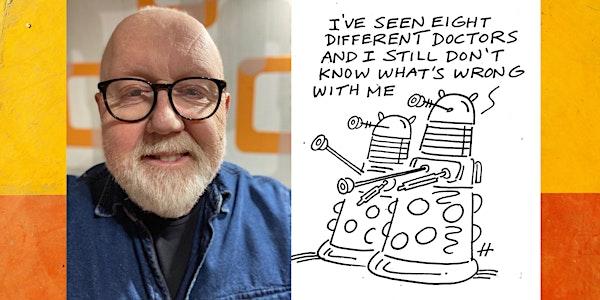
Former Shields Gazette graphic artist David Haldane established himself as one of the top cartoonists in the world. Blyth born David, now 70, worked for the Gazette from 1977 to 1983, he currently creates cartoons for The Observer and Private Eye and had his work regularly produced in Punch, The Express, Mirror, Guardian, Telegraph, Daily Mail and the Sunday Times. He also contributed sketches to the original TV series Spitting Image.
However, it is for producing cartoons for The Times from 2005 until 2017 that David made his mark, transforming him into one of the best cartoonists in the world.
South Shields playwright Ed Waugh has been asked to host an evening in conversation with David at The Word in South Shields on Wednesday September 24th at 1pm. He said: “I’ve known David for 20 years or so and he’s both very sharp and very funny. You have to be to create top-class satirical cartoons every day, often at very short notice, for national newspaper front pages.”
He added: “David’s career stories are both deep and hilarious. It will be a fantastic event for people who want a laugh and those who want to find out about some of the stories behind the many thousands of tremendous cartoons David has created and had published.”
The event follows his sold-out illustrated talks at the prestigious Lit & Phil in Newcastle and Blyth Library.The talk on Wednesday, September 24 at 1pm is part of The Word’s WRITE Festival.
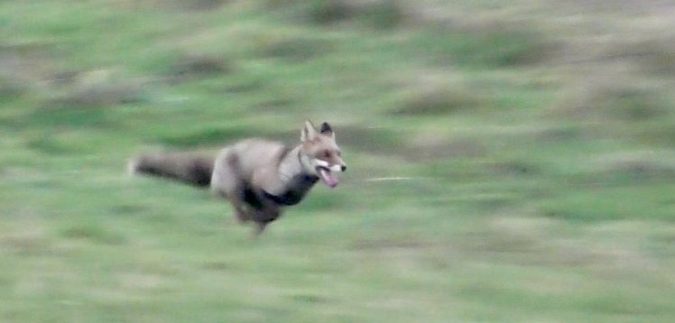
In April this year the work of hunt saboteurs featured on this site, this latest post again looks at tackling illegal foxhunting but this time using a different approach.
‘First time I witnessed a hunt I was shocked by its enormity. It was a deeply emotional experience nothing could have prepared me for it. The following week I witnessed a fox killed by hounds. That day I made a promise – I vowed to get justice for that fox. It’s his memory that drives me on.’
To find out more about the work of the Northumberland Hunt Watch I sat down with Lynne in the Littlehaven Hotel, South Shields where she started off by telling me she has always loved animals.
‘Since I was a child. My earliest memory, of being anti-hunt, dates back to school I was 10 year old. During an English class debate the teacher asked me to argue in favour of foxhunting. I was horrified and refused point-blank. Despite never having witnessed a hunt in my life I always felt an empathy for the hunted fox.’
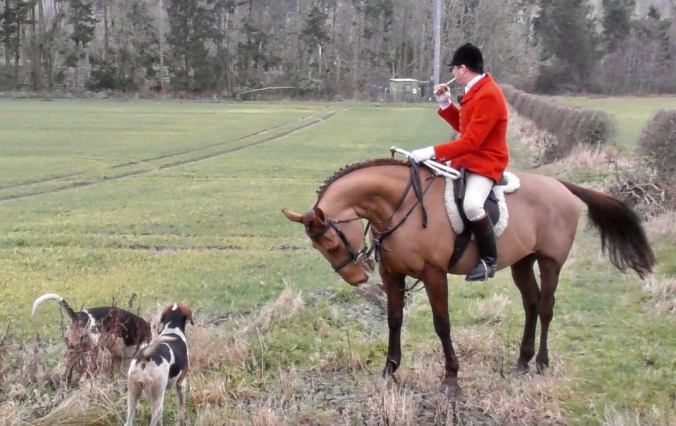
Tynedale hunt near Corbridge, Northumberland.
In 2002 Scotland banned foxhunting, England and Wales followed in 2004.
‘I thought that was the end of it. However, just because an activity is criminalised doesn’t mean it ceases to exist. Through social media I realised it was still happening on a massive scale. I was aware of the foxes out there alone with nobody to help them. I felt compelled to take action.’
‘I founded Northumberland Hunt Watch in 2020. Prior to this, I already had 5 years experience monitoring hunts. There wasn’t an anti-hunt presence in Northumberland at that time, leaving all the hunts in the area unchecked. There are some pockets of deeply engrained hunt culture in Northumberland, operating in some very rural and isolated locations.’
‘For these hunts it’s very much a way of life. They have a cultural pride in hunting, and strongly resist any attempts at criminalisation. The hunt community is a very tight community. They hunt together, socialise together, conduct business together and support one another.’
‘There are many different reasons why people foxhunt. Foxhunting has nothing to do with pest control or managing fox numbers. The hunts want foxes in the area to hunt which conflicts with the pest control argument. For some hunters it’s for the thrill of the hunt or the thrill of the kill. That is very difficult to understand.’
‘There are farmers and landowners involved in the hunt, who grant permission to access the land. Without this land there would be no foxhunting. For the riders who subscribe to the hunt, following hounds provides the freedom to ride over land that would otherwise be out of bounds. The fox is not restricted to boundary lines, so the hounds and riders are free to ride where the fox goes.’
‘The car support who follow the hunt mainly consist of elderly men. To them it’s a day out to socialise. They turn up with their binoculars, sandwiches and flasks having a good natter, they enjoy watching the hound’s work. I often talk to the members of the hunt to gain a better understanding of why they do what they do. We can’t expect to change something unless we fully understand it.’
‘We’ve talked about what we call ‘clean boot hunting’ a humane and lawful activity, which follows the scent of a human runner rather than a fox. With clean boot hunting they can still have everything they have now. The jobs will still be there, they can still have their socials and get together, their balls, their meets so they can still have their sherry and a bit hokey cokey, just don’t kill a fox. I think they fear their way of life will fall apart without hunting the fox.’
‘But humane hunting would be far more sustainable. Currently hunts claim to be trail hunting, which would involve hounds following a trail of artificial scent instead of a live fox. Unfortunately, trail hunting in my experience is just a cover for foxhunting.’
Have you a vision of what you want the group to be?
‘Yes, when I set the group up I thought I’m going to do this my way, I’m not going to war with them. I’m going to win hearts and minds. For me it was all about a love of wildlife, and a hatred of foxhunting and not a hatred of the people. I strive to end foxhunting for good so I knew that we needed to be taken seriously by the hunts and the police.’
‘I aimed to create a professional group with a credible image, as far removed from the negative stereotype as possible. We refer to ourselves as volunteers or wildlife guardians, rather than sabs, protesters, or activists. We don’t wear masks and we have a dress code. We’re conscious of how we come across to all the people we meet.’
‘Some people are just out for a dog walk in the countryside, families with kids, older people. Last thing we want to do is scare people, we want to be approachable. We’re always polite and respectful and get on with the farmers.’
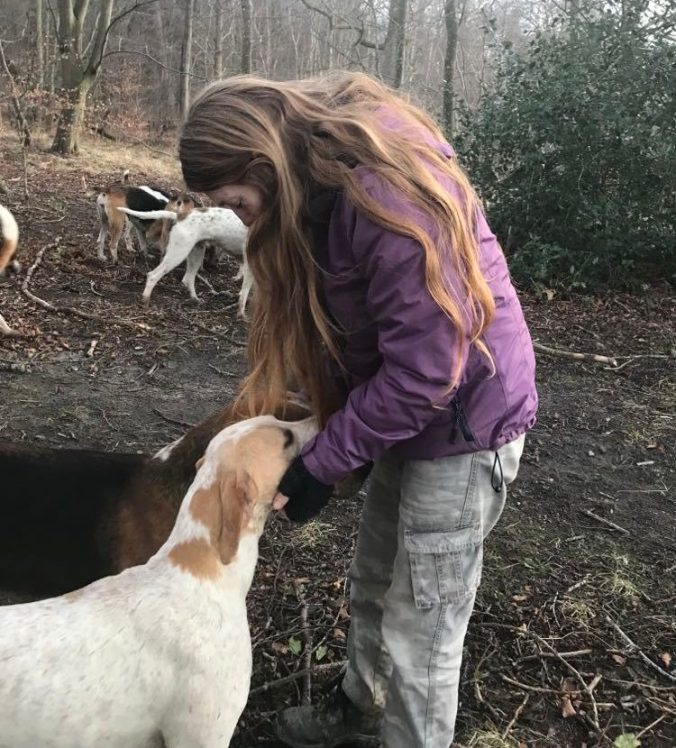
Lynn with the West Percy hounds.
‘We absolutely love the hounds they are such lovely sweet animals, we would never do anything to put them at risk, and our hunts know that. We often pop along to their hound shows in the summer some we are made more welcome than others.’
‘We aimed to build relationships and establish trust in the community and we have. All of our hunts know who we are and they know our names. We engage in polite conversations, some team members live in hunt areas, so it’s not uncommon to exchange waves. Our approach has earnt us respect and fear in equal measures!’
‘Our overall aim is to make the countryside a safer place for wildlife. On a day to day basis we aim to be a visible deterrent, to prevent hunting and on most occasions we are. We rarely need to intervene as our presence is often enough of a deterrent. Our hunts will often try to avoid hunting when we are there, and certainly avoid hunting in front of us.’
‘Last year at a hunt I was filming when the hounds picked up a scent and chased a fox toward me. The whip panicked and stopped them all “Lynne, can you see me stopping the hounds? Have you got it on video that I’m stopping the hounds?” I replied, “Yes, I have, thank you.” The fox made his way to safety.’
‘In the long term we aim for prosecutions as this is the only way to end foxhunting for good. To achieve prosecutions then we need to be professional and credible.’
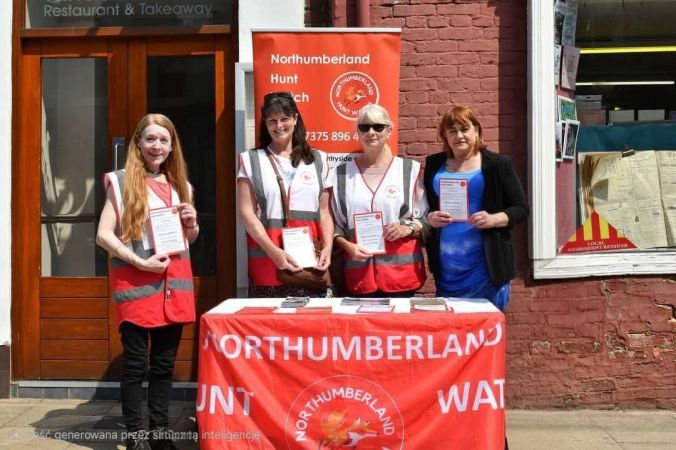
Outreach stall in Morpeth with Lynn, Judy, Amanda & Lynne
How much work is involved in the group?
‘A lot. We work very hard and put a lot of work in. I take this very seriously and am very committed to what I do. During the season we are out 2-3 times a week, despite working and other commitments. I would be out every day if I could. The fieldwork we do is just the tip of the iceberg. We do much more behind the scenes. Personally, I work on foxhunting every day of the week.’
‘I have taught myself a great deal over the years and always have my nose in a foxhunting book. I am also concluding a PhD in Criminology specialising in foxhunting with hounds. I have invested significant effort into this because I want to bring the issue of foxhunting criminality to a wider audience.’
Lynne & Judy leaving a successful Tynedale meet.
‘The lady who assists me in running the group, Judy, is a former police officer, so between us we have an in-depth knowledge of hunting and the law. We both work very hard on this, preparing cases and evidence for the police especially.’
‘Out of season we hold outreach stalls in hunt towns where we talk to the local community about our work. This has enabled us to lay the foundations for a positive brand identity while building up good relationships, trust, and respect within the community. We want the community to feel comfortable having us in their area trusting us to perform our job professionally.’
Have you experienced any threatening situations?
‘Violence and aggression from any of our hunts is exceptionally rare. We have had very few minor incidents in 5 years, most of which were dealt with swiftly, either by the police or the hunt themselves.’
‘Following one minor incident at one of our hunts I reported it to the chairman, he dealt with it, and we received an apology, so it was resolved sensibly and that was the end of it. There were no more incidents.’
‘We cover all the Northumberland Hunts from the Scottish border down to the Durham border, although Tynedale is our main hunt who we monitor regularly and have done for 5 years. They were a bit of a nightmare at first but they soon leant that it didn’t get them anywhere. They are very polite towards us now and we have built a good relationship with them. We are there to do a job which we do well and without getting into altercations.’
‘With all of our hunts we established clear expectations for behaviour from the outset ensuring that our conduct was respectful and polite. Over the years we have built a good rapport with most of them exchanging polite greetings “good morning, gentlemen” and in return “good morning, ladies.”
‘We never engage in name-calling or squabbles because throwing insults is not a stepping stone to positive change. This means that we can focus on what is truly important—the foxes. It might make someone feel better after calling someone names but it doesn’t achieve anything for the fox.’
‘The hunts also have a code of conduct regarding their behaviour towards us too. We have an unwritten rule between us we don’t call them ‘hunt scum’ and they don’t ride their horses at us, so this works well. This mutual respect means any of our team can be monitoring a hunt alone, in some isolated locations without any problems. Our approach saves lives.’
‘At one of our hunts we intervened between the fox and hounds, rating the hounds back so the fox could escape. This was in front of the hunt master and he said “thank you for helping” so we replied “no problem we’ll come back and help again next week.”
‘When we monitor hunts we focus on listening and observing, avoiding verbal confrontations is for creating a safe environment for the foxes allowing them a safe passage to escape. Foxes don’t know we are there to help them so we need to create a safe environment otherwise they would just see us as part of the pack. If there is chaos they could easily be scared back toward the hounds, we are very conscious of that. We often see foxes fleeing past us to safety. Silence is golden. It saves lives.’
How frustrating is it knowing fox hunting is illegal and it still goes on?
‘Very frustrating but there is a wide range of reasons why it continues. Weaknesses in the Hunting Act is a key issue, and also how it has been interpreted. This has provided loopholes for foxhunts to circumnavigate the law. There are so many issues that we will need an entire article to discus that alone. In a nutshell trail hunting has ensured that it is extremely difficult to prove them guilty and beyond all reasonable doubt. Consequently, trail hunting operates exactly as it was intended.’
‘We are committed to ensure that we have the best chance possible. Our behaviour will also come into question so we always act lawfully. Foxhunting is a low-level offence so if we break the law we lose the moral high ground and cannot expect the police to enforce one law while ignoring another. We have to be seen to be credible witnesses to make any progress.’
‘Because of how we operate we have built a good relationship with the rural crime team who we submit our footage to. We have had several incidents sent to the Crown Prosecution Service for review, and the police have acted swiftly in gathering the evidence.‘
Drone footage was captured of the Tyndale Hunt hunting a fox on 3 October 2024. This was submitted to the police. More information about this case can be found on the Northumberland Hunt Watch Facebook and You Tube pages.
‘There are some excellent groups across the country that have worked hard to end foxhunting, bring hunts in court or raise awareness, such as Beds and Bucks Sabs, 3 Counties Sabs, Cheshire Monitors, and West Midlands Sabs, to name a few.’
‘However, not everyone who joins a cause has genuine motivations, and the less credible groups can undermine the work of those who are genuinely committed and doing good work. It’s about quality rather than quantity, so finding people with the right attitude can be difficult.’
Lynne recording West Percy Hunt at Ingram Valley.
What have you found out about yourself since starting this group five years ago?
‘I have found that I am stronger and more resilient than I ever thought possible. If you have genuine intentions and committed to doing your best job for wildlife then you can make a difference. A middle-aged woman with a vision took on ten hunts, most of which were untouched and located in some of the most isolated rural areas of the country. I was subsequently joined by other middle-aged women to create a hardworking and professional group that has made a significant impact on hunting in this area. Never underestimate the power of middle-aged women on a mission!’
If you are interested in the work of NHW or would like to volunteer contact >>>
A series of talks by cartoonist David Haldane have been booked into venues this September including the Civic Theatre, Gosforth and The Word in South Shields.
‘I started work at the Shields Gazette in 1977. It was a great job really enjoyed it. It was my first real wage packet. We used to get paid weekly. In cash!’ recalls David.
Born in Blyth in 1954 David last featured in April this year talking about his work at national newspapers including the Mirror, the Guardian and The Times (link below). In a recent phone call he looked back to his early days and what inspired him.
‘I noticed cartoons when I was young. At the age of 7 I got scarlet fever which then was quite serious, luckily there were anti biotics. I remember I was isolated in my bedroom at home and couldn’t touch any of my books or they would have to be destroyed’.
‘There was a guy who lived in the street who was a Merchant seaman, he brought back some papers like the Chicago Tribune. I had a pile of papers on my bed with loads of full colour comic strips inside like Popeye and Prince Valiant.’
‘Me mam bought me a jotter from Woolworths, I just sat and copied them when I was ill. From then on I drew regularly, in particular funny stuff. When I was studying for my ‘O’ levels in Blyth library I noticed a whole series of Punch annuals which I started to read and from then on fell in love with the cartoons.’
‘People have heroes – rock stars, singers, guitarists, my heroes were cartoonists. I was 15 year old sitting in Blyth library thinking I wanna do this – never thinking I actually could or meet these people.’
‘There was a magazine called The North which featured walks and the like in places like Berwick. The art teacher put me in touch with the editor. That magazine is where I done my first published strip. I was still at school at the time and did it for a couple of years. Did I get paid? Put it this way I gave up my paper round for it.’
‘When I enrolled on a Design course at Newcastle Polytechnic I was doing a few cartoons on the side sending them in to magazines like Punch. When I got my first cartoon published in Punch it was when I was at the Gazette in 1977.’
‘The Shields Gazette were building up the art department working on advertising, editorial and illustration and four of us got a job at the same time. The newspaper then was absolutely thriving they used to do three or four editions a day. Other papers were published in the area – Whitley Bay, Chronicle and others it was a real Fleet Street on the Tyne.’
‘I remember local punk band the Angelic Upstarts came in to be interviewed by the editor, they were big, like the North East Sex Pistols. There were many wild rumours about them – the pigs head on stage was one!’
‘We were mainly advertising stuff like a pull out of Ocean Road which would feature all the shops. They would pay for adverts and we used to draw them up. This was before computers so it was all hand drawn. It was like a little factory in there we used to churn the stuff out on a daily basis.’
‘Working there was experienced journalists like Janis Blower, John Landells the waterfront reporter, his son Steve joined later. Mike Blackah was the editor. There was a huge room with a lot of sub-editors. It was a very busy, thriving newspaper office. When I started working at the real Fleet Street in London, I realised how similar they were.’
‘In the early 80s I worked on a short run of TV show Spitting Image. This was during the Thatcher years – the real hardcore political stuff. Ian Hislop and Nick Newman were writing short sketches which played before and after the commercial breaks. They wanted cartoonists to fill in the bits without puppets. Newman asked cartoonists who were working on Punch and Private Eye. Four or five of us worked on them and subsequently I got a few sketches on.’
‘I remember going to a script meeting in London. It was great meeting the scriptwriters who went on to produce a lot of shows. One of them told me to stick to drawing cartoons as you’ll make a lot more money. I took his advice. They still release box set DVDs of the show, I’m grateful to still receive the odd royalty payment.’
‘When I’m drawing I listen to film soundtracks – Japanese, Korean, quite niche, also Italian horror movies, spaghetti western, jazz sometimes. I have some Michael Nyman here as well, beautiful stuff. The music is on in the background but not when I’m thinking of ideas. I tend to sit in silence to work out ideas.’
To find out more of the life and work of David Haldane he will be appearing at ‘An Evening With’ at The Word, South Shields on September 24th & Gosforth Civic Theatre September 30th 2025.
‘The Sound of a Landscape’ is a new book by artist, author and sound recordist Mie Fielding, who co-authored ‘Closest Thing to Heaven’ about the Newcastle music scene, which featured on this site in December 2020.
In ‘Sound of a Landscape’ Fielding pictures the Northumberland coast in all its wild splendour. His unique artwork is complimented by Cullercoats poet Harry Gallagher.
“I got to know Harry as he played the late Tom Hadaway (My wife’s uncle) in a theatre production. As I’ve recorded bird sounds and produced avant-garde music for over 30 years, it was a natural idea to put these artistic elements together” explained Mie Fielding.
MiE Fielding
The book is further enhanced with sound recordings by scanning the accompanying QR code, bringing ‘The Sound of a landscape’.
“The book also gave me a chance to produce two specially written pieces of sound art. One portraying Storm Arwen and the other lamenting the demise of a way of life, once a common sight along the Northumberland coast – the Cullercoats Ghosts” addedFielding.
“As for the sounds in the book, they took nearly a year to capture using an ‘Ambisonic, microphone and other technical equipment”.
An exhibition about the book featuring its poetry, art and sound is held at Newcastle Central Library from 14 -20 December 2023.
During the 1926 General Strike miners in Cramlington derailed a train of Flying Scotsman carriages pulled by the Merry Hampton engine.
The miners thought the train on the Edinburgh to London mainline was full of blacklegs undermining the strike, unfortunately for them it was a passenger train, no one was killed with only one person injured.
Was it workers defending their jobs and communities, or terrorists? Eight Northumberland miners were sentenced to 48 years for their involvement.
To explain the near 100 year old story an event is booked on Tuesday, October 24 @ 2pm & 7pm, Tyneside Irish Centre, Newcastle.
This will include an illustrated talk by playwright Ed Waugh (Wor Bella, Hadaway Harry, Carrying David), recitations and songs plus a showing of the brilliant 30-minute BBC film (1970) The Cramlington Train Wreckers which features interviews with the surviving four “train wreckers”. It is a historical document and anyone interested in Geordie social history should not miss this.
The joint production between Westoe Miners Banner Group and Wisecrack Productions aims to tell the incredible story of The Cramlington Train Wreckers.
The Battery has stood guard at the mouth of the river Blyth in Northumberland for more than a century. It’s an impressive array of buildings that acted as a lookout, armaments, storage and an assembly point during World War 1, the Battery also boasted two six-inch guns for coastal defense.
This weekend, May 20 & 21, the Battery is hosting two days of exciting historical activities when it presents Blyth Battery Goes to War.
Lindsay Durward, secretary of Blyth Battery Volunteers, explained “We are delighted to announce our exciting activities for the weekend. There is something for people of all ages, from children to the older generation.”
Run by dedicated volunteers the weekend will involve a full programme of music, comedy, song and dance and re-enactments from 10am to 4pm each day. Top Northumberland folk combo Beeswing will close the weekend at 3pm on Sunday.
“We take the history of the battery very seriously. One of the main aims of Blyth Battery Goes to War is to put the battery plus Blyth on the map as well as enjoy ourselves.”
“It’s a free event but we would ask everyone to put a few coins in our donation buckets, buy a cuppa in our cafe, tell their friends to come back after the event and talkto us. We are always looking for volunteers to come along and see what we do”.
For further details about the Blyth Battery Goes to War weekend and summer visits, visit the Blyth Battery Facebook page, BlythBattery.org.uk or contact







 ALIKIVI UK : NORTH EAST MUSIC & CULTURE