SEARCH FOR THE UNKNOWN SOLDIER – South Shields connection to the Boer War

Ladysmith St, South Shields.

Stories are worked on for days or weeks, and some films took months. To knock it into shape there’s always a lot of pushing and pulling, but when they drag on you know it’s time to think about letting go and finding something new.

But sometimes a story just lands in your lap and quickly comes together without too much work, this is one of those rare moments.

Walking along Ocean Road I was stopped outside The Marine pub by a good friend of mine who told me an interesting story about a connection between a South Shields street and a British soldier from the town who fought in the Boer war 1899-1902.

“He is buried in Westoe Cemetery near Ladysmith Street and there’s an inscription on the headstone. Unfortunately I can’t remember his name, it was a while ago when I saw the grave, but I think it was near the main gates” said 60 year old Sand dancer (native of South Shields) and musician Rob Atkinson.

Rob had just come out of the pub and had a few sherbets so I wasn’t sure if he was pulling my chain but it was a story that peaked my interest as I didn’t know much about the Boer war.

After a quick search the name Ladysmith was revealed as a city in South Africa that was a bloody battleground between British and Boer forces, it was reported thousands of British soldiers were killed there. Also as Rob mentioned, Ladysmith Street runs parallel with Westoe Cemetery.

In further research I found Devonshire – a street in the Tyne Dock area of South Shields – is another name of an infantry regiment who not only served in the First and Second World War but also in the Boer War.

I contacted award winning journalist and local history author Janis Blower and asked if she heard about the South African connection to a soldier from the town?

“The siege of Ladysmith between late 1899 and early 1900 was one of the key events of the war.

A number of South Shields men served, mainly in the Imperial Yeomanry and Durham Light Infantry, with some 107 eventually awarded Freedom of the Borough. It’s likely veterans are buried at Westoe and Harton. Do you know his name?”

Westoe Cemetery, South Shields.

To find the headstone of the unknown soldier I took a walk over to the old Westoe Cemetery with its weather beaten headstones, many buried under a mountain of ivy and some toppled over.

Among the resting, lie famous industrial and political people from the town including Dr Thomas Winterbottom, Robert Ingham MP and members of the Readhead shipbuilding family.

Initially Rob had indicated the area where the grave was and luckily after only a few minutes searching where the headstones were still standing, I found it, as I said earlier this story just fell into place.

The grave was a family plot with substantial headstone including our man’s details –
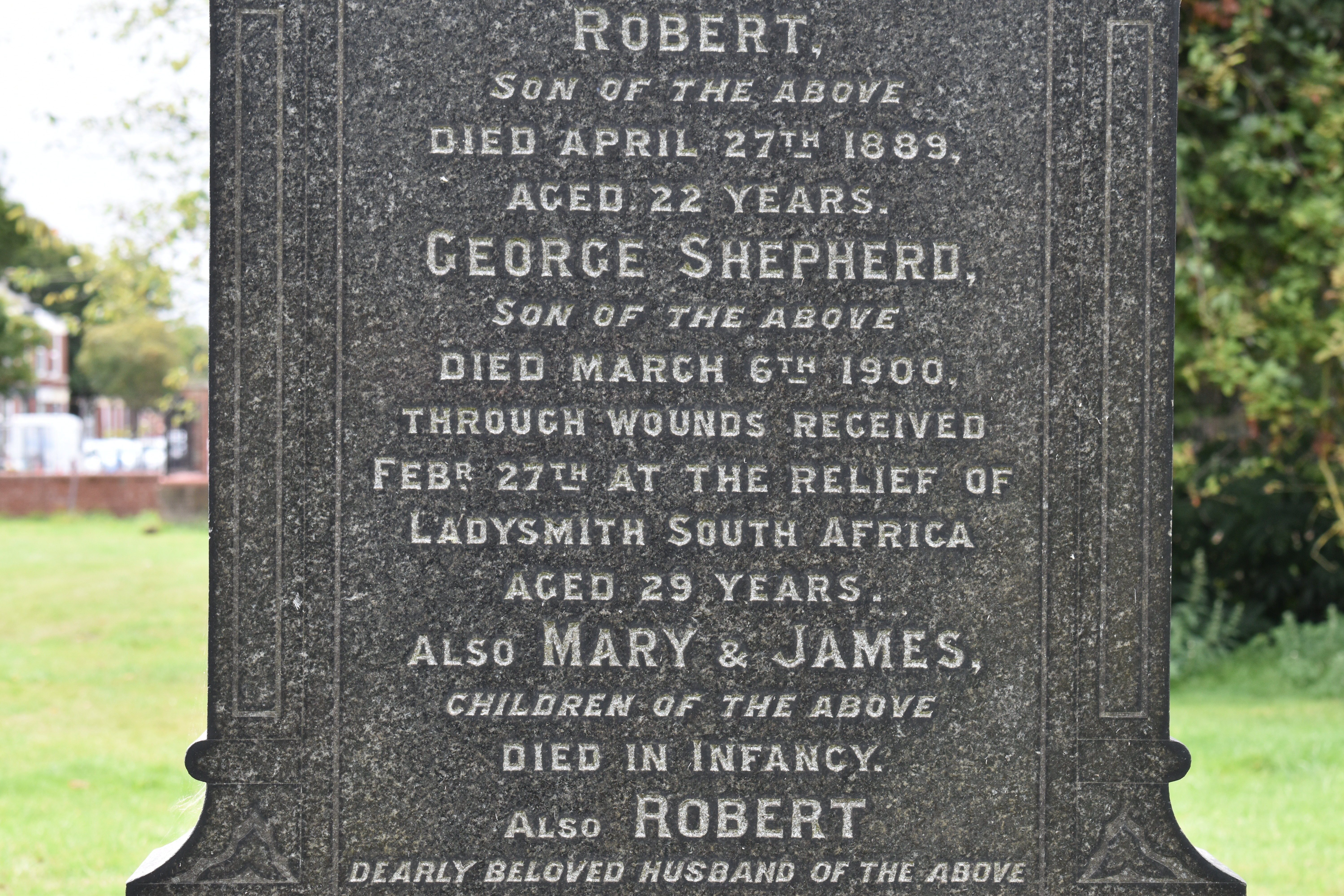
George Shepherd died 6th March 1900 through wounds received Feb 27th at the relief of Ladysmith, South Africa aged 29 years.

The search for the unknown soldier ended there but when researching in the local history library I heard of someone who had been looking into his relations involvement in the Boer war, it sounded interesting so I left a contact.

A day later John Caffery got in touch and we arranged to meet. He has been researching his family tree for nearly 20 years,

“I started after our parents died, my wife Veronica also searches her side. My brother in law showed me a photo of a family member called John Robertson.

I went to the library and searched through their archives and found a few pieces of information – he was born on 28 August 1883 and lived in the Laygate area of South Shields – then it just spiralled”.

“In a loft we found a box of certificates, medals and photographs from the First World War and the Boer War, all for John, with me being interested in military stuff this was great.

I don’t think many people know about the Boer War which was a disaster for the British army. Through more research I found the Boers were backed by German artillery and officers”.

John Caffery with a framed photo of Private John Robertson who served in the 161st company of the 36th Battalion of the Imperial Yeomanry.

“Then we found something special, searching through old copies of The Shields Gazette we got to 1902 and found that he was awarded the Freedom of the Borough along with the rest of the Battalion. We’re proud of what he done”. 

Returning to South Shields from South Africa, John married in 1906, lived in South Palmerston Street and found work in the coal pits. But by 1914 the First World War began and he signed up to the Royal Irish Fusiliers.

In 1918 he was wounded and discharged, and after returning home resumed pit work until retirement. Sadly in 1959 John Robertson passed away at 75 year old.

John Robertson’s medals from the First World War.

As John Caffery told me this moving story he expressed only pride and respect for a brave young man who after fighting in one war, signed up to serve in another.

John has worked on a few Tyneside history stories which he will be sharing in the coming weeks plus he told me what he is working on next.

“I’ve been looking into the rest of the soldiers who received the Freedom of the Borough, there was over one hundred, and as always you go off on a tangent and taken down another path where I’ve come across some letters from soldiers and their families from the Northumberland Fusiliers who survived the First World War – some of them break your heart to read”.

“They’ve never been published or displayed and with me being involved with Hive Radio storytellers on Tyneside, we are looking to read them out on a podcast on Remembrance Sunday, November 11, 2022. I think they would like that”.

For more info contact:

Hive Radio :

Hive Radio Storytellers Share Love by Hive Radio Storytellers Podcast (anchor.fm)

Readheads shipbuilders contact:

Tyne Built Ships & Shipbuilders

Alikivi   September 2022.
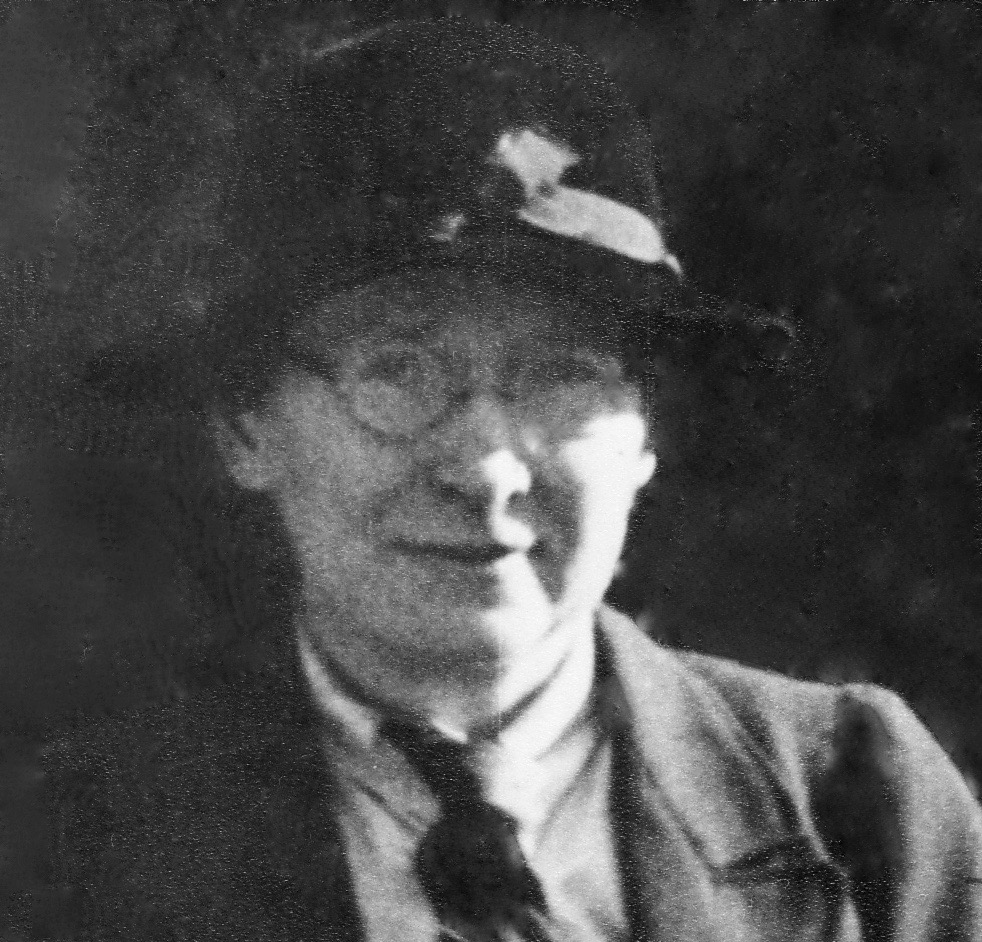
PICTURES OF AMY:  BLUE PLAQUE for MISS FLAGG (1893-1965)

After researching the life and making a documentary about South Shields historian & photographer Amy Flagg, I was impressed by Amy’s work and thought she deserved recognition so I put forward a nomination for a blue plaque to be placed in the town to celebrate her achievements.

Reported to be a shy and quiet person, Amy was one of only a few female photographers working in the UK when she started photographing the housing clearances along South Shields riverside in the 1930’s.

In addition to her love of photography, she had a passion for researching the town’s history and collated notes about the towns shipbuilding heritage which were later published in 1979.

Amy volunteered at the Ingham Infirmary and South Shields Public Library, she also enjoyed her garden at home in Chapel House, Westoe Village. In 1962, she gave the grounds of Chapel House to South Shields Corporation to enable the expansion of the Marine and Technical College.

On her death in 1965, she left a substantial sum of money to the infirmary and bequeathed her extensive collection of photographs and notes to the towns Library.

Bomb damage after an enemy air raid in South Shields Market Place. pic courtesy of South Tyneside Council.

Amy’s work is most notable for the haunting images she took in the aftermath of enemy air raids during the Second World War, they are an important and unique record of the impact of war on the town.

She was a very courageous woman, at nearly 50 years old she was climbing onto bomb sites and demolished houses to get the picture – where the bombs dropped she captured the scars with her camera.

Amy printed the photographs in her dark room at home and the images are her most precious legacy. When I first came across them back in 2008 in the Local History Library I thought they looked incredible and to find that a lady from South Shields took them was an inspiration.

So it was a great pleasure to be invited to see a blue plaque officially unveiled on 8 March 2022 to celebrate the life and work of Amy Flagg. The Mayor of South Tyneside, Councillor Pat Hay, unveiled the plaque at Chapel House.

“It was a great honour to unveil the blue plaque to commemorate Amy Flagg. She was an incredible photographer and historian. She also dedicated much of her time volunteering in her community”.

“This plaque is a tribute to Amy’s life, her remarkable contribution to the rich heritage of the area and the amazing legacy she left behind. She will be remembered for many years to come.”

The Mayor was joined by the Mayoress Jean Copp, Leader of South Tyneside Council, Councillor Tracey Dixon and Deputy Leader Councillor Joan Atkinson, two actors from Beamish Museum plus residents of Westoe Village also joined the celebration.

To mark the occasion South Shields Museum and Art Gallery is showcasing some of Amy’s photographs and her research, plus the documentary (link below) will be shown. The display is available until June.

There’s also a small display of Amy’s work in South Shields new cultural centre and library, The Word.

Thanks to South Tyneside Council and South Shields Museum & Art Gallery for additional information.

Alikivi   March 2022.

FRAMING HISTORY

South Tyneside History website celebrates the heritage of the borough by preserving photographic and printed history. The images have been digitally recorded from original items held by South Tyneside library.

Included are historical maps, old postcards and thousands of images by notable South Shields photographers James Cleet, Amy Flagg and Freddie Mudditt – recently I’ve been invited to add my collection to the site so I’ll be in good company.

pic by Amy Flagg of South Shields Market bombed during Second World War. Courtesy of South Tyneside Council.

For over 25 years I’ve photographed South Tyneside, the main focus of this collection of images (2,000) were taken over the past decade of the changing face of South Shields.

The collection is a unique documentary record of the demolition of buildings at the sea front and market place, to construction of The Word, Littlehaven Promenade, Harton Quays, Haven Point and more – if it was getting knocked down or built up I was there!

Pic taken 11 March 2013 with South pier in the background and a flooded sea front car park, now the site of Littlehaven Promenade and Seawall.

The images will be available to view soon in the meantime why not check the site

 South Tyneside Libraries (southtynesidehistory.co.uk)

Gary Alikivi   January 2022

LOWRYS WAR

One of Britain’s most popular artists L.S. Lowry is best known for painting working class life and finding beauty among dirty buildings, chimneys, factories – the everyday

‘When I was 22 we moved from the residential side of Manchester to Pendlebury, an industrial suburb of Salford. At first I didn’t like it at all then I wanted to depict it. Finally I became obsessed by it and did nothing else for 30 years’.

I read that one of his paintings was in Newcastle’s Laing Art Gallery so I went to check it out. In the main exhibition hall there was another painting that caught my eye – Twentieth Century by C.R. Nevinson (1889-1946), I made a note to check out more work by this artist.

C.R. Nevinson, The Twentieth Century 1932-35

Now over to the Lowry, smaller than I imagined there it was amongst other fine works by various artists, the information card notes Laing Art Gallery bought the painting direct from the artist.

River Scene was painted in 1935 at a time when he was looking after Elizabeth his bedridden mother in the family home in Station Road, Pendlebury, his father had died in 1932. It was also the time when the Lowry style of reflecting working class life was cutting through.

River Scene, 1935.

The Royal Academy had previously labelled him ‘a Sunday painter’ when it was known he spent his days as a rent collector, but January 1939 was the debut exhibition of Lowry in London, the first major recognition of his work.

A mixed reception from art critiques followed with 16 of his paintings sold for about £30 each. Although his mother didn’t agree – the show was a success and another exhibition was arranged for later that year.

But in September everything including art galleries and exhibitions were put on hold as the country prepared for restrictions and blackouts as the Second World War was declared.

Lowry, who was now in his 50s, was devastated, adding to this, his mother died in October aged 83, he fell into a deep depression. Even though at times his relationship with his mother was fractious, living at home, making her tea and painting in the attic would have brought a comfortable routine to his life.

Lowry had loved his mother but the relationship was strained with her disapproving of how much time he spent painting, she only liked one of his paintings – Lytham Seascapes with Yachts. After one particular scathing remark Lowry went outside in a fit of rage and built a bonfire of his paintings, fortunately his friend Reverend Geoffrey Bennett saved them from the fire.

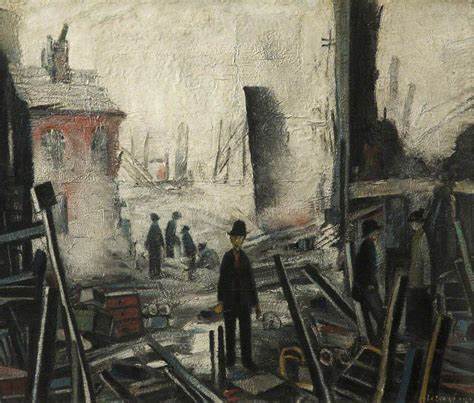
Blitzed Site, 1942

During the war Lowry was an official war artist and night time fire watcher on the rooftops of Manchester department stores. Although tired and feeling a deep sadness after his mother’s death, his painting took on a sharper focus.

Part of the city were in ruins after the Luftwaffe bombing raids ‘I remember being first down in the morning to sketch the bombed buildings before the smoke and grime had cleared’.

After the war ended success was around the corner for Lowry with exhibitions and paintings sold. Aged 65 he retired with a £200 a year pension as a rent collector from the Pall Mall property company, plus a move from the family home to a house 20 mile away in Mottram-in-Longdendale.

‘Heaven only knows why I came to this place. I absolutely loathe it! I hate the house I live in now but here I am and here I suppose I’ll end my days’.

Without any family Lowry lived alone in Mottram until his death in 1976, among all the doom and gloom of his life there was a shy smile of contentment that appeared now and then.

Gary Alikivi   January 2022

Notes: L.S. Lowry, The Art and the Artist, T.G. Rosenthal

L.S. Lowry, Michael Leber & Judith Sandling

Laing Art Gallery, Newcastle.

AMY FLAGG WAR DIARIES #5 BOMBS FALL ON JARROW

In 2016 when researching in South Shields Library about Historian and Photographer Amy Flagg (1893-1965), along with her photographs of damage to the town by German air attacks during the Second World War, there was a number of personal scrapbooks full of the towns history and genealogy of families in the borough.

Also included was ‘Air Raids on South Shields’, the typed notes and diary entries were a record of official statistics of enemy attacks since the first bomb dropped in 1940.

Miss Flagg also recorded incidents in the surrounding areas including Jarrow. Detail from Tyneside newspapers and maps have been added to some entries.

Amy Flagg, Historian & Photographer, 1893-1965.

Friday, 25th/Saturday, 26th April 1941: 

On Saturday morning German radio claimed the main attack of the previous night’s raid was on the Sunderland Flying Boat Works at Sunderland. In fact this was another bungled raid by the Luftwaffe, as no bombs fell there.

Home Security could only deduce that inexperienced crews were being used. They felt the large number of parachute mines exploding on Tyneside was believed explained by a strong to gale force NE wind which had blown them inland during sea mining operations.

22.08pm Five injured. Incendiary bombs fell on the Old Granary near Jarrow Staithes and at Hebburn. Fires were started but were quickly controlled. A parachute mine fell at Primrose – no damage. Another fell near the Old Staithes causing damage to houses and shops.

In great detail Miss Flagg describes this large scale attack on 10th April 1941.

23.30 – 03.00am High explosives fell on Station Street and Sheldon Street, Jarrow. Houses were destroyed and suffered a death roll of twenty-four, seven members of one family being wiped out, nine people were seriously injured and nineteen slightly injured.

A Roman Catholic Priest died from shock. A police constable was slightly injured by an incendiary bomb.

Fires were started at the Petroleum Installation at Jarrow, Jarrow Tube Works and at Mercantile Dry Dock but were quickly subdued.

High explosives fell on a colliery railway line leading to Jarrow Staithes, on a coal depot at Jarrow Railway Station and on the A185 near to Old Church, Jarrow, where the road was blocked and gas and water mains damaged.

pic Amy Flagg. courtesy of South Tyneside Council.

Published reports in Tyneside newspapers:

Tuesday, 2nd July 1940:

Newcastle and Jarrow were attacked during the late afternoon. The damage was considerable. A single German Dornier bomber passed over Blaydon, shot down a balloon and dropped bombs on Newcastle and Jarrow.

Fourteen dead and 120 injured in Jarrow. Three high explosives dropped in streets. Four houses and six flats demolished, six houses and thirty flats damaged. School partly collapsed.

Three domestic shelters and five others damaged. Four or five streets were affected but most casualties occurred in Princess Street, a search of the debris for trapped victims went on throughout the night, firemen, ARP workers and others working in relays.

It was announced that the August Bank Holiday is to be cancelled.

Monday, 7th /Tuesday 8th April 1941:  

‘HMS Manchester’, waiting in Jarrow Slake to convoy the new aircraft carrier ‘Illustrious’, may have been the objective of the two disastrous raids this week; but it proved quite ineffective so far as naval vessels were concerned, no hit being scored on either.

Considerable damage, however, resulted along the riverside from Tyne Docks to the oil tanks, as well as other parts of the town.

Immediately after the ‘Alert’, enemy aircraft became very active and there was an intense barrage from ground defences. At 23.45, 4 high explosive bombs dropped on Henry Wilson’s Timber Yard, Tyne Dock, Clayton and Armstrong’s Timber Yard, Tyne Dock, the Anglo Iron Foundry, Tyne Dock and a dwelling house and shop in Porchester Street.

Friday, 6th June 1941:

At 15.00 an enemy aircraft dropped one 500kg bomb, 20 yards West of the LNER railway line at East Jarrow. Two pigs and a number of hens were killed by blast. No other damage or casualties were reported.

Pic. Amy Flagg. Courtesy of South Tyneside Council.

Monday, 29th/Tuesday, 30th December 1941:

Two high explosives – damage to Primrose Hospital windows.

Single high explosive fell, believed to be a 1000kg, in a field 100yds East of the Pontop – Jarrow railway causing damage to a signal box, Wardens’ Post, overhead colliery electricity cables and a seed drill.

A smaller bomb also fell in this vicinity. An UXB or aircraft shell went through the roof of a house and penetrated the soft ground under the floorboards.

Thursday, 30th April/Friday, 1st May 1942:

Explosive incendiary bombs were dropped. A hut adjoining the Jarrow Tube Works was set on fire and a woman was slightly injured. No damage to the Tube works but an electricity pylon 500 yards NW of Boldon Railway Station was short circuited.

A single high explosive was believed to be dropped in the River Tyne about 50 yards from Hawthorn Leslies Shipyard and was suspected of being unexploded.

Link to Amy Flagg’s war photographs on the excellent South Tyneside History website.

https://southtynesidehistory.co.uk/

Link to Amy Flagg documentary film ‘Westoe Rose’.

WESTOE ROSE – making the documentary about South Shields Historian & Photographer Amy Flagg | ALIKIVI (garyalikivi.com)

Alikivi  April 2021

AMY FLAGG WAR DIARIES #4 AUTUMN RAIDS & RESCUES OF ‘41

In 2016 when researching in South Shields Library about Historian and Photographer Amy Flagg (1893-1965), as well as her photographs of damage to the town by German air attacks during the Second World War, there was a number of personal scrapbooks full of the towns history and genealogy of families in the borough.

Also included was ‘Air Raids on South Shields’, these typed notes and diary entries were a record of official statistics of enemy attacks since the first bomb dropped in 1940.

The next few posts feature selected pages from Amy’s war diaries. Detail from Tyneside newspapers and maps have been added to some entries.

This entry includes reports of widespread bombing, miraculous escapes and acts of heroism in South Shields.

pic Amy Flagg. King Street, South Shields.

Tuesday 30th September/Wednesday, 1st October 1941:  

At 21.20 A bomb fell near the Market Place entrance. The rear of Crofton’s premises was badly damaged, rolls of lino, carpets and other goods being flung considerable distances.

A cafe at the corner was totally obliterated and a number of people were trapped in a basement.

A Rescue Party foreman, who afterwards received the George Medal for his gallantry, was lowered head first into the cellar and succeeded in rescuing three people, despite the danger from a broken gas main and the possible collapse of heavy masonry, he continued searching for the remaining victims.

A youth and an elderly woman were found and extricated but another woman was buried up to her neck and in danger from the likely collapse of wreckage.

Without hesitation he placed himself in a position to hold up the unsafe debris and maintained this position until the casualty was removed.

The Shields Gazette Offices and Printing Works received a direct hit by heavy calibre bombs, the whole printing department and part of the offices were wrecked. There were no casualties, the only occupants of the building at the time were the firewatchers who were unhurt and a reporter who was at the head of the stairs.

He was knocked down by flying debris and nearly stepped out of a hole in the wall into space.

Another heroic deed resulted from a stick of bombs which fell at 21.21 near West Holborn. One 1,000kg bomb fell through the corrugated roof of the Electric Power Station, it hit and demolished a thick wall, twisted a steel girder and came to rest on the manhole of a boiler.

It failed to explode but there was great danger of it doing so owing to the heat of the boiler.

A Corporation employee very courageously drew the fires. At 04.30 on October 1st it was removed by the Bomb Disposal Squad and dispatched to Newcastle as, owing to its damaged state, the officer in charge was unable to remove the fuse.

About 21.30, a bomb fell in Rydal Gardens, two houses in Ambleside Avenue were destroyed, seven people were going to an Anderson shelter in the garden and were in the hall of their house when the bomb dropped.

They were trapped at the foot of the stairs, they eventually got out by a Rescue Party and Wardens, two were dead, two injured and the rest were suffering from shock.

pic Amy Flagg. courtesy of South Tyneside Council.

In 2012 I made a documentary, ‘War Stories’, in the film South Shields resident Doris Johnson talked about her memories growing up during the Second World War. She remembers this night vividly as her parents lived in the area.

Friday, 3rd October 1941:

At 21.23 Hyde Street and Wharton Street was the scene of further casualties and destruction. One bomb fell in Wharton Street, six houses were razed to the ground and many more made unsafe.

Two bombs fell in Hyde Street where twenty houses were destroyed and a large number damaged. In both streets people were trapped under the debris or in their surface shelters and some of the casualties were fatal.

Small fires broke out under the wreckage, human chains were formed and buckets of water were passed along, the fires were soon put out. Gas and water mains were affected and upwards of forty houses had to be taken down later.

Some of the many homeless were accommodated in Rest Centres.

Nearby in Anderson Street, a bomb fell in the middle of the road between Challoner Terrace East and West. It wrecked houses on both sides of the road and a number of people were trapped in the basements; some were dead when, after strenuous tunnelling and digging they were extricated.

Severe damage was done to the Synagogue, some dwellings and the service mains in Ogle and Wellington Terraces.

Throughout the remainder of the raid the whole town was without electric light and the activities of the Rescue Parties, First Aid Parties and Ambulance Service were severely impeded. The ‘All Clear’ at the end of the raid had to be sounded on police car sirens.

Alikivi  April 2021

Link to Amy Flagg’s war photographs on the excellent South Tyneside History website.

https://southtynesidehistory.co.uk/

Link to Amy Flagg documentary ‘Westoe Rose’.

WESTOE ROSE – making the documentary about South Shields Historian & Photographer Amy Flagg | ALIKIVI (garyalikivi.com)

AMY FLAGG WAR DIARIES #3 THE LUFTWAFFE EXPLOSIVE RAID ON SHIELDS

In 2016 when researching in South Shields Library about Historian and Photographer Amy Flagg (1893-1965), as well as her photographs of damage to the town by German air attacks during the Second World War, there was a number of personal scrapbooks full of the towns history and genealogy of families in the borough.

Also included was ‘Air Raids on South Shields’, these typed notes and diary entries were a record of official statistics of enemy attacks since the first bomb dropped in 1940.

The next few posts feature selected pages from Amy’s war diaries. Detail from Tyneside newspapers and maps have been added to some entries.

pic Amy Flagg. Courtesy of South Tyneside Council.

This post tells how in over two hours King Street and the Market Place were made almost derelict by high explosive bombing. This was the night when the German Luftwaffe carried out an intensive and determined air raid on South Shields.

Thursday, 2nd/Friday, 3rd October 1941:

At 20.05 the Air Raid Message ‘Red’ was received and the ‘Alert’ sounded. A large number of enemy aircraft, flying at low altitude came in over the river. One or more of these planes succeeded in cutting loose some of the barrage balloons and it was evident that a heavy attack was developing.

At 22.30 the Air Raid Message ‘White’ was received and the ‘Raiders Passed’ was sounded. In between the times Shields suffered.

The first bombs fell at 20.55. Wardle’s Timber Yard in Long Row where stacks of timber was damaged and a boundary wall was blown down blocking the road leading to Brigham and Cowan’s Shipyard. The attack was then carried, at 21.20 to the riverside and the Market Place.

Three bombs fell near the river, one on vacant land near Comical Corner, one in Shadwell Street where the road and some adjoining railway lines were torn up, and the third on the new quay near Pilot Street.

A stick of bombs fell over the Market Place causing some of the worst damage done in the raid – one fell in vacant ground between the foot of River Drive and the Tyne Dock Engineering Company’s premises in Thrift Street.

An Air Raid Warden on duty in River Drive was killed by blast and on the north side of the Market Place a messenger was seriously hurt.

Two more fell in the Market Place, one on the entrance to the shelter under the south east quarter, near East Street, the explosion fractured a gas main which burst into flame and set fire to a trolley bus standing nearby, the other fell on the shelter in the north east quarter.

The Market Place fires soon spread to adjoining buildings. Miller’s Stores caught fire and the flames crossed East Street and spread to the Tram Hotel, the Grapes Hotel, Jackson’s the Tailors at the corner of King Street and the King’s Shoe shop.

The whole of this block was soon ablaze and had it not been for the solidity of the dividing walls at Lipton’s and Mason’s shops, more fire damage would have occurred in King Street.

pics Amy Flagg. Taken from her pamphlet ‘Humanity & Courage’.

Another bomb fell on Dunn’s Paint Stores and shop, demolishing the building and starting major fires spreading to Hanlon’s shop, the Locomotive Hotel, Campbell’s Lodging House and the Union Flag public house.

Tins of burning oil and paint were hurled into the air and started fires in the City of Durham public house, the Metropole Hotel and the Imperial Hotel.

Crofton’s drapery stores at the corner of King Street was set on fire by a leaking gas main, then the fire spread to Woolworth’s next door, which was completely gutted. The side entrance to the Regal Theatre and Galt’s Fruit Store in Union Alley were also damaged by fire.

With so many fires and so much damage to the water mains, water had to be relayed from the Ferry Landing and the static water tank in North Street.

Despite many rumours at the time, the loss of life in the Market Place shelters was comparatively small – twelve killed, five were rescued, this was partly due to the fact that as the road to the Market Place from Union Alley had been blocked in the previous raid, many people from the cinema had to go in the opposite direction to the shelters in North Street.

Three men on their way to work were crossing the Market Place as the bombs began to fall, one took refuge in the shelter nearby, but was injured, the second was killed just outside the shelter and the body of the third was never found.

It was suspected that he had been blown by blast into the burning paint shop, long digging to recover his body was without result.

pic Amy Flagg. Courtesy of South Tyneside Council.

At daylight on Friday morning, the Market Place looked like the ruins of Ypres. Nothing could be seen but broken buildings the square was littered with debris and a tangle of fire hose. It was a scene of complete devastation.

In addition, all remaining windows in St Hilda’s church were shattered, the roof dislodged and old stone walls pitted and scarred with shrapnel.

The Old Town Hall suffered heavy interior harm and none of the business premises was left intact. All the overhead wires were down and it was not until the afternoon of October 9th that buses were able to pass along King Street.

Alikivi  April 2021

Link to Amy Flagg’s war photographs on the excellent South Tyneside History website.

https://southtynesidehistory.co.uk/

Link to Amy Flagg documentary ‘Westoe Rose’.

WESTOE ROSE – making the documentary about South Shields Historian & Photographer Amy Flagg | ALIKIVI (garyalikivi.com)

AMY FLAGG WAR DIARIES #2 SHIELDS BLITZ

In 2016 when researching in South Shields Library about Historian and Photographer Amy Flagg (1893-1965), as well as her photographs of damage to the town by German air attacks during the Second World War, there was a number of personal scrapbooks full of the towns history and genealogy of families in the borough.

Also included was ‘Air Raids on South Shields’, these typed notes and diary entries were a record of official statistics of enemy attacks since the first bomb dropped in 1940.

The next few posts feature selected pages from Amy’s war diaries. Detail from Tyneside newspapers and maps have been added to some entries.

In this post Miss Flagg describes in great detail a large scale enemy attack by over 70 German planes.

Water, gas and telephone lines damaged, shipyards under siege, trains flung around like toys, houses obliterated, Ingham Infirmary on full alert. An attack so severe that one of the largest bombs in the country, a ‘Satan’, was dropped on the town.

Fire brigades from across the North East were called in to help – it was a night when South Shields was caught in a ‘blitz by fire’.

Thursday 10th April 1941:

Shortly before the siren sounded, enemy aircraft were heard, ground defences became very active and two high explosive bombs were dropped. Then came a shower of incendiaries, an estimated 6,000 falling in the Tyne Dock area, Mile End Road, River Drive and Wapping Street district.

It soon became clear that a large scale attack was developing and directed on the shipbuilding, ship repairing and timber yards on the riverside.

After this, a series of flares were dropped, illuminating the whole region. Major fires were started on the west side of Tyne Dock, Redhead’s Yards, Middle Docks, Tyne Dock Engineering Company, Wardle’s Timber Yard and Brigham and Cowan’s Store Shed.

The Queen’s Theatre, the Railway Station tower and houses in Fawcett Street and Robertson Street were ablaze. Houses in Westoe Road, Tyne Dock and east Jarrow were also involved.

Pic. Amy Flagg. Taken from her pamphlet ‘Humanity & Courage’.

The resources of the Fire Services were fully extended and a call for ‘Mutual Aid’ had to be made – this was a reciprocal system that enabled a service to get help from other districts.

Fire Brigades from Durham, Gateshead, Middlesbrough, Newcastle and Sunderland arrived, each town sending their complement of Rescue and First Aid Parties.

During the progress of this blitz by fire, a large number of high explosive bombs were dropped, causing great havoc. The largest number of casualties were found in the Mile End Road area, including Empress St, Palatine St, Fort St, and William Terrace.

Two large calibre bombs fell close together in this thickly populated part of town, completely shattering a whole block of houses. Bombs also fell on the railway line near Studley Bridge and Ellesmere Street, where passenger coaches were flung about like toys.

Several bombs fell in Redhead’s Yards, doing much structural damage. Bombs also fell in Cayton and Armstrong’s Timber Yard, the TIC Docks, Middle Docks and a Fire Station in Anderson Street, and on the Battery Field at Westoe.

In King George Road, two houses were obliterated, and a bomb also fell at the Deans. Prince Edward Road West was blocked by a large crater on the embankment below Dean Terrace. A water main burst, filling the crater and burying a motor car in mud.

pic. Amy Flagg. Taken from her pamphlet ‘Humanity & Courage’.

One of the largest bombs dropped in this country to date, was found unexploded in Newton and Nicholson’s premises, Templetown. It was a 1,800kg bomb, recognised as a ‘Satan’.

The estimated number of bombs dropped was 38, but this does not include many which fell in the river, the harbour and the sea near the pier.

50 people were rendered homeless or evacuated. Two Rest and Feeding Centres were opened and maintained until all were housed elsewhere.

On the following morning a request for the help of fifty men was made under the Police Mutual Aid Scheme. Two Mobile Canteens also came to supplement local arrangements for the feeding of personnel.

Casualties – 25 killed, 11 seriously injured, 65 slightly injured. Toll in human life was also taken at the Mile End Road area where a family of four was wiped out, but their pet spaniel was rescued alive after 80 hours.

Four soldiers were injured at Marsden Battery through a shell burst from their own gun. Three suffered from head injuries and one from abdominal injury.

Alikivi  April 2021

Link to Amy Flagg’s war photographs on the excellent South Tyneside History website.

https://southtynesidehistory.co.uk/

Link to Amy Flagg documentary ‘Westoe Rose’.

WESTOE ROSE – making the documentary about South Shields Historian & Photographer Amy Flagg | ALIKIVI (garyalikivi.com)

AMY FLAGG WAR DIARIES #1 AIR RAIDS on SOUTH SHIELDS

In 2016 when researching in South Shields Library about Historian and Photographer Amy Flagg (1893-1965), along with her photographs of damage to the town by German air attacks during the Second World War, there was a number of personal scrapbooks full of the towns history and genealogy of families in the borough.

Also included was ‘Air Raids on South Shields’, the typed notes and diary entries were a record of official statistics of enemy attacks since the first bomb dropped in 1940.

The next few posts feature selected pages from Amy’s war diaries. Detail from Tyneside newspapers and maps have been added to some entries.

In one of the entries Amy recorded the night the war came to ‘Chapel House’, the Flagg family home in Westoe Village on Thursday, 16th April 1942:  

At 00.45 four bombs fell in the grounds of residential property in Westoe. The first on the edge of a field at ‘Seacroft’, failed to explode and was dealt with by the Bomb Disposal Squad.

The second and third fell in the gardens of ‘Fairfield’ and ‘Eastgarth’ respectively. The last one fell on the lawn 10 yards from ‘Chapel House’.

No casualties were reported but considerable damage was done to a large number of houses in the neighbourhood, including over 40 roofs of houses in Horsley Hill Road which were penetrated by lumps of clay thrown up by the explosions.

In her diaries Amy recorded incidents that happened on Tyneside, she would add accounts of what she had seen, descriptions of her photographs or what was in official Air Raid Precautions (ARP) reports.

Saturday 22nd June 1940: The first bombs dropped on South Shields were four high explosives dropped near the junction of Marsden Road and Centenary Avenue. Several houses were slightly damaged by shrapnel. There were no casualties.

Friday 9th August 1940: One high explosive bomb fell in a garden at the back of Lawe Road near Pearson Street. Four people in an Anderson shelter ten feet from the crater were uninjured. One Home Guard was killed by machine-gun fire. No casualties from the bomb.

Pic. Amy Flagg. Courtesy of South Tyneside Council.

A comprehensive report by Amy detailed a raid by German aircraft on Sunday 16th February 1941: 

This night will be long remembered in South Shields. 130 enemy aircraft were engaged in action on the coast from Hull to Berwick. Bombers and minelayers came over in waves and were met with intense Anti-Aircraft fire.

At 00.25 a Heinkel 111, was hit by gunfire and collided with a Barrage Balloon cable on the North Foreshore. Part of one wing was broken off and fell on the shore. The plane lost height very quickly and crashed in Beach Road.

One member of the crew bailed out but his parachute caught on the overhead wires and he hung downwards until rescued. He was badly injured and died shortly after admission to the Ingham Infirmary. The remainder of the crew perished with their plane on impact with the ground.

At 00.50 a mine, which had not been released from the bomb rack of the plane, exploded with terrific force. It was seen and heard from beyond Newcastle and windows were broken as far away as Tynemouth, North Shields, Westoe and Laygate.

The Model Yacht House in South Marine Park and a small building were completely wrecked. Parts of the plane, maps, papers and clothing were subsequently collected and dredged from the lake.

The explosion had tragic results – one officer of the Borough Police Force and one Auxiliary Fireman were killed. Two other members of the Auxiliary Fire Service died in hospital.

Seventeen more members of the Police Force, Fire Brigade and Auxiliary Fire Service were injured, some very gravely, and were admitted to the Ingham Infirmary.

Other enemy aircraft, apparently taking the flames as target, dropped bombs on Broderick Street, where an elderly couple lost their lives and several houses were demolished.

On the junction of Lawe Road and St Aidan’s Road, damage was caused to St Aidan’s church and a number of houses, ‘Sea Merge’ and ‘Tyne View’ being completely wrecked.

During the same raid six parachute mines descended on the South Sands near Trow Rocks, and on some fields near the New Marsden Inn, but caused no damage or casualties.

Many houses severely damaged and widespread breakage of windows was suffered in many parts of the town. 85 people were rendered homeless, some of whom were taken to an Emergency Centre.

Alikivi  April 2021

Link to Amy Flagg’s war photographs on the excellent South Tyneside History website.

https://southtynesidehistory.co.uk/

Link to Amy Flagg documentary ‘Westoe Rose’.

WESTOE ROSE – making the documentary about South Shields Historian & Photographer Amy Flagg | ALIKIVI (garyalikivi.com)

THE VILLAGE PEOPLE – new local history book about Westoe, South Shields by Dorothy Fleet.

In 2016 I made a documentary ‘Westoe Rose’ about South Shields photographer and local historian Amy Flagg who lived in the Westoe area of the town.

Her most notable work was recording the impact of bomb damage on South Shields during the Second World War. When doing some local history research in The Word I came across a new book about Westoe.

The book goes into great detail not only of the houses but it’s residents. The section on Chapel House, where the Flagg family lived, includes a copy of an inventory of furniture which Amy listed for 21st May 1941.

It includes a typewriter and photographic equipment in an attic, a what not and stirrup pump in the hall, with a gongstand in the breakfast room – it’s all in the detail.

To find out more I talked to the book’s author and member of South Shields Local History group, Dorothy Fleet…. 

More recently the Village has undergone a revival and many houses have been restored as cherished family homes. It has regained its elegance and has a sense of the atmosphere of yesteryear. Although it is now totally surrounded by our busy town, Westoe Village remains a place apart.

This book tells the story of each of the houses and the families who lived there from the mid-1700s. About 200 years ago it gradually became the desired location for families of successful local businessmen, who often worked together for the successful development of the town. For centuries before then it was a remote rural village of farms and cottages.

(Map of 1768 with the River Tyne flowing out into the German Ocean, now the North Sea. A blue arrow points to Westoe at the bottom of the pic).

One of the stories in my book about the history and notable residents of the Village concerns Mrs Paine and her family. In 1780 a dashing Royal Navy Lieutenant called William Fox was in command of the ‘Speedwell’, an armed vessel on press gang duty in Peggy’s Hole on the North Shields bank of the River Tyne.

Mrs Paine’s young daughter, Catherine, fell in love with William and they arranged to elope to Gretna Green. Catherine joined William in a horse drawn carriage and they travelled at speed, changing horses at the posting stations along the way.

Married by the blacksmith at Gretna, they returned home the following day, and their marriage was accepted by the family. The following year Catherine gave birth to their son, George Townsend Fox.

Their romantic story ended tragically when William fell or was pushed into the icy cold river late one night when boarding the ‘Speedwell’. His fellow crew members recovered his body but, with no knowledge of hypothermia, presumed he was dead.

Left almost penniless Catherine returned to her family home. By 1807 her son George Townsend had married and had eight children, one was William who emigrated to New Zealand.

After a highly successful legal and political career there, he served four terms as their Prime Minister and his childhood home in the Village is now a privately run hotel that bears his name.

The book is already selling well and with all proceeds going to the Local History Group to hopefully keep the group going forward and remaining solvent. With all the research, design and illustrations it’s been a real team effort.

For further information about ‘Westoe, a History of the Village and it’s Residents’

contact:   dorothyfleet60@gmail.com  

Interview by Gary Alikivi   November 2019.