During spring 2012, Jarrow playwright Tom Kelly and I made a short film about the impact of World War Two on South Tyneside, North East England.
Using archive material and personal interviews we revisited the past and spoke with people who shared their memories and experiences of war. These extracts are taken from some of the interviews.
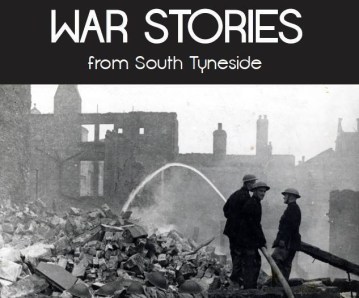
Photograph by Amy C. Flagg
In the air raid shelters….
Doreen Purvis: My cousin Anne who was 3 or 4 year old used to insist on being taken outside to look at the stars in the middle of bombs dropping around and German planes overhead. This child would have to be taken to the door of the shelter and shown the stars to stop her crying.
Derek Hutchinson: We were all sitting in the air raid shelter and the bombs were coming down and everybody’s ducking from the bomb blasts, but I’m rubbing my hand’s thinking well if this air raid goes on after 3 o’clock I won’t have to go to school. If it stay’s this side of 3 o’clock I’ll have to go to school.
Doris Johnson: I was at the Glebe Church and the siren went. So my friend Jean and I decided we’d run home to Hyde Street just a short distance away. So we ran and went into our respective homes and my parents said we would go into the shelter. My neighbour called out to me did I have anything to read. So I ran round into my neighbours shelter and the man of the house moved to let me sit down.
Then the bombs started to fall and I was blown out of the doorway. My mam and dad who I loved dearly, were killed. My dad was found later that night, then died. But my mam didn’t survive at all. That was a day, a night, that I’ll never ever forget.
Derek Hutchinson: The last bomb of the raid was a whoosh, then a (whistle noise) louder and louder. Louder than I’ve ever heard before and then…bam. The wall’s of the shelter shook, the ceiling shook, bit’s of dust came down, the candle fell of it’s rack and went out. Then the all clear went.
So we clambered out the back door, forced it open cos there was stones in front, the air raid shelter was actually in the backyard. We went through the house, through the kitchen, as we walked along the passage a big wall of dust came along the passage. When we finally got to the front door it was leaning off it’s hinges.
Outside where there had been houses there was now a hole. It was a bomb crater, they had bombed our street and six houses had gone. We went into our front room and on the mantelpiece were two ornaments, very delicate. My grandmother’s pride and joy. She was really horrified ‘Oh my God, my ornaments’. She was clutching the ornaments saying they were alright ‘apart from a little strap on one of them was broken by Hitler’.
So these figures survived the war and I went on the Antiques Roadshow with them and I showed them a picture of the bombing which was horrifying. He valued them which wasn’t very much and then said ‘Well you know why they survived don’t you’. I said I had no idea. Well he said ‘They are made in Germany. If you look on the bottom you can see the makers mark’.
Maureen McLaughlin: We were at school and the teachers were trying to persuade everybody to go onto evacuation. But I didn’t want to go and leave my mam cos I was the only daughter and just had one brother. But my friends were all going so I said yes I’ll go.
They gave us a list to get, my mother had a job to get them because you had coupons. I had to have new pyjamas, jumper, skirt, shoes, wellies, slippers, yer case had to be full of these new things. But when it came to going I wouldn’t go, I started crying so she took me home.
Memories of food rationing…
Doris Johnson: My dad was a grocer and food started to get scarcer, you got your ration book and you had to abide by that. There were queues for anything which wasn’t rationed. Then sweets were rationed you were very lucky if a shop had a bar of chocolate in.
Maureen McLaughlin: I’ve been asked where you hungry during the war well I wasn’t as the rations were enough for us. Then again if we were short of butter or sugar some of these people in the street with big families would sell you their coupons. You’d take it to the corner shop and they’d sell you the butter, sugar, meat or cheese.
Doreen Purvis: In those day’s everybody took two or three spoonful’s of sugar in their tea so sugar was a very precious commodity. My mother said a cup of tea got knocked over into a sugar bowl and they were so concerned that they actually dried the sugar out on the top of the stove so they could use it again.
Dave Bell: During the war when there were shortages my Granda loved pea’s pudding and found out there was some available in Ferry Street in Jarrow. Now he lived in Nixon Street which is two or three street’s away and he sent my Aunt Joyce, his youngest daughter to go and get him a bowl of this pea’s pudding.
Well she got it and coming back she was just crossing the square in front of the Empire cinema when a dog fight broke out overhead. A German plane was being attacked by a spitfire and the two of them were swirling about and opened fire.
As the bullets were overhead, in fear she threw herself down onto the cobbles and the pea’s pudding went flying amongst all the horse muck. So that was the finish of me Granda’s pea’s pudding.
Picking up shrapnel…
Maureen McLaughlin: We used to go around in the morning after the air raids had been, that was our past time. All the young ‘uns hunting for bit’s of shrapnel in the street’s. We all had a tin and collected bit’s of shrapnel to see who had got the most, bit’s of bombs and aeroplane an’ that.
Derek Hutchinson: Of course it really was called looting. All the thing’s we picked up off the bombed street’s had presumably belonged to somebody. We had photographs and ornaments, it was stealing but we didn’t know. So a lot of my time was spent running away from long legged policemen.
Doreen Purvis: My Grandmother lived in Thornton Avenue just beside the dock gates and of course there was lot’s of bombing raids during that time. Under the cover of the bombing the docker’s would often liberate various items from the docks, climb over the wall with them and stash them in my Grandmothers house. Usually as a reward she might get a bottle of whiskey or something similar.
One night a German war plane came down over the South Marine Park and lake in South Shields…..
Bob Robertson: My parents then lived in Eleanor Street. One of the plane’s I believe came down in one of the parks. But on it’s way it jettisoned two or three 500lb bombs and did an awful lot of damage.
Derek Hutchinson: A plane flew very close overhead on fire. It crashed at the right hand side at the bottom of Beach Road and blew up. Killed the airmen, blew down the building that houses the little boats. And just created mayhem.
If you could grapple in the lake with bent coat hanger’s and pull something out with German writing on this was a swappable article – well I pulled out a flying boot. ‘I’ve got a flying boot’ I shouted’. So they all came running along ‘Hey that’s great’. Then I put my hand inside the flying boot and pulled out what appeared to be cooked tripe. This wobbly, jellified, whitey creamy skin.
Of course it was the poor man’s foot – it had been blown off. ‘You’ll never do any swaps with that it’ll stink. Chuck it back in’ they said. So I threw it back in the lake.
Doreen Purvis: The radio was a great source of information during the war but the Germans also used it for propaganda purposes. And there was a broadcaster called Lord Haw-Haw who used to home in when there had been a raid the night before.
On one occasion he was talking about South Shields and he was talking about people in the ruins of their houses starving to death, well just at that point me Grandma was dishing up stew. So she thrust a plate of stew in front of the radio and said have a smell of that ya’ bugga’.
I am looking to add to these stories so if anyone would like to share their experience of that time just get in touch at garyalikivi@yahoo.com
A short version of the film is available on the ALIKIVI You Tube channel.
Gary Alikivi August 2019.



 ALIKIVI UK : NORTH EAST MUSIC & CULTURE