THE WORD IS HALDANE

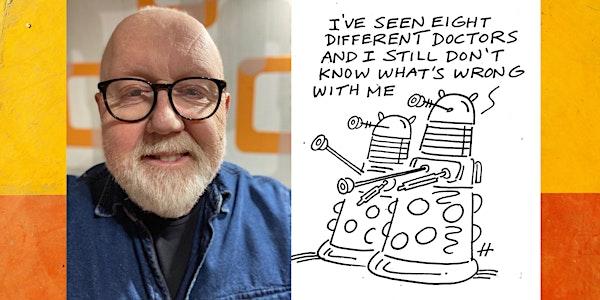
Former Shields Gazette graphic artist David Haldane established himself as one of the top cartoonists in the world. Blyth born David, now 70, worked for the Gazette from 1977 to 1983, he currently creates cartoons for The Observer and Private Eye and had his work regularly produced in Punch, The Express, Mirror, Guardian, Telegraph, Daily Mail and the Sunday Times. He also contributed sketches to the original TV series Spitting Image.

However, it is for producing cartoons for The Times from 2005 until 2017 that David made his mark, transforming him into one of the best cartoonists in the world.

South Shields playwright Ed Waugh has been asked to host an evening in conversation with David at The Word in South Shields on Wednesday September 24th at 1pm. He said:  “I’ve known David for 20 years or so and he’s both very sharp and very funny. You have to be to create top-class satirical cartoons every day, often at very short notice, for national newspaper front pages.”

He added: “David’s career stories are both deep and hilarious. It will be a fantastic event for people who want a laugh and those who want to find out about some of the stories behind the many thousands of tremendous cartoons David has created and had published.”  

The event follows his sold-out illustrated talks at the prestigious Lit & Phil in Newcastle and Blyth Library. The talk on Wednesday, September 24 at 1pm is part of The Word’s WRITE Festival. 

Tickets for In Conversation With David Haldane at The Word cost only £3 and can be bought on line >>> https://theworduk.org/whats-on/top-cartoonist-david-haldane-in-conversation-with-ed-waugh/ or via (0191) 4271818.

Link to previous interview with David in June 2025 >>>

COMIC STRIP PRESENTS Northumberland cartoonist David Haldane | ALIKIVI : NORTH EAST UK CULTURE 

ART FOR ART’S SAKE in conversation with animator Sheila Graber

Meeting up with contributors to this site I’ve asked how they survive in the arts. Some talk of persistence and others simply being obsessed by it. I think to give yourself a good chance you’ve got to be prepared to work on it day in day out basically 24/7/365 days a year.

85 year old Sheila featured on this site in June 2018 where she talked about spending her life in art – so she was the perfect person to ask.

Surviving in the arts is for me going with the flow. I believe in my Mam’s saying ‘Every day in every way in everyday I’m getting better and better’ particularly when you are feeling crap or when things have gone wrong. In the arts you need this saying because there are times when things just don’t happen for you. Tempered with that my Dad used to say ‘worse things happen at sea’! So never, never, give up. Keep positive and keep going.

After attending Art College Sheila then went to Birmingham School for Training Art Teachers in 1961.

That was the best thing to happen to me. I was shown that everyone is an artist in their own way and it’s your job as an art teacher to bring it out. It’s about giving something positive to people in their lives.

I first taught art in comprehensive schools in South Shields and by 1970 I was divorced and had time to play so bought a super 8 cine camera. Play is very important plus having a messy room or studio where no one tidies up after you!

My first messy place was at home in South Shields working at a desk looking out onto our little garden. Later it was a studio in the Pilot Office overlooking the river Tyne. Then by the mid 70s I got a break in animation.

I was contacted by an agent for World TV who sold the short films I made globally. She later commissioned me to animate 10×10 minute ‘Just So Stories’. The actual process of animation can take a long time to produce minutes on video so the only way I could produce this was to give up teaching – which I did in 1980.

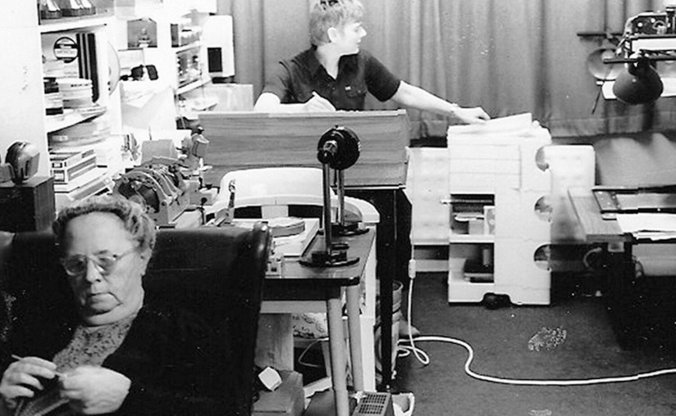
Sheila animating Frame by Frame for World TV and her Mam crocheting for a local shop – a true cottage industry.

Sheila also works with various charities, the last post features Anna Malia and North East Animal Rights, how did you get involved with them?

When I lived in Ireland I saw an incident, not to go into it here too much as it’s really upsetting, but there was a field of cows and a calf that broke free from the herd. It was about how it was dealt with by the farmer that really affected me. I thought if I get the chance I would do something for you – for that calf.

I heard a song by North East musician Jen Stevens, loved it, and thought that would really work with images. I asked Jen if I could use it and she said yes. We put it out and Anna Malia from North East Animal Rights got in touch and we took it from there.

Link to Jen Stevens song & video >>> https://www.youtube.com/watch?v=HMDkdZ3TaEk

Sheila is currently working on a book about George McVay, a little known artist who lived from 1902-1967. Former Shields Gazette journalist Janis Blower is in the process of editing it.

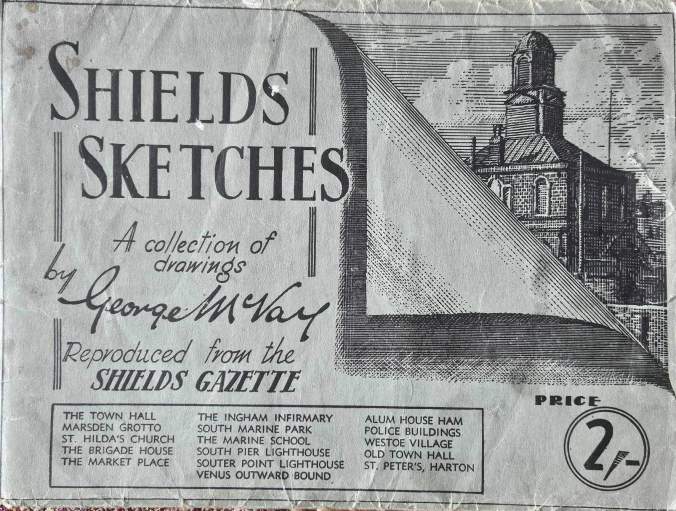
George was a very good photographer which accounts for the very large detail in his pictures. His style of painting was very photographic. When I was 8 my mam bought a set of his prints that the Gazette had commissioned and I loved looking at them like kids look at ipads now. For a long time I done plasticene models of them.

All his life he drew some amazing illustrations of Shields and surrounding areas. Some people may recognise his black and white drawings, very clear, very precise everything from the old Town Hall to the piers, the river and the Groyne. In the book Janis Blower will be adding underneath a description and history of George’s picture.

In his early days I gather he worked at Readhead Shipyard, he was studying planning, design and engineering. His Dad was mayors secretary at South Shields Town Hall and was a good photographer. It’s thought he said to his son that he should work in the Town Hall and he eventually did, he was employed in the ratings department.

Out of the goodness of his heart he’s done drawings for presentations at the town hall. There are some amazing manuscripts, whatever was required he could do it even when people leave. He also done commissions for the Shields Gazette.

The Shields museum have some in their store. He has stuff in the Hancock and Discovery museum, Newcastle. He did a showing at the Laing Art Gallery and down in London but all track of that is lost. Unfortunately, nobody has given him the recognition that he deserves.

What I’ve found over the years is that he and I have followed parallel tracks. We have both done a lot of work for charity and both drawn the most popular buildings and views in Shields because we love the place.

To contact Sheila check out her official site at >>>

Products — SHEILA GRABER ART

Alikivi  July 2025

COMIC STRIP PRESENTS Northumberland cartoonist David Haldane

A series of talks by cartoonist David Haldane have been booked into venues this September including the Civic Theatre, Gosforth and The Word in South Shields.

‘I started work at the Shields Gazette in 1977. It was a great job really enjoyed it. It was my first real wage packet. We used to get paid weekly. In cash!’ recalls David.

Born in Blyth in 1954 David last featured in April this year talking about his work at national newspapers including the Mirror, the Guardian and The Times (link below). In a recent phone call he looked back to his early days and what inspired him.

‘I noticed cartoons when I was young. At the age of 7 I got scarlet fever which then was quite serious, luckily there were anti biotics. I remember I was isolated in my bedroom at home and couldn’t touch any of my books or they would have to be destroyed’.

‘There was a guy who lived in the street who was a Merchant seaman, he brought back some papers like the Chicago Tribune. I had a pile of papers on my bed with loads of full colour comic strips inside like Popeye and Prince Valiant.’

‘Me mam bought me a jotter from Woolworths, I just sat and copied them when I was ill. From then on I drew regularly, in particular funny stuff.  When I was studying for my ‘O’ levels in Blyth library I noticed a whole series of Punch annuals which I started to read and from then on fell in love with the cartoons.’

‘People have heroes – rock stars, singers, guitarists, my heroes were cartoonists. I was 15 year old sitting in Blyth library thinking I wanna do this – never thinking I actually could or meet these people.’

‘There was a magazine called The North which featured walks and the like in places like Berwick. The art teacher put me in touch with the editor. That magazine is where I done my first published strip. I was still at school at the time and did it for a couple of years. Did I get paid? Put it this way I gave up my paper round for it.’

‘When I enrolled on a Design course at Newcastle Polytechnic I was doing a few cartoons on the side sending them in to magazines like Punch. When I got my first cartoon published in Punch it was when I was at the Gazette in 1977.’

‘The Shields Gazette were building up the art department working on advertising, editorial and illustration and four of us got a job at the same time. The newspaper then was absolutely thriving they used to do three or four editions a day. Other papers were published in the area – Whitley Bay, Chronicle and others it was a real Fleet Street on the Tyne.’

‘I remember local punk band the Angelic Upstarts came in to be interviewed by the editor, they were big, like the North East Sex Pistols. There were many wild rumours about them – the pigs head on stage was one!’

‘We were mainly advertising stuff like a pull out of Ocean Road which would feature all the shops. They would pay for adverts and we used to draw them up. This was before computers so it was all hand drawn. It was like a little factory in there we used to churn the stuff out on a daily basis.’

‘Working there was experienced journalists like Janis Blower, John Landells the waterfront reporter, his son Steve joined later. Mike Blackah was the editor. There was a huge room with a lot of sub-editors. It was a very busy, thriving newspaper office. When I started working at the real Fleet Street in London, I realised how similar they were.’

‘In the early 80s I worked on a short run of TV show Spitting Image. This was during the Thatcher years – the real hardcore political stuff. Ian Hislop and Nick Newman were writing short sketches which played before and after the commercial breaks. They wanted cartoonists to fill in the bits without puppets. Newman asked cartoonists who were working on Punch and Private Eye. Four or five of us worked on them and subsequently I got a few sketches on.’

‘I remember going to a script meeting in London. It was great meeting the scriptwriters who went on to produce a lot of shows. One of them told me to stick to drawing cartoons as you’ll make a lot more money. I took his advice. They still release box set DVDs of the show, I’m grateful to still receive the odd royalty payment.’

‘When I’m drawing I listen to film soundtracks – Japanese, Korean, quite niche, also Italian horror movies, spaghetti western, jazz sometimes. I have some Michael Nyman here as well, beautiful stuff. The music is on in the background but not when I’m thinking of ideas. I tend to sit in silence to work out ideas.’

To find out more of the life and work of David Haldane he will be appearing at ‘An Evening With’ at The Word, South Shields on September 24th & Gosforth Civic Theatre September 30th 2025.

Alikivi   May 2025

Link to previous post >>>

DRAWING NEWCASTLE’S LIT & PHIL – with Blyth born cartoonist David Haldane | ALIKIVI : NORTH EAST UK CULTURE

DRAWING NEWCASTLE’S LIT & PHIL – with Blyth born cartoonist David Haldane

David Haldane appearing at the Lit & Phil, Newcastle on 23 April 2025.

David Haldane’s work has appeared in a number of national newspapers including Punch, The Express, Mirror, Guardian, Telegraph, Daily Mail and The Times. On Wednesday 23rd April he is booked at Newcastle’s Lit &Phil where he will be sharing stories from his life.

Now living in Morpeth he said “It’s been an incredible 50 or so years learning about drawing cartoons and then creating them for the leading newspapers and magazines in the country.”

Born in 1954, David started his career in the 70s working for the Shields Gazette “I was working for the art department at the Gazette. I received my first pay packet there, every Friday, in cash. It was so busy with three editions of the paper every day. It was like Fleet Street!”

During the 1980s David contributed sketches to the original series of Spitting Image. Now retired from The Times, his latest cartoons regularly appear in the satirical magazine Private Eye.

Playwright Ed Waugh is hosting the evening at the Lit & Phil “I’ve known David for over 20 years and he’s both very sharp and very funny. You have to be to create top-class satirical cartoons every day, often at very short notice, for national newspaper front pages”.

He continued “David’s career stories are both deep and hilarious. It will be a fantastic evening for people who want a laugh and those who want to find out about some of the stories behind the many thousands of tremendous cartoons David has created and had published.” 

Tickets for the Lit & Phil are only £5 and can be bought on line 

https://www.litandphil.org.uk/event/david-haldane-in-conversation-with-ed-waugh/ 

or via (0191) 232 0192.

The Blyth Library event is on Monday, May 12, and tickets are available from 

Blyth Library – David Haldane In Conversation with Ed Waugh Tickets, Mon, May 12, 2025 at 6:00 PM | Eventbrite

David will also be staging his ‘Evening With’ at The Word, South Shields on September 24 and at Gosforth Civic Theatre on September 30.

Alikivi  April  2025

TIME TRAVELLER – in conversation with Local Historian, Luan Hanratty

46 year old Tynemouth resident Luan Hanratty has strong Celtic roots. His father was born in Jarrow with their family connections going back to Galway in Ireland and his mother originally from Rosyth on the east coast of Scotland.

Luan at Arbeia Roman Fort, South Shields.

‘Yes, the Hanratty name is Irish, however, a brief background to my employment story is that I worked the financial sector in Prague, Czech Republic, moved to Shanghai in China where I was employed as an English teacher. I even appeared on TV there and published some books. Education is strong in my background as my father was a Drama Teacher’.

‘After Covid in 2020 I came back to the UK and based myself in South Shields. I was looking for my next adventure when I came across some local history and got obsessed with reading the stories’.

‘With my business partner Gary Holland we put together a website called Penbal – which is a Celtic name for the Tynemouth headland – the site features articles on Tyneside local history, photographs, AI art, links to Maritime Trust, Lifeboats Brigade and Fishermen’s Heritage plus local products for sale – prints, postcards, mugs, t-shirts and more’.

The latest story has recently featured on BBC News >>>

Roman Stones Missing from Mill Dam Roundabout, South Shields – Penbal

Luan’s latest post on the site is about a long lost river which flowed from the Mill Dam in South Shields.

‘Beneath the busy modern landscape of South Shields lies a forgotten natural feature – a river called the Mill Dam Creek but also known as the Branin River. This flowed from Mill Dam, next to Customs House today, out to the sea near North Marine Park and the Pier. This effectively made the Lawe an island’.

‘The channel played a vital role in the development of the town, both as a waterway and a habour, and once it was dammed with ballast, the Mill Dam formed a bridge between the north and south reaches of the early town’.

‘So important then, was the creek as a resource that it forms the base of the first industrial activity in South Shields, with coal mining also evident on the south bank where the pit wheel now stands above Asda carpark in Coronation Street’.

‘If you stand on the long sloping escalator when exiting Asda and look out across the huge carpark, you really get a feel for the valley nature of the Mill Dam Pond. Imagine what it must have looked like all those centuries ago’.

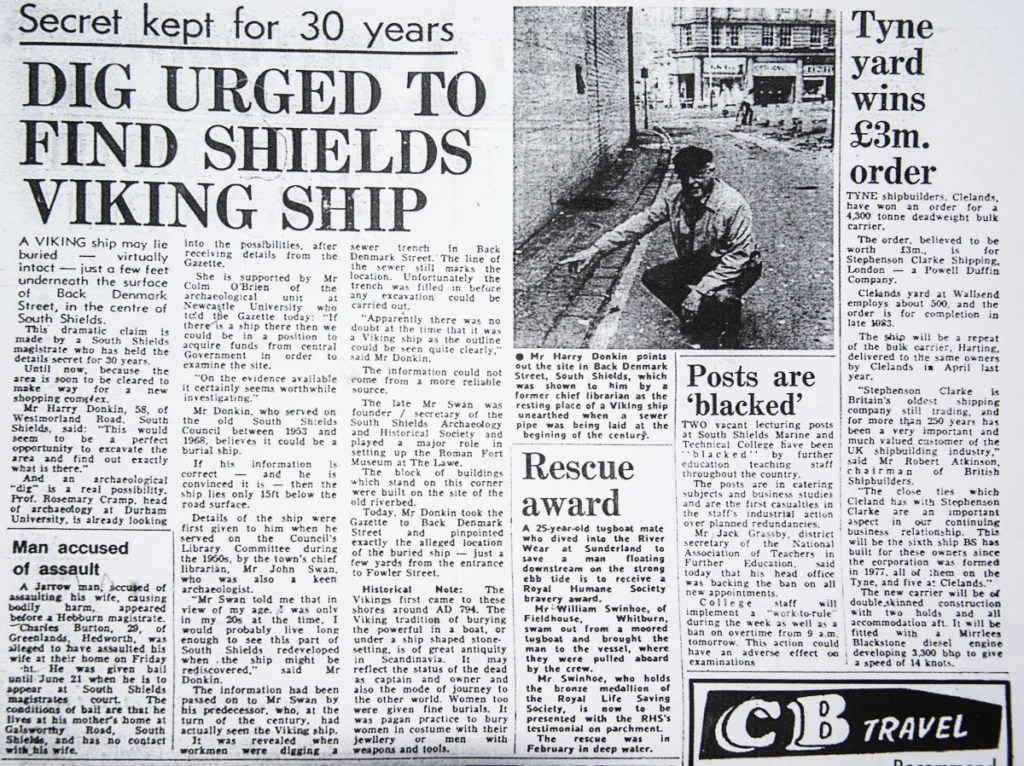
‘Another twist to the story is that in the 19th century much of the eastern end of the creek was covered by Denmark Street, where the Denmark Centre is today. In the 1830s, while building the street, a Viking longboat was discovered beside what was originally the river bed’.

‘Maybe there is someone out there who has more information about this amazing find. We know it featured in The Shields Gazette in the 1980s’.

Viking ship article in The Shields Gazette 1980s.

Full story >>> The Lost Waterway of South Shields:  Mill Dam Creek – Penbal

Luan stresses that he has no plans to research any murders or the race riots that have happened on Tyneside.

‘So far, we have over 200 local history posts and we don’t look at any taboo subjects, I just like to paint a picture of our very rich heritage here on Tyneside’.

For further information contact Luan >>>>

Penbal – Messis ab Altis

Alikivi   January 2025

HAVE YOU HEARD THE NEWS ? in conversation with award winning journalist Janis Blower

A journalist for 44 years Janis’ first and only job was at The Shields Gazette…

I don’t remember having any clear idea of what I wanted to do but the only subject I was any good at in school was English and History, so it was always going to have to be something to do with writing of some sort.

My brother in law John had been a reporter at the Gazette and my sister Pam worked on the front counter reception, that’s how they met. When I left school I wrote to the editor at the Shields Gazette, Jim Sinton, asking for a job, nowadays you would need a Media degree from University but I just sent the letter in.

I fell very lucky and got taken on as trainee reporter and signed my indentures for three years. I literally learnt on the job then periodically being sent to college learning the law and shorthand, then at the end of the three years got my National Council for the Training of Journalists proficiency certificate.

What was the job of a journalist then ?

I spent a lot of time covering court cases, council meetings, area health meetings that sort of thing. Then if you were covering a story where somebody had done something or something awful had happened to them you would go out with a photographer, interview them, take some photographs, get back to the office and write your story up.

Sometimes you would get the story over a telephone interview but I liked going out and seeing people because it was the only way of getting the feel of the story plus you picked up other things as well.

In interviews I’ve found most people are open to talking not only about good times but also bad, did you find that ?

The dreaded part of the job is what is called these days, the death knock, and a lot of times you ended up getting the bums rush. It was having to go and see somebody where someone had died possibly in tragic circumstances.

You would start by saying I understand if you don’t want to talk to me but….You always had to brace yourself for being told to f off which did happen sometimes, and I totally respect that.

A lot of time people would speak to you because they wanted the story to be right, to make sure you understand what the person who had died was like. So yeah it can be a surprise to find how willing people are to talk.

Were there any deadlines that you had to work to ?

There was nothing written in stone you just knew to get your story in as soon as possible, it was more instinctive than anything else.

You’d been to the event, got your notes down then find a telephone box and hope you’ve got the right money. If you didn’t you’d reverse the charges (laughs).

You are writing it in your head as you are dictating it down the phone line. Hoping to hell you are getting it right. Terrifying at times but brilliant training.

We used to go to court in the morning and write the stories up, taking down a note from one case and writing the previous one by hand (laughs).

The messenger would come across from the office pick your story up, take it back and that would get in that night’s paper. That’s how current it was. Even covering trials in Newcastle Crown Court, you would phone your copy over after an hour or two of the trial for that night’s paper.

There were four or five copy girls who would take dictation. The early edition used to come out around 1pm and that was basically yesterday’s final edition with a bit of updating in it. But the final would come out at 4pm.

Years ago The Shields Gazette on a Monday would have a celebratory page of wedding pictures

Yes there was always certain jobs that you did before the end of the week, one was the Agoes which was snippets of what happened 25 or 50 years ago that went into the paper and the other was the wedding reports.

People would come into the office and pick up a form that had to be filled in with the details of the bride and groom, their parents, what they did for a living, what the bride and bridesmaids would be wearing, anything special about it and name of the church.

You wrote the report from that, then the photographer would go take the picture on the Saturday.

You would see them married up together on the Monday. There was a kudos of having it in the Gazette. Do people realize now just how valued the Gazette was, you had achieved something if you were in the paper.

Janis wrote a daily column called Cookson Country featuring people and places around the town it’s popularity led to the books ‘Aall Tgithor Like the Folk O’Shields’. How did that come about ?

Cookson Country in the paper started in the late 1980’s and it had been such a success with the use of the old photographs. I can’t remember who brought up the idea, it was maybe the editor or management but they said ‘Why don’t we do a book, a spin off from Cookson’.

That’s when the paper was still owned by Portsmouth and Sunderland Newspapers who had their own publishing arm, they were doing books and magazines commercially. So it was ‘Yeah I’ll give it a go by all means’.

The first one was very popular, we done that about 1993 or 4 because my son Alexander was only a baby. I look back now and wonder how I accomplished it really, working, having a small child and doing them. There’s five of them in all with the last one in 1999.

Did you find it hard work to put them together or did they fall into place ?

No, it wasn’t hard work I think for the first one, the blue one, I settled on the things around the town that were most well-known, like the Market, Old Town Hall, Comical Corner, Marsden Grotto and Marine Parks so it was easy to come up with a selection of things to do, and the Gazette did have this wonderful collection of old pictures.

For the text the Gazette had this detailed cuttings archive dating back to just before the Second World War. So no it wasn’t a chore to put it together.

Can you remember any stories or photographs that caught your attention, that stood out ?

I think what I was struck by most and this had come out of Cookson in a way was how hard people’s lives had been. I did a bit about guys gathering sea coal, you had all this coal that was washed from out of the ground seams and spilled off ships, and men would go and gather it.

I can still remember the tidal edge along the beach down there was black with all the coal washed up on the beach.

I wasn’t aware how poor parts of Shields had been, the riverside area especially, that was a learning curve. Also to see how much the place had changed, then how in some instances it had stayed the same.

There are still huge parts of Shields that are still recognizable from 100 years ago.

This photograph (above left) is at the top of Mile End Road of the old corporation staithes where all the midnight mechanics would go round and empty the ash closets, then it was all taken to the staithes put in hoppers, taken out to sea and dumped.

You could never imagine that there was something on the riverside that looked like that. God knows how old some of these buildings were.

That was the biggest revelation, coming to realise that there had been this whole riverside town parts of which probably dated back a very long time, and it’s just gone.

It used to be one street with pubs and shops along it, people now go to York for the Shambles with its little streets, we had that. But because it was so dilapidated and insanitary it was all cleared.

How important do you think local history is ?

It’s important, you’ve got to know and understand where we have come from and how the town has been shaped. But I have a profound dislike of the word nostalgia. I hated it when Cookson page was referred to as nostalgia.

There is a saying that nostalgia is a seductive liar. Nostalgia now for people can be the 1980s, when I started doing Cookson a lot of the readers memories were going back to war time.

I never tried to look at the past through rose tinted spectacles, you look at those old photographs in the books we’ve talked about, families in those houses on the riverside were living in appalling conditions, the sewage, the water supply was poor, walls of the houses full of bugs, people were hungry, they were dirty – there’s no nostalgia for that.

It is important that we know about these things so you can see what improvements we have made, how much we’ve come on in that time.

Now that you are retired do you still keep your hand in ?

Since I’ve retired I have done some work with school children and they are absolutely fascinated by things you tell them. I’ve taken some on walks along the riverside, to The Customs House and where Brighams dock was and tell them they would have been covered in coal dust sitting near The Customs House, where the old coal staithes where.

Then behind you is the top of St Hilda Colliery pit head, can you imagine 150 year ago little children your age working down that pit ?

They are fascinated about it, I tell them to go home and talk to their parents, talk to Granda and Grandma what life was like when they where children. Don’t get seduced by nostalgia for the olden days, cos they were hard…really hard.

Alikivi      Interview January 2020
CLOSE ENCOUNTERS ON TYNESIDE Dan Green investigates Mysterious Tyneside

‘There’s a starman waiting in the sky
He’d like to come and meet us
But he thinks he’d blow our minds’.

Sang Bowie in ’72. Over the years there’s been many songs written about UFO’s and aliens. Back in the ‘50s Bill Buchanan and Dickie Goodman wrote The Flying Saucer which landed at no.3 in the American charts.

In the ‘60s The Byrds sung of a Mr Spaceman and in the ‘80s the Ramones ripped through Zero Zero UFO about aliens visiting earth.

Some Native American tribes believe they have gained knowledge through extra-terrestrial contact with their star ancestors. But when you find a mystery closer to home, it can add more interest.

This was the case for former South Shields resident Dan Green. Dan is a British author, broadcaster and researcher, he recently got in touch and told me some interesting stories that he researched when living in the town. One of them reminded me of an experience I had back in Summer 2013.

I was walking on South Shields beach around 6pm, above was bright blue sky with a few clouds.  I was enjoying the sun and listening to the gentle waves – my mind was just wandering.

Out of the corner of my eye and way up high, I saw a small silver disc moving slowly. I thought it might have been a plane because there is a flight path nearby. I watched the disc move slowly for a minute or two, looking around for maybe a reflection off something else in the sky.

It was silent and moving very slowly then suddenly it shot off very fast and didn’t leave a trail. What was it?

In 1988 author Dan Green wrote an article for The Shields Gazette chronicling close encounters in the town including incidents now referred to as ‘Unidentified Aerial Phenomena’. He found that in 1967 the UK was besieged with a flurry of strange lights appearing in the skies.

The newspaper reported ‘A bus driver said he saw a cigar shaped object surrounded by a bright green glow over the coast near Brighton. Sparks were coming from its tail and for a short time it travelled parallel with the bus’.

Not to be outdone was our own South Shields, with the Gazette reporting some boys claimed to have seen a bullet shaped object hovering over Horsley Hill electricity sub-station.

One boy glanced up and saw the glowing green outline of an 8ft long cigar shaped object hovering 100 yards away – ‘It must have spotted us, cos it just shot back up into the sky’.

Below is part of Dan’s article in The Shields Gazette from 1988.

‘I was an impressionable 10 year old when the Shields Gazette popped through my letterbox with a page reading ‘UFO over Tyne Dock’.

‘On the night of October 21st 1967 residents living near the river had been invited to the spectacle of three dazzling white triangular lights stationary in the sky. They had been hanging for a full half hour before vanishing’.

‘People craned necks out of their windows to witness it, and one in particular had called the police. This enterprising fellow, later nicknamed Ronnie Rocket – took his enquiry as far as the Ministry of Defence who eventually sent him a reply that ‘Everybody had seen a weather balloon that had blown over from Liverpool!’ 

‘That October week saw more puzzling sights in the skies of Shields, as early morning workers catching the ferry viewed a host of fiery ‘Flying crosses’, and a sighting of a cigar shaped object was reported by a couple walking their dog in the Bents Park during the day’.

‘Residents in Whiteleas saw an object streaking across the sky ‘like a bullet’. The 1967 UFO flap was never given any plausible explanation, but I’m sure as hell it wasn’t a scousers balloon’.

For further information about the work of Dan Green contact –  www.dangreencodex.co.uk/

Gary Alikivi October 2019.

HIDDEN TREASURE on Tyneside with investigator Dan Green

Mysteries of the world are fascinating subjects, and we rely on scientists, archaeologists and storytellers to bring them out of the dark. Finding a mystery closer to home can add more interest.

This was the case for former South Shields resident Dan Green. Dan is a British author, broadcaster, researcher and writer, he recently got in touch and told me some interesting stories that he researched when living in the town.

I lived in South Shields for over forty years, and this is one of my better investigations, originally introduced to the public as a centre page article in the Shields Gazette in 1989.

I’d come across ‘The Cuthbert Code’ first told to me by a retired Benedictine monk who was living in the town. He told me how St Cuthbert was originally buried at Lindisfarne and eventually found a resting place in Durham Cathedral, only to be disturbed by Henry VIII’s marauding commissioners looting for treasure during the Reformation.

While orthodoxy tells us that he was reburied at this shrine in 1542, the Cuthbert Code records that his loyal monks looked to safeguard his body against any further attempts at sacrilege, so reburied him in a secret location.

A substitute skeleton was placed in the tomb. The secret of his reburial location is closely guarded by no more than 3 monks at any one time.

I discovered an 1895 manuscript tucked away in the safe of St Hilda’s Church in South Shields, called ‘The legend of the Fairies Kettle’. It mentioned Cuthbert and how a gold cup had been stolen from its fairy guardians at Trow Rocks on the coast at Marsden. Then it was whisked away to Westoe, then taken to Durham Cathedral to be buried alongside Cuthbert.

Knowing a bit about Freemasonry I deduced that there was a broader message here and that a treasure linked to St Cuthbert was telling us that something thought to be in Durham Cathedral was in fact at Westoe.

This ‘treasure’ being Cuthbert himself – bear in mind that during medieval times the monks of Durham owned Westoe Village.

I set off on the scent of the saint and a hunch led me to Westoe Village. In 1989 there stood a derelict Nunnery once owned by The Order of The Poor Sisters of Mercy. At the time of my interest the Nunnery had just started to be re-developed and the ground was disturbed.

The builders allowed me access and on the stone floor under inches of dust and grime I found a five-pointed star mosaic.

By now I had my centre page in the Shields Gazette newspaper, and they promised they would carry a follow up. I’d accumulated a lot of evidence including a curious plaque high up on a wall in the village stating, ‘Follow the Paths of the Lord and you will find him’. Was this telling us to follow some subterranean path or tunnel under the Nunnery leading to Cuthbert?

The new owner of the land was intrigued by my Gazette article and allowed us three days to nosey below the site before it would be filled in. Hurriedly I took two burly ex-Westoe miners, plus a stonemason friend of theirs and entered an accessible dark mazy passageway that led to another sealed off passage.

I hadn’t told the owner that my crew were armed with lump hammers, they smashed a hole through the passage wall.

Using plasticine we took an imprint of a Freemasonry mark on a brick in the wall. We were now under a stairwell and a hollow cavity. Our stonemason accomplice told us that there should be something below – the perfect place to hide something of value. Cuthbert?

Frustratingly, our time was up, with no chance of being able to return or continue. At least, with photos we had taken each step of the way, we had the follow up Gazette article.

But then the Editor took fright at the implications and refused to print it. I also did a short phone interview for The Sunday Times.

What happened next is a mix of comedy and tragedy. My Cuthbert Code resurfaced in 1997, just before I left South Shields when new evidence again cast doubt on the final resting place of another Catholic saint, Thomas Beckett at Canterbury Cathedral. A similar situation to mine then.

I arranged to meet up with the latest Gazette editor and try again to see if what had been my intended second article could at last be presented to the awaiting Shields’ population. I took a dossier in and after studying the work he broke his silence with, ‘Is this a wind up?

I found the question disappointing and assured him it wasn’t, and we continued talking for some time. He concluded he’d think about running a feature and be in contact in a few days.

He did and said that he couldn’t possibly run it. I pressed him why and here’s his reply which I still remember clearly, ‘Because I live in the flat above your location!’

What was the odds of that? I didn’t know whether to laugh or cry, but it was true, his flat was right above the location. Perhaps, if he’s still there, with lesser odds, St Cuthbert and his treasure is also there below him.

More mysterious stories from Dan will be posted soon, for further info contact:

www.dangreencodex.co.uk/

Gary Alikivi  October 2019