
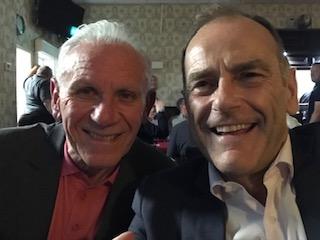
Now 85, Arthur talks about joining the police force as a cadet in 1955…
‘Yes, I was a polis in Newcastle, the city was a lot different then I’ll tell ya, it was still getting over the war to be fair. My first beat was Sandyford Road where the Civic Centre is now. That was all houses then’.
‘It was quite a tough beat, a rough area with pubs like The Lamberts Leap and another called The Sink near the Haymarket. You had to earn your corn, there were no radios or panda cars – you were just pushed out onto the beat and that was it, you had to get on with it’.
‘There was a police pillar (similar to a post box but with a telephone inside) on the corner of Sandyford Road. If you arrested anyone you hoped you could get the person to the pillar. It was difficult cos sometimes you had a couple of guys fighting…you had to get them there, it wasn’t easy’.
‘There was generally more respect for the police then, you would get more help from the public once you established yourself on the beat, which you had to do cos you were tested out straight away’.
‘Once they knew you were fair and straight you got a lot of help from them. You were on that same beat for years, you weren’t just passing through you got to know every shop keeper, every doctor, every villain…you got to know the whole community. But then the T. Dan Smith regeneration project of slum housing clearance began and the place changed completely’.
‘I always liked paper work, always took pride in my reports. A crime file for shoplifting or murder has a beginning, middle and end and you had to go to court and defend what you had written. In the end someone could go to prison so you’re under pressure, under scrutiny. That reality far exceeds any drama’.
‘I moved from department to department, CID, drug, vice, crime squad, then around 1978 I worked for the anti- corruption team in the Government based in Hong Kong. For the year I was there I would see people living in cages on roofs, people swapping babies in hospitals, it was a weird place. I wrote an article for the Police Review national magazine on what I saw, they paid me £25 for it. It was read all over the country’.

‘I didn’t start writing until I was 40 you know. When I came back to the UK, I worked in Washington Police Station, a young cop called Jeff Rudd came to see me ‘I used to be a musician in a band, I’ve still got all these tunes going round my head but can’t put words to them. I read your article and seen your reports, I wonder if you’d be interested in putting some words to my tunes?’
Well, I give it a go and then thought nothing of it until a few months later I was pleasantly surprised when he handed me a tape with the songs on. I really enjoyed my time with Jeff, he was a very accomplished guitarist. We ended up writing around 50 songs, one of them ‘Big Bren’ was about the athlete Brendan Forster, that was played on radio’.
‘That led us to doing an interview and playing some of our music on the Frank Wappat BBC Newcastle radio show, then we done a couple of gigs in Washington. Next thing my wife Irene said why not contact Tom Hadaway? (writer When the Boat Comes In, Newcastle Live Theatre).’
‘I wasn’t sure at first because I didn’t know him but as he was from North Shields we met and he told me to write a play. ‘What do I write about Tom?’ I asked ‘Write about what you know. What fires you up.’
‘So, I went away and wrote about the bait room. Tom read the play and was laughing at it ‘Yeah, you know how to write dialogue son’.
‘There was a police section house near Exhibition Park, in it was a bait room, just a pokey little room with a table to play cards on. If you’re on night shift you’d take sandwiches and a flask of tea in. That’s where you gathered around 1am where the events of the night would unfold’.
‘You would get advice on how to deal with someone, it was a good place to sort things out like the older cops would tell you how to deal with a death, how to deliver a death message to the unfortunate family. It was a sort of meeting of minds over a game of cards. Aye the bait room was a good place to vent your spleen so to speak.’

Running parallel with his police work Arthur was training in athletics at the running track at Ouseburn, Newcastle.
‘I was on shift in the Bigg Market from 5pm till 1am, that was rough, there was fighting most nights. After finishing I would grab a few hours sleep then go to court, then onto shot put training. I was in the British athletics team from 1962-71 and competed in the 1970 Commonwealth games in Edinburgh. I was very fortunate and saw the world with athletics’.
Arthur talked some more when the conversation turned to the present day and the riots that are happening this summer around England. He recalled a quieter time for the police.
‘I remember we had a huge kettle for the bait room. It was always on the stove. One day a big fish wagon went past the section house and dropped a fish out of one of the boxes. I picked it up brought it back into the station put it in the kettle and boiled it up. All day everybody was complaining about the smell from this mackerel…and no, we didn’t eat it!’
‘Another story was one night when I was up beside the Hancock Museum going to the section house at Park Terrace. Can you remember the litter bins that used to hang on a lamppost? Well, this one was upside down on the lawn outside the Hancock and it was moving around. I lifted it up and there was a hedgehog underneath it!’
‘So, I put it in my coat and took it up to the section station. Inside are lockers to put your bait in so I put the hedgehog inside one of them and waited for the copper to open it. He just about had a heart attack when he opened the locker!’
Hearing these innocent stories was a world away from watching how the police were dealing with the riots around the country, but then Arthur’s tone changed.
‘I remember it was winter time, snow piled up on the ground. I went in for my bait around 12.45am and heard a muffling sound, I opened the door and there was an older police officer trying to commit suicide with a plastic bag on his head. There was a scuffle as I grabbed hold of him but couldn’t get the bag off. I looked around found a fork and split the bag but caught his face at the same time’.
‘He was playing hell with me for saving his life ‘What right did I have’ and all the rest of it. As we were having this argument I could hear the other officers coming in for their bait so everything was put back right, we straightened up the chairs and table as if nothing had happened’.
‘That policeman only had a couple of year service left, he was very bitter, he didn’t thank me. Turned out he had a hell of a life with his wife and thing was he had seen action in the second world war’.
After writing about his experiences in The Bait Room, Arthur kept in touch with Tom Hadaway and wrote another play.
Tom looked at it and gave me pointers, when I finished it landed on two desks. One was the BBC in Manchester where I met them, it ended up on the Saturday Night Theatre radio show, which was a big thing’.
‘The other was the script reader for David Puttnam (producer Chariots of Fire, Local Hero, Midnight Express) who hated it at first but won her round in the end. She said she couldn’t do anything with it but put me in touch with an agent who was looking for writers for a tv show called The Bill. That’s where the writing started’.

In 1988 Arthur retired from the police force giving him more time to devote to his writing where over the next decade he delivered TV episodes for Wycliffe, The Bill, Casualty, Spender and Harrigan. The Bait Room was finally made in 2009.
‘I used the same discipline for writing as I did sport. Getting a focus, deciding what you want and going for it.’
‘What am I doing now? I’ve had a lot of my writing shown around the North East. ‘Pickets & Pigs’ was a story set to the background of the 1984 Miners strike’.
‘Later this year I’ve got a play on stage which I started writing in 2003 with Dave Whitaker. ‘Blackbird in the Snow’ is one of those that you leave on a shelf for a while then go back to’.
‘I worked with Dave on a musical about the Jarrow March called ‘Cuddy’s Miles’. John Miles wrote the music for it, Cuddy was a cook on the march, he was John’s relation. That was well received when it played The Customs House in 2004’.
‘Sadly, Dave passed away in 2021. He’ll be sorely missed so the new play is produced as a salute to Dave’s beautiful lasting memory’.
‘Blackbird in the Snow’ has a four night run with the premier on 5th November 2024 at Laurels, Whitley Bay. For more info and extra dates contact the official website >
Blackbird in the Snow | Line-Up (lineupnow.com)
Alikivi August 2024


 ALIKIVI UK : NORTH EAST MUSIC & CULTURE