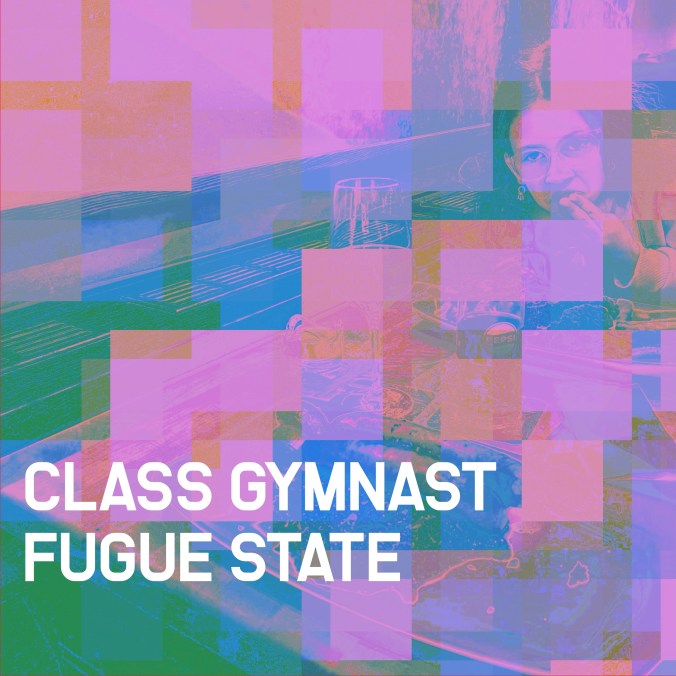
Class Gymnast are Jon Melvin (Vocals), Mark Cliff (Drums), Jordon Ridley (Bass), Andrew Yates (Guitars) and John Dempsey-Curry (Guitar).
“We’re mainly South Shields lads, although I suppose our spiritual home is Sunderland – we’ve rehearsed at The Bunker on and off for the best part of two decades” said guitarist John Dempsey-Curry.
What are your hopes for this single?
“I’ll be honest, it’s just nice to get some music out there. We started this ‘project’ in 2019 as a way of playing some older songs and ended up writing and recording new music. Right when we started trying to do anything of substance, the pandemic happened and we had to slow right down. We’re not fast at the best of times, but we ended up writing and recording around one song a year, and never really doing anything with it. This is us finally committing to something.”
How long have the band been playing music for?
“We’ve all been playing together in some form for a while. Three of us were in a band called The Volts in 2000 for a couple of years. Four of us were in The Broken Things back in the early 2000s. A few of us started a band called Maps Are Fiction / The Dead Generosities in the 2010s. A couple of us are in the going concern The Union Choir. I believe The Broken Things may be making a brief comeback as part of a charity gig alongside some other bands of that time shortly, which will be exciting.”
What do you think about the state of live music today?
“We’re all in our 40s and most of us have kid(s) so getting out to see gigs is hard. Playing them even harder. I know from other folks I’ve seen posting pictures (on social media) that there’s still a thriving small band scene, so I know there’s a scene out there, but it does feel very much like there’s a lack of venues dedicated to this kind of thing like there was ‘in my day’. I’m very probably wrong on that though!
Have the band planned any gigs soon?
“On the live music front we are playing the Ship Isis in Sunderland on 31st January with two other bands – American Wrestling and Becca Rubin.”
Produced by Martin Trollope – aka Harbourmaster – ‘Fugue State’ the debut single released 26/1/2026 and same day music video premiering on You Tube at 6pm. Pre-orders on Apple music 19/1/2026.
55 year old artist and stonemason Rob MacDonald originally from Rugby in the Midlands has lived in Catalonia, Spain for the last 15 years working on community art installations. His latest project is in Sunderland.
About 10 years ago I came across a story about International Brigades in the Spanish Civil War (1936-39) who came from the UK. It was really interesting especially finding a guy who was on a ship coming from the UK with the same name as me. It piqued my interest so at first I decided I was going to make a sculpture of this guy explained Rob.
Rob in Sunderland City Hall with brochure of the monument in Catalonia, Spain. (pic. Alikivi Sept 2025)
I’d already worked on a few projects and exhibitions in Barcelona so I met with local contacts Alan Warren and Sonia Garangou, teachers and lead historian on the Ciudad de Barcelona. Together we developed a community art history project in the coastal town of Malgrat de mar 40 miles north of Barcelona.
As we talked about the history it became obvious that this wasn’t just about Rob McDonald on that ship it was about all of the International Brigade volunteers and how it related to politics and fascism today. We agreed that it needed to be a community led project because the memory of the Spanish Civil War is a sensitive issue. We didn’t want to go off and just make something ourselves.
The big question about it in Spain is the historic memory, the political left want to talk about it, republicans want to talk about it, but there are questions remaining like where are the unmarked graves? In Catalonia they realise how important the International Brigade volunteers were. In the end the backbone of the idea was to build a monument.
The first monument was opened on May 30th 2022 at Malgrat de mar. It is actively being added to every year, it’s a living monument. When working on it the figures were made in a series of workshops with local people. Some worked on them for 2 minutes others stayed for over an hour as I told them about the stories. I also went into schools and the students took away the information and learned more about the International Brigades.
There are loads of levels to the project – art projects, exhibitions and performances. It’s been really successful. Also, every year in May there is an event held at the monument where the Mayor and all the dignitaries of the town attend. All political parties support the project. There is a broad support, the first 30,000 euros for this monument were crowd funded.
Now we are based in Sunderland college. I have found a lot of pride here, people get behind the area, not just the football team but the shipbuilding history.
Normally around towns you see monuments of kings and queens and people you don’t know. But it isn’t working class history the sculpture is not done by the people and the community are never asked. It gets decided by someone in an office somewhere. The community don’t engage with it. The participation living monument is about community engagement. That is what we are interested in.
I’ve talked to people about working class struggle and the arts. We built up this idea that monuments and public spaces are part of the struggle for working class people’s dignity, history and rights – it’s all tied together. And the symbolism of sculpture is important because it talks to the community about who they are and who they are not.
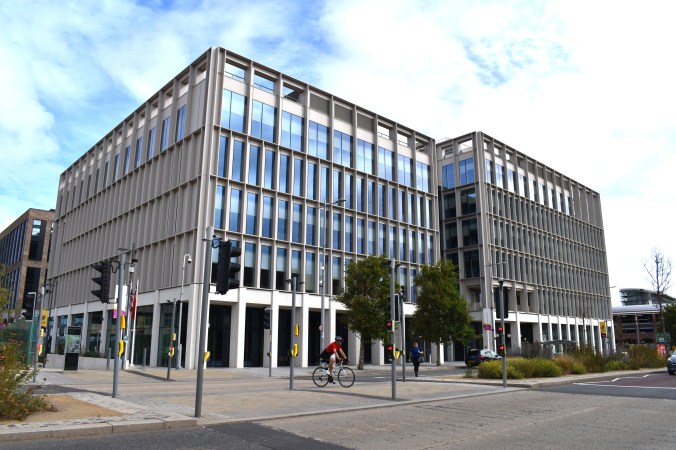
Sunderland City Hall (pic Alikivi Sept 2025)
There are amazing stories of Sunderland being involved in the International Brigades. One ship bound for Spain in the civil war had on board two unemployed shipworkers from the city. Some of the ships were built here and the captains were from the city. There were men from here who risked their lives to help feed people in a foreign conflict.
Part of the project is not only to expose the history but find it as well because people from the city will be related to some of the Brigade volunteers. We need to build up those connections.
We are at a critical point in the project we are networking with people to make this monument happen. It’s important that people are involved in the process of making it. We are in talks with Culture and local Council – organisations we are looking to partner with and make links to get support.
There are a couple of areas where we would like for a monument – Mowbray and Barnes Park are nice and this new development down here (we are in City Hall) but there may be other suggestions.
The history of the Brigades might be tucked away in a cupboard here in the City Hall when really it should be in an exhibition for the community to see. You know they were brave people, heroes really, and this is an important part of social history that needs to be told.
Retired since 2010 and now living in France, Mark was born in Teesville on the outskirts of Middlesbrough where he began playing piano at 7 year old and by 15 started working in showbusiness.
Initially, it was my older sister Margaret who influenced me, she was a brilliant pianist and suggested I start piano lessons. Most weekends the family would sing all the popular up to date songs of the fifties accompanied by my sister on piano recalls Mark.
Of all his experiences in showbusiness it’s a cliché to say but Mark really has been there, done it and worn out the t-shirt. Read on for some of his highs and lows.
For many years I ended up working as a singer and entertainer on the North East club circuit, before moving to Manchester in 1976 where I continued performing while also working as a session singer for the BBC.
Throughout my career I’ve also performed in countries like Norway, Malta and the casino circuit in Portugal plus venues like Bristol Hippodrome and Liverpool Empire. I’ve even worked seasons at Butlins holiday camp.
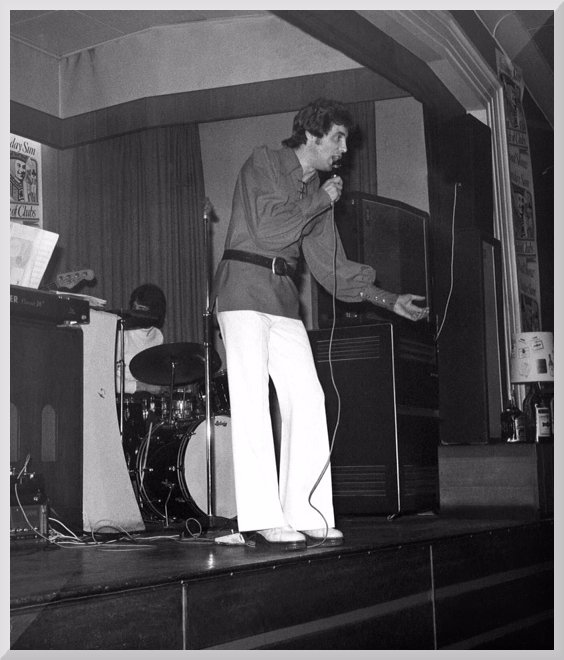
Mark performing on the North East club circuit.
When did you get your first big break?
Between 1967 to 1969 I was singing with the Bill Sowerby big band at the Top Rank suite in Sunderland. The band regularly supported big name groups who appeared there. Slade and Family come to mind.
On one occasion Radio One DJ ‘Emperor Rosco’ – real name Michael Pasternak – was appearing at the Top Rank with his road show. I happened to be in the venue rehearsing an original song with the big band.
After we finished, Roscoe introduced himself “if you ever fancy moving to London and working as a session singer, you’d be welcome”. He gave me his card and a few months later I took him up on his offer.
When I started working for Rosko he was in the process of forming his own independent record label Mother Records. He co-wrote a song ‘909’ which I recorded as a demo, which presumably was meant for a name artist.
Rosko’s management took the demo along to EMI to discuss a distribution deal for Mother Records. The feedback I received was that they were very impressed with my version and would like to distribute the song.
The song was released in 1971 and started to receive air play with favourable reviews in music magazines. From what I remember it received good reviews on Rosko’s round table and the Pete Murray show as well as other Radio One shows. The only negative review was from Tommy Vance.
Just when Mark was making headway in the music biz a scandal hit the headlines. ‘Bribes at the BBC’ the Sunday newspapers suggested that certain BBC DJs were being paid by record companies to play their records.
Rosko was not mentioned or involved however it stopped DJs at the BBC from being involved in any third-party interests explained Mark. However, he knew he needed to keep up the momentum that he had built up so far.
Rosko’s management approached me and suggested that I should promote the record on the cabaret circuit and local radio stations. In comes Colin Hutchinson.
Colin was based in Middlesbrough and booked the artistes who appeared at the Fiesta Cabaret club in Stockton. Subsequently I signed a five year management and agency contract.
Colin promoted me as a solo entertainer and ironically one of the first venues where I promoted the record was at the Top Rank Suite in Sunderland for a local BBC radio station.
‘You’ll Never See Julie Again’ recorded by Frankie Vaughan.
By 1974 things were looking up, management approached me and put an idea on the table. They said although Frankie Vaughan’s career was slightly waning – having been a big star in the late fifties and sixties – he still had massive pre-sales orders regarding record sales.
By this time, I’d started singing on cruise ships and when on one P&O liner I sat down and wrote ‘I’ll Never See Julie Again’. Within two weeks of being on dry land I recorded a demo version of the song at Keith Murray and Billy Hygates studio in Redcar using local musicians. The song was published with EMI and produced by Les Reed for Columbia records.
Unfortunately, 1974 was a bad year all round for record pressing due to a major shortage of plastics. The major companies gave preference to guaranteed sellers – chart bands like Paper Lace.
Coincidently, in 2020 Mark teamed up with songwriter Chris Morris who was vocalist and guitarist with 70’s pop band Paper Lace who appeared on TV talent show ‘Opportunity Knocks’ and had UK chart hits including a number 1 ‘Billy Don’t be a Hero’ in March 1974.
Regardless of negatives, the first PRS cheque I received for ‘I’ll Never See Julie Again’ noted that the song had sold well in Canada and Australia with reasonable UK sales. We appeared on at least 14 different TV shows to promote the single.
Looking back, I think I’ve had a few setbacks when it comes to recording and record releases however regardless of this, I’m really grateful for the opportunities I’ve received during my career.
On the bill with Bob Monkhouse and Harry Secombe.
What was your experience of working on cruise ships?
I started performing on cruise ships at the age of 25 and initially I was naive as to how it worked. The cruising market at that time was very old fashioned, for example the ship was split between first class and tourist.
There was a first class room on the old Canberra with decor like an old fashioned colonial Gentleman’s club. I only sang there once as after I performed the first two songs combined with topical patter, I was aware that none of the snobby gentlemen were interested. A number of them were sleeping with the Times newspaper covering their face.
After my third song I announced in a rather cheeky way that I had better places to perform, audiences normally listen and react to my show. I walked off to the sound of my own footsteps. Needless to say, I was never asked to work there again.
Fortunately, the cruise director had an idea to double me up to perform in the night club come cabaret lounge for the tourists. On that show and subsequent performances, I received standing ovations from the audience.
Some months later I was sent a P&O in house magazine with an article written by the same cruise director on the Canberra – ‘Mark Aynsley and another young entertainer called Billy Hygate were like a breath of fresh air’.
It went on to say that the future of entertainment on cruise ships was changing and both Mark and Billy had lifted the bar to a higher and modern level.
What are you doing now and can you bring your story up to date?
In 1982 my wife Alison and I established Almara Music Productions. Almara was an agency that represented vocalists, dancers, bands, comedians and magicians in varied fields of TV, entertainment, cruise ships, theatres, cabaret and summer season shows.
We retired in 2010 and permanently moved to south west France although since retiring, Almara Music Productions continues to be the platform for my songwriting promotion.
To listen to a compilation of music by Mark Aynsley Hay & Chris Morris plus family, friends & associates check out the official website:http://www.chrismarkmusic.com
The music world has always had its fair share of myths, legends and hell raising antics. The time Ozzy bit the head off a dove or was it a bat? Well both actually. According to reports one was in a record company office the other was live on stage. He also snorted a line of ants. The list is endless for the Oz.
I came across a gaffer tape incident involving a music journalist and Killing Joke, as I was trying to find out who the journalist was, where and when it happened – if it did! I read a few other short stories with North East connections
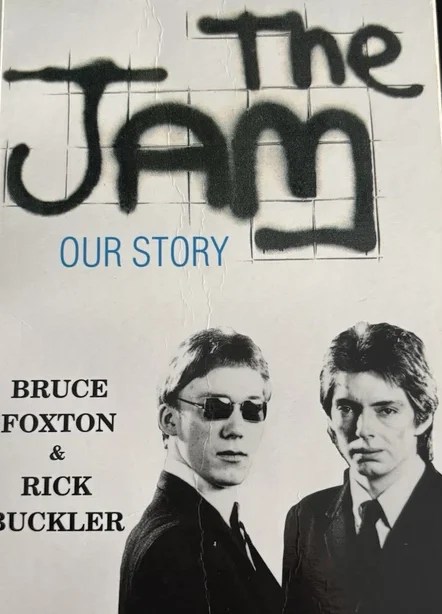
This one taken from the 1993 book ‘Our Story’ by Bruce Foxton and Rick Buckler from The Jam.
‘The Vapours profited greatly from Bruce and The Jam. They became regular touring companions which lay them open to the usual barrage of pranks and abuses. While on stage, Paul, Rick and Bruce took great pleasure in taping their personal effects to the roof of their dressing room. But the main butt of jokes was Vapours tour manager, Tony Newman’.
‘He was once dispatched with instructions to purchase copies of each weeks Melody Maker, Sounds and New Musical Express. The unfortunate soul came in for some gleeful ribbing when he returned with 16 copies, one for each member of the party. ‘Plonker!’ cite Rick and Bruce in unison.
The headline band decided Mr Newman, who is remembered as looking like a natural victim in the Woody Allen mode, had ‘spent far too long trying to ingratiate himself with us’. He was promptly gaffer taped to a chair outside the Swan Hotel in Newcastle’.
Also taken from the same book…’It was still Paul who suffered from the worst excesses of fandom. On one occasion his sartorial elegance nearly cost him his life. Having taken to wearing the long, college scarf featured in many latter day photo sessions, he had probably never considered the garment a possible lethal weapon’.
‘Stepping out of a doorway in Newcastle, two enthusiastic fans made a grab for the scarf from either side of him. Consequently, Paul found the breath being sucked out of him as he tried to ward off his admirers. It was a neat analogy for his state of mind’.
The band appeared on the first episode of live music show The Tube filmed in Newcastle and broadcast on Channel 4.‘Of all The Jam’s television appearances this one, which took place on 5th November 1982, was arguably the most important. The announcement of the split had become public knowledge just a few days previously’.
In ‘Ska’d For Life’ by Specials bassist Horace Panter he talks about recording and playing live…’There’s a kind of etiquette at rock gigs. The audience at say, Newcastle Mayfair, will behave in a certain way towards different bands. The security staff will know their limits and the crowd will be aware of this. You behave yourself, you have fun. You misbehave, and something else happens – generally something you don’t like. These are unwritten rules. This is why venues like Newcastle Mayfair keep putting on shows. There is a system. It works’.
He recalls the mayhem surrounding a gig on the American tour in Palo Alto.
’Frank has a stand up row with the PA crew, and Neville has had enough and wades in with his fists. He then grabs a mike stand and hurls it at half a dozen guys that are still having a go at Frank by the monitor desk. Fists fly, but it’s soon over, and we retire to the dressing room, where Jerry and Terry destroy furniture, fixtures and fittings’.
‘Nev has lost a tooth and has a nasty gash over his right eye. Rico leaves, never to return. We get back to the hotel in subdued mood only to find reception closed and the crew without their room keys’.
‘This is ‘bar room blues band’ country and I don’t want to sound egotistical, but I can’t help feeling that we are achieving nothing playing here in the suburbs. It reminds me of my days in ‘Breaker’ playing workingmen’s clubs in Sunderland and dreaming of a record contract. It doesn’t work. Two more gigs and we’re out of here. The novelty has worn off. It’s now a slog’.
‘When recording ‘More Specials’ in 1980 at Horizon Studios I got a call from the office in London. They had received a letter from the mother of a teenage boy who had been in some kind of accident. He was in intensive care in Gateshead’.
‘The letter said that the lad was a mad keen Specials fan, and a message of encouragement would help enormously. I said I’d see what I could do, but the vibe at the studio was not conducive to brotherly love, and the plight of a distraught mother seemed to be a different universe compared to the ‘I don’t see why Dammers says his songs are better than mine’ and ‘we should make decisions as a band and not have one person calling the shots’ that sort of rubbish that people were starting to come out with’.
‘After a couple of weeks, I eventually got a cassette of rough mixes together and wrote a few lines of encouragement. A while late I got a letter back from the mother in Gateshead, thanking me for sending the tape, but she had buried her son a fortnight previously. The tape had arrived too late’.
‘This had a deep impact upon me and made me question an awful lot about who I was and what I was doing with my life. I was part of the most influential pop group of the day, I was doing what I had only been able to dream about a few years ago’.
If you’ve got a story to add just get in touch.
Alikivi March 2025
Research >>>
‘Ska’d for Life’ – a personal journey with the Specials by Horace Panter (2007)
After a career lecturing in Psychology for over 30 years, Eileen is now retired from Sunderland College. Throughout the years she has researched her ancestry and in turn became absorbed with local history.
My ancestors were Sunderland keel men in the 1600s, there were a few miners among them but mainly trades associated with the River Wear. My grandmother played the organ at her local church and her sisters sang in a local concert party. When she retired my mother went to evening classes and taught herself piano, she also wrote pantomimes and songs for the local community centre. When she was in her ‘80s she organised singing groups at her local ‘natter’ club.
About 15 years ago I started collecting Wearside folk songs from the 1800s. For me words are the most important thing. I don’t like the music overpowering what the song is about because the most important thing is what the song is telling you. I prefer unaccompanied singing and the harmonies.
I used to sing at events with the Tyneside Maritime Chorus which was run by folk singer/songwriter Benny Graham. We mainly sang songs from Tyneside like Keep Yer Feet Still Geordie Hinny and TheBlaydon Races which are widely known. This set me off wondering whether there were any equivalent songs from Wearside apart from The Lambton Worm – although that was originally written for a Tyneside pantomime.
Sunderland Antiquarian Society which has been going since 1899, has a lovely archive mostly donations from local people. I research there and the local studies library in Sunderland.
The first song I found was The Old Wife’s Lament to the Keel Men of the Wear and it was all around historical events about the keel men and it was written in dialect. That set me on the road to researching the history that went with the song and there’s a bit where it talks about them fighting the French. But did the French ever invade the North East coast?
I found an article about the Battle of Hendon in 1799 where local volunteers staged a mock invasion because they thought a French invasion was imminent. The song has historical references but some humour also.
There a lot of songs about death and tragedy, mining disasters and shipwrecks but there are songs that tell light hearted stories. The Durham Militia pokes fun at things, it’s like the 1800s version of Dad’s Army, with lyrics like ‘You’ll march away like heroes – just to make the lasses stare’ and suggesting that the only battles they will fight will be in the pub.
During covid I gave a presentation online to the Traditional Song Forum about my research and was asked to write a paper which was published in a book of folk song research in 2022 entitled Thirsty Work and Other Legacies of Folk Song.
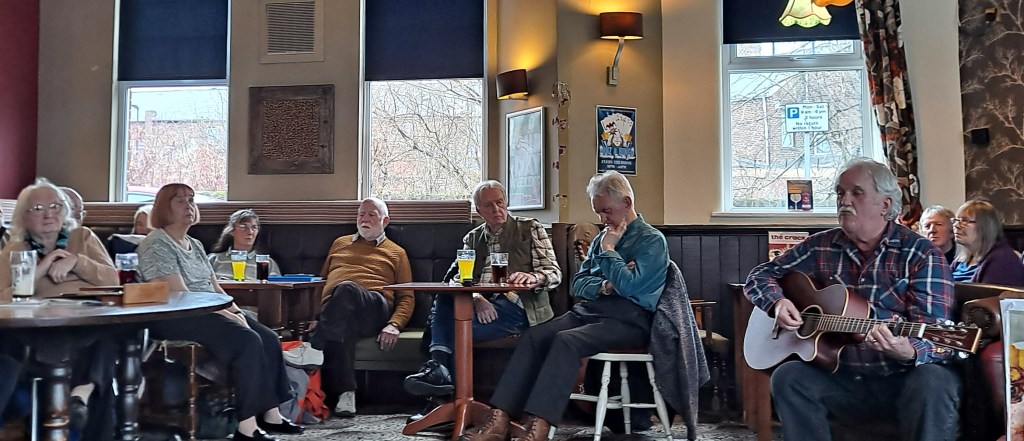
Ed Pickford, Ingrid & Barrie Temple, Tony Wilson performing at the Stumble Inn Folk & Acoustic Afternoon, Sunderland, February 2024.
The folk world is a small world, you get to see the same faces at the clubs and you get to know people from all over the North East. I first went to folk clubs in the late 60s and early 70s when virtually every pub had a folk club. I also used to go to The Bay in Seaburn to see bands like The Who, Free, Jethro Tull, there were loads coming to Sunderland then.
In about 2000 my husband and I began to go regularly to folk clubs in the area such as South Shields, Birtley, Tynefolk in Ryton and The Welly Folk Club in Wolviston.
When you say you live in the North East to other folk people they are jealous because of the amount of clubs and events up here. If you are prepared to travel half an hour you can go to a folk club most nights of the week.
There are venues like The Central Bar in Gateshead, South Shields Jack Clark Park, Croxdale in Durham, the Collingwood Arms and The Bridge in Newcastle which has been going 60 years. Saltburn, Whitby and Hartlepool also have annual folk festivals.
Keith Gregson performing at the Stumble Inn Folk & Acoustic Afternoon, March 2024
I also arrange a monthly folk afternoon at The Stumble Inn on Chester Road, Sunderland. We get around 30 – 50 people coming to our sing around and we are keeping the tradition going because in the 60s the pub was formerly The Royalty and had a very popular folk and blues club called The Glebe.
The pub is near Sunderland University metro so we have people coming in from Newcastle, Cullercoats and South Shields. Some come from further afield like Chester le Street and Teesside. Being on from 1-4pm people are happy to travel on public transport at that time – on the night they are not so keen.
Our folk gatherings at The Stumble Inn are on the 4th Tuesday of the month. All are welcome to sing a song, play a tune or just listen to the songs its very informal and free. We are based downstairs so the room is easier to access with your pints of beer and musical instruments.
We have singers from all over the region like Barrie and Ingrid Temple, Ed Pickford, Tony Wilson, Anne Lamb, Keith Gregson, Brian Hunt, Ken Hamer and others who all perform in a range of styles.
It’s an old genre but people still write songs now in the folk tradition about current events keeping the music alive. Music and song are so fundamental to our lives.
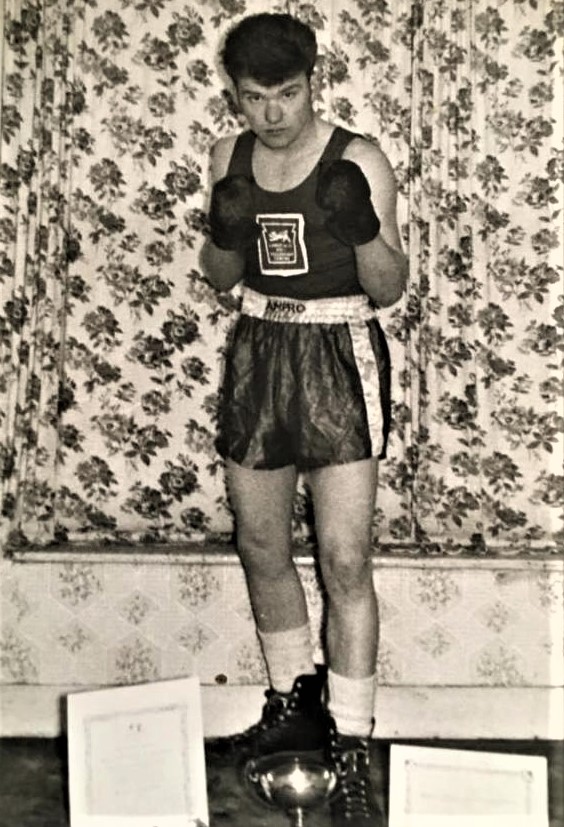
Terry Patterson had one foot considerably smaller than the other so wore a calliper.
“It’s known as a clawfoot. I was bullied by school gangs so decided to fight back”.
From gutting fish, to boxing to heartfelt poetry – this is Terry Patterson’s story.
Born in North Shields in 1956 Terry attended Ralph Gardiner Secondary modern school, he left with no qualifications but was taken on as an apprentice fish filleter at North Shields fish quay.
“Working on the fish quay was hard but good fun. Weighing, icing and boxing salmon to begin with, then learning how to fillet various types of fish and how to drive a popper lorry. I tell ya’ the smell took some getting used to”.
With school bullying still fresh in his mind, Terry joined North Shields Boys Boxing Club where he was taught by ex-professional Joe Myers.
His boxing career lasted a total of 22 years, in that time he worked in the shipyards and had been a school caretaker.
A couple of years ago I interviewed ex-boxer now coach Preston Brown from Sunderland.…”Yeah I know Pasty Brown very well” said Terry. “Over the years I fought a few Sunderland lads. Derek Nelson was a classy boxer who turned pro. I fought two ABA finalists in Gordon Pedro Philips and Willie Neil. I fought Pedro in the North Eastern Counties final but lost. Both lads were well schooled”.
“Willie’s coach asked if I’d fight him one evening because his opponent hadn’t turned up. I weighed in at 10st 6lbs (welterweight), he was heavier than me by 6lbs. I knew his reputation for knocking people out. Norman Fawcett negotiated with his team and £50 was slipped into my hand for taking the fight”.
“Willie could bang a bit – so could I – but he had me down three times during our bout. We set about each other unleashing hell for three fierce rounds. I had him going at one point after landing a good left hook but the bell sounded and my chance to finish him had gone”.
“Gordon and Willie are still good to this day – it’s been 36 years since we shared a ring. I see them at boxing dinners and Boxing Club Reunions. Both of them bought my novel ‘Like Mother Like Son’.
In over 200 bouts Terry won national honours and passed the advanced ABA coaching exam plus he was involved with coaching youngsters until 1986.
After an industrial accident left him unfit to continue his love of boxing, Terry was determined to focus on another sport and won the Disabled Sport England Snooker Championship five years in a row.
“I qualified as a UK professional snooker referee and got a call up to referee the Maltese open in 1997” said Terry.
In 2002 he became North Tyneside’s first World Professional Snooker Coach. He coached at Wallsend Supa Snooker for disabled and able-bodied youngsters, but after a fall on icy roads, not only had he injured his back, he suffered from a dark depression.
Terry added “I was diagnosed as clinically depressed. It’s something I just try to get on with. A surgeon advised me to take up knitting – no I didn’t – but I was determined to excel at something.”
Throwing himself into a number of academic courses at North Tyneside College Terry volunteered at Newcastle’s Percy Hedley training centre working for clients who had cerebral palsy.
He spent over five years working in various care homes until the injuries he sustained over the years got the better of him.
“Depression is something I’ve dealt with my whole lifebutI feel life still holds challenges for me”.
With an interest in poetry and short stories he began to spend his time writing. To date Terry has produced 46 novellas and three novels ‘Like Mother like Son’, ‘He Who Rides a Tiger’ and ‘Living with Grandpa’. His writing is free to read on Movellas.com.
“I’ve also written plays – two of which have been staged in various theatres. ‘Reaping the Benefits’ and ‘The Redundant Blade’ which was written as a tribute to Tom Hadaway”.
“We were only four days from staging ‘The House Across the Road’ when covid broke and we lost cast members. Eighteen months later we tried again and two days before the production two young cast members took ill. My producer and I lost a lot of money and we decided to walk away and the group disbanded.”
Prolific North East Writer and theatre producer Alison Stanley and cast will be reading one of Terry’s plays at Laurels in Whitley Bay, at 2pm on Thursday 22nd August. ‘A Home for Willie’ raises awareness of dementia.
Terry explains “At 68 years of age I’ve never done any for personal gain, never made anything from it butwould love to have one of my books or plays made into a television programme or series”.
“I would like to follow where Catherine Cookson and Tom Hadaway left off. I hope that one day when I’m no longer around I’ll be remembered like the people who inspired me”.
Emma first appeared on this site back in 2019 talking about her influences in music and how she got started…
“It was ‘Aretha Now’ and ‘Aretha Sings the Blues’, both records shaped my development as a singer. I used to sit for hours listening to the songs on vinyl”.
Last Christmas as the sun went down on a cold, dark night I filled me hot water bottle, turned on the TV and watched an exhilarating performance by Aretha Franklin. The live concert from Amsterdam in 1968 was an absolute joy to watch.
In the packed audience the front row laid flowers for the Queen of Soul as Aretha ripped into (I Can’t Get No)Satisfaction wiping away the painful memories I have of the Stones version.
With Aretha at the piano my mind flips back to Christmas Eve 1975. I was a 10 year old kid watching Freddie Mercury singing Bohemian Rhapsody on his white piano, the BBC were broadcasting a Queen concert from Hammersmith Odeon. Live events like these on the telly stood out as really special.
With fast cutting, crash zoom and whip pan camera shots, Aretha’s black and white film captures a danger – giving the concert an air of at any momentthis could all fall apart. I can see why the show has acquired legendary status. Closing out at 35 minutes my only complaint was why so short?
Here we are in 2024 and life for Emma is coming at her fast, she kick started the year being pictured on the cover of Blues Matters magazine which features her new album ‘Memphis Calling’ recorded in Sam Phillips studio, USA.
“The studio breathes, it has an immense presence. The live room is awesome, beautifully designed. I let my emotions out on the recording” said Emma.
USA publications Downbeat and Living Blues have also featured Emma. Keeping the momentum up live dates see Emma hitting the North during March, first up is Bowness Bay Festival on 16th then Boom Club in Leeds on 23rd. More gigs are planned during spring.
A gig in the North East is a quickie on the coast in May with an acoustic set at the Harbour View, Sunderland on the 23rd where you might see Emma on Roker beach plodging in the sea. For non-Geordie or Mackem speakers that’s when yer ankle deep in water.
More dates during summer are being fixed in the diary with venues lined up through to the autumn. Details to be released soon.
Ray Dobson & Trevor Thorne with their book ‘Music in Sunderland’. (Alikivi collection May 2022)
“Don Airey was in my year at Bede Grammar school and each year there was a concert with the highlight being a band playing pop songs. I remember being impressed with Don playing the school organ on ‘House of the Rising Sun’.
Little did we know he would go on to play with Deep Purple, Rainbow, Whitesnake, and Black Sabbath while also playing on over 300 albums” said Trevor.
An excerpt taken from a book produced in Sunderland by retired teacher Ray Dobson and semi-retired accountant Trevor Thorne. Ray also brought his background as a local music photographer while Trevor has written several local history books.
They hit on a method of working with one taking the lead on a subject and the other chipping in with their own knowledge of different genres from skiffle to rock to punk and bringing it up to date with Sunderland bands Field Music, The Futureheads and The Lake Poets.
Geoff Docherty with his book ‘A Promoters Tale’.
The book also highlights the work of Geoff Docherty…
“Geoff’s forthright and honest manner endeared him to his audiences and the performers. He is today, remembered for his huge contribution to the musical culture of the North East”.
Ray added “Geoff is primarily known as the most successful rock music promoter in the North East. He was determined to bring quality live music to the area and his first venue was the Bay Hotel in Sunderland where he began by booking Family for the huge fee of £150”.
”The gig was a success and was followed the next week by an unknown band called Free – Geoff remembers people arriving under the illusion that they wouldn’t have to pay an entry fee”.
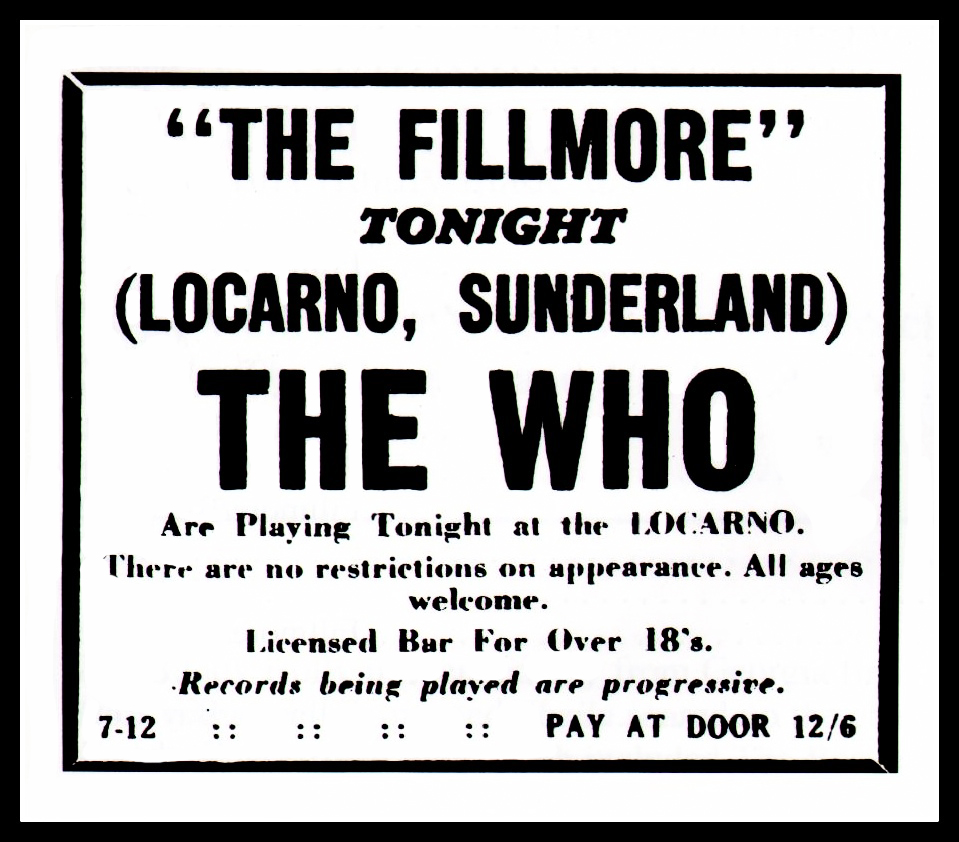
The Who at the Locarno 1969.
The Bay continued to attract huge stars including Pink Floyd, Tyrannosaurus Rex and The Who. In 1969 Docherty moved to a larger venue and a who’s who of legendary rock bands such as Mott the Hoople, The Kinks and Bowie followed.
“Perhaps Geoff’s greatest achievement was to bring one of the world’s top bands to town. He used his powers of persuasion to talk the rather daunting Peter Grant (manager) around to allow Led Zeppelin to perform at the venue, but on the eve of the event he was told the band would not be coming”.
“This only served to increase his determination and after numerous attempts to impress on Grant that he owed him a gig, it was eventually agreed he could have Zeppelin – twice”.
“Geoff also had a secondary career in band management. The best known of which was Beckett which included Terry Slesser – who later formed Back Street Crawler along with Paul Kossoff. Kossoff even lived with Geoff, under his care, while recovering from addiction”.
“Beckett performed on the Old Grey Whistle Test and had an acclaimed, though not commercially successful album, to their name. Unfortunately, they parted ways on the eve of an American tour and the chance of stardom faded away”.
Trevor added“One of the most intriguing bands we came across was Juice. From posters and online information, they seemed to be everywhere.
The band supported Pink Floyd, Free, Blondie, Deep Purple, The Faces, Terry Reid, and Black Sabbath as well as many others. We eventually tracked down the drummer Kelly Davis, who had a fund of tales to tell”.
“It seems they were the go-to support band during the 1970s. Kelly was particularly complimentary about Ian Paice, the Deep Purple sticksman.
While they were waiting for their gig to start, Paice went through the drumming routine for ‘Black Night’ with Kelly, taking up an hour and a half of his time to pass on tips on that and other songs. In 2011 Juice got together again and still record songs”.
Kiss album ‘Rock & Roll Over’ released in 1976.
Ray recalls a story about American born songwriter & musician Sean Delaney who is often referred to as ‘The Fifth member of rock band Kiss’and “had worked with the likes of John Lennon, Cher, Clive Davis and many others. He played a key part in designing the Kiss stage make-up, choreography and pyrotechnics”.
“Seanwas raised in Utah but moved to New York where he became involved in the music scene. An accomplished musician in his own right, Sean met producer Bill Aucoin in Max’s Kansas City, it was here the two spotted a new band and, took them under their wing.
Under their guidance the band were to become one of the most famous rock bands in the world – Kiss”.
“Several successful years later, having personally produced and co-written songs for both the band and their solo recordings, Sean moved to Arizona.
There he was impressed by an English/American band named Smith and Jackson. When the English contingent returned to the UK, Sean resolved to follow them and manage the band”.
“Much to everyone’s amazement, he arrived in Sunderland a few weeks later where he lived with singer Paul Jackson and his family. He became a great friend to many locals and would often stay with my wife Sue and I.
Sean fell in love with the local pubs and became a popular figure on the local music scene, where his outrageous eccentricity endeared him to everyone”.
“While in town, Sean produced an excellent album for Smith and Jackson to which he contributed two of his songs. The album was released on RGF Records and was intended for the ears of Gene Simmons (Kiss)”.
“I remember on Christmas Day 2002, at about 4 am, my wife Sue woke me up to ask if I could hear singing downstairs. On closer listening, we realised that it was Sean, who was sleeping on the sofa.
Next morning after he left, we found an empty chocolate box with some lyrics scribbled on it. This was probably Sean’s last attempt at song-writing.”
“Sean flew back to the US with some demos of the album but, within a day or so he had a stroke. On 13th April we received a call from Sean’s nephew to say he had passed away. Paul Jackson went home and wrote a song called ‘Ballad of Sean Delaney”.
“Sean left an indelible mark on those lucky enough to be his friends during that last period of his life spent in Sunderland. His funeral took place in Utah and written on the bottom of the gravestone are the four names of Kiss members – Gene, Paul, Ace and Peter”.
More stories and features in ‘Music in Sunderland – Past, Present & Futureheads’ is out now (£9.99 plus £2.80 UK postage) and available at Waterstones (Sunderland), Clays Nursery (Washington), Sunderland Museum, also from Trevor directatjandmthorne@btinternet.com
Known for his paintings of industrial scenes, cotton mills, chimneys and ‘matchstalk men and dogs’, L.S. Lowry from 1960 until his death 16 years later, regularly left his home and travelled over the Pennines to sketch in Durham and Northumberland towns – continuing his great love affair with the North East coast.
He first landed in Berwick in 1932 after his father died of pneumonia aged 74, his doctor advised him to rest before taking on the responsibility of looking after his bedridden mother.
Lowry was devastated after her death in 1939 and with the worry and strain he considered a permanent move to Berwick ‘I’ve not cared much for anything since she died. I’ve nothing left and just don’t care’.
Lowry on Seaburn promenade about 1960. pic. L.S. Lowry estate.
Did he spend days or weeks at a time in the North East ? I’m not sure but after retirement as a rent collector he based himself near Sunderland and a room in the Seaburn Hotel quickly became a home-from-home for one of the UK’s most popular artists. ‘I sometimes escape to Sunderland. I get away from art and artists.’
Leaving the hotel he would walk along Roker seafront making pencil sketches on hotel notepaper and the back of old letters. Lowry was generous with his work and gave a number of his drawings to people he met by chance.
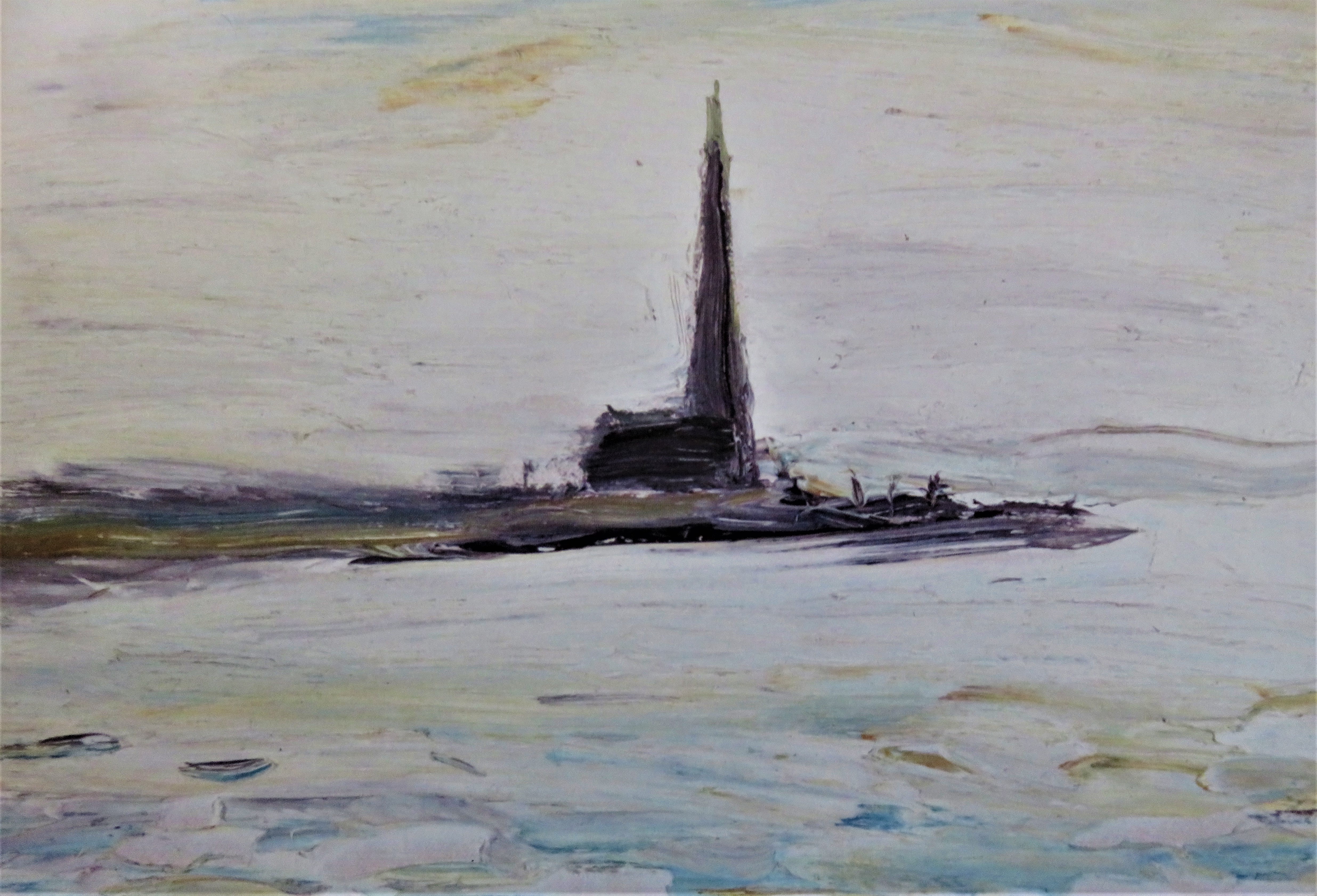
Newbiggin-by-the-sea 1966 oil on canvas. Private collection.
He would catch a train, taxi or a lift with friends up to Blyth, Berwick, Bamburgh or Newbiggin. Constantly drawn to the coast he would stare out to sea, and was inspired to use the sketches as a basis for oil paintings’Don’t start thinking I was trying to put over some message, I just painted what I saw’.
Lowry was interested in St Peter’s Church in Monkwearmouth and seven mile away its twin monastery St Paul’s in Jarrow. Nearby in Bede Art Gallery he would meet Director, Vince Rea, and on a number of occasions enjoyed talking with amateur artists in the gallery.
St Paul’s, Jarrow 1962, pencil and ballpoint pen on paper. Private collection.
As mentioned in a previous post Lowry spent many hours at South Shields where the Tyne meets the North sea watching tugs, ships and fishing boats coming in. On the north side of the river is the notorious Black Midden rocks, before piers were built it was a graveyard for ships.
High up on the headland is Tynemouth Castle and Priory providing a dramatic backdrop. Lowry loved the scenery, the atmosphere, and above all, the sea.
He exhibited work at Newcastle’s Stone Gallery and became a friend of owner Mick Marshall. In later years he encouraged young artists to stay close to their roots rather than assume a move to London was necessary‘No need to go to London to become a famous painter, you won’t find better lamp posts there’.
Sunderland Museum have an exhibition devoted to him and as a permanent reminder there is a Lowry Road and a new housing estate – Lowry Park, I think his mother would approve.
Gary Alikivi December 2021
Notes:
L.S. Lowry by Michael Leber & Judith Sandling
L.S. Lowry in the North East published by Tyne & Wear Museums 2010.
The fantastic four of Tommy Hearns, Roberto Duran, Marvin Hagler and Sugar Ray Leonard were my era and I loved them. I’ve met Roberto Duran and Marvin Hagler and went to see Tommy Hearns box as he was my favourite.
He was a great boxer, very skilful.
His fight with Marvin Hagler in 1985 is the most exciting three rounds of boxing. If Hearns boxed he would of won, but they both went at it hammer and tong and Hagler knocked him out in the third round remembers Preston.
Then every now and then you get a freak of nature like a Mike Tyson, he was powerful, had agility, and skill yes, but he was a fighter knocking people out. Boxing matches bring a clash of styles.
Today in the ring you have Anthony Joshua, Tyson Fury, Billy Joe Saunders who just fought for a world title, there’s still good boxers out there.
They came from amateur boxing but it’s not as popular as it used to be as there are more distractions now, kids can be in their bedrooms on their computers where parents can keep an eye on them.
17 year old John ‘Pasty’ Brown.
FIRST ROUND
I was born and brought up in Hendon in the east end of Sunderland and my Dad, John, was a boxer. In the ‘60s a boxing club was opened and my Dad ended up coaching.
Through boxing he helped a lot of kids and hopefully I can do the same. Boxing can learn you discipline and respect – it can do a lot of good.
When I was young I was out in the street, bird nesting, playing on railway lines. But I drifted over to the boxing club with the other lads and my Dad was in there. I wasn’t forced into it. I’d sit ring side and took an interest in it.
What I’m doing now is a continuation of what my Dad did. Some kids when they first come in to the gym are not sure about it, but about 90% of them end up respecting the place, have determination and dedication to turn up training each week, and learn discipline. You’ve got to put the time in. It’s a tough game you can get hurt.
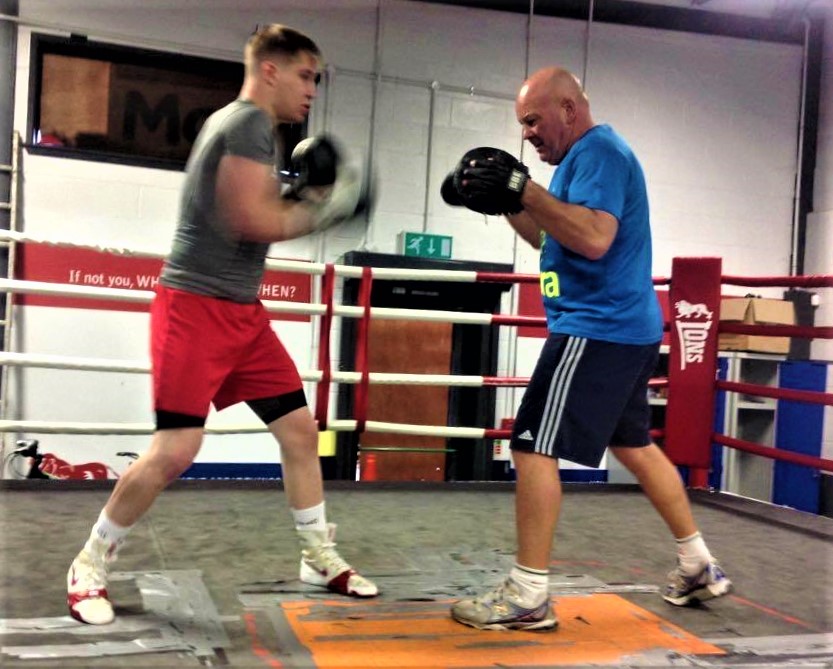
Preston in the gym.
IN THE RING
When I became a member of Sunderland Amateur Boxing Club I started boxing competitively through the ‘70s and ‘80s. I slowly progressed from boxing to coaching and become official through the A.B.A. (Amateur Boxing Association).
Sunderland lad Tony Jeffries was one of the gym’s proteges, he represented GB in the 2008 Beijing Olympics and won a Bronze medal.
At the gym with Tony was a kid called Stuart Kennedy, I thought he was a very good boxer, but just like in life, you’ve got to have a bit of luck. Stuart glided around the ring with his footwork but didn’t get the lucky breaks.
A kid called Anthony Wilkinson boxed with me, he won three British titles two years in a row and at 17 turned professional. I thought he was a bit young for it but he was making money. I think he could have been the best boxer we produced.
ALL FIRED UP
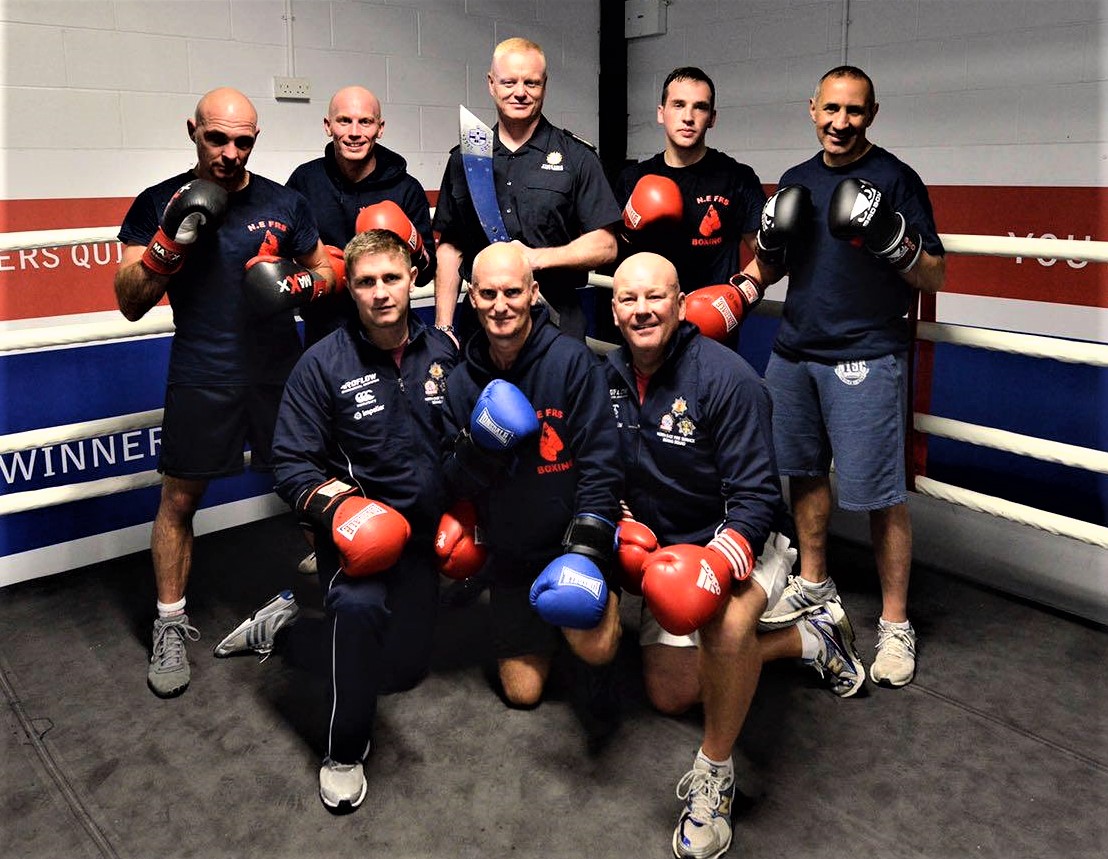
I got a job in the fire brigade, 22 year I’ve been in now, and there was a couple of firefighters who were boxers, they knew I had coaching badges so asked me to help out with some training.
We got on for a couple of year arranged a few charity matches with the police and then got invited to go over to Boston and Denver plus a small club in Ireland where we go annually.
The firefighters loved the boxing training and after using other gyms, with the total backing and support of Chief Fire Officer Chris Lowther, I set up our own in an old storage building in the Sunderland fire station grounds.
We got help with funds for equipment from the local council who said ok as long as you open it up to the community. We kitted the gym out with the best because the council were totally onboard with the whole idea and we had a big opening night in April 2019.
When we first opened the doors to the kids we were only getting a handful but that quickly grew to 35 a night so we extended to two hourly sessions. We got loads of kids off the streets.
The youngest is 9 year old when they train, you can’t box until you’re 11. From 11 to 15 you’re a schoolboy, 15 to 17 classed as a junior, at 17 you can box men. My first senior fight was at 17 the other lad was 34. I got beat but we’re still good friends (laughs).
I was classed as a boxer not a fighter, I had boxing skills with my feet, hand speed and technical ability. I boxed him in the first round, dancing round him you know.
Second round he thought it was time to slow me down and hit me with a body shot and knocked me down I had a standing count of eight to compose myself. That’s the difference between a boy and a man.
Kids start off at three rounds of a minute and a half, as you get older you go to two minute rounds and seniors box three minute rounds.
Our gym aims to channel the energy of young kids, it gets them interacting with people, better than them playing on their phones.
CREATING CHAMPIONS
We’d love to produce Olympians or World Champions but if they come out just feeling better about themselves we’ve won. In the gym we’ve had police officers mixing with criminals, different people who wouldn’t normally get on but who’ve got a love of the sport.
The atmosphere is fantastic everybody loves it and you can forget about what is happening outside – like being in a bubble.
There’s no better feeling in the world when the referee holds up your hands to say ‘and the winner is’. In the same breath if you get beat by the better man you think ‘I’ll do better next time’.
The fire lads and the kids have a thing where they say, ‘I didn’t win that fight, but we learnt from it’. And that’s important because it’s all about competing. The gym’s motto is creating champions in the ring, creating champions in life.
Anyone that can step in the ring has my total respect. You’re stepping into the unknown, the man across from you might be better. So, have you done enough training ? Have you worked with the coach enough ?
You will be put in the ring against someone with similar experience.
Although our club has fought against a team that’s put in ringers – fighters with a lot of fights – matched against someone with only two or three. That’s not on really, it’s about giving the lads a proper fight, they’ve got to be matched up correctly.
Preston coaching in the gym.
HEADS UP
Head guards were brought in a few years ago and the kids and females need to wear them but the bigger lads can agree to wear them or not. I’m a big believer in them when you are training but they are uncomfortable to wear when competing.
I will insist on everyone wearing one when sparring and training. The women may not be big and powerful as the lads but they are very skillful and I appreciate that, it’s an art.
PROGRESS
Britain has produced some good boxers over the years who have come through amateur gym’s but in the past year covid has restricted that so it’s a problem, we’ve got to work something out to go forward and make progress.
For more information contact Preston on: 07740 285 966
Sunderland Central Fire station, Tyne & Wear Fire & Rescue Service,
Phoenix building, Railway Row, Sunderland SR1 3HE
Gym address: Unit One, Westbourne Road, Sunderland SR 1 3SQ

















 ALIKIVI UK : NORTH EAST MUSIC & CULTURE