HAVE YOU HEARD THIS ONE? #6

Following on from the last post here’s another batch of North East stories this time featuring music, books, TV, boxing and the police. First up is former White Heat & Loud Guitars frontman Bob Smeaton.

‘If you asked me to list what gave me the biggest buzz I would say playing live top of the list, writing songs in second and recording in third. One thing I did learn is that playing songs live and recording them in a studio are two different animals’.

‘I love performing in front of an audience and felt that I was a much better frontman than I was a singer, so studio work for me back in the early days was not always an enjoyable experience. Also, the vocals were always done last, so the rest of the band were able to relax and the pressure was on me to deliver’.

What did I do after White Heat and Loud Guitars split? I pretty much stopped performing gigs as my career went down a different path’.

Full interview > ANOTHER JOURNEY UP THE RIVER – New album from ex White Heat frontman Bob Smeaton | ALIKIVI UK : NORTH EAST CULTURE

In August award-winning author & freelance journalist Terry Wilkinson talked about his new book…

‘At midnight on 3 May 1941, the factory and Head Office of Wilkinson’s Mineral Water Manufacturers in North Shields was hit by a single German bomb. It went through the roof, descending through all three floors, taking all the heavy bottling machinery and chemicals down to the basement – which was in use as a public air raid shelter. 107 died, 43 of which were children. Whole families were wiped out.’

‘Nothing is known of the identity of the plane which dropped the bomb – type, squadron, mission etc – as German records were mostly destroyed in the closing stages of the war’.

‘I wanted to write a story that answered all these questions and create a fictional alternative. Having said that, nobody could say with any conviction this is not what happened’.

Full interview > STORIES OF WAR – with award-winning author & freelance journalist Terry Wilkinson | ALIKIVI UK : NORTH EAST CULTURE

Also in August former boxer Terry Patterson remembers his time boxing in the North East…

‘Over the years I fought a few Sunderland lads. Derek Nelson was a classy boxer who turned pro. I fought two ABA finalists in Gordon Pedro Philips and Willie Neil. I fought Pedro in the North Eastern Counties final but lost. Both lads were well schooled’.

‘Willie Neil’s coach asked if I’d fight him because his opponent hadn’t turned up. I weighed in at 10st 6lbs (welterweight), he was heavier than me by 6lbs. I knew his reputation for knocking people out. £50 was slipped into my hand for taking the fight’.

‘Willie could bang a bit – so could I – but he had me down three times during our bout. We set about each other unleashing all hell for three fierce rounds. I had him going at one point after landing a good left hook but the bell sounded and my chance to finish him had gone’.

‘Gordon and Willie are still good to this day – it’s been 36 years since we shared a ring but I see them at boxing dinners and club reunions’.

Full interview > KNOCKOUT with former boxer Terry Patterson | ALIKIVI UK : NORTH EAST CULTURE

Former police detective & writer Arthur McKenzie talked about his work…

‘There was a police section house near Newcastle’s Exhibition Park, in it was a bait room, just a pokey little room with a table to play cards on. If you’re on night shift you’d take sandwiches and a flask of tea in. That’s where you gathered around 1am where the events of the night would unfold’.

‘You would get advice on how to deal with someone, it was a good place to sort things out like the older cops would tell you how to deal with a death, how to deliver a death message to the unfortunate family. It was a sort of meeting of minds over a game of cards. Aye the bait room was a good place to vent your spleen so to speak’.

‘So, I went away and wrote about the bait room. Tom Hadaway (writer for episodes When the Boat Comes In) read the play and was laughing at it ‘Yeah, you know how to write dialogue son’. He gave me pointers, when I finished it landed on two desks. One was the BBC in Manchester where it ended up on the Saturday Night Theatre radio show, which was a big thing’.

‘The other was the script reader for David Puttnam (producer Chariots of Fire, Local Hero, Midnight Express) who hated it at first but won her round in the end. She said she couldn’t do anything with it but put me in touch with an agent who was looking for writers for a tv show called The Bill. That’s where the writing started’.

Full interview > COP ON THE TYNE – in conversation with ex police detective & writer Arthur McKenzie | ALIKIVI UK : NORTH EAST CULTURE

TV actor & musician Michael McNally got in touch and talked about his time in ground breaking BBC TV drama The Cops…

‘I’d watched the first two series and it was my favourite programme on TV. When I started watching it, I thought it was a fly on the wall documentary it took me 10 minutes before I realised it was a drama. I was totally hooked’.

‘One of my first scenes was I was sat in a police van at 11pm on a Friday night on Bolton High Street. The general public were walking up and down the street they knew nothing of this, it wasn’t a closed set like on some programmes and we had to go and arrest someone’.

‘Two actors were having a fight then we got the message to go, so on with the blue flashing lights, we pulled up and jumped out of the van. Some people were trying to defend the actors and some were encouraging us to get in there and sort it out’.

‘We didn’t know where the cameras were we just heard someone say stop. We got back in the van, re-set and done the scene about four or five times’.

‘Same happened when responding to a fight in a bar, we had to pull people out and the general public in the bar didn’t know what was going on. There was an element of choreography for the fight, we didn’t want anyone to get hurt’.

‘After that first night the cast got together afterwards for some pub grub and a karaoke. Most of us were unknown actors so mixed in with the general public without any hassle. Every member of the cast got up and sang, mine was Should I Stay or Should I Go by The Clash – it was a really good night’.

Full interview > THE COPS with TV actor & musician Michael McNally | ALIKIVI UK : NORTH EAST CULTURE

Got a story to add to the site? Just get in touch.

Full list of hundreds of interviews >

About | ALIKIVI UK : NORTH EAST CULTURE

Alikivi   November 2024

THE COPS with TV actor & musician Michael McNally

Flicking through TV channels I landed on BBC police drama The Cops. I remember when it was first broadcast in the late 90’s it was like watching a Ken Loach film on steroids. No surprise when it walked away with two BAFTA awards.

Executive producer was Tony Garnett, you might not know the name, but his pedigree is second to none. He and Loach pulled off some groundbreaking, influential work on Kes, Up the Junction and Cathy Come Home.

Written by Jimmy Gardner (The Bill, This Life, Inspector George Gently), The Cops is a gritty fictional drama which deals with the chaotic lives surrounding criminals and cops. Even everyday mundane events are served up on a shovel.

The script is sharp, the pace unrelenting, the hand-held fly on the wall documentary camerawork increases tension and keeps the viewer locked in to the authentic voices. The working class voices. And they don’t shy away from difficult situations, some scenes are far from being an easy watch.

After binge watching series one and two I switched on the third and sadly the final season, I recognised one of the characters, Michael McNally, who featured on this site 28 August 2018 (link bottom of page). So I got in touch with Michael to find out his story behind The Cops.

I’d watched the first two series and it was my favourite programme on TV said Michael. When I started watching it, I thought it was a fly on the wall documentary it took me 10 minutes before I realised it was a drama. I was totally hooked.

My favourite directors are Mike Leigh and Ken Loach – The Cops is somewhere in between their methods, the way they work with actors or non-actors in some of Loach’s films. In the programme there were two of the best actors I ended up working with, and that’s including working with Gary Oldman, there was Katy Cavanagh and John Henshaw – absolutely fantastic actors and people.

Some of the stories they told, drugs, robberies and coppers beating people up – how did they get away with showing this? I found it really brave, fascinating and refreshing to watch, I never imagined I would have an opportunity to get on it. I remember watching a BAFTA awards programme and it won beating a show called This Life which was also excellent TV.

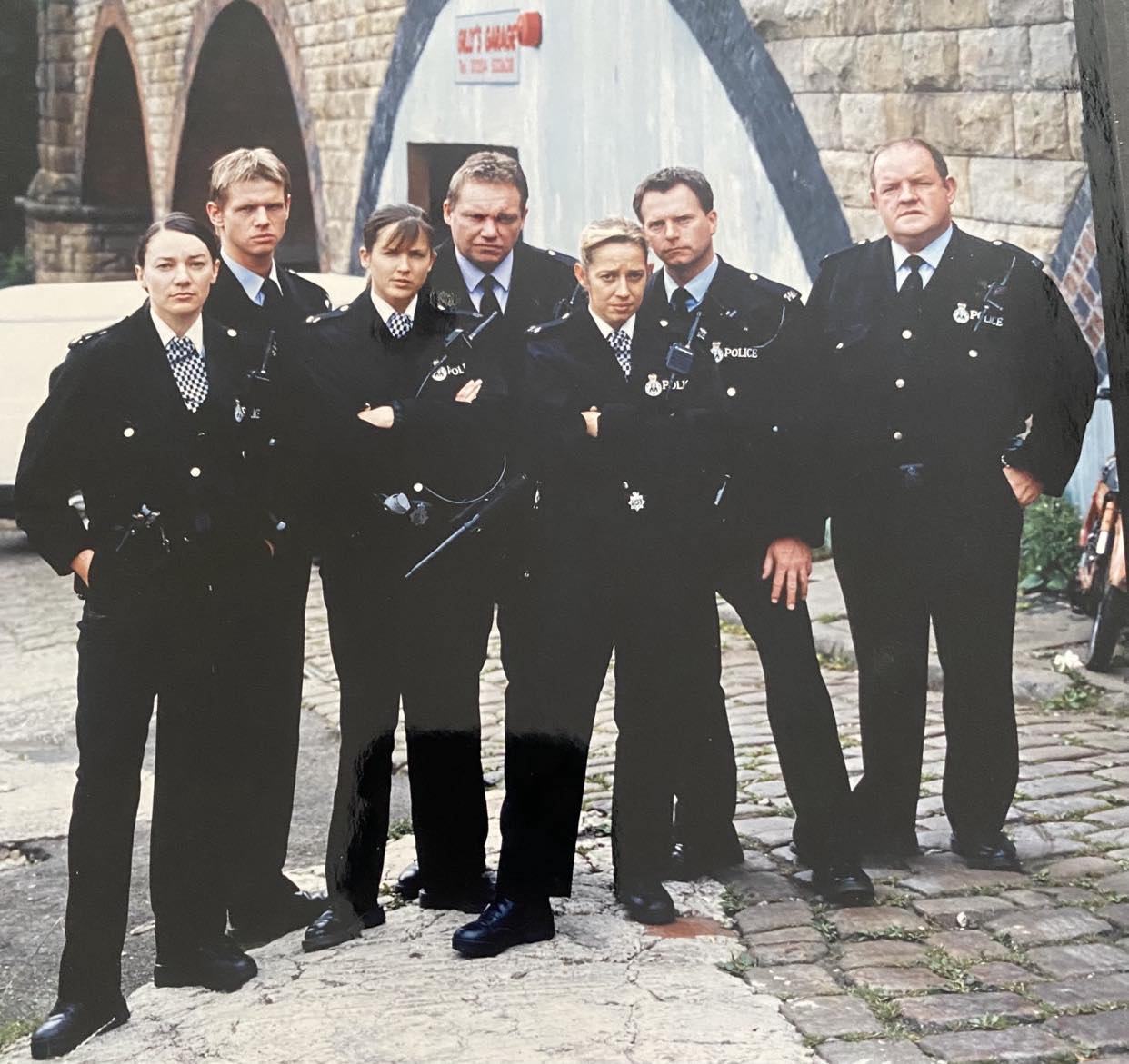
Michael in the back row behind Katy Cavanagh and next to John Henshaw.

How did I get on the show? I remember I was just about to get on a train from Durham, I was living back in the North East then, I was excited about going down to London for an interview and read for a part to play alongside Robson Green (fellow Geordie actor, Soldier Soldier, Wire in the Blood).

When my agent called me up ‘Don’t get on the train, you’ve had a recall’. Three weeks earlier I’d had one interview for The Cops, I’d met the cast and was introduced to an incredible actor called John Henshaw (Early Doors).

At the interview it was all improvisation, there was no script, we were set up in different scenarios, like an acting workshop. I was nervous but got through it and think I done alright but never heard anything so was disappointed I’d missed out on this fantastic show.

Then a few weeks later another call from my agent ‘Get in your car and drive to Bolton’ – that’s where The Cops is filmed. It was great meeting up with all the cast again, the casting session was videoed, but again after a good session a few weeks had passed and no word. I’m thinking what’s going on? I missed that reading with Robson Green for this.

Then I got a call to go back down to Bolton they said they would pay my expenses so that was fine. This time it was more specific and the actors were working well together. I went back home and a week or so later they asked me to come down for a day and that’s where they said I had the job.  

I stayed in digs in the town, one of the camera men had a small flat I rented off him. During the week I was there in my police uniform, at the weekend I was still playing in a band in working men’s clubs in the North East. That was 23 years ago, a great experience, PC John Martyns was my character.

Martyns was an ex professional footballer, based on a David Batty type player (1990s/2000s Leeds United, Newcastle United, England) an aggressive little player who made a bit money in the game then came out of it and ended up a copper – like some do in real life!

For me it was a really exhaustive process, there were lots of actors up there for the same parts. It was also one of the most exciting processes I’d been in because every time I went there it was nothing like any interview I’d had for an acting job before.

All the actors had a hunger for success, it was like they hadn’t achieved their full potential yet and they wanted to be part of something special. I went in on the back of the two series so felt a bit under pressure.

We were based in an old run-down school transformed and fitted up into a Police station. In rehearsals every Director you worked with would just give you tiny bits of information to work on then leave you to it.

They would give you a scenario like going into a bar where there are two attractive ladies, you are arrogant full of yourself, you don’t know what they are like, and you have to chat them up.

You would get three or four different situations like this which would last five or ten minutes. You’d think is anyone going to say stop – you were really out of your comfort zone. It was all about staying in the moment and it prepares you for the actual filming.

My first night filming I was given a script but told the filming might start before the script and might go on after – you just have to wait until somebody shouts ‘cut’. So, the script was just a guide, the general public were unknowingly involved in some of the scenes.

One of my first scenes was with Danny Seward, a lovely talented guy, also another singer and songwriter. I was sat in a police van on Friday night 11pm on Bolton High Street with a walkie talkie. The general public are walking up and down the street, in our scene we had to arrest someone.

Two actors were having a fight in the street and we got the message to go, so on with the blue flashing lights, pulled up and jumped out of the van – it wasn’t a closed set like on some programmes. Some of the general public were trying to defend the actors and others were encouraging us to get in there and sort it out.

We didn’t know where the cameras were we just heard someone say stop, so we got back in the van, re-set and done the scene about four or five times.

Same happened when responding to a fight in a bar, we had to pull people out and the general public in the bar didn’t know what was going on! There was an element of choreography for the fight, we didn’t want anyone to get hurt.

After that first night the cast got together afterwards for some pub grub and a karaoke. Most of us were unknown actors so mixed in with the general public without any hassle. Every member of the cast got up and sang, mine was Should I Stay or Should I Go by The Clash – it was a really good night. We were all getting in taxi’s later because it was filming the next morning.

Michael Caine’s masterclasses in acting were a real influence when they were shown on TV. Caine learnt you about film technique, camera angles and using your eyes.

I didn’t go to drama school like most actors I’ve met, I was a law student who first acted in a Channel Four film Accounts and moved to London. I remember everything Caine said, but The Cops was like chucking it all out the window.

You just had to be truthful to the moment, trust the guys who were filming and don’t be worried about their job just fully concentrate on being truthful and honest about the scene.

When the cast were socialising in a hotel bar the production team would watch who we would gel with and if there was any tension, or the one’s not making any eye contact, things like that. I’m sure they were aware of this and then put us together in scenes.

The police organisation weren’t too happy about some of the scenes because we were exposing bad behaviour inside the force. So, we had a couple of weeks training by officers from the London Met where we turned up in uniform, learnt how to read people their rights, how to deal with challenging situations, they told us loads of stories – really fascinating stuff.

The producers also sent us off to Doncaster, undercover with coppers. I remember over a weekend sitting in the back of a cop car with two uniformed officers watching how they made arrests and calmed situations down. On one occasion we spent two hours chasing a horse!

Production team and cast of The Cops.

Because it was so refreshing to do that work in The Cops, in a way everything else felt a bit of a disappointment. I thought would I be happy to do some of the jobs I’d done before?

After finishing on The Cops I got an interview for a regular place on Emmerdale. I’d already been in Crossroads, and soaps have their place rightly so, but coming off the back of a challenging show to a light fluffy programme – well I wasn’t sure about that.

After talking to my agent, I went along and done an improvised scene with an actress, but I got that feeling of I don’t want to be here. I must have given that impression because I didn’t get the job. I talked to my agent about it and sort of felt relieved.

What did I do after The Cops? Unfortunately, I went through a divorce then picked up working again, this time in education. I was a Drama teacher for young offenders in the Prison Service in Barnard Castle. I felt I was doing some really effective theatre work with the prisoners and some of them loved being involved. I done that for over 12 years.

What am I up to now? I still teach music and my next project is for PRS Inclusion Services, it’s for people with disabilities. I’ll be developing a choir from four community groups with a performance at the end, I’m looking forward to that.

I’m missing acting so I’ve been looking if I can get back into doing some again. Here in the North East I’ve been involved in a few performances and still playing music, also just been down to London and got some new photographs taken with the aim of getting a new agent. I think at my age I will be a lot better now with more life experience, and it means so much more.

You’ll find all 24 episodes, three series of The Cops on BBC iPlayer.

RUN FOR HOME with North East actor & musician Michael McNally | ALIKIVI UK : NORTH EAST CULTURE

Alikivi   July 2024