SURVING IN THE ARTS in conversation with North East actor Jamie Brown

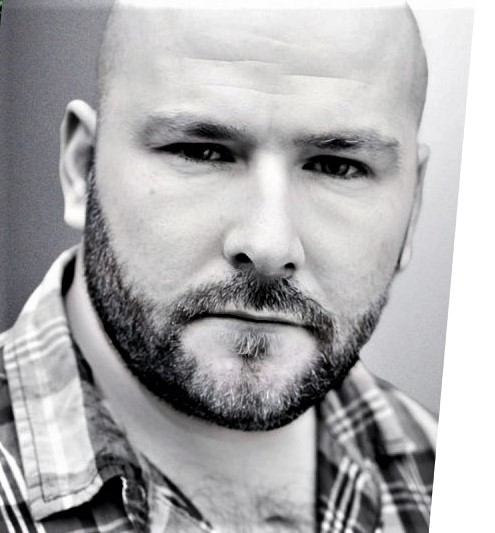
Jamie in ‘Hadaway Harry’. Photo credit Von Fox Promotions

Meeting up with contributors I’ve asked the usual questions of who, where, what, why and when. For a band you might not listen to their music, but we still want to know if they were signed? What venues did they play? Did they release any records? And yes, some did appear on Top of the Pops and the legendary live music show The Tube broadcast from Newcastle.

However, occasionally I throw in a question that is relevant for working class people in a creative business. How many times do you hear working class voices on stage or TV?

Wisecrack Productions, a North East based theatre company, have produced a number of plays documenting working class history – helping in their own little way. Earlier this year I met up with actor Jamie Brown who has starred in some of the plays and asked him – how do you survive in the arts?

I work with two theatre companies. I’m company director for Theatre Space North East based in Sunderland. It’s about cultivating creativity within the community. We do theatre tours and plays in the parks through summer seasons.

Also work with 1623 Theatre Company. 1623 was the year the Shakespeare plays were published. The work centres around taking inspiration from Shakespeare and people’s everyday lives and making new work from it.

When I came back to the North East as a professional actor I was cast in The Machine Gunners at The Customs House, South Shields with an actor called Donald McBride who was a few decades my senior. He said with a twinkle in his eye and a wink ”You’ll be around a long time you will, just keep your head down and be nae botha”.

There is something in just doing your job, doing it well and knowing your role within that room. As a younger actor there is a lot to be said for that.

As I’ve plied my trade in the area for the best part of 20 years one of the things I tell students when I go to do talks at project days is there are two types of people in the world. There are those that plant seeds and there are those that just go around picking flowers.

There are two types of actor, some pick flowers while others like to get their hands dirty and plant seeds. I think you need to be doing both. But you’ve got no insurance that anything is gonna grow if you’re not the person starting it off. So, you’ve got to rely on yourself to put things in place and bring things to life.

There are some actors who want to travel the country or travel the world but for me it was about having a sense of place, a sense of community, bringing stories to life about that place, for the people from that place.

There’s a lot to be said about shared experience and shared history and values you have around you. Also, you can’t just wait for people to knock on your door, you’ve got to be doing stuff in the meantime.

There is or was a perception that when I came out of drama school someone would put out a casting call, you’d apply, go for an audition but it wouldn’t always happen. There’s a lot of in house casting, a lot of casting people who they know because it’s a high risk business and they want to take as few as risks as possible. They would prefer employing people who they can work with and who will do a good job. As a young up and coming artist sometimes that’s not you because you haven’t had the opportunity to work.

Being on the other side of the table I completely understand it but as a young actor seeing the same people get cast in the same sort of things it is frustrating and you think if that was only my chance. But don’t give up, chances do come and you’ve got to be ready to take them and not kicking up a fuss or overstepping your role.

An actor who has a creative brain has aspirations to direct, but are you the right director in that room and in that moment? Overstepping can be a bit fractious as well. You have to know your role within the room and its boundaries.

You might want to be an established theatre director in the future but if you are being employed as an actor by all means contribute your ideas when it is appropriate or when they are asked for, they are welcomed, but if you overstep you are going to realise very quickly you are not somebody who understands that particular hat you need to wear in that room. It can rub people up the wrong way.

What projects have I been working on? Well last year we done As You Like It outside Durham Cathedral on the green then St Peters Church, Sunderland and the Anglo Saxon farm at Bede’s World in Jarrow. This year we are planning more inside and out doors shows at places relevant to the story we are doing. We’re really excited about it.

Alikivi   2025

Link to previous posts >>> HADAWAY HARRY – in conversation with actor Jamie Brown | ALIKIVI : NORTH EAST UK CULTURE

SOUL MAN – in conversation with North East actor Jamie Brown | ALIKIVI : NORTH EAST UK CULTURE

WISECRACK with playwright & theatre producer Ed Waugh

Working in media and entertainment can be a risky business and after Covid it only increased. Picking up a couple of jobs but then nothing for a while has been a regular pattern for me these past few years. It’s a struggle but I wouldn’t change it for the world, I’ve loved every minute of it since my first video commission in January 1997.

I remember the day well. I was in a community centre in Hetton le Hole, Durham talking to a group of former miners who were interested in making a video when someone burst into the room with tears in her eyes “You never guess what’s happened?” We all turned around thinking the pipes have burst, there’s been an accident, someone’s died, what’s happened? “Kevin Keegans left Newcastle United”!

South Shields theatre producer Ed Waugh

I was interested how others working in the creative industry have managed so I got in touch with South Shields playwright and theatre producer Ed Waugh. Ed is part of the North East based Wisecrack team who use theatre to document working class history. I asked him about his past year.

‘Where did 2024 go? The whole year passed like a whirlwind. We’d come off a busy 2023 but from January 1 we were focused on Wor Bella, which was transferring to the wonderful Newcastle Theatre Royal in April. If that wasn’t enough to organise, we did a pre-show run in London to get the production on its feet’. 

Wor Bella is about North East women footballers in WW1 and the interest was massive. We had full pages in The Guardian and Daily Telegraph as well as tremendous coverage in other national publications. The upshot was London sold out’.

‘Coming home to the Theatre Royal was magnificent – three sold-out houses and just as in London standing ovations after every performance. It was my fifth show at the most prestigious venue in the region, a record for a local writer, so you can imagine how it swelled this Geordie’s heart with pride’.

(Link to interview with actress Catherine Dryden who starred in ‘Wor Bella’).

WOR BELLA HITS LONDON – the incredible story of heroic North East women footballers during WW1. | ALIKIVI UK : NORTH EAST CULTURE

‘I’m just so honoured to be working with a top-class, professional and dedicated Wisecrack Productions team. We have director and actor Russell Floyd and other brilliant actors, technicians and hugely important people behind the scenes who allow us to put excellent stories on stage. It’s a true team effort’.

‘We’ve now sold around 800 Wor Bella scripts, so that’s canny. Many more thousands of people now know the story of these selfless working class women who saved the WW1 war effort’.

‘My book Geordie Plays Volume 1 has also almost sold out – the last few remaining first editions at Newcastle City Library are now officially collectors’ items’.

‘2024 ended with a triumphant tour of our play The Cramlington Train Wreckers. It’s about the General Strike of 1926 and how miners in Northumberland inadvertently derailed the Flying Scotsman during the nine-day strike before it was sold out by the TUC and Labour Party leaders. Word of mouth – the only marketing that really matters – was phenomenal and every venue sold out’.  

‘We’re looking to get The Cramlington Train Wreckers out again in May 2026 to mark the centenary of the 1926 General Strike – the biggest rupture in British society since the civil war in the 1640s’.

‘In February 2025, Hadaway Harry – produced by and starring Jamie Brown – is touring the region. Hadaway Harry is about champion Tyneside rower Harry Clasper who was a forgotten Geordie legend’.

‘When he died in 1870, 130,00 lined his funeral procession in Newcastle. It will be the play’s 10th anniversary. I can’t believe a decade has gone by!’ 

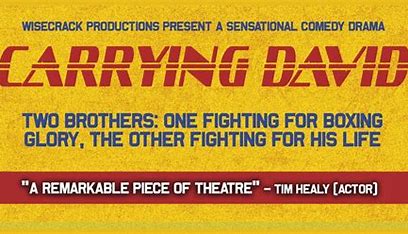
‘Then in June, Carrying David will play Newcastle Theatre Royal. My sixth show there. Carrying David is about Glenn McCrory’s rise to becoming the first North East world boxing champion. It is being produced by and stars Micky Cochrane. Don’t miss these plays, you’ll be spellbound!

(It’s worth checking out both ‘Hadaway Harry’ and ‘Carrying David’ reviews on Google).

Actress & Theatre producer Leah Bell

Dirty Dusting, of course, continues to tour nationally – and internationally – and that play is touring venues in the UK in October under the guidance of the inimitable Leah Bell’.

(Link to interview with actress & theatre producer Leah Bell from July 2021)

TAKE A BOW – writer, actress & theatre producer, Leah Bell | ALIKIVI UK : NORTH EAST CULTURE

‘The old warhorse Waiting For Gateaux – written, like Dirty Dusting with Trevor Wood – will be performed in New Zealand this year. Having these four plays produced in 2025 by other people means I can take the year out to write. I’m working on a few new ideas that will hopefully see the light of day in 2026 and beyond’.

ITV news reader Ian Payne & former BBC journalist & presenter Jeff Brown

‘I’ll also be doing my talks throughout the region, which amounted to around 40 last year, and I’m producing a series of talks with Ian Payne and Jeff Brown … “the two lads off the telly”. They are happening in April and May’.

‘We’ve done four of these ‘Evenings with’ before, and they sell out quickly. The lads are always good crack and the event is great fun. Loads of other stuff but I was only allowed 500 words for this post and I’ve used up over 600 already! Have a great 2025’.

For some it may be challenging times but Wisecrack continue rolling on. For further information, tour dates & video contact the official website >>>

Home | Wisecrack Productions

Alikivi   January 2025

READ ALL ABOUT IT – in conversation with Tyneside comedian & magician Robert Reed

‘Being an outcast gave me more time to focus on myself, to perfect my act. I’m glad I never fitted in at school, cos this has worked out well for me in the long run’.

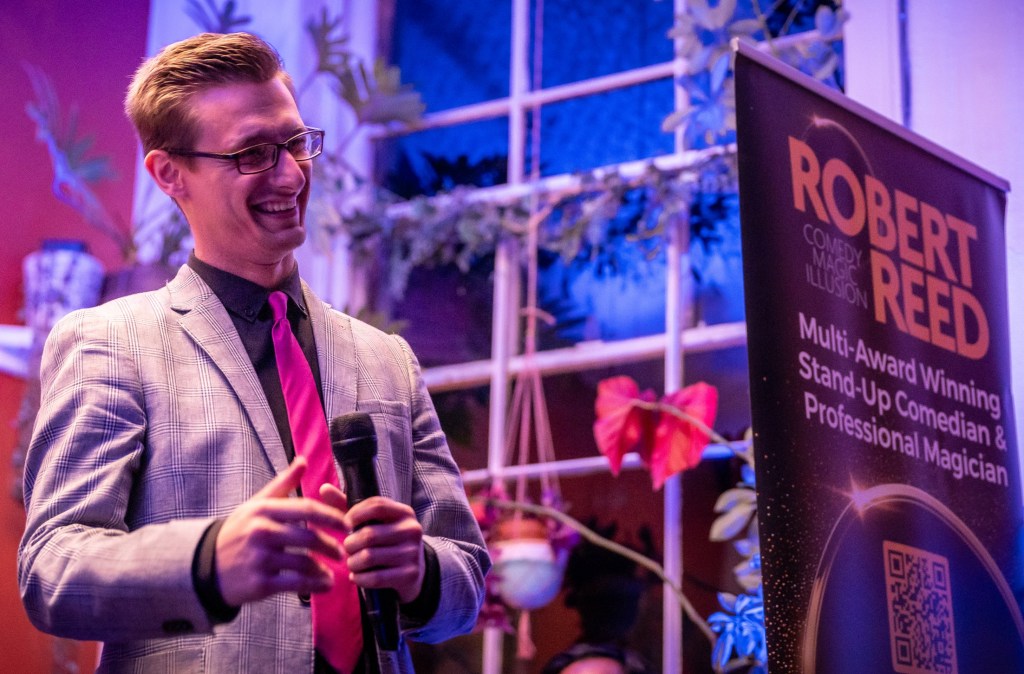
Born in South Shields, Robert Reed is a multi-award winning comedian and professional magician, at 25 I think he’s the youngest contributor to this site.

‘Well, I’m honoured (laughs). I’m a solo performer, my ego wouldn’t stand sharing the stage with anyone else. When I’m on stage I can take the mick out of myself and get the crowd on my side by exploiting my weak points, it shows my vulnerable side and the crowd give me more of a chance. Hecklers? I take them on. I use one-liners to my advantage’.

‘I can be rude but I’m not offensive as say Jimmy Carr. I do find their acts funny but to be honest I haven’t got the bollocks to go down the route of the Jimmy Carr’s or Frankie Boyles. I’m still young for this career so wouldn’t like to shorten it by rubbing people up the wrong way’.

‘I would say I’m like a modern and ruder version of Tommy Cooper (1970s comedian). My magic is more to a professional standard but it’s masked by the silliness and immaturity of the jokes’.

‘I started doing magic as a hobby when I was 10 then started in comedy when I was 17. I was always into one liners and silly dad jokes so I give it a go and came up with 30 one liners and tried them at stand-up gigs – they went down well’.

‘In rehearsal I figure out the magic trick first and the jokes come as I work it out and script the show. I’ll have hundreds of ideas but it’s finding the right seven or eight which will get the audience onside, then engaged, then the final kicker’.

‘After performing the routine around 20 times at restaurants, weddings or corporate events more jokes come along so you perfect the show. Some of the best jokes aren’t scripted they happen on the night’.

‘The end of the show there is a kicker where actually the crowd see a good magic trick. They leave the show having seen a good balance of magic and comedy – hopefully’.

(I never get a telephone call on my landline so was surprised when it started ringing at this point in the interview. We both looked at the phone then back to each other. Robert remarked ‘That’s me, good trick yeh?’)

‘I wouldn’t be around without the help of family, fellow magicians, fellow comedians and some closely trusted friends. But the hour or two on stage has got to be made all about you. There is plenty of time afterwards to thank people. I never forget who helped me get where I am. You’ve got to be respectful and I’m lucky to get assistance from many people in the industry’.

‘There were two people who inspired me – first was Uncle Joe who lived on the Whiteleas estate, South Shields. He wasn’t an entertainer but worked in the Docks. He was well known for his card tricks down the pub. When I visited with my mam he showed me how to play cards, every week would be a new coin trick or a brainteaser. Then I would go to school and show my friends’.

‘The second person to take me under his wing was a physics teacher called Mr Obee at St Joseph’s school. Every break time we would talk about magic and jokes, he would loan me magic books, then he would show me a different trick each time which I would perform for the other kids at dinner time. Now I don’t go anywhere without a deck of cards – you feel naked without one’.

‘We’re still in contact and he came to see my recent show at Durhan Fringe. His motto was ‘work hard and be nice’ which I’ve always followed. It was helpful propaganda about putting the hard work in. He told me that every hour you aren’t working on your dream someone else out there is. I’m very grateful to him’.

‘I stopped sleeping 8 hours a day and cut it to 6 so I could get extra hours at work. It became all about maximising the time I could work it out. I became obsessed with it, it’s the most important thing in my life – I want to be entertaining people’.

‘When I meet fellow professionals, I ask them about their working day and how they structure it. Get up at a certain time, start work, have a break, go back to work and repeat the next day. I recently met author Terry Deary who is noted for the Horrible Histories books and he talked about a similar structure that he was doing so I thought I’m on the right path here’.

‘For new ideas I always have a notebook and pen with me or record on the phone. They can be there for days or months. Sometimes it’s a name of a shop that I can twist around or just talking to myself in the shower and imagining being on stage that sparks off something which I then try out on friends’.

‘If you want it enough you will sacrifice holidays, relationships even sleep. Sometimes you can think of an idea and work through the night to get it. Then when you wake up you have the punchline’.

‘The toughest crowd you ever get is when you perform a new routine. In July I was at the Durham Fringe for five nights on an hour slot. All new material. Over the nights I done rewrites, shaped things, it got there. But looking back it was my first gigs that were the toughest. It was for 300 people in dickie bow ties going round the venue performing magic on tables’.

‘But then I was thrown in at the deep end and asked to perform for 10 minutes on the stage, I didn’t have a routine ready – that was sweaty and scary. Hopefully I got away with it being just a kid. The 10 minutes felt longer than the two hours going round the tables’.

‘I’m heavily involved in the South Tyneside International Magic Festival event which we hold every year at The Customs House, South Shields. This year it’s the 20th anniversary so we have an impressive bill lined up. We get magicians from around the world to come to Shields. The Customs House have been responsible for a lot of creative talent coming out of the area. Ray Spencer (former Director) was pivotal in a lot of this’.

‘After the shows the performers all meet up in the bar of the Littlehaven Hotel down at Shields beach, some stay over there as well. Are we competitive? No, we’re open and all get on really well – honest we do. We are happy to get together. We have midnight shows, plenty drinking and get in some take aways’.

‘I look forward to the socialising because it’s with people you only see a few times a year and you share the same loves, passions and interests. And you spend time with people you’ve looked up to and admired. We’ve always been the kid at school who never fit in, or was odd, or bullied, not the cool one, or never done sports, just desperate to show off their humour or talent’.

‘Don’t think any performer will truly retire, your brains still working you’ve still got the urge to do something. Once you do one gig you’re hooked it’s like a drug. I’m trying to get as many gigs under my belt as I can’.

‘I’m happy doing what I do now entertaining a crowd telling silly dirty one-liners and doing magic tricks. I’m looking to work hard for that TV break, or entertaining at bigger venues for more people where they think I’m worth spending money on a ticket for the show – that’s my measure of success’.

‘We all need money to keep going but the amount isn’t a motivator, it’s hearing the crowd laughter walking off stage, thinking they were entertained tonight – that’s my goal. This is a reason why I don’t want to slow down. I’m programmed to work every day and I love it’.

Alikivi   September 2024

For further information check the official website at > www.robertreed.live

Facebook > Robert Reed Magician

Instagram > @Robert ReedOfficial

X > @The_Robert_Reed

WALKING MY STREETS – New Poetry and Prose collection from Jarrow born Tom Kelly.

Tom Kelly is a short story writer, playwright and lyricist now living further up the Tyne in Blaydon. He’s written a number of musicals with the late John Miles that have been produced by The Customs House, South Shields, including the work of Tyne Dock born author Catherine Cookson.

‘Tom & Catherine had its premier at South Shields Customs House, it was really exciting. All the team were really nervous on the opening night but when the overture began, we all felt it was going to be a success. And it was. It had a ‘sold out’ run. A measure of its success was that me mam wanted to go every night! And she was not a theatre-goer. She loved ‘Tom & Catherine.’

“The play was first produced in 1999, and again 2001. In 2006 there was an outdoor performance at Bents Park, South Shields in which Jade Thirlwall (Little Mix) appeared, and most recently in 2019” said Tom.

His two football plays I Left My Heart in Roker Park (1997 & 98, 2004 & 2014) and Bobby Robson Saved My Life (2019) toured the North East and were well received by audiences and critics alike.  

I Left My Heart in Roker Park’ is a one-man play that looks at the life and football times of an avid Sunderland supporter. As more than one have said of the play, ‘it makes you laugh and cry” said Sunderland fan Tom.

His new book ‘Walking My Streets’ is his fourteenth and thirteenth published by Red Squirrel Press. Tom read at the Lit & Phil, Westgate Road, Newcastle, Cullercoats Library and The Word in South Shields to promote the book.

I’ve already read at a number of venues and thankfully it’s gone down very well. As it says on the books cover, ‘Walking My Streets’ explores in prose and poems Kelly’s life and the changing face of his native north-east of England’.

Walking My Streets is available from Red Squirrel Press.

Contact the official website >

https://www.redsquirrelpress.com/poetry?Author=Tom%2520Kelly

Alikivi   June 2024

JAZZ PARTY – in conversation with drummer & first leader of the Green Party Group on South Tyneside, Councillor David Francis.

I really believe there are pivotal moments in your life. There are times when things happen and put your life in a different direction.

I remember as a kid getting the first Van Halen album and it totally blew my mind, I thought it was amazing – still do now. When I put the record on the turntable, and hearing for the first time Eruption.

I started playing guitar first, and at school had a good teacher who encouraged me on the drums. Then I completed a degree at Leeds College of Music and came back to the North East and got into a bit of teaching, gigging and working in a drum shop.

Around 2010 I was in a bookshop in Newcastle when I picked up Labour MP Tony Benn’s diaries and thought, well there’s more important things going on in the world than drums.

I wasn’t happy about how things were going under the coalition so looked at the Green Party – and joined in 2014.

FIRST LOVE

The first music I was into was Michael Jackson then quickly got into rock like Hendrix, Cream then more modern stuff like Iron Maiden.

I would go to Pet Sounds in Newcastle and pick-up second-hand vinyl for £3.00 and also visit the record fairs. I progressed to listening to Frank Zappa and lots of jazz.

There is links with musicians in the North East who have played with known musicians, some are a bit tenuous but others are more legit.

I’d point out that my own links to anyone well known where more tenuous than legit, but I did cross paths with people like Gerry Richardson and Ronnie Pearson who were in Last Exit with Sting when he lived up here in the ‘70s.

Gerrie was an organ player and went onto teach music at Newcastle College then The Sage Gateshead. Ronnie was the drummer and went on to have a drum shop in Newcastle.

I met them and played in bands a few times with Gerry and worked with Ronnie’s son who also had a drum shop.

Although I doubt Gerry remembers me now as a lot of jazz gigs were thrown together and you would meet loads of other musicians that would lead to getting gigs. It would often be –  ‘We need a drummer next week, can you do it?’

GOING LIVE

I was in loads of bands over the years playing jazz. When it first opened the Sunderland Glass Centre had a posh restaurant and on a Friday and Saturday they would have a trio playing in the corner – I was the drummer from time to time, that’s where I met Gerry.

When I first started playing jazz gigs after my music degree in the late ‘90s there wasn’t an easy way to find out what was going on, then there was a guy called Lance Liddle from South Tyneside who started a Jazz blog. He would review gigs, then add what was coming up.

There was a number of venues in Newcastle like the Jazz Café run by Keith Crombie, there was The Bridge Hotel, and a pub called Beamish Mary, we played those venues a lot.

I was also playing in a bluesy rock band at the time, plus doing corporate gigs in places like Edinburgh and Birmingham.

Then a few gigs for the Royal Television Society awards dinner at The Sage. They were a bit surreal as you’d be playing when Aled Jones or Reeves & Mortimer come up on stage to get an award (laughs).

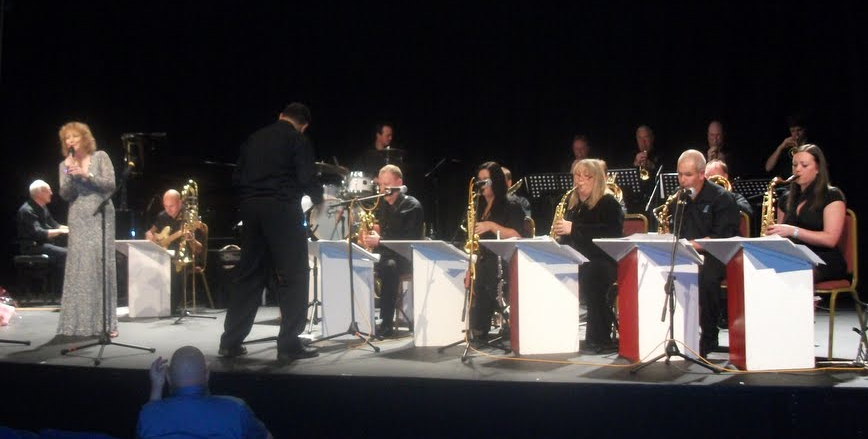
The Customs House Big Band

BIG BRASS SOUND

Through those bands I ended up at South Shields Customs House in the late ‘90s playing in the Big Band which was first put together by Joe Peterson (Community Arts Officer) and first ran by Tommy Moran, then Keith Robinson when I was there.

We’d have a rehearsal once a week then go for a drink in The Steamboat. I met my wife at that time – Elaine was a saxophone player.

Most of the time I spent learning how to be a good musician but not spending time out hustling getting gigs, I was waiting for people to call me.

I’d get a message to go to Harrogate on a New Year’s Eve and if you done well one of the musicians would recommend me to another gig.

In those jazz gigs you’re playing a fairly standard set rather like rock covers doing Hendrix, even if you haven’t worked it out note for note you know how they go. A lot of musicians have a back catalogue of songs in there (points to head) that they can play.

THAT’S THE TONIC

I did play a lot of gigs where it was written out and as a decent enough music reader I got through. You learn a lot of improvisation and skills on some gigs.

One time I got a call off a bass player who I regularly worked with, ‘Can you do a gig in North Allerton with an American keyboard player called Dave Keys’. ‘Yes, sounds good’ I said.

He directed the songs, all his, all original, you really had to pay attention and follow his lead. He’d say things like ‘This is a shuffle and a couple of stops, I’ll nod my head at the stop’ those sorts of things you know, directing the song as its being played – in front of the audience (laughs).

But music has common phrases and chord progressions that come up time and time again and you can work through it. I enjoyed the buzz of jazz and improvisation, the not knowing keeps it fresh.

There is a saying ‘It’s never the same way once, never mind twice’ (laughs).

Drumming on stage with Tony Bengtsson.

THE MARKET

You’ve got to work on your business, and I did eventually take control of that side of things, around 2010. What happened was I was teaching in schools, doing some private lessons, playing gigs but not earning much because I was travelling all over the place.

So, I started to build up work closer to home and getting contacts, it’s the working on your business, not just in it, that was needed.

Lately in music I’ve played on an album with singer/songwriter Tony Bengtson, he plays a folk, country, Americana style, he’s a really good player and maybe not getting as much recognition as he deserves.

WATCHING THE WORLD GO ROUND

I suppose the performance aspect is a parallel between musician and politician, there may be something in the saying that ‘Politics is showbusiness for ugly people’. It wasn’t in the family at all, my parents took an interest in, but weren’t active in politics.

When I was a kid we lived in the States for a year and on a basic level I became aware of the American history, like Abraham Lincoln, Martin Luther King, the  Civil Rights movement, and as I got older I took an interest in current affairs and politics.

I remember being a student in Leeds watching TV shows Spitting Image and Have I Got News For You and then the 1997 election and Tony Blair getting in, a real air of optimism after the Thatcher decade.

I’d always listen to Talk radio and listened to the political commentators, watched Question Time, but always observing not taking part.

Around 2010 when I was in a bookshop in Newcastle I picked up a copy of one of Tony Benn’s diaries, then read other volumes and thought, well there’s more important things going on in the world than drums.

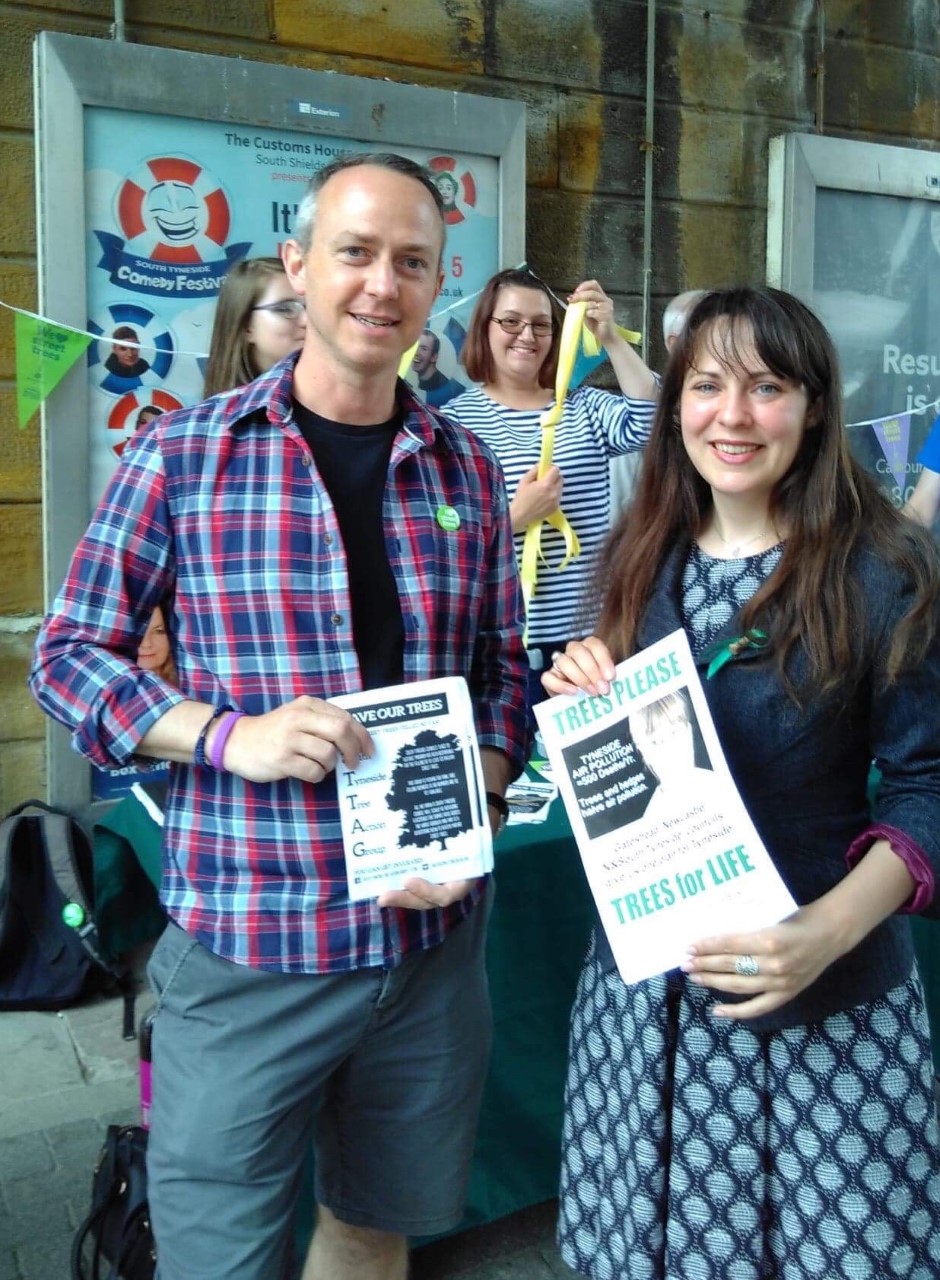
With Green’s Deputy Leader, Amelia Womack in South Shields.

GO GREEN

A musician friend who I mentioned earlier, Tony Bengston, was standing as a Green candidate. I wondered what was going on and I wasn’t happy about how things were going under the coalition plus not being enamoured about The Labour Party so I looked at the Green Party and found they weren’t just a one issue party.

Actually, they were somebody I could connect with and feel more comfortable with, so I joined in 2014.

We’d done a beach litter pick and it felt good to do this in South Shields with nice people, but importantly it was a tangible thing to do, a contribution to improving the area.

Then within weeks we were out on the streets knocking on doors. Not long after an opportunity arose to meet the Green’s Deputy Leader Amelia Womack when she came to South Tyneside – the result was I got more involved.

I got elected a few years ago then a few more candidates followed so we aren’t looked upon as the party in South Tyneside who have no chance.

Labour has a long history in this town and some responses on the doorstep are ‘I’ve always voted Labour and not interested in anyone else’. Which is fair enough, I get that.

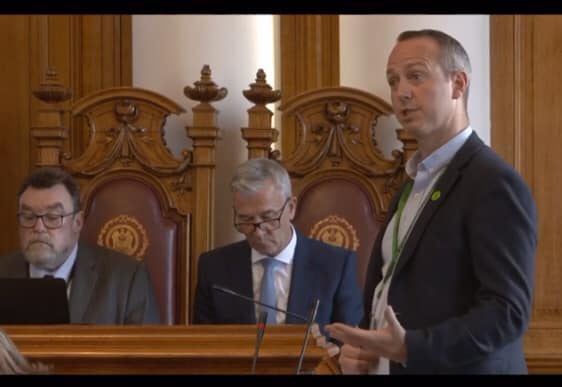
In the council chamber, Town Hall, South Shields.

I HEAR YOU KNOCKING

I’ve only had experience of knocking on doors for the Greens so don’t know what it’s like for everyone else but when I first started in this area (Beacon & Bents, South Shields), a lot of people weren’t sure who we were, some people thought we were the same as Greenpeace.

At first, we’d hear on the doorstep ‘Are you all about saving the whales?’

Some people aren’t interested, or are watching TV, or got the dinner on, but generally people are really nice and give you a bit time even when they don’t agree with you.

Then it got to the stage when people knew of what we were doing, they’d see or hear us working with people and trying to improve the local area.

It surprised me how favourable the response was becoming when people got to know us, and even if they don’t want to talk to you they are still civil about it. You aren’t going to please all the people.

I remember the worst reaction I had was when someone answered the door and he was trying to be polite and his other half was upstairs shouting ‘Just tell him to f*** off’. I’m glad I wasn’t face to face with her – he just looked a bit embarrassed (laughs).

A lot of people just want to talk to you if they have an issue with fly tipping in their back lane or sorting out wonky pavements in the street. They want to talk to somebody who can go away and get something done.

Interview by Alikivi  August 2021

FRINGE BENEFITS with North East actor & writer Wayne Miller

Really when I was young I wanted to be a stuntman. I was a huge fan of Jackie Chan. I watched every martial arts film, Bruce Lee, the lot. I thought acting would help me to be a stuntman because a lot of Asian stars are actors and martial artists.

So at school I got into acting on stage, but when I got further into it, it just felt right, natural really, it was never hard work. Playing guitar was harder work but acting definitely came easier and it helps a lot playing someone else and forgetting my day to day worries.

GUNNER MILLER

I first performed at the Edinburgh Fringe Festival in 1998 on a three week run with a show called The Machine Gunners. That was at the end of our year in drama with South Tyneside College. While we were up there we saw a few shows some were in venues the size of a cupboard.

It’s like Russian roulette you might get one gem from five shows. Some have gone on to be professionally produced like Jerry Springer the Opera, I saw Six the musical which transferred to the West End, it’s on a UK tour this year.

It’s a testing ground for shows, some people think they’re going to make money, but you’re a fool if you think you can – if you do it’s a bonus.

The best thing is test your work out, get some reviews, draw up some interest, and if you have a tour planned use it as a springboard. You might be lucky if a promoter spots it and comes onboard to produce it.

CALL TIME

You aren’t going to please everyone. If you’ve sold tickets and people come back you’ve done a good job. One critic can give you a good review, the next doesn’t. That’s just the nature of the business.

It’s the hardest slog doing the entire month of August because you are competing against thousands of shows, it’s a big competition fighting to get people in.

You get in 5-10 minutes before showtime, get all your props in place, costumes on… then bang, on the button, perform, take yer bows. At the end you’ve got five minutes to get out the building.

Some companies have three shows on, so they have to scoot over the other side of Edinburgh to do a show.

Just knowing you have done that slog is a proud thing and to have it on your posters and sometimes share a stage with well-known companies. After Edinburgh we brought The Machine Gunners back to South Shields and sold out The Customs House theatre for a few nights.

A few days after that show I went down south for a year to Maidenhead drama school, it didn’t do a lot for me if I’m honest. I wanted to improve my voice and movement but the majority was learning and reciting monologues.

It wasn’t really working for me and while down there I was receiving offers of work, one being Wearside Jack for ITV.

WEARSIDE JACK

Someone at Tyne Tees saw me in a play and passed on my contact to Sheila Matheson, I think it was. At first I thought it was a wind up (laughs). I mean Wearside Jack I thought he was a lot older than me and really everyone didn’t know that much about him.

It wasn’t until we met that I got to know more about what the production team thought he was like. They said he might have been someone working away on the lorries with Sutcliffe.

I grew a beard to look a bit older and he did have a Wearside accent. There were so many possibilities, one of the theories was that there was two people involved. We had various storylines for him.

We filmed a few scenes in Sunderland, then over in North Shields Fish Quay because there was witnesses that said they had seen Sutcliffe there. One woman in a café near the quay said she had seen Sutcliffe talking to a guy with a North East accent.

We also filmed a version where he was a loner, where he just wanted to attach himself to something, make him feel like a somebody.

We put it out later at night after the 10.30pm Tyne Tees news, and they broadcast an ITV Real Crimes version. We done the same on a programme about a murderer called Billy Dunlop and that focused on the double jeopardy law which was looking to get changed at the time.

This guy had killed his girlfriend, got arrested, went to trial and he was found not guilty. Later he confessed to it but couldn’t be tried again for the same crime, that was the double jeopardy law.

Living those roles was hard, I got to meet the family in the Dunlop case during filming, I was worried about that. To get to know that story and everything around it was hard.

Yeh for a few years I was the go to man to be North East killers. I was getting dodgy looks on the bus from old ladies – they looked over but couldn’t place me, they knew they had seen my face but not sure where, they’d nudge their mate or shuffle away. I thought not to get typecast I’ll have to go to panto land and make people laugh.

BOILIN’ STOTTS

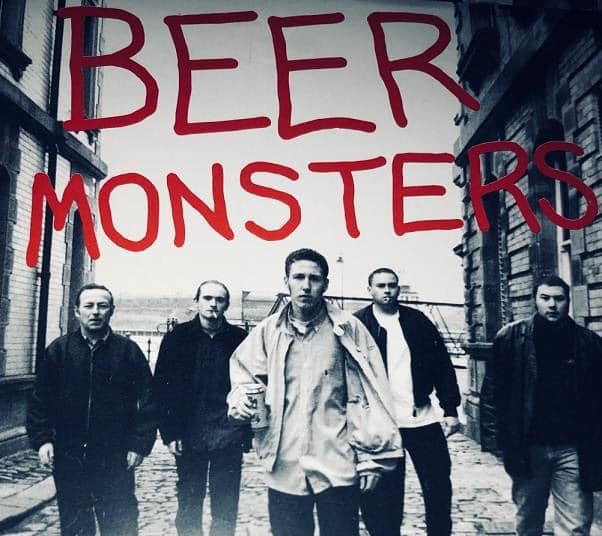
Then it was the North East plays by Boyle Yer Stotts, me and the lads had this theatre company and we were putting our own shows on – Beer Monsters, Pray for Rain, a few others.

But it was hard surviving then, paying the bills. I was also playing rhythm guitar in a few bands – Shake Yer Tailfeather, MG’s and Cookin’ on Gas. The music thing was great at first but at the end it got a bit pressurised.

Really at first it was a bunch of mates getting together playing music and I didn’t want to get in the situation of having to gig a certain amount of times a week.

A friend, Michael McNally was running a government programme called New Deal for Musicians which helped in between gigs, and I done a few pantos so that sort of kept me going. (interview with Michael McNally August 2018)

Cookin On Gas played the workingmen clubs, the whole circuit. Sometimes we’d strip back the numbers because in Shake Yer Tailfeather there was eleven in the band so we hardly played pubs, we done more one off clubs, theatre venues, private shows and corporates.

That lasted until the mid-2000’s when it started to get thin so I began writing and directing stuff at The Customs House. I knew panto inside out so I wrote some of that and added in some stuff for a children’s show that sort of came easy to me.

SCHOOLS OUT

I proposed some school holiday shows to The Customs House, they welcomed the idea so I wrote and directed shows for kids. Parents will always put their hand in their pocket for their kids to do something or go places rather than for themselves. It was steady at first then eventually I was getting a full diary of work.

I prefer writing now because I feel less pressure, I write in my own time where if I’m acting I have to learn a script by a certain time, act at a certain time – I’m up against the clock and if I’m producing a show I have to oversee every part.

CARRY ON COVID

We set up Walton-Gunn productions last year to produce pantos and do some new writing where we can take a risk with shows that might not make any money but are balanced out with panto profit.

Last March we played our first show and at midnight everything was locked down for Covid, so we only did one show in the run, but now we’ve just announced we have a panto season starting.

We have our adult panto Dickless Whittington – bringing back the filth. In the show is Kylie Ann Ford, Jen Normandale,  Steven Stobbs and Megan Robson. I’m a huge Carry On fan, absolutely love them.

I was a huge Sid James fan when I was a kid, yeah Carry-On films were panto, the bawdy humour and jokes (laughs).

Then it’s Sleeping Beauty in August and Wendy the Witch in October. These things like everybody else will be in jeopardy if we are back in lockdown so we’ll see how it goes.

GANGSTER STYLE

In October my play The Big Time is on in North Shields Exchange and then in London where it’s playing in a fringe pub with a pub downstairs and the gig upstairs with the seating and small stage.

The Big Time was originally put on in Edinburgh Fringe 2018 where it sold well and got good reviews. I wrote it back in 2013 so it’s good it still has life in it. You always look for that in a play.

The Big Time is about two wannabee gangsters who want to get into a criminal organisation so they agree to kidnap someone but end up taking the wrong girl.

They take her to a hut in the middle of nowhere and the gangsters turn up and see it’s the wrong girl. It’s a criminal farce all set in one place and the story is how are they going to get out of it.

Being set in one hut in real time it isn’t restricted about when or where its shown. At it’s core it is so basic you aren’t restricted by any scene changes, it’s just pure dialogue. The plan is to put it on with its sequel – The Big Goodbye– as a double header.

The goal and sign of achievement for a show is for it to last and be brought back time and time again and this one has done really well in that sense.

Adult Panto Dickless Whittington – 8.30pm 11-13 June 2021 at Armstrongs Bar, South Shields

Tickets £12 from ticketsource.co.uk/walton gunn

The Big Time – 8pm 2 October 2021 at Exchange Building, North Shields.

Tickets £10 from the venue. Tel: 0191 258 4111

Interview by Alikivi  June 2021

HELLO TOMORROW: Changing Face of South Shields in photographs (3)

For the past 10 years I’ve set myself a documentary project capturing the changing face of South Shields. Included are a small selection of the photographs.

This is Harton Quay next to the river Tyne, the ferry landing, the BT building and The Customs House theatre & arts venue. It’s also next to The Word and the Market, two area’s that have benefited from the 365 Town Centre Vision regeneration. Following posts will feature other area’s of the town.

In 2013 South Tyneside Council proposed a very bold £100 million regeneration project for the town, and public consultations were held. Progress on different phases of the regeneration is ongoing as more developments are planned.

So far the council have delivered – Hello Tomorrow is not just a slogan on the posters.

Gary Alikivi  April 2020.

OUR LAYGATE – in conversation with Ann Ahmed

In research I came across an article which said Laygate was the best example of integration in Britain. And it was. It is one of our best examples, so why haven’t people heard about it ?

I would just like to do it justice and spread the word about the unique area where we lived. I would like other theatres to see it and try and play it to a wider audience. I’ll push it as much as I can. The story deserves to be told. said Ann.

I met Ann at The Word in South Shields just down river from Laygate, an area where she grew up…..

I was raised in the community of Laygate after the Second World War and seamen settled in the area after the war. It had Arabs, Africans, Somali’s, Malaysians, it was a very tight community. The area wasn’t looked upon fondly by some people outside that community.

My grandfather and step grandfather where from the Yemen, so my dad was really dark. My mam was from Scotland, she had a terrible time from her family because she was married to a black man. She was ostracised from them.

He was a seaman who was away for two year stretches and the money wasn’t there. No Social Security or Health Service then.

Not long ago somebody asked me ‘Did you really live in Laygate ?’…I said ‘Well I wouldn’t lie about it would I’. It had, and sometimes still has, for whatever reason, a bad reputation, but it was the friendliest, welcoming, community spirited place you could ever go.

Nothing has been written about the community from this angle. Most stories are about the Arab riots, but I wanted to show what a great place it was to grow up in.

I’ve been thinking about it for a long time and I still see most of the people that lived there. I bumped into one of the girls I know and we got talking about Laygate, and she said ‘All of that will be lost, all those stories, those memories, you should write it down’. So I went away, thought about it and started writing things down.

My friend’s dad had a Somali cafe, well it was a sitting room with chairs and tables in. He would get a chicken, kill it in the backyard, and we would pluck it’s feathers out.

Once I remember coming from the shops with some bread and I was walking up our back lane when Hanratty was there with his horse. He would collect scrap or old clothes with a cart and horse.  He often gave out balloons to kid’s who got him scrap.

Well, I was desperate for a balloon, so I gave the horse the bread. When I got in the house, my mam went mad, she nearly killed me, because she had four kids to feed.

So, with more stories like these I rang Ray Spencer, Director at The Customs House and asked him would he be interested, could he see it playing at The Customs House ? We met up and after reading through them he said a definite yes.

What is the play about ?

It’s about how we got on, the relationships we had, the abuse we suffered sometimes from outsiders, and it’s mostly based in our back lane, Laygate Place, with other scenes in our sitting room and Holy Trinity School.

I wanted to show how we lived together in that community, you could say from a woman and child’s perspective. Not just my family, but the Arabs at the top of the street, the Somali’s down the road, the Arab cafe just along the way.

We may have had our fights and arguments as kids, but at the end of the day we are all still lifelong friends. Some I’ve known for 60 years.

How long did it take to write the play ?

About five to six months, but with re-writing and editing, it has taken nearly two years. I got together with Susan Evans, she wrote a play for The Customs House, and she showed me the format she uses, which was a great help.

How many characters are there ?

We’re looking for actors for the play. We need 14 in all with seven of them being able to play children so they should be about 16-18. It’s hard trying to get a Somali actor locally, so if anyone feels like auditioning, contact me via Facebook.

Because of cost’s involved I’ll be fundraising for the production. If people would like to donate I’ve got a GoFundMe page  gf.me/u/wz89xz   or they can contact me through Laygate Play Customs House on Facebook.

We’ve also got a fundraising Batty Bingo night at Armstrong Hall on 18th April 2020.  The last one we did had a great turnout, great tributes and the tickets for this one are selling fast as well. It’s £10 a ticket but well worth the money !

‘When the Boat Comes In’ written by Peter Mitchell has recently played at The Customs House, will it have a similar look ?

It is the same as being set in the North East and we all have Geordie accents but that play dealt with unemployment, strikes and an affair. This won’t, it’s centred on a small community.

What is your family background ?

My mam had a really tough time bringing us up. We had to rely on family and friends. But, during the ‘50s and ‘60s nobody had anything, so it didn’t bother you as much as today when they want the latest games or trainers.

Having nowt we did feel it, but you just got on with it. We eventually had to leave Laygate when the Housing Act came in because it was classed as a slum. That is where the story finishes, 1968.

Where you sad to leave Laygate ?

Yes and no. I think if our house had an indoor bath and toilet I would have liked to have stayed, but it was classed as a slum. If you wanted to go to the loo you had to go down the backstairs and into the yard.

We had the blackest backsides known to man because of the newspaper we used as loo roll (laughs). We were moving to a house that had an indoor toilet and a bathroom. It was like a palace to us!!

While I was writing the story, I organised a reunion at Trimmers bar with all my friends and people from Laygate. I told them what I was doing and that I wanted to include some stories about what they did as kid’s.

We finished by asking what was Laygate like for them growing up, and they all said it was the best time, it was lovely, it really was. We’re all proud to be from Laygate.  It was great bringing back all those memories.

It’s called ‘Our Laygate’ because to us, the kids of the ‘50s and ‘60s, when it was mostly an integrated community, it is ours. I know it’s still integrated today and it’s still a great, vibrant community – but to us, that era is ours.

Our Laygate is on at The Customs House 14th & 15th July 2020. Tickets £12.50

Interview by Alikivi   September 2018.

ALL MY ROCK STARS WERE POLITICIANS in conversation with South Shields MP Emma Lewell-Buck

I never had a musical awakening, all my rock stars were politicians (laughs). I was a weird kid, I was always into politics, sitting in front of the telly watching the news, my nana once said to my mam ‘There’s something not right about that bairn, you need to keep an eye on her’. Yeah I think I was destined to do this.

I met Terry Waite a few years ago, I remember watching on telly his situation as a prisoner years ago, he is Patron of a national homeless charity with a place in South Shields so he came and done a talk, I was sitting listening, fascinated, My god it’s Terry Waite (whispers). I was stuck to his side all night (laughs).

I’d watch documentaries where they had discovered new communities in far flung places of the world, always fascinated by the world around me, the planet and people – I just love people.

I always had a dream from when I was young to be in politics but shelved it because I never thought it could happen to kids like me.

My Great Uncle Richard Ewart was MP for Sunderland after the Second World War, before that he was Union Organiser and local councillor in South Shields, when he left school he worked in Whitburn Pit, this was a time of working class politicians. I looked to find a similar voice so dropped in to Emma’s office on Westoe Road, South Shields….

I originally got involved in local politics, became a local councillor and thought I’d never get to be an MP, so I will work to change my little part of the world. It came from there because I don’t come from a political family at all, I’m the only one in the family that’s interested in politics.

I believe in public service, that you can change things. Every single day people are in and out of this office and my amazing team here change things for them purely because I have two letters after my name.

People can come in here and be rock bottom about being evicted, all kinds of mess and we can sort them out within hours or quicker, and that’s good isn’t it.

A lot of people get into modern politics because they like being on telly or they like being famous. I just want to be a really good public servant, give something back and do some good for the people that I’ve grown up with, my neighbours, friends, family, the town.

Within the last 10 years or so pop music entertainers from South Shields like David Ducasse, Joe McElderry and Little Mix have been successful, is there any reason behind this ?

Firstly, representing your country at anything is a big deal, like David in Eurovision. Shields has talented people, it’s a creative place we have lots of artists and musicians.

I think that is because of the environment here, you look out to the River Tyne and North Sea with their wide-open spaces and you can just relax and think. That outward looking creativity and the impact of the people which makes the culture unique, that gets translated into art and music.

But I think in the past opportunities to get your stuff out there, get known or make a name for yourself have been limited and hard, but now with social media, 24/7 outlets and new avenues they are making it easier.

You can put a song on twitter or you tube and there is constant exposure if you do it right.

In the past singers or bands could of spent years going from club to club looking to get noticed, now with the resurgence of talent shows it gives people the opportunity to go on X Factor and the whole country could see you.

What music did you listen to when you were young ? (Emma was born in 1978)

I listened to my dad’s music mainly, my ma used to work nights in the pub, so I used to sit with my dad listening to Jethro Tull, Eric Clapton, Bob Dylan, I’d also like some Eurythmics and Madness. I never really followed any musical trends or fashion.

Did you play a musical instrument ?

Once as a kid I tried to teach myself how to play flute. I went to Woolworths in Jarrow with my pocket money and bought a little plastic flute. I’ve a lot of friends who are musical, but not me (laughs).

The Customs House in the past 20 years has been very successful with Ray Spencer at the wheel, is there still a place for it with all the changes happening in South Shields ?

Ray has been great nurturing the talent like we’ve talked about earlier. Arts and culture are an escape for people and we’ll always need it from the stresses of our daily life, so there’ll always be something like it in the town.

Going back to an earlier point the world is so in your face now, people get overwhelmed and there’s a rise in mental health problems. That’s because everything is at you all the time, the world just doesn’t seem as big as it used to because you’re getting stuff thrown at you all the time.

You need something comforting and nice like music and arts as opposed to being exposed to the horrors of the world. Listening or watching some things can move you in ways that some things just can’t.

With the austerity and cuts, arts and culture are the first to be hit because they are not seen as an essential service. People getting care is an essential service, do you cut money from a service which has a care package that people need to live, or do you cut it from arts and culture ?

That’s the problem austerity has brought, people have had to make those decisions, which can lead to the enrichment of the area suffering.

Have you had to make those decisions ?

When I was on the council I did because I had a budget but not now as I’m an MP in opposition. (Emma was lead member for social care) I have a lot more clout to help people but in terms of getting funding for things I have to fight twice as hard being in opposition.

Like the money for the new Metro cars, I fought for that for three years in opposition, if we were in Government and I asked it probably would have been just given – that’s the difference.

What is the difference between being an MP living in the North East compared to living closer to the capital ? 

First time I set foot in parliament was the day I was MP for Shields, never set foot in it before in my life. There are other people who were in and out of there every day looking for work, and one day they become an MP.

It depends how you’ve grown up, if you’ve spent your whole life working in places and networking to become an MP it’s not that big of a deal, if you’ve come from a normal job like me it is a big deal.

I imagine politics to be a hard profession, why do it ?

I’ve had hard jobs before, this is hard but not harder than any other jobs I’ve done before. I’ve just grew up wanting to make a difference and politics is the way you can do that.

I would look around and see my mam and dad, hard-working members of the family not being treated the same as others, they didn’t have much, just trying to get by and that massive level of inequality – it all used to make me angry.

How some people are treated wrongly and have all the chances in the world but others don’t, there should be a level playing field.

 Interview by Alikivi   January 2020.


SANTAS BIGGER BAG O’SWAG

If yer lookin’ for a Christmas present to buy why not take a butchers at these goodies that have appeared on the blog this year. 2019 has seen nearly 100 musicians interviewed and also featured authors and artists….

79318119_437132350300093_5999559298030501888_n

On ‘Live & Acoustic’, Blues Siren Emma Wilson sings 4 favourites from her live set plus her original blues break up song ‘Wish Her Well’. With guitar accompaniment from Al Harrington, Emma’s raw and dynamic vocals shine through

‘I used to sing sweeter soul style but learned and developed a big voice. It was get big or get off’.

The 5 track EP reached no.12 in the Independent Blues Broadcasters charts and received rave reviews from Blues Matters magazine and several American Blues stations.

For a hard copy on CD email Emma at  emmawilsonbluesband@gmail.com or contact the official website : www.emmawilson.net or via Facebook.

bloody well everything icon bandcamp

Gary Miller from folk rockers The Whisky Priests….‘Leaving school in the mid-80’s, being in a band meant having a voice and a sense of hope and purpose during the dark era of Thatcherism. So, The Whisky Priests kind of evolved out of that and initially became a vehicle for expressing all my frustrations and passion at that time’.

Get yer copy of Whisky Priests – ‘Bloody Well Everything’ 12-disc CD Box Set contact: https://whiskypriests.bandcamp.com/merch/chistmas-2019-offer-bloody-well-everything-limited-edition-box-set-only-300-numbered-copies-free-tour-t-shirt

THOMPSON

The Steve Thompson band recorded an album earlier this year…’The Long Fade really is my life’s work. After 50 years of being a backroom boy writing songs for other people I finally recorded them in my own name with a fantastic group of musicians and singers. Making the album was a fantastic adventure with lots of laughs with old friends’.

You can download and stream links at http://www.thelongfade.xyx

Gary Alikivi    December 2019.