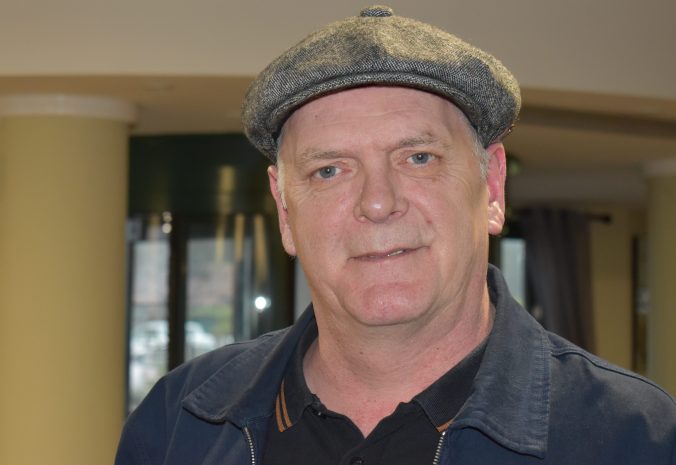
BANJO IN BOGOTA – in conversation with Tyneside storyteller & folk musician Tony Wilson

Tyne Dock in South Shields was an interesting part of the town to live, with its churches, terraced houses and huge industrial Victorian arches next to the river. It was in the early 80s when a lot of the old housing stock was being demolished and in Porchester Street I watched Ascendency being filmed. Julie Covington of hit TV show Rock Follies was the star, not long after that The Machine Gunners was set in Porchester and filmed for BBC TV.

‘Up to when I was 7 year old I lived in Porchester Street. It’s not there now but St Mary’s Church around the corner is where I used to sing in the choir and the scouts’ said Tony.

‘Now I live on the Lawe Top beside the roman fort. It’s almost aspirational for someone who comes from Tyne Dock to wind up being a skuetender’ (native to the Lawe Top).

‘I’m proud of coming from South Shields and when you were young trips to the fort were absolutely mind blowing. The area it’s in is incredible, with the whole vista of the river and parks and beach nearby – we’re lucky here’.

Being a former Tyne Docker now Skuetender he’s not wrong there. Tony featured on the site back in May 2018 talking about storytelling and songwriting and what music means to him.

‘I turned back to folk singing in 2017 after the government education cuts made it too expensive for schools to have extra-curricular practitioners, like me, to come in. Before that I was storytelling in schools for 20 years covering hundreds of issues such as the steelworks when I was in Ebbw Vale, the Romans here in South Shields, the coal industry and iron stone mining in Teesside and Northumberland. It was an extremely successful time’.

‘Storytelling is very important, its communication, social history, emotional control, drama, its use of vocabulary. For me it was learning how to be a performer and developing stamina to be able to do four hour sets a day, then drive 100 miles to go to a hotel, get up next day and do it again’.

‘Cities like Manchester, Oxford, Cambridge, all over the UK. I’d stay in these areas year after year for a fortnight at a time and, unlike a music tour where you could be in Aberdeen one day and Bournemouth the next, I’d plan easy distances to plan a route back home – loved the life.’

‘Then around 2009 I got an email. The message was ‘would you like to tell stories in Argentina?’ I wasn’t sure it was kosher at first but I received a phone call a few weeks later confirming it was. I was given contacts of previous storytellers who recommended it’.

‘Me and my wife went out and ended up over the years going to about 15 countries for six weeks at a time. They were international schools where the kids had already learnt English but mostly from American cartoon shows and they wanted them to hear colloquial language, more English. With my accent, I knew I would have to speak a bit slower – and there’s nothing worse than a posh Geordie!’

‘When we were in a Spanish speaking country, for the youngest ones, you’d have someone to explain the context of the story and then I’d still tell the story in English. Half of their lessons were in English, to make it an immersive experience’.

‘To accompany the lessons it was helpful to use British sign language, or borrow a guitar. I always took a banjo with me as it was such a different instrument for them to hear. Once the banjo was broken en-route and we found the only banjo repairman in Bogota in Colombia’.

‘It was hard work getting up at 5am, into a taxi for a two hour drive to tell stories to 3-400 children in ampitheatres – but what an experience! The last time we went over was Peru in 2016. We’d been to Uruguay, China, South Korea, all over – loved it. Sometimes I look back and think how did that happen – you’ve got to seize every opportunity’.

‘I’ve been songwriting for years and always have a songwriting project on the go. I write about 15 songs per year. Ideas can come from a book, a documentary or what someone says in a street… then I do a lot of research and add some ‘meat’ to the story. Songwriting can possess and obsess you’.

‘Recently I wrote a number of songs about Iron Stone Mining, the workers and how dangerous it was working there, although I do try to stay away from disaster. It’s not all ‘Grim up North’.

‘A friend of mine gave me a diary about his distant relation who had been captured by the Portugese and transported to Portchester Castle in Hampshire! Having lived in Porchester Street I didn’t know about this place. The songs can take you anywhere!’

‘I wrote a song with local playwright Tom Kelly about ‘the seven lads of Jarrow’ who, in the 1830s worked in the mines under diabolical conditions so tried to form a union with union organiser Tomas Hepburn. They ended up being brought up on jumped up charges – 10 were captured 3 escaped. 7 ended up in a kangaroo court and were transported to Australia never to return. It’s such an emotional subject’.

‘In 2019 I was planning to write autobiographical songs, one was about the day they tarmacked the cobbles in Porchester Street and as kids we could roller skate across the street. Another was the times walking through Tyne Dock arches with my dad and me being on his shoulders. Or another about my sister playing with her friends in the backyard in Porchester Street – then covid came along’.

‘I didn’t want to write about the pandemic or what happened around it, like being scared or having a feeling of waiting for death to come. I wrote nothing about that. I just wanted to write about the one’s I love and keep sane’.

‘All the performances I did in South America and all of the daily storytelling work I did in schools I now channel into what I present now as a musician. I still do regular open mics, folk club spots and am a paid guest in clubs and festivals throughout the UK’.

‘I love performing, it’s like an out of body experience. I’m not hippy dippy, mystical or spiritual but enjoy giving people enjoyment, sharing moments with people…and it beats the hell out of singing in the bathroom!’

Tony has placed all of the stories, CPD and instructional DVDs for parents and children on You Tube at ‘Tony Wilson Storyteller.

For further information contact the official website > http://www.tonywilsonfolksinger.co.uk

Alikivi   September 2024

TYNE DOCK ON THE TELLY

The first post of 2023 looks at TV and Film productions using South Shields locations. The latest being TV cop drama series Vera, starring Brenda Blethyn with her fake Geordie accent. Gateshead born Jill Halfpenny shudda’ been a shoo-in for that role.

And not forgetting an episode of Inspector George Gently with Martin Shaw filmed in the Rose & Crown pub at Holborn docks. Back in the ‘90s Catherine Cookson films were shot along the riverside and scenes from an episode of Spender starring Jimmy Nail were set up on the South pier.

Rewind further to the 1970’s and BBC TV series When the Boat Comes In, created by local Shields lad James Mitchell, they used The Customs House building at the Mill Dam as a backdrop.

But I remember in 1982 when a convoy of film trucks landed in South Shields. To be precise, Devonshire and Porchester Street in the Tyne Dock area of the town, and there was not one, but two projects filmed there. Those days I lived just two minutes away so took the chance to see the action.

There was BBC TV series Machine Gunners and a film called Ascendancy starring Julie Covington, who alongside Rula Lenska, had featured in popular ITV series, Rock Follies.

In March 2021 I interviewed Punishment of Luxury vocalist & actor Brian Rapkin, where he talked about his music and acting career on North East productions. So I recently got in touch and asked him about it…

‘Yes it was 1982 when I had a part as a Polish officer in Machine Gunners for the BBC. I was acting in a speaking part for the first time ever, and I remember being very nervous and excited.’

Brian was in demand during the ‘90s, as well as the aforementioned Catherine Cookson films, he worked in Newcastle on the TV series Byker Grove with Jill Halfpenny and Ant and Dec ‘They were just kids then’. He also featured in Spender starring Amanda Redman and Jimmy Nail ‘Mr Nail knew the actors were on tenterhooks so he chivied the crew along, that helped my nerves’.

I remember a few nights nipping over to Porchy watching Ascendency being filmed. I have a hazy memory of huge lights shining on a scene where a family were dragged out of a house in pyjamas and nighties and put up against the wall by armed soldiers. I haven’t been able to find any copies of the film to check the scene, or if it made the final cut.

Unfortunately I was still at school so a bit busy during the day, but straight after the bell I went to Porchy to see what was happening in Machine Gunners. I remember where one scene a milkman with his horse and cart was delivering bottles, and shouting at a group of kids ‘Where you going now’. Funny what sticks isn’t it?

Other locations in South Shields were used in the Gunners, one of them was Westoe School. I can’t remember exact details – wey it was over 40 years ago – but at the time of filming half the houses in Porchy were empty, and not long after the crew left, the street was knocked down. Devonshire is still there today.

Alikivi   January 2023.

POWER TO THE PEOPLE: Former South Shields Councillor, Alderman & Mayor, James Dunlop 1865-1938

The blog has featured highlights from the life of Tyneside born international musician Chas Chandler, little known South Shields born musicians Kathy Stobbart and Jack Brymer, a brave war story from North Shields hero Tommy Brown, also a profile of my Great Uncle, Richard Ewart MP, a committed socialist from the south of the Tyne. His story ‘From Coal Mine to the House of Commons’ is on the link below.

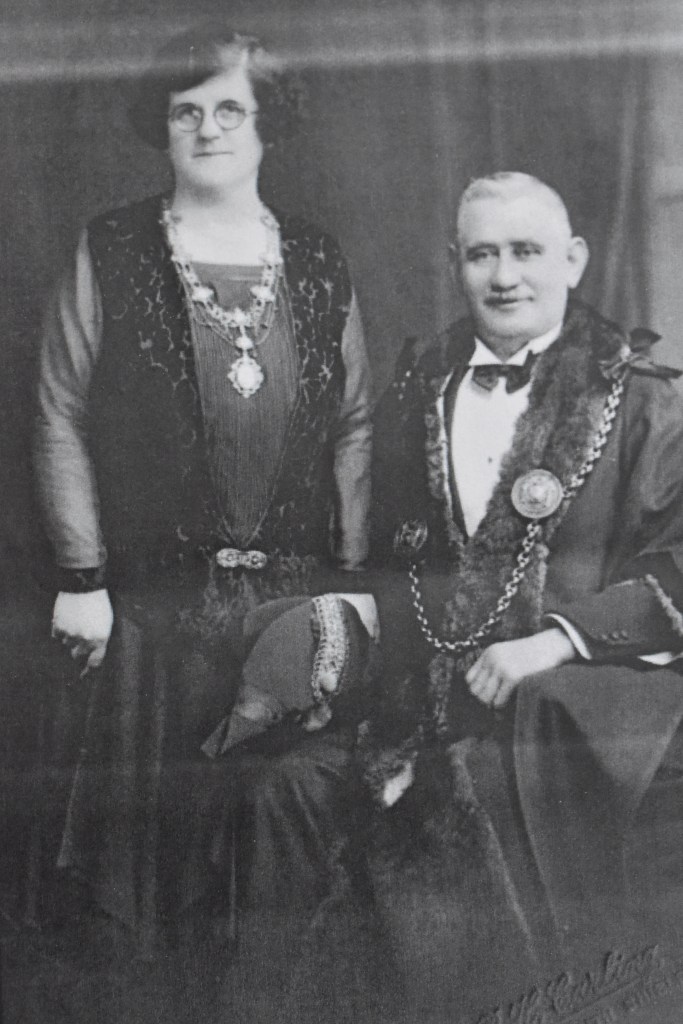
The latest story researched and put together from a number of print sources features the colourful life of South Shields Mayor James Dunlop, it also includes a crossover in my family research.

James Dunlop with his wife Marie pic. courtesy South Tyneside Council.

Glasgow born Dunlop spent a short time in Canada then returned to England where he worked in Barrow in Furness and Middlesbrough before moving to South Shields at the end of the nineteenth century finding employment in Tyneside shipyards.

Soon he was an active member of the Independent Labour Party but found their brand of politics a little tame so joined the Social Democratic Federation where he became a leading figure in the South Shields party.

Dunlop was quickly gaining a reputation as a fiery character who fought for what he thought was right for the working class people of the town.

Being successful at fighting local elections the Labour party took note and called him in, James agreed to become Tyne Dock ward councillor in 1906.

He retained strong links with the Social Democratic Federation party who were supported by the Russian Socialist Democratic Workers Party.

Through political and social gatherings Dunlop is likely to have met two Russian comrades – Tyneside shipyard worker Heinrich Fischer and my Great Uncle Alexander Alikivi who made the journey from Russia to the North East as a Merchant Seaman and settled in South Shields.

Family research is yet to point to a definite political affiliation for Alikivi but it was highly likely he was a member of the Russian Socialists, a party with someone speaking his mother tongue would be welcoming to someone so far from home.

Fischer was a confirmed member of the Russian Social Democratic Workers Party, useful reading about his life is an interview with author Vin Arthey who wrote an excellent book, The Kremlin’s Geordie Spy (link below).

Russia was in turmoil as a workers revolution raged across the country, to help the struggle in overthrowing the ruling Tsar regime and form a socialist government, arms were smuggled from the river Tyne to St Petersburg using established Baltic trade routes.

Along the riverside the boat building yards of Tyne Dock and Holborn would be suitable access points for smuggling. Was suspicious activity seen and reported ?

Upshot was a major police operation was launched on Tyneside leading to a number of arrests being made and Dunlop held on suspicion of gun running – this won’t look good for a recently elected councillor of Tyne Dock.

A search of his home revealed a box in the cellar which the police suspected had previously held guns and bullets. An Edinburgh address was on the box which led them to the ringleaders of the organisation.

How much involvement Dunlop had isn’t known, but fortunately for him he escaped any charges.

During the next decade Dunlop’s political career took off – employed as a boilermaker at Readheads shipyard his rallying calls for socialism won a strong following, he was promoted to Chairman of the Housing and Town Planning committee and made Alderman of the town.

James became a senior member of the Labour council with one of his proudest moments in 1928 becoming South Shields Mayor.

pic. November 3rd 1920 Alderman Dunlop laid a stone at the entrance of Cleadon Park Housing Estate, South Shields.

Sadly, after a 32 year membership and service to the Council, James passed away aged 73. A full council meeting was held to remember a valued colleague, Mayor Harris, councillor Gompertz, and my Great Uncle and brother in law of Alexander Alikivi, Councillor Richard Ewart, also attended. After the Second World War Ewart was elected MP for Sunderland.

Local newspaper The Shields Gazette featured the story –

“One could not but admire his courage, persistency and unshakeable belief in what he thought was right. I am sure the working class people of this town will remember with gratitude his fight for better housing conditions” said the Mayor.

Councillor Gompertz added “Alderman Dunlop’s work had a standing monument in the Cleadon Park Estate. People who had travelled the country looked upon Cleadon Park as the finest homes for working people in the whole country”.

“A pronounced Socialist, he laid the foundations of the party and we thank him for the enormous amount of spade work he did. In this Council chamber we miss his voice, which at times was raised against injustice and always in the cause of freedom”.

Research:

The Shields Gazette, South Shields Corporation minutes of proceedings July – Dec 1938.

‘We Do Not Want the Earth’ – The History of South Shields Labour Party by David Clark.

‘The Kremlin’s Geordie Spy’ by Vin Arthey.

RUSSIA’S GEORDIE SPY with author Vin Arthey | ALIKIVI : NORTH EAST UK (garyalikivi.com)

THE LAMPLIGHTER’S SON – Richard Ewart M.P. 1904-53. The long hard road from North East coal mines to the House of Commons. | ALIKIVI : NORTH EAST UK (garyalikivi.com)

Alikivi   February 2022.

TYNE DOCK BORDERS documentary about Tyne Dock in the North East of England.

Growing up in the shadow of Tyne Dock arches, bombing around the streets on my Grifter, playing football on St Mary’s field and as a teenager, a member of Tyne Dock Youth Club in South Shields.

The club had a film night every Sunday. No matter what film was screening I’d get a chair and plonk myself down at the front. The films were projected from a room at the back of the hall. The pictures, colour and sound were gripping. Three films stand out from those nights – Carrie by Stephen King, Monty Pythons Life of Brian and Duel by Stephen Spielberg.  

11741715_490181331141433_1105900592_n

On my Grifter in front of Tyne Dock Arches being demolished in October 1977.

Around 2007 I started researching my family tree with the Local Studies Library in South Shields a great resource. Putting the story together I knew of a family connection to Ireland, but never realised the full impact that the Irish had on the North East and in my case, Jarrow.

The research led to making Little Ireland. The documentary is available to watch on my You Tube channel.

Since then, I’ve filmed a lot around South Tyneside recording stories by local people recalling memories of their hometown. Skuetenders, War Stories, Home from Home, Westoe Rose and Secrets & Lies.

It’s been interesting to uncover and record stories that would have been lost or forgotten.

The documentary Tyne Dock Borders filmed late 2011, includes interviews with residents from this industrial part of South Shields. They remember the railways, arches and ‘colourful’ part of the town.

Also featured are two famous people who were born in the area – author Catherine Cookson and James Mitchell – creator of BBC tv series When the Boat Comes In.

To view the film go to the ALIKIVI You Tube channel and subscribe to watch more.

Gary Alikivi  2018.