BANJO IN BOGOTA – in conversation with Tyneside storyteller & folk musician Tony Wilson

Tyne Dock in South Shields was an interesting part of the town to live, with its churches, terraced houses and huge industrial Victorian arches next to the river. It was in the early 80s when a lot of the old housing stock was being demolished and in Porchester Street I watched Ascendency being filmed. Julie Covington of hit TV show Rock Follies was the star, not long after that The Machine Gunners was set in Porchester and filmed for BBC TV.

‘Up to when I was 7 year old I lived in Porchester Street. It’s not there now but St Mary’s Church around the corner is where I used to sing in the choir and the scouts’ said Tony.

‘Now I live on the Lawe Top beside the roman fort. It’s almost aspirational for someone who comes from Tyne Dock to wind up being a skuetender’ (native to the Lawe Top).

‘I’m proud of coming from South Shields and when you were young trips to the fort were absolutely mind blowing. The area it’s in is incredible, with the whole vista of the river and parks and beach nearby – we’re lucky here’.

Being a former Tyne Docker now Skuetender he’s not wrong there. Tony featured on the site back in May 2018 talking about storytelling and songwriting and what music means to him.

‘I turned back to folk singing in 2017 after the government education cuts made it too expensive for schools to have extra-curricular practitioners, like me, to come in. Before that I was storytelling in schools for 20 years covering hundreds of issues such as the steelworks when I was in Ebbw Vale, the Romans here in South Shields, the coal industry and iron stone mining in Teesside and Northumberland. It was an extremely successful time’.

‘Storytelling is very important, its communication, social history, emotional control, drama, its use of vocabulary. For me it was learning how to be a performer and developing stamina to be able to do four hour sets a day, then drive 100 miles to go to a hotel, get up next day and do it again’.

‘Cities like Manchester, Oxford, Cambridge, all over the UK. I’d stay in these areas year after year for a fortnight at a time and, unlike a music tour where you could be in Aberdeen one day and Bournemouth the next, I’d plan easy distances to plan a route back home – loved the life.’

‘Then around 2009 I got an email. The message was ‘would you like to tell stories in Argentina?’ I wasn’t sure it was kosher at first but I received a phone call a few weeks later confirming it was. I was given contacts of previous storytellers who recommended it’.

‘Me and my wife went out and ended up over the years going to about 15 countries for six weeks at a time. They were international schools where the kids had already learnt English but mostly from American cartoon shows and they wanted them to hear colloquial language, more English. With my accent, I knew I would have to speak a bit slower – and there’s nothing worse than a posh Geordie!’

‘When we were in a Spanish speaking country, for the youngest ones, you’d have someone to explain the context of the story and then I’d still tell the story in English. Half of their lessons were in English, to make it an immersive experience’.

‘To accompany the lessons it was helpful to use British sign language, or borrow a guitar. I always took a banjo with me as it was such a different instrument for them to hear. Once the banjo was broken en-route and we found the only banjo repairman in Bogota in Colombia’.

‘It was hard work getting up at 5am, into a taxi for a two hour drive to tell stories to 3-400 children in ampitheatres – but what an experience! The last time we went over was Peru in 2016. We’d been to Uruguay, China, South Korea, all over – loved it. Sometimes I look back and think how did that happen – you’ve got to seize every opportunity’.

‘I’ve been songwriting for years and always have a songwriting project on the go. I write about 15 songs per year. Ideas can come from a book, a documentary or what someone says in a street… then I do a lot of research and add some ‘meat’ to the story. Songwriting can possess and obsess you’.

‘Recently I wrote a number of songs about Iron Stone Mining, the workers and how dangerous it was working there, although I do try to stay away from disaster. It’s not all ‘Grim up North’.

‘A friend of mine gave me a diary about his distant relation who had been captured by the Portugese and transported to Portchester Castle in Hampshire! Having lived in Porchester Street I didn’t know about this place. The songs can take you anywhere!’

‘I wrote a song with local playwright Tom Kelly about ‘the seven lads of Jarrow’ who, in the 1830s worked in the mines under diabolical conditions so tried to form a union with union organiser Tomas Hepburn. They ended up being brought up on jumped up charges – 10 were captured 3 escaped. 7 ended up in a kangaroo court and were transported to Australia never to return. It’s such an emotional subject’.

‘In 2019 I was planning to write autobiographical songs, one was about the day they tarmacked the cobbles in Porchester Street and as kids we could roller skate across the street. Another was the times walking through Tyne Dock arches with my dad and me being on his shoulders. Or another about my sister playing with her friends in the backyard in Porchester Street – then covid came along’.

‘I didn’t want to write about the pandemic or what happened around it, like being scared or having a feeling of waiting for death to come. I wrote nothing about that. I just wanted to write about the one’s I love and keep sane’.

‘All the performances I did in South America and all of the daily storytelling work I did in schools I now channel into what I present now as a musician. I still do regular open mics, folk club spots and am a paid guest in clubs and festivals throughout the UK’.

‘I love performing, it’s like an out of body experience. I’m not hippy dippy, mystical or spiritual but enjoy giving people enjoyment, sharing moments with people…and it beats the hell out of singing in the bathroom!’

Tony has placed all of the stories, CPD and instructional DVDs for parents and children on You Tube at ‘Tony Wilson Storyteller.

For further information contact the official website > http://www.tonywilsonfolksinger.co.uk

Alikivi   September 2024

TYNE & WEIRD – with author Rob Kilburn

Folklore, urban legends, strange happenings and eccentric characters from history are all brought to life in Tyne and Weird, Rob Kilburn’s first book.

I asked 27 year old Seaburn lad Rob, what inspired you to write this book ?

‘I feel it’s important to be aware of some of our own history and I think on a personal level it was about finding inspiring characters and stories from the North East’

‘I started Tyne and Weird on Facebook a couple of years ago with the aim of building up an audience. I started sharing stories from around the North East that I found interesting, exploring quirky, strange history and some darker themes’.

Did you come across any surprises when researching the stories ?

‘I think the sheer amount of history unique to the area was a bit of surprise. The more you dig into archives and connect with community you realise how much of the world is connected to our little part of England’.

Have you a favourite story in the book ?

‘One story I found particularly interesting was the two lads from Gateshead who allegedly captured the Loch Ness Monster on camera’.

Is there a story set in South Shields ?

‘Yes, there are stories from all over Tyne and Wear. South Shields has had a number of interesting visitors like Buffalo Bill, Houdini and Jimi Hendrix to name just a few’. 

Have you an idea for future projects ?

‘Yes, I am currently working on a sequel which will also look at areas in the North East outside of Tyne and Weird. There is a lot of weird out there and some of the stories in this one are fantastic’.

Where is the book available ?

The book is available on Amazon or you can get it directly from me here:
https://www.etsy.com/uk/listing/898847869/tyne-and-weird-the-book

Interview by Alikivi   March 2021.

GLASTONBURY TOR – More than just a Hill by author, Dan Green

Mysteries of the world are fascinating subjects and we rely on scientists, archaeologists and storytellers to bring them out of the dark.

Former South Shields resident Dan Green, British author, broadcaster and researcher has already shared some of his experiences on this blog including poltergeists, UFO’s and fairies.

He recently got in touch about some more unpredictable events that he has experienced.

Of all the apparent mysteries I have investigated and had to leave unsolved, this is certainly high up on my list.

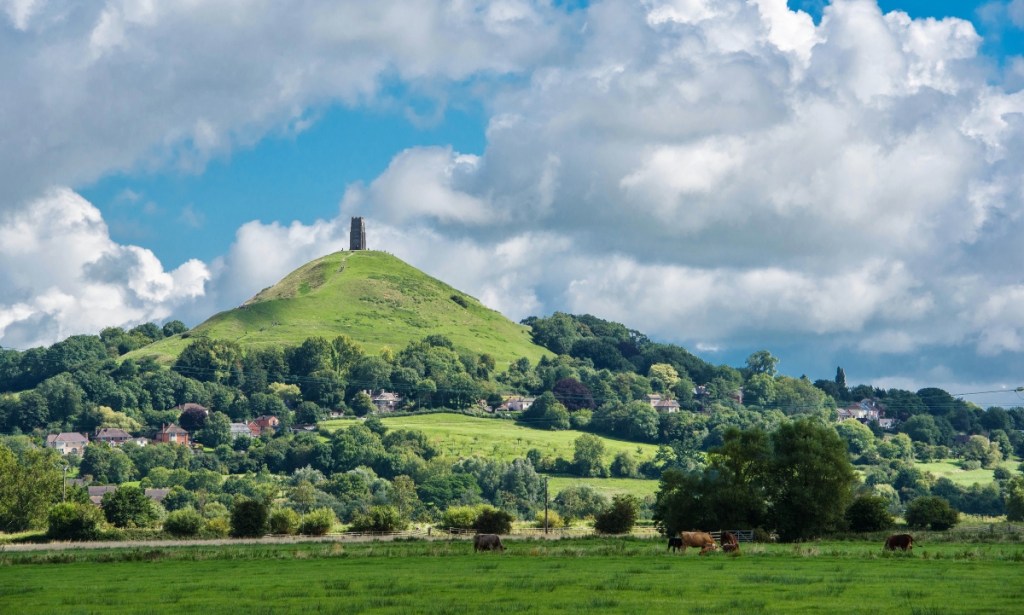
Even higher is Glastonbury Tor, a 158 metres high conical shaped hill in Somerset. Placed on a ley line, it has the reputation of being a fairy hill, with alleged strange properties with an entrance to Fairyland, no less, somewhere on its eastern slope.

I’ve visited the Tor at all times of the year both with people and on my own. I can vouch for my own strange experiences such as the first time I ascended to the summit at about 11.30pm and almost immediately there was a brief silent silver flash only feet above my head. Nice welcome.

Minutes later on the left-hand slope I watched a five second silent bombardment of what I described at the time of grey ping pong balls. Obviously, they weren’t physical but without being a psychic I saw them clearly.

Years later I learned that other people have also watched this ping pong phenomenon. What could they have been? And how can they produce themselves?

More strangeness awaited me starting in 2005 and lasting the next five years. I was ascending the Tor on a July afternoon like I’d done umpteen times when suddenly I became overpowered with a great fear, so much so that I had to crouch down to the grass, unable to progress any further.

My body was awash with what I can only imagine a panic attack must feel like. I had no idea what was happening to me and was so fearful – unlike me – I had to retreat back down the pathway.

I wrote the experience off as it just being one of those weird things and had put it to the back of my mind when I visited next, the following July. Proving that lightning can strike twice, the same thing happened to me again at exactly the same point.

For the following five years I experienced the same intense trepidation at the same point, unable to go any further.

On the last occasion two surprised family members watched me scale down the slope to crawl further along and then come up on the path again, when past the troublesome spot. They thought I was playing some sort of game.

In 2010 everything returned to normal for me and I happily skipped over the spot, going backwards and forwards just to be sure. What on earth (or maybe under earth) had all that been about?

Dazzling white ‘something’ at the base of the Tor.

In 2008 I went to Glastonbury to investigate the experience of local man Mike Chenery. On February 2007 at 4.33pm on a bright day he was walking up Orchard Lane at the foot of the Tor when he noticed all the singing birds had suddenly stopped their throng. It’s the sort of thing that happens at times of a solar eclipse.

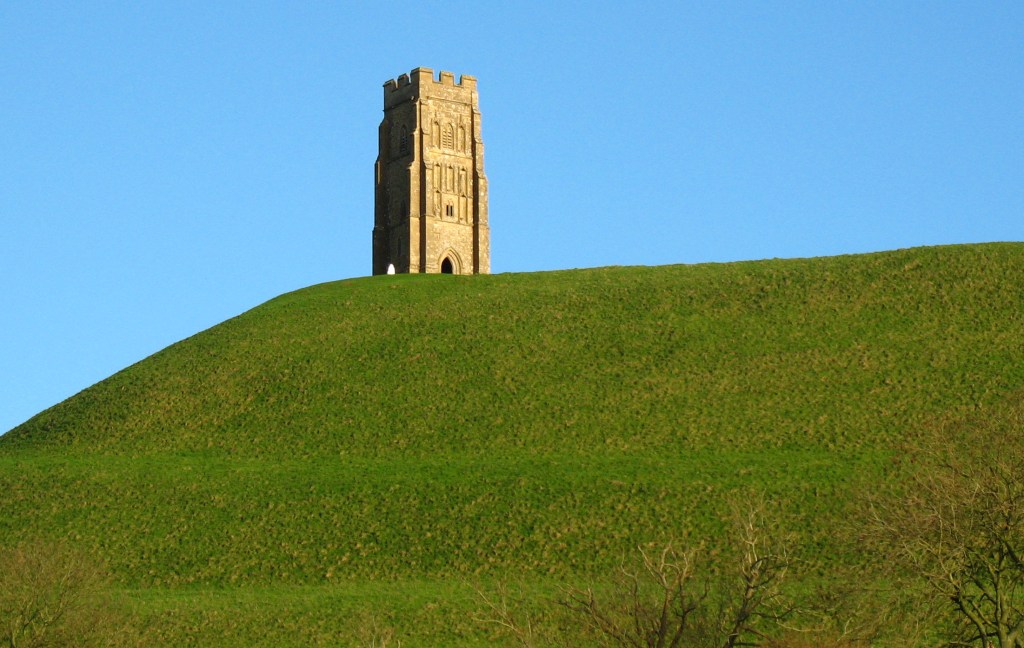
He was at the vantage point of one of the un-arched sides of the Tower at the top of the Tor and as he glanced up at the deserted summit he saw a dazzling white something that he told me glided a short distance from within the tower.

At first it showed itself as linear, long and very narrow, moving its perspective to face his direction and then widening.

Mike always carries his digital camera with him and quickly took a pic before the apparition popped off. When I met him he still had the pic saved on his camera.

What had he photographed? Not a camera glitch, for a close up shows definite contours, neither an optical effect.

Interviewing Mike I have no reason to doubt his story or integrity. Could this be the most amazing photo ever taken on the famous Fairy hill?

I was once told by an ex-mayor of Glastonbury who preferred anonymity of how one night he witnessed what he described as a spaceship when he saw a reddish orange light appear above the Tor before sinking into the summit. He reassured me that he ‘Wasn’t on anything’.

As well as speaking with a good few other individuals with their own drug and alcohol free experiences, I’ve had further Tor experiences of my own, but they are so personal and likely unbelievable to a listener that I prefer keeping them to myself.

There are more things in heaven and earth, Horatio, and as much as I would like to say that Glastonbury Tor is nothing more than simply a hill, my own experiences clearly won’t allow me. Would it you?

Dan Green 2021

Read more Dan Green investigations:

HIDDEN TREASURE on Tyneside with investigator Dan Green | ALIKIVI (garyalikivi.com)

MIND GAMES ? Dan Green investigates Mysterious Tyneside | ALIKIVI (garyalikivi.com)

Edited by Alikivi  February 2021.

NORTHERN MINSTRELS – with Historian Dave Harker.

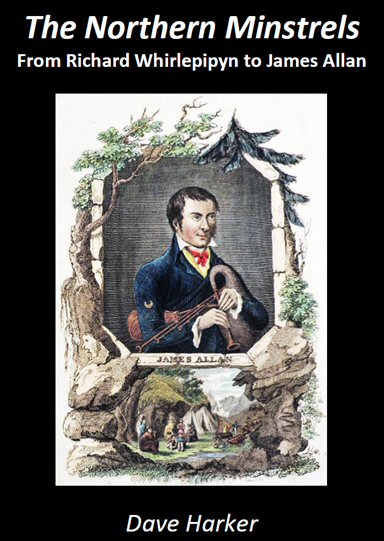
Dave talks about his new book which tracks the history of North East popular music and song. 

“The Northern Minstrels draws on a wealth of research to tell the story of North East pipers, minstrels, choristers, street singers and dancing masters, covering the duels, disputes and riots”.

Newcastle based Dave, who turned 74 on November 5, has previously published 16 books, eight of which cover the history of North East music, including biographies of Geordie Ridley, Blind Willie Purvis, Joe Wilson and Ned Corvan.

Joe and Ned were used by playwrite Ed Waugh for successful plays Mr Corvan’s Music Hall and The Great Joe Wilson.

What inspired you to write The Northern Minstrels ?  

This is the richest region in England in terms of singers and songwriters whose audiences were predominantly working-class.

Terms like ‘North-Eastern’ ‘English’, ‘Scottish’ and so on to describe songs ignore the fact that while what survive today may have been sung in a given region or country, that does not mean that they originated there.  

I had to put the musicians in a social context to show the ways in which music making and printed balladry helped shape the politics of their day.

This included general literacy, printing presses, religious upheavals, employment of official minstrels, as well as laws relating to vagrancy.

Did you have any challenges when writing the book ?

The book is by far the most challenging I have ever written because there are so few sources and I had to research what was happening all over England and southern Scotland.

I felt it was important to collate the information that survives so others can expand on my work in the future.

What is your background Dave ?

I was born in Guisborough in what was then the North Riding of Yorkshire on 5 November 1946. I won a scholarship to Guisborough Grammar School in 1958.

In 1966 I went to Jesus College, Cambridge, which seemed like a good idea at the time. I was awarded a BA in 1969, and in 1970 became a senior scholar at University College.  

I later declined the offer of a fellowship at a Cambridge college and accepted a temporary lectureship at Manchester Polytechnic, since I wanted to give something back to students less privileged than myself.

I joined the Labour Party in 1975 but left in disgust and joined the International Socialists. In 1976, to my surprise, Cambridge University accepted my PhD thesis, ‘Popular Song and Working-Class Consciousness in North East England’.

In 1977 as a member of the Socialist Workers’ Party I organised buses to both Anti-Nazi League carnivals in London.

The ‘80s saw more academic work for Dave including the Trades Union Council, Senior Lecturer in Trade Union Studies and building miners’ support groups in 1984-85….

But by then I was thoroughly disgusted with my colleagues’ careerism. By the early ‘90s I built the largest travelling stall of second-hand socialist books in Britain, and probably in Europe, for Manchester district Socialist Workers Party, and supplied Bookmarks bookshop in London.

I drifted away from the SWP, though I became the founding secretary of the North West Retired Members’ Branch and an officer of Manchester Trades Union Council.

In 2015 I moved back to Newcastle, and in 2017 I received the Robert Tressell Award ‘For Services to Working People’.

What does the North East mean to you ?  

A few years ago, I researched the history of the word ‘Geordie’ and discovered that it had been used to patronise working people on Tyneside for over 200 years.

Virtually all ‘definitions’ had no historical accuracy or conceptual content, and the best one I know was that ‘Geordie’ was the name by which Tynesiders are known outside the district, either geographically, or culturally, even if they live there.

What bothered me was the tribalism in the region – Mackems (from Sunderland), Smoggies (from Teeside) and so on – not least because it did not serve the interests of working people, but on the contrary helped to divide them.

Only 100 copies of The Northern Minstrels have been printed.

They are available for £25 (plus £5 p&p) per copy from Dave at d1harker@btinternet.com

Interview by Alikivi  November 2020.

METAL TOON, METAL CITY video filmed in Newcastle for new single from Chief Headbangers, Raven.

On Tyneside during the ‘70s and ‘80s rock music was heard from Sunderland to South Shields, bounced over the river Tyne to Whitley Bay and Wallsend – the vibrations were felt in Newcastle. A North East New Wave of British Heavy Metal was coming in.

Riding the wave were Fist, Hellanbach, Mythra, Tygers of Pan Tang and Venom pushing metal to its limits and discovering a new energy. Another of those bands was Raven.

Now based Stateside, but originally formed in Newcastle in 1974, early gigs saw the trio cutting their teeth on North East live circuit of working mens clubs.

Headline gigs at Newcastle Mayfair and Dingwalls gained the band a solid live reputation. The gates were opened, and the band went onto UK support slots with Iron Maiden, Ozzy and Whitesnake.

By the early ‘80s two albums ‘Rock Until You Drop’ and ‘Wiped Out’ were recorded in Wallsend’s Impulse Studio on the Tyneside label, Neat Records. Then a call came in from America.

Raven were at the forefront of speed metal spawning the big four beasts from the United States – Megadeth, Slayer, Anthrax and dragging Metallica out on their first, and scorching, tour across the USA.

We know where they ended up. These were life changing moments. Raven knew their future was Stateside and subsequently signed to Megaforce and then major label, Atlantic.

Fast forward 40 plus years and the band are still hitting it hard with new single ‘Metal City’ from their forthcoming album. The music video was filmed on Tyneside capturing iconic structures like the Angel of the North, Tyne Bridge and even St James’ Park home of Newcastle United.

I asked bassist and vocalist John Gallagher did filming stir up any memories when you were at the locations ?

It definitely stirred up some memories especially with one part of the shoot. We were driving to one of the locations when I mentioned “I grew up down that street there” and our video guy Paul said “Then let’s check it out!”

So, the footage with me playing the bass is in the backlane in Benwell where we played football as kids.

After ‘Top of the Mountain’ this is the second track released and both are very strong opening singles, I asked John are the band putting down a marker for what the listeners can expect from the rest of the album ?

Very much so. Top was the perfect choice as the first song as it sounds like one of our early songs dragged kicking and screaming into the 21st century!! And Metal City is not only the title track but it’s a real anthem type song.

Yep, added to trademark Gallagher scream, check out the geet big chorus!

The rest of the album runs the gamut from crazy fast songs like The Power, and a tribute to Lemmy in Motorheadin’. Added to super aggressive tracks like Human Race and Break plus a bit of an epic in When Worlds Collide.

So, there’s variety, and all heavy with ‘all killer, no filler’.

How do you look at this album compared to previous releases ?

This one is a belta! We actually think this album is the best thing we’ve ever done, for a band that’s been around the block as long as we have that’s really a case of laying down the gauntlet to many of the other bands of our era who are putting out ‘ok’ albums.

The band have just released new European tour dates, when was your last gig pre – covid ?

Our last shows were on the Monsters of Rock cruise which departs from Florida. We did the pre-party show in Miami and a show on the cruise.

Always great fun, and we actually did Chainsaw for the first time in about 30 years. We can’t wait to test drive these new songs on stage!

Watch the video on You Tube: https://www.youtube.com/watch?v=jtKKmm6ibOM&list=RDjtKKmm6ibOM&start_radio=1&t=20

Check official website for tour dates and album release:  https://ravenlunatics.com/

Interview by Alikivi September 2020.

LETTERS FROM JARROW (1) – The IRA on Tyneside

Recently I completed a DNA ancestry test which came back 14% Scottish and 86% Irish, a bigger percentage than I thought but not a surprise as in 2008 I had already researched the family tree through census’, birth, marriage and death records, plus visiting Ireland a few times.

My Irish family came to Tyneside in the North East of England around the late 1880’s and settled here – a long way from County Galway, Derry and Antrim.

Amongst old certificates, photos and letters, my grandfather wrote down memories of his mother and her family, plus describing where he used to live and play as a kid in Jarrow at the time of the First World War.

‘My mother’s family originated in Galway in the west of Ireland. She came from a big family, her brothers, uncles and cousins were all fishermen. I remember my mother as being a very hard-working woman.

She worked as a Stoker in the chemical works over the bridge in East Jarrow.  She worked there all through the 1914-18 war.

She was a very kind woman, strict but fair, and was very religious. The family were also involved with the IRA and Sinn Fein’.

These last remarks were very interesting because when researching my family history, I came across Donmouth, a North East local history website by Patrick Brennan (link at the bottom of the page).

In one of the sections, he covers the IRA in Jarrow which I have condensed here.

After being cruelly treated by England over the centuries – for example the Great Famine 1845-50 – Irish people were looking to create an Independent Irish Republic.

A British Volunteer force, known as ‘the Black and Tans’ landed in Dublin. The IRA operated a guerrilla campaign attacking small groups of Black and Tans and murdering informers. Out of control Tans went on an orgy of looting and arson.

By 1919 the Irish Self Determination League (ISDL) was formed, the purpose was to raise funds for Sinn Fein but some members decided to take direct action. Mainland Britain had its first arson attack in Liverpool Docks, days later, a large explosion near London Bridge.

On Tyneside, many men and women of Irish birth gave support to the Irish republican cause through membership of the ISDL or Irish Volunteers – better known as the IRA.

Since the 1880’s Jarrow had an active political organisation in the Irish National League and held an important role in the ISDL. They held political meetings, fund raisers and ceilidhs in Lockharts Cocoa Rooms and the Co Op Guild Hall in Jarrow. 

More direct action was called for resulting in more volunteers being recruited and by the end of 1920 six companies with a total of 160 men had been established:

A Company – Jarrow. B – Hebburn. C – Newcastle D – Wallsend. E – Bedlington. F – Consett.

Within a few months a further four companies were set up: Stockton, Chester-Le-Street, Thornley and Sunderland bringing the total to 480 men.

Arms, guns and explosives were either stolen from Army Drill Halls or obtained from foreign sailors. In Jarrow, baby’s prams were used as cover to transport weapons to and from an arms dump in St Pauls Road in East Jarrow.

March 1921 saw the first incendiary attack on a Newcastle warehouse and oil refinery, plus a timber yard at Tyne Dock. Largely unsuccessful, the second attack was more ambitious, 38 fires at 20 different farms were co-ordinated to be lit at 8pm throughout Durham and Northumberland. This demonstrated the extent of the I.R.A throughout the region. (Reports from the Evening Chronicle 1921).

A number of operations were planned and executed around Tyneside. Farm fires and attacks on oil works in Kenton, Wallsend, South Shields, and an aircraft shed in Gosforth was destroyed.

Also, the daring attack in Jarrow – a gas main blown up on the old Don Bridge (pics below).

This story featured in my documentary ‘Little Ireland’ (link at the bottom of the page).

Con Sheils speaking in the film said ‘They were just trying to make a point, that’s all they were trying to do. Not harm anybody, just trying to make a point that they wanted home rule for Ireland’.  

THE SINN FEIN OUTRAGES: GAS MAIN BLOWN UP  (report from the Evening Chronicle 23rd May 1921).

At 11.15pm on Saturday night there was a heavy explosion at the west end of the town, and it was discovered that a hole 18 inches by 18 had been made in the lower of two gas mains carried across the Don bridge at East Jarrow. The gas company’s workmen were soon on the spot, and the main was temporarily repaired.

The IRA on Tyneside were severely damaged when two of their top men were arrested in connection with the theft of explosives from a colliery in Blyth on the Northumberland coast.

They were sentenced to prison but released in 1922 as part of Truce arrangements made a year earlier.

But more trouble was on the horizon with pit strikes, mass unemployment and extreme poverty meant the Irish had another fight on their hands – by 1936 Jarrow was about to march onto London.

For further information:

https://garyalikivi.com/2018/08/22/little-ireland-documentary-on-irish-immigration-into-jarrow-uk/

http://www.donmouth.co.uk/

Alikivi   May 2020