As requested, readers of this site have contributed stories featuring supernatural phenomena. Actor and theatre producer Alison Stanley talked of her experiences. Featured in this story is a medieval castle in Chillingham, Northumberland which is reported to be one of the UK’s most haunted castles.
In the past I’ve been a celebrant at funerals and enjoy doing it. I’ve always been interested in spiritualism. I believe in a next life. We’ve talked about what happens when you die and we’ve mentioned ghosts, spirituality and the like people believe different things explained Alison.
Some say when you die you just die and there is no afterlife. But how do they know for sure? And by the laws of science we are a ball of energy and by those laws it doesn’t die so where does that energy go? The physical body dies and is buried or cremated but what happens to the energy? It’s an interesting subject.
A few years ago we went to Chillingham Castle on a day trip. There was me, my mother, my youngest son and my step dad. It was a grey dark day lashing down with rain. We were driving along the country roads getting near the castle. We turned a corner and saw an old woman in a red coat standing at the side of the road. She wasn’t old as somebody from the 1800s but there was something about her that didn’t look right. We all remarked about this woman who was in the middle of nowhere really.
I looked in my rear view mirror and she was standing looking at the car. Where did she come from as there were no houses around maybe she has dementia? I just wasn’t sure I couldn’t put my finger on it. What really was wrong was she didn’t look wet she was bone dry. But it was lashing down?
We get in to Chillingham Castle and looked at all the artefacts and stuff it’s quite cluttered. On one of the clothes dummies was a lady with a red coat and she had a hat on. It was from one of the women who had worked there as a housekeeper. I swear it was the same coat we had seen.
Another time was 10 years ago. We were sitting in a bar called the Pig & Whistle in Hollywood which is a very theatrical, grand sort of place. I went through a red velvet curtain to the toilet downstairs and after four steps I couldn’t go any further, I stopped because I froze and the hairs on the back of my neck stood up. There was no way I could go any further down the stairs.
I came straight back up and told my husband we’re going to another bar for a drink because there is no way on God’s earth I’m going to the toilet here. Later we found out there had been a fire there and there was strong spiritual activity in the pub.
I think if someone is in the next life and they visit you I think it’s a bit of an honour really. They might have plenty to do and they have taken time out of their day to see you – so yes, it’s an honour.
More revelations of supernatural phenomena will feature on this site. If you want to share your experience don’t hesitate to get in touch.
Sitting in the Littlehaven Hotel on a sunny autumn day in South Shields I’m listening to a familiar story which I’ve heard a lot since starting this site in 2017.
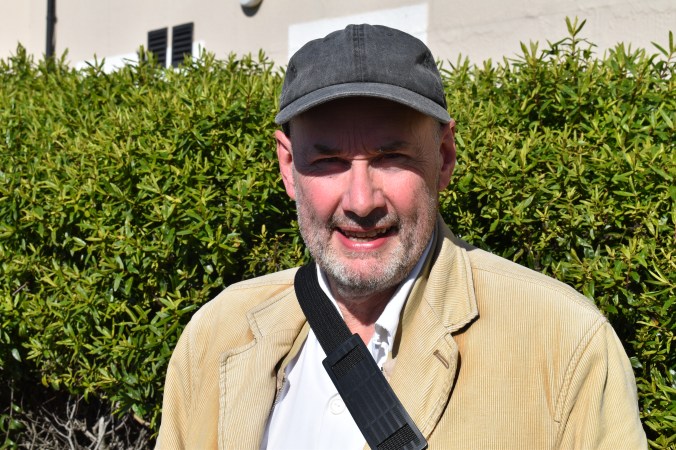
59 year old Durham musician Stuart Willis told me ‘I was in a band for a short space of time and got a taste of the music business. Although we weren’t a success commercially, we played gigs and got attention from record labels but didn’t quite get it over the line’. This is Stuart’s story.
(Stuart Willis outside Littlehaven Hotel, South Shields September 2025. pic. Alikivi).
Older generations of the family originally came down from Scotland to the North East to work in chemical factories and the mines. My father was first in the family to go to grammar school and became an accountant. He was the one who bucked the trend.
I remember my mam brought a classical guitar record into the house. I absolutely loved it. I was around 11 year old when I got a cheap guitar and music book for Christmas. I picked it up very quickly. There wasn’t anyone else in the family who played and the school I went to didn’t even do music lessons.
My first influences were The Jam and Specials the whole Two-Tone and post punk scene with bands like Television, Magazine and Gang of Four who I saw at the Gateshead Festival in 1982(The Police headlined with U2, The Beat and Lords of the New Church on the bill).
On the North East music scene was a band I liked called Neon. Tim Jones was in them and he went on to play fascinating music. I first played in a punk band in the local community centre when I was 16. Then I met Michael Salmon in 1985.
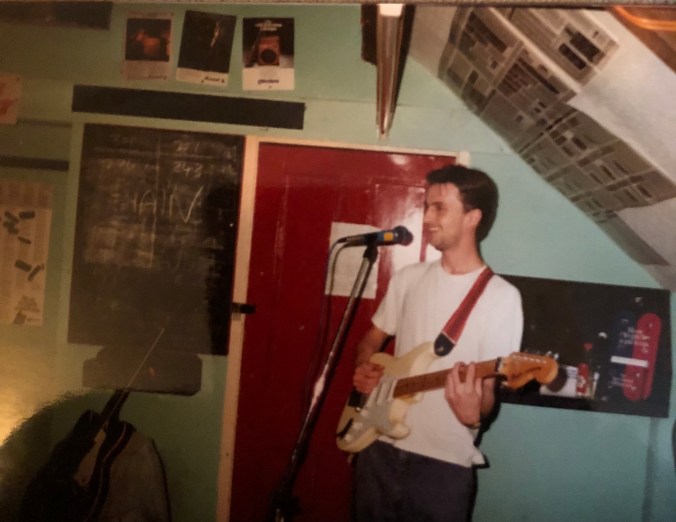
(Michael Salmon in rehearsal 1980s)
He was a drummer in Prefab Sprout with Paddy McAloon the main songwriter. When Michael left Prefab it was purely amicable. He wanted to realise his ambition of being a songwriter.
I was 18 playing in a duo in a pub in Witton Gilbert, County Durham. Michael was there that night. He liked what we were playing. I was playing classical guitar with Mark Wiles on bass.
Michael was a charismatic guy, excellent guitarist, singer and songwriter almost a teacher to me. Michael had a phenomenal record collection and I was introduced to all these amazing sounds.
We got in a drummer who was playing on the Durham scene and we called ourselves Swimmer Leon. Rehearsals were in Fowler’s Yard in Durham a lot of bands rehearsed there. We practised in there every week. The room itself almost became another member of the band. The sound was born in that room. We had about three albums worth of great songs that Michael had written.
The first place we recorded in was Consett Music project. We were all nervous. We recorded three tracks live and added a few overdubs. We took the songs out to play a few gigs.
(Swimmer Leon 1985)
We were mainly playing live around 1985 we got on well and had a cracking time. We supported a few big bands mainly playing University gigs. One night we supported the Ronnie Scott Quartet, he had a jazz group who had the club in London. Then there was ex Waterboy Karl Wallinger and World Party.
There were loads of times we met different musicians at these gigs who knew Michael from his Prefab days. There was the drummer from The Ruts who gave us some insightful advice about the record industry. He told us not be in a band because you can get lumbered with huge debts. Best to play for other people and get paid. Wise words.
For me the quality of any live work or recording we done was so important. Sometimes playing smaller gigs is a cacophony of sound but when we played the Students Union in Durham that gig was recorded straight off the mixing desk and we loved that sound.
After gigs other guitar players want to speak to you. That’s really great we appreciated all the attention but we thought where’s the women! We didn’t play ordinary chords so a few times they’d ask ‘At the beginning of that song what’s that chord’? and ‘Can I look at yer Gretch’. We were a quirky band and got a lot of press.
(Swimmer Leon 1986)
We also recorded in the Cluny Warehouse in Newcastle with John Silvester. Michael’s songs had jazzy elements too them, complicated chord progressions with complicated lyrics – it was like post punk jazz. With all the obscure influences we weren’t your run of the mill band. We were an arty band. We thought yeah, we’re great we’ll get a record deal!
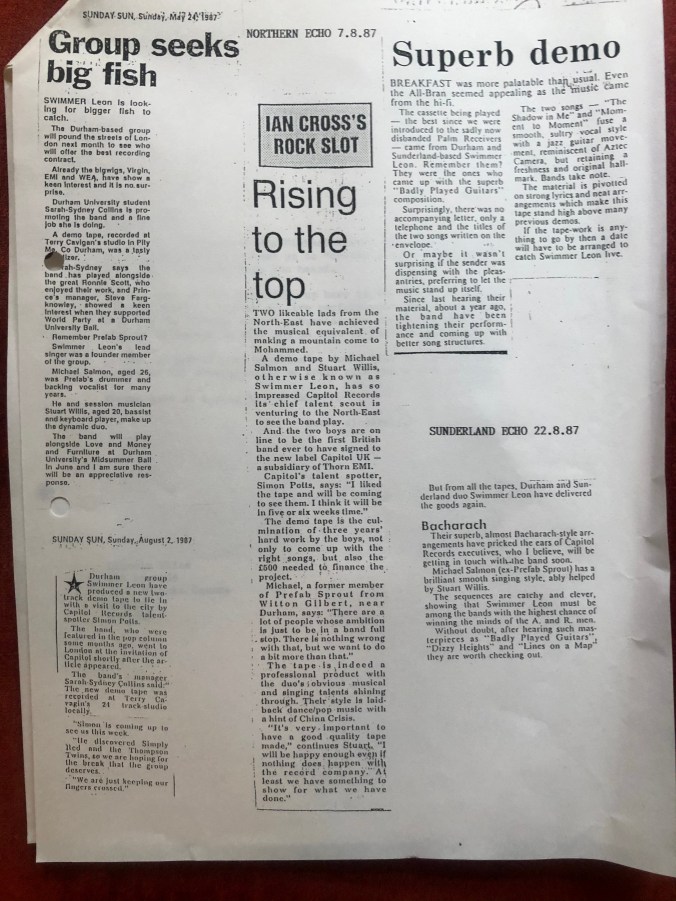
Did you know we ended up with a development deal with CBS? Thing was we never sent a tape to them, strangely Michael thought it should come to us! The only thing we did was send tapes with the band name and telephone number to the local press to get reviewed.
All the major labels had regional scouts who would pick up on the music section in the local papers then come to gigs and take it from there. This is what happened to us and led us to recording in Guardian studio in a little village called Pity Me in County Durham. It was a really good studio.
Guardian was two houses knocked together with a large console and a piano at the side. The owner Terry Gavaghan was very professional about the work and we got on well with him. He wanted to know the structure of the songs, so we played them through sitting near the console.
Michael played drums on that recording his first time since leaving the Sprouts. I played guitars, bass and all the keyboards. Terry recorded it separately with a guide vocal, guitar, drums, bass and put stuff on top. He produced both tracks which still sound good today.
I was working in Windows musical instruments and record shop in Newcastle so I put their telephone number on our demo tape. A local reporter wrote a review of the tape. At work I got a call telling me it was Simon Potts at Capital Records and he was phoning from L.A. Yes Los Angeles! He asked if we had many songs so I told him about three albums worth. ‘OK I’m sending someone up to see you.’
Research has found an interesting story about Simon. He was originally from Newcastle and lives in Hawaii now. With a great pedigree within the music industry he signed The Beat, Simply Red, Thompson Twins, Stray Cats, all selling in huge numbers having massive hits. Last band he reportedly signed were Radiohead.
This guy came up to Witton Gilbert from London and liked what he heard. We quickly arranged a showcase gig in Newcastle pub Slones. Actually, Brian Mawson, my manager at Windows music shop arranged the gig for us.
I loved working in Windows. It was a great place surrounded by people with aspirations to become musicians. There were new instruments on sale, latest records, local releases also a wall full of wanted musicians and bands advertising gigs – a great atmosphere. Darren Stewart who played bass for a few years in Swimmer Leon worked there. Dave Brewis also worked there he was in The Kane Gang.
The night of our gig London record label were having a promotion so a lot of artists were there and ended up at our gig. It was mad. Simon Potts from Capital flew in from L.A. We had Bananarama dancing down at the front, I think the Kane Gang were there. The head of A&R at Capital records told us ‘We’re giving you some money to record, just as long as you don’t go to Montserrat with George Martin!’ So, we went back to Pity Me and Terry Gavaghan!
We were in Guardian for three days and recorded three songs. By then GO Discs were interested in us, Warners were interested in us, Phonogram were interested in us. We were going up and down to London for meetings but we couldn’t get it over the line. It was just two kids really, me and Michael Salmon. The thing was we didn’t have a manager.
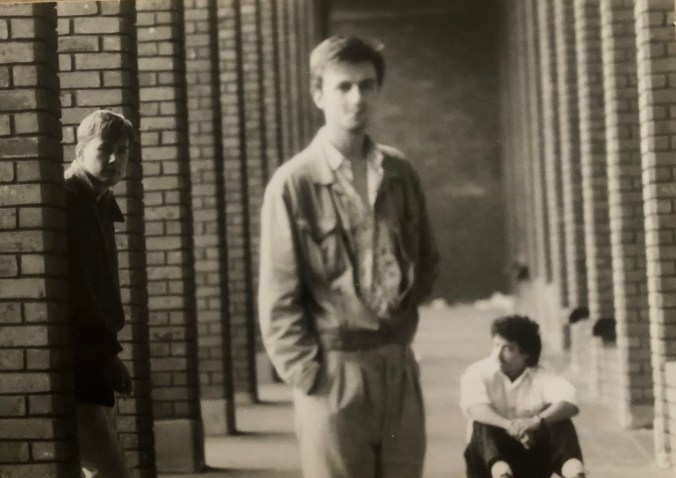
(Swimmer Leon promo shot 1987)
I remember going to CBS for a meeting. We were in a lift and there was Mick Jones from The Clash. I thought what’s going on here? From being a 16 year old punk playing gigs in Grindon Community Centre to meetings, gigs, studios and all this record label stuff without us really trying.
But life caught up with us. There was a time we thought is this gonna work? We didn’t want to move from Durham. I was from Sunderland so was Terence the drummer, Michael was from Witton Gilbert, Mark was living in Durham. The irony is when the band split up in 1989 we all moved.
I lived in London in the early 90s and worked in marketing for Virgin records. It wasn’t a glamorous lifestyle. I was living in a dingy flat in Blackheath. I saw the inner workings of the record business and couldn’t wait to leave. Richard Branson had sold the label by then to EMI and everybody was losing their jobs. I handed my car keys in went to Kings Cross train station and couldn’t wait to get back to Sunderland.
What am I doing now? My ambition was to study music properly so I done a music degree at Newcastle University from 1993-95 and ever since then I’ve been a teacher at Durham University in the music department, performer in classical guitar and specialise in historical music performance where I play the lute. I’ve also got a publishing deal for Schott, publishing guitar books.
Don’t want to come across like a moaning old bloke but young people today don’t understand what a band is. To get four or five like minded people trying to evolve a sound and make it into something special for you – that happened for us. We were lucky to be able to do what we done in the 80s. Today I still listen to all the bands I listened to back then. I’m still passionate about music.
(pic. Gavin Webster, Centurion bar, Newcastle. Alikivi Sept. 2025)
I first met Gavin back in 2021 where we are today in the Centurion bar in Newcastle Central Station. He talked about being brought up in Blaydon during the 1960s and breaking into alternative comedy in the early 90s.
I missed out on the workingmen’s club circuit. But there was still a buzz for the whole comedy scene. I’ve been doing this for 33 years, I’m 56 now.
We talked about TV shows we watched as kids – Wheeltappers and Shunters Club, The Comedians and Minder.
It was great. It seemed there was chaos and a caper everyday down London. I wanted to move down there and get to know these types of people, hustling and bustling during the days, loved it.
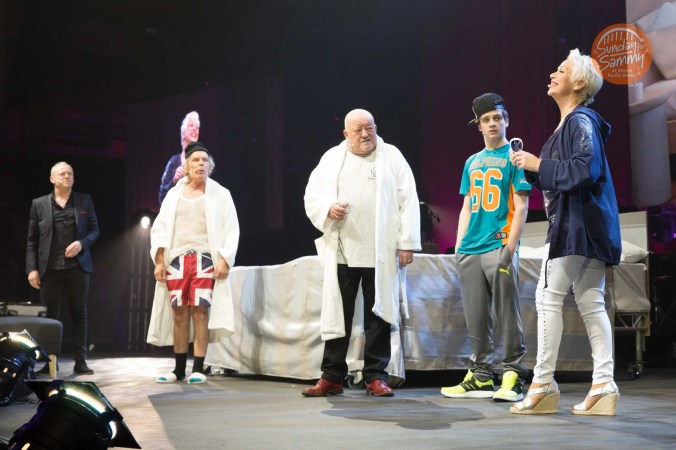
Scene from Sunday for Sammy in 2018.
In 2004 I was at Newcastle City Hall watching an afternoon of Geordie entertainment. Sunday for Sammy concert was organised by Auf Wiedersehen Pet stars Jimmy Nail, Tim Healy and Lindisfarne drummer Ray Laidlaw.
Among the TV, theatre and music talent on stage was AC/DC vocalist Brian Johnson ripping into Nutbush City Limits. A great afternoon. Played to packed houses the show returns to Newcastle every two years.
Yeah about 20 years ago I done a Sunday for Sammy show at Newcastle City Hall. Originally, I think Ray Laidlaw phoned me up about it. I really enjoyed it. In fact, I done it twice, the first time was with the lads from Viz. There was myself, Simon Donald, Simon Collier plus a couple of actors and I think the boxer Glenn McCrory done a part. We done a Sid the Sexist sketch. The next time I done my stand-up routine.
There were two shows. A matinee and a show in the evening. The matinee went well and at the later show I went on early because I had another show to do at The Stand in Newcastle. I had played the City Hall with 2,500 people there, a full house, but only about a dozen people turned up at The Stand. That has happened twice in my career.
At the Edinburgh Fringe in 2003. It was a benefit gig for an HIV/AIDS charity at the 3,000 seater Festival Theatre on Nicholson Street. It was a star studded line up and I did a 10 minute slot. My parents came up for the day. After the show I took them down to my other gig where only 11 people turned up. You get brought down to earth with a bump.
My agent at the time told me to go to the Oranji Boom Boom Club in London as it’s a good place to go, people get down there. I played the club on a Wednesday night and did a good decent job, worked hard, took it seriously. But in front of only a dozen people. However, a few year later I done some TV work on Channel Four and the producer came up to me and told me that he saw me at the Oranji Boom Boom Club.
During the past few interviews I’ve asked how do you survive in the arts?
Sometimes it’s been tough. I met a shock jock type of comedian from Australia his father was very rich. He was well supported. He would tell wild stories about how people walked out of his gigs. Now if I done that, I wouldn’t be able to pay my rent. It’s alright if you have unlimited funds coming in.
There has been times without work but I get by. I’ve done some voice over work, small comedy/drama parts. I’ve been in two Ken Loach films. I had speaking parts in I, Daniel Blake and Sorry I Missed You.
I done some of the animal voices on a children’s TV show called Walk on the Wild Side with Jason Mamford. We recorded that in a studio in Wardour Street, London. The set up is you watch the video on the big screen and read through the script. I got to write some of season three. Sarah Millican done it, Jon Richardson, Rob Gilbert, Mark Benton – loads of comics done voices on it.
I totally understand when some actors can end up working in shops and restaurants cos you need a regular income or you can end up skint. Actors need TV shows like Eastenders and Emmerdale. The films and voice overs don’t happen all the time – stand up has kept me going.
What am I doing now? I do a pod cast called Bazookaaah, small stand-up tours, regular gigs at Edinburgh Fringe and the Tyne Theatre in Newcastle. This new show on 21 November is called Glory Be its Gavin Webster. It’s stuff from Edinburgh with some new stuff that I’ve added. I always write a new show every 18 months or so.
Last time at Tyne Theatre was January 2024. For this show I arranged it and done a deal with them just for the one night so it’s not a massive commitment for them. Really looking forward to it.
We’re sitting in the Centurion bar at Newcastle’s Central Station where I first met Leah back in 2021 where she talked about learning her craft in North East workingmen’s clubs from the age of 15, working with Bobby Thompson, touring with Ken Dodd in the ‘70s and appearing in panto with David Jason.
Now, after nearly 60 years in the business I was interested to find out just how did you survive in the arts?
This industry has always been tough for working class. I do promotion and acting, I’ve been writing with Alison (Stanley who featured in previous post) I’m busy all the time. When you’ve asked me is there weeks when I have nothing on, well no, I’m always busy.
Like when I started a production company in Jersey about 30 year ago. We would do plays or musicals but if we went on tour I would always play a role in it keeping an eye on things making sure there were no issues. You take on a couple of roles. That’s how I survive.
You can never say I’ll be working 52 weeks a year. But there was a time you’d wonder where you’ll be for summer season. I remember going to Jersey in March and not coming back till October. Whereas now it’s I wonder if I’ll get a summer season.
Some people take shows out to Europe. My niece Hariet has her own production company and she does a lot of work abroad. Although you’ve got to be careful who you work for.
In the 1970s I took a contract for South Africa when apartheid was in full flight. When I look back, I didn’t understand what apartheid was all about then. You couldn’t pick your phone up and read about it.
It was a total culture shock at 19 year old – like wow here we are in Durban. Then I ended up working in Rhodesia – it’s not called that now. The agent asked me to drive from Rhodesia to Cape Town – a very long way and I did it by myself. My mother didn’t know. I look back and think how did I do that and why!
Comedy and singing musical theatre was what I was doing on the Crazy Horse saloon circuit. It was quite unique for a female to be performing on stage, plus there were plenty other English acts going out. I think some British guys had bought into the Crazy Horse clubs and subsequently tapped into the UK club market.
Back then there were hundreds of entertainers plus it was a real show it wasn’t just a few singers getting up we had all the costumes and gear for a proper show.But as I’ve said back then you couldn’t pick your phone up and read about apartheid. I mean, I lived in Benwell all me life.
I remember flying back home and me ma’ and da’ met me at Newcastle airport. ‘I’m home at last’ I said as I flung myself at them ‘You must be the only lass who’s happy to be in Benwell’ said me Da.
I travelled a fair bit. I went to Australia twice a year for six years in the 80s. I just loved their lifestyle. I also performed at the American military bases in Germany. I remember the agent John Rae from Spennymoor here in the North East organised one tour. There were a few of us and he drove us around in a mini bus. He had all the responsibility and the things we done he must have wanted to kill us sometimes.
All this experience of understanding an audience has helped when I’m putting a show together. You see the show differently from actors who only see it from their point of view.
I remember doing Catherine Cookson’s ‘The Cinder Path’. I had Nicky Cochrane in it who played Steve McDonalds brother in Coronation Street. He was playing Ginger Slater, essentially the baddie. I gave myself a character called the fishwife who kept the story going and throwing a few laughs in as it was heavy going.
One show we were doing a matinee at Billingham Forum. I was waiting with Nicky to go on stage for our scene when he turned to me ‘Leah, this is a tough crowd’. I replied ‘Farringdon Social Club was a tough crowd this is a walk over’. A bunch of pensioners on the front row who might nod off would not present a problem.
Club audiences had a reputation for being tough but that was only because they weren’t there prepared to put up with anything. You had to be good. You had to know your stuff. That’s been a great backbone for work that I do now. How to read an audience. They’ve paid their money and tickets can be pricey for a whole family so you have a responsibility. That crowd need to be entertained.
I was brought up in variety but now I only do one variety show a year that’s the Silver Bells Christmas variety show for three nights at the Phoenix Theatre in Blyth. Looking around there were a lot of young people coming up but their take on variety was different from mine. I was old school. I’m not saying it was better in my day just different. So, I thought to keep working I’d just change what I’m doing. I’m going to step up. I went and done panto as well that led me to acting which I really enjoyed.
For the Blyth variety show we do sketches and a few gags a typical show I really enjoy it. I use the pantomime cast so there’s a lot of us on stage and this year it’s with Tommy Cannon who is a good friend. The poster said Cannon & Bell but when it was done large the Bell looked like Ball!
Tommy and his wife were up recently and we got watching some of the old TV shows like Wheeltappers and Shunters Club and yes it was a laugh but we were saying we wouldn’t dare say that type of joke now. Time has moved on. And so it should.
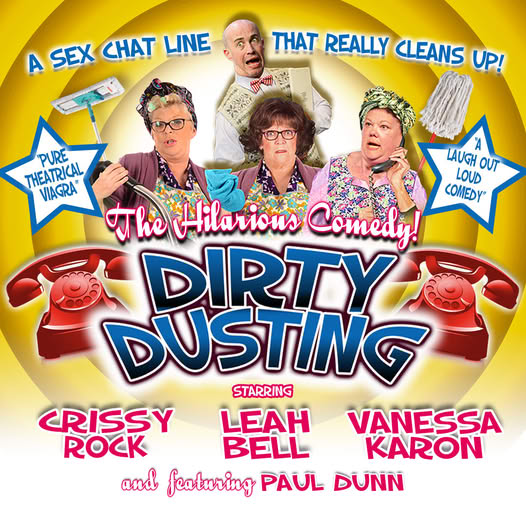
What am I doing now? ‘Dirty Dusting’ written by Ed Waugh is on tour in October. We’ve got my good friend Chrissy Rock (Benidorm) in it with Vanessa Karon and Paul Dunn. Can you believe the show still sells out. It was originally performed over 20 years ago. First time I did it was 12 years ago and it’s been on tour at least twice a year every year.
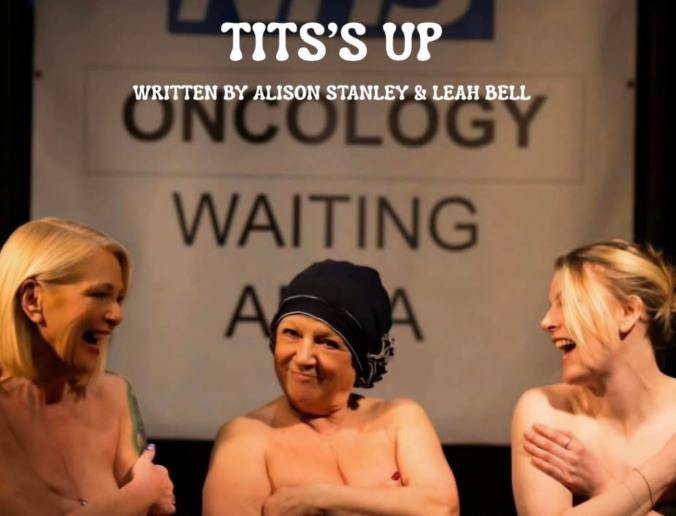
From late November through December, we have ‘Sleeping Beauty’ panto at Consett Empire with Marcus Collins from X Factor then next year Alison Stanley and I have ‘Tit’s Up’ going out on tour. That play is about the relationship between three ladies as they wait in the Oncology department in hospital.
It’s sharp, it’s funny, we wrote it together. Some of the shows funnier bits are added on the spur of the moment and Alison tells me to write them down for the next show cos ‘you might forget it’. My character is nosey she wants to know everybody’s business, she thinks she’s gone for a day out.
We’ve just done a short tour and it’s done well at the box office. On the first performance me and Alison were nervous because some ladies from the Cancer Society were in the audience.
Mentally and physicaly I feel better now than when I was 40. I’m 72 now but I’ve always been energetic and kept busy and turn up early for work. I’m happy to have made the move from variety to acting. The world has moved on and so it should. Would I ever retire? No chance.
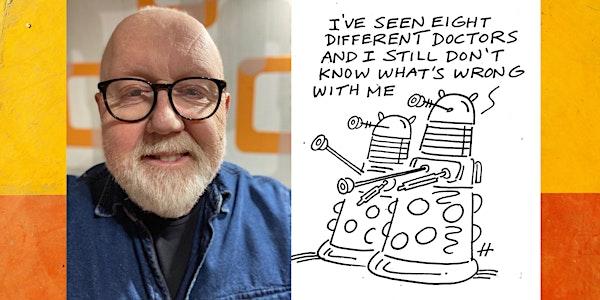
Former Shields Gazette graphic artist David Haldane established himself as one of the top cartoonists in the world. Blyth born David, now 70, worked for the Gazette from 1977 to 1983, he currently creates cartoons for The Observer and Private Eye and had his work regularly produced in Punch, The Express, Mirror, Guardian, Telegraph, Daily Mail and the Sunday Times. He also contributed sketches to the original TV series Spitting Image.
However, it is for producing cartoons for The Times from 2005 until 2017 that David made his mark, transforming him into one of the best cartoonists in the world.
South Shields playwright Ed Waugh has been asked to host an evening in conversation with David at The Word in South Shields on Wednesday September 24th at 1pm. He said: “I’ve known David for 20 years or so and he’s both very sharp and very funny. You have to be to create top-class satirical cartoons every day, often at very short notice, for national newspaper front pages.”
He added: “David’s career stories are both deep and hilarious. It will be a fantastic event for people who want a laugh and those who want to find out about some of the stories behind the many thousands of tremendous cartoons David has created and had published.”
The event follows his sold-out illustrated talks at the prestigious Lit & Phil in Newcastle and Blyth Library.The talk on Wednesday, September 24 at 1pm is part of The Word’s WRITE Festival.
Have you ever wondered how working class people survive in the arts and creative industry? From my own experience I can tell you it’s hard. Very hard.
In the early days of the 1990s I had a weekly diet of baked tatties. I’d go to me ma’s for me Sunda’ dinna. I got by.
It’s surprisingly full for a Tuesday morning in Newcastle’s Central Station bar The Centurion when I spot Alison. Looking resplendent in her beret while finishing off a bacon sarnie we find a quieter place to talk. She throws back her head and laugh’s out loud when I ask her have you ever had a proper job?
Yes, I was at the Inland Revenue for years. When I was there, I thought of myself as a resting writer, a resting actor but really found it soul destroying.
Sometimes you have to take jobs that you wouldn’t choose to do to survive in the creative industry. You have to get by. I’ve been lucky that my husband who doesn’t work in the arts, has a full time job and supports me fully as do all my family.
An opportunity to work as a library assistant in North Tyneside Council came up. I love the smell of books so the idea of being surrounded by them was great. I loved being involved when schools came in, I would read stories for the kids and put on various events.
The job was part time so it gave me more time to focus on what I should be doing – writing. I became busier in my creative work and was being offered jobs that I couldn’t turn down so had to decide if I was working in a library or an actor. You have to take the leap, you have to believe in what you are.
I’ve been acting now for about ten years. A freelance creative has always been my career choice that’s in all of my disciplines that I’ve worked in from actor to writer to theatre producer now film making.
I decided years ago to go out and make my own work rather than wait for someone to knock on the door and offer something – that doesn’t happen. You’ve got to get your name out there to increase your network. That would be my advice to anyone starting in this business. You’ve got to take chances. This is what I do. It’s a mind set.
I consider myself as a socio-economic playwrite. I write about subjects that are relatable to people, quite pertinent and pushing boundaries seeing how far you can go. If it makes people laugh, cry or squirm I’ve done my job. It’s important to me to be challenging and turn a spotlight on real issues.
I’ve got a few projects that I’m working on now. Lately we’ve been touring ‘Living the Life of Riley’ around the North East which was great and that is going out again in February 2026. ‘Life of Riley’ has been in the works since 2016.
And another short North East tour for ‘Tits Up’ co-written with Leah Bell. That’s planned for another tour next year. Really pleased with that as it’s sold out now.
That’s a play about three women who meet when they are diagnosed with cancer and how it impacts on them and how they deal with it. Unfortunately, we live through a time where if it’s not breast cancer it’s some form of cancer that lives are touched by. The play is both heartwarming and heartbreaking.
In ‘Tits Up’ there is someone who is diagnosed with cancer and there is the carer who she couldn’t manage without. That is real stress. You’re worried about the situation and the endgame that might be coming.
Of course, we all fall off our seats laughing with the actor Leah Bell but there is a serious side which comes through. There is a balance we have to get right.
My ambition is to produce more plays outside the North East and tour nationally, which ‘Living the Life of Riley’ is already doing and we are working towards that with ‘Tits Up’. We have taken ‘Hard’ to London and it’s definitely something we want to pursue more.
Screenwriting is something else that I’m starting to do. I filmed a scene from ‘Hard’ over two days on a shoestring budget and I loved it plus it has been awarded three times in UK film festivals so that spurs you on.
I’m interested in using latest phone technology for film making and being creative with it, keeping it fresh. I roped in Leah Bell and Tony Hodge (Byker Grove) to be involved. Really looking forward to more. I’m excited about it.
Have I got time for anything else? Me mother Rose was a talented writer but didn’t have anything published. When she passed away last year, I started a writing competition for Working Class Women Over 35. The first winner is announced in October this year and next year the play is produced at Laurels in Whitley Bay.
Also, it’s early stages at the minute but I’m writing a few fictional stories about events that happen in a town. That’s maybe for a book. I’m really enjoying it there is no deadline so it’s sort of like a hobby but we’ll see where it goes. Owt really that stops me getting a proper job!
Meeting up with contributors to this site I’ve asked how they survive in the arts. Some talk of persistence and others simply being obsessed by it. I think to give yourself a good chance you’ve got to be prepared to work on it day in day out basically 24/7/365 days a year.
85 year old Sheila featured on this site in June 2018 where she talked about spending her life in art – so she was the perfect person to ask.
Surviving in the arts is for me going with the flow. I believe in my Mam’s saying ‘Every day in every way in everyday I’m getting better and better’ particularly when you are feeling crap or when things have gone wrong. In the arts you need this saying because there are times when things just don’t happen for you. Tempered with that my Dad used to say ‘worse things happen at sea’! So never, never, give up. Keep positive and keep going.
After attending Art College Sheila then went to Birmingham School for Training Art Teachers in 1961.
That was the best thing to happen to me. I was shown that everyone is an artist in their own way and it’s your job as an art teacher to bring it out. It’s about giving something positive to people in their lives.
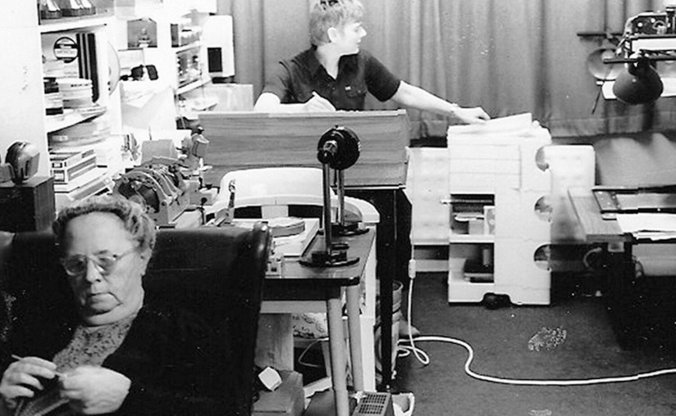
I first taught art in comprehensive schools in South Shields and by 1970 I was divorced and had time to play so bought a super 8 cine camera. Play is very important plus having a messy room or studio where no one tidies up after you!
My first messy place was at home in South Shields working at a desk looking out onto our little garden. Later it was a studio in the Pilot Office overlooking the river Tyne. Then by the mid 70s I got a break in animation.
I was contacted by an agent for World TV who sold the short films I made globally. She later commissioned me to animate 10×10 minute ‘Just So Stories’. The actual process of animation can take a long time to produce minutes on video so the only way I could produce this was to give up teaching – which I did in 1980.
Sheila animating Frame by Frame for World TV and her Mam crocheting for a local shop – a true cottage industry.
Sheila also works with various charities, the last post features Anna Malia and North East Animal Rights, how did you get involved with them?
When I lived in Ireland I saw an incident, not to go into it here too much as it’s really upsetting, but there was a field of cows and a calf that broke free from the herd. It was about how it was dealt with by the farmer that really affected me. I thought if I get the chance I would do something for you – for that calf.
I heard a song by North East musician Jen Stevens, loved it, and thought that would really work with images. I asked Jen if I could use it and she said yes. We put it out and Anna Malia from North East Animal Rights got in touch and we took it from there.
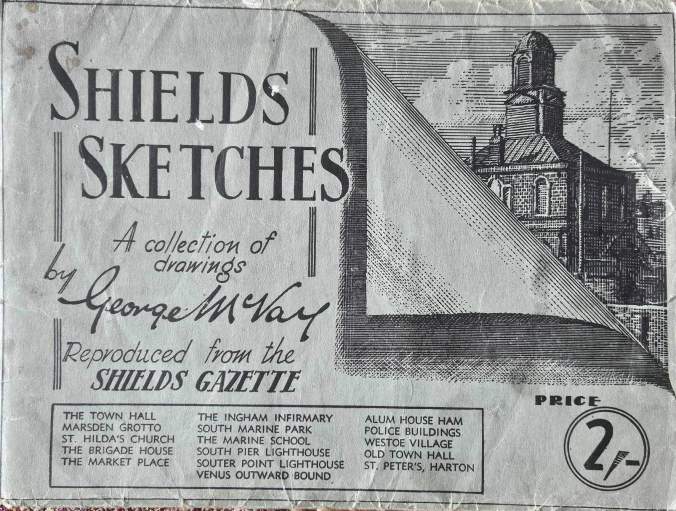
Sheila is currently working on a book about George McVay, a little known artist who lived from 1902-1967. Former Shields Gazette journalist Janis Blower is in the process of editing it.
George was a very good photographer which accounts for the very large detail in his pictures. His style of painting was very photographic. When I was 8 my mam bought a set of his prints that the Gazette had commissioned and I loved looking at them like kids look at ipads now. For a long time I done plasticene models of them.
All his life he drew some amazing illustrations of Shields and surrounding areas. Some people may recognise his black and white drawings, very clear, very precise everything from the old Town Hall to the piers, the river and the Groyne. In the book Janis Blower will be adding underneath a description and history of George’s picture.
In his early days I gather he worked at Readhead Shipyard, he was studying planning, design and engineering. His Dad was mayors secretary at South Shields Town Hall and was a good photographer. It’s thought he said to his son that he should work in the Town Hall and he eventually did, he was employed in the ratings department.
Out of the goodness of his heart he’s done drawings for presentations at the town hall. There are some amazing manuscripts, whatever was required he could do it even when people leave. He also done commissions for the Shields Gazette.
The Shields museum have some in their store. He has stuff in the Hancock and Discovery museum, Newcastle. He did a showing at the Laing Art Gallery and down in London but all track of that is lost. Unfortunately, nobody has given him the recognition that he deserves.
What I’ve found over the years is that he and I have followed parallel tracks. We have both done a lot of work for charity and both drawn the most popular buildings and views in Shields because we love the place.
To contact Sheila check out her official site at >>>
In April this year the work of hunt saboteurs featured on this site, this latest post again looks at tackling illegal foxhunting but this time using a different approach.
‘First time I witnessed a hunt I was shocked by its enormity. It was a deeply emotional experience nothing could have prepared me for it. The following week I witnessed a fox killed by hounds. That day I made a promise – I vowed to get justice for that fox. It’s his memory that drives me on.’
To find out more about the work of the Northumberland Hunt Watch I sat down with Lynne in the Littlehaven Hotel, South Shields where she started off by telling me she has always loved animals.
‘Since I was a child. My earliest memory, of being anti-hunt, dates back to school I was 10 year old. During an English class debate the teacher asked me to argue in favour of foxhunting. I was horrified and refused point-blank. Despite never having witnessed a hunt in my life I always felt an empathy for the hunted fox.’
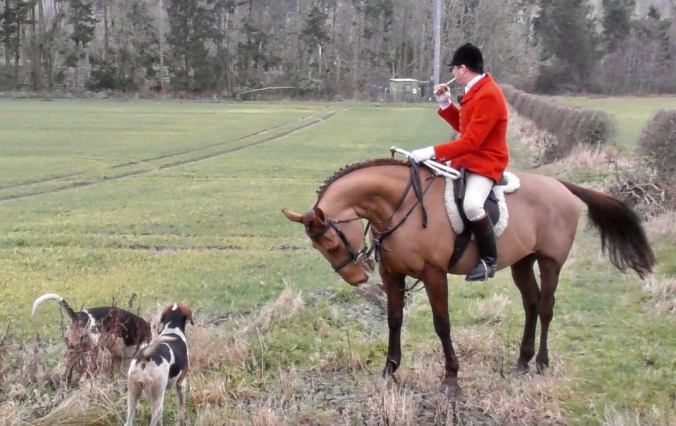
Tynedale hunt near Corbridge, Northumberland.
In 2002 Scotland banned foxhunting, England and Wales followed in 2004.
‘I thought that was the end of it. However, just because an activity is criminalised doesn’t mean it ceases to exist. Through social media I realised it was still happening on a massive scale. I was aware of the foxes out there alone with nobody to help them. I felt compelled to take action.’
‘I founded Northumberland Hunt Watch in 2020. Prior to this, I already had 5 years experience monitoring hunts. There wasn’t an anti-hunt presence in Northumberland at that time, leaving all the hunts in the area unchecked. There are some pockets of deeply engrained hunt culture in Northumberland, operating in some very rural and isolated locations.’
‘For these hunts it’s very much a way of life. They have a cultural pride in hunting, and strongly resist any attempts at criminalisation. The hunt community is a very tight community. They hunt together, socialise together, conduct business together and support one another.’
‘There are many different reasons why people foxhunt. Foxhunting has nothing to do with pest control or managing fox numbers. The hunts want foxes in the area to hunt which conflicts with the pest control argument. For some hunters it’s for the thrill of the hunt or the thrill of the kill. That is very difficult to understand.’
‘There are farmers and landowners involved in the hunt, who grant permission to access the land. Without this land there would be no foxhunting. For the riders who subscribe to the hunt, following hounds provides the freedom to ride over land that would otherwise be out of bounds. The fox is not restricted to boundary lines, so the hounds and riders are free to ride where the fox goes.’
‘The car support who follow the hunt mainly consist of elderly men. To them it’s a day out to socialise. They turn up with their binoculars, sandwiches and flasks having a good natter, they enjoy watching the hound’s work. I often talk to the members of the hunt to gain a better understanding of why they do what they do. We can’t expect to change something unless we fully understand it.’
‘We’ve talked about what we call ‘clean boot hunting’ a humane and lawful activity, which follows the scent of a human runner rather than a fox. With clean boot hunting they can still have everything they have now. The jobs will still be there, they can still have their socials and get together, their balls, their meets so they can still have their sherry and a bit hokey cokey, just don’t kill a fox. I think they fear their way of life will fall apart without hunting the fox.’
‘But humane hunting would be far more sustainable. Currently hunts claim to be trail hunting, which would involve hounds following a trail of artificial scent instead of a live fox. Unfortunately, trail hunting in my experience is just a cover for foxhunting.’
Have you a vision of what you want the group to be?
‘Yes, when I set the group up I thought I’m going to do this my way, I’m not going to war with them. I’m going to win hearts and minds. For me it was all about a love of wildlife, and a hatred of foxhunting and not a hatred of the people. I strive to end foxhunting for good so I knew that we needed to be taken seriously by the hunts and the police.’
‘I aimed to create a professional group with a credible image, as far removed from the negative stereotype as possible. We refer to ourselves as volunteers or wildlife guardians, rather than sabs, protesters, or activists. We don’t wear masks and we have a dress code. We’re conscious of how we come across to all the people we meet.’
‘Some people are just out for a dog walk in the countryside, families with kids, older people. Last thing we want to do is scare people, we want to be approachable. We’re always polite and respectful and get on with the farmers.’
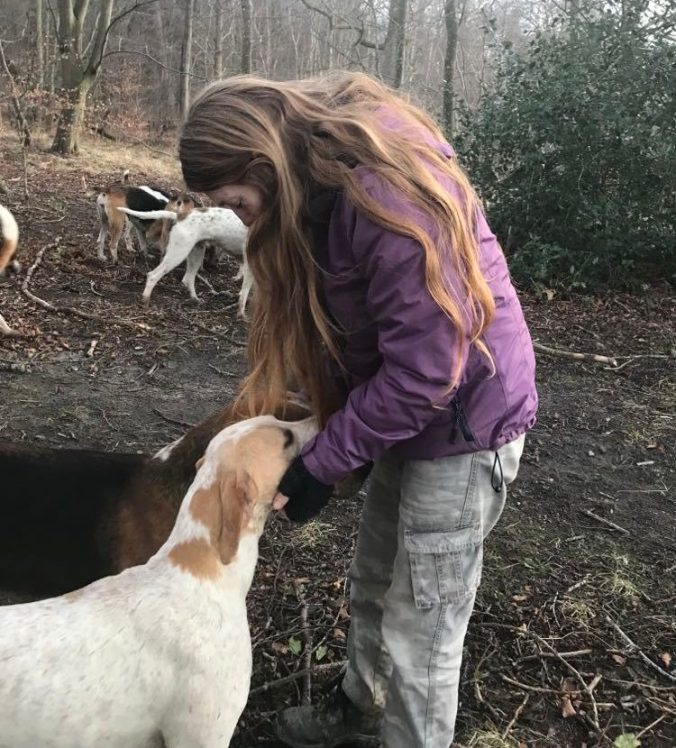
Lynn with the West Percy hounds.
‘We absolutely love the hounds they are such lovely sweet animals, we would never do anything to put them at risk, and our hunts know that. We often pop along to their hound shows in the summer some we are made more welcome than others.’
‘We aimed to build relationships and establish trust in the community and we have. All of our hunts know who we are and they know our names. We engage in polite conversations, some team members live in hunt areas, so it’s not uncommon to exchange waves. Our approach has earnt us respect and fear in equal measures!’
‘Our overall aim is to make the countryside a safer place for wildlife. On a day to day basis we aim to be a visible deterrent, to prevent hunting and on most occasions we are. We rarely need to intervene as our presence is often enough of a deterrent. Our hunts will often try to avoid hunting when we are there, and certainly avoid hunting in front of us.’
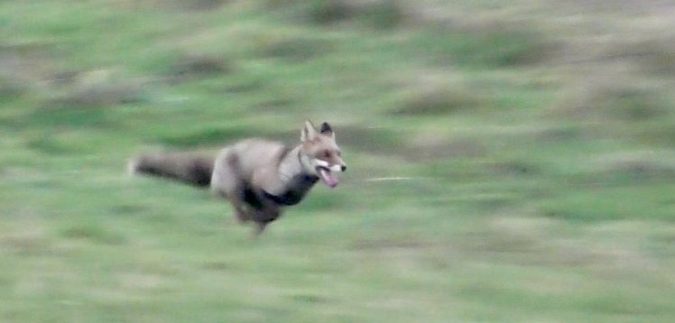
‘Last year at a hunt I was filming when the hounds picked up a scent and chased a fox toward me. The whip panicked and stopped them all “Lynne, can you see me stopping the hounds? Have you got it on video that I’m stopping the hounds?” I replied, “Yes, I have, thank you.” The fox made his way to safety.’
‘In the long term we aim for prosecutions as this is the only way to end foxhunting for good. To achieve prosecutions then we need to be professional and credible.’
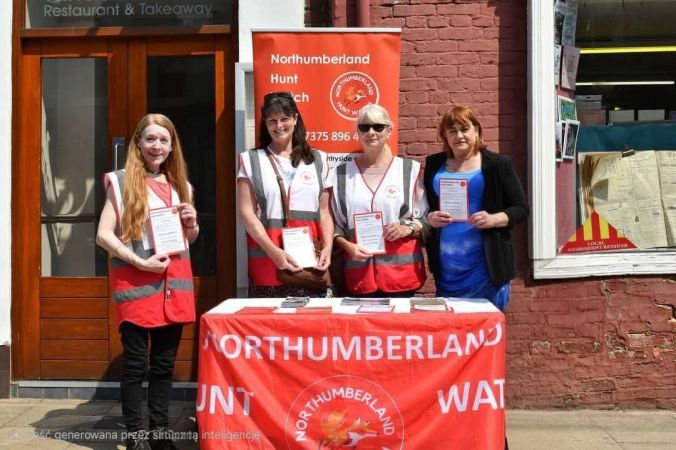
Outreach stall in Morpeth with Lynn, Judy, Amanda & Lynne
How much work is involved in the group?
‘A lot. We work very hard and put a lot of work in. I take this very seriously and am very committed to what I do. During the season we are out 2-3 times a week, despite working and other commitments. I would be out every day if I could. The fieldwork we do is just the tip of the iceberg. We do much more behind the scenes. Personally, I work on foxhunting every day of the week.’
‘I have taught myself a great deal over the years and always have my nose in a foxhunting book. I am also concluding a PhD in Criminology specialising in foxhunting with hounds. I have invested significant effort into this because I want to bring the issue of foxhunting criminality to a wider audience.’
Lynne & Judy leaving a successful Tynedale meet.
‘The lady who assists me in running the group, Judy, is a former police officer, so between us we have an in-depth knowledge of hunting and the law. We both work very hard on this, preparing cases and evidence for the police especially.’
‘Out of season we hold outreach stalls in hunt towns where we talk to the local community about our work. This has enabled us to lay the foundations for a positive brand identity while building up good relationships, trust, and respect within the community. We want the community to feel comfortable having us in their area trusting us to perform our job professionally.’
Have you experienced any threatening situations?
‘Violence and aggression from any of our hunts is exceptionally rare. We have had very few minor incidents in 5 years, most of which were dealt with swiftly, either by the police or the hunt themselves.’
‘Following one minor incident at one of our hunts I reported it to the chairman, he dealt with it, and we received an apology, so it was resolved sensibly and that was the end of it. There were no more incidents.’
‘We cover all the Northumberland Hunts from the Scottish border down to the Durham border, although Tynedale is our main hunt who we monitor regularly and have done for 5 years. They were a bit of a nightmare at first but they soon leant that it didn’t get them anywhere. They are very polite towards us now and we have built a good relationship with them. We are there to do a job which we do well and without getting into altercations.’
‘With all of our hunts we established clear expectations for behaviour from the outset ensuring that our conduct was respectful and polite. Over the years we have built a good rapport with most of them exchanging polite greetings “good morning, gentlemen” and in return “good morning, ladies.”
‘We never engage in name-calling or squabbles because throwing insults is not a stepping stone to positive change. This means that we can focus on what is truly important—the foxes. It might make someone feel better after calling someone names but it doesn’t achieve anything for the fox.’
‘The hunts also have a code of conduct regarding their behaviour towards us too. We have an unwritten rule between us we don’t call them ‘hunt scum’ and they don’t ride their horses at us, so this works well. This mutual respect means any of our team can be monitoring a hunt alone, in some isolated locations without any problems. Our approach saves lives.’
‘At one of our hunts we intervened between the fox and hounds, rating the hounds back so the fox could escape. This was in front of the hunt master and he said “thank you for helping” so we replied “no problem we’ll come back and help again next week.”
‘When we monitor hunts we focus on listening and observing, avoiding verbal confrontations is for creating a safe environment for the foxes allowing them a safe passage to escape. Foxes don’t know we are there to help them so we need to create a safe environment otherwise they would just see us as part of the pack. If there is chaos they could easily be scared back toward the hounds, we are very conscious of that. We often see foxes fleeing past us to safety. Silence is golden. It saves lives.’
How frustrating is it knowing fox hunting is illegal and it still goes on?
‘Very frustrating but there is a wide range of reasons why it continues. Weaknesses in the Hunting Act is a key issue, and also how it has been interpreted. This has provided loopholes for foxhunts to circumnavigate the law. There are so many issues that we will need an entire article to discus that alone. In a nutshell trail hunting has ensured that it is extremely difficult to prove them guilty and beyond all reasonable doubt. Consequently, trail hunting operates exactly as it was intended.’
‘We are committed to ensure that we have the best chance possible. Our behaviour will also come into question so we always act lawfully. Foxhunting is a low-level offence so if we break the law we lose the moral high ground and cannot expect the police to enforce one law while ignoring another. We have to be seen to be credible witnesses to make any progress.’
‘Because of how we operate we have built a good relationship with the rural crime team who we submit our footage to. We have had several incidents sent to the Crown Prosecution Service for review, and the police have acted swiftly in gathering the evidence.‘
Drone footage was captured of the Tyndale Hunt hunting a fox on 3 October 2024. This was submitted to the police. More information about this case can be found on the Northumberland Hunt Watch Facebook and You Tube pages.
‘There are some excellent groups across the country that have worked hard to end foxhunting, bring hunts in court or raise awareness, such as Beds and Bucks Sabs, 3 Counties Sabs, Cheshire Monitors, and West Midlands Sabs, to name a few.’
‘However, not everyone who joins a cause has genuine motivations, and the less credible groups can undermine the work of those who are genuinely committed and doing good work. It’s about quality rather than quantity, so finding people with the right attitude can be difficult.’
Lynne recording West Percy Hunt at Ingram Valley.
What have you found out about yourself since starting this group five years ago?
‘I have found that I am stronger and more resilient than I ever thought possible. If you have genuine intentions and committed to doing your best job for wildlife then you can make a difference. A middle-aged woman with a vision took on ten hunts, most of which were untouched and located in some of the most isolated rural areas of the country. I was subsequently joined by other middle-aged women to create a hardworking and professional group that has made a significant impact on hunting in this area. Never underestimate the power of middle-aged women on a mission!’
If you are interested in the work of NHW or would like to volunteer contact >>>
A series of talks by cartoonist David Haldane have been booked into venues this September including the Civic Theatre, Gosforth and The Word in South Shields.
‘I started work at the Shields Gazette in 1977. It was a great job really enjoyed it. It was my first real wage packet. We used to get paid weekly. In cash!’ recalls David.
Born in Blyth in 1954 David last featured in April this year talking about his work at national newspapers including the Mirror, the Guardian and The Times (link below). In a recent phone call he looked back to his early days and what inspired him.
‘I noticed cartoons when I was young. At the age of 7 I got scarlet fever which then was quite serious, luckily there were anti biotics. I remember I was isolated in my bedroom at home and couldn’t touch any of my books or they would have to be destroyed’.
‘There was a guy who lived in the street who was a Merchant seaman, he brought back some papers like the Chicago Tribune. I had a pile of papers on my bed with loads of full colour comic strips inside like Popeye and Prince Valiant.’
‘Me mam bought me a jotter from Woolworths, I just sat and copied them when I was ill. From then on I drew regularly, in particular funny stuff. When I was studying for my ‘O’ levels in Blyth library I noticed a whole series of Punch annuals which I started to read and from then on fell in love with the cartoons.’
‘People have heroes – rock stars, singers, guitarists, my heroes were cartoonists. I was 15 year old sitting in Blyth library thinking I wanna do this – never thinking I actually could or meet these people.’
‘There was a magazine called The North which featured walks and the like in places like Berwick. The art teacher put me in touch with the editor. That magazine is where I done my first published strip. I was still at school at the time and did it for a couple of years. Did I get paid? Put it this way I gave up my paper round for it.’
‘When I enrolled on a Design course at Newcastle Polytechnic I was doing a few cartoons on the side sending them in to magazines like Punch. When I got my first cartoon published in Punch it was when I was at the Gazette in 1977.’
‘The Shields Gazette were building up the art department working on advertising, editorial and illustration and four of us got a job at the same time. The newspaper then was absolutely thriving they used to do three or four editions a day. Other papers were published in the area – Whitley Bay, Chronicle and others it was a real Fleet Street on the Tyne.’
‘I remember local punk band the Angelic Upstarts came in to be interviewed by the editor, they were big, like the North East Sex Pistols. There were many wild rumours about them – the pigs head on stage was one!’
‘We were mainly advertising stuff like a pull out of Ocean Road which would feature all the shops. They would pay for adverts and we used to draw them up. This was before computers so it was all hand drawn. It was like a little factory in there we used to churn the stuff out on a daily basis.’
‘Working there was experienced journalists like Janis Blower, John Landells the waterfront reporter, his son Steve joined later. Mike Blackah was the editor. There was a huge room with a lot of sub-editors. It was a very busy, thriving newspaper office. When I started working at the real Fleet Street in London, I realised how similar they were.’
‘In the early 80s I worked on a short run of TV show Spitting Image. This was during the Thatcher years – the real hardcore political stuff. Ian Hislop and Nick Newman were writing short sketches which played before and after the commercial breaks. They wanted cartoonists to fill in the bits without puppets. Newman asked cartoonists who were working on Punch and Private Eye. Four or five of us worked on them and subsequently I got a few sketches on.’
‘I remember going to a script meeting in London. It was great meeting the scriptwriters who went on to produce a lot of shows. One of them told me to stick to drawing cartoons as you’ll make a lot more money. I took his advice. They still release box set DVDs of the show, I’m grateful to still receive the odd royalty payment.’
‘When I’m drawing I listen to film soundtracks – Japanese, Korean, quite niche, also Italian horror movies, spaghetti western, jazz sometimes. I have some Michael Nyman here as well, beautiful stuff. The music is on in the background but not when I’m thinking of ideas. I tend to sit in silence to work out ideas.’
To find out more of the life and work of David Haldane he will be appearing at ‘An Evening With’ at The Word, South Shields on September 24th & Gosforth Civic Theatre September 30th 2025.
Musicians, writers and actors have contributed stories to the site for over 8 years now resulting in world wide views totalling over 430,000. A big thank you to all the readers – much appreciated.
The site also has local and social history posts. A contributor who goes under the pseudonym Tinwhistler sends in his recollections of characters in South Shields. The likes of Big Hec, Billy Meths and Wavis O’Shave have already featured and the number of views prove there is a thirst for these stories.
In his latest post he talks about how a myth can be cultivated to the point of belief.
‘Our heroes are due to legend created from what is said or written about them, however, they can become exaggerated when tales are passed down. The negative aspects are usually omitted so you might be left with a ‘Robin Hood’ tale bearing little resemblance to reality’.
‘Controversial characters become larger than life courtesy of Chinese whispers elevating the likes of small time hoodlum to status of master criminal.’
‘We have heard of individuals such as this with their names and gang titles posted via graffiti. Never in a position to place a face to any of the names sprayed out there, I often wondered if these characters did exist?’
‘What if they were simply the imaginings of a furtive mind creating a band of disciples who followed a not so large Mr. Big? Back in the 1980s in South Shields there was indeed a case of this.’
‘This originated in the realm of dreams that belonged to Wavis O’Shave and the title bestowed was ‘The Hard’ showcased by Tyne Tees television on their nationally networked UK live music show The Tube.’
‘The Hard was tough, a shaven headed individual with a pumped up upper torso (a little padding), wearing Dr Marten boots on hands as well as feet.’
‘The Hard was filmed completing stunts such as spreading out one of his hands on a brick wall and banging several digits with a claw hammer, his mantra was an unforgettable “Felt Nowt!”
‘So where and how did the Hard originate? The North East of England has had more than its fair share of this type over the years, some individuals, some gangs usually involved in some kind of turf war.’
‘Spotting them wouldn’t be too difficult, in fact take three or four and morph their assorted traits, qualities and characteristics and hey presto!’
‘Going back to the 1970s O’Shave was solely involved and directly responsible for the Hard’s precursor. Back in those days we would read the writings on the walls to see if we might discern who these characters were, what they might be about and wonder if they actually existed at all.’
‘And so it came to pass. Wavis cunningly wove a mental tapestry involving the adventures and exploits of one of these types, creating a legend that would expand over a period of time. A title was bestowed on the non-existent extra hard tyrant and it was ‘Big Moss’.
‘The somewhat susceptible youths who we spotted in our neighbourhoods were fair game to test out the believability of his creation. Several of us in the know would be dispatched to where they would assemble – street football, outside the chip shop or leaving a youth club.’
‘The message was that Big Moss had been seen in the area and he was big trouble, keep out of the way and avoid at all costs. We answered questions as best we could but there were inevitable distortions as a precise script had not been devised.’
‘If asked as to his South Shields origins one reply might be the notorious old Deans Estate, another might be Horsley Hill or possibly one of the town’s outlying estates such as Biddick Hall or Whiteleas.’
‘The general description given was – bigger than you can imagine, a mop of ginger red hair, Dr Marten boots, 60s style evaprest trousers that were worn too short for his long legs which left exposed ginger shin fur. An additional warning was issued, “whatever you do, do not laugh!”
‘The Big Moss wardrobe was somewhat random from charity shops and jumble sales married up with home made turtle neck knitwear topped off with a blazer or suit jacket as the pockets were useful for carrying tapes of preferred music.’
‘If you were stopped by Big Moss and asked what music you liked and your answer wasn’t what he happened to like then it was likely a case of seeing stars. If he motioned to place his cassette recorder (the size of a small suitcase) on the ground, then it was best to run as it meant he was going to fight you.’
‘As previously described, Big Moss wore a jacket with pockets where he kept tapes by Black Sabbath and Budgie who were a Welsh hard rocking trio.‘
‘He also carried cigarettes – unfiltered Capstan Full strength, a Ronson Varaflame lighter and in his inside pocket held close to his heart more tapes. These were of American band The Carpenters. It was strongly rumoured that Big Moss was secretly in love with Karen Carpenter.’
‘There were some agnostics who would only believe in him if they actually saw him and this was when the sightings were confirmed – up close and threateningly personal.’
‘The role of Big Moss was played by a Wavis acquaintance known as ‘HAT.’ Hat fitted the bill perfectly as Wavis had fashioned his mental prototype largely on his colleague, just a few tweaks were needed here and there.’
‘His hair was a natural ginger combed forward creating a fringe curling up at his forehead. His hairstyle was commented on by a local barber who asked “who the hell cuts his hair cos it looks like he’s wearing a cap or a hat”.
‘Hat’s wardrobe was what Big Moss’s apparel was based on and the crowning glory was an auburn curly wig was taken from the wardrobe of somebody’s mother (possibly mine) and though worn reluctantly it achieved the desired image.’
‘So, Hat played the role of Big Moss, the personification of mixed up violence/ hardness married to dodgy dressing. He was let loose during December 1977 until February 1978 and new believers arrived after a successful campaign.’
‘They were accosted several times, stared at, made to listen to his music via the cassette. One track enforced upon the poor unfortunates was self penned by Big Moss, rap in nature maybe pre dating what came out of the States. In fact, he may have been the first possessor of a ghetto blaster, who knows.’
‘His self penned ditty was played repeatedly to these new believers frightened to look at their companions as it may lead to triggering an unwanted reaction. Expressionless faces secured their safety. They were now believers, converts and fearful of the spectre that had descended upon their once safe neighbourhood.’
‘Wavis fielded their questions as best he could. One question was “is he called Big Moss because of his size?” Wavis replied that this was partially correct, it was also because there was another of that family, Little Moss. The new believers were told that if they thought Big Moss was hard then never ever get in the way of Little Moss.’
‘Twice as bad but only half the size. The new believers were told of the exploits of Little Moss such as how he had toppled opponents twice his size, taking them on frequently in pairs and sometimes their fathers as well.’
‘Little Moss was the absolute rock, the hardest individual in these parts. But this was wrong. Wavis informed them of another even more ferocious member of that clan. This individual was said to fight opponents in threes with their Staffordshire Bull Terriers as well. This was none other than Medium Moss. A new legend was born.’
















 ALIKIVI UK : NORTH EAST MUSIC & CULTURE