
After a career lecturing in Psychology for over 30 years, Eileen is now retired from Sunderland College. Throughout the years she has researched her ancestry and in turn became absorbed with local history.
My ancestors were Sunderland keel men in the 1600s, there were a few miners among them but mainly trades associated with the River Wear. My grandmother played the organ at her local church and her sisters sang in a local concert party. When she retired my mother went to evening classes and taught herself piano, she also wrote pantomimes and songs for the local community centre. When she was in her ‘80s she organised singing groups at her local ‘natter’ club.
About 15 years ago I started collecting Wearside folk songs from the 1800s. For me words are the most important thing. I don’t like the music overpowering what the song is about because the most important thing is what the song is telling you. I prefer unaccompanied singing and the harmonies.
I used to sing at events with the Tyneside Maritime Chorus which was run by folk singer/songwriter Benny Graham. We mainly sang songs from Tyneside like Keep Yer Feet Still Geordie Hinny and The Blaydon Races which are widely known. This set me off wondering whether there were any equivalent songs from Wearside apart from The Lambton Worm – although that was originally written for a Tyneside pantomime.
Sunderland Antiquarian Society which has been going since 1899, has a lovely archive mostly donations from local people. I research there and the local studies library in Sunderland.
The first song I found was The Old Wife’s Lament to the Keel Men of the Wear and it was all around historical events about the keel men and it was written in dialect. That set me on the road to researching the history that went with the song and there’s a bit where it talks about them fighting the French. But did the French ever invade the North East coast?
I found an article about the Battle of Hendon in 1799 where local volunteers staged a mock invasion because they thought a French invasion was imminent. The song has historical references but some humour also.
There a lot of songs about death and tragedy, mining disasters and shipwrecks but there are songs that tell light hearted stories. The Durham Militia pokes fun at things, it’s like the 1800s version of Dad’s Army, with lyrics like ‘You’ll march away like heroes – just to make the lasses stare’ and suggesting that the only battles they will fight will be in the pub.
During covid I gave a presentation online to the Traditional Song Forum about my research and was asked to write a paper which was published in a book of folk song research in 2022 entitled Thirsty Work and Other Legacies of Folk Song.

The folk world is a small world, you get to see the same faces at the clubs and you get to know people from all over the North East. I first went to folk clubs in the late 60s and early 70s when virtually every pub had a folk club. I also used to go to The Bay in Seaburn to see bands like The Who, Free, Jethro Tull, there were loads coming to Sunderland then.
In about 2000 my husband and I began to go regularly to folk clubs in the area such as South Shields, Birtley, Tynefolk in Ryton and The Welly Folk Club in Wolviston.
When you say you live in the North East to other folk people they are jealous because of the amount of clubs and events up here. If you are prepared to travel half an hour you can go to a folk club most nights of the week.
There are venues like The Central Bar in Gateshead, South Shields Jack Clark Park, Croxdale in Durham, the Collingwood Arms and The Bridge in Newcastle which has been going 60 years. Saltburn, Whitby and Hartlepool also have annual folk festivals.
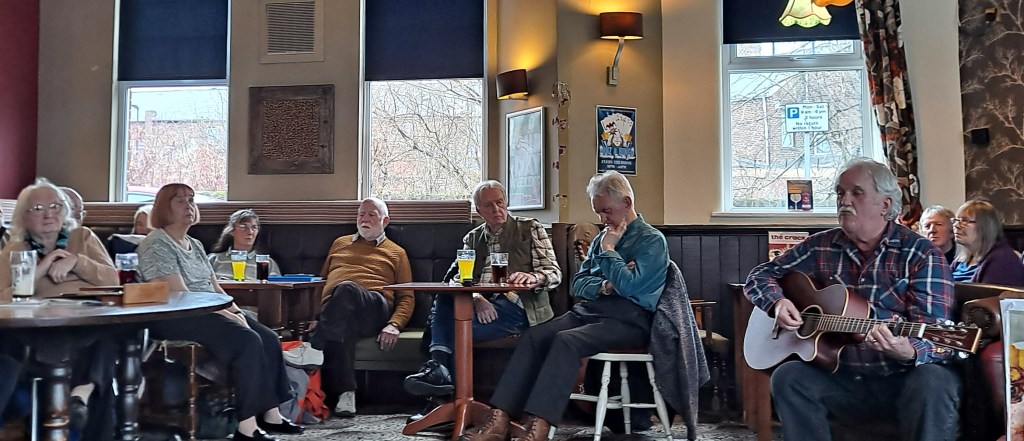
I also arrange a monthly folk afternoon at The Stumble Inn on Chester Road, Sunderland. We get around 30 – 50 people coming to our sing around and we are keeping the tradition going because in the 60s the pub was formerly The Royalty and had a very popular folk and blues club called The Glebe.
The pub is near Sunderland University metro so we have people coming in from Newcastle, Cullercoats and South Shields. Some come from further afield like Chester le Street and Teesside. Being on from 1-4pm people are happy to travel on public transport at that time – on the night they are not so keen.
Our folk gatherings at The Stumble Inn are on the 4th Tuesday of the month. All are welcome to sing a song, play a tune or just listen to the songs its very informal and free. We are based downstairs so the room is easier to access with your pints of beer and musical instruments.
We have singers from all over the region like Barrie and Ingrid Temple, Ed Pickford, Tony Wilson, Anne Lamb, Keith Gregson, Brian Hunt, Ken Hamer and others who all perform in a range of styles.
It’s an old genre but people still write songs now in the folk tradition about current events keeping the music alive. Music and song are so fundamental to our lives.
Alikivi October 2024
 ALIKIVI UK : NORTH EAST MUSIC & CULTURE