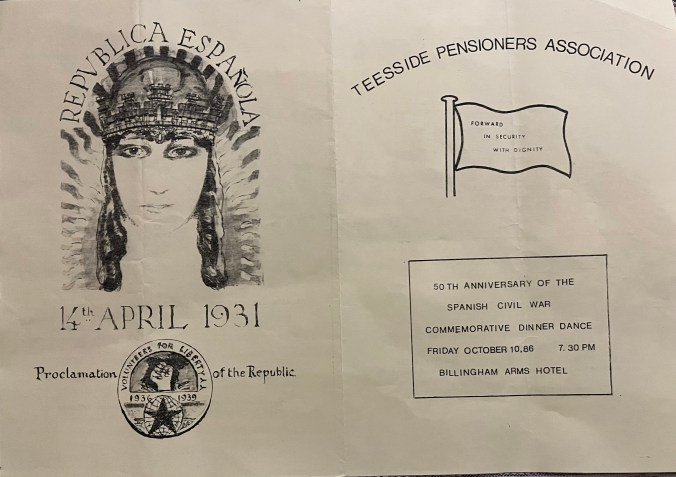
‘On 10th October 1986 the Teesside Pensioners Association held a commemorative dinner in the Billingham Arms Hotel to mark the 50th anniversary of the outbreak of the Spanish Civil War. Trade Union leader Jack Jones was the principal speaker.’ said organiser and head of North East Volunteers for Liberty, Tony Fox.
‘A formal dinner, principally for the relatives of International Brigade volunteers, will be held at The Moline Cross, in Norton (https://www.themolinecross.co.uk/)
The dinner will mark the 40th anniversary of the Commemorative dinner in Billingham Arms and the 90th anniversary of the outbreak of the Spanish civil war.’
Tony added ‘As well as a number of relatives of North East volunteers I’m pleased to announce that David Jones has agreed to speak at the dinner, he will be representing his grandfather, Jack. We will have a two course dinner, of either chicken or beef, with vegetables, the dessert can be ordered on the night. The cost will be £20 per person, without drinks. Pre-payment is necessary.’
Contact: NEVolunteersforliberty@gmail.com for further details or to book a place for Saturday October 10th 2026 at 6.30pmat The Moline Cross, in Norton – TS20 1PE.
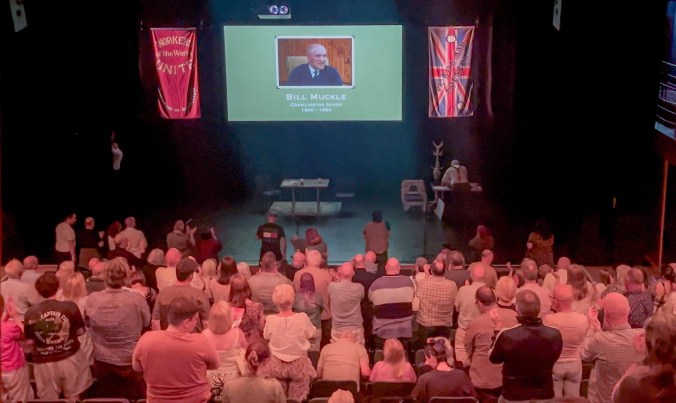
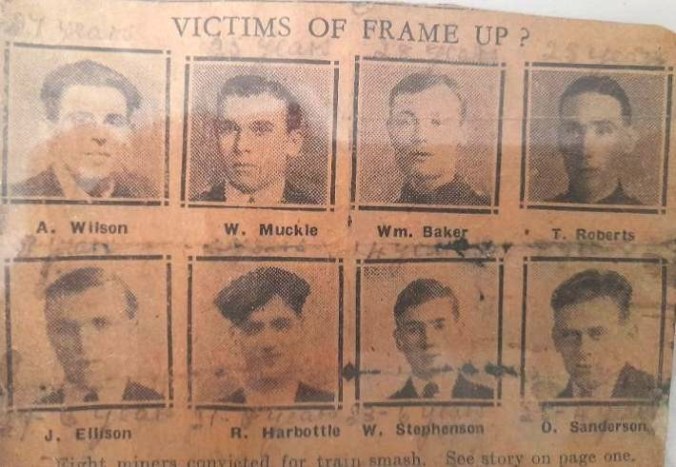
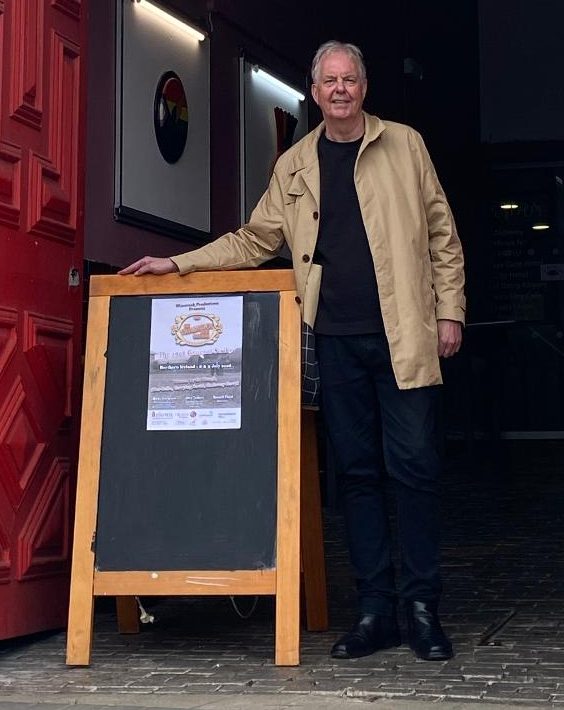
A play about North East miners imprisoned for accidently derailing the Flying Scotsman during the 1926 General Strike, was staged in The Waterfront Hall in Belfast and The Playhouse in Derry. Both venues saw enthusiastic audiences and standing ovations.
The Cramlington Train Wreckers was written by North East playwright Ed Waugh who has spent more than 20 years writing plays about working-class life (Wor Bella, Hadaway Harry, Carrying David).
“It’s a story about working-class unity. Whether you’re from north east England, Belfast or Derry, they’re stories about solidarity told with a different accent.” said Ed.
Mr Waugh worked closely with Northern Ireland’s trade union movement to help stage the production. They received backing from several trade unions, including NIPSA, Unite, Unison, the Fire Brigades Union and the Irish Congress of Trade Unions.
Ed praised working with NIPSA…
“I’ve been incredibly proud to work alongside NIPSA. Their commitment to bringing people together reflects exactly what this play is about. It shows that working people are united by their shared struggles.”
“That message of working people being united has certainly connected with audiences in Northern Ireland.”
Neville’s music has attracted attention from the BBC and the specialist music press. His debut album The Edge of Destruction established Neville (53) as a distinctive voice in contemporary British music. The critically acclaimed debut featured on this site in July 2023. However,for this post Neville has brought something special from his family history research.
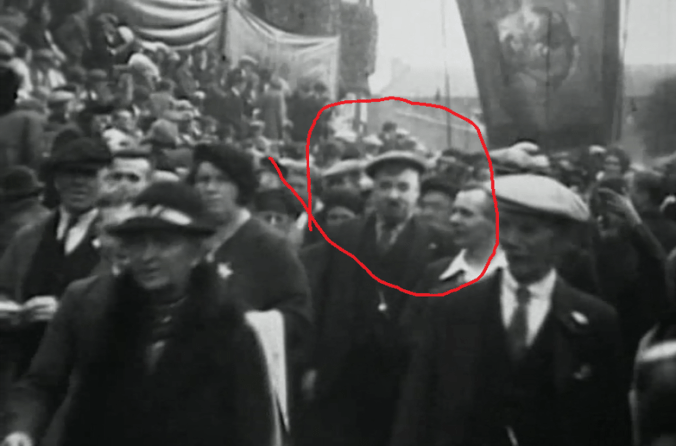
Durham Miners Gala has been a regular date in the working class calendar for over a 100 year. Thousands of people, many with Union flags and miners banners, march through the city on a big day out in July. They commemorate the past while looking forward to a stronger future together. In film footage of the Gala from 1939, Neville recognised one of the marchers…
‘My great-grandfather John Wright Neville is in the 1939 Durham Miners’ Gala film. The film catches him pointing to where the cameraman is standing.’
‘This Gala took place only two months before the outbreak of World War II. Very much the end of an era. He got his nickname ‘Mutt’ because he muttered – an unfortunate legacy of life in the trenches. He’s wearing the standard ‘sunday best’ uniform for working-class men at the Gala. As far as I’m aware no other working man in that film has ever been identified.’
What else did you know about him?
‘He was a boilermaker at Greensfield Locomotive Works in Gateshead. Boilermakers were the elite of the railway world, building and repairing the massive steel steam locomotive boilers needed immense physical strength. Something which clearly helped him to anchor the championship-winning LNER tug-of-war team for 1929, 1930 and 1931.’
‘My grandfather, John Wright’s son, was the seventh of seven boys as was John Wright (and his father) – so 7th son of a 7th son of a 7th son, pretty rare. John Wright’s wife’s name was Ellen. Big families they had then.’
Still image of John Wright Neville from the film of the 1939 Durham Miners Gala.
How did you first come across the footage?
‘When I was Assistant Keeper of Fine Art at Durham University they built the Palatine Centre in 2012 and I was asked to research what was previously on that site, which was the Elvet Colliery.’
‘As well as commissioning a sculpture by the artist Peter Sales to acknowledge the mining heritage of the site I had to find photographs if possible, of the colliery. Not so easy as the colliery closed in 1908, but I believe I found one shot of it derelict.’
‘Looking through archives for images of course the Miners Gala came up. By chance I showed the 1939 film to my father, who identified his grandfather. I was then able to show it to my grandfather (who was in his 90s then) and he confirmed it, and when I got a photograph of my great grandfather he was unmistakable.’
‘So, a million to once chance. The narrative of the rest of my great grandfather’s life reads like the plot of a classic novel. He married into a Romani gypsy family and was disowned by his master-chandler father.’
Where is the film available?
‘I believe it’s held by the NEFA (North East Film Archive). It used to be on YouTube but I think it’s long gone sadly. Luckily, I recorded it at the time and just cut up the bit with John Wright to show my grandfather to confirm his identity.’
What’s next in your family research?
‘I’ve realised in jotting down the information for you that it would be a fascinating thing for me to try to research. The National Railway Museum at York has hard copies of the LNER Magazine (1927-1947). Boilermakers were highly unionized and this information is preserved at the National Archives.‘
‘What would also be interesting would be to identify the Greensfield banner, since railway workers didn’t march with miners’ lodges but behind their own NUR branch banners.’
Alikivi July 2026
If you can help Foster with the Greensfield banner get in touch.
A hit play about North East miners imprisoned for derailing the Flying Scotsman during the 1926 General Strike is transferring to Northern Ireland before it plays the prestigious Newcastle Theatre Royal.
Playwright Ed Waugh (Carrying David, Wor Bella) was invited to talk about the play at two Irish venues last week.
Firstly, how did you get there Ed?
‘I flew! It only takes 40 minutes from Newcastle to Belfast International Airport. My Metro journey from Newcastle Airport to South Shields took much longer!’
‘I spent a couple of nights in Derry but while in Belfast, and Derry, there was lots of talk about the race riots. Theatre shows were cancelled and the bars weren’t up to their usual capacity. I was told people are reticent about coming out of their homes to socialise publicly at the moment.’
pic.PlaywrightEd Waugh in The Waterfront Hall, Belfast.
How did the Ireland connection come about?
‘I was approached by Northern Ireland Public Service Alliance (NIPSA) who have a membership of 47,000 and are the biggest Northern Ireland-based trade union.
They were instrumental in getting additional trade union support from the Irish Congress of Trade Unions (ITUC), Unite, the Fire Brigades Union (FBU) and Unison. The latter have 50,000 members in Northern Ireland and are based across the UK.’
Along with the talks Ed was interviewed by BBC Radio Ulster in Belfast and BBC Radio Foyle in Derry.
‘I was amazed by the BBC presenters who interviewed me in Belfast (BBC Ulster) and Derry (BBC Foyle). They had obviously done their homework and their preparation was brilliant, they were good interviews. I was impressed.’
‘I was able to get the point across about the need for workers’ unity and the importance of trade unions in this, to cut across racial, religious and gender bigotry.’
‘These disgusting prejudices are whipped up by the representatives of the wealthiest 1 per cent to detract from the growing inequalities in society. It’s the traditional ‘divide and rule’ tactic to scapegoat minorities rather than the real culprits.’
pic. Playwright Ed Waugh outside Derry Playhouse.
How did you find Belfast and Derry?
‘Both Belfast and Derry are highly political cities. There are political murals everywhere and every family was affected by the troubles.’
‘Despite these historical injustices, Belfast is a brilliant place. I’ve been a number of times and it reminds me of Newcastle. People are very friendly and the place has a buzz.’
‘Mind you, Derry blew me away. What a fantastic place! I paid tribute to the Undertones mural before heading to the BBC to be interviewed but en route people would just say “hello” and smile. it was lovely.’
‘It was announced before the BBC Radio Foyle (Derry) interview that I was speaking and there to meet me at the station to say hello was a chap from Wallsend. He’d emigrated in 1973 but still had his Geordie accent.’
Would you call the visit successful Ed?
‘When I got the taxi home in the evening the taxi driver asked me what I was doing in Derry and when I told him he said he’d be at the front of the queue if there was another general strike.’
The Cramlington Train Wreckers is playing Derry Playhouse on July 8 and Waterford Hall, Belfast, on July 9, before transferring to Newcastle Theatre Royal on July 12. The two shows at Newcastle will be at 3pm and 7.30pm. There is limited ticket availability for both shows.
How many books have you published and when was the first?
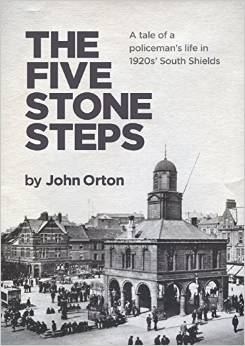
Four so far Gary. My first book, ‘The Five Stone Steps’, a tale of a Policeman’s life in 1920s South Shields, came out in 2014 and was followed by ‘Blitz PAMS’ (2016) a tale of the Blitz on Shields, then ‘A Chill Wind off the Tyne’ (2018).
My last book, ‘He Wears a Blue Bonnet’ (about Scottish survivors of the Dunbar death march who were sold as indentured servants to work in the salt pans of Shields) – was published in 2022.
What is the new book about?
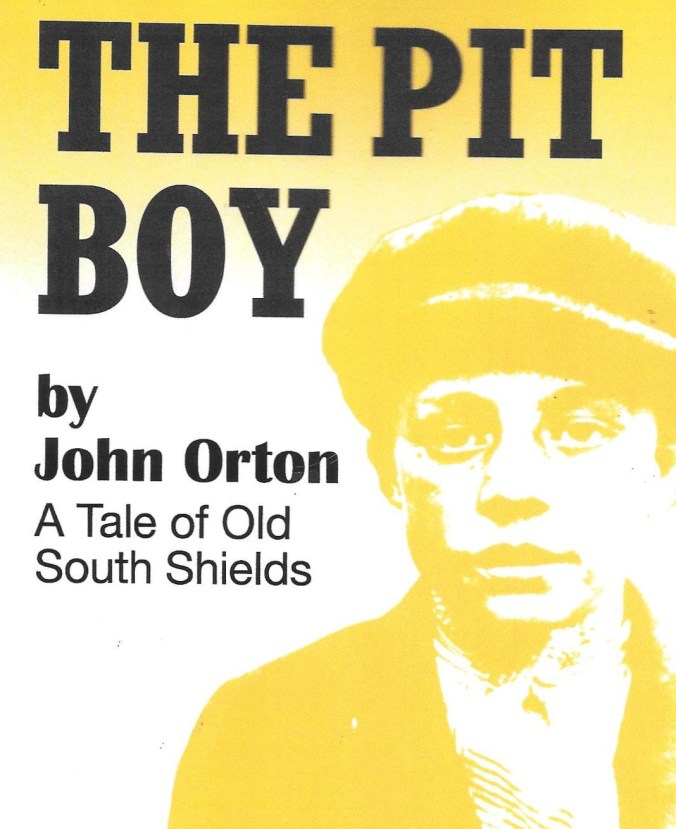
‘The Pit Boy’ is true story of the early life of my Granda’, Teddy, who was brought up in Wilson Street High Shields in the 1900s. His early days were marked by poverty. His Da’, a rivetter/boiler maker who had moved to Tyneside from Loughborough, died of rheumatics in 1902. Teddy’s Mam, Lizzi, took to the drink, and the family ended up in the Workhouse.
Back on the cobbled streets of Shields, Lizzie took up fish hawking, but when the drink took over, she abandoned Teddy and his brother Alf on a doorstep in Brunswick Street. She was sent down for two months for child cruelty and neglect.
Teddy started as a trapper lad at St Hilda colliery. He worked hard down the pit, went to night school, and when War broke out in 1914, he had become the youngest deputy in the Durham coalfield.
Why do you focus on South Shields?
After my Granda’ died in 1955 when I was six, my Nan, Gertie started coming for tea four times a week. ‘Tea’ went from half past two until six o’clock. She sat in an old wicker chair in the corner, drank tea and never stopped talking in her broad Geordie accent.
Her tales of old Sheelz still ring in my ears – of Dick Borke (Burke) the one-legged bookie, of when they ‘bornt Kredga in the streets’, (effigies of Kruger were hung from lampposts and burnt during the celebrations of the relief of Mafeking.) Although I left Shields in my early twenties, I love the town and the old memories kindled by my Nan.
When writing, is that when you are happiest?
I have always suffered with my nerves and had a breakdown in my second year at Oxford. I was advised to take a year off and went home. After a couple of weeks, me Mam told me that she didn’t want me moping round the house and if I was going to stay then I’d have to get a job and pay keep.
I tripped off down to the old Labour Exchange in Wawn Street and joined the long queues of men drawing their dole. There was only one job going in the whole of Shields – at Wrights Biscuits. I took it and learned more about life there than I ever had at Oxford.
I went back to my studies, and qualified as a Solicitor. I had a second nervous breakdown in my mid forties and have never fully recovered. I started writing as a form of occupational therapy and have kept it up. I am happy sitting at the keyboard researching my stories and then writing them.
It is fascinating to learn how folk lived a hundred years or so ago and then write about it. It’s not all I do but it’s now a settled part of my life.
As well as novels do you write short stories?
My first thought was to answer no – but then I reflected on how I started ‘The Five Stone Steps’. I had been intending to write a whodunit set in 1920s South Shields.
A very good friend of mine, Tommy Gordon, had taught me ragtime piano and I knew that his Da’, also Tom, but only ever called Jock, had been a Station Sergeant in the Shields police. I asked him about policing in the twenties and he went to his bookshelves and produced a dusty, dog-eared manuscript of his Da’s memoirs.
As I read these tales of Old South Shields, very much like those my Nan had remembered, I could almost hear Jock Gordon’s whisky voice as he sat down at a table by the fire to set his memories to paper.
I thought that one particular tale about publicans in old Shields putting out a little jug of whisky for the Bobbies on night shift might make a good story. My first book is in fact a collection of short stories but much like a ‘soap’ on telly all the tales connect-up.
What are your hopes for this book?
All my books are self-published with help from Uk Book Publishing in Whitley Bay, a great team. With the stranglehold Amazon has on the book trade it is nigh impossible for a self-publisher to make any money and the few independent bookshops that are left are reluctant to stock self-published books.
The only place in South Shields where my books can be bought is the Shop at The Word, so I rely on social media and word of mouth for my books to get known.
My hope for ‘The Pit Boy’is that a Tale of Old Shields will capture the imagination of folk and remind everyone of what a vibrant industrial town Shields was in the 1900s – that despite the poverty and hardship, folk stuck together, got on with life, and made the most of things.
I’m often accused of living in the past but we should all remember our forebears and their struggles – without them we wouldn’t be here!
Alikivi June 2026
Search for more John Orton posts on the North East Music & Culture site.
Ronnie is in his mid 40s and was educated at Monkwearmouth school. He worked as a mental health therapist for 20 years.
“After leaving my professional life behind I decided to focus on myself and had some counselling and in the sessions found myself writing about the past.”
When he was young Ronnie had a traumatic experience where two of his friends were murdered.
“Talking about the horrendous murders that took place and the lads I knew hasn’t been easy to revisit. But the truth never is. It naturally pushed me towards writing.”
“Also, in my youth I made a million bad decisions which resulted in a little holiday in the old mental health unit Cherry Knowles in Ryhope. This was also inspiration behind my writing.”
Earlier this year Ronnie met up with a couple of friends who have been supportive of his work. Two examples are added below. He is now looking to get some of his poems and a short story published.
“My friend has helped a lot with telling my story and I’ve really taken to poetry and bending words, its great fun.”
“This has all started to come together the last few months, I’ve got a couple of great editors working on the short story. The poems haven’t been edited yet.”
“We’ve had some really good feedback but if I’m honest, I think the story was born in Sunderland and I would like it continue to have a North East connection.”
What are your hopes for the work when it is published?
“I’m hoping the overall work of the two books is a positive message. Even when you think you are at rock bottom, believe it or not you can bounce back.”
Alikivi June 2024
This evening by Ronnie James
I wonder the meaning.
As I’m cleaning.
Am I right in believing.
This evening.
Isn’t for thieving.
Its for believing.
My mate knows the meaning of this evening.
Talking goods times and current achievements
Its not for screaming or disbelieving.
Its time for escaping the machining.
And giving the evening a meaning
Mad Matty by Ronnie James
He resided in the bed next to me.
Long jet black crazy curly hair. As if he’d been electrocuted. God knows why he was there we never spoke. Apparently, I heard some horrible violence some staff I heard saying.
He was drugged to the point he couldn’t talk just laugh and giggle. He needed constant attention from staff.
He would sleep under my bed at night.
I’d waken to hear a giggle. I’d look to my left and his bed would be empty. Bastards under my bed. I looked under upside down there he is. Giggling laughing, insanity, crazy eyes, evil. This happened a few times.
I went from trying to be his mate to him hissing like a wild cat at me under my bed to me completely exploding with anger to which either situation me being restrained by 3 or 4 men and Matty getting carted off to where ever.
After a few times of that and other situations 1 day he never came back. Apparently, he hung himself. He never got out the asylum.
Punk bands Sanction This, Red London and Slalom D will be playing at Sunderland Museum Vaults on 21 June. The gig is to raise funds to build a community monument to remember the International Brigade Volunteers from Sunderland who fought the rise of fascism during the Spanish Civil War in the 1930s.
Slalom D vocalist Fi Duncan talked about how the gig came about…”We’re good friends with Julio, one of the main organisers. He asked us because we’ve always taken a stance against racism and fascism. Especially at a time like this, we all have to stand up for what is right.”
“The International Brigade will always be an inspiration for people wanting to be on the right side of history. It’s an excellent cause, in one of our favourite venues, surrounded by our mates, it’s going to be a great gig”.
Entry is £10 on the door.Museum Vaults, 33 Silksworth Rd, Sunderland SR1
Glynis was born in Cullercoats, a small fishing village on the North East Coast of England.
‘Where I spent a happy, carefree childhood. Cullercoats Bay was, literally, at the end of my street, and the village had a real community feel – it still does. Now aged 63, I haven’t moved too far from where I grew up.’
Her creative writing journey began at the age of eight.
‘In reality, I was copying the themes and formats of children’s authors. At the age of 11, I was still making notes for my first full-length story book – Five at Mystery Camp!’
‘Leaving school, I wanted to do something other than sit behind a desk – so with the qualifications I had, I was encouraged to spend the next 45 years working behind a desk! I also took on part-time work all within the Cullercoats or North Shields area. I was a barmaid, had a go at working as a housekeeper and one job was cleaning a local morgue. The smell was one of bleach and cleaning products but the atmosphere was spooky and spine tingling. I dreaded every shift – my imagination sometimes does get the better of me.’
Who inspired you to start writing?
‘Growing up, I would spend a lot of time in Cullercoats library, and my first real interest in reading came from Enid Blyton mystery stories. By the time I joined Marden High School in North Shields, it seemed my natural reading progression was to jump from Enid Blyton’s Malory Towers series to James Herbet – The Rats – a huge leap in genre. My imagination was ignited, and my storytelling went up a few notches!’
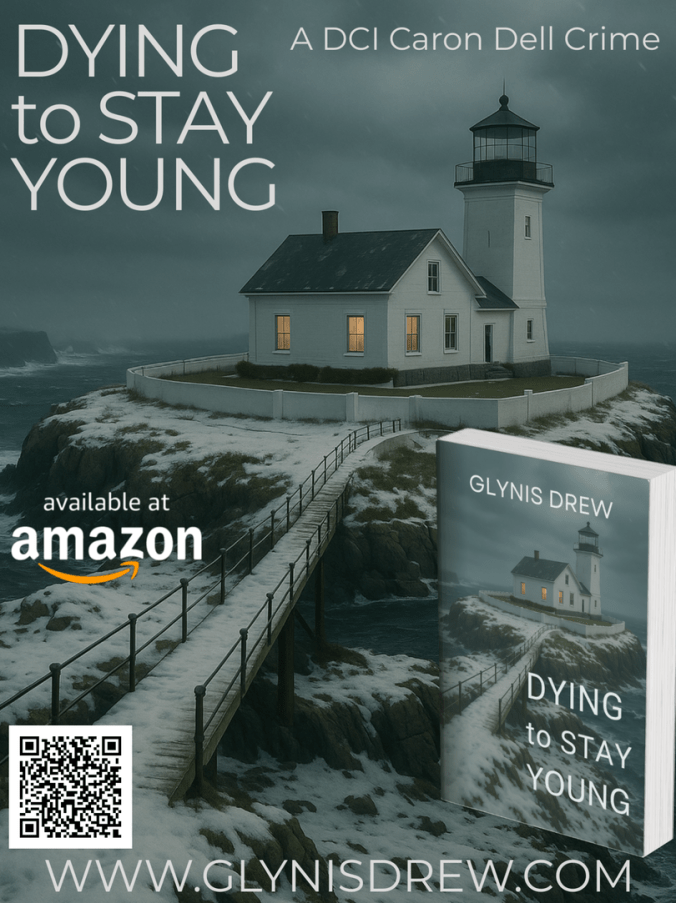
‘I created my DCI Caron Dell crime fiction novels in 2005, and have written several short stories – none of which are published. I began taking things more seriously when my daughter, Beth, a singer-songwriter, wrote a piece called Stay Young. Something about that song lit a fire in me—and that spark become the basis for my first novel.’
‘To date, I have written and self-published two books from my DCI Caron Dell series: Dying to Stay Young and Where is January Blue?’
Have you surprised yourself?
‘I am surprised at how engrossed I have become in my research, whilst developing personality profiles, locations, and murder! Autopsies were an eye-opener, too!’
‘I’m learning something new each time I delve into the world of DCI Caron Dell – she is a stalwart for justice. And, I’m totally bowled over by the interest and support I’ve received, not just from family and friends, but from people I haven’t even met. So, a huge thank you – genuinely, I value everyone’s support.’
How was your debut book received?
‘My first book Dying to Stay Young, has good reviews on Amazon and five-star reviews in Goodreads. I am delighted by the feedback. Another huge thanks to those who have taken the time to read my books and to those who have left a review.’
‘At the beginning of March 26, Cullercoats Library hosted an event for me to talk about my DCI Dell novels. The venue was very fitting. Providing more detail about DCI Caron Dell and having a face-to-face discussion has encouraged me to continue my storytelling. For my first event, I was grateful for a full room and an engaged audience.’
While researching have you come across any unusual stories?
‘Not unusual, but more surprising. Whilst listening to Professor David Wilson, a Criminology expert, I was shocked by the low number of convictions for crimes against vulnerable groups. With one statistic flooring me – 2% of abuse against women crimes actually lead to a conviction.’
‘Obviously, there is more to the stats, but what is worth noting is that not all crimes are reported, so what is the real percentage? Is it higher or lower? I don’t think we’ll ever know for certain. My interest was piqued, and my hunger to write psychological thrillers grew.’
Would you like to see any of your books adapted for the stage or TV?
‘Absolutely, that would be utopia!’
For furtherinformation and upcoming releases contact the official website >>>
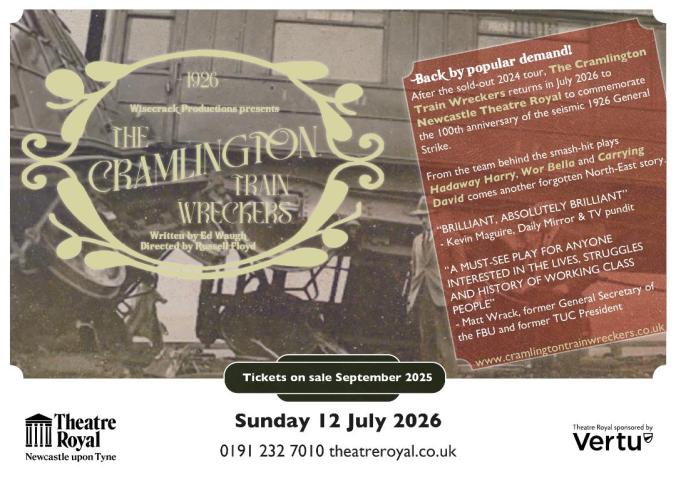
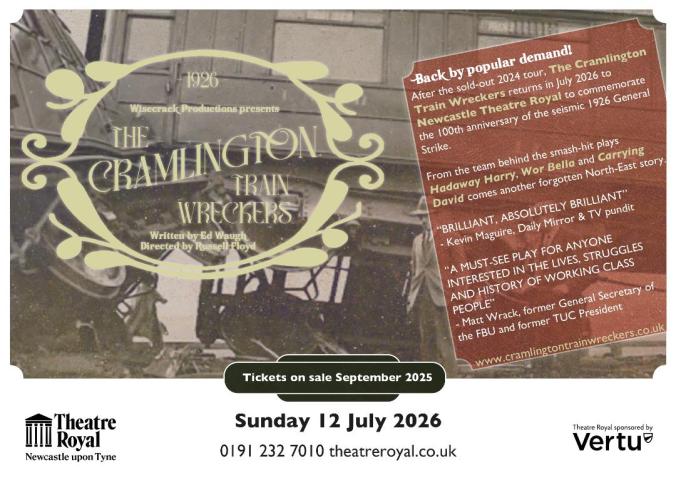
After a sold out stage tour in 2024 Cramlington Train Wreckers is back. The inspiring story of working class solidarity will be staged at Newcastle Theatre Royal on Sunday 12th July 2026to commemorate the 100th anniversary of the national strike in 1926.
The strike was the biggest rupture in society since the English civil war. Miners were asked to take a pay cut to ‘improve productivity’ – really just to maintain the profits of the bosses. North East actor Micky Cochrane played one of the main roles on the tour and is revisiting the play at Theatre Royal.
“The audiences were really good in ‘24. Lots of bums on seats and a great response. A lot of people come with high expectations for Ed’s plays and love what he does.”
Written by Ed Waugh (Wor Bella, Carrying David, Hadaway Harry) the story of the striking miners who accidently derailed the famous Flying Scotsman train in Northumberland is told by former actor and director Russell Floyd (The Bill, Eastenders), and after a very successful Carrying David and Billy Elliott the musical, the afore mentioned Micky Cochrane.
“I had worked with Russell on Carrying David and The Great Joe Wilson. I know how he works and what he brings out of actors. We work really well together.“
“I also won the North-East Culture Awards Performing Artist of the Year. It was a great reward for the fantastic plays and big roles I played last year” said Micky.
Also starring is Alex Tahnee who was in Romeo & Juliet and Alice in Wonderland “I knew Alex. She was great. The play has lots of information so we had to be on it. We had to help each other out”
“I had heard of the Cramlington Train Wreckers but I didn’t know the full story and main players so it was another chance to learn more about the history of the area.” explained Micky.
Tickets for Cramlington Train Wreckers at Newcastle Theatre Royal on Sunday 12th July 2026 available from >>>
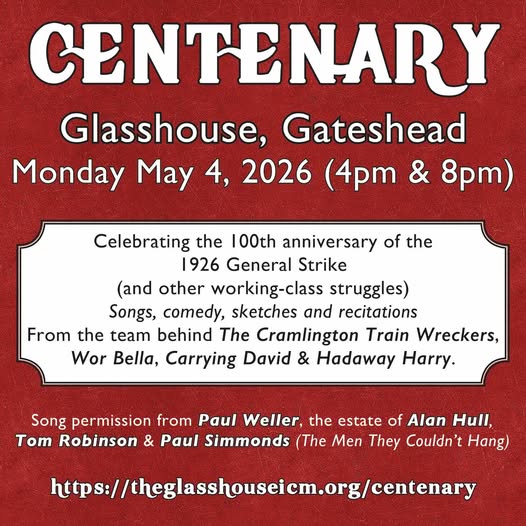
May 4, 2026, marks the centenary of the first full day of the 1926 General Strike where millions of British workers withdrew their labour and challenged the establishment. They believed a better world was possible.
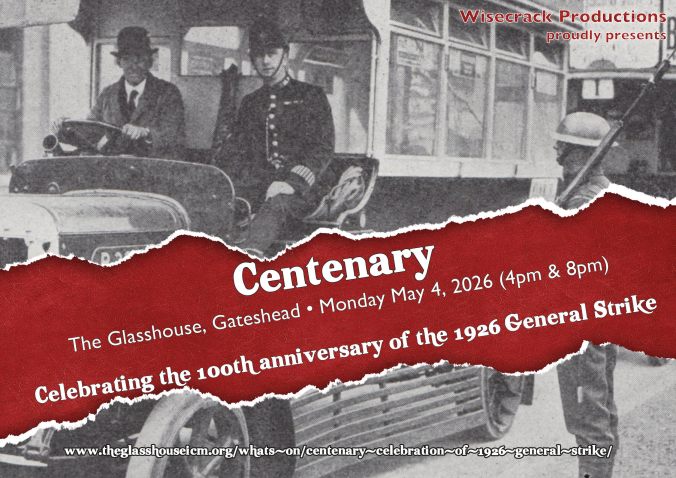
To mark this historical event the same team that brought successful plays Wor Bella, Carrying David and Hadaway Harry are staging Centenary at the Glasshouse.
“We have a great team and the show will be fantastic. We did a very popular show about four years ago called ‘Boris Out’, and look what happened to him!” said playwright and Theatre producer Ed Waugh
“One hundred years ago millions of workers and their families went on strike. A General Strike poses the question of state power, the 1 per cent – the privileged Establishment or the working class – those who actually create the wealth in society.”
“Despite the heroism and sacrifice of the trade union rank and file, the union leaders in the TUC realised the question of state power was at stake – the Russian Revolution nine years earlier had sent shockwaves throughout the world. These TUC cowards sold out the strike unconditionally after only nine days.”
Ed added “Their pusillanimity led to a carnival of reaction against the trade unions and workers by the Tory government. The miners continued their strike for another six months but were starved back to work. We haven’t had a general strike in this country since. But we’ve been close”.
“We have to learn the lessons of 1926 for the next time, which is on the horizon. The 1926 General Strike was a hugely important period in working class history.”
‘Centenary’ will include songs, comedy, stand up and recitations to celebrate the nine day strike. A big addition are musicians Paul Weller (The Jam) Alan Hull (Lindisfarne), Tom Robinson and Paul Simmonds (The Men They Couldn’t Hang) have personally given permission for their music to be played at the show.
“We are delighted to have been given personal permission from these great songwriters. It will be an evening of brilliant musical and comedic entertainment and inspiration.”added Ed.
Tickets are available for ‘Centenary’ at The Glasshouse, Gateshead at 4pm or 8pm on Monday May 4th 2026.





 ALIKIVI : NORTH EAST UK MUSIC & CULTURE