Meeting up with contributors to this site I’ve asked how they survive in the arts. Some talk of persistence and others simply being obsessed by it. I think to give yourself a good chance you’ve got to be prepared to work on it day in day out basically 24/7/365 days a year.
85 year old Sheila featured on this site in June 2018 where she talked about spending her life in art – so she was the perfect person to ask.
Surviving in the arts is for me going with the flow. I believe in my Mam’s saying ‘Every day in every way in everyday I’m getting better and better’ particularly when you are feeling crap or when things have gone wrong. In the arts you need this saying because there are times when things just don’t happen for you. Tempered with that my Dad used to say ‘worse things happen at sea’! So never, never, give up. Keep positive and keep going.
After attending Art College Sheila then went to Birmingham School for Training Art Teachers in 1961.
That was the best thing to happen to me. I was shown that everyone is an artist in their own way and it’s your job as an art teacher to bring it out. It’s about giving something positive to people in their lives.
I first taught art in comprehensive schools in South Shields and by 1970 I was divorced and had time to play so bought a super 8 cine camera. Play is very important plus having a messy room or studio where no one tidies up after you!
My first messy place was at home in South Shields working at a desk looking out onto our little garden. Later it was a studio in the Pilot Office overlooking the river Tyne. Then by the mid 70s I got a break in animation.
I was contacted by an agent for World TV who sold the short films I made globally. She later commissioned me to animate 10×10 minute ‘Just So Stories’. The actual process of animation can take a long time to produce minutes on video so the only way I could produce this was to give up teaching – which I did in 1980.
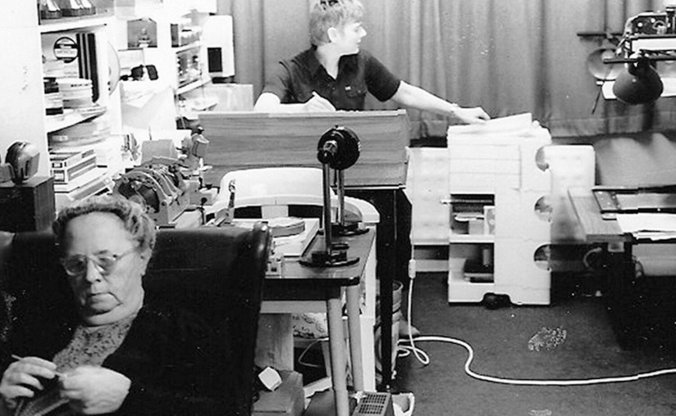
Sheila animating Frame by Frame for World TV and her Mam crocheting for a local shop – a true cottage industry.
Sheila also works with various charities, the last post features Anna Malia and North East Animal Rights, how did you get involved with them?
When I lived in Ireland I saw an incident, not to go into it here too much as it’s really upsetting, but there was a field of cows and a calf that broke free from the herd. It was about how it was dealt with by the farmer that really affected me. I thought if I get the chance I would do something for you – for that calf.
I heard a song by North East musician Jen Stevens, loved it, and thought that would really work with images. I asked Jen if I could use it and she said yes. We put it out and Anna Malia from North East Animal Rights got in touch and we took it from there.
Sheila is currently working on a book about George McVay, a little known artist who lived from 1902-1967. Former Shields Gazette journalist Janis Blower is in the process of editing it.
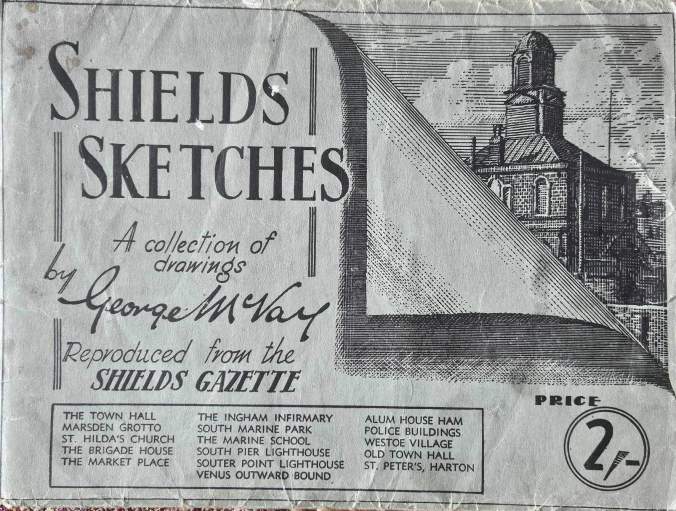
George was a very good photographer which accounts for the very large detail in his pictures. His style of painting was very photographic. When I was 8 my mam bought a set of his prints that the Gazette had commissioned and I loved looking at them like kids look at ipads now. For a long time I done plasticene models of them.
All his life he drew some amazing illustrations of Shields and surrounding areas. Some people may recognise his black and white drawings, very clear, very precise everything from the old Town Hall to the piers, the river and the Groyne. In the book Janis Blower will be adding underneath a description and history of George’s picture.
In his early days I gather he worked at Readhead Shipyard, he was studying planning, design and engineering. His Dad was mayors secretary at South Shields Town Hall and was a good photographer. It’s thought he said to his son that he should work in the Town Hall and he eventually did, he was employed in the ratings department.
Out of the goodness of his heart he’s done drawings for presentations at the town hall. There are some amazing manuscripts, whatever was required he could do it even when people leave. He also done commissions for the Shields Gazette.
The Shields museum have some in their store. He has stuff in the Hancock and Discovery museum, Newcastle. He did a showing at the Laing Art Gallery and down in London but all track of that is lost. Unfortunately, nobody has given him the recognition that he deserves.
What I’ve found over the years is that he and I have followed parallel tracks. We have both done a lot of work for charity and both drawn the most popular buildings and views in Shields because we love the place.
To contact Sheila check out her official site at >>>
In April this year the work of hunt saboteurs featured on this site, this latest post again looks at tackling illegal foxhunting but this time using a different approach.
‘First time I witnessed a hunt I was shocked by its enormity. It was a deeply emotional experience nothing could have prepared me for it. The following week I witnessed a fox killed by hounds. That day I made a promise – I vowed to get justice for that fox. It’s his memory that drives me on.’
To find out more about the work of the Northumberland Hunt Watch I sat down with Lynne in the Littlehaven Hotel, South Shields where she started off by telling me she has always loved animals.
‘Since I was a child. My earliest memory, of being anti-hunt, dates back to school I was 10 year old. During an English class debate the teacher asked me to argue in favour of foxhunting. I was horrified and refused point-blank. Despite never having witnessed a hunt in my life I always felt an empathy for the hunted fox.’
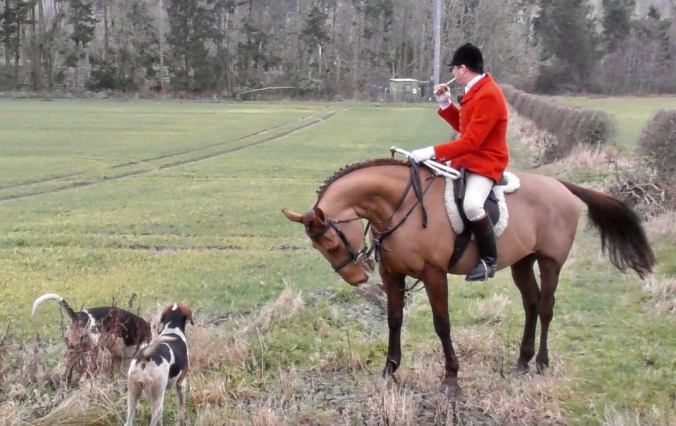
Tynedale hunt near Corbridge, Northumberland.
In 2002 Scotland banned foxhunting, England and Wales followed in 2004.
‘I thought that was the end of it. However, just because an activity is criminalised doesn’t mean it ceases to exist. Through social media I realised it was still happening on a massive scale. I was aware of the foxes out there alone with nobody to help them. I felt compelled to take action.’
‘I founded Northumberland Hunt Watch in 2020. Prior to this, I already had 5 years experience monitoring hunts. There wasn’t an anti-hunt presence in Northumberland at that time, leaving all the hunts in the area unchecked. There are some pockets of deeply engrained hunt culture in Northumberland, operating in some very rural and isolated locations.’
‘For these hunts it’s very much a way of life. They have a cultural pride in hunting, and strongly resist any attempts at criminalisation. The hunt community is a very tight community. They hunt together, socialise together, conduct business together and support one another.’
‘There are many different reasons why people foxhunt. Foxhunting has nothing to do with pest control or managing fox numbers. The hunts want foxes in the area to hunt which conflicts with the pest control argument. For some hunters it’s for the thrill of the hunt or the thrill of the kill. That is very difficult to understand.’
‘There are farmers and landowners involved in the hunt, who grant permission to access the land. Without this land there would be no foxhunting. For the riders who subscribe to the hunt, following hounds provides the freedom to ride over land that would otherwise be out of bounds. The fox is not restricted to boundary lines, so the hounds and riders are free to ride where the fox goes.’
‘The car support who follow the hunt mainly consist of elderly men. To them it’s a day out to socialise. They turn up with their binoculars, sandwiches and flasks having a good natter, they enjoy watching the hound’s work. I often talk to the members of the hunt to gain a better understanding of why they do what they do. We can’t expect to change something unless we fully understand it.’
‘We’ve talked about what we call ‘clean boot hunting’ a humane and lawful activity, which follows the scent of a human runner rather than a fox. With clean boot hunting they can still have everything they have now. The jobs will still be there, they can still have their socials and get together, their balls, their meets so they can still have their sherry and a bit hokey cokey, just don’t kill a fox. I think they fear their way of life will fall apart without hunting the fox.’
‘But humane hunting would be far more sustainable. Currently hunts claim to be trail hunting, which would involve hounds following a trail of artificial scent instead of a live fox. Unfortunately, trail hunting in my experience is just a cover for foxhunting.’
Have you a vision of what you want the group to be?
‘Yes, when I set the group up I thought I’m going to do this my way, I’m not going to war with them. I’m going to win hearts and minds. For me it was all about a love of wildlife, and a hatred of foxhunting and not a hatred of the people. I strive to end foxhunting for good so I knew that we needed to be taken seriously by the hunts and the police.’
‘I aimed to create a professional group with a credible image, as far removed from the negative stereotype as possible. We refer to ourselves as volunteers or wildlife guardians, rather than sabs, protesters, or activists. We don’t wear masks and we have a dress code. We’re conscious of how we come across to all the people we meet.’
‘Some people are just out for a dog walk in the countryside, families with kids, older people. Last thing we want to do is scare people, we want to be approachable. We’re always polite and respectful and get on with the farmers.’
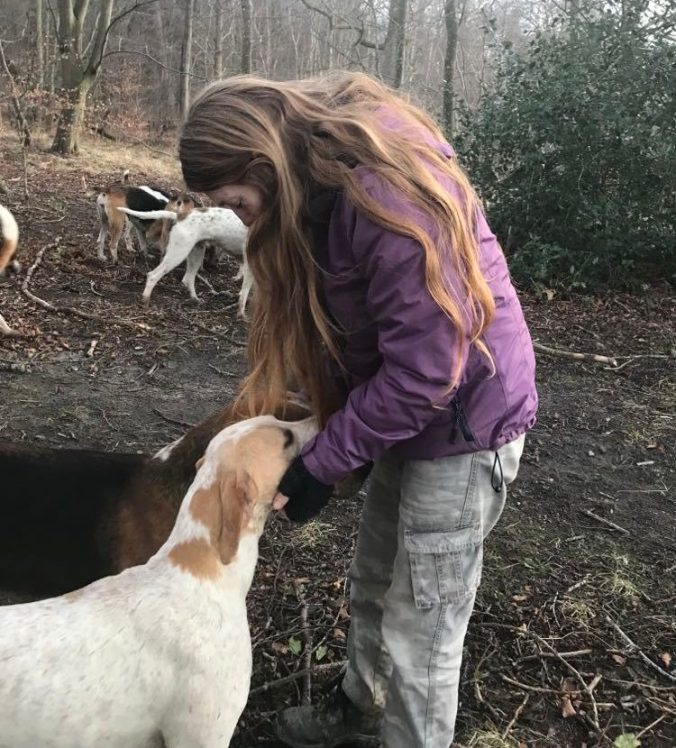
Lynn with the West Percy hounds.
‘We absolutely love the hounds they are such lovely sweet animals, we would never do anything to put them at risk, and our hunts know that. We often pop along to their hound shows in the summer some we are made more welcome than others.’
‘We aimed to build relationships and establish trust in the community and we have. All of our hunts know who we are and they know our names. We engage in polite conversations, some team members live in hunt areas, so it’s not uncommon to exchange waves. Our approach has earnt us respect and fear in equal measures!’
‘Our overall aim is to make the countryside a safer place for wildlife. On a day to day basis we aim to be a visible deterrent, to prevent hunting and on most occasions we are. We rarely need to intervene as our presence is often enough of a deterrent. Our hunts will often try to avoid hunting when we are there, and certainly avoid hunting in front of us.’
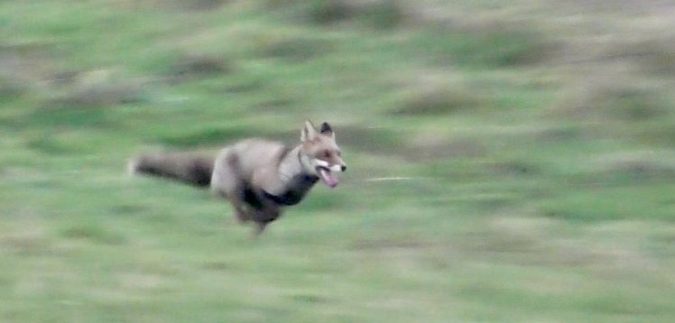
‘Last year at a hunt I was filming when the hounds picked up a scent and chased a fox toward me. The whip panicked and stopped them all “Lynne, can you see me stopping the hounds? Have you got it on video that I’m stopping the hounds?” I replied, “Yes, I have, thank you.” The fox made his way to safety.’
‘In the long term we aim for prosecutions as this is the only way to end foxhunting for good. To achieve prosecutions then we need to be professional and credible.’
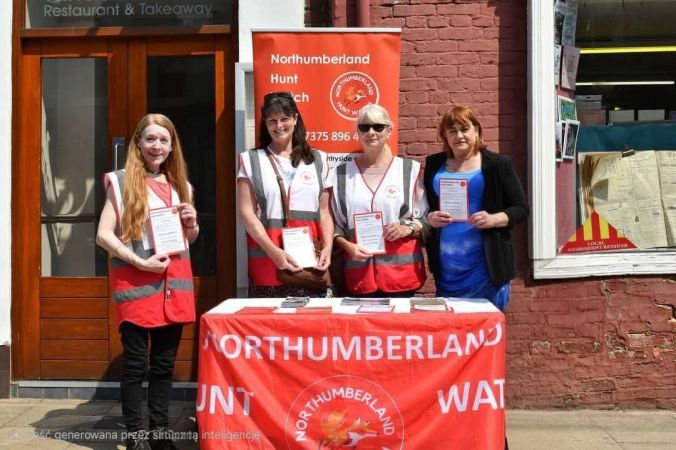
Outreach stall in Morpeth with Lynn, Judy, Amanda & Lynne
How much work is involved in the group?
‘A lot. We work very hard and put a lot of work in. I take this very seriously and am very committed to what I do. During the season we are out 2-3 times a week, despite working and other commitments. I would be out every day if I could. The fieldwork we do is just the tip of the iceberg. We do much more behind the scenes. Personally, I work on foxhunting every day of the week.’
‘I have taught myself a great deal over the years and always have my nose in a foxhunting book. I am also concluding a PhD in Criminology specialising in foxhunting with hounds. I have invested significant effort into this because I want to bring the issue of foxhunting criminality to a wider audience.’
Lynne & Judy leaving a successful Tynedale meet.
‘The lady who assists me in running the group, Judy, is a former police officer, so between us we have an in-depth knowledge of hunting and the law. We both work very hard on this, preparing cases and evidence for the police especially.’
‘Out of season we hold outreach stalls in hunt towns where we talk to the local community about our work. This has enabled us to lay the foundations for a positive brand identity while building up good relationships, trust, and respect within the community. We want the community to feel comfortable having us in their area trusting us to perform our job professionally.’
Have you experienced any threatening situations?
‘Violence and aggression from any of our hunts is exceptionally rare. We have had very few minor incidents in 5 years, most of which were dealt with swiftly, either by the police or the hunt themselves.’
‘Following one minor incident at one of our hunts I reported it to the chairman, he dealt with it, and we received an apology, so it was resolved sensibly and that was the end of it. There were no more incidents.’
‘We cover all the Northumberland Hunts from the Scottish border down to the Durham border, although Tynedale is our main hunt who we monitor regularly and have done for 5 years. They were a bit of a nightmare at first but they soon leant that it didn’t get them anywhere. They are very polite towards us now and we have built a good relationship with them. We are there to do a job which we do well and without getting into altercations.’
‘With all of our hunts we established clear expectations for behaviour from the outset ensuring that our conduct was respectful and polite. Over the years we have built a good rapport with most of them exchanging polite greetings “good morning, gentlemen” and in return “good morning, ladies.”
‘We never engage in name-calling or squabbles because throwing insults is not a stepping stone to positive change. This means that we can focus on what is truly important—the foxes. It might make someone feel better after calling someone names but it doesn’t achieve anything for the fox.’
‘The hunts also have a code of conduct regarding their behaviour towards us too. We have an unwritten rule between us we don’t call them ‘hunt scum’ and they don’t ride their horses at us, so this works well. This mutual respect means any of our team can be monitoring a hunt alone, in some isolated locations without any problems. Our approach saves lives.’
‘At one of our hunts we intervened between the fox and hounds, rating the hounds back so the fox could escape. This was in front of the hunt master and he said “thank you for helping” so we replied “no problem we’ll come back and help again next week.”
‘When we monitor hunts we focus on listening and observing, avoiding verbal confrontations is for creating a safe environment for the foxes allowing them a safe passage to escape. Foxes don’t know we are there to help them so we need to create a safe environment otherwise they would just see us as part of the pack. If there is chaos they could easily be scared back toward the hounds, we are very conscious of that. We often see foxes fleeing past us to safety. Silence is golden. It saves lives.’
How frustrating is it knowing fox hunting is illegal and it still goes on?
‘Very frustrating but there is a wide range of reasons why it continues. Weaknesses in the Hunting Act is a key issue, and also how it has been interpreted. This has provided loopholes for foxhunts to circumnavigate the law. There are so many issues that we will need an entire article to discus that alone. In a nutshell trail hunting has ensured that it is extremely difficult to prove them guilty and beyond all reasonable doubt. Consequently, trail hunting operates exactly as it was intended.’
‘We are committed to ensure that we have the best chance possible. Our behaviour will also come into question so we always act lawfully. Foxhunting is a low-level offence so if we break the law we lose the moral high ground and cannot expect the police to enforce one law while ignoring another. We have to be seen to be credible witnesses to make any progress.’
‘Because of how we operate we have built a good relationship with the rural crime team who we submit our footage to. We have had several incidents sent to the Crown Prosecution Service for review, and the police have acted swiftly in gathering the evidence.‘
Drone footage was captured of the Tyndale Hunt hunting a fox on 3 October 2024. This was submitted to the police. More information about this case can be found on the Northumberland Hunt Watch Facebook and You Tube pages.
‘There are some excellent groups across the country that have worked hard to end foxhunting, bring hunts in court or raise awareness, such as Beds and Bucks Sabs, 3 Counties Sabs, Cheshire Monitors, and West Midlands Sabs, to name a few.’
‘However, not everyone who joins a cause has genuine motivations, and the less credible groups can undermine the work of those who are genuinely committed and doing good work. It’s about quality rather than quantity, so finding people with the right attitude can be difficult.’
Lynne recording West Percy Hunt at Ingram Valley.
What have you found out about yourself since starting this group five years ago?
‘I have found that I am stronger and more resilient than I ever thought possible. If you have genuine intentions and committed to doing your best job for wildlife then you can make a difference. A middle-aged woman with a vision took on ten hunts, most of which were untouched and located in some of the most isolated rural areas of the country. I was subsequently joined by other middle-aged women to create a hardworking and professional group that has made a significant impact on hunting in this area. Never underestimate the power of middle-aged women on a mission!’
If you are interested in the work of NHW or would like to volunteer contact >>>
Since 2012 I’ve been researching the life of this fascinating character who was originally named Theophile Lucifer Gardini. He spent his last years living in a terraced house round the corner from where I live in South Shields.
In 2018 I produced a short documentary ‘Secrets & Lies’ based on what I found about his life so far, a link is at the end of the post.
I often mention him to neighbours and hear the odd story about Avro and his wife Anne. Recently an old friend got in touch and remembers the couple who lived at 45 Henry Nelson Street.
‘We moved into 32 Henry Nelson first week of June 1990, I think Avro died in the November so it was only a short time. I remember his wife used to have a little furry dog. She used to walk it out all the time.’ Recalled 60 year old Jeff Anderson now living in Washington, County Durham.
Jeff Anderson
‘I’d see them in the street. Always well dressed. Always smiling. I don’t think local people were aware of who he was to be honest.’
‘Actually, very first time I came across him and his wife was prior to moving into the same street. I saw them on the corner of King Street in the town centre. They really stood out, there was a real glow about them. They had a big smile on their faces. You couldn’t help but notice them’.
‘What they were wearing was very classy – not the type of clothes the everyday person of Shields would wear on a Saturday afternoon. They really stood out of the crowd just by their whole demeanour.’
‘But when Avro died I remember his wife was absolutely devastated. From the initial sighting in King Street and other times in Henry Nelson they had this glow about them but after Avro died that seemed to vanish from her. From what I can remember she was never quite the same’.
‘A strange thing happened to me on the night he died. I went to pick my wife up from work in the town centre but there was nowhere to park so I had to go back round the block. I went past St Hilda’s Church and as I went round the corner I had like a paranormal occurrence – the only way to describe it. I actually saw a vision of Avro on the ground reaching up to me. I was shocked, I thought what’s going on. This is a bit weird.’
‘I continued on and as I came back round the block again there was no sign of him. Gone. It really freaked me out as you can imagine. It wasn’t until a few days later that I learned he had died that night. So, you know what was going on there?’
‘I didn’t know anything about him having any health problems. He died at 76 you say? Doesn’t seem that old now does it?’
If you have any information about Italian born author & artist Baron Avro Manhattan (1914-90) please don’t hesitate to get in touch.
Musicians, writers and actors have contributed stories to the site for over 8 years now resulting in world wide views totalling over 430,000. A big thank you to all the readers – much appreciated.
The site also has local and social history posts. A contributor who goes under the pseudonym Tinwhistler sends in his recollections of characters in South Shields. The likes of Big Hec, Billy Meths and Wavis O’Shave have already featured and the number of views prove there is a thirst for these stories.
In his latest post he talks about how a myth can be cultivated to the point of belief.
‘Our heroes are due to legend created from what is said or written about them, however, they can become exaggerated when tales are passed down. The negative aspects are usually omitted so you might be left with a ‘Robin Hood’ tale bearing little resemblance to reality’.
‘Controversial characters become larger than life courtesy of Chinese whispers elevating the likes of small time hoodlum to status of master criminal.’
‘We have heard of individuals such as this with their names and gang titles posted via graffiti. Never in a position to place a face to any of the names sprayed out there, I often wondered if these characters did exist?’
‘What if they were simply the imaginings of a furtive mind creating a band of disciples who followed a not so large Mr. Big? Back in the 1980s in South Shields there was indeed a case of this.’
‘This originated in the realm of dreams that belonged to Wavis O’Shave and the title bestowed was ‘The Hard’ showcased by Tyne Tees television on their nationally networked UK live music show The Tube.’
‘The Hard was tough, a shaven headed individual with a pumped up upper torso (a little padding), wearing Dr Marten boots on hands as well as feet.’
‘The Hard was filmed completing stunts such as spreading out one of his hands on a brick wall and banging several digits with a claw hammer, his mantra was an unforgettable “Felt Nowt!”
‘So where and how did the Hard originate? The North East of England has had more than its fair share of this type over the years, some individuals, some gangs usually involved in some kind of turf war.’
‘Spotting them wouldn’t be too difficult, in fact take three or four and morph their assorted traits, qualities and characteristics and hey presto!’
‘Going back to the 1970s O’Shave was solely involved and directly responsible for the Hard’s precursor. Back in those days we would read the writings on the walls to see if we might discern who these characters were, what they might be about and wonder if they actually existed at all.’
‘And so it came to pass. Wavis cunningly wove a mental tapestry involving the adventures and exploits of one of these types, creating a legend that would expand over a period of time. A title was bestowed on the non-existent extra hard tyrant and it was ‘Big Moss’.
‘The somewhat susceptible youths who we spotted in our neighbourhoods were fair game to test out the believability of his creation. Several of us in the know would be dispatched to where they would assemble – street football, outside the chip shop or leaving a youth club.’
‘The message was that Big Moss had been seen in the area and he was big trouble, keep out of the way and avoid at all costs. We answered questions as best we could but there were inevitable distortions as a precise script had not been devised.’
‘If asked as to his South Shields origins one reply might be the notorious old Deans Estate, another might be Horsley Hill or possibly one of the town’s outlying estates such as Biddick Hall or Whiteleas.’
‘The general description given was – bigger than you can imagine, a mop of ginger red hair, Dr Marten boots, 60s style evaprest trousers that were worn too short for his long legs which left exposed ginger shin fur. An additional warning was issued, “whatever you do, do not laugh!”
‘The Big Moss wardrobe was somewhat random from charity shops and jumble sales married up with home made turtle neck knitwear topped off with a blazer or suit jacket as the pockets were useful for carrying tapes of preferred music.’
‘If you were stopped by Big Moss and asked what music you liked and your answer wasn’t what he happened to like then it was likely a case of seeing stars. If he motioned to place his cassette recorder (the size of a small suitcase) on the ground, then it was best to run as it meant he was going to fight you.’
‘As previously described, Big Moss wore a jacket with pockets where he kept tapes by Black Sabbath and Budgie who were a Welsh hard rocking trio.‘
‘He also carried cigarettes – unfiltered Capstan Full strength, a Ronson Varaflame lighter and in his inside pocket held close to his heart more tapes. These were of American band The Carpenters. It was strongly rumoured that Big Moss was secretly in love with Karen Carpenter.’
‘There were some agnostics who would only believe in him if they actually saw him and this was when the sightings were confirmed – up close and threateningly personal.’
‘The role of Big Moss was played by a Wavis acquaintance known as ‘HAT.’ Hat fitted the bill perfectly as Wavis had fashioned his mental prototype largely on his colleague, just a few tweaks were needed here and there.’
‘His hair was a natural ginger combed forward creating a fringe curling up at his forehead. His hairstyle was commented on by a local barber who asked “who the hell cuts his hair cos it looks like he’s wearing a cap or a hat”.
‘Hat’s wardrobe was what Big Moss’s apparel was based on and the crowning glory was an auburn curly wig was taken from the wardrobe of somebody’s mother (possibly mine) and though worn reluctantly it achieved the desired image.’
‘So, Hat played the role of Big Moss, the personification of mixed up violence/ hardness married to dodgy dressing. He was let loose during December 1977 until February 1978 and new believers arrived after a successful campaign.’
‘They were accosted several times, stared at, made to listen to his music via the cassette. One track enforced upon the poor unfortunates was self penned by Big Moss, rap in nature maybe pre dating what came out of the States. In fact, he may have been the first possessor of a ghetto blaster, who knows.’
‘His self penned ditty was played repeatedly to these new believers frightened to look at their companions as it may lead to triggering an unwanted reaction. Expressionless faces secured their safety. They were now believers, converts and fearful of the spectre that had descended upon their once safe neighbourhood.’
‘Wavis fielded their questions as best he could. One question was “is he called Big Moss because of his size?” Wavis replied that this was partially correct, it was also because there was another of that family, Little Moss. The new believers were told that if they thought Big Moss was hard then never ever get in the way of Little Moss.’
‘Twice as bad but only half the size. The new believers were told of the exploits of Little Moss such as how he had toppled opponents twice his size, taking them on frequently in pairs and sometimes their fathers as well.’
‘Little Moss was the absolute rock, the hardest individual in these parts. But this was wrong. Wavis informed them of another even more ferocious member of that clan. This individual was said to fight opponents in threes with their Staffordshire Bull Terriers as well. This was none other than Medium Moss. A new legend was born.’
On the last day of a successful season for the Toon and qualification for more European football next season, paranormal investigator and lifelong Newcastle United fan Dan Green, got in touch with his take on Newcastle finally lifting a trophy and perhaps a curse?
‘Born in 1956 I became 69 years old this year. I noticed this rang a bell somewhere. Oh yes, Newcastle United last won a trophy – the Fairs Cup, defeating a Hungarian team without knowing they’d be left hungry for another trophy for 69 years – 56 years ago’.
‘Was this an omen sent me direct from the footy Gods? Were Newcastle actually going to win a trophy in 2025? And heaven knows they did. One of the top clubs in British soccer with the most loyal fans asking why had it taken so embarrassingly long? Were the whispers that the club had been cursed, actually true?’
‘It’s folklore that 1920’s club legend Hughie Gallagher who had fell out with the club said ‘Newcastle United, you’re doomed’ – allegedly his bad vibe last words before committing suicide. Ruud Gullit, coach of the club during seasons 1998/9 experienced his own difficulties in a short space of time declared ‘There must be some sort of curse on this club’. Even down to earth Kevin Keegan spoke of a ‘jinx’. In our modern day scientific world of technology, can curses be real?’
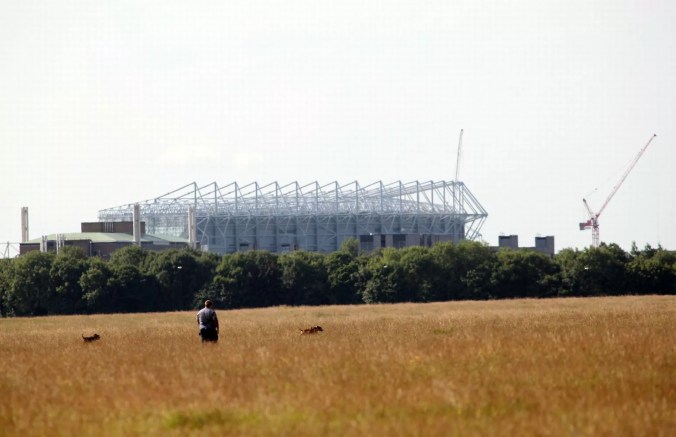
‘St James Park was built on the former site of Gallows Gate, part of the Town Moor. Hence the title of the famous Gallowgate end. It’s said that in 1650 alleged ‘witches’ – likely just innocent women – were hung there in one of the largest mass executions ever held in the country by lunatic ‘witch hunters’. Nearby St James Park is now clearly visible in the distance from the spot.’
‘Apparently modern day witches along with priests had taken the proposition serious enough to try and lift the curse. Obviously, it hadn’t worked. Local newspaper the Evening Chronicle even tried to end a 29 game losing streak of matches in London. In a game at Arsenal renowned psychic Uri Geller was called in for the occasion. When the Magpies won Gunners coach Arsene Wenger said ‘There must be a sorcerer at work’.
‘Found in many religious faiths and ritualistic practices do emotional curses work? Many believe they do, so let us assume then that a curse was placed on the ground, the consequent stadium and therefore team.‘
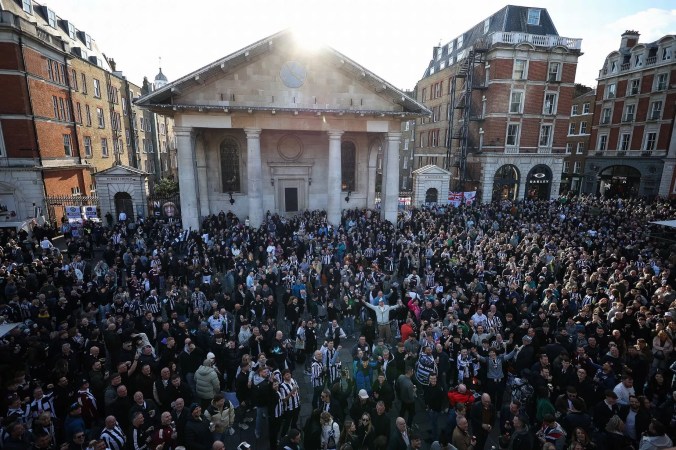
‘In 2023 Newcastle made the Carabou cup final at Wembley and an estimated 50,000 fans invaded London, assembling at Trafalgar Square. The team lost the game. In 2025, making Wembley again, it wasn’t possible to recreate this wild scene as preparations for St Patrick meant that Trafalgar was going to be sealed off. Again, tens of thousands this time invaded the city, meeting up and assembling throughout the Covent Garden area. The following day, this time they won the cup’.
‘I couldn’t help the almost duplicate sounding of ‘Covent Garden’ with ‘Coven garden’, a coven being a group or gathering of witches, from Anglo-Norman ‘Convent’ and ’Cuvent’ from Old French ‘Covent’. By placing the fans at a re-arranged assembly point, was fate playing a part here in overdue fortune of the club?’
‘I looked into the history of Covent Garden, and yes, it does have something of both a religious and occult history especially with the star shaped junction of Seven Dials where seven streets converge at a Doric obelisk topped by six sundials, the column itself serving to cast the shadow of a 7th dial’.
‘Centuries ago, diviners, psychics, mystics, astrologers and the like would congregate there. The ancient fields were owned by Westminster Abbey and Convent – there’s that word again – and the neighbourhood was built on the site of an ancient settlement founded by Pagan Anglo-Saxons in the 7th century.’
‘Was the arrival of up to 50,000 positively charged Geordies somehow transforming a negative energy, a curse, tracing back to 1650? Was this spot the very area – possibly what pseudoscientists call a ley line or an ‘energy highway’ that can connect various historic structures – that needed the timely injection? Could such a ley line connect all the way back up North to Newcastle’s Town Moor?’
‘Initially, to celebrate the win, an open top bus tour was sidestepped and a celebration planned at the city’s Town Moor. However, the open top tour did go ahead leading the team to the Town Moor – to return the scene of the crime, the very place where centuries ago witches were hung and placed their curse’.
‘The Heavens appear to have played their part too. On March 14th the day before the Toon Army headed for London there was a total lunar eclipse and full moon, and on 29th the day of the Town Moor celebration – a partial solar eclipse!’
‘By lifting up a trophy it may well be that Newcastle United were also, after 375 years, finally lifting an ancient curse too’.
Micky Cochrane and Glenn McCrory with Tim Healy, who was ringside on the night of the world title bout in 1989 when Glenn became world cruiserweight champion. (Copyright Ed Waugh)
“Carrying David is emotional and heart-breaking. It’s about the love of two brothers. This is pure theatre. You don’t have to like boxing to be emotionally involved in this wonderful story” said actor, Micky Cochrane.
Carrying David premiered in 2019 and played to full houses gaining the actor a standing ovation for his telling of an emotive and inspiring story.
Post-Covid, the play was staged in London and toured the north of Ireland to sell-out crowds, including the prestigious Lyric theatre in Belfast.
The play tells the incredible story of Glenn McCrory’s rise to becoming the first-ever world champion boxer from the North East. It also has the further twist that Glenn’s terminally ill brother David inspired him to become the best in the world.
The play was written by Ed Waugh who brought North East working class stories to the stage Wor Bella, Hadaway Harry and more recently The Cramlington Train Wreckers which toured the region with sold out performances.
Ed explained“This play is about two lads from Stanley. Glenn McCrory played by Micky Cochrane – aiming to become world boxing champion and his brother David McCrory – fighting every day to stay alive!”
David’s muscle-wasting disease meant Glenn often physically carried his brother on his back, hence the title of this fantastic story.
“David and I were very close,”said Glenn, a former Sky television pundit. “He was my inspiration. David would say, “If I can defy death, you can become a world champion! Saying those words still brings tears to my eyes. I think of David every day.”
David was not expected to live beyond 14 but evaded death until he was 29, living to see his beloved brother win the coveted world cruiserweight title in 1989.
The fight was held at Stanley Leisure Centre and broadcast live throughout the world. It is the remarkable story of an underdog defying all the odds – a North East story that people still talk about today.
Ed added “The performance by Micky is sublime. He won a standing ovation at every venue, the reviews are all five-star.Rocky was a great film…but this County Durham Rocky story is even better…and true!”
Carrying David will be performed at Newcastle Theatre Royal on Saturday and Sunday, June 21 & 22. Tickets (including concessions) are available from the Theatre Royal or via the Theatre Royal websiteCarrying David | Newcastle Theatre Royal
In previous posts Tony has talked about the influence Ginger Baker had on his drumming, and the many nights with friends going to watch bands like The Nice, Tina Turner, Jimi Hendrix and The Animals at Newcastle’s Club a’Gogo.
Before joining the Pirahna Brothers, Tony drummed for North East band Turm with Micky Balls (lead guitar), George Sturrock (guitar), Alf Passmore (bass) and the late John Lawton (vocals). He remembers the night they got a gig opening for Jethro Tull in a County Durham club.
‘It was an amazing experience to play on the same bill as the legendary Jethro Tull, unfortunately, the venue we were booked in was the Argus Butterfly in Peterlee. I say unfortunately because The Argus Butterfly was and still is a difficult venue for two bands to play as the stage and concert room are really small and there was an even smaller dressing room at the back of the stage’.
‘We arrived first and set our gear up and heard that Jethro Tull and all their equipment were travelling up from London in a small Thames van’.
Turm at the Cellar Club, South Shields
Before big names including Cream, Pink Floyd, Deep Purple, Jimi Hendrix and Led Zeppelin packed out halls around the UK, they built their reputation playing smaller venues including Bay Hotel in Sunderland, Club a’Gogo in Newcastle, Cellar Club in South Shields, Kirklevington Country Club in Yarm and Argus Butterfly in Peterlee.
‘When we got the booking I hadn’t heard of them as they were yet to hit the big time but when they entered the club, we were all fascinated by the lead singer. He was very thin, wore unusual hippy type clothes and had very long hair. This was becoming the fashion in London but was yet to be a fashion on Tyneside. Here was Micky and me wearing brightly coloured satin shirts in pale blue and fluorescent pink – so last year darling!’
‘All the guys were very friendly and were taken by our Geordie accents. They piled their equipment out of this small van, we wondered just how all their gear, four band members and a roadie got in the van – never mind drive 200 miles up the A1 dual carriageway. Note – there were no motorways yet’.
‘We were ready to play our set. Our fourth song in was a rousing number called Amen which had three or four sing along choruses with clapping to accompany it. This was a perfect song for John’s voice and the girls loved it’.
‘Each time the chorus started I would jump off the drums and go back stage clapping as I did. It sounds ridiculous, and it probably was, but it seemed to work well for the show’.
‘However, Mick Abrahams, the lead guitarist of Jethro Tull, was in the dressing room catching a well-deserved snooze on top of several amp covers. The first time I rushed in he jumped up in shock but then he saw the funny side when I ran back on stage for the opening riff after the sing along chorus. The next time I did it, Mick was laughing a lot as he had watched me returning just in time to start up after the chorus. The third time however he was ready. He grabbed me by the arms and didn’t let me return at the end of the chorus’.
‘The looks on the rest of my groups faces was a picture when they started with no drums. I can still see the vision in my mind today. Fortunately, he let go of me and it didn’t ruin the whole song, great guy, and a great laugh’.
‘After our opening set it was time for Jethro Tull to go on and they just couldn’t have been more different to us and were truly mesmerising. Their music was unlike anything I had heard before and their style was far away from anything I had seen before on the various stages in the North of England’.
‘Another first for me was that Ian Anderson, the main vocalist and front man, played a flute that was a huge surprise. He also played harmonicas which he kept in small leather pouches around his waist and there was a funny side to this. He also kept his cigarette tobacco in these pouches and this meant he had to knock the tobacco out of each harmonica each time he was about to play them which was really very funny to watch’.
‘The visuals of the band were like nothing I had seen before and Ian sang many of his songs on one leg. This became his trademark as time went on and still is today. The drummer and bass players were very solid, had a great sound and the band was well received’.
‘Turm and Tull had a great time together as fellow musicians even if we probably looked a bit out of the current fashions in London. After this meeting they released Living in the Past a song that started my romance with my wife Jane many years later’.
‘They became rock superstars filling massive stadiums all around the world to thousands of people. I wonder if they ever thought back to the good old Argus Butterfly in Peterlee, the Turm and the 200 plus audience – somehow, I doubt it’.
Words: Tony Hodge
Edited: Alikivi May 2025
More stories on the site from Tony Hodge including Jimi Hendrix, Cream, Tina Turnerand Club a’Gogo.
This second part of Tony’s memories feature his pilgrimage to Newcastle’s Club a’Gogo where he saw many bands who were on their way to a successful career in music. They included Amen Corner, The Nice and a young guitarist from the United States – Jimi Hendrix.
North East venues for the Hendrix tour in 1967 included dates at Kirklevington Country Club in North Yorkshire on January 15th. The Cellar Club, South Shields on February 1st and February 2nd at Imperial Hotel, Darlington with a gig at Club a’Gogo in Newcastle on March 10th.
‘We were right at the front and only a few feet away from the great man himself. He was tall and looked very young. His style of guitar playing was like no other I had ever seen – even playing with his teeth on some numbers. At one point Hendrix dropped a ten shilling note and the guy next to me rushed to pick it up and hand it back to him. He thanked him saying that was for the bands supper’.
‘He went on to finish the night with a long guitar solo and then thrust his guitar into the ceiling leaving it there with the feedback screaming as he left the stage. On many subsequent visits we saw the hole still in the ceiling. A great memory of a great night’.
‘Over the following months we saw many emerging London based bands play at the a’Gogo like ‘Amen Corner’ with Andy Fairweather Low, Jeff Beck with a very young Rod Stewart as his main vocalist wearing an extremely long college scarf and of course our very own local mega band ‘The Animals’
‘This club forged mine and many other local musicians’ tastes for the years to come and we got to see megastars playing only a few feet away from us’.
‘While I’m talking of being right up close to your idol musicians there are two more instances of things that could never happen today. On these occasions my brother Barry and I went to music events at the Sunderland University students Union’.
‘On one night ‘The Nice’ played and my brother was sitting on the edge on a two-foot-high stage only a foot or two from Keith Emerson and his famous Hammond Organ when he did the world renown stabbing of the keyboard. We also saw Tina Turner when she was still performing with Ike. She wore a one-piece lemon coloured jump suit and looked amazing. Once again, only feet away from us, wow!’
‘We didn’t know it at the time that only a few months after these events these bands would play in much bigger venues and stadiums so the days of being within a few feet of your idol were gone for ever’.
Plaque for Handyside Arcade and Club a’Gogo in Newcastle.
‘Sadly, the Club a’Gogo itself was only open for six years, it became a bingo hall as the game was becoming all the rage in the North East. Finally, the club and the surrounding buildings were demolished in the 1980’s making way for the Eldon Square shopping complex. The club was only open for a short time but the mark it left on the Newcastle music scene was amazing’.
‘These venues were where I started to love that different style of music, but it wasn’t until we formed bands that I got the chance to play it not just listen to it’.
Words: Tony Hodge
Edited: Alikivi May 2025.
Link to previous interview with Tony from February 2021 >>>
On 1st February 1967 on his way to becoming one of the most influential guitarists of the 1960s, Jimi Hendrix played the Cellar Club in South Shields.
A previous post (19 March 2025) looked at the impact this gig had, also mentioned was the opening of the new Cellar Club in December 1966 by Cream.
Reading the article stirred up some memories for North East musician and actor Tony Hodge, he recalled the time he was introduced to the band and in particular the drummer Ginger Baker and how influential he became in his life.
‘In the sixties my good friend Ray Laidlaw played in Downtown Faction along with Rod Clements and Simon Cowe – all three became famous in the amazing band Lindisfarne. Ray and Rod had an excellent bass and drums connection, driving the band’s music with real power – I loved to hear them play’.
‘On many occasions we went to see each other’s bands play at various venues including the Briar Dene Tavern in Whitley Bay and The Nautilus Pub, a short walk from my house that became a regular haunt from 1964 onwards.’
‘I would often go with Micky Balls and meet Ray and other likeminded musicians like Billy Mitchel, Will Browell and Billy Dunn. We always had great meetups and all types of music were discussed’.
Micky Balls and Tony in Newcastle.
‘One night near Christmas 1966 Ray mentioned he had heard of a drummer that played with two bass drums. This drummer apparently could play a drum roll with his feet!’
‘A drum roll is hard enough to play with your hands using sticks, never mind with your feet using foot pedals. I found it hard to do a fast double beat that was required in some pop songs of the time never mind a full drum roll. I said I couldn’t see that it was possible and we had quite a heated discussion about how impossible it would be’.
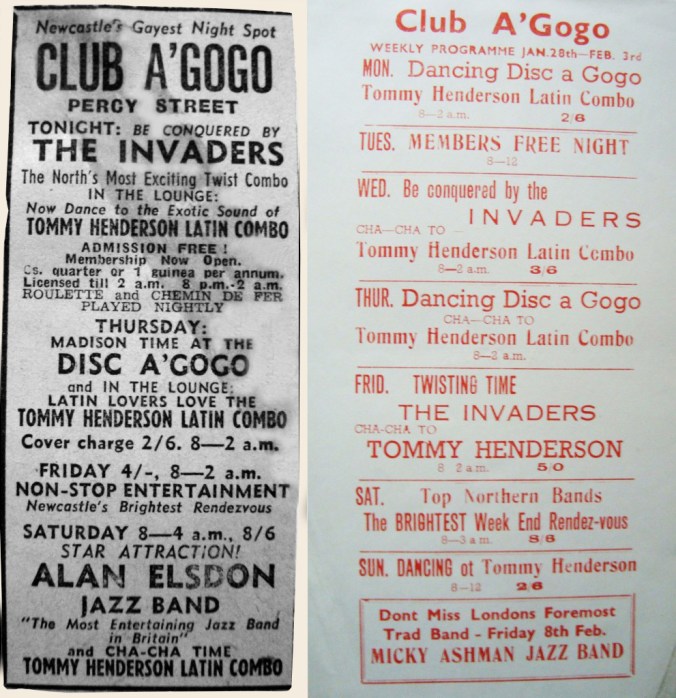
Fortunately, the band were due to play at Newcastle Club a’Gogo and Ray saw this as a chance to convince Tony. The Club a’Gogo was a popular venue housed in two upstairs rooms above Handyside Arcade in Newcastle.
It opened in 1962 as a jazz club but broadened its musical style and became better known as a Soul, Rhythm n Blues and Rock venue attracting big stars likeThe Who, The Rolling Stones, Jeff Beck and local stars The Animals.
Tony explained ‘It was split into two separate rooms each with its own stage three feet up from the floor. One room was called ‘The young set’ for under eighteens and the other was called ‘The jazz lounge’ for everyone young and not so young’.
‘When the big stars played there, they would play a set in each room. This must have been a nightmare for the road crew as during the interval everything needed to be set up in one room then taken down and set up in the other’.
‘If you got in early, you could be right at the front and literally a couple of feet from the stars. That was amazing for a fan. On every visit I always got to the front and had the most amazing view of people who were to become megastars’.
‘We had come to see the band that we had discussed in the pub with this special drummer. It was a newly formed band from London. Unusually they were just a three-piece group, lead guitar, bass guitar and drums and had no separate singer as was the popular set up of the time’.
‘The club had an amazing atmosphere, it was dark and you were all packed in together. Small lights lit the stage which was only big enough for artists to play and not a lot of extra room for big theatrics. The stage was absolutely packed with equipment’.
‘To each corner were two sets of PA speakers and on the right-hand side were four Marshall 4×12 cabinets and the same on the left-hand side. In the middle was a set of Ludwig drums with two tom toms, two floor toms and two bass drums showing the name Ginger on one drum and Baker on the other. Yes, this band was Cream and the amazing drummer Ginger Baker. At this time of course, I had no idea who he was – but that was about to change’.
‘On came a man dressed in a long purple Teddy boy jacket and a ginger quiff with a half pint glass of rum (I think) in his hand. He sat down picked up his sticks and hit all four tom-toms then did an amazing roll on the two bass drums. He stood up and left through the back door of the stage, his sound check completed. This was the one and only Ginger Baker’.
‘Both Ray and I just stood and looked at each other in amazement. The speed and technique were just amazing and so different to us two young drummers, I heard nothing like it before’.
‘I was still recovering when two other guys entered the stage and came to the microphone. Ginger came through and sat down behind this huge kit. They started to play with no count in just heavy tom-tom beats, then guitar, then the man in front of me who was Jack Bruce started to sing ‘Driving in my car, smoking a cigar, the only time I’m happy is when I play my guitar’.
‘The opening to N.S.U. was like nothing I had heard or played – ever! The drums rolled around the kit the volume was deafening and when the guitar solo came in by Eric Clapton the hairs on my neck stood up. It was loud, very loud. It was something you never forget’.
‘The rest of the set was also amazing playing in a style I could never have imagined. Ginger played a drum solo that was again long and loud but it ended with him playing the two bass drums and his tom toms in a chest thumping roll that went on for several minutes.
That was the famous twin bass drum roll Ray had been talking about, it was true, a drummer could play a drum roll with his feet. I had to learn that, I had to be able to play drum rolls with my feet. I was hooked’.
‘The trip back on the bus was all about the miracle we had just seen, a drummer like no other. I was changed overnight, by this one-man, Ginger Baker. Without my friend Ray persuading me to go to the Gogo to see him I would not have become the mad drummer I became. That night ‘Animal’ was born’.
‘I had to have a double bass drum kit and if possible, a Ludwig one. Off again to the music shop and more debt but I got a lovely Ludwig drum kit with a pearl finish just like Ringo Starr. It looked and sounded fantastic’.
‘Once I got this kit my whole style changed. I was more brash and started playing a drum solo at the end of The Pirahna Brothers first half. It was long, loud and not very technical but this new style and the notoriety it brought with it opened many doors. My nickname was ‘Animal’ and people shouted it out at venues’.
More stories from Tony Hodge coming soon including Jimi Hendrix, The Nice, Jethro Tull and Tina Turner.
Edited: Alikivi May 2025
Link to previous interview with Tony from February 2021 >>>
These recollections are from two former pupils who attended Westoe County Secondary School over 50 years ago. The South Shields school was on Iolanthe Terrace and closed down in the 1980s. It had a fearsome reputation amongst schools in the town.
MJ: You could walk past the outdoor toilets, get nabbed and have your head stuffed down the bog with the chain flushed. Plumes of smoke rose from the roofless toilets – I made a Prefect report on the smokers. I knew if I did, they’d kick my head in.
New boys could be thrown over the 6ft wall into the girls school next door. They were unable to climb back over as the girls would de-bag (pull trousers down) them and threaten them with used sanitary products.
Our most dreaded teacher had a bald head onto which he applied some strange lotion that left him wafting carpet cleaner as he went by. Pupils hidden at a distance would shout his nickname whenever he went by in the playground and he’d produce a little note book and jot in it pretending that he knew the culprit to be dealt with later.
He was once seen kneeling in front of his desk as if it were a sacred shrine. He told the kids he had his hair pulled out in a Japanese prisoner of war camp during the second world war. Other teachers told us to ignore him.
IT: There was obvious staff room conflict regarding his sadistic attitude to the kids and over use of the cane. I recall our English teacher deriding him to us a few times. I remember teachers rowing with him in the dinner hall on a couple of occasions.
MJ: We had an equally dread teacher, when you went into his classroom you’d stay absolutely silent throughout. Although sober he was like an inebriated Oliver Reed on a live chat show, you were on edge from the start fearing his unpredictable behaviour as he’d make it clear from the start, behave or he’d ‘crease you’ or ‘ruddy do you’.
IT: He was a terrifying man, well built with little patience, and there’d be a sudden burst of anger to any pupil he perceived to be play acting – as if anyone would dare – or gave the wrong answer during the lesson.
He kicked my desk on one occasion and it lifted a couple of feet in the air. I was terrified when he started walking towards me and feared he would lay into me.
MJ: Then there was another teacher who’d top up his earnings as a taxi driver. After handing out maths books he’d write out 10 sums on the board complete with answers and get us to copy them out then tell us to do the next 10 on our own.
We couldn’t do any to save our life so when we handed our books in for marking he’d mark the first 10 as correct and the other 10 with a cross. If you dared go to his desk and ask for help in doing one of the remaining sums he’d look up from his newspaper and say ‘Go away – you’re barmy.’
IT: I don’t remember him ever smiling. He was a humourless man. Seemed to me to be just waiting for retirement.
MJ: We only ever went on one school trip early one Saturday morning, a coach trip to Fountains Abbey. From the moment we left we were rowdy and when someone threw a shoe out the window after 20 minutes the teacher had the coach turn round and that was that.
Whenever rumours went round in an afternoon that nearby school Ocean Road were coming round at home time to scrap with us we’d break legs off wooden chairs in preparation but they never once turned up. The teachers never understood why in the morning they’d find all the chairs broken.
We once got involved in an inter-schools quiz – a posh lot turned up as challengers. We thought we’d have no chance but they weren’t all that hot and somehow we had equal scores right up to the last and potential winning question.
‘What sport is played at St Andrews?’ An arm shot up from one of ours. ‘Football’. ‘Incorrect’ came back the answer, they answered ‘Golf’.
We didn’t know about golf at St Andrews only that Birmingham City’s ground was another St Andrews. We wanted our hands on the winners but they received a hurried escort out the building.
IT: The fact that there are no Westoe School class photos spoke of the low value attached to schooling and futures of those in the lower education system. I reckon there must have been a Caning League mentality amongst some of the staff and a culture in which status was earned based on flair or disciplinary prowess. Maybe some had a City & Guilds qualification in caning. Perhaps the staff room walls were plastered with framed certificates.
MJ: When the school closed down I wonder if they left all their canes behind in a cupboard?















 ALIKIVI UK : NORTH EAST MUSIC & CULTURE