EURO GOES POP in conversation with David Ducasse from pop band Scooch

A previous blog made a link from South Shields born jazz musician Kathy Stobart to Radiohead. This time trying a bigger stretch from South Shields to Swedish Kings and Queens of goth pop ABBA….

Well there was two boys and two girls (laughs). We were more like STEPS than ABBA….tho’ I wish we’d won like Abba !

What happened after Scooch had been selected to represent the UK ?

Well it was just mad, I wouldn’t say it was scary, just full on. When we were chosen things were never the same. The last UK entrant to win was Katrina and the Waves in 1997 and she was brilliant. It’s almost like a Eurovision family once you’ve done it.

We’ve done quite a few gigs around the Eurovision night and you all perform on the same shows, your paths cross. It’s because you have achieved something, a milestone in your career, it was a moment in time for us or you can get unbelievable success like ABBA.

1

In 2007 Eurovision was held in Helsinki and the UK representatives were pop band Scooch including South Shields born David Ducasse. The song Flying the Flag reached number 5 in the UK charts, unfortunately didn’t do as well in the competition….

We came second to last, but the experience was the closest we got to huge exposure. It was something we never imagined, just to have that opportunity. Sometimes it feels like five minutes ago and other times it’s like Did that really happen ?

Not many people get to represent their country at anything…

Yeah, that was the lovely thing about it, almost having a second life with Scooch because we had done stuff in the ‘90s and the demise of the band then felt like the rug was pulled under our feet.

Our lead singer Nat got pregnant and of course needed time off, and sadly Russ and Caroline just went separate ways and we all chased very different dreams.

We thought why get back together and pursue something which was really hard work and we were at that point where it was make or break. Coming back for Eurovision ? We just didn’t see that coming.

How did the Eurovision entry first come about ?

Russ had been in the audience of Eurovision with his friend James Fox (UK representative 2004) and at the end of it they were talking to the producer Dominic who he had met years before when he was a runner on a show called Liquid TV.

Dominic told Russ he can remember Scooch and asked him what are you doing now sort of thing, well Russ being a chancer just said, ‘How do you think we’ll go down on this show ?

Scooch still gigged now and then, within a few months of that conversation we got a call saying ‘Would you like to give it a go ?

We never thought it would happen but I remember it was on a Valentines Day 2007 and we were in ! An old Scooch song which we demoed but never done anything with, was submitted but Dominic said it was too good.

Too good ? What did he mean ?

The entrants for that year were all blasts from the past, remember we hadn’t got to the actual Eurovision yet this was the selection process to find who was going to represent the UK.

It was all people who had done something before like Liz McClarnon from Atomic Kitten, you had Brian Harvey from East 17, Justin Hawkins from The Darkness was thrown in as the wild card at the end.

So you had your own niche like R&B, a ballad type of thing, rock, and for want of a better description we were the cheesy act. This was a new label for us although we had been around in the ‘90s as a pop group.

Dominic asked if we had anything else. Russ was doing some work in film at the time and he was working with two songwriters, Morton from Sweden and Paul Tarrie, they were writing a song for an animation movie featuring aeroplanes.

One idea was around the inflight announcements, they went with that, and Russ had the bap de da bap chorus, they asked for more, but it didn’t exist then !

Meanwhile we got to a studio in London where Morton and Paul were writing the rest of the song, we put it down and then left them to craft it all together for what became Flying the Flag.

Originally, how did you join Scooch ?

The manager Steve Crosby was a former DJ, he put STEP’S together and wrote their big hit 5,6,7,8 with Pete Waterman. But he was ousted from there so put together Scooch as a big two fingers up to Waterman, that’s why he went to Watermans former partner in the record business Mike Stock.

What happened was Scooch had just lost one of their members so put an advert in The Stage newspaper and I sent my cv and demo in.

Natalie, Caroline and Russ liked me so I went down and hung out with them in Surrey where they were based, just got to know each other, and got on really well. Steve said go back to Newcastle have a think about it and so will we and we’ll speak soon.

Next day the call came… ‘You’re in’. I was already in development with a boy band called Northern Line but they didn’t seem as settled, a few members came and went, so I jumped ship to Scooch.

When was this and did you move to London ?

Around late 1997 cos it wasn’t another 18 months until we got the deal. No I didn’t move straight away, every so often I would go down rehearse, record a vocal , learn a routine. I used to clean Kirkpatricks pub in South Shields to pay for my train ticket.

Then Mike Stock got involved and re-recorded one of our songs, he put his magic on it and Steve started knocking on doors of record companies or they would come round to a rehearsal.

On one day you’d have a couple of A&R from a company coming at 1 till 2pm, then another like Polydor at 2 till 3pm.

We’d sing When My Baby, Syncopated Rhythm, a cover of You to Me are Everything then When My Baby acapella to prove we could sing.

Then we’d sit down, and they’d ask a few questions, they always asked would I move to London. Which I did eventually in May 1998.

Where did you live ?

Our manager Steve had a record shop in Stoneleigh and he lived in the flat upstairs, then he moved out and Russ and I moved in. I think it’s an Italian restaurant now.

Thing was then, I was 22 years old, but I always had to remember my Scooch age in interviews. We played it a few years younger than we really were.

Who were the songwriters for Scooch ?

The majority of the songs were Mike Stock and Matt Aitkin, Morton a songwriter from Sweden also wrote some.

We had a development deal with Mike Stock and part of that agreement was that we were to write some of our own songs and Morton was the guy to help us develop those skills. It was a nice team we all knew and trusted each other.

What studio did you record in ?

For Flying the Flag it was Mortons house in Fulham but back in the day it was 100 House, the home of Love This records run by Mike Stock. It was an incredible place to be, it had the recording and dance studios, with amazing choreographers working there.

One day was Diana Ross rehearsing for Top of the Pops next day Atomic Kitten and Christmas parties with everyone turning up. Basically it was pop heaven seeing all the artists in the canteen and their records on the wall, people I had grew up listening to. Yeah it was a great experience.

What was your experience of dealing with the record company ?

Basically, the record label are like a big bank so you get a budget for whatever deal they give you. We were at EMI on their pop division label Accolade records, and they just liked us.

Our first deal was a single and they gave us x amount of thousands of pounds to promote the single. They said ‘Let’s see how it charts and then we’ll see where we go’.

We got a second single out with an option to a third and our second release More Than I Needed to Know hit number 5, a great success. The record company said ‘ok let’s do an album’.

But being four naïve youngsters we never made any money from ‘90s Scooch. Every hotel you were staying in you were spending your money, you had to make money back before seeing a penny.

I spent a lot of time with the management and asked them ‘Why are we staying in the Malmaison with four separate rooms? Why do we have four separate cars ? I cottoned on.

I went to the band and said we need to get clever here, get some endorsements, we only got an advance of around £2,000 between us. So how do you pay your rent in London ? We had to wise up a bit and find ways to cut costs.

I loved our manager Steve as a friend, but as I was spokesman for the band we would also have business conversations. One day he said he was putting his expenses in and I asked him what expenses ? He said ‘When we’ve went for a meal or I’ve paid for your train ticket to Newcastle’.

I needed to investigate further, we were learning as we were thrown into it, because with the record deal came lawyers and who was paying them ?

When we done the two singles and looked to the album we were potentially going to do more work, that was another expense, so we needed to look after our side of things.

How did you survive in the business ?

Just things like when we done Top of the Pops, this was our third time, I told Steve we had to wear something different from the music video we had filmed for the single.

Top of the Pops wanted us to film three versions for different episodes of the show, so we borrowed outfits from the All Saints girl band, then Steve got £50 off the record company to buy new outfits.

Russ and I were due to sign on the dole in Epsom on the afternoon when we were supposed to record the show. So I rang up the dole and explained why we couldn’t make the signing on time…

’Cos we’re doing Top of the Pops’. He didn’t believe us at first ‘Can you prove it and are you actually seeking work ?

I said, ‘Of course I can prove it our faces are on cd’s, it just doesn’t pay well that’s why we’re signing on’ (laughs).

They agreed we could sign early, so when we went there we signed autographs and had our pictures taken, then made our way to the TV studio. We still got our Job Seekers Allowance because we really needed the money for our rent in London.

Our biggest earners where sponsorship deals, we were paid ambassadors for the Children’s Health Authority and the Rugrats DVD things like that. Touring is the best way to make money that’s why Little Mix go out twice a year.

Looking back to your time in Scooch where there any moments that stand out ?

You can’t get better than the live Eurovision audience, knowing that for three minutes everyone will hear something you’ve worked really hard at.

Although I did have two nearly pinch myself moments. One was meeting the Prime Minister Tony Blair in the corridor at GMTV and he shouted ‘Look it’s Scooch!’ and getting to press the button on the National Lottery draw ! Yes easily pleased (laughs).

Was there a moment when you thought this is it I’ve made it ?

I don’t think I’ve ever felt that way as a performer because I’ve always viewed each job as a role or a stepping stone to where I always wanted to be – an actor. My dream job would be a six month stint on Emmerdale – so I can get home on a weekend!

What’s next David ? We have something planned but can’t tell you just yet. Watch this space.

Interview by Alikivi  January 2020.

COUNTRY MAN with ex-BBC Radio presenter Stan Laundon

Magic times don’t come around too often but David Bowie had a few with ‘Life on Mars’, ‘Starman’ and ‘Ashes to Ashes’ where he could be wagging his finger singing the brilliant nursery rhyme lyric ‘My mama said, to get things done, You’d better not mess with Major Tom’. 

After watching the TV series Life on the Road with Brian Johnson his guest was Dolly Parton telling him that her two biggest hits, ‘Jolene’ and ‘I Will Always Love You’ were written in the same night – not just a magic time, that’s a magic hour. With ‘I Will Always Love You’ Whitney Houston banked millions for DP in song writing credits while ‘Jolene’ has been covered by many artists including dark goth rock band The Sisters of Mercy.

Dolly features in this interview with former Radio presenter Stan Laundon who throughout his career has interviewed and worked for many stars…

In 1974 I made my first ever visit to Nashville, Tennessee, and because of my BBC connections I met up with a host of country stars including Johnny Cash, Dolly Parton, Conway Twitty and one of my own idols, Jerry Reed. Jerry wrote US Male and Guitar Man both tracks eventually recorded by Elvis Presley.

During my time in Nashville, I was looked after by a public relations man who asked me where I was from and I told him Hartlepool and gave him the story of the Hartlepool Monkey.

Legend has it that during the Napoleonic Wars a shipwrecked monkey was hung by the people of Hartlepool, who believed him to be a French spy. To this day, people from Hartlepool are affectionately known as ‘monkey hangers’.

Unknown to me he relayed the story to Dolly Parton, who I met three times in the week I was there. On my third meeting Dolly smiled and held her hands to her throat!

When I asked her what all that was about she replied ‘You’re a Monkey hanger!’ So I’m proud to have been called that by such a huge star (laughs).

Dolly Parton

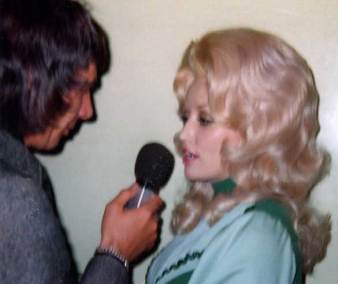
Stan with Dolly Parton in Nashville, Tennessee June 1974. Photograph © Shay Brogan.

Are you from a musical family Stan ?

No, my parents rarely listened to the radio when I was young. I got interested in music when I was at school. There were one or two lads who played guitar at break times, and I thought, maybe I’d like to play the guitar one day.

I remember I was introduced to the music of Gilbert & Sullivan for the first time when one of the teachers arranged for the schoolboys and girls to stage HMS Pinafore.

However, it was my time away from school when, like many teenagers I listened every night to Radio Luxembourg, early pop music and especially Lonnie Donegan.

It was a few years later when the British pop scene took hold and I got into the music of Joe Brown, Billy Fury, Johnny Kidd and The Pirates and so on.

It was round this time when I was introduced to country music and enjoyed the early recordings of Johnny Cash, George Jones and Buck Owens.

After leaving school what was your first job ?

As my father had been at sea for most of his early life, I thought it might be a good idea to try to follow in his footsteps. My father agreed but my mother said an abrupt ‘No!’ she said I’d be better off serving an apprenticeship. So, it was off to Richardsons and Westgarth to serve my time as a turner.

Also round this time I persuaded my mother to buy me a guitar. I bought a copy of Bert Weedon’s tutor book Play in a Day and a friend of mine also gave me lessons.

My time in the factory also introduced me to another musician, Alan Lindridge. He used to laugh at me singing songs by Lonnie Donegan.

The laughter turned to friendship and both me and my neighbour, Billy Crallan, joined up with Alan in his pop group The Trakkers about 1959/60.

You ran Joe Brown’s Fan Club, how did that come about ?

When I was about 18 I was a member of Joe’s Fan Club and was told that the young lady who ran the club was about to give it up to go and train as a nurse. The idea of running Joe’s fan club appealed to me so I tried to arrange a meeting with him at a theatre in Sunderland.

Thankfully, the management passed on my request, and I managed to meet up with him after the show.

Coincidentally, I met Billy Fury in the hotel car park who took me into a reception area when he called Joe to come down to meet me. After some discussion Joe said he’d like me to run the fan club and I had to write to his manager in London about our conversation.

After the paperwork was completed the Official Joe Brown Fan Club was run by me from my mother’s house in Dyke Street, West Hartlepool.

What were your duties in running the fan club ?

When Joe had his number one hit with A Picture of You in 1962 the number of fan letters he was receiving went from just a couple of dozen a week to hundreds!

I was a busy young man at this time – playing with The Trakkers, working in the factory and running Joe’s fan club. This was long before the days of computers – so all fan mail replies had to be written on a typewriter.

I couldn’t do it all so I telephoned Joe and said I can’t continue. He said, ‘Then pack it in’ I said I was sorry it had come to this, and he said ‘No, you don’t understand, I mean pack your job in and come and work for me in London!’

I didn’t think twice, so at the tender age of 19, I did as he said and moved to London and spent four happy years with him down there from ‘62 until ‘66.

On my arrival in London, I was fortunate enough to be staying with Joe’s mother in Wanstead and, after six or seven months, things were about to change again. Joe called round one day and said, ‘I want you to pack it in!’.

I thought what have I done wrong. ‘I’m sorry’ I said. He then replied ‘No, get someone else to run the fan club because I want you on the road with me!’ 

So, I became his road manager – even though I couldn’t drive at the time – and I travelled all over the country with him doing shows with Marty Wilde, Billy Fury, Johnny Kidd and others. I even met The Beatles and Roy Orbison at The Empire Pool, Wembley in March 1963.

Eventually Joe stopped touring as he went into the West End to appear in a musical called Charley Girl with Dame Anna Neagle. I was beginning to get a little bored and decided to find another job and say my goodbyes to Joe which I did in October ‘66 and moved back home to Hartlepool.

For the next few years, I did some freelance work as a journalist writing a country music column in Hartlepool Mail as ‘Country Boy’ and following motor sport at Croft, near Darlington, and reporting on that too.

How did you get involved in radio Stan ?

In 1970 I read in my local paper that a BBC radio station was planned for Teesside. With my musical background I applied for a job and was fortunate enough to be given a position as a technical operator at BBC Radio Teesside in September 1970.

The radio station went on air for the first time on New Year’s Eve 1970 and because of my interest in country music, the management allowed me to present a programme called ‘Country Time’ which was broadcast for 25 minutes.

This proved to be popular and in February ‘71 they increased the programme running time from 45 minutes. Then in 1972 it went to an hour before eventually running live for two hours every Sunday afternoon. The programme ran for 21 years!

Looking back how would you sum up your career in radio ?

I had 23 very enjoyable years at the BBC, starting as it was as BBC Radio Teesside, becoming BBC Radio Cleveland in 1974 and now BBC Tees.

Needless to say I was a very happy man and they invited me back in April 2011 to help celebrate the 40th anniversary of local radio on Teesside when I presented another two hour show on Easter Sunday!

To contact Stan check his official website: 

www.stanlaundon.com 

 Interview by  Alikivi  February 2020.

SMOULT THE BOLT

In 2006 the idea was to make a number of short documentaries in South Shields featuring residents of the town and their hobbies, interests or passion. The first was Colin Smoult, this was his story and a link to the 4 minute film is at the end. 

South Shields has always been a rock town and even when music has faded and past like the indie culture of the late ‘80s, the big dance boom of the ‘90s then you’ve still got the rock scene.

We might be gettin’ older, greyer, fatter but I think a lot of people in this town will always have a place in their heart for rock music.

We’ve always had people from this town that’s been so fanatical for the bands that they have followed. I’ve grown up with many of them from my late teens onwards and some of them remain just as passionate about their music now as they did over 25 years ago.

My name’s Colin Smoult I’m 42 years old and I live in a town where I was born, South Shields. A small seaside town 10 miles east of Newcastle.

My occupation is a shopkeeper, its essentially what people used to refer to as a head shop. I sell things like pipes and bongs which 20 years ago might have been seen as very risqué.

But this day and age it’s all fairly acceptable. It’s only a tiny shop with a minimum amount of trade but I’m me own boss and if it pays the bills, I’m quite happy. That allows me plenty of time to pursue my other hobbies and interests – my main one is local live music.

I’ve been the singer and guitarist in a band called Shovelmouth for the past eleven years now and we play various gigs in pubs scattered right across the region.

The songs are all rock cover versions, but the pub rock scene is huge in the North East of England. On a Friday and Saturday night there are probably 100 pubs and more putting on live entertainment featuring full on rock bands.

South Shields alone has half a dozen pubs that put on live music and the largest of these is called The Office. Not only does my band get to play there but I am responsible for booking the acts every weekend.

The acts are normally small local bands playing a variety of covers but now and then we put on special events that feature tribute bands, some of these are from out the area.

I’m a rocker at heart but I find there is a lot of people who love this kind of music, so I book the bands that people want to see the most. I’m pretty passionate about live music and only book the very best from the talent that we have.

Some people may see it as a bit sad and may view it as a bunch of middle-aged folkies trying to re-live their youth, but nostalgia is a big booming industry and if people want to see songs from their youth played live in their local pub – then who am I to deny them.

Whether I’m the bloke singing the songs or the man who books the bands I’m content to know I’m doing my bit to allow people to have a good time after a long week at work.

I’m also involved with a website called Riffs which pushes and promotes local bands, and apart from news pages and gig guides I also post up my own reviews of the many bands that I get to see here.

So, I suppose my hobby is full time because as well as being directly involved every weekend, during the week I am always writing things up and arranging things for the venue and my own band.

I like to keep in touch with lots of groups out there and there’s quite a lot of time spent gob shyting with people on the internet as well.

Don’t get us wrong I get a big buzz out of being on stage and entertaining people, but if you’ve got any band up there on stage with a superb crowd watching them, for me the atmosphere in the room is just as enjoyable.

The standard of musicianship on the local circuit is extremely high and is way beyond what people would term as pub bands in other parts of the country.

The old club scene has become a lot more pop orientated in the last 20 years and a lot of the rock players that used to play that circuit have now moved into the pubs instead.

So, the end result is that we have some amazing musicians kicking around and most of the bands that you get to see are free admission too.

So, for a lot of people aged in their ‘30s, ‘40s, ‘50s watching a live band on a Saturday night is a very cheap way to have a fantastic night out. If I’m not playing with my own band, then I’m here at The Office watching them instead.

Either way for me every weekend is dominated by my love for live music. I got tons of pride in what I do. But for me there’s only one true satisfaction and that’s putting a smile on people’s faces.

If I can be involved in any way with live music that others gain a lot of pleasure from, I get immense satisfaction from doing that.

I suppose as I get older, I won’t be able to bounce around on stage in the same way, then eventually there will come a time when I’ll have to retire from live performances, but I’ll always stay involved with the local band scene even if I have to be brought in on a wheelchair.

I’ve jokingly said that when I die, I want my ashes scattered under the stage of The Office. But honestly, it’s as good a place as any and that way I’ll always be close to what I love.

Alikivi    January 2020.

SANTAS BIGGER BAG O’SWAG

If yer lookin’ for a Christmas present to buy why not take a butchers at these goodies that have appeared on the blog this year. 2019 has seen nearly 100 musicians interviewed and also featured authors and artists….

79318119_437132350300093_5999559298030501888_n

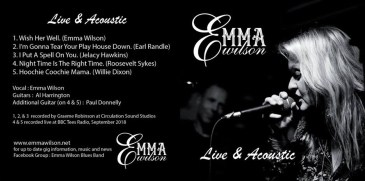
On ‘Live & Acoustic’, Blues Siren Emma Wilson sings 4 favourites from her live set plus her original blues break up song ‘Wish Her Well’. With guitar accompaniment from Al Harrington, Emma’s raw and dynamic vocals shine through

‘I used to sing sweeter soul style but learned and developed a big voice. It was get big or get off’.

The 5 track EP reached no.12 in the Independent Blues Broadcasters charts and received rave reviews from Blues Matters magazine and several American Blues stations.

For a hard copy on CD email Emma at  emmawilsonbluesband@gmail.com or contact the official website : www.emmawilson.net or via Facebook.

bloody well everything icon bandcamp

Gary Miller from folk rockers The Whisky Priests….‘Leaving school in the mid-80’s, being in a band meant having a voice and a sense of hope and purpose during the dark era of Thatcherism. So, The Whisky Priests kind of evolved out of that and initially became a vehicle for expressing all my frustrations and passion at that time’.

Get yer copy of Whisky Priests – ‘Bloody Well Everything’ 12-disc CD Box Set contact: https://whiskypriests.bandcamp.com/merch/chistmas-2019-offer-bloody-well-everything-limited-edition-box-set-only-300-numbered-copies-free-tour-t-shirt

THOMPSON

The Steve Thompson band recorded an album earlier this year…’The Long Fade really is my life’s work. After 50 years of being a backroom boy writing songs for other people I finally recorded them in my own name with a fantastic group of musicians and singers. Making the album was a fantastic adventure with lots of laughs with old friends’.

You can download and stream links at http://www.thelongfade.xyx

Gary Alikivi    December 2019.

SANTAS BIG BAG O’ SWAG

If yer lookin’ for a Christmas present to buy why not take a butchers at these goodies that have appeared on the blog this year. 2019 has seen nearly 100 musicians interviewed and also featured authors, artists and poets.

In his new poetry collection, Jarrow-born Tom Kelly examines the history of the town as he tries to make sense of the past…. This Small Patch is my eighth collection published by Red Squirrel Press and will have its South Tyneside launch on 11th January at 1.30pm in The Word, South Shields’.

To buy a copy contact the official website:

https://www.redsquirrelpress.com/product-page/this-small-patch-tom-kelly

The 10 track album ‘Square One’ by former Tygers of Pan Tang, Fred Purser and Jon Deverill is out on the shelves, where does it stand with your Tygers output ?…. Jon Deverill ‘I’m very proud of it. It’s by far my best work. I’m so delighted it’s been released. We never lost faith that one day it would be’.

Square One by Purser/Deverill available to buy at HMV, Newcastle or on-line via EBay or Discogs.

In 1979 Def Leppard, Iron Maiden and South Shields band Mythra released records making them one of the original NWOBHM bands. Guitarist John Roach…’Yes we never said we were the best, just one of the first. We’ve released a 40th Anniversary Edition of Death and Destiny, we are very proud of it’. 

Order now from: https://mythra.bigcartel.com.

Gary Alikivi    December 2019

SANTAS BAG O’ SWAG

If yer lookin’ for a Chrissy present to buy why not take a butchers at these goodies that have appeared on the blog this year. 2019 has seen nearly 100 interviews posted mostly musicians and also featured authors, artists, poets and TV presenters….

Gary James from The Tube, spills the beans on the groundbreaking ‘80s TV music show in his autobiography ‘Spangles, Glam, Gaywaves & Tubes’….

‘It’s a fabulous main present for ‘70s & ‘80s music and fashion fans you love, or a stocking filler for those you don’t. All for a paltry £12.99 (or cheaper if you can be arsed to shop around). Some bad language (he says ‘sod’ in it)’.

Contact  http://www.bookguild.co.uk

Lowfeye are musician/producer Alan Rowland and song writer Carol Nichol…

’Some songs on our album POW can be political or critical of society. I find the mainstream music scene along with TV celebrities really awful. It’s bland, it’s beige, it’s plastic and unfortunately we are spoon fed this crap by radio and TV’.

Contact Carol via Facebook and get yer copy at only £5 from paypal.me/lowfeye

The Fauves punk band formed in South Shields in 1978 and got back together 2016, bassist Bri Smith…

I’ve got the perfect stocking filler for xmas for all you punks out there – The Fauves latest cd album ‘Back off World’. Most of the songs were written between 1978-81. There is a couple of new tracks and we think it has come out really well. Have a wonderful xmas you won’t be disappointed’.

Get yer copy from Goldies opposite South Shields Town Hall or contact The Fauves on their official website  thefauves.wordpress.com

The Attention Seekers have a regional feel about some of their songs which gain’s regular play on local radio and at St James’ Park. Guitarist, Alan Fish…

If you’re looking for a chilled Xmas why not relax to the sounds of the latest CD from The Attention Seekers ‘A Song for Tomorrow’. Or if you’re looking for something more action-packed why not start Xmas Day singing along with ‘The Fans’ version of ‘The Blaydon Races’. Physical copy of ‘A Song for Tomorrow’ available from  

http://www.the-attention-seekers.co.uk/shop.html 

or download from the iTunes store.

‘The Blaydon Races’ at   https://open.spotify.com/album/6RdXvJhnJxwgPubsFU0cvz 

Gary Alikivi   December 2019.

STOCKIN’ FILLERS

If yer lookin’ for a Christmas present to buy why not have a butchers at these books that featured on the blog this year. 2019 has seen nearly 100 interviews posted mostly musicians but also featured authors and poets like Keith Armstrong

I was interested in people like Dylan Thomas, the rhythm of his poetry. Actors like Richard Harris, hell raisers like Oliver Reed – all good role models! Yeah in my early days I loved the old bohemian lifestyle of reading poetry and getting tanked up.

Order direct from Northern Voices Community Projects, 35 Hillsden Road, Whitley Bay, Tyne & Wear NE25 9XF.

More than four decades after the BBC’s iconic TV series ‘When the Boat Comes In’ was first screened, ‘Jack High’ a novel by Peter Mitchell tells the story of Jack Ford’s missing years. ‘

This is a man who has found a family in war. He interacts with union men, upper crusts, politicians….all he knows is how to survive and when he see’s a chance he takes the opportunity’. ‘Jack High’ is available through Amazon.

Some authors talked about growing up in the North East, like former White Heat front man now music documentary director Bob Smeaton

I was working as a welder at Swan Hunter Shipyards at the time. When punk and new wave happened around 76/77 that’s when I started thinking I could possibly make a career out of music. The doors had been kicked wide open’.

‘From Benwell Boy to 46th Beatle & Beyond’ available on Amazon or can be ordered in Waterstones, Newcastle.

Earlier this year I read a great book ‘The Kremlin’s Geordie Spy’ and got in touch with the author Vin Arthey…

Newcastle born William Fisher turned out to be a KGB spy, he used the name Rudolf Abel and was jailed for espionage in the United States in 1957. He was exchanged across Berlin’s Glienicke Bridge for the American U-2 pilot, Francis Gary Powers. The Tom Hanks film ‘Bridge of Spies’ tells the story of how it happened.

Contact Vin at varthey@gmail.com ‘I have a few pristine copies on my shelf but with p&p, it would come out at £10 more than the Amazon price’.

A big influence on my life was watching and being in the audience of ‘80s live music show The Tube, so when I got the chance to talk to former music TV producer Chris Phipps about the program, I didn’t miss the opportunity

‘As an ex-BBC producer, I initially only signed up for 3 months on this unknown program and it became 5 years! I was mainly hired because of my track record for producing rock and reggae shows in the Midlands’. Chris released ‘Namedropper’ revealing backstage stories from the groundbreaking show.

The book is available at Newcastle City Library or through Amazon.

 Gary Alikivi   December 2019.

FAMILY AFFAIR in conversation with North East songwriter Alan Fish

Loud Guitars Playhouse 4

The Loud Guitars live at Newcastle Playhouse (pic. Paul Hill).

Last time I interviewed Alan (Sept.13th 2019) he talked about his time in North East band White Heat who were signed to Richard Bransons label Virgin. After they folded in ’82, The Loud Guitars were born….

There was three of us from White Heat, me, Bob Smeaton, and Col Roberts, we decided to control everything. Fund the gigs our self and not look for management or deals.

Because there was a dark cloud over the ending of White Heat we thought this self-containment idea would help clear it. Virgin eventually let us go so we had total control, it was very cathartic.

For recording we funded it all, brought in some really good players, professional and slightly younger so from a live point of view they super charged the band. We had Martin Campbell, brilliant rock guitar player, Gary Cowey and Stu Haikney were involved early on as they had their own studio.

Bob and I had songs left over from The White Heat days and really it was a very important time for us to be able to do it independently. When I look back on what I’ve done I’ve always been happier when it’s independent.

We built on the legacy of White Heat and we put out new material with professional musicians who we paid. Now that sounds obvious to pay them but it is the correct way, the job is done well and it makes for a happier work place.

By the early ‘90s The Loud Guitars run their course then I made the decision that was it. From the recordings I felt we pushed the quality up from White Heat days as in that band I felt our studio output didn’t reflect what we were like live.

However, we still weren’t getting a lot of radio play and I became obsessed to write and record music of a standard that would get radio play.

I took time out, this was when technology was advancing at a fair old rate and recording facilities were becoming affordable. So, I invested quite a bit in new instruments, microphones and developed a skillset to record my own stuff.

I set up my home demo studio where I could take the song to a certain point, essentially getting the song down in the right key, right speed, then taking it to my studio of choice, The Cluny Studios in Newcastle run by Tony Davis.

Tony is a fantastic engineer and a brilliant musician so we’ve developed a good relationship over the years where I might play a bit guitar for him on some of his recordings. A lot of North East bands would have recorded there in what is a highly competitive industry.

Att Skrs Cluny Studios with Tony Davis, Paul Liddell, Stu Haikney

In The Cluny Studio, Newcastle (left to right) Tony Davis, Paul Liddell, Alan Fish & Stu Haikney.

When did you put the Attention Seekers together ?

The concept has been around for ten years now, it was to be primarily song writing and recording. I wanted a change from what I’d previously done because the main thrust of White Heat and Loud Guitars was live performance. In a way having the band has unified my family.

When I was song writing in the studio with Bob Smeaton on the record deal after White Heat had finished, I would only do it if I could bring my wife Viv down with me. I’ve seen too much destruction with musicians and their nomadic lifestyle (laughs).

We wanted to share this experience and enhance our life together, but they weren’t happy, so I walked away from it. A few days later I got a call saying, ‘Ok bring her down but she’ll have to cook (laughs)’.

Viv came down and we enjoyed the time together. It’s always been like that since those days. We bought a people carrier to get to gigs, my daughter has played in the band and Viv’s the road manager when we go out at gigs.

I didn’t trade on the back of previous bands because Attention Seekers were so different. We didn’t want people turning up to a White Heat rock gig and end up listening to three acoustic players.

In fact, our first gigs were on busker’s nights where we tried out new material and there was no pressure. My eldest daughter was becoming a proficient violin player so she came along, my brother in law had a nice voice and had never sung live so we eased him in and that added to the busker night.

Publicans were impressed after a few songs and asked us to return and do a full gig. This was around ’98 when we started getting around the pub circuit and we adopted a very low-key policy of no individuals, no front men. This attracted really good musicians who liked the non-committal feel to the band.

I explained this wasn’t about a unit of a traditional band it was about bringing in the right people when they were available because they still had their main bands with regular gigs.

We were getting popular on the whole circuit, places like The Magnesium Bank in North Shields, The Smugglers in Sunderland and Tyneside Irish Centre in Newcastle.

Sounds like there was more emphasis on the song rather than a band ?

Yes, there was I had done the live band thing which I enjoyed but if I had something with a promoter or radio it would always be labelled as The Attention Seekers. There is a consistent feel that runs through the songs.

I’ve found by taking this approach local radio play has increased significantly with Paddy McDee and Julia Hankin playing us on a regular basis. St James’ Park (Newcastle United) play us because some songs have a regional feel about them.

The album ‘A Song for Tomorrow’ has overall sound of Crowded House/Waterboys with an acoustic version of the Boomtown Rats song ‘I Don’t Like Mondays’ in the middle. A strange choice compared to the other songs ?

Yes, playing original music can be a big ask to an audience and sometimes you’ve got to give them something back. Something familiar. We arranged it without the bombastic drama of the original with the ‘Tell me why’ sentiment slightly changed.

The audience realize what song it is by the second verse. It’s ‘Tell me why’ this is still happening because that song is nearly 40 years old.

It’s talking about mass shootings in America that happened and are still happening. It’s a very difficult situation for USA to solve because of the gun laws.

The American singer, Jesse Terry, gave the song another edge with his accent and we wanted to give the song an anti-gun feel. But from the beginning we know it is a very good Boomtown Rats song, the melody, the lyrics all fitted together so you knew it wasn’t going to fall apart.

How did American singer/songwriter Jesse Terry get involved in The Attention Seekers ?

I was watching the TV program Tyne and Wear live and the music show Cookin’ in the Kitchen’came on. There was a great performance from Jesse on there and I wanted to pass on my comments so tracked him down.

It was like serendipity, he was looking for a UK based guitarist and had checked me out on You Tube – the upshot was, would I be interested? And I was looking for a vocalist to record with Attention Seekers – you don’t turn away from these moments so a deal was struck.

The album A Song for Tomorrow is the result of our coming together. Jesse has quite a following in the States and gets the songs played out there.

For more information contact the official website:

http://the-attention-seekers.co.uk

Interview by Gary Alikivi  October 2019.

BURNING ON THE INSIDE with Bill Newton former guitarist of ‘80s post punk band SILENT SCREAM

Silent Scream were very much influenced by what was going on around us. There was so much fantastic music in the late ’70s and early ’80s: punk, post-punk, new wave, futurism, new romanticism, Bowie’s Berlin stuff and really fresh sounding early hip-hop and disco-pop such as Grandmaster Flash and Was (Not Was).

We all loved bands like The Only Ones, The Scars, Psychedelic Furs, Echo and the Bunnymen, Wah! Heat, Japan and The Associates.

Silent Scream were alive between ‘80-82. The line up was Stephen ‘Stesh’ Miller (vocals) Steve Newton (bass) Steve Bell (drums 80-81) Bobby Greenland (drums 81-82) and Bill Newton (guitar)…..

There was a vibrant music scene in Newcastle during the early ’80s with some excellent bands, like Deda, Rival Savages and Treatment Room. I’m surprised things didn’t explode like it did in Manchester and Liverpool.

Silent Scream did attract quite a following as we were very much part of the developing new romantic/futurist scene.

People came to see us to hang out, pose and be seen. The audience were an intrinsic part of the movement and were as important as the bands at that time.

When did you start gigging ? 

Around 1980 I had been playing guitar in a band with my brother, Steve on bass, and a friend from school, Steve Bell on drums. I met Stesh at a Chelsea punk gig in Newcastle and decided to form a band there and then.

I remember that Silent Scream had this idea of wanting to be elusive and mysterious, so we only played a small handful of gigs between ‘80-81.

We played our debut at Newcastle University and I’m ashamed to admit I don’t remember much about this apart from being really nervous.

Bauhaus had just played a storming gig at the same venue and I remember thinking, ‘How the f*** are we supposed to follow that?’

We played The Cooperage, where we were awful, Balmbras in The Bigg Market, Newcastle, twice where we were pretty good, and Rumours in Sunderland which I thought was our best gig mainly due to a sterling performance by Steve Bell on drums.

We also travelled to London to play at the renowned Moonlight Club in Hampstead as part of a showcase of North East bands. We shared the bill with Zap! and Red Performance.

Stesh was sadly lost to us some years ago. He was such a creative talent. He could turn his hand to anything and was acclaimed as an influential DJ in Newcastle after Silent Scream split up.

There was also talk of us supporting The Psychedelic Furs at Newcastle Mayfair on their 1980 album tour but unfortunately this fell through.

Who were your influences in music ? Was there a defining moment when you said ‘I want to do that’ ?

Seeing Bowie perform Starman on Top of the Pops in 1972 made me want to be a musician. I’d been playing guitar pretty badly from the age of 13.

Punk exploded when I was 15 and gave me that DIY ‘you-don’t-need-to-be-Carlos Santana’ confidence to explore the guitar with a different mind set.

I was massively influenced by the spiky, staccato energies of John McGeoch, Keith Levene, Will Sergeant, Wire, Gang of Four etc.

Hearing Magazine’s Shot by Both Sides in 1978 was a pretty defining moment, and my favorite album of all time is Never Mind the Bollocks.

Did the band have a manager ?

We were managed by Dave Baird who was a guiding influence. He arranged gigs, studio time, photo shoots etc. Dave is still in the business today producing new music.

What were your experiences of recording ? 

Silent Scream recorded two demos. The first at Impulse Studios in Wallsend in 1980 with Steve Bell on drums. The cost of this would have been laughably cheap by today’s standards and we were so young and naïve.

I don’t think we really knew what we were doing or how to get the most out of the experience.

Stesh had already recorded a marvellous single, I Don’t Wanna Know, with his previous band, The Voice Of The Puppets so he had a bit of savvy. He was also a little bit older than the rest of us so we looked up to him.

The track list of the first demo was Deadline, Fate, All the Promise, Thin Ice, Trapped and Pantomime. Copies have mysteriously disappeared over the years, and I haven’t heard it in ages. Maybe someone reading this will have a copy.

Our second demo was recorded at Guardian Studios in Pity Me, County Durham over two days in October 1981 with Terry Gavaghan as producer. Bobby was drumming at this point and three songs were recorded. This became known simply as EP. The tracks are The Maze, Drown and Join Together.

Did you get any press or appear on radio ?

Our recorded material and gigs were well reviewed in the local press, and I remember we featured in an early edition of i-D magazine. The demo was sent to various labels and was picked up by The Shadows guitarist, Bruce Welch, who loved our sound.

We also had interest from various record labels. Unfortunately, before we could even negotiate any kind of deal we had split up.

What are you doing now and are you still involved with music ? 

I am writing and recording under the name Psykobilly and have recorded a number of songs at Smiley Barnard’s Sunshine Corner Studios. The man himself plays drums, bass and produces.

Smiley is, among others, ex-Joe Strummers Mescaleros and is currently drumming with The Alarm and Archive.

I’ve released a single Leave It All Behind and a low key, lo-fi EP Social Media Influenza on all major digital platforms. I’m releasing my first album, with a working title of Black Candle in early 2020.

It’s taken a long time for me to do this on my own as I don’t have much confidence in my singing voice and have produced, mixed and engineered over half of the album independently, learning on the go really.

I try to write in a way that doesn’t make me easily pigeonholed or categorized. It’s broadly dark pop, but a mix of ballads, rock ‘n roll and ‘80s influenced synth pop.

I’m lucky to have the very talented Trevor Johnson working with me. Trevor has produced official videos for the songs, and we like to think of our project as a way of marrying sound and image in a deeper, kind of dark cinematic style.

Trevor is influenced by the Situationist movement. His visuals are an important part of my work as they bring new and challenging perspectives to the soundscape.

You can watch all of the official Silent Scream and available Psykobilly videos on You Tube. French label, The Evil Has Landed, is in the process of releasing the Silent Scream EP on vinyl although I think copies might be pretty rare. Worth checking on Discogs. The demo is also available digitally on Bandcamp

The first track on the EP, The Maze, is going to be included on the marvellous compilation album series Killed by Deathrock Vol. 3 on the Sacred Bones label based in New York, USA.

There has always been an appetite for lost, hard to find and enigmatic stuff that came out in the post-punk explosion, way before the invention of smartphones and social media.

The EP is pretty widely available on various YouTube channels and has almost 10,000 views.

These days of course, everything is captured and can be stored for posterity. But in 1981 it was a different story.

Thank God photos and footage were taken and kept, and good people like yourself Gary are archiving some of these independent treasures from almost 40 years ago.

Interview by Gary Alikivi    October 2019.

ALL SAID & DONE with Derek Miller from North East prog rockers CIRKUS

Out of the ashes of North East bands Moonhead and Lucas Tyson, Sunderland band Cirkus emerged on the ‘70s progressive music scene. With the right backing they were confident of achieving success on a national scale….

Every band thinks that they have something different to offer. We also had two agents at the time, Ivan Birchall who was a true professional as a booking agent, and Mel Unsworth.

14333563_315324728826261_5632378065568057183_n

The line-up was John Taylor (bass) Stu McDade (drums & vocals) Paul Robson (vocals) Dogg (guitar) & Derek Miller (keyboards).

We played all the usual clubs and were lucky to play the University gigs. The University audiences gave us the benefit of the doubt but the club audiences were unsure how to react to our set. We opened with ’21st Century Schizoid Man’ a King Crimson song.

Incidentally we got our name from one of their tracks. In fact on several occasions, we didn’t even get to the bridge and were ‘paid off’ on a regular basis (laughs).

 In 1974 the band went into Sound Associates/Emison & Air Studios in London. What was your experience of recording ?

We were encouraged by the reaction to our songs from Ken McKenzie. He owned the studios where we had demoed our songs.

This resulted in a fight for our signature between songwriters and producers, Dave Dee, Mickie Most and Chinn & Chapman. Finally we signed up with a guy called Robin Britten who was manager of The Hollies. But this is where it all went pear shaped.

We were already earmarked by Chinn & Chapman for the project known as Smokie, but Britten intercepted negotiations and we recorded the album Cirkus One, incorporating Beatles producer Ron Richards and Tony Hymas. The album included orchestral arrangements, a 32 piece orchestra and chorus.

What did you think of the album ?

It’s a good album but some of the mixes are questionable and poor old Ron was struggling. But timing is everything. We seemed to be doing alright on a retainer and with our own apartment in Central London, but as Britten was about to hand over the over produced and over engineered concept album.

The Sex Pistols were telling everyone to ‘eff off’. And prog rock was dead.

Britten lost a small fortune and failed miserably trying to get it off the ground. Anyone that has been sacked will relate to this. I still remember being called into the office and having that sinking feeling ‘Is he talking about us?

How did you handle this situation ?

Our bassist John Taylor, with his unstinting optimism suggested we all return to the North East and regroup. This idea was a bit of a sickener as I had just set up in London and got a job at RCA records.

The ultimatum was return to Geordieland or be replaced. For reasons I find hard to understand now, I hired a transit van and returned.

Did you have any nightmare gigs where everything just went wrong ?

We had a couple. Namely the Marquee in London where there were loads of reps from record companies to see us. What happened was that the pa actually ‘blew up’ and we couldn’t continue.

Then there was the time our manager Robin Britten was trying to sell the band, so he chartered a private plane to fly to a gig in the North East, Ashington Central to be precise.

It was a nightmare flight, with sick bags being handed around. We done the gig, but we were awful. Not a great way to sell the band.

On another occasion we invited Mike Chapman (songwriter/producer) up to see the band at the Londonderry Hall in South Shields. It didn’t start well as Chapman arrived at Sunderland station and walked into the glass doors, he was expecting them to be automatic. We thought it was funny, he didn’t.

He wondered what sort of hell he had walked into when a police car was overturned and set on fire – just a normal Saturday night in Shields. In the end the gig was cancelled.

By ‘75 lead vocalist Paul Robson left to be replaced by Alan Roadhouse (ex Halfbreed) who also played sax….

Yes, along comes Alan, multi-instrumentalist, singer and larger than life character. Exactly what was needed to kick start Cirkus the club band.

Paul and Alan were both great vocalists in their own right. Alan had a certain flamboyance which the club audiences lapped up. He also played sax and flute. This allowed us to tackle all sorts of covers from Gerry Rafferty to Moody Blues. We became a live juke box.

We rehearsed all week and had a new song nailed by the weekend. We had a winning formula that continued for several years. The highlight of the first set was an explosion of pyrotechnics at the end. It worked like a dream scaring the sh** out of most people.

Especially when sparks landed in the bingo machine and set fire to it. In the end we had to pay for a new machine (laughs).

One highlight was watching the roadies trying to use a foot pump to inflate our blow-up doll ‘Melissa’ by the end of the song (laughs).

Everything seemed to be hunky dory then ?

Yeah, at this time we were still writing new material. We recorded a couple of our own songs, Amsterdam, Pick up a Phone, and Melissa. We performed them live and mixed them in with the covers in the set. The EP sold well, and we recouped our outlay.

By the early ‘80s ‘ I’m On Fire’ was featured on a Battle Of The Bands album but this proved to be the final offering from Derek.

We were deciding if we should invest the proceeds into a new EP or divvy up the dosh. John, Stu and Dogg thought it was a good idea to divvy up and that was the beginning of the end for me. I decided to leave the band.

In my opinion we were going nowhere. We were repeating ourselves and going back to the same clubs every three months. I think the lads kept going for a few years after I left, and I lost touch with the band.

But you know looking back over the years we were lucky to be able to recruit some of the most talented guitarists, like Keith Satchfield of Fist. Yes, there was some hiccups along the way but we did have some brilliant gigs.

We did a series in Holland where the Dutch people seemed to like our original music, tho’ it might have been what they were consuming (laughs).

We had some great gigs in the clubs as well. At one time we were gigging eight shows a week, two on Sunday. My dad, who was horrified when I packed my job in at the Shields Gazette, was immensely proud to see the queues round the block on a Saturday night.

Other bands around at the time were Geordie, Goldie, Burlesque and The Piranha Brothers, that was the peak of the club land scene in the North East.

The 1990’s saw sporadic releases from the band with ‘Cirkus II The Global Cut’ and only Derek Miller featuring from the original line-up. Then in ‘98 the much anticipated third Cirkus album ‘Pantomyne’ was released.

This brought together original members and main songwriter, Stu McDade and featured cameo performances by an array of other musician’s most notably former frontman Alan Roadhouse. How did these recordings happen ?

I wanted to record some new material, so I built a little recording studio. I was working with a new singer called Ian Wetherburn, who I thought had a great voice and also looked the part.

We put an experimental album together and Audio Archives picked up on this and decided to distribute the cd. It was basically demos but I decided to release it anyway.

We pressed 500 copies and as with Cirkus One is highly collectable. Off the strength of the Global Cut album, I met up with Stu McDade and we decided to pool our resources and record a new album. Pantomyme was the result and again Audio Archives agreed to distribute.

For different reasons we lost touch until about three years ago when we decided to record some new material. Sadly in 2016 we lost Stu, leaving some unfinished tracks.

With a brand-new set of talented musicians, we managed to finish the tracks and also add some new ones. ‘The Blue Star’ album was released in June 2017 and is dedicated to Stu.

BLUE

Can you bring the Cirkus story up to date ? 

The new line up bears little resemblance to the original band as we have morphed so much over the years and Cirkus V is the new band.

Now we have Mick Maughan (guitars, vocals, production), Nick L Mao, (vocals, guitar, production), Brian Morton (bass) Dave Ramshaw (vocals), Paul Moose Harris (vocals) and me on keyboards.

On the back of the success of The Blue Star album comes Trapeze. We all record remotely passing tracks back and forth with someone ultimately doing the final mix. The tracks are all written by the band and as we speak the album is nearly finished.

Interview by Gary Alikivi   October 2019.