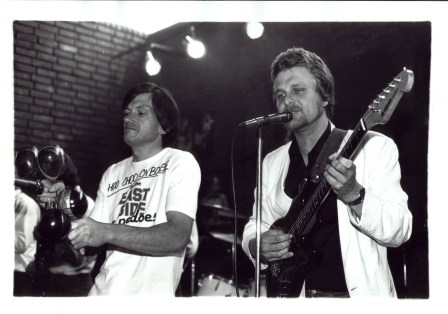
DURHAM BLUES with Steve Hall former guitarist of North East band East Side Torpedoes

HughieSteve

When did you first become interested in music and who were your influences ?

I was brought up in a musical family. My grandfather played violin in local band The Rascals during the 1920s, 30s and 40s. They played around the dance halls in County Durham and Newcastle, including regular gigs at the tea and supper dances at the Oxford Galleries in Newcastle.

My uncles played saxophone and drums in local bands. My mother didn’t play in public but played piano in the house.

As a young lad in the ’60s and ’70s I was more interested in sport. I played rugby and cricket at school in Consett and for local clubs. But I had always listened to music and started to dabble in playing guitar and piano at about 13.

My early influences were very eclectic, everything from rock and blues to jazz, soul and funk. I couldn’t make up my mind what I liked best. But when I heard American guitarist Terry Kath play on their first album Chicago Transit Authority it inspired me to practice harder and take it seriously. He knocked me out. Jimi Hendrix had described him as the best electric guitarist in America and I agreed.

I also listened to the great blues players like Freddie King and B.B. King, and the great rhythm players like Steve Cropper and Cornell Dupree so I could develop my rhythm playing, which to me has always been as important as lead. By the time I was 20 I had given up rugby and cricket to focus on music.

Where was your first gig ?

It was at the Consett Methodist Church Youth Club in 1969. It was me and a few pals from school. We were OK as individuals but crap as a band.

We had to put the bass, guitar and vocals through one WEM 30-watt amp. After that, me, the piano player and bass player got together at the YMCA and started practicing every week to get better.

We saved up and over a couple of years made our own wooden speaker cabinets for the backline and PA, powering them with second hand Sound City, Selmer and RSC amps.

We couldn’t afford the up-market stuff like Vox, HiWatt and Orange. We played weird bluesy progressive rock, all our own songs.

Our drummer was Dave Storey, who ended up with prog rock band The Enid and stayed with them until a hip operation forced him to retire in 2016. We did a few local gigs 1970-72 and went down surprisingly well. One was recorded but the tape is long lost.

bandcityhall.jpg

How did the East Side Torpedoes get together ?

In 1973 Dave Storey left to go pro and the other guys all left town to go to various jobs and colleges. I bummed around for a few years, spending some time abroad busking and doing various jobs.

I worked on building sites, steelworks and so on. I played in a couple of club bands doing covers and at the Grand Hotel in Tynemouth with the resident band, headed up by pianist Mike Waller.

In 1978 I was spotted by local singer and record-company entrepreneur Mike Maurice. We formed a band called Roxoff, with ex-Animals guitarist Hilton Valentine on rhythm guitar.

We played the college circuit and had a residency at the Red House on the Quayside in Newcastle. We had a sort of Dr Feelgood style.

By 1980 the band was starting to wind down when its single, a cover of Morning Dew, flopped, that’s when I was asked to join the Eastside Torpedoes.

In 1979 they had been runner-up in a Melody Maker contest and had a record deal with EMI. So I started a four-year stint in the band on lead guitar and backing vocals.

We played all over the country but also had a residency every Sunday at the Newcastle Playhouse, taking over from the Newcastle Big Band and Last Exit. The band was very popular live, one of promoter Harvey Goldsmith’s favourite live bands.

Did you record any of your songs ?

EMI dropped the band in 1981 because they thought our style, soul/R&B with a four piece brass section, was out of date and a big band would be expensive to cart around on tour.

In 1982 Chas Chandler recorded the band’s first and only album Coast to Coast at Portland Studios in London.

But the album was poorly produced and we weren’t happy with it. Critics and Radio DJs who had loved the band live were waiting to play and review it, but we were so unhappy we buried it.

We sold the first pressing through a local record company to our North East fans only and didn’t bother with promotion or a second pressing. We remixed the master tape at a local studio. It sounded a lot better but decided not to press the remix because we were unhappy with some of the arrangement changes forced on us by the production team during recording.

In 1985 the band recorded a single that was an airplay hit, but by then I had left. Recently, the first track from Coast to Coast has been given some proper mastering and sounds a hell of a lot better, more like the band’s actual live sound. What a pity it wasn’t properly mastered at the time.

Did you record any radio or tv ? We did lots of radio and some TV. In 1982 we did a full live recorded show for Metro Radio. The same year Tyne Tees TV made a documentary about us and we appeared regularly on Friday Live.

BandKnebworth

Did the band have a manager or promoter ? 

The band went through more managers than Newcastle United. We had a bit of a reputation for obstinacy, so some didn’t last long. We didn’t like being told what to play or what to look like.

When I was in the band the managers were Warren Haddrick, Hilton Valentine and Germaine Stanger.

Various promoters took on the band, including Harvey Goldsmith, and we were active up and down the country on his Dingwall’s circuit. Our finest moment, probably, was playing at the Knebworth Jazz Festival in 1982 in front of 21,000 supporting Ray Charles. That year everything happened for me – married, first child, album, Knebworth. Never had another year like that.

Can you think of any funny moments being in the band ?

Funniest moment I can remember was with Roxoff. We were playing upstairs in The Cooperage on the Quayside. We did a Dr Feelgood number called Lights Out, and when the chorus came in hard me and the bass player used to jump in the air.

The ceiling in the upstairs room in The Cooperage was very low and we ended up on the floor with mild concussion. We took a long break and managed to carry on and finish the gig.

How and when did the band split ?

I left the Eastside Torpedoes in late 1983. After that I played with a couple of club bands and got involved with commercial productions, writing a few jingles for radio and the advertising industry. The band carried on, I think, until 1986.

I’m not sure why it eventually split up, but I know they had bad luck with their single, a cover of Jackie Wilson’s Higher and Higher. It was an airplay hit – Luxembourg power play and Dave Lee Travis’s record of the week – but the record company had trouble with the distribution so it got to the shops too late. Wouldn’t have happened today with online distribution.

53272244_1257226241095010_5071693817741049856_n

Are you still involved in music now ?

In 1988 I left the music business to become an academic. I wanted to see more of my kids and decided that touring wasn’t for me. I had a successful career in academia, eventually becoming a Professor of Criminology and writing a number of books. In 2017 I got a lifetime achievement award.

But I couldn’t give up music entirely. I played with numerous local bands including The D7s, the Richard Kain Band, The Questionnaires, The Wendy Saint Band and The Short Blues Line. The Questionnaires, played the Fish Quay Festival in 2003, supporting Paul Young.

What does music mean to you and what has it given you ?

Throughout my life music was in tension with other things. First with sport, then with writing. So it was never second but it was never first, if you know what I mean.

I wish I had been more dedicated, although in the early years I used to practice up to six hours a day. I was never in love with the lifestyle.

I’m an ordinary working-class guy from a pit village in County Durham and I never had any real ambitions apart from seeing my kids grow up. And I like my Sunday dinner.

Life on the road didn’t suit me. But I loved the writing and recording side of things. I would have loved to own my own studio and just pump out albums, but it wasn’t to be, because I never earned enough money or became well-known enough to do that.

Looking back, it gave me a lot of great memories and some good friends who I’ve kept in touch with for a long time. That’s enough for me..

Interview by Gary Alikivi     March 2019

MANTRA FOR THE MASSES with Nod the Geordie Poet

These days semi-retired university lecturer Alan Clark is married with two grown up kids and lives near BBC studios in Borehamwood, London. But back in the late ’70s he was on the dole living in a house full of punks in Jesmond, Newcastle…

We lived in Chester Crescent which must have been grand at one time but some of the houses were decaying, and the council took them over and let them out cheaply.

One of the first Northern punk bands, the Big G used to practice in our living room. I think we lived next door to a vicar and he may have complained from time to time.

When the Big G split in 1979, The Weights formed and played Newcastle, the Edinburgh festival and gigs in London

I used to perform at their gigs and then got opportunities all over the place, including the telly.

Who were your influences ?

I was really interested in the Liverpool Poets, especially Adrian Henri. I thought that punk needed poetry as Adrian Henris generation of freaks and hippies did. I was also reading Allen Ginsberg poems and in fact met him at Newcastle Uni when he did a gig there.

I always liked writing at school and wrote daft things just to amuse my mates. About ‘78 I wrote a poem about Daz and one of my housemates Walter from The Weights said I should come and do a gig.

Where was your first gig ?

That was at The Guildhall on the Quayside. It was a Weights gig with other bands on too. They played backing for some of my poems, including 12 bar blues for Daz and a trippy poem about magic mushrooms.

We were all into Frank Zappa. Micky Emerson aka Red Helmet was the experimental lead guitarist. Norman, his brother, was the drummer, Walter aka Peter Howard was and still is a well-known man about the Toon and Anth Martin was the singer and main songwriter. He went on to do a literature degree at Oxford.

As for my experience, well I was quite nervous, but the alcohol and herb helped. I remember I nearly got in a fight with some squaddies for being critical of the government and the army!

You supported The Clash at Newcastle City Hall in 1982. Was this the highlight ?

I enjoyed doing the gig with The Clash and meeting and joking around with them afterwards. But they were strange times for me. I was badly beaten trying to get in to the City Hall. I explained on the door that I was the support act and they didn’t believe me.

I saw one of the roadies and lurched in to get his attention but was set upon by a mob of City Hall stewards. They got me on the floor and kicked the shit out of me.

By the time I got on stage I was bruised and bewildered. I performed mostly with a backing track. One poem was War On The Scroungers, and in parts, I mimicked a posh Tory accent. I had a distinct impression that people didn’t really get the satire!

Curiously, I’d worked at the City Hall as a steward in the early ’70s and knew the head guy Ivor, who looked very apologetic afterward, but wouldn’t say so. I took a case all the way to the council committee in charge of the Hall and explained to them I had done some non-violence training.

The stewards said I was foaming at the mouth and that was their excuse. The council committee agreed and I never got an apology.

You mentioned TV opportunities…

I was on John Walters programme on BBC Radio 1, you may remember him as John Peel’s producer. I was on local culture programmes for BBC North East and Tyne Tees around 1980-82.

I performed Daz on location in Wallsend. They filmed me in front of an old washing machine with Swan Hunters shipyard in the background.

Then I recorded some work in the BBC studio, and a performance for Come In If You Can Get In on Tyne Tees. I was pursued by The Tube at one stage, but didn’t have a manager and was a bit too disorganised to follow up.

What were your poems dealing with ?

I was quite political and involved in anti-nuke politics. I was fascinated by nuclear issues and went to CND meetings in Newcastle, but also got involved in the campaign to stop Torness nuclear reactor which is just over the England-Scotland border.

I lived as part of the occupation for a while and travelled up and down to Newcastle. I also went on big marches in London and actually got invited to play at the women’s peace camp at Greenham Common.

What was the attraction to nuclear issues ?

I had a strange experience when I was young. I was standing at a bus stop waiting to go to school when the whole sky lit up bright pink. I traced the date and it looks like I was seeing effects from what is called the Tsar Bomba. The 50 megaton largest nuke ever let off in Russia.

Tyneside is nearly 2,000 miles from where it was set off on Novaya-Zemlya island. Neither the UK nor any other European nations set off a nuke in Europe.

The Tsar Bomba was the only explanation I could ever find for what happened. I have yet to meet another person who can confirm that they saw it.

Was performing taking a back seat to protest ?

I moved to Whitby in pursuit of love, then after falling out of love, moved to Corbridge. I was living in an old pottery and used to practice guitar and singing in the large kiln chimneys. I was busking all over the North East, and made good money in the Monument Metro in Newcastle.

I kept on performing in various venues and events and would regularly work at The Cooperage and did some recording with The Weights.

By 1984 the rock and roll lifestyle was taking its toll. I decided to give up the material world and ran away to join Hare Krishna who I’d met when doing a gig in Suffolk. I went cold turkey working in a restaurant at the Krishna temple in Leicester.

Being a Hare Krishna involved a lot more than chanting on Oxford Street and I was eventually involved in the running of the movement in the UK. I met some very kind and thoughtful people, but also, some people for whom the religion seemed to be a cover for extreme selfishness.

I was lucky to make friends with some of the original devotees who came to the UK in 1968. Through them I met George Harrison a few times at his house in Henley and we had a few chats about gardening.

I began to have doubts about the philosophy of the movement and after an extended period in India I stopped being so involved. One of the main benefits was meeting my wife Akinchana, who is Indian. We have a daughter who is 27 now and a son who is 21.

When I left the movement, I ended up doing a degree, as a very mature student and then an MA, getting work as a lecturer in media at the University of Hertfordshire.

What are you doing now ?

I’m still teaching, although cutting back as I’m close to retirement. It means I have more time for writing and recording. I’d like to do some performing one day. The most recent track I recorded and mixed was just over a year ago and is on soundcloud.

Interview by Gary Alikivi   February 2019.

TWIST & POUT – with songwriter John Reed, former drummer with North East sixties psychedelic pop band Toby Twirl

1382260_792804634094129_8498464491215217842_n

We gave people music they wanted to hear. In return they kept coming back to see us. Promoters wanted to book us. Our diary was never empty. It was a fantastic time.

The band were so professional. Very good at what they did and were great entertainers. We all got along really well, everyone had a great sense of humour and that made it fun.

We also had a fantastic roadie in Colin Hart from South Shields. He was definitely the sixth member of the band. Very efficient and did his job well. So, well that after we broke up, he went on to work with Deep Purple and Ritchie Blackmore’s Rainbow.

Through contacts that I made with Toby Twirl and song writing, when the band broke up we kept in touch. That eventually led to a job offer in London working for a music publisher.

I also worked for Radio Luxembourg running their publishing company and produced many records for EMI, Sidewalk, Sonet Records etc. I’ve had over 50 songs recorded.

I worked for RCA and Polydor Records in promotions and worked with many famous artists including Eurythmics, Starship, Bruce Hornsby, Mr. Mister, Lionel Richie, Stevie Wonder, Rick Astley, Five Star, Vanessa Paradis, the list is long.

How did Toby Twirl get together ?

Barrie, Stu and Jim Routledge (original drummer) got together at Rutherford College in 1963. They were joined by Norman Errington on guitar and Graham Bell singer. This band was called Shades of Blue. Graham soon disappeared to London and was replaced by Dave Holland and Norman left, replaced by Nick Thorburn.

I joined the band late ‘67 as Richie McConnell was getting married and didn’t want to do all the travelling. The band had three drummers over the time, Jim Routledge, Richie McConnell and myself.

Who were your influences and did you come from musical families ?

At the time I would say The Beatles had the most influence on us but anything in the charts that rocked our boat left a mark on us. We sang some pretty good harmonies and did a very good Hollies medley which is on the CD we released last year of old recordings.

I don’t recall any of us coming from what you would call musical families. Barrie was the only one classically trained. My mother played piano and sang in the church choir so there was music in our house on a regular basis. Just not my kind!

I think in the ’60s we were typical of many young guys who were bewitched by the music of the day and wanted to play and emulate all the bands that were having hits. Also, worth remembering that there were literally hundreds of clubs around the country that employed bands most nights of the week.

I remember that Sunderland alone, at the peak of the working men’s club era, had over 200 clubs that had acts on every night of the week.

Did you have a manager ?

Initially we were managed by Mel Unsworth and then signed a management agreement with The Bailey Organisation who owned all The Bailey Clubs. At their peak, they had 26 clubs around the UK!

What venues did you play and what other bands were about then ?

Working men’s clubs were the order of the day but occasional club dates like The Cellar Club in South Shields, Club A Gogo in Newcastle and La Cubana in Sunderland.

There was the Junco Partners, John Miles Set (The Influence), to be honest, we were working almost every night and never had the chance to see other bands.

Any funny stories from that time…

One story that sticks in my mind is we used to play a week’s cabaret at The Casino Club in Stockport. The owner also had a bingo club which was an old cinema with proper stage and lighting. We played there on a Sunday when The Casino Club was closed.

As I was on drums at the back of the stage, I couldn’t see too much of what was going on up front. Halfway through our act, the entire audience (mainly pensioners) rose to their feet and rushed towards the stage. It certainly wasn’t Beatlemania but were freaked out by the invasion!

We kept playing and giving each other strange looks until Nick leaned forward and started to laugh. At the front of the stage was an old orchestra pit. Through the doors to the pit came caterers with trays of pies, mashed potato and mushy peas.

The pensioners were after their free supper which was included in the admission price and they weren’t going to miss it for some group. It certainly brought home the old saying The pies have come.

1960s. Toby Twirl group.

Photo session at Trinity Towers, Lawe Top, South Shields 1968.

Can you remember the photo session on the Lawe Top in South Shields ?

To be honest, none of us really remember this session. It was a pretty crazy life and there was something going on most days. If not a photo session then a rehearsal or travelling to the next gig.

I am in the photo, blonde hair, scarf and stripy blazer. I have no idea where that came from as I didn’t wear scarves. Might have been part of the props the photographer had.

Others in the photo are Holly on a bike, Barrie with a cuddly toy Nick with his guitar and Stu. None of these items other than the guitar are anything to do with us.

Until recently I would not have been able to tell who the photographer was, but thanks to Facebook, his daughter, Julia Northam posted the photos on our page. She informed us that they had been taken by her father, Freddie Mudditt who worked for Fietscher Fotos, who did freelance work for the Bailey Organisation.

She reckoned we were appearing at The Latino, South Shields in October 1968 and that is when he was asked to do the shoot.

11813382_937684346272823_5900480548155041133_n

How did the record deal come about ?

Before I joined the band, Barrie sent a demo of their song Utopia Daydream to Wayne Bickerton at Decca Records. He liked the track, saw the band and signed them. This track ended up as the B side of our third single for Decca, Movin’ In.

The band had three singles out on Decca. The only release we actually played on as musicians, was the second single Toffee Apple Sunday / Romeo & Juliet 68.

The other tracks were played by session musicians, and we just added the vocals. All tracks were recorded at Decca Studios in West Hampstead, London.

Interestingly, the single that garners the most attention is the second single Romeo & Juliet 68. It’s regarded as a psychedelic classic.

If you manage to find one, they sell on Ebay and other sites for between £850-£1000. It cost the grand sum of 6/8d when it was first released.

Why did the band fold ?

A variety of reasons led to the breakup. Frustration that our records never got any decent airplay, yet we were filling clubs every night and going down a storm.

As there were five of us and a roadie, a van to maintain and living costs, solo acts supporting us were getting over twice what we were earning individually, yet we were top of the bill and packing them in!

We knew without a chart record we couldn’t raise our fees significantly to make a difference. The final blow was when Stu was drowned off the North East coast in Tynemouth in a canoeing accident. That knocked the stuffing out of us.

We tried to carry on but realised it just wasn’t working. Our last gig was in Hartlepool late 1970.

What has music given you ?

Music has always been very special to me. I guess it got me out of the mundane jobs I could have ended up doing. I was following a dream that became a reality.

I am grateful to music as it has given me a whole life doing what I love and not many people have that opportunity.

 Contact Toby Twirl on their Facebook page.

 Interview by Gary Alikivi    February 2019.

HERE COME THE DRUMS in conversation with Harry Hill, drummer of North East rock legends Fist

17426120_1193746917408886_2631511052999680305_n

The stories and laughs were coming thick and fast. Lucky I had the dictaphone cos I wouldn’t be able to write them all down, I’ve included the clean one’s. North East rock legends Fist are back in rehearsals…

Yeah we’ve just filmed four songs at The Queen Vic in South Shields for a promo video. We had to play them six times each. It was like doing two full gigs back to back (laughs).

We have an album’s worth of new songs but for this we played existing tracks Vamp, Name Rank & Serial Number, Lost & Found and Lucy which we last played on a radio session for Tommy Vance.

We used a local team to put it together, Colin Smoult on the live sound and lights by Glenn Minnikin. The results are pretty good. Mind you I was playing drum fill’s that I made up when I was 22 – it’s a bit harder to play them now (laughs).

Local musician and producer Tony Sadge done such a great job on the sound mix that we’ve asked him to get involved with recording a new album. There’s a few labels interested so with all that happening we’re back up to full strength.

49468761_1887823161334588_3450633277440786432_n

Sandy Slavin, former drummer with 80s American rock band Riot writes on social media about his experiences in music. Have you come across any of the stories ?

Yeah, certainly have. You know what it is, he hit’s the nail on the head. When we started playing live there were no mics on the drumkit. You just had to hit them and hit them hard. There was none of this ‘just turn it up in the mix’ that you can get today.

Before Fist and even before Axe I was in a band called Fixer in the early ’70s. On stage there was two Marshall cab’s, a big bass cab and the p.a. which you had to compete with to be heard.

I agree with Sandy you had to play hard to be heard and balance that up with plenty feel for the music. Any drummer can learn techniques but if you haven’t got feel you’re wasting your time. Simon Kirk (Bad Company) and John Bonham (Led Zeppelin) were masters at it.

Drummers have different styles. Bonham played along with riffs that Jimmy Page was playing on guitar. It’s interesting to hear it. Keith Moon sometimes followed Roger Daltrys singing in The Who and then Townsend’s guitar. He was a phenomenal drummer. Very erratic at times but brilliant. I’ve played with Dave Urwin (Fist guitarist) for such a long time we just link in.

You mentioned being in a band called Fixer…

Yeah, the band was put together around ’73. Fixer had a singer called Tom Proctor. He recently got in touch and said he had a cassette of a tape we made. We recorded it in a barn using three mic’s. One for vocals and two on the drum kit.

Sounds great. I remember we rehearsed every night. Listening to the tape you can tell.

As a result of those tapes guitarist Geoff Bell and I got an audition for Whitesnake through producer Martin Birch and Tony Edwards (RIP) who was manager of Deep Purple. This was around ‘76.

We went down to a rehearsal studio in London, and they asked us to just jam together. We knew our styles of playing so well, we were comfortable together, they were impressed.

We passed the audition and said You’ve got the job. But in the meantime, out in Germany, Coverdale had just formed a band.

Sounds like a mix up in communication ?

Well with a couple of mates, Terry Slesser (vocals, Beckett) and Paul Thompson (drums Roxy Music) I went to see their first gig at Ashington Regal. Afterwards we chatted with Coverdale and he explained what had happened. That was it. Just not to be.

Fist supported UFO on a UK tour during ’79 & ’80. What are your memories ?

We had a great time. Someone reminded me a few days ago of an incident that I’d forgotten about. We were playing Hammersmith Odeon and a guy was heckling us. Really pissed me off. So I put my sticks down, jumped off stage and chased him into the foyer to give him a good kickin’.

Thinking back, the Hammersmith had a high stage so I must have been fit to get down and run after him (laughs).

I remember playing Sunderland Locarno (6 miles from Harry’s hometown South Shields). That was a great Friday night gig. We played it a couple of times after that and done a few other venues in Sunderland by ourselves.

There was the Boilermakers Club and the Old 29 pub which was only a very long thin shaped bar. We never got much reaction and nobody clapped cos there was nowhere to put their drinks (laughs).

One Friday night we played the Newcastle Mayfair (2,000 capacity) with a 10,000 watt pa that we’d hired. We asked the sound man Stosh, when the p.a. had to go back and he said not till Monday. Champion, we booked a gig for Saturday afternoon in the Old 29 pub. We knew there’d be a reaction this time.

As we blasted out the p.a. in this little pub the audience were pinned against the back wall (laughs).

Can you remember any other bands gigging around the North East at the time ?

Yeah Raven, who we played with a few times. There was Tygers of Pan Tang…wiped the floor with them. Then next time John Sykes and Jon Deverill were in and that was a different band. That was a kick up straight away.

Robb (Weir, guitarist) is still playing in the Tygers and has got a great band now. Really solid.

Fist were playing at Norbreck Castle down in Blackpool around ’81 /82 and John Sykes popped in. He just lived in the area. He came over and introduced himself. Chatting with him he said he’d made a huge step up in joining the Tygers. And he was right.

We had the same record company (MCA) and with a lot of bands they look and sound ok but in a studio there’s nowhere to hide. Well there probably is now, but we can’t find it (laughs).

38144348_1932374336821308_3746805245691297792_n

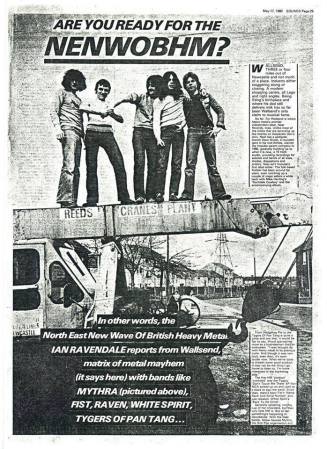
There was the famous article in a 1980 edition of Sounds, when North East New Wave of British Heavy Metal bands were interviewed by Sunderland based music journalist Ian Ravendale…

I bumped into Ian a few years ago and we got chatting about the interview. I said I remember two things you wrote. ‘Fist maturity shines out like a lasar in a coal shed’ (laughs).

The other was ‘If Harry Hill gets any heavier he’s gonna need a reinforced drumstool’. Cheeky sod I was only 12 stone ! (laughs)  They were great those rags Sounds, NME, Melody Maker every Thursday. Nowt like that now.

Full article in Sounds by Ian Ravendale 17th May 1980.  http://ianravendale.blogspot.com

I saw Fist at the British Legion in South Shields around ‘82. Would you ever think then that you’d still be playing together in 2019 ?

Fist has been my life. It’s always been there. I remember getting to 25 and thinking I’m too old to be a drummer in a rock band. But I look at music back in 1970 when I was listening to Zeppelin, that’s 50 years. Then go back another 50 year to people dancing to the Charleston in the ’20s. Then forward to the rock n roll explosion. Maybe now we’ve reached saturation point.

Old stuff blows all over the new music. Although recently I heard a band called Greta Van Fleet who were like a breath of fresh air. Great little band.

What do you think of live music today ?

Back when I started playing you went to see local bands and they could really play. Every one of them. Today you will see some who maybe haven’t put the time in. For any band to get tight they have to be on the road.

I stepped in for a band called The Radio Set who had a single produced by Peter Hook (Joy Division/New Order). It was indie stuff completely different for me but it was good. In rehearsal they complained I was too loud (laughs).

But they only done about five or six gigs, with a couple of festivals. The band sounded confident and correct, but they never had that bit magic that you need.

Are there many independent venues on Tyneside ?

I think it’s getting harder and harder. The beauty of Fist is there is some international work. We’re going over to Belgium and Germany later this year. The following is amazing there.

But with the local scene economically it is so difficult to keep going for any venue. Some need to take £1,000 just to break even.

When pubs are struggling like they are now the first thing they do is put live music on to drag a few people in. It might get them in but it won’t necessarily make you any money.

49213308_1888855964564641_7813816516800937984_n

Fist have got some live dates planned…

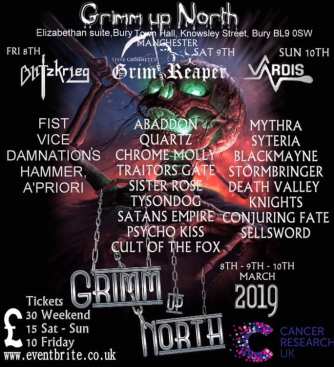
Yeah, the first gig back for a few years is the Grimm Up North Festival. Steve from TysonDog asked us to come along and as it’s for a charity close to my heart we said yes. It raises money for diabetes and heart disease.

We’ve got Norman Appleby back on bass, Glenn Coates on vocals and Davey Urwin on guitar. So it’s back to the original line up from ’82. We’re scheduled for the Friday and we’ll do about 50mins before Blitzkreig top the bill.

We’re deciding what tracks to put on the EP. We’ve got around ten match perfect songs so far, with another two we’re putting together now. So, plenty to choose from, it’s really exciting times.

What does music mean to you ?

Absolutely everything. At times probably totally cocked my life up but I’ve got no regrets whatsoever. It’s not just music it’s everything around it. Creating things, the friends you make, I couldn’t imagine life without music.

Check the Fist facebook page for latest gig dates.

 Interview by Gary Alikivi   February 2019.

DARK THOUGHTS with Gateshead musician Esme

At the start of 2017 Penance Stare started as a solo project. Now it’s a duo comprised of Esmé on vocals, guitar and electronics and Graeme on drum kit and electronics. Esme remembers the first gig…

It was in the dark Boiler Room at the Old Police House in Gateshead. I was using a broken microphone so I had to yell, unamplified over the music.

35162192_459766357798023_8047142105509789696_n

The Old Police House is bringing incredible shows to Gateshead. Drone/noise/ambient gigs at either the Soundroom or the Art Gallery. Across the river Tyne in Newcastle we have places like the Star & Shadow. Bands are still playing in bars just as much as DIY indie venues.

Newcastle and the surrounding area have a really good scene for both metal and experimental music, with a lot of crossover between.

What’s your music background ?

I was a child in the ’90s when Britpop and Alternative rock were popular. The earliest music I owned were the Shine cassette compilations of indie hits from around ’95/96. I still revisit that music occasionally. .

Our influences include Cranes, Velvet Cocoon, Cocteau Twins and My Bloody Valentine. We’ve both played in bands for many years before this, and have projects outside of Penance Stare. We currently rehearse in Gateshead’s Soundroom.

Are you from a musical family ?

My dad played guitar, not well or in bands but he would pull faces while jamming bad blues licks. He bought me some used equipment as a teenager.

My mother exposed me to a lot of music too. Growing up I would steal her records and tapes. She sang a lot, not very well, but she got a lot of enjoyment from it. I can relate to that.

When did you first pick up an instrument and what was it? 

Aged 12 or 13. My first electric guitar was a black Encore Stratocaster. A horrible guitar, the quality of cheap instruments has increased dramatically since then. I plugged it into a tiny Kustom amp.

Like a lot of kids my age I was really into Kurt Cobain. I moved on to Sonic Youth and started writing my own songs.

What do you think of crowdfunding, have Penance Stare taken that route ?

We haven’t done anything like that. I’m not sure its what listeners want. I note that one of the big platforms recently went bust.

Have you recorded any of your songs ?

Penance Stare recordings are deliberate in their rawness and intimacy and all of the recordings thus far have been made at home. We anticipate that future recordings will continue in this tradition. All releases were made available on limited edition cassette and digital download.

Much like a lot of the UK underground at the moment, we deal in cassettes and downloads. That’s out of necessity as much as anything. Hardly anyone can afford to make vinyl now.

Releases:

House Of Bastet EP  (summer 2017)

Scrying (spring 2018)

Solananceae (early 2019)

What are the Penance Stare plans for this year ?

We won’t be playing any shows in a while as we’re writing a brand-new live set. So far, progress has been fast, so we expect to be back by the summer. There will also probably be another release by the end of the year.

 Contact Esme at  https://www.facebook.com/penancestaremusic/

 Interview by Gary Alikivi     February 2019.

SOUND OF THE UNDERGROUND with Davy Craig former guitarist for North East noise merchants Drill

Drill formed in the late 80s. A live review in Sounds said…’when the massive guitar barrage is coupled with vocals they sound like they’re fresh off The Exorcist. Drill have a magnificent intensity’….

For my first gig we were booked at the Riverside on Wednesday 18th July 1990. I was 21. A few of my mates were in the audience and by the time we went on stage I was a shaking mess.

But once the drum machine counted us in for the first song I was in the zone. The audience stood as if they’d been sonically blasted into submission. That was my first proper gig and I wanted more.

1505405_10152896548462474_9077714190345643040_n

Davy Craig on the right playing his first gig at The Riverside, Newcastle.

Who were your influences ? I’d read an interview with Will Sergeant from Echo and the Bunnymen. A lot of music journalists and ‘musos’ gave him a hard time, because of the simplistic style of his playing. He sounded incredible to me though.

He said something along the lines of ‘I’m not very good at playing anyone else’s stuff, or like anyone else…but no bastard can play like me! That was the whole key for me.

How did getting the job with Drill come about ? 

There was an advert in The Sunday Sun in July 1990 for a band who required a third guitarist. That intrigued me. They were into Big Black, The Band of Susans stuff like that. I spoke to a lad called Kev Wilkinson and arranged to meet up.

I went along to the rehearsal rooms and Kev said…‘Well get inside and set up, because I’m fucking sick of all of the metal heads we’ve had so far!’

The first thing I noticed was no drummer, then the bassist Drew Gallon, who played for The Shotgun Brides and later Forgodsake. He was helping the band out.

In the corner standing in front of a huge double stack of four cabs was Tony O’Brien. Kev and Tony had previously been in The Shotgun Brides.

I was asked to play a few things which sounded absolutely deafening. Having enjoyed it I left and when I got home got a call from Kev. He told me that I was in the band, but I had to learn all of the songs for a gig that Wednesday at the Riverside!

I was also told that I couldn’t use my strat or my Fender Amp as they weren’t powerful enough. I borrowed a Marshall cab from Tony, along with a Fender guitar, the humbucker being crucial to the sound, with a borrowed 2 x12 cab.

I learnt the songs and rehearsed a couple of times prior to the gig and felt confident. I was ready to play my first gig with Drill.

10400171_73344737473_5124899_n

Things were going well with the band ?

Yes, Kev would pick me up for rehearsals and gigs so we had a lot of time to chat. He was very forthright in his view of what the band should be like and I loved being part of it.

We started writing new songs together with Kev at the helm. Part of me wondered if he was just making it up as he went along or he was a genius with real vision. It felt great to be part of something that seemed so different to anything else around.

I became mates with the other lads from The Shotgun Brides. I got on well with Chris McCormack, later of 3 Colours Red and Professionals.

Who was in the line up and what equipment did the band use ?

I had to sell my beloved Fender Strat at Grott Guitars in Newcastle. I put what money I had to buy a Simms Watt 4 x 12 cab from Rock City and picked up a Burman 100 Watt Amp that was in Grott Guitars.

I needed a guitar, Kev wanted me to have something with a meatier sound.

I entered McKay’s on Westgate Road and saw two guitars that were ideal. One was a Yamaha, and the other was a bright green Gordon Smith Gypsy II, with double humbuckers and a coil tap.

Tony put a new bridge on it, along with a brass nut, for ridiculous sustain. I was geared up.  I was encouraged to join in writing.

Simon Moore eventually joined on bass. We worked on each other’s sound and everyone was happy to experiment. Si used Marshall’s ‘The Gov’nor’ pedal on his bass. It took a while to get the sound right as we wanted that cutting distortion, without losing the bottom end.

His style of playing suited the band perfectly. Kev used a Fender Mustang guitar which gave a great top end cutting through the rest of us.

Tony used multiple guitars, but mainly Gibson models, Les Paul Special, Firebird, a couple of Flying V’s plus a stunning Gibson L5-S. His 4 x 10 cabs made his guitars sound quite trebly, but Tony was playing what was closest to being lead parts.

I suppose I was in the middle, with the Simms Watt 4 x 12, then aside from the drum machine, playing in various time signatures. Kev’s voice was the ingredient he wanted to get spot on. He picked up a zoom guitar effect, which was the size of a Walkman.

I think he initially wanted to use it for his guitar but decided to use it on his vocals instead. He utilized a number of effects, but the main ones were distortion and harmoniser/octave controls.

thumbnail

What venues did the band play ?

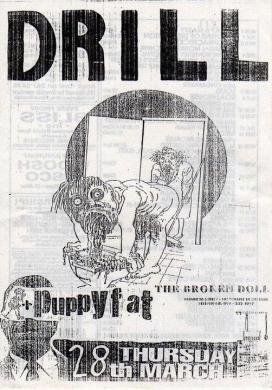
We didn’t play many gigs just the Riverside and a few local venues in Newcastle. At The Broken Doll I was always asked what the fuck was I playing, but in a good way and many just marvelled at the E-bow, as they scraped themselves off the walls pummelled by our sonic assault.

I very quickly felt that I was going to keep playing in the band and see where things were going to take us.

The clincher for sticking with it came when we signed to Abstract Records with Edward Christie. In September 1990 we joined the stable that previously had New Model Army and UK Subs as it’s main bands.

What was your experience of the studio ?

We booked into Impulse Studios in Wallsend with Kevin Ridley, the singer with Forgodsake. Kevin was a really nice bloke and he really pushed us.

We went in on 17th January 1991, the day the Gulf War started. We had no idea what was going on in the outside world as we were walled into the studio. It felt really claustrophobic and I think we captured that on the album, which was completed in five days.

At first, we started with one of our favourites, Compressed Head. We played everything correctly, but Kevin Ridley wasn’t happy and said it sounded flat. Not having been in a studio before, even to do a demo, I had no idea but Kevin was right. It didn’t sound like it should.

We were paying for the studio time, or at least the record company were and we felt like we were wasting it. We scrapped that song for now and said that we’d come back to it.

We moved onto other tracks and I think the first one we did was Pylons. When we came back in to listen to it, it sounded spot on and somehow the studio, the desk and ourselves had come alive.

We blasted through the songs and Kev added his vocals, deciding to run a lead out of the recording booth and into the old Victorian toilets which was covered in tiles. It sounded fantastic. Kev doing his vocals sat on the netty was a masterstroke.

With an instrumental called E the sample was played backwards and by pure chance it sounded like someone saying Eee, ya fucker…! It was hilarious and fitted.

I loved playing that song as I was given free range to create atmospheric sounds over sparse chords that it was built from. I scraped the E-bow, holding it with my ring and little fingers, at the same time holding a plectrum and changing from one to the other very quickly. Plus employing my made up chords and even using a wee bit of string bending!

Anyway, the album was finished and mixed with us having completed Compressed Head, a great way to end. Overall, I’m very proud of the whole thing.

iu

Skin Down was released in June 1991 and billed as Industrial Noise Guitar music. It was met with some excellent reviews across the board, most giving us 10/10.

Some local music writers had really championed the band, none more so than Kriss Knights and especially Lee Conlon who was a big part of the Paint It Red magazine. The big nationals also seemed to love us with Melody Maker describing it as ‘a musical white knuckle ride’. 

Written press weren’t the only ones to champion the album. The record company on hearing what we’d delivered, pushed us to the forefront of the label and it sold quite well.

National radio got involved, with us being played and championed by John Peel. We got album of the month on BBC radio, ahead of the first Blur album.

I loved all of this and wanted more. It felt like we were riding a huge wave and were about to sign to an agency for tours. I thought it was all about to happen!

With an album recorded how did you promote it ?

We only played a handful of gigs. One was supporting Swervedriver at Riverside. After our second song the house lights came on as there was a technical problem. We looked out and saw Swervedriver stood next to the desk, mouths agape.

We just laughed, got on with it and showed them what we were made of. It went down a storm with the crowd going crazy at the front. When Swervedriver came on the crowd moved back from the stage and were very subdued.

We also did a gig in a pub near Blyth. Not many turned up, but those that did were going mad. Four people were sat in the corner and asked to speak to us after the gig. They’d come over from America to see us, having been told about us by the label.

They loved us and wanted us to go to L.A. for a four venue residency, with a view to moving on through the US. I couldn’t believe it.

We thought they were mad coming all that way but they were genuine. I had my bags packed in my own mind and I think Si was up for it as well. But Tony and Kev were married, with mortgages and well paid jobs. They didn’t fancy getting stranded in L.A. so it didn’t happen. The same thing happened with tours that were in the offing in Europe and Japan.

We hadn’t even played London and our only gig outside of the North East was in a working men’s club in Burnley. It was booked by a group of fans from the area.

As we sound checked people coming out of the snooker room were shouting ‘What the bluddy ‘ell’s this flamin’ racket?’ The atmosphere wasn’t good to say the least.

We set up on stage, instructed not to move the house organ, drum kit, or bingo machine. The place was jam packed when we went on. A crowd of around 30 kids were at the front jumping around and absolutely loving it. The rest of the ballroom consisted of pensioners out in their finest clobber.

With the drum machine we knew the songs by names, but also by the numbers that were programmed in. Kev did away with the set list and said Davy, what number will we play next?  I shouted out a number, he pressed it and we launched into it. As I shouted the number, I noticed that most of the crowd suddenly sprang into life.

No, they weren’t going to start headbanging or crowd surfing, they were looking for their bingo dabbers and cards! I couldn’t stop laughing. We’d broken the unwritten code of never mess with the bingo!

I read a number of years later that club was the inspiration for Peter Kay’s Phoenix Nights!

On reflection what do you think of your time in the band ?

I left having only been in the band for just over a year. It was great when it lasted. But I felt that so many opportunities were missed.

What am I up to now ? Well, I’ve been in a few bands since but my health, both physically and mentally wasn’t very good and I become disabled around five years ago. I haven’t played since but hoping to improve and maybe get out doing some solo stuff.

It’s nice to hear people still talking about the band, both online and in conversation. I’m very proud of it all, but it seems a bit sad that it didn’t take off and it just ended with a whimper.

Interview by Gary Alikivi    January 2019.

ONLY A NORTHERN SONG in conversation with Tyneside songwriter John Clavering

What projects are you working on ?

I’m in the studio writing and arranging with musician Cortney Dixon. Cortney is like a creative soul mate we have a lot in common the way we work. She is also working with a writer called Jim Lowe – Grammy award winning producer whose worked loads with bands like Stereophonics and the Charlatans.

So the songwriting is really coming on and she plans on releasing something this year. I also play keys for her live.

51286867_1541843769279409_567609327217541120_n

On stage with John and Cortney Dixon.

It’s really interesting stuff as Cortney is not interested in pop or the girly image. She’s interested in making an album with two sides, the cover, the whole product you know. Really old school. I’m enjoying that stuff.

She has management who benefit her with contacts and wisdom as they’ve been around a long time.

A couple of year ago when I was engineer at The Customs Space Studio in South Shields I was working with Martin Francis Trollope who is engineer there now, Cortney and Jade Thirlwell who went on to be in Little Mix. Obviously, Jade went through the whole TV route while Cortney went opposite to that but they are both talented and great singers.

It’ll be interesting to see where Jade goes after Little Mix and the crazy pop world that she is in. Cortney has been offered that route, she met the Cowells and all of them you know but she didn’t want that. I’m proud that she’s took her own path. Quite a punk ethic really.

What is your background in music ?

I was in a few bands in the ’80s and ’90s. One was 3 Kicks a Newcastle based funk/pop sort of band then The Ghosts of Soul. For that band we done our songwriting, gig’s and video all funded by playing the workingmen’s clubs.

We would have a different name doing the covers, make some money then put it all back in and do some recording. I remember how hungry we were. We would of done anything to make enough money.

We were at college when Ghosts of Soul were about so we had a grant but that wasn’t enough. We could use the studio gear at college which was great but to be a travelling, touring musician can be expensive.

Were you making a living as a full time musician…..

I don’t think you can make a career out of it you’ve got to be lucky to play more than a couple of gigs a week. But if you get a couple of corporate gigs, you can get paid £600 for a night’s work.

In my experience some people aren’t interested in creative stuff when they do covers. Unfortunately people don’t see you as a real musician in the industry.

How do you think live music is seen now ?

I worried a few years ago that it was going to be everybody singing along to a MacBook (laughs). But it hasn’t gone that way, it’s gone back to bands. There has been a huge resurgence in the sales of classic guitars, Fender, Gibson and old analogue keyboards.

As a keyboard player and music technologist that really interests me. But still can’t afford the buggers (laughs). As a ’80s/90s musician it feels good that it’s going back to that as it worked really well. It’s fascinating.

51353613_605663463192647_6888177087996231680_n

John 2nd from left and Cortney (in blue) with the live band.

There might not be the financial returns from music but it’s still valuable….

Yes, like you with film and video you do it because you want to do it. It’s a need. You get an idea in your head, you create it and put it out there. The only way you can justify your existence is by people saying that’s good and that’s a kind of ego rubbing there.

But I find it sad that in this commercial world so few people can make their way by just being an artist. A lot of artists I know have another job.

People don’t pay for stuff now with Spotify, and on You Tube there is visual tours of art galleries now. So they don’t have money for new art.

There are original bands out there who use the internet as their only outlet. A lot of niche stuff getting heard on Soundcloud and Spotify. They’re not playing live so not making any money at it.

But there is nothing like standing in the front row of a gig. You will never get that feeling from watching You Tube on your phone. I love going back and watching the ’70s/80s stuff that I missed like Led Zep.

That’s all great but seeing stuff live like Sam Fender is amazing. Sam is a good friend of mine from North Shields. He is a singer/songwriter. He has a really good band, it’s exciting, he’s touring again this year.

Some of his songs have a strong meaning and tackle things like suicide. He get’s it across well. Really visceral with hundreds of students at the gig jumping around. Me standing there like an old fart but it’s really great.

On stage it’s all live. There is no tech running. Just guitar, bass, drums, singing.

Sam has built a following with drip feeding a few original songs on-line, and with good management he has been guaranteed live gigs, TV stuff. He was on the Jools Holland show a few months back.

He is very media friendly, and I think you will see a lot of him. It’s very interesting watching his career develop.

51308616_597862860641441_8872661689116393472_n

What does music mean to you ?

Music is a huge part of my life. It’s kept the wolf from the door in a financial sense but creatively it’s my steam valve. I feel really good when I write a song. It’s a soul thing, part of my make up is to be making music.

Interview by Gary Alikivi   January 2019.

TWO YEAR LATER…. Alikivi blog in the news.

A 2 year milestone for the blog is four articles which featured in local newspaper The Shields Gazette in the last few weeks. Included in the articles are extracts from some of the interviews I’ve done with musicians.

https://www.shieldsgazette.com/lifestyle/nostalgia/hair-raising-adventures-of-a-south-tyneside-musician-1-9573698

https://www.shieldsgazette.com/lifestyle/nostalgia/hanging-bed-sheet-from-south-shields-bridge-to-promote-gig-1-9560464

https://www.shieldsgazette.com/lifestyle/nostalgia/how-guitar-present-led-to-a-life-of-music-1-9547817

https://www.shieldsgazette.com/lifestyle/nostalgia/when-south-shields-had-a-thriving-rock-scene-1-9535098

Gary Alikivi  February 2019
 

CUSTOM SONGS in conversation with Tyneside musician & studio engineer Martin Francis Trollope

We had John Gallagher from Raven in the studio the other week. He came in to add vocals and bass for something Steve Thompson was putting together. (Steve is a North East songwriter who featured in a post June 27th 2017). 

It was amazing. I only heard of Raven when I went to a Slayer gig last November with Anthrax supporting them. They said it ‘was great to be in Newcastle where Venom and Raven came from’. A few month later here he was hanging out in the studio.

I listened to the album, and I could totally see it. When John came in and put the vocal down, he could still do it. He was screaming and held a note for about a minute and the bass, well he was flying all over the place. Yes, he’s still got it.

Steve was putting these songs together for his publishing company and he was having such a good time it’s ended up for an album. He’s done about 15 songs. He likes it here so just kept coming back.

A lot of people do return, we get reviews on social media saying the studio is just nice and relaxed atmosphere.

36002541_1869003436491732_4830522217135603712_n

Who else have you had in the studio ? 

Lately we’ve had Newcastle musician Afnan Prince in the studio, also Connor Pattison from Durham. They have an Arctic Monkeys sound.

After some recordings here the file of individual tracks of bass, snare drum, vocals etc get sent to another engineer who puts a sort of extra shine on the mix you know and gets it played on the radio.

We had some kids from Sunderland doing like indie rock which is a big thing. We had a band called Tank Engine in doing a real thrashy rock. They are from Washington and used to be in a band called Your Code Name is Milo who did fairly big thing’s in the 2000s.

The drummer is in a band with tv’s The Hairy Bikers. They are releasing stuff in Spring and I’m really looking forward to it, really interesting band.

I’ve done a lot of rap, so I was producing some beats and people were coming on and rapping on them. There was some acoustic stuff like with singer/songwriter Trev Gibb who has branched out on all sorts of sounds now.

Most of what I do now is the finished product. Radio play, You Tube and Trev’s is for an album.

Most of what I record here end’s up on Radio Newcastle at some point. Some end up on BBC Radio 6. One was for a 15 year old called Tom Smith. He played on all the instruments, and we sent it in and Radio DJ Tom Robinson loved it and played it.

Just this Saturday I had four songs produced here on BBC Newcastle so that was good.

Sounds like the studio is getting a reputation… 

Yes it’s building up. Only in the last couple of years it’s started to happen as this has been here about 15 years. First off it was based around a youth club which was a great idea when it was 50p to come in and record. I wouldn’t have started recording if it wasn’t for that.

About 10 years ago Daniel Clifford and I were in a band called Squares and recorded a few EP’s with original engineer John Clavering. We picked up how to record so we made an album.

We didn’t know anything about EQ or compression (laughs). But we learned and I ended up getting a job here.

Do you think there is much original music out there and venues to play ?

As far as I know there is some amazing stuff in the North East. I catch up with it by listening to BBC Radio Newcastle on a Saturday night 8-10pm. That’s their introducing show run by Nick Roberts.

All you have to do is load an mp3 to the introducing site, they have a listen, and your song can go to your local radio or if they really like it a national show like BBC1 Extra.

For venues there is still The Cluny, or The Riverside which is good. The Head of Steam is still going. These are Newcastle but as far as I know nothing in South Shields. You can hire out The Customs House but you’d have to already have a following to do that.

Most pubs are focused on cover bands because that’s what gets people through the doors. I think The Queen Vic were trying out bands but don’t know how that worked. Bands I record haven’t mentioned playing in Shields.

I’m working on putting a funding bid together to organise a live music event mainly for a student audience. Just need to fine tune it.

004.jpg

With home recording made easier why would musicians use this or any studio ?

I love that you can record at home. It’s what I used to do for demos and singles. Had some good sounds recorded in the house. But if you pay what we charge £15 per hour you get access to excellent industry standard microphone’s, guitar amp’s, drum kit to make a big noise which you wouldn’t be able to do in your house. Plus, my years of experience which all counts.

Interview by Gary Alikivi     January 2019.

 Contact Martin on 0191 456 3917

The Customs Space, Captains Row, South Shields NE33 5AS

ENTER STAGE RIGHT with former Tygers of Pan Tang vocalist Jon Deverill

thumbnail

Fred Purser and Jon Deverill

Jon has just released a new album, Square One with former Tygers guitarist Fred Purser…

Square One was recorded in the early 1990s. After the collapse of the Tygers in 1983 guitarist Fred Purser and myself decided to continue our partnership.

I have huge respect for Fred. He’s quite simply the most talented man I’ve met. On the album he wrote, engineered, produced and played all the instruments, except the drums.

We both shared the same vision and were completely on the same page. Our musical tastes are very similar. Fred has his own recording studio, so the facilities were there to make the album. I love the songs.

When was your first experience inside a recording studio ?

I had formed a band called Persian Risk with my good friend Phil Campbell who later joined Motorhead. We went into a small studio in Cardiff and recorded four songs. I loved it. I’ve always enjoyed recording. Creating something is very exciting.

How did you get interested in music and who were your influences ?

I used to sing along to records in my bedroom and watched Top of the Pops religiously. I discovered that I could actually sing the songs so formed a band in school.

My early influences were Alice Cooper, Robert Plant, David Bowie, Peter Gabriel and David Coverdale.

My first band was called Pageant and I formed it with some friends in school. I was fifteen. We played in church halls before progressing to pubs in South Wales.

We took it very seriously and wrote our own songs. At that time I decided I wanted to sing professionally.

p1

What led you to getting the job with the Tygers ?

I was gigging around South Wales with Persian Risk and saw an add in Melody Maker about the Tygers looking for a new singer. I’d seen the band at Reading Festival earlier that year, 1980. They were great and I very much wanted to join them.

I got in touch and came up to Newcastle for an audition and got the job. I was on cloud nine. My life changed forever. A once in a lifetime chance and I still can’t believe my good fortune.

In the space of a year, I went from playing small pubs in South Wales to Hammersmith Odeon. I was with the Tygers for six years in total. We played in Europe and Japan. To promote The Wreckage album we toured America, plus of course all around the UK.

My first gig with the Tygers was at the legendary Marquee Club in London. Gone now of course. Oh yes, I was living the dream !

tzfpigf

1982 was a good year for the Tygers with a UK tour for new album The Cage, a slot at the Reading Festival in August and appearing on TV show The Tube in December. What are your memories from that time ?

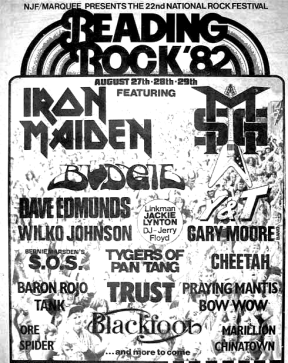
I remember Reading Festival and The Tube very clearly. Reading was amazing. 57,000 people. Our biggest gig ever. We were the last band on stage B and the first to use lights that day. Iron Maiden closed the day on stage A.

The Tube was great too. It was a good gig for us and went out to a big audience. We were on with Twisted Sister who I feel stole the show. They got signed by Atlantic Records after their performance.

Iggy Pop was also on. He was frightening. Really scary. God knows what he was on!

Hellbound – Spellbound Live ’81 album has just been released. What can you remember from those times ?

The live Tygers album was recorded at Nottingham Rock City in 1981. It was my first tour. I loved it. So exciting and I’ll never forget it. High energy and quite literally Crazy Nights!

We were promoting Spellbound which is an album I’m very proud of. I think it’s the best Tygers Of Pan Tang album. I still enjoy listening to it.

After a successful album The Cage, you worked with songwriter Steve Thompson again…..

Even though we released The Wreckage and Burning in the Shade as Tygers records. They were really more like my solo albums.

I loved working with Steve Thompson. He’s a very talented songwriter and we hit it off instantly. We wrote those two albums and I’m proud of them.

Your next move was into acting. How did the change of career come about ?

I’ve always wanted to be an actor. It’s something I’ve done all my life so returning to it made perfect sense. In 1989 I auditioned and got in to The Royal Welsh College Of Music And Drama and spent the next three years training to be an actor. They were three of the best years of my life.

I’ve been working as a professional actor ever since. Never stopped singing and I’ve done a lot of musical theatre. A highlight being Blood Brothers in the West End. I’ll continue doing it.

Music and acting – what do they mean to you ?

Music and acting are my life. They mean everything to me. Being creative and expressing myself is life to me. I have to act to live. I love what I do and continue doing it till the end. They say you’re a born actor. Yes. Totally!

With the Square One album out on the shelves where does it stand with your Tygers work ?

I’m very proud of it. It’s by far my best work. I’m so delighted that it’s finally been released. We never lost faith that one day it would be.

4zqsivkz

Contact the band https://www.facebook.com/sparechaynge/

Interview by Gary Alikivi   January 2019.

Recommended:

Micky McCrystal, Road Works Jan 3rd 2019.

Fred Purser, Square One Dec 30th 2018.

Robb Weir, Rock City Live Dec 19th 2018.

Robb Weir, Doctor Rock Nov 5th 2017.

Richard ‘Rocky’ Laws, Tyger Bay Aug 24th 2017.

Micky McCrystal, Cat Scratch Fever Mar 17th 2017.

Tygers of Pan Tang, Guardian Recording Studio May 3rd 2018.

Ian Penman, Writing on the Wall, Aug 1st 2018.

Steve Thompson, Godfather of New Wave of British Heavy Metal June 27th 2017.