The music world has always had its fair share of myths, legends and hell raising antics. The time Ozzy bit the head off a dove or was it a bat? Well both actually. According to reports one was in record company offices the other was live on stage. He also snorted a line of ants. The list is endless for the Oz.
I came across a gaffer tape incident involving a music journalist and Killing Joke, as I was trying to find out who, where and when it happened – if it did! There were other short stories I read some with North East connections.
Sadly, both deceased now, Lemmy and Jimi Hendrix were two of music’s biggest characters – their spirit and influence live on. But what is their connection to my home town of South Shields?
In his autobiography ‘White Line Fever’ Lemmy recalls that in early 1967 “I went up north. I woke up one morning sitting on a beach in South Shields eating cold baked beans out of a can with my comb. I thought there’s got to be more to life than this.”
Was this just a random visit to the seaside town? Why not go to the main cities of Newcastle or Sunderland close by, or was there someone or something else in the town that attracted him?
Around the same time Lemmy was a roadie for Jimi Hendrix. He explained in his biography that in early 1967 he got in touch with a friend, Neville Chesters, who was a roadie for Hendrix. Lemmy ended up dossing down at Neville’s London flat that he was sharing with Hendrix’s bass player.
Lemmy recalls “They needed a spare set of hands, so about three weeks after I landed at Neville’s, I got a job working with them. I worked for Hendrix’s band for about a year on all the TV shows and tours through England. I was only a fetcher and a lifter but still it was an amazing experience”.
Even though he didn’t expand on the beach story the timeline of the visit to South Shields and a gig sort of fits, but what we do know for certain is that Jimi Hendrix played the Cellar Club, South Shields on 1st February 1967.
When Lemmy was a roadie was that when he ended up on South Shields beach and not on a random visit? Or has he been twice? We’ve got to take in account that after a full on rock n roll lifestyle with Hawkwind and Motorhead, Lemmy’s memory might have been a bit fuzzy remembering events for his biography.
Just a couple of thoughts here – the beach is only a 5 minute drive away from the club, plus to hoy a spanner in the works was Lemmy even a roadie at the Shields gig or did he join the road crew at a later date?
He explained in his biography – ‘I worked for Hendrix’s band for about a year on all the TV shows and the tours through England’. I suppose we’ll never know for certain unless a Hendrix or Lemmy aficionado can help nail down specific dates. Anyone got access to their diaries!
A post looking further into Hendrix’s South Shields gig will be added to the site soon. Where you there in the audience? Where you a member of local band The Bond who also played that night? If you have any information, much appreciated if you get in touch.
If ya like ya lists these make for interesting reading. There’s been a new welcome addition to the back office stats from owners WordPress. Previously they’ve counted views from each country with the total to date 422,000.
Now they have drilled down further and added the number of views from what regions and cities where the posts are being read. These are from start date February 2017 – March 2025.
Top 10 countries >>>
UK
USA
Australia
Canada
Spain
Germany
Ireland
France
Netherlands
Italy
This list includes countries with ex pats who I think will add views from countries like Australia and Canada. European countries Germany, Spain, Italy, France etc might include followers of the New Wave Of British Heavy Metal – I’ve added many posts including North East bands Fist, Raven, Tygers of Pan Tang etc.
Top 10 regions >>>
England, UK
Scotland, UK
Virginia, USA
Wales, UK
California, USA
Northern Ireland
Dublin, Ireland
Limburg, Belgium
Texas, USA
Ontario, Canada
This list is harder to summarise – USA regions Virginia, California and Texas in the top ten are a surprise. I have added a few posts with musicians based in America so maybe that’s it really. I can speculate as much as I like about why people are attracted to the site but honestly, I’m just very grateful that people enjoy reading it.
Top 10 cities >>>
North Shields, England
London, England
Newcastle upon Tyne, England
Manchester, England
Edinburgh, Scotland
Washington, USA
New Silksworth, England
Sheffield, England
York, England
Birmingham, England
Few things popped out of that list – New Silksworth is only a small suburb of the city of Sunderland so a big shout out to the Silks whoever you are! Washington, the capital of America, is not to be confused with Washington near Sunderland because when I checked on the list the stars and stripes are next to the name.
Outside the top 10 the next most international cities viewed are Menlo Park in California, USA, Maasmechelen in Belgium, then Lincoln in Nebraska, USA, next is the Australian city of Perth and then Dallas in Texas, USA.
Big thanks to all the readers it’s much appreciated that you check in to the site from wherever in the world you are. New posts have slowed up lately so why not do a quick search on the archive to see who or what is there – you might be surprised – and why not pass the link on to a friend.
If you’ve got a story to add why not get in touch.
Rock is still big in the North and you can’t get bigger than at Newcastle Trillians. In the coming months bands booked have the power to rip yer skin off yer skull. Here’s a few gigs to stir yer up and let yer know yer still alive in ’25.
Friday 14 Feb > Tytan/Baphomet – ex Angelwitch NWOBHM flag bearer Kev Riddles – “Great to be returning to Trillians, our North East home from home. Brilliant atmosphere and banter at the expense of yours truly! Amazing how a London accent brings out the best in people, see ya there!”
Friday 28 Feb > Godzz of Wor – ex Venom/ Ballbreakers guitarist Jim Clare – “We’ll be rocking the place with 205 years of experience – not bad for a three piece. Hardest working trio in the North East”.
Saturday 8 March > Spartan Warrior – NWOBHM/Guardian/Roadrunner Records frontman David Wilkinson– “Trillians shows are always pretty special it’s one of the best rock venues in the UK. Having hosted many fantastic and legendary bands across the decades it’s the North East equivalent of the Cart and Horses down south. We always have a great crowd in Trills, that’s appreciated and never taken for granted. We’re really looking forward to playing a headline show on home turf alongside special guests Risen Prophecy and Overdrive. It’s going to be a hell of a night…guaranteed!”
Also squeezed in are dates for White Tyger who opened for ex Motley Crue frontman Vince Neil and WASP guitarist Chris Holmes. The Midland Metallers hit the stage on Thursday 27 Feb. Stopping off in the Toon on Sunday 9 March is former vocalist with Ritchie Blackmore’s Rainbow/Michael Schenker Group/Vandenburg/Elegant Weapons frontman Ronnie Romero on his UK tour.
WordPress, who run this publishing site have a statistics page where all the viewing numbers, countries, dates and comments are gathered and crunched. A new addition to the stats is the percentages from what device the site is being read from – currently it’s mobile 63%, desktop 32% and tablet 5%. We are entering nerdsville territory so some people’s eyes will glaze over but stick with it, the stats can bring up some interesting surprises.
I remember back in 2017 posting an interview with former Angelic Upstarts guitarist Mond Cowie and noticing views from the Bahamas – who’da thought punk would invade the tropical paradise!
The site kicked off in February 2017 with first year views of 15,478 quickly rising to 79,850 in 2020 with most people staying at home during the Covid pandemic. It was March of that year that hit the highest monthly views with 9,700.
2021 reached 77,259 with a high of 8,400 in February that year with a small dip back to a total of 51,482 in 2022. This year has experienced a sharp upturn in numbers, so after eight years you can say ‘it’s daein’ canny’. For non Geordies and Mackems that means ‘it’s doing fine thank you very much’.
2024 has hit over 53,000 views with nearly 3,000 this month. December readers from the UK and USA are high with an unexpected spike in numbers from Belgium. So, yep its daein’ canny. All the best for 2025!
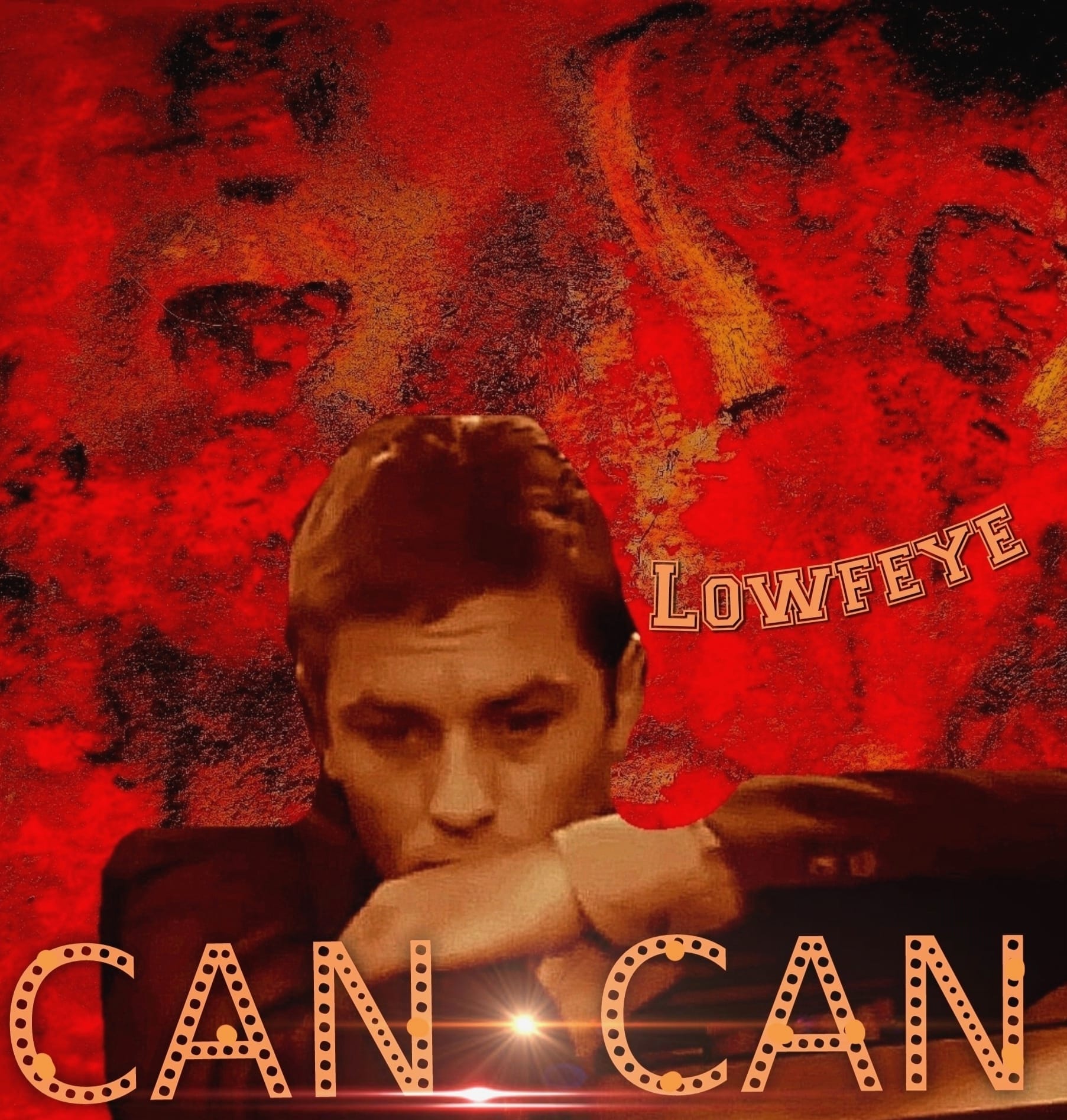
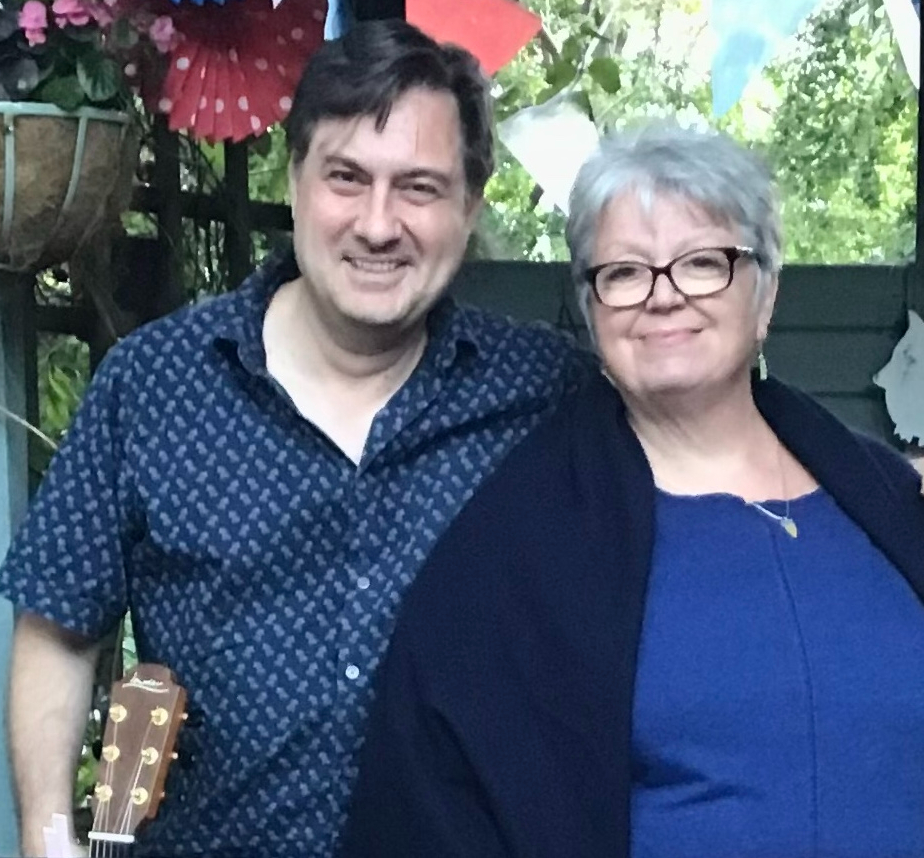
Lowfeye are Alan Rowland (musician) and Carol Nichol (singer & songwriter). They’ve just released ‘Can Can’ their fourth independently produced album. What have Lowfeye cooked up for these dark, cold, wintry nights? Carol throws a log on the fire.
‘Yeh it’s just the two of us – we have creative control which is paramount to the artistry and creativity of Lowfeye’ said Carol. ‘Songs start to evolve almost by accident. I can be in the Dakota desert composing a country rock road movie soundtrack with it all swirling around in my head while in reality I’m walking around a supermarket, buying wine, chips and beans that’s £14.70 please’.
‘Songs tend to flow fast and easy. They present themselves out of nowhere, almost as if I’m getting a brief from a film director who doesn’t exist’.
‘In the writing process they come in waves of sounds and colour all drifting out of my acoustic guitar or keyboard. Melodies, lyrics and hooks entwine with the influence of film themes, art, nostalgia, current affairs and story telling’.
Stand out songs on this 10 track album are Big Bang which bubbles around the pot, hypnotic goth rock of Babycham, dark piece Jeanne Hebuterne reveals the heartbreaking suicide story about the French artist while Dog Bite puts a vice like squeeze on before Valley of the Dolls hits the road running and Red Star rolls the credits. Lights out.
‘In terms of arrangements Alan and I concoct a cinematic landscape of colourful dreamlike worlds where rock and pop sit hand in hand with classical, folk and ambient. Anything can creep into the mix and make itself at home’.
‘Final stages of the songs reveal their identities with swirling organs rising through chiming guitars, orchestral textures battle it out with pounding drums’.
For creative artists managing and prioritising time is a daily challenge however the pay-off can be surprising and satisfying. As Carol throws another log on the fire she weighs up the benefits and snags of getting yer hands dirty.
‘Not being chained to labels does enable creative freedom, but the down side is juggling regular jobs. On that note if we were signed to a record label we would probably be dropped for not sticking to one formula or style of music’.
‘Getting the right take can involve days of stop-start hit and miss recording sessions, occasional gear malfunction, a phone ringing or the dog barking through a good vocal take, all of these things take time to iron out and finalise’.
‘On the flip side an afternoon can be sufficient to have a track in the bag all done and dusted. And all this recorded in a home studio in a box room setting on basic DIY equipment’.
From their first recording in 2017 with ‘Pow’ to their new offering ‘Can Can’ Lowfeye have produced another independent album full of ideas and imagination.
‘Like all Lowfeye albums ‘Can Can’ is like opening a chocolate box of sound with lots of different flavours. Lyrics can often go into risqué territory – you don’t know what yer going to get’.
How’s it gaan? After sharing stories first posted here in 2018 about the New Wave of British Heavy Metal there’s been a welcome spike in views from Poland, Slovakia and the Netherlands.
NWOBHM has always been popular since the first posts in 2017 which featured Fist, Raven, Mythra, Satan, Hollow Ground and Tygers of Pan Tang, plus stories from Impulse Studio big wig David Woods and producer Steve Thompson who brought the hammer down on seminal recordings on the Neat label. Also posted are stories from Durham’s Guardian Studio, although producer Terry Gavaghan has remained elusive. So far.
While new interviews are being lined up to take the site to the end of 2024, November has featured a compilation of stories from this year – and here’s another batch.
First up is a regular to the site, songwriter & vocalist Emma ‘Velvet Tones of Teesside’ Wilson. Emma first appeared back in 2019 talking about her influences in music…
‘Aretha Now’ and ‘Aretha Sings the Blues’ were both records that shaped my development as a singer. I used to sit for hours listening to the songs on vinyl’.
Emma kick started 2024 being pictured on the cover of Blues Matters magazine featuring her new album ‘Memphis Calling’ recorded in Sam Phillips studio, USA.
‘The studio breathes, it has an immense presence. The live room is awesome, beautifully designed. I let my emotions out on the recording’.
100 year old actress and entertainer Helen Russell sadly passed away this year. She will be missed. In May, Helen featured on the site looking back at the start of her career.
‘We didn’t have a phone in the house so I’d take calls on the local public telephone box outside to tell me where I was playing that night. Sometimes it meant getting a bus to Newcastle and then catching another to Stanley in County Durham, or Ashington in Northumberland, then heading back after 10pm – all the time humping my guitar and other equipment. I had no helpers.’
‘When guitar groups became popular in the ‘60s I had to stop dancing on stage because of all the leads and wires. That’s when I took up the guitar and later started writing my own songs.’
Another regular to the site is songwriter and former Neat records producer Steve Thompson, he got in touch in May.
‘I was 24 year old at the time and just quit a waged job to live on fresh air and follow a dream. I was either very brave, very stupid, or both. I quickly began knocking out songs and pitching them all over the place. I knew I needed some action or I was going to starve’.
‘One day I was at the dentist in Wallsend. I’d been called upstairs to the surgery when the receptionist called me back down. It was my publisher on the phone they tracked me down to tell me ‘Hurry Home just entered the charts at 63’. You could’ve knocked me down with a feather, that was the break I was looking for’.
‘From there on in incredible things happened it climbed the charts over a period of three months and peaked at 17. Here I am top 20, I had arrived! Then all sorts of things started to happen, the lyrics were printed in pop magazine Smash Hits, all the airplay on Radio One, name checks from DJ Mike Read on the Breakfast show, and of course Top of the Pops. All this was happening but I was still broke’.
In February former entertainer Peter Embleton recalled his time in clubland.
‘I had a marvellous time working the North East, the greatest training ground for anyone, my job was to put on a show not just be a singer of songs’.
‘As well as all over the North East I worked in Australia and the cruise lines, I was voted male vocalist of the year twice in the ‘80s in the National Club Mirror awards’.
‘I look at some of the talent now and feel sorry that they never experienced the Saturday night atmosphere of say the King Street club in North Shields. The club full at 7pm, great musicians to play for you led by the inimitable Micky Watson, what a buzz.’
‘Yes of course there were poor nights when it didn’t all go according to plan, but hey the good times by far outweighed the bad times. I feel lucky to have experienced the golden age of clubland, there were some brilliant acts and musicians’.
How’s the stats so far this year? Numbers from the UK and USA with regular hits from the European block of Spain, Italy and Germany plus a sudden spike from Ireland.
So, it’s big thanks to readers taking the total views over 410,000 since knocking out the first post in February 2017 which was an interview with one of the original New Wave of British Heavy Metal bands Mythra.
This post features another batch of North East stories from this year with links to the full interviews at the end. First up are Hartlepool based VaingloriousUK who got in touch in July.
‘We began seeking out, tidying up and uploading historic – and sometimes hysterical – video footage of music associated with the North East. The VainGloriousUK channel currently has up to 170 videos uploaded’.
‘One of these was the appearance of Brian Johnson’s first group Geordie. Recently we learned that our copy appears to be the only one still in existence when we were contacted about it being used in a forthcoming documentary about Brian’.
‘Most musicians are flattered that we care so much about their music, some are a bit wary about how their historical musical legacy may now be viewed – what you thought was important at 16 is not the same when you are 66!’
North Tyneside Actor & Theatre Producer Alison Stanley got in touch and talked about her latest project ‘Tits Up’.
‘A couple of years ago a young friend of mine was diagnosed with breast cancer, people think it’s older people who develop this disease, so I wanted to raise awareness of this’.
‘Last year I found a lump and experienced the process of going to the breast clinic. Fortunately, my lump wasn’t anything of concern but it did make me think’.
‘Even though I was fine I began questioning my own mortality and spent nights wondering what would happen if I had cancer? What would’ve happened to my son who is autistic?’
‘I went along to Live Well with Cancer in North Shields where the ladies were kind enough to share their stories with me.’
In June we had a severe Heed Case – musicians Newts Newton (ex Angelic Upstarts guitarist) and Si Cadelik (Northumbrian Psych rock bassist) filled yer in about their new album.
‘The new album explores gaslighting, narcissism and entitlement. All three elements feature heavily in populism and identity politics. Social media allows this to flourish, elbowing aside balance, objectivity and critical thinking. This emboldens extremists and those who seek to radicalise people with their brand of hateful rhetoric’.
‘Rather than tackle the causes of problems, the trend is to scapegoat. This should be a worry and concern for everyone, not just two people in a band. One day, that scapegoat might be you!’
‘We’ve been involved in music since our late teens, so that’s approximately 40 years and counting. In some ways it feels like forever, in others, like only yesterday’.
In July playwright Tom Kelly talked about writing a number of musicals including the work of Tyne Dock born author Catherine Cookson.
‘Tom & Catherine had its premier at South Shields Customs House, it was really exciting. All the team were really nervous on the opening night but when the overture began, we all felt it was going to be a success. And it was. It had a ‘sold out’ run. A measure of its success was that me mam wanted to go every night! And she was not a theatre-goer. She loved ‘Tom & Catherine.’
‘The play was first produced in 1999, and again 2001. In 2006 there was an outdoor performance at Bents Park, South Shields in which Jade Thirlwall (Little Mix) appeared, and most recently in 2019’.
Following on from the last post here’s another batch of North East stories this time featuring music, books, TV, boxing and the police. First up is former White Heat & Loud Guitars frontman Bob Smeaton.
‘If you asked me to list what gave me the biggest buzz I would say playing live top of the list, writing songs in second and recording in third. One thing I did learn is that playing songs live and recording them in a studio are two different animals’.
‘I love performing in front of an audience and felt that I was a much better frontman than I was a singer, so studio work for me back in the early days was not always an enjoyable experience. Also, the vocals were always done last, so the rest of the band were able to relax and the pressure was on me to deliver’.
‘What did I do after White Heat and Loud Guitars split? I pretty much stopped performing gigs as my career went down a different path’.
In August award-winning author & freelance journalist Terry Wilkinson talked about his new book…
‘At midnight on 3 May 1941, the factory and Head Office of Wilkinson’s Mineral Water Manufacturers in North Shields was hit by a single German bomb. It went through the roof, descending through all three floors, taking all the heavy bottling machinery and chemicals down to the basement – which was in use as a public air raid shelter. 107 died, 43 of which were children. Whole families were wiped out.’
‘Nothing is known of the identity of the plane which dropped the bomb – type, squadron, mission etc – as German records were mostly destroyed in the closing stages of the war’.
‘I wanted to write a story that answered all these questions and create a fictional alternative. Having said that, nobody could say with any conviction this is not what happened’.
Also in August former boxer Terry Patterson remembers his time boxing in the North East…
‘Over the years I fought a few Sunderland lads. Derek Nelson was a classy boxer who turned pro. I fought two ABA finalists in Gordon Pedro Philips and Willie Neil. I fought Pedro in the North Eastern Counties final but lost. Both lads were well schooled’.
‘Willie Neil’s coach asked if I’d fight him because his opponent hadn’t turned up. I weighed in at 10st 6lbs (welterweight), he was heavier than me by 6lbs. I knew his reputation for knocking people out. £50 was slipped into my hand for taking the fight’.
‘Willie could bang a bit – so could I – but he had me down three times during our bout. We set about each other unleashing all hell for three fierce rounds. I had him going at one point after landing a good left hook but the bell sounded and my chance to finish him had gone’.
‘Gordon and Willie are still good to this day – it’s been 36 years since we shared a ring but I see them at boxing dinners and club reunions’.
Former police detective & writer Arthur McKenzie talked about his work…
‘There was a police section house near Newcastle’s Exhibition Park, in it was a bait room, just a pokey little room with a table to play cards on. If you’re on night shift you’d take sandwiches and a flask of tea in. That’s where you gathered around 1am where the events of the night would unfold’.
‘You would get advice on how to deal with someone, it was a good place to sort things out like the older cops would tell you how to deal with a death, how to deliver a death message to the unfortunate family. It was a sort of meeting of minds over a game of cards. Aye the bait room was a good place to vent your spleen so to speak’.
‘So, I went away and wrote about the bait room. Tom Hadaway (writer for episodes When the Boat Comes In) read the play and was laughing at it ‘Yeah, you know how to write dialogue son’. He gave me pointers, when I finished it landed on two desks. One was the BBC in Manchester where it ended up on the Saturday Night Theatre radio show, which was a big thing’.
‘The other was the script reader for David Puttnam (producer Chariots of Fire, Local Hero, Midnight Express) who hated it at first but won her round in the end. She said she couldn’t do anything with it but put me in touch with an agent who was looking for writers for a tv show called The Bill. That’s where the writing started’.
TV actor & musician Michael McNally got in touch and talked about his time in ground breaking BBC TV drama The Cops…
‘I’d watched the first two series and it was my favourite programme on TV. When I started watching it, I thought it was a fly on the wall documentary it took me 10 minutes before I realised it was a drama. I was totally hooked’.
‘One of my first scenes was I was sat in a police van at 11pm on a Friday night on Bolton High Street. The general public were walking up and down the street they knew nothing of this, it wasn’t a closed set like on some programmes and we had to go and arrest someone’.
‘Two actors were having a fight then we got the message to go, so on with the blue flashing lights, we pulled up and jumped out of the van. Some people were trying to defend the actors and some were encouraging us to get in there and sort it out’.
‘We didn’t know where the cameras were we just heard someone say stop. We got back in the van, re-set and done the scene about four or five times’.
‘Same happened when responding to a fight in a bar, we had to pull people out and the general public in the bar didn’t know what was going on. There was an element of choreography for the fight, we didn’t want anyone to get hurt’.
‘After that first night the cast got together afterwards for some pub grub and a karaoke. Most of us were unknown actors so mixed in with the general public without any hassle. Every member of the cast got up and sang, mine was Should I Stay or Should I Go by The Clash – it was a really good night’.
After a career lecturing in Psychology for over 30 years, Eileen is now retired from Sunderland College. Throughout the years she has researched her ancestry and in turn became absorbed with local history.
My ancestors were Sunderland keel men in the 1600s, there were a few miners among them but mainly trades associated with the River Wear. My grandmother played the organ at her local church and her sisters sang in a local concert party. When she retired my mother went to evening classes and taught herself piano, she also wrote pantomimes and songs for the local community centre. When she was in her ‘80s she organised singing groups at her local ‘natter’ club.
About 15 years ago I started collecting Wearside folk songs from the 1800s. For me words are the most important thing. I don’t like the music overpowering what the song is about because the most important thing is what the song is telling you. I prefer unaccompanied singing and the harmonies.
I used to sing at events with the Tyneside Maritime Chorus which was run by folk singer/songwriter Benny Graham. We mainly sang songs from Tyneside like Keep Yer Feet Still Geordie Hinny and TheBlaydon Races which are widely known. This set me off wondering whether there were any equivalent songs from Wearside apart from The Lambton Worm – although that was originally written for a Tyneside pantomime.
Sunderland Antiquarian Society which has been going since 1899, has a lovely archive mostly donations from local people. I research there and the local studies library in Sunderland.
The first song I found was The Old Wife’s Lament to the Keel Men of the Wear and it was all around historical events about the keel men and it was written in dialect. That set me on the road to researching the history that went with the song and there’s a bit where it talks about them fighting the French. But did the French ever invade the North East coast?
I found an article about the Battle of Hendon in 1799 where local volunteers staged a mock invasion because they thought a French invasion was imminent. The song has historical references but some humour also.
There a lot of songs about death and tragedy, mining disasters and shipwrecks but there are songs that tell light hearted stories. The Durham Militia pokes fun at things, it’s like the 1800s version of Dad’s Army, with lyrics like ‘You’ll march away like heroes – just to make the lasses stare’ and suggesting that the only battles they will fight will be in the pub.
During covid I gave a presentation online to the Traditional Song Forum about my research and was asked to write a paper which was published in a book of folk song research in 2022 entitled Thirsty Work and Other Legacies of Folk Song.
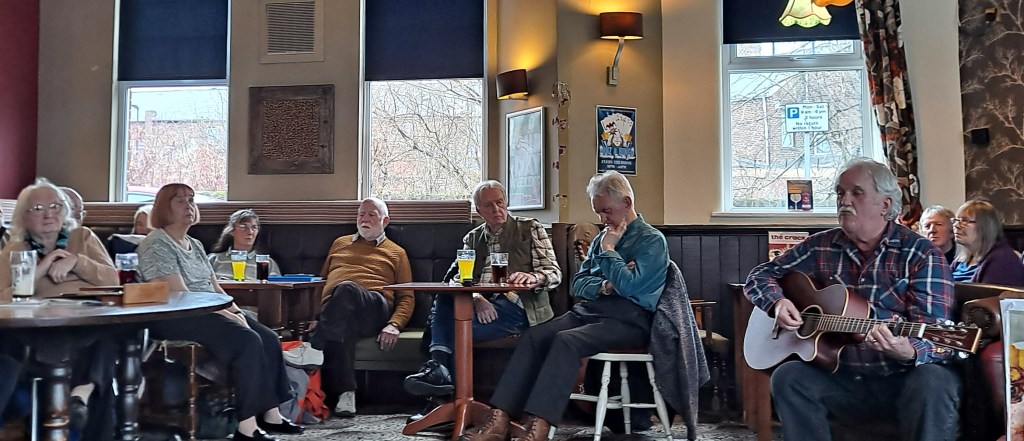
Ed Pickford, Ingrid & Barrie Temple, Tony Wilson performing at the Stumble Inn Folk & Acoustic Afternoon, Sunderland, February 2024.
The folk world is a small world, you get to see the same faces at the clubs and you get to know people from all over the North East. I first went to folk clubs in the late 60s and early 70s when virtually every pub had a folk club. I also used to go to The Bay in Seaburn to see bands like The Who, Free, Jethro Tull, there were loads coming to Sunderland then.
In about 2000 my husband and I began to go regularly to folk clubs in the area such as South Shields, Birtley, Tynefolk in Ryton and The Welly Folk Club in Wolviston.
When you say you live in the North East to other folk people they are jealous because of the amount of clubs and events up here. If you are prepared to travel half an hour you can go to a folk club most nights of the week.
There are venues like The Central Bar in Gateshead, South Shields Jack Clark Park, Croxdale in Durham, the Collingwood Arms and The Bridge in Newcastle which has been going 60 years. Saltburn, Whitby and Hartlepool also have annual folk festivals.
Keith Gregson performing at the Stumble Inn Folk & Acoustic Afternoon, March 2024
I also arrange a monthly folk afternoon at The Stumble Inn on Chester Road, Sunderland. We get around 30 – 50 people coming to our sing around and we are keeping the tradition going because in the 60s the pub was formerly The Royalty and had a very popular folk and blues club called The Glebe.
The pub is near Sunderland University metro so we have people coming in from Newcastle, Cullercoats and South Shields. Some come from further afield like Chester le Street and Teesside. Being on from 1-4pm people are happy to travel on public transport at that time – on the night they are not so keen.
Our folk gatherings at The Stumble Inn are on the 4th Tuesday of the month. All are welcome to sing a song, play a tune or just listen to the songs its very informal and free. We are based downstairs so the room is easier to access with your pints of beer and musical instruments.
We have singers from all over the region like Barrie and Ingrid Temple, Ed Pickford, Tony Wilson, Anne Lamb, Keith Gregson, Brian Hunt, Ken Hamer and others who all perform in a range of styles.
It’s an old genre but people still write songs now in the folk tradition about current events keeping the music alive. Music and song are so fundamental to our lives.
Now living in South Shields, retired teacher Rosie Anderson still feels there is work to do and more stories to tell.
‘Sometimes I feel as though I’m just getting started. I sing whenever I can. This year my musical partner Adam Holden and I have played at The Watch House in Cullercoats, The White Room in Stanley and Cockermouth Festival which were all great. I’m determined not to just bow out because I’m getting older’.
‘I grew up in Wylam in the Tyne Valley, in a house full of music. Both my Grandparents played piano. My dad listened to The Beatles, both parents loved the theatre and musicals and they took me and my brother there – I still love all that’.
‘When I was a kid I told my parents I wanted to be a performer but they were worried I wouldn’t be able to afford a home like them, they wanted me to have a ‘proper’ job. They wouldn’t let me study performing arts so I trained as a teacher’.
‘My first job was in Benwell, Newcastle. Then I went to the Middle East where I spent 10 years teaching in Kuwait and Qatar, before returning to Newcastle. I taught at Walkergate Primary School where I would do all the music shows and drama productions. Loved doing the shows there, I never gave lyric sheets out to the kids, they learned by listening and singing the songs back’.
‘When I left teaching I saw an advert for facilitators for Singing for the Brain with the Alzheimers Society. I really loved doing that. I did that for six years until covid hit. Singing on-line with people on the screen in front of you didn’t work really’.
‘People love stories in whatever form, be it a book, a film or a song. Some people write songs about being in love, and about their feelings. My songs are mostly about people and places. I find stories present themselves to me and I take them and turn them into a song’.
‘There are two songs that I have written that stand out for me. Sally Smiths Lament was written after my husband Chris and I worked on a film about soldiers from County Durham during World War One’.
‘Sally was the wife of miner Fred Smith, who featured in our film. They lived in a tiny terraced house and every day Fred and his sons needed a bath, a clean shirt, a clean bed and a dinner. The kids needed to get to school – how did she cope with all that, especially when Fred was away at war. I wanted to give Sally, and all the women like her, a voice.’
‘When I wrote it the song just seemed to be presented to me, her whole life. I got to sing it at a celebration in West Auckland and her family came to hear it – it was very moving. It travelled well and won three competitions – the Newcastle Folk Club, Rothbury Traditional Music Festival and first prize at Morpeth Gathering’.
‘I can’t just decide to sit down and write a song – some people do and I applaud them for the discipline but I have to wait until they come. Three things happened to me in my life that I put together in a song called Breakdown’.
‘When I was a kid I lived at Chapel House Estate in the west end of Newcastle. One night me, my mother and a friend went for a walk. This woman came out of her house in her dressing gown, she wasn’t in control of herself, didn’t know what time or day it was. I had never seen that behaviour in an adult before. Now I believe she was having a nervous breakdown’.
‘That always stayed in my head and another one was when I was living in Fenham. I went to the shops with my children who were only small then, and a woman came out of her house with a letter and asked if I would read it to her as she was confused and couldn’t understand it’.
‘Then about 30 years ago I went on a blind date in Newcastle with this very nice bloke. He said I need to tell you something before we go any further ‘When I was working in Canada I had a nervous breakdown in the car park of a Burger King’. It was hard to concentrate on anything else after that’.
‘But I remembered those incidents and those three individual people are lodged in my heart for their own traumas. They gave me that song’.
‘This year we went to Kjerringoy a former trading post in the Norwegian Arctic Circle, out in the middle of nowhere, it was beautiful. A family ran it in the 19th century and had 3000 fishermen working for them, catching and processing thousands of tons of cod’.
‘The father and husband died and the wife continued to run it single-handed for many years until she eventually remarried. I asked the locals if there was a song about her and there isn’t. So that’s my next song – Annalisa from Kjerringoy. Her story needs to be told’.
‘I’m also aware we need to start telling more stories about people and their lives and jobs today otherwise in 100 years time there will be no one singing about us!‘
‘What does music mean to me? It’s hard to describe it, it’s so deeply embedded, there’s no life without it. Music is at the core of my being, there is no day without singing and because I have grandchildren now I have a new audience! We sing folk songs and songs from musicals, they’re word perfect when they sing them back’.
‘Music gives such joy, when I was singing with the Alzheimers Society the collective joy and reminiscences of songs from the past and enjoying it together was just so valuable for the families’.
‘We had people who wouldn’t sing at all but liked being there and that was fine. Once, two women brought their mother to a session and she sat between them. She didn’t communicate at all, had her head down, closed off you know. But when we started singing a song, I can’t remember which one, she lifted her head up and actually got up and started moving around in the middle of the circle’.
‘One daughter got up and started dancing with her. When we got to the end of the song the daughter turned round and said to me ‘She’s just said my name for the first time in years’.
‘Music gets right in there (pointing at heart) we’ve got to keep it going and expose our youngest children and oldest adults to music because it really does reach parts that others can’t reach. It’s like hearing the heartbeat in your mother’s womb’.
‘As a child I wanted to do music, as an adult I taught it with kids then people with dementia, despite my age I’m still committed to what I always wanted to do. Women who’ve had careers and families can still chase their dreams’.






 ALIKIVI UK : NORTH EAST MUSIC & CULTURE