ON THE ROAD with author and former Iron Maiden roadie Steve Newhouse

Romford in Essex is where Steve Newhouse call’s home. He’s lived around the East End of London all his life and after leaving school with no qualifications he picked up various job’s in supermarkets and warehouses, he’s also worked for the Royal Mail…

In 1995 I decided to have a change in career and joined Royal Mail. I worked for them for 21 years until retiring in 2016. I have since written four novels of which two have been released.

10377355_10152864903054027_922962444848810933_n

Steve has recently found time to write down memories about the part of his life that he worked in the music business…

I toured a lot with Iron Maiden, then with More, Di’anno, Wildfire and in later years with Michael Jackson, U2 and Spandau Ballet. I worked as a scaffolder, stage hand and crew supervisor.

First, I was asked to write a column for on-line magazine Metaltalk. The column became really popular so was asked if I wanted to write a book.

When did you start working for bands ?

About 1975. When I first started, I was just a dogsbody helping carry the gear in and out of rehearsals or gigs. Then as things progressed with Iron Maiden, I got on so well with Doug Sampson that looking after him became the obvious choice. I was mainly a drum tech/roadie after that.

Doug Sampson was Iron Maiden drummer from 1978-9 before Clive Burr was in place and then Nicko McBrain took over the stool.

Steve remembers growing up with his friends and what music they were listening to as teenagers…

First record I bought was probably the T. Rex single Ride a White Swan, and my first album was a cheap compilation of glam greatest hits.

About ’73 or ’74 I went to my first concert at the Rainbow Theatre in Finsbury Park to see Nazareth. T.Rex, Sweet, Bowie, Slade was my thing and later that turned to Purple, Sabbath, Zeppelin and Quo.

I grew up with a guy called Paul Andrews (Paul Di’Anno original vocalist with Iron Maiden) and whereas Paul’s tastes were a lot wider, Reggae, Swing, Blues etc. some of his influences rubbed off on me.

We always had friends that were either in a band or wanted to form one.  Paul always had a decent voice, and we were asked to join various bands with me playing bass. I wasn’t very good, so when the opportunity came to roadie for Iron Maiden I gave up playing bass.

Iron Maiden were one of the pioneers of what became known as the New Wave of British Heavy Metal. Along with Sheffield’s Def Leppard and the Tygers of Pan Tang from Tyneside, they were at the very start of a nationwide musical movement.

I don’t remember much about the Tygers but I got to know the Leps fairly well and did a UK tour with them while working for More and Lionheart.

Also, in ‘81 the Maiden UK tour was opened by French band Trust. I can remember a gig at Newcastle City Hall, the crowd were great, and people were jumping off the balcony onto the p.a stack!

I was at all the gigs pictured above. In the early days, Maiden were just another heavy rock band. I think it was Geoff Barton at Sounds who first used the term New Wave of British Heavy Metal and all of a sudden, we were part of it.

Things had been fairly quiet up until then, with punk rock all the rage. Suddenly rock band’s were springing up all over the country and got tagged with the NWOBHM label.

What are your thoughts when looking back on the time in the music business ?

I have no regrets about being in the business. It was a great chance to be involved in something I loved. I got to work for some great people and met a lot more. I still have a lot of connections with my past. And I still believe now that Maiden are the hardest working band of any genre.

Any funny moments working for the band ? Yeah plenty. They’re all in the book (laughs).

51--YMEvPPL._SX329_BO1,204,203,200_

Loopyworld – The Iron Maiden years’ out now and available at https://www.loopyworld.co.uk/

Interview by Gary Alikivi     April 2019.

GET YER STRIPES – a year in the life of a Tyger with Glenn S Howes

glenn

On 1st December 2017 this blog has a full interview with Glenn where he talks about his early years as a musician in the North East.

Guitarist for Tyneside metal band’s Avenger, Blitzkreig, Fist, Tygers of Pan Tang and playing European festivals like Headbangers Open Air, Heavy Metal Night and Keep It True.

As I’m in the process of tracking down former members of the Tygers I got back in touch with Glenn, and we arranged to meet and talk about his time in the band….

In ‘97 I re-joined Blitzkrieg. They were already heavily involved with Jess Cox (former Tygers vocalist) through the Neat Metal record label in Wallsend.

Jess was co-managing the band and arranged for Blitzkrieg to appear on the ‘99 March Metal Meltdown festival at Asbury Park, New Jersey, USA. Excellent bands like Sweet Savage, Vicious Rumours, Sepultura, Overkill, Biohazard and Anvil were on the bill.

On the flight over to Philadelphia I was talking to Jess, and he mentioned that he had been trying to organise getting the original Tygers back together. He also wanted John Sykes involved. Robb Weir was in but in the end, Sykes turned it down.

Also, the original drummer and bassist didn’t want to do it. I seem to remember they had genuine personal reasons not to join.

Jess just said to me Do you fancy having a go? I was to take on John Sykes role. I said yes! He also persuaded the then Blitzkrieg bassist Gav Gray to take on the bass role. Gav brought his good friend Chris Percy in on drum’s.

When we got back from the USA. I got a call from Robb asking for us to get together for a jam. Essentially checking me out (laughs). I tried to impress him with a few Eddie Van Halen licks (laughs). It went well. Rob said ‘yes it’ll work let’s go for it’. Thank you, Mr Halen.

I loved the Wildcat album back in the day and still think it was one of the best NWOBHM albums. In those days the Tygers were held in high regard and were tipped to be huge.

I was so happy and excited to be doing this. So much so I served my notice with Blitzkrieg in ’99 and left them to concentrate on the Tygers that same year.

Where did you rehearse?

We started rehearsing in a place under the Byker Bridge near Newcastle. We were booked on the bill for The Wacken Festival in Germany in August ’99, so rehearsals were for that gig during the Summer. I have good memories of those rehearsals.

We then found out we were playing the Friday night but were surprised that not only was it a headlining slot, but above Saxon! I still don’t know why that happened it must have been a mistake or Saxon must have wanted to get away earlier.

What are your memories from that gig?  

They used a rotating stage mainly to get the drum kit’s ready for the next band. We were ready at the back watching Saxon who were mind blowing. I was thinking we have to follow that!

To say my bowels were loose would be an understatement (laughs). But it was a great gig, we went down well and got a lot of favourable reviews for our set.

I remember the intro that Jess wanted to play I think it was The Planets by Holst. We went on, played a few bars but the lights weren’t on. The lighting guy was fast asleep. Snoring his bracket off.

Now this was a major festival with Saxon and Dokken on the bill. We were told the audience was nearly 20,000. There was certainly a sea of faces that’s for sure. Robb Weir just ran straight over to the lighting guy and kicked him in the bollocks. Bang, wake up (laughs).

For stage clothes Me, Robb, Gav and Chris were wearing nothing flash just like jeans and t-shirt you know. But Jess decided to wear a cheese cloth suit! I asked him why and he said he liked to change the rules. It made him look like Jesus. It wasn’t an ironic piss take either. Just weird.

I’ve done thousands of gigs in different countries. Small and massive crowds but that was one of the highlights of my career. Headlining, getting that kind of attention, it can be mind blowing. Then you get back home and back to reality.

Your mates say ‘Have you had a canny weekend then? Me: Aye just played in front of 20,000 people with the Tygers of Pan Tang in one of the biggest festivals in Europe’. Not everyone actually believed me. (laughs).

You weren’t a rockstar then?

No (laughs) there’s a whole myth around that in my opinion. There’s an expectation to be throwing a TV out the window, shagging groupies and snorting ants or other stuff up your nose.

But the truth is that is only a small minority of bands who do that and get away with it. To be a musician in a rock band is more me.

When I’ve played Festivals which ever country I am in and your meeting, talking to fans who bring cd’s and your signing stuff for them, that is the best part. They are showing their love and respect for the songs you wrote and recorded. It’s amazing.

I’ve seen people doing the rock star thing. Maybe that’s just their extreme personalities or it’s done for sensationalism. That’s up to them and I don’t criticize them for it. I like socialising and having a really good time, but I’ve never snorted ants or thrown a tv out of a window (laughs).

I’ve just watched The Dirt movie about Motley Crue, was it all true? Did it give a musical background? and who were Mick Mars guitarist influences etc? No one really knows. There was no depth to it.

As I’ve said a lot of this type of thing is done for sensationalism and to perpetuate the rock star myth. It sells.

Did you record with the Tygers?

The Wacken show was recorded. Jess took the tapes back to Neat studio and we redone just a few bits. Jess arranged all of that via his label. That was licensed out to Spitfire Records and released in 2001. Basically the full set from Wacken gig.

We did have a few new song ideas for a new album, but nothing materialised from those sessions. I would have liked to have put some new stuff out.

But it wasn’t long after that Robb decided not to take this version of the Tygers forward and leave behind the Jess Cox version. Much like he did when Deverill took over I suppose.

How long were you in the Tygers?

Not long (laughs). About a year, I think. The initial discussion between Robb and Jess was for there to be another album like the Wildcat era but it didn’t pan out.

Looking back there wasn’t anything negative around the band and certainly no animosity that I was aware of.

My only thinking is it just didn’t feel right for Robb. Maybe he would have liked the original members in the band. I’m not sure, better to ask him. I always got on well with Robb and for me he always had the right vision for the Tygers and I respect that.

I think Jess worked on a few other projects after that. He contacted me and talked about another Wildcat type project but by that point I wasn’t interested as had other projects on the go and it all seemed a bit late.

What do you think of the Tygers now? 

Since Robb created that new line up, I think he has done a cracking job. They have been solid with some great musicians in the band.

Before they went from the Wildcat era into the Deverill and Sykes period, Robb talked of needing something special to move the Tygers on and he was honest with that.

Sykes and Deverill certainly added that extra ingredient. Deverill was a great vocalist and frontman. I think Robb did the same the second time around post Jess Cox. They have brought out some impressive albums.

I joined other NWOBHM heroes Fist as frontman/guitarist in 2013 and I stayed with them for over four years. We played a show with the Tygers and Avenger at The Cluny in Newcastle. I stopped and watched the initial part of their set and was gobsmacked at how great they are. An amazing band.

Looking back can you walk through that Wacken Festival Day?

I can pick out the whole Tygers period. Good memories of rehearsing together then travelling over to Germany. The night before the gig me Gav and Chris went out on the town and were drinking with the locals, they were amazing and found them really friendly.

We got a taxi back to the hotel and Gav and Chris went to bed and I stayed up for a tab (cigarette) as I smoked in those days. I sat outside the hotel and a guy got out of a taxi who I recognised but wasn’t sure as it was around midnight and dark.

He walked up to me and said in an American accent ‘Hey man do you mind if I sit down, are you going to the festival?’

I then realised he was one of my heroes, Don Dokken. We sat and chatted for hours. We talked about everything. Family, where we lived. We talked about music, guitars etc. He was a really cool guy.

Next day we bumped into each other backstage ‘How ya’ doin’ Glenn’. You know it was another highlight from the gig meeting him. Me, Gav and Chris were really happy to do it. Jess had his spotlight. Robb done his thing. Yes happy times. Fantastic memories.

Interview by Gary Alikivi    April 2019.

Recommended:

Steve Lamb March 25th 2019.

Jon Deverill Jan 22nd 2019.

Micky McCrystal Mar 17th 2017 & Jan 3rd 2019.

Fred Purser Dec 30th 2018.

Robb Weir Nov 5th 2017 & Dec 19th 2019.

Richard ‘Rocky’ Laws Aug 24th 2017.

Tygers of Pan Tang in Gaurdian Studio May 3rd 2018.

Steve Thompson June 27th 2017.

SONG FOR THE SIREN – Blues & Soul from Teesside with Emma Wilson

When did you first get interested in music and who were your influences ?

My influences initially came from my mam. An inspired young woman who promoted jazz gigs in the ‘50s. My Dad was a charismatic market trader who encouraged me to whistle and sing along to the funky ‘70s theme tunes like Kojak and Pink Panther. I’m sure that developed my ear.

My older sister’s and brother were playing records by Van Morrison, Little Feat, Funkadelic and of course Motown. But the first record I bought was from Austin’s Record Store in Middlesbrough.

It was Aretha Now and quickly followed by Aretha Sings the Blues. Both records have shaped my development as a singer, and I still perform tracks from both in my current set.

I used to sit for hours listening to the songs on vinyl especially anything on the Stax and Chess labels. Writing out the line-up, lyric’s and liner notes made me feel closer to the music and that I could get to know the people on the record. I suppose it was a bit of studying.

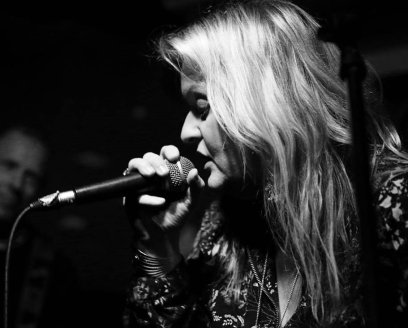
BIB EMMA 4

Was there a defining moment listening to a song when you said ‘I want to do that’ ?

Hearing Avalon by Roxy Music made me think I would love to be part of a band and make such wonderful sounds.

But a defining moment was seeing Heaven 17 on Top of the Pops singing Temptation. Carol Kenyon sings the iconic backing vocal. I was mesmerised. Her voice, her style, the way she looked. I remember wanting to be a singer from that moment.

Many years later I was booked as a backing singer for an advert for Barclays Bank. I didn’t know earlier that morning Carol had been in to lay down the lead vocal. I cried when I found out that I’d just missed her. But I did get to hear her down the cans (headphones) and ‘sing’ with her.

When and where did you start gigging ?

I was 16 when I started gigging in and around the Teesside and North Yorkshire area. Simon my brother, had a guitarist friend called Graham Brotton who was in a band. Unbeknown to me, Simon told him I would sing with them. Bearing in mind by then I had only sung in school musicals!

Well one afternoon I was lying on my mum’s sunbed in the spare room when this cassette came flying through a gap in the door and landed at my feet ‘You’ve got a gig in four day’s …learn this!’ Shouted Simon.

The songs on the tape were all soul tracks and after rehearsing with the band we played the gig, and my youthful confidence got me through. I remember Tracks of my Tears was the first song of the set.

Simon had so much confidence in me and a great piece of psychology to get me to do my first gig, never having too much time to think about it. He is still my unofficial A&R with his finger on the pulse recommending songs to add to my set.

Can you remember your first band ?

I took every gig on offer and eventually put my own band together Ask the Cat. We played over in Scarborough at The Stage Door and had some great pub night’s around Teesside.

I had my own p.a which my parents bought for me from Bandland in Stockton – most girls wanted a car (laughs). It was a huge Peavey in a wooden case that I would load in the back of my mum’s Ford Estate and she would drive me to the next gig.

I’d then unload it, tottering along in my stilettos, and set the sound up – not too much top on the mic, a bit of middle, being careful with the bottom end and a smiley face e.q. I can do it blindfolded now.

Did this early experience lead to new opportunities, playing to a wider audience ?

My brother Simon and I joined LTK and the Barhops, a soul revue band from York. We done some Little Feat and Gospel tracks. A singer called Ken Pickering was also in the band.

It was a great experience as we played University balls and clubs in Leeds and York. We had a great following and such a big sound.

I learned a lot about performing and technical stuff in those few years. You could say I had some of the sharp edge’s knocked off by the more experienced band members. That’s when I developed my big voice.

I sung sweeter soul style track’s but in LTK I learned how to use my chest voice. It was no more chirping for me, it was get big or get off!

If there were no monitors I was never allowed to moan about it because the philosophy was you should know the song in your head, ‘why do you need monitors ?’ Now when I ask sound guys to turn down monitors on loud stages, I’m met with bemusement.

Did you get to tour with name bands ?

In 2002 I toured the UK supporting Fine Young Cannibals. Just me and a guitarist doing my own material.

After the first couple of gigs I noticed the audience were mostly made up of women who were big fans of the singer Roland Gift. They saw the support act as just more time to have to wait and see him.

So, I started to mention him in my set ‘Oh I’ve just seen Roland getting his dinner’ things like that and they loved it. They’d just made a connection. After that they listened to my set, and it made the gig’s easier and more fun.

Roland thought it was hilarious and was extremely sweet to us. I also supported Mary Black at the Mean Fiddler in London for just one show, but that was a great moment.

Have you recorded any of your songs ?

My first experience of recording was epic! My brother and cousin were signed as 29 Palms by Miles Copeland to IRS Records in 1991. I was asked to sing backing vocals on both their album’s.

I went from singing in pub’s to recording in The Chapel Studio in Lincolnshire with producer Mick Glossop. Mick had worked with musicians with the calibre of Van Morrison, John Lee Hooker and The Waterboys.

The Chapel was residential and I remember being so excited that Marty Pellow had been in my room the night before!

Mick Glossop was brilliant I basically got a masterclass from one of the legends of record making. He’s an amazing musician who knows how to put a sound together. I was so lucky to work with him at such an early point in my career.

Vocals on the 29 Palms album required a much more intimate and harmonically complex sound than I had ever used vocally. I done six or sometimes eight layered vocal track’s all on tape not digital. I still use the techniques he taught me today.

He subsequently booked me to add backing vocals on a single by Martyn Joseph on Sony records. We just missed out on doing Top of the Pops as the single stalled at number 31.

I also recorded for songwriters when pitching to big artist’s and pretty much sure of doing Candy Man in a kitchen in Notting Hill Gate. Christina Aguillera recorded that one.

Also done scores of TV advert stuff and recording sessions when session singers could do really well. But auto-tune came along and ballsed that up for us.

That was around the time when I started running my own music night’s. Starting in 2000 for ten year I was running my own Live Nights London at five venue’s across the capital mainly working out of The River Bar on Tower Bridge.

I met great friends and loved promoting duos and band’s, but I never gigged much myself then.

What are you up to now ?

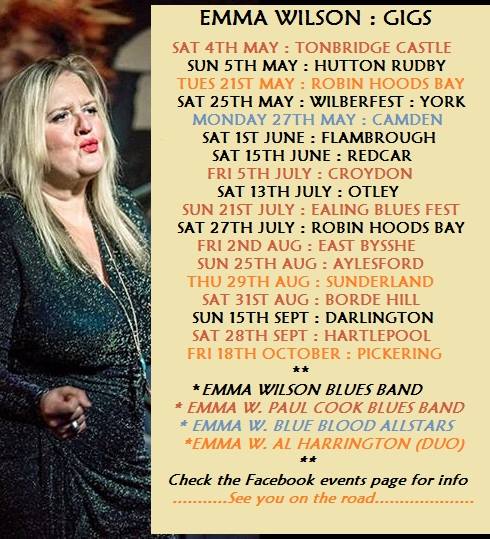
I am very lucky to be still involved in music. I have my own band and we are gigging around the UK on the blues scene, which has embraced me with such warmth and encouragement.

For more information contact the official website http://emmawilson.net/

59163289_2409295602434428_7345977600537264128_n

Interview by Gary Alikivi   March 2019.

NIGHT OF THE TUBE with former TV music producer Chris Phipps

How Frankie Goes to Hollywood were discovered by default, why Tina Turner was nearly not on, what was a life changing career appearance for her. Also, what was Ozzy doing in a coffin on City Road ?

Hear all the backstage stories from ‘80s music show The Tube at a free talk by Chris Phipps.

The Tube was broadcast from Tyne Tees Television Studio 5 in Newcastle and hosted by Jools Holland and Paula Yates. It showcased everyone from Madonna, French and Saunders to Frankie Goes to Hollywood.

I was in the audience for the early shows and watched some great bands including Thin Lizzy, Big Country, The Alarm and American rock singer Pat Benatar.

Chris will be talking about the sights and sounds from behind the scenes when he worked on the show. ‘As an ex-BBC producer, I initially only signed up for three months on this unknown programme and it became five years! I was mainly hired because of my track record for producing rock and reggae shows in the Midlands. On the night I’ll be telling of my Jamaican exploits’.

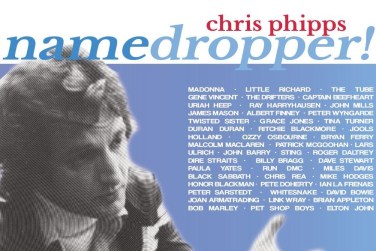
Chris will also have copies of his new book ‘Namedropper’ for sale at a special price.

Newcastle City Library (opposite Trillians Bar) 8pm Saturday 18th May 2019. Free entry.

Namedropper Cover

Interview by Gary Alikivi    April 2019.

SOME KIND OF MAGIC with Northumberland poet, writer & broadcaster Katrina Porteous

The poetry is part of me, I couldn’t do without it. It’s been with me all my life. It’s a sort of compulsion! It’s a basic human connection, we all play with the sound of words when we’re children.

I find art very mysterious. If you’re a writer, artist, musician or film maker, in the end what makes it work? You can’t teach it, you can’t explain it, it’s something mysterious. There’s something magic about it.

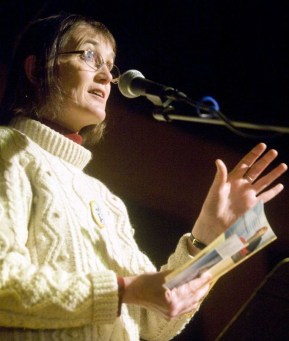
Katrina - credit The Daily Astorian

Pic by Daily Astorian.

When were you first interested in poetry and who were your influences?

Songwriters like Bob Dylan, Paul Simon, Leonard Cohen and Patti Smith were really important when I was in my teens.

Film was also influential, especially the 1982 cult film Koyaanisqatsi, with a soundtrack by Philip Glass. There were shots of wide-open American landscape. A lot was in timelapse, so the film was speeded up then slowed down.

It cut between close up microscopic to wide angle shots, it was playing with perspective and time. That was really influential on my way of seeing things.

Poets who influenced me included Geoffrey Hill, who I met when I was 18. Northern Arts paid for a three-day course in Ambleside, that was 1979.

In the early ‘80s I travelled around the west coast of America and saw the wide landscapes of the Arizona desert which were just beautiful. American poets like Robert Pinsky influenced me at that time, and the Irish poet Seamus Heaney, who taught at Harvard.

What is your background?

I studied History at Cambridge University and then gained a Harkness fellowship to the USA, where I studied in California then Boston.

In 1989 I won an Eric Gregory Award for poetry from the Society of Authors. It was £6,000, I’ve been very lucky. That started me on the road to working freelance.

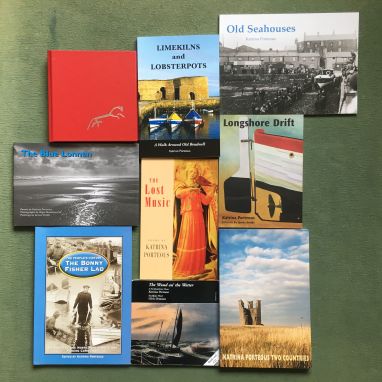
Katrina's books

You have written a number of local history books. How does that fit with your poetry?

I’ve lived on the Northumberland coast for over 30 years in the village where my Grandparents used to live. I wanted to write about the sea so the best way was to talk to the local fishermen.

They were a huge influence on me, some of them were in their 80s.

They knew so much and there was a sense that fishing was coming to an end. It was very difficult to earn a living and young people weren’t coming through.

All their stories, skill, knowledge, even their dialect was all going, so I spent many years spending as much time as I could with them, going to sea, in the huts talking to them. This was very formative to my poetry.

A whole series of work came from it. My first two poetry books with Bloodaxe and a series of local history books featuring Seahouses and Beadnell. I still have a load of material that I got from the fishermen, there’s still a lot of writing to do there.

I feel as though I could be doing this work for the rest of my life. And you come across some great names, like fishermen called Geordie Birdy, Bill Cloggy, Dobbin and Kelpy Jack (laughs).

I’m more driven to write poetry though. The local history informs the poetry, it gives me a subject.

In 1999 I was asked to write something in the Northumberland dialect and with me talking to the fishermen and writing down the phrases of their everyday speech, I tried to put them all in one poem.

I worked with musician Chris Ormston which resulted in a CD called The Wund an’ the Wetter. With it being 20 years old we are performing it soon at the Iron Press Festival. Chris plays the small pipes, and he is one of my longest standing music collaborators.

Do you perform your poetry at many live events?

We play various folk and poetry festivals around the country, church halls, schools and women’s institutes. I’m really interested in spoken word, perhaps even more than poetry in books. Although I have produced books, I have written a lot for BBC Radio 3 and 4.

How did work on the radio come about?

I’ve had work on the radio for about 20 years now and it first came about through my publisher Bloodaxe. Radio producers are looking around for poems about certain subjects.

Sometimes they get in touch with book publishers, tell them what they are after, and they get in touch with poets. It can be very competitive. But worth working on because you can bring other sounds to your work. It’s a lovely way of experimenting with sound.

Think of it as a piece of music. I wrote a half hour poem for Radio 3 about Holy Island where I worked with producer Julian May. We brought in sea sounds, the wind, all the different birds and the sound of the seals. Then you can layer the voices and make it more abstract, hearing sounds rather than words.

Artists are always looking to perform to a wider audience…

Poets are quite happy with six! (laughs). I’ve travelled to Festivals with musician Chris Ormston where we played to six people in one place and ten at another. But asking about reading to a wider audience is a serious point because I like to have my work in books, but there is a limited amount of people who will pick up a poetry book.

But like music, poetry is for everyone, and I would read my work to a general audience rather than just a poetry audience. I’ll read my work anywhere and working with musicians makes it more accessible to people.

Katrina with Peter Zinovieff at Sage Gateshead

Performing with Peter Zinovieff at The Sage, Gateshead.

I also work with electronic composer Peter Zinovieff. We’ve made five pieces and are going to be making another one next year. Peter was one of the first people in the world to have a computer in a private house.

He was making music with a computer from the mid ‘60s in his EMS studio in London, where he designed the VCS3 synthesiser.

This was one of the first commercially available synthesisers and used by all sorts of bands like Pink Floyd, The Who, Tangerine Dream and Roxy Music’s Brian Eno. At the same time, classical composers such as Harrison Birtwistle were working in Peter’s studio.

Where did you meet Zinovieff?

I met him in the mid ‘80s in Cambridge when I was studying there. The first piece we made was for Radio 3 in 2011, then we made a few pieces for Life Science Centre planetarium here in Newcastle. They were about astronomy and physics, the large and small, thinking about scale and perspective.

The text for those pieces is coming out in a book from Bloodaxe later this year called Edge. They are big performance pieces with visuals and made for surround sound but I’ve also got stereo recordings so can perform them anywhere.

We are working on another science-based piece with music and poetry with the NUSTEM Exploring Extreme Environments project at Northumbria University.

That will be around ice and glaciers and using some of the recordings the scientists have made in Antarctica. Peter will create a soundscape from that. We’ll have that ready next year.

What else have you got planned for this year?

On 24th May I’m going to be working with folk fiddler Alexis Bennett at a gig on The Cutty Sark in Greenwich, London. So really looking forward to that. Also the Iron Press Festival on 22nd June at St George’s Church, Cullercoats.

Contact Katrina on her website http://www.katrinaporteous.co.uk/

 Interview by Gary Alikivi    April 2019.

MORE THAN WORDS with North East poet Keith Armstrong

I’m standing at the bar in The Bridge Hotel in Newcastle waiting for poet and writer Keith Armstrong. If you imagine someone looking like the actor Bill Nighy, you’re not far wrong.

He breezes in and before you know it we are sitting in a quiet corner and after his first sip of cider he tells me a story…

I took the train down to London with a mate of mine, it was 1977. We had third row tickets for the Rainbow Theatre to see Bob Marley and the Wailers.

We were frisked as we went in, everyone was, but through a heavy fog of ganja smoke we saw a fantastic show. He had such a presence on stage. It was pretty much the best concert I’ve been to in my life.

First time I travelled abroad was in 1966. I went with a friend, we took a Melody Maker trip to the Berlin Jazz Festival. Flew over there then got a coach past Checkpoint Charlie to the venue. It was afternoon gigs, avant garde stuff and the big jazz guys of the day like Miles Davis, Stan Getz and Sonny Rollins were on the bill.

We got back to London and walking down Carnaby Street we bumped into two of the Beach Boys who we went to see in concert that night at Hammersmith Odeon.

313343_10150279462417234_211706092_n

What is your background ?

I was born and bred in Newcastle and my father worked in the shipyards. Absolutely steeped in the tradition. School days were spent at Heaton Grammar and it taught me to be a rebel because I couldn’t stand the confinement of the place. Just being edgy, wanting things to change – haven’t lost it.

First job I ever had was at Newcastle University Library I got paid six pounds 14 shillings and threepence a week. I was always bookish at school, so libraries were good to get into. Plus, I was the only boy amongst 15 women librarians – I learnt a lot.

Gateshead College was another library I worked at in the early ‘70s. Within that I was developing an interest in the arts and arranged events with poets and theatre.

From 1980-86 I was a Community Arts worker in Peterlee, County Durham then went freelance as a writer. I was glad to escape the 9 to 5 into an alternative prison of freelance (laughs).

I was interested in people like Dylan Thomas, the rhythm of his poetry. Actors like Richard Harris, hell raisers like Oliver Reed – all good role models! Yeah, in my early days I loved the old bohemian lifestyle of reading poetry and getting tanked up (laughs).

Listening to The Beatles, Bob Dylan, they were all there and I wrote poetry but always felt that I wanted to make them song-like. That’s why I ended up working with Gary Miller and The Whisky Priests. (Featured on the blog March 23rd 2019).

20108676_10212751378275783_1952693382877553180_n

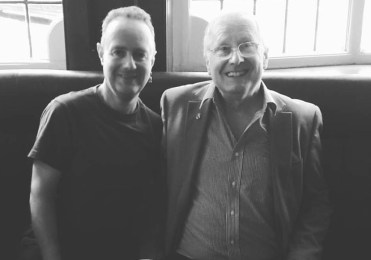
Keith with North East musician Gary Miller.

How did that come about ?

I was writing lyrics and I see very little difference in poetry to song lyrics. Around the early ‘90s I cottoned on to The Whisky Priests. I was looking for a band that had an edge, a bit of anger, you know a bit of an attitude. Also one steeped in the working class tradition of the North East.

So, I asked this guy Ross Forbes who was press officer at the NUM and he mentioned The Whisky Priests. I found they were playing at The Rose Tree in Durham. I went along and I knew this was what I was after, even I got up dancing (laughs).

It was really important for me and my poetry as it’s a different audience for what I write. And they weren’t playing in just the backroom of a Folk Club. They were taking it forward, for a younger audience. We also travelled a bit to Germany, Holland and Ireland.

I always admired the fact Gary could write songs and was quite prolific about it as seen on The Whisky Priests anthology box set. But yeah, I wrote some lyrics, they recorded Bleeding Sketches and it came out in 1995.

What does writing mean to you ?

When I do write it’s to express my emotions and follow my heart. That’s why I like Gary Miller because he is like that. We worked on a project together called The Mad Martins. They were three brothers one of which has his paintings in the Laing Art Gallery in Newcastle.

I researched the story and asked Gary to write some stuff for it, that’s how it kicked off. It’s a special story that we put out on a triple CD. But writing, I couldn’t live without it.

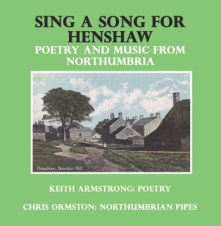
Henshaw cd front jpeg

What you working on now ?

Well, I’m just forcing myself to write at the minute. Emotionally I’m a bit sapped with things going on around me you know, personal stuff.

There are plans to go out to Tuebingen near Stuttgart with Northumbrian piper Chris Ormston as part of a Cultural Exchange arranged with County Durham. That’ll be in July.

Originally, they sent me over there in ‘87 as Poet in Residence and I’ve been going back there ever since. Then in October it’s same again for Limerick over in Ireland, fell in love with the place and they keep inviting me back.

But I could still be reading my poetry to 10 people in the back room of a pub in Penrith. Why do it? I don’t know. But I’m keeping my options open (laughs).

Interview by Gary Alikivi    April 2019.

ROKSNAPS #7 – Snap Happy with Martin Blank

Roksnaps are photograph’s taken by fan’s which captured the atmosphere of concerts in the North East during the late ‘70s and early ‘80s. T-shirt’s, programmes and autographs were hunted down to collect as souvenir’s – and some people took photographs on the night.

One fan who kept his photos and shared them on the blog is Martin Blank…

Like many fans at the time, I liked to leave a gig with as many souvenirs as I could whether it be a T-shirt, scarf, badge, programme or poster. If very lucky, maybe a plectrum, drumstick or even a sweaty towel used by the band and thrown into the crowd.

If it was a band I was keen on I would sometimes record a gig, although this was greatly frowned upon at the time by record companies worried that the recording would appear on a bootleg LP and rob them of potential sales.

Funnily enough recording gigs and photographing bands seems to be encouraged nowadays.

Cassette-recorders in the ‘70s were rather bulky and therefore trying to get into a venue with a huge bulge under your coat was no mean feat. I can’t describe the joy of leaving a venue knowing that you had the gig on tape which could then be relived in the privacy of your bedroom.

Even better was taking photos because no other pics from the gig would be identical to the ones you’d taken.

captainsensiblecityhall77

Captain Sensible of The Damned outside Newcastle City Hall in 1977.

The first camera I got was an instamatic and the first gig I took it to was T.Rex at Newcastle City Hall in ‘77. For reasons I can’t remember I didn’t take any photos of support band The Damned but straight after they left the stage I went outside and who walks past but none other than Captain Sensible.

I fumbled around in a desperate attempt to find my camera in hope of getting a few candid snaps of The Captain. Shoving my camera under his nose I asked him if it would be OK to take a few photos. ‘Of course’, he said with a big grin on his face.

As I was happily snapping away, hardly believing my luck as he was striking just about every pose known to man, in jumped a group of punks. One of them was carrying The Damned’s debut album.

I asked if there would be any chance of getting a few photos of the rest of the band. The Captain went in the stage door and a couple of minutes later appeared with vocalist Dave Vanian looking like he’d just walked off the set of the latest Hammer Horror film.

paulinemurrayuni78

Pauline Murray vocalist with North East punks Penetration at the Newcastle University 1978.

The next gig I took my camera to was the Stuff the Jubilee event at The Guildhall featuring The Adverts, Penetration, The Big G and an unknown band from Manchester called Warsaw. Regrettably, I was so excited watching the bands that I totally forgot to take any photos.

Warsaw, of course, were soon to change their name to Joy Division and did rather well for themselves. On that night they came across as a rather poor run-of-the-mill Punk band. So bad that somebody commented, ‘They’re so bad they’re good.

My brother had a better camera, a Zenith which he would sometimes let me borrow. Whereas with an instamatic camera it was basically sheer luck whether or not you got a good photo or just an abstract-looking blur, with an SLR (single lens reflex) you could focus, alter the aperture which was great when the stage lighting was poor and even zoom-in.

Taking photos at The Mayfair, Uni or Poly was easy as nobody was bothered but the City Hall had a strict ‘no photos’ policy. Some stewards were OK with it and would let you go to the front of the stage to get a few pics providing you were very quick. Loitering around the stage snapping away could get you dragged back to your seat or, even worse, thrown out.

The advantage of many Punk gigs was that they took place at the Uni, Poly or in pubs which meant you could get really up-close. Several times I got disparaging looks from a member of a band: ‘Get that fuc*ing camera out of my face’.

Of course, there was always the risk of your camera being damaged in the frenzy of a Punk gig but it was always worth taking the chance.

Sometimes when I show the photos to kids who are into Punk nowadays, they’re amazed. It’s a bit like they’re seeing photos of the Second World War or something, ‘O my god you were actually there!

I guess it’s one thing seeing photos in a book, magazine or on a website but to actually handle the originals gives them some sort of connection to the past.

I’ve been offered considerable sums of money for some of the photos, but I wouldn’t sell any of them as I occasionally like to dig them out and reminisce about how great it was to be a teenager in the ‘70s.

generationxuni78

Generation X, Newcastle University 1978.

Interview by Alikivi   April 2019.

BOLD AS BRASS with North East musician and former Lindisfarne sax man Marty Craggs

When I first started playing sax there weren’t that many sax players on the Newcastle scene but now I think the sax has become more popular and it’s good to see and hear all these great young jazz musicians taking up the sax, they can really play!

36688181_2021340667899985_7487959388162883584_n

When did you first get interested in music and who were your influences ?

I was born in Newcastle on the banks of the River Tyne. My Grandma played the harmonica and the piano, rumour has it that she could rock!

I started piano lessons at the age of 9 but wasn’t until I was 15 when I really woke up to music. I saw the Rolling Stones on Top of the Pops. Blown away!

The first record I bought was Whatcha Gonna Do About It by the Small Faces then started listening to The Beatles and The Yardbirds until I discovered the blues with Muddy Waters, Howlin’ Wolf and John Mayall. By 1967 it was Motown and Junior Walker.

Then I got into the Stax sound with James Brown, Sam & Dave, Booker T & the MG’s, just all soul music and finally bought a saxophone.

When and where did you start gigging ?

I joined my first soul band at the age of 18, The Georgia Quintet. Got into their brass section of two saxes and a trumpet, great guys, still friends with them all today.

Those early years I gigged the local scene with many bands. We went to all the social clubs, school dances, universities. It was great fun learning the ropes and gathering experience.

In ‘75 I joined Harcourts Heroes with Ray Jackson and Charlie Harcourt. They were a crackin’ band. By ‘78 I had moved to London and formed a band called The Breakers with Charlie Foskett and Maggie Luckley.

We got a deal with MAM Records and recorded in Broadoak Studio in Brighton. We done a couple of tours, one supporting Darts. Great band, nice folk’s it was all good craic! But London got too big for me, so I came home to Newcastle.

I met up with Ray Laidlaw, Rod Clements, Jed Grimes, Billy Mitchell and Steve Cunningham who had a crackin’ band called Pacamax. I joined them and had so much fun, this was around 1980. We played all the festivals and folk clubs.

20190330_112834

How did the gig with Lindisfarne come about ?

The call from Ray Laidlaw to join Lindisfarne came in 1983. We spent many happy days touring the world and recording with the band.

I played sax, flute and vocals on the Amigos album and sung lead vocal on Roll on that Day, co-written with Rod Clements. I also co-wrote Everything Changes with Alan Hull. We used the Reel Time Studio in Newcastle.

Lindisfarne have a large back catalogue of recorded music…

Yes I was also on the Here Comes the Neighbourhood album in ‘98. We went into the Watercolour Studio, in Ardgour, Scotland to record that one.

Again I added whistle, harmonica, accordion and vocals. I also recorded lead vocal for one of my own songs Driftin’ Through. The album was produced by Sid Griffin.

Elvis Lives on the Moon was recorded in Newcastle’s High Level Studio by Kenny Craddock, he is sadly missed. Dance Your Life Away was recorded and produced by Steve Daggett at Impulse Studio in Wallsend. We also recorded Buried Treasures and Live and Acoustic.

In 1990 the band achieved a UK top 3 single with the most famous footballer at the time, former Newcastle & England player Paul Gascoigne….

We had great fun with Gazza and his version of Fog on the Tyne. I co-wrote that with Alan Hull. It was all good until the sad and untimely death of Alan in 1995. Alan was a big influence on me both as a friend and a song writer.

I was privileged to write a couple of songs with him, it was great to watch him work. He was a prolific songwriter, great performer and a cool guitar player too, just loved his Strat playing.

Looking back all the gigs and tours with Lindisfarne were memorable especially at Newcastle City Hall. But by 2000 I had left and with Les Dodd and Brian Duffy we formed a band called The Happy Cats.

After joining Lindisfarne I started touring and gigging the folk clubs and festivals discovering a whole new world of music on the folk scene. I did some gigs in Ireland and started listening to Irish Celtic music.

I loved the celtic sound of fiddles, flutes, accordion, acoustic guitars and whistle all taking the melody.

This got me listening to John Prine, Mary Black, Dalores Keen and of course the Saw Doctor’s. I joined an Irish band called the ShyTots based in North Shields where I learned to play the Bodhran, a great band full of fun.

This was the thinking behind The Happy Cats, a celtic sounding band, with a big emphasis on fun.

Over the years I have picked up new instruments as and when the songs required them. Now I’m playing sax, flute, harmonica, bodhran, accordion and whistle. Also found myself singing more these days and enjoying the music.

Did you record with The Happy Cats ?

Yeah, we made three albums and gigged for 17 years. Fans became our friends, the Toon to Tuam tours were infamous, mighty craic in County Galway (laughs).

We recorded our debut album Follow the Moon at Watercolour Music Studio, Ardgour, Scotland. It was produced and mixed by Micky Sweeney. I sang lead vocal on all tracks and played sax, whistle, harmonica and accordion. Rachael Bailey added fiddle and Michael Bailey was on bass guitar.

The Take my Hand album was recorded at Cluny Studio, Newcastle where I sang lead vocal on all tracks.

For Ten Years On we went into Charltons Studio in Cambois to record. That was mixed and mastered in Blast Studio here in Newcastle. I played sax, flute, whistle, harmonica, accordion and sang lead vocal on all tracks.

Again, Mickey Sweeney produced that record. But sadly, The Happy Cats split up in December 2017.

LBJAM

Marty Craggs Little Band Jam.

What are you doing now ?

Paul Alex Campbell (ex Christian’s) and I have been writing and recording for our band the Unexpected Visitors. A fantastic six piece band, that rocks.

We’ve already done a few gigs and hope to release our debut album this year. Also been gigging with my old pal Trevor Sewell, an award winning guitar player. It’s 50 years since we were on stage together, it’s been a blast.

These are busy times because we, Steve Dolder (drums) Dave Whiffin (guitar) and Michael Bailey (bass) put together a celtic/Irish influenced four-piece band called Marty Craggs Little Band Jam. We are playing songs from the Lindisfarne and Happy Cats days, plus adding some good cover songs.

We guarantee 100% full on sing-along night out. The Lindisfarne Festival Thursday 29th July 2019 is a date for your diary. I would like to thank my right-hand man and Roadie No1, Alan Loughhead, for all his support and help. Top man.

What does music mean to you ?

Music is my life, it’s what makes me tick. I’m constantly writing songs and gigging. Still as enthusiastic about everything to do with the business as I was back in 1966. I’m so lucky and blessed to still be able to do it! Luckiest boy!

In 2016 I got together with my son Andrew and daughter Beverley, both great musicians and singers, and we realised that after all these years we hadn’t played or performed together. So, we wrote and recorded The Craggs Family Album recorded at Broadoak Studio in Brighton and Blueattic Studio in Hexham.

All mixed and mastered at Blast Studio,Newcastle. The project was a wonderful time and a great thing to do, a very proud Dad.

Interview by Gary Alikivi March 2019.

WHEN MILLER MET CUNNY documentary about workingmen’s clubs

During late 2015 I made a documentary about workingmen’s clubs on South Tyneside and most of the filming took place in the Royal British Legion Club in South Shields.

After initial research I approached Club Steward Pam Carrol about filming in the club ‘What will be your best time ? I’d like to film when there is some entertainment on’.

Expecting a Friday or Saturday night she returned with ‘No son, Monday is best. We’ve got a singer on and an afternoon bingo session. The club will be packed’. It was, and musician Alan Knights provided the entertainment.

009

Wayne Miller and Iain Cunningham, still picture taken from the ‘Home from Home’ documentary 2015.

Included is a transcript of the interview with two of the contributors to the documentary, North East actor’s Wayne Miller and Iain Cunningham, both regulars on stage at The Customs House theatre, South Shields.

A couple of points (or pints) before the stories, filming had to be stopped a few times because I was laughing so hard and if you don’t speak Geordie it’s written in the Tyneside dialect.

Miller: We were part of a travelling pantomime company that did the clubs for 15 years.

Cunny: Yes 1997 we started. We were just bairns.

Miller: Yeah, just young bairns from college drafted in to do touring panto that we thought was a one-year thing ended up being 15 years. It was a great training ground for us as actors.

Cunny: Really is where you learn your trade, where you don’t know what to expect. Was always fun to do. One thing I didn’t realise was how important it was to the people at the clubs you know the whole family day out sort of thing. They saved up and it was a big deal wasn’t it. The kid’s always got a selection box, the dad always got a beer.

Miller: Mam always got a Babycham.

Cunny: Ya know no expense spared.

Miller: Yeah, you are right it was that big, massive day out all the kid’s dressed up in their Christmas outfits and Santa of course. All the club’s provided a Santa to come out after the pantomime.

Which always reminds me of the story when the concert chairman came in, he was like ‘Lad’s, lad’s, we’ve got Santa comin’ in right, so if you tell us when the panto is ending, we’ll bring out Santa, kids are gonna love it, they’ll gae crackers’.

I said alright mate it generally runs for this length of time, we’ll defeat the villain then we’re gonna sing Reach for the Stars. If you listen for that then get Santa ready to come out.

Cunny: We’ll make a big deal of it, a massive thing so all the kid’s get very excited shouting yeah Santa.

Wayne: That was the plan.

Cunny: It was.

Wayne: Lo’ and behold we defeated the villain and right boys, and girls were gonna sing Reach for the Stars now so if you’d like to get on yer feet and… where you goin’ where you goin’ !

Cunny: There was a jingle and right at the back there was Santa.

Miller: 400 kids’ just get up off the floor and run towards the back. We’re just singin’ Reach for the Stars in front of this only kid that’s scared of Santa and is cryin’ his eyeball’s out.

Cunny: Christmas Eve shows were brilliant. The excitement.

Miller: Yeah, they knew it was comin’. Santa’s on his way. But come Boxing Day it was like chalk n cheese.

Cunny: Nobody wanted to be there. Including us. To be fair me and Miller had to go on and whip the crowd up to a frenzy, get them joining in.

Remember doing one club in Gateshead and I came running on first, the music started I shouted Hiya gang. I looked out and the kids were (looking down) just playing with the new toy they had brought.

On concert chairmen…

Miller: Going in the club the concert chairman would greet ya’… ‘I’ll show ya’ round the club lad’s, show yer round the club. There’s yer stage, there’s yer stage right. See that…that’s yer organ.

Both together: Can’t move that. Nah can’t move that.

Miller: There’s the drumkit ower there.

Both together: Can’t move that. Nah can’t move that.

Miller: So, do you think yer’d get yer set on there ?

Cunny: Most of the time we couldn’t. We’d have to scale it down to one bit of scenery and a cloth. And the dressing rooms. Every dressing room ya’ can garantee some turn would have written a note on the wall.

Miller: Turn back lads. Unplug yer gear. Get in the van and get yersel away.

Cunny: Yeah, don’t bother. It’s rubbish here.

On the demise of the workingmen’s clubs…

Miller: It is quite sad, and people aren’t goin’ in and learning their craft. Like group’s, singer’s, acoustic act’s, stand-up comedians.

Cunny: There is no better place to learn.

Miller: Comedy isn’t in the club’s anymore it’s going into the theatre’s, upstairs of pubs. You are seeing now comedians don’t know how to handle a crowd. That’s what the club give ya’.

Cunny: Yeah, they don’t know how to handle the drunk man hecklin’ them (laughs).

13895586_1225372580819888_8204873674232638731_n

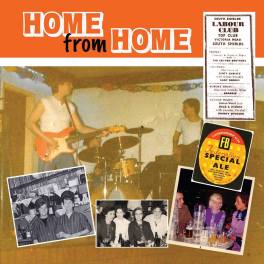
‘Home from Home’ 25mins (2016).

9min edit at

https://www.youtube.com/watch?v=vSBp5XD242U

 Interview by Gary Alikivi.


WHEN JOE MET MAD DOG – stories from workingmen’s clubs

In late 2015 I made a documentary about workingmen’s clubs on South Tyneside and  most of the filming took place in the Royal British Legion Club in South Shields.

After initial research I approached Club Steward Pam Carrol about filming in the club ‘What will be your best time ? I’d like to film when there is some entertainment on’.

Expecting a Friday or Saturday night she returned with ‘No son, Monday is best. We’ve got a singer on and an afternoon bingo session. The club will be packed’. It was, and musician Alan Knights provided the entertainment.

004

Michael ‘Mad Dog’ Davis and Joe Peterson in the Royal British Legion, South Shields 2015.

Included is a transcript of the interview with two contributor’s to the documentary, North East club entertainer’s Michael ‘Mad Dog’ Davis and Joe Peterson, both regulars in the club.

A couple of points -or pints – before the stories, the filming had to be stopped a few times because I was laughing so hard and it’s written in the Tyneside Geordie dialect.

 Joe: I tell yer what they used to do, they used to bring their own food.

Mad Dog: They still dae it.

Joe: They bring cheese, crackers things to eat put them out on the table and they would share.

Mad Dog: And everyone used to have their own seat. You can’t seat in that seat. You go into a strange club and sit in a seat. You can’t sit there that’s Harry’s seat. He isn’t here. Doesn’t matter. That’s Jackie’s seat. You can’t sit there. And big fight’s if yer did.

 Joe: We were in the club’s for a long time but the ‘70s were different where there was a boom  and there was money to be made an’ I remember people from mechanics to taxi drivers deciding to play instruments and do stuff on stage, to go and make a living.

Mad Dog: It was yer apprenticeship that’s what it was.

Joe: For the young ‘uns aye.

Mad Dog: You find out now that everyone who done that apprenticeship in the clubs are a different type of musician that you have now.

Joe: A lot of them in the North East, good players start in the clubs and learnt the trade. It was one of the most hardest club area’s in the country, it was renowned for it. So if you could do it here.

Mad Dog: Same with comedians, any top comedian probably started off on the club’s first. Then the good one’s went onto bigger things.

Joe: We used to have regular meeting places like The Crown at Tyne Dock which is a bingo hall but a nightclub as well. Often we’d go there after gig’s and there’d be a musician’s scene. There was so much work about people were working most nights you’d finish a gig and end up there. If yer were a bit of a distance you would hurry to get back for a couple of pints in The Crown.

Mad Dog: We’re talking Tuesday or Wednesday night you could have 10-15 people playing on stage who made it back to The Crown after their show. There used to be a resident duo of organ and drums, next thing you know there’s a guitar, bass, three singers, brass section. Everybody heading back to The Crown.

Joe: After that everybody head off to..

Mad Dog: The Shah Jan

Joe: Yeah The Shah Jan for a curry. It was renowned. The room was full of musicians.

Mad Dog: I counted once,  in a year I had a curry 7 days a week (laughs).

003

On concert chairmen…

Joe: The thing about the concert chairmen is looking back now they were down to earth solid fella’s, lot of them tradesmen.

Mad Dog: Managers in the dock’s.

Joe: Aye in the dock’s, shipyards, then they were part of an entertainment night with a microphone in front of them and Ladies and Gentlemen. Things they weren’t used to. So as musicians we used to look from the outside in and think that’s crazy. Someone with experience just wouldn’t do.

Mad Dog: They’d get a microphone, and the bingo’s on. They used to have sockets on the wall that you plug into the house system and on many occasion the microphone hasn’t worked so they actually started talking into the hole in the wall (laughs).

Joe: Once there was a whistle noise in the background from the p.a and they were trying to find out where the noise was coming from. We had a listen to our speakers it’s not our gear. Then someone in the lounge shouted up to the concert room where’s that feedback come from, what’s that whistle ? And the concert chairman put the microphone to his ear well it’s not our gear (laughs).

On the demise of the workingmen’s clubs…

Mad Dog: The cheapest place in town to drink was the social club and it still is in some of them. Don’t think the kid’s these day’s follow in their father’s footsteps like we did in our era. But it was things like the no smoking, wasn’t a community thing anymore, karaoke, all little things together. Cos it used to be a live thing, you’d go to clubs to watch a live band.

Joe: What’s different about now is people were out most nights. Now it’s once or twice but then there was things on most nights and if there wasn’t you could sit in the lounge with family.

Mad Dog: If yer travel around there used to be thousands of club’s and now there is so many boarded up and haven’t made it. They haven’t moved on, they haven’t tried to change.

13895586_1225372580819888_8204873674232638731_n

‘Home from Home’ 25mins (2016).

9min edit available at https://www.youtube.com/watch?v=vSBp5XD242U

Interview by Gary Alikivi.