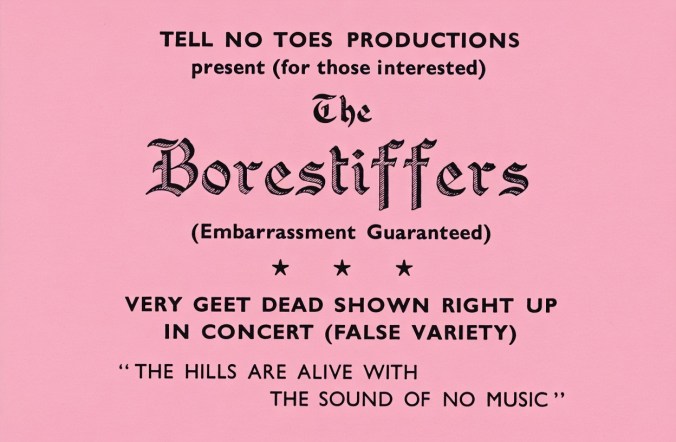
THE BATTLE OF BOLINGBROKE – The Borestiffers 50th anniversary gig

Where were you in the latter half of the 70s? New Rose by the Damned was the first single released by an English punk band, Monty Pythons Flying Circus became as big an influence on TV comedy than The Beatles had on music and before the end of the decade audiences were exposed to their surreal comedy film ‘The Life of Brian’. Sadly, millions mourned across the world as 1977 claimed the life of Elvis Presley.

However, here in South Shields also in 77, boxing’s Heavyweight champion of the world Muhammad Ali visited the town to have his wedding blessed at Laygate Mosque. And legendary punk band Angelic Upstarts formed and within a few year appeared on Top of the Pops and toured the USA. Before making it they gigged at the Bolingbroke Hall in the town. Another crew who played in that hall were The Borestiffers.

Who were The Borestiffers? The Borestiffers featured an early Wavis O’Shave he of later musical fame and appearances on live TV music show The Tube, other members included Heedfuzz, Braddy, Teddy Anteater and John ‘Fig Roll’ Davies who would rarely turn up. February this year was the 50th anniversary of that notorious gig played in front of several rival gangs of the town.

A surreal non-musical skiff-lish group playing empty suitcases, sooty guitars, bullworkers and even a kitchen sink, The Borestiffers in total recorded two cassette albums, played four gigs in South Shields, three at Bolingbroke in 76 and one at The People’s Palace in 77. But it was the initial gig that ended in a riot that remains in folklore memory.
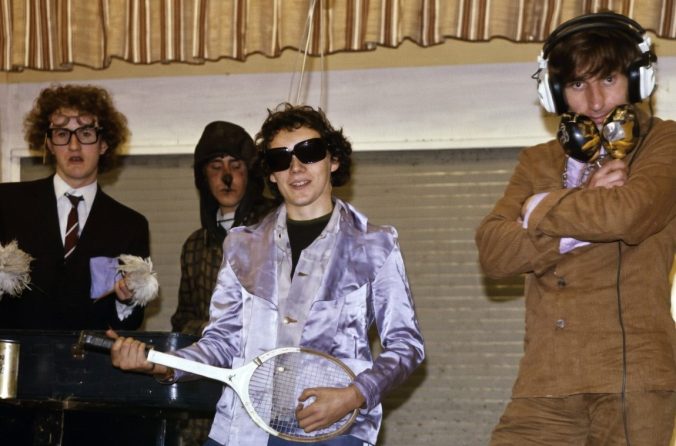
Heedfuzz, Wavis, Braddy & Teddy.

I hear you had some trouble during your Bolingbroke rehearsal?

WAVIS:  Two of hardest men in the town used to work out in the gym there and when they heard us making such a racket they turned up to see what was happening. All of the band went deadly silent and I had to explain. When they asked how much we charged admission I told them, a slice of bread, hard boiled egg or a stick of celery.

HEEDFUZZ: They wanted to sit in on the rehearsal of the first piece of our noise. Once we finished, they silently returned to the gym.

Who and how many turned up – any local ‘celebs’ of the town?

WAVIS: There was a fair turn out from about four different rival town gangs – Whiteleas, Biddick Hall, the Nook and Westoe.

BIG PHIL: There were about twenty members of the Whiteleas Estate Aggro Boys – most of them didn’t have a clue what to expect. I knew it was going to be nuts but the idea of trouble wasn’t in my mind, we were a well-known gang of lads who stood together in times of trouble.

HEEDFUZZ: About 50 or so attendees from various parts of the town. Turf warfare was a common practice during the 70s.
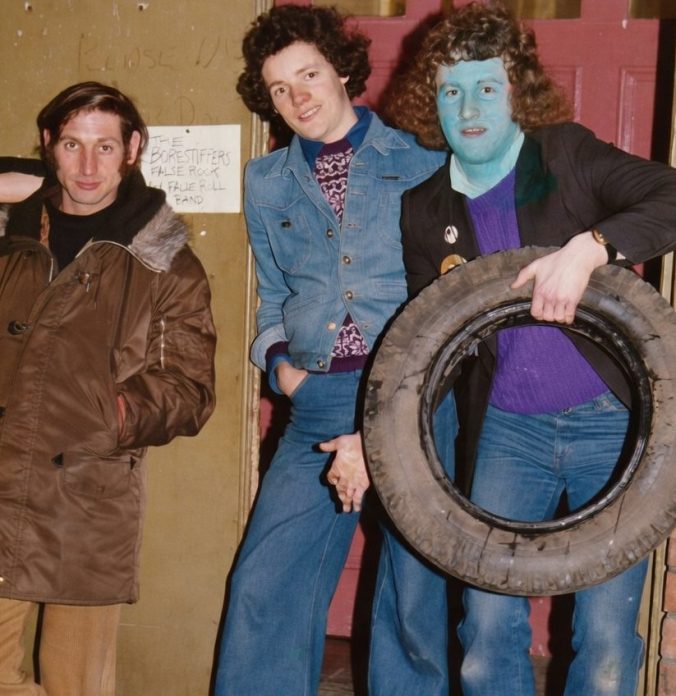
Teddy, Braddy & Heedfuzz

What songs were on the set list?

WAVIS: Most I recall were from the first Borestiffers cassette album ‘Black Shoes and Mongooses’ like Rubber Song where we dropped the stylus onto the rubber turntable and chanted ‘Rubber song’. Three different songs about shoes, one making it to my ‘Anna Ford’s Bum’ album, also Josepheener Tursepheeners with accompanied customised absurd dance.

HEEDFUZZ: We also did The Seven Puppets of Corbett – spoofing the Queen hit, and it was about The Sooty Show. Intro music was the Can Can followed by a loud recording of an outside back yard toilet flushing where we entered the stage, wandered round like lost souls, and then re-entered again.

Can you remember how you were dressed?

WAVIS: I had a Subbuteo floodlight strapped on my head and played a Sooty guitar.

HEEDFUZZ:  I had a top hat with a child’s pink telephone attached around the rim with elastic bands, and a tailcoat.

BIG PHIL: The gig itself was so surreal many of the lads just couldn’t cope with what they had witnessed – the weird outfits, the fact that the group couldn’t play. I was in heaven.

On the night was there a compere?

WAVIS; Nope, we had no one to spare but I doubt anyone would offer if we did, but we did have member of the Sunderland Hells Angels on the door as a bouncer who in later life featured on various TV shows as Martial arts instructor. His jacket was padded out with multiple parts of a lathe.

HEEDFUZZ: Spike Milligan would have been superb but he had earlier wrote to Wavis declining an invite to manage us thinking we were musical.
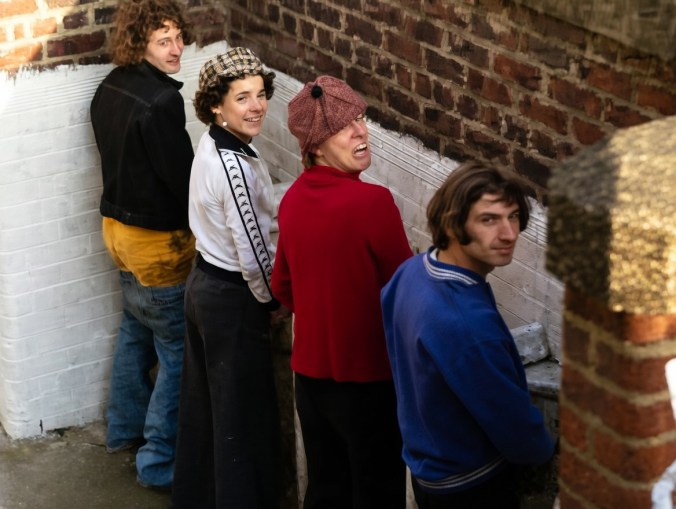
Heedfuzz, Braddy, Wavis & Teddy. pic taken in the famous South Shields landmark The Westoe Netty.

Why did you choose to play Bolingbroke Hall?

WAVIS: I had to tell the owners that we wanted it for a poetry recital otherwise I doubt they’d have given it us. Eight quid it cost. I thought it was the perfect size venue for an expected sizeable gathering and if there were any trouble which I’d predicted, they’d be plenty of space for people to fight! It inspired the Angelic Upstarts to book the place.

HEEDFUZZ: It was a suitable size and ideally situated in the centre of town ideal for public transport.

BIG PHIL: At the end it all erupted, and the place got trashed in unison by all the gangs there. On the way home everyone was laughing in bewilderment. We knew we had witnessed something out of the ordinary but most couldn’t grasp what! I was a bit upset about the mini riot but over the moon that I had witnessed so much absurdity in such a short space of time.

HEEDFUZZ: On the way to the show I met a kid who was going and he opened his wallet to prove he had a ticket as well as a slice of bread in there asking if it was really needed. I told him it was a charity gig for the Marine Park wildlife.

Alikivi   April 2026

SOUTH SHIELDS 1977 – THE KING, THE QUEEN & THE PUNK – film stories & soundbites.

1977 saw three big events happen in the small seaside town of South Shields in the North East of England. The boxer Muhammad Ali had his wedding blessed, the Queen visited on her Royal Silver Jubilee and three lads from a working-class housing estate formed a punk band – the Angelic Upstarts.

Why not put them together in a film ?

Some projects take a lot of digging around to get made but on this one each person contacted about contributing to the film lead to another and another – making the whole process easier. 

This blog features stories and soundbites from contributors to the documentary made in 2013. 

Start.

Narration: 1977 was an extraordinary year of royalty and revolution. It was the storm that followed the calm. We’d had the long hot summer of ’76 and the high-water mark of disco and glam rock.

Trevor Cajiao: The glam thing happened when I was 12/13 year old and I loved all that stuff Slade, Sweet and Mud.

Neil Newton: I remember Wizzard coming on and the bloke with the big hair his face all painted and being mesmerized by that.

Narration: Many 1970’s teenagers were enjoying their first live gigs from such established and diverse acts as Chuck Berry and Black Sabbath.

Richard Barber: My first gig was February 1977 I went to see Black Sabbath at Newcastle City Hall on the Technical Ecstasy tour. We were second row from the back and as soon as Ozzy came on he went ‘Everyone go fuckin’ wild’ and everyone piled down the front. One kid had a big wooden cross and that just got chucked somewhere.

Trevor Cajiao: When I heard rock n roll that’s what I realised that I wanted to get into. I saw Chuck Berry at the City Hall in 1976, it was fantastic, blew me away.

Narration: 1977 was a sad time for fans of Marc Bolan and Elvis Presley. Both stars died young.

Colin Smoult: The death of Elvis was a big impact on everybody, even if you were into Elvis or not because he was such an iconic figure.

Neil Newton: My mam was a big fan of Elvis I remember the day he died it didn’t really have much of an impact on us cos I wasn’t particularly a fan – but he had some canny tunes.

Narration: In the North East we saw a visit from the American president Jimmy Carter and in the same year the Queen came to South Shields on Friday 15th July as part of her Silver Jubilee. The very next day a King came to town.

Derek Cajiao: I’d been given a camera for my birthday I hadn’t had much experience using the camera, but I went down to take some photographs and I managed to catch Ali as he passed the fairground and the Sea Hotel. I got some great shots of him on the bus, and it was fairly apparent he was playing the crowd, pointing at people, threatening to jump out of the bus and chin somebody, really working the crowd.

Pat Robinson: (Her husband Sepp Robinson was Mayor). We were on the top of the bus and at one point it rained so at one of the pubs we passed I said to my husband go and get a bottle of whisky, we passed it round cos we were so cold and wet, at least it warmed us through for a few minutes. Muhammad Ali’s wedding was blessed, and we all went to the mosque and these incredibly beautiful people arrived, they were both stunning and dressed in white.

Afterwards we went to Gosforth Park for a fantastic lunch and right through the two days when the cameras were on Ali turned on the big lip but when he wasn’t doing that, he was a sensitive, pleasant, attentive man. He was absolutely charming.

Narration: But away from the glamour and celebrity a sense of frustration was taking hold. The soundtrack was one of anger, the future seemed bleak and the music was reflecting that.

Colin Smoult: I think the music change in 1977 was down to the blandness being presented in the charts, novelty singles, very middle of the road stuff. Bands appearing on Top of the Pops that were no better than a cabaret act. There was no wonder that the punk revolution came along.

Neil Newton: When punk came along I was much more aware of it because it was so direct.

Trevor Cajiao: A lot of people were saying the whole punk thing was like the rock n roll of the ‘50s as it was a rebellious type of thing but as a kid I didn’t understand that because I was just using my ears and The Clash don’t sound like the Johnny Burnett Trio, but in hindsight what they were getting at was the actual energy, the guitar music, rebelling against stuff.

Narration: In South Shields three friends from the Brockley Whins Estate started a punk band The Angelic Upstarts and little did they know where it would lead them.

Mensi: The nucleus of the band really was me, Decca and Mond.

Mond: We had known each other since we were kids, we used to hang around the shops at Brockley Whins.

Decca: They said here Decca we’re forming a band and you’re gonna be the drummer.

Mond: We found you can hire the Bolingbroke Hall and we used to get about 300 people in.

Decca: I think that’s when we started to take it serious, we all got our heads together. I mean Mensi was a prolific song writer.

Mensi: I just write about what’s happening around us.

Decca: He came out with Murder of Liddle Towers, the song that made us famous. Next you know you’re on Top of the Pops and the rest is history.

Narration: The end of the 1970’s saw people looking forward to a new decade. Would we ever see a year like 1977 again.

Closing music & credits.

The film was narrated by Alistair Robinson, music from The Panic Report and the Dipsomaniacs, with excellent photographs by South Shields photographer Freddie Mudditt (Fietscher Fotos) and Derek Cajiao.

The King, The Queen & The Punk (25 mins 2013)  watch the edited version on Alikivi You Tube channel.

Gary Alikivi   February 2020.