TON OF TUNES – musician Barry Lamb talks about his latest project, Miniatures 2020.

Barry has lived in Woodford Green, Essex for 25 years but originally lived in South Shields….

My grandparents lived their entire lives on Quarry Lane. I have often thought about writing a song called Quarry Lane but have shied away from it due to the similarity with Penny Lane.

I have so many memories of long walks with my grandfather along the cliff tops from Souter lighthouse to Shields pier and walking across Cleadon Hills. My album Dusk features a picture of Cleadon mill.

Barry left the town in 1966…

It is an area I have a strong affinity with. I would have loved to have been part of the punk/New Wave scene as Shields is very much my spiritual home, but I was in Essex at that time.

Along with experimental progressive rock band Two Headed Emperor, Barry is presently involved with Miniatures 2020….

It’s a tribute project to former Mott the Hoople keyboardist, Morgan Fisher’s original Miniatures album from 1980. It was such an inspiration to me personally and was very much connected to the post punk DIY ethic of the period.

I also discovered as I made contact with other musicians about the project that there is a tremendous amount of goodwill, affection and respect for the original album. 

On the original record Fisher invited 50 musicians to send in tracks of up to one minute long.

They included an eclectic mix of Robert Wyatt singing a Frank Sinatra song, Robert Fripp playing keyboard, Andy Partridge (XTC) offering the history of rock’n’roll in 20 seconds and Pete Seeger playing Beethoven on the banjo plus many others contributing to the album which is regarded as a cult classic.

Who is on the album this time around ?

We have over 100 artists contributing a track of a minute or less. Jake Burns of Stiff Little Fingers, Billy Bragg, Terry Riley, Tim Jones is on – he was in North East bands Neon and had a spell with Punishment of Luxury. Wavis O’Shave has contributed a track.

It also features Toyah, Tom Robinson, David Cross (King Crimson), Ric Sanders (Soft Machine, Fairport Convention), and a handful of old prog rockers, also celebrated experimental music pioneers, new wave and post punk legends – there are plenty of surprises.

Did the musicians involved in the project jump on board easily ?

It was really easy to persuade people to get on board. Very few people said no and nobody that I approached was negative about it at all. Even those that said no were intrigued and curious about it. 

When did you first come across the Miniatures?

It was1980, one of the staff in Parrot Record shop in Colchester recommended it to me knowing my taste for the unusual and more adventurous end of the musical spectrum.

Parrot Records was a treasure trove of discovery and especially good for those obscure new wave singles released on independent and home-made labels. I bought it on the strength of the sleeve notes and a number of the artists involved. 

http://morgan-fisher.com/images/m1back.jpg 

What got you interested in music and are you from a musical family?  

My family are not especially musical but my dad played trombone in a jazz orchestra. His love of jazz and the more adventurous end of rock music stirred my own interest in music.

My grandfather was from New York and he got me interested in protest folk and the blues. But most of my musical influence came about in secondary school on the Essex coast.

Can you remember your first gigs ?

My first gig was at the Golf Green Hall in Jaywick, Essex, I didn’t really enjoy it. I wasn’t that confident, we were under rehearsed, and the audience were not that interested.

Then we played mostly small venues in and around Essex, later played in Reading, Oxford and London. The usual stuff of people setting off fire extinguishers, a couple of fights and hecklers would go on.

I am sad to say that I was so drunk on one occasion I could barely function. I ended up falling off stage and being pushed back up by my brother. The sound engineer walked out and the support band asked, “what is your singer taking …I want some”. 

Did you record any of your music then?

In the ‘80s the Insane Picnic recorded at Sea Level studio which was a small studio in Jaywick, Essex. Prior to that we just recorded on tape recorders at home and released stuff as part of the DIY cassette scene.

After the Insane Picnic we built our own rudimentary studios and now have a studio in my loft.

I have recorded with a lot of different people over the years including fellow ‘Shieldsian’ Wavis O’Shave, also Keith Levene (PIL), Jasun Martz (Frank Zappa), Isatta Sheriff (Mongrel). I am still making music with Two Headed Emperor along with my own experimental sound dabblings.

What are your hopes for the Miniatures project and will it be available to buy ?
My main hope with Miniatures is that it will be a fitting, honouring of Morgan Fisher that it will introduce Miniatures to another generation and will stand up as a great legacy project. I am proud of how it is shaping up.

It should be available late December early January on CD and will be available in the usual digital formats.

More info here: https://www.barrylamb.com/miniatures-2020.html

Interview by Alikivi  November 2020.
LIGHT UP THE LAWE with UK artist, Andrew McKeown.

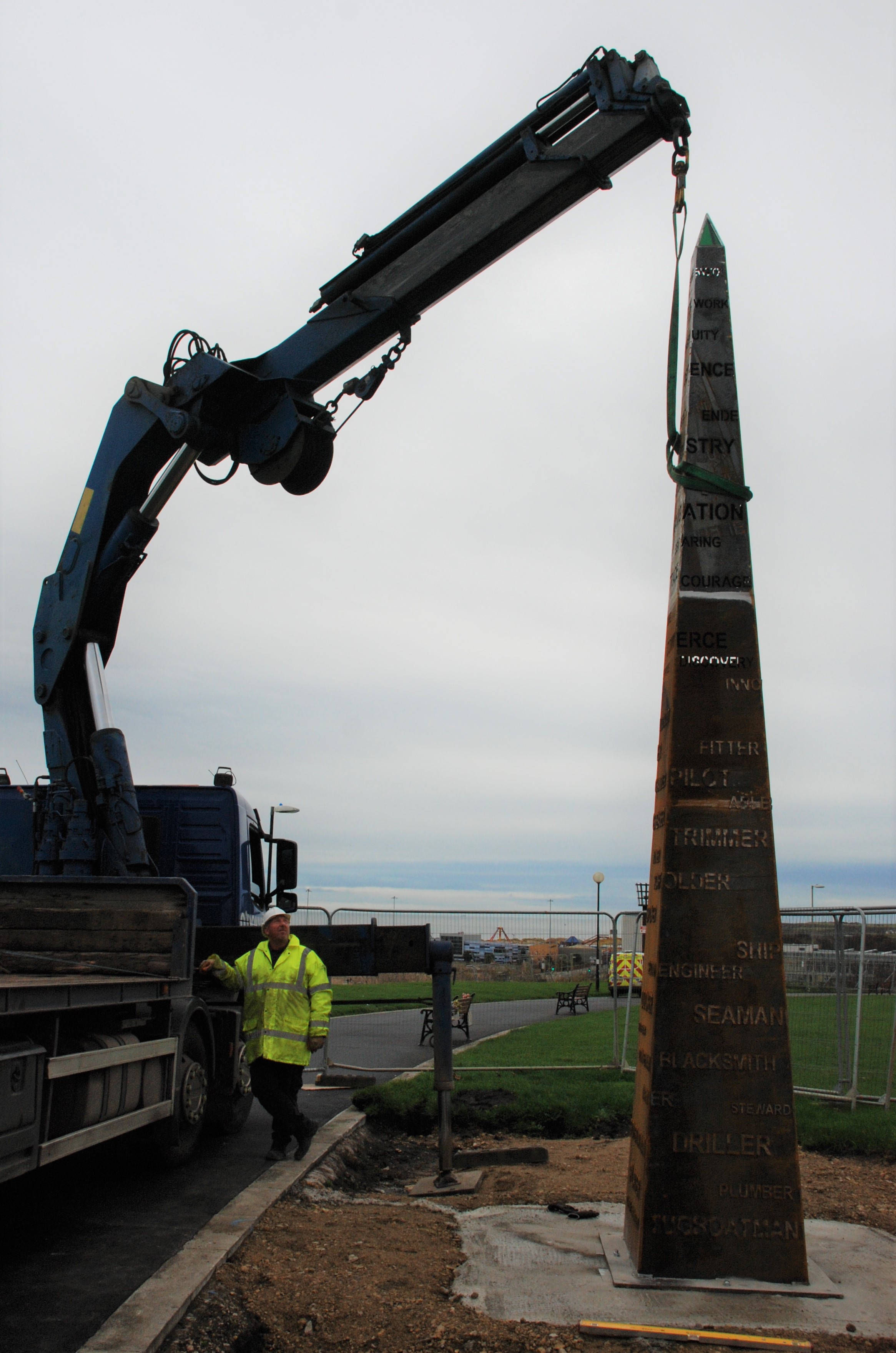
Part of the renovation of the North Marine Park in South Shields is a new sculpture placed on the Lawe Top.

The artist, Andrew McKeown, specialises in Public Sculpture and has completed many large-scale commissions throughout the UK and Internationally.

In an earlier interview on the blog in June, Andrew talked about his work…..

I am working on designs for a large contemporary steel Beacon in the North Marine Park. The Beacon takes its inspiration from the Lawe Top Beacons built in 1832.

The installation of his new work was on the morning of 31st October 2020, and I managed to grab a few words with Andrew….

Today I’m supervising the installation of the new Beacon sculpture. The blacksmiths are just fixing the bolts down now, it’s pretty much all installed.

Has it been a hectic day ?

Yeah, just a bit (laughs). We started at 9am, the blacksmith got loaded up earlier than expected but we got up here and got on with it.

What does it feel like seeing your work finally put in place ?

Fantastic. I’ve been working on this project since January after getting the commission. It was applying first, then getting selected then there was all the planning to do with the designs.

The brief asked for it to be between 4-6 metres high. I went for 6 metres and that feels about right.

The original Victorian Beacons were a lot taller than that so I know it’s not meant to be a navigational aid as such, it’s a decorative piece with a nod and towards the Victorian Beacons.

I think when the block paving is around, the lighting added and when it’s rusted after about 3-4 weeks it’ll develop a stronger rusty colour. It’s core ten steel and rusts so much it’s almost like a protective layer.

It’s the same steel as the Angel of the North (sculpture in Gateshead by Antony Gormley). It’s just nice to finally be the day when it all comes together, and it looks like what I wanted it to look like.

What is the idea behind the words that are on the sculpture ?

Yeah well, it’s already happened hasn’t it. This morning within half an hour of it going up a Grandad and his Grandson walked past, and the Grandson asked what is a Foyboatman? The Grandad explained and then added that his dad was a riveter.

That’s what type of conversations I really intended from the piece to happen. It keeps the sculpture alive and all those historical trades and occupations alive.

It refers to the community of South Shields and the words at the top refer to the character of the area, the history and the aspirations.

Words like exploration, wisdom, work, toil and adventure, words that make people think that yeah we have got this background as well as the shipping industry that pioneered the way for a lot of things

Can you see it being here for a long time ?

The way it has been made and the materials it has been made with, it can be there for years until someone wants to move it. Maybe in a renovation of North Marine Park in another 100 years, but I’ll be long gone by then.

Interview by Alikivi  October 2020.

THE GHOST OF CHRISTMAS PAST ? by author & broadcaster, Dan Green.

Mysteries of the world are fascinating subjects and we rely on scientists, archaeologists, researchers and storytellers to bring them out of the dark.

The blog in October 2019 featured a couple of stories by author and broadcaster Dan Green. He recently got in touch and wanted to share another story.

Dan was a resident of South Shields for 40 years and at the time of this event he was living in the town.

‘During many years of research, I have heard dozens of amazing anecdotal stories concerning ghosts and whatever they might be or represent.

It has left me having little doubt whatsoever that there is a phenomena behind it all, generally unknown and let alone accepted.

However, as good and convincing as other people’s stories may be it is far more rewarding if you can call on evidence from your own personal experience’.

You can’t usually force a ghost to appear or meet with one, but this seems to have happened to me during the late 1990’s when my wife and I travelled down from the North East having resigned ourselves to looking after grandchildren, thus allowing their mum to go out at the time of the Christmas festivities.

Little did we know that this innocent occupation would be taking place in a most ridiculous location – a haunted derelict asylum on a Christmas Eve.

Something you could only expect – for those of you old enough to remember their movies – from Bob Hope and Bing Crosby.

St Johns asylum, Lincoln, UK.

The derelict St John’s asylum in Lincoln was built in 1852. Originally built to house 250 patients it went on to accommodate thousands from all over Lincolnshire, finally closing its doors in December 1989.

At the time of our visit its caretakers were my wife’s daughter and her boyfriend.

The property was Grade II listed meaning it couldn’t be demolished and had just been bought by ‘Bungalow’ Bill Wiggins then the boyfriend of glamourous Hollywood starlet Joan Collins, who was to convert the main building into flats.

At the time, building had only just started and so we were offered a luxurious penthouse room for our stay, in the midst of all the empty, decaying, wall peeling eerie corridors.

It was quite simply surreal having to leave the warmth and safety of the suite to have to go along dimly lit dank and neglected corridors to the nearest toilet situated in the old asylum quarters. You swore you could hear whispering voices at the dead of night.

Interior of St John’s asylum, Lincoln.

On our first night, two days before Christmas Eve, Lincoln was snowed in. My wife and I retired around 11am after a hectic day’s babysit and nestled down into the extra comfy bed, switching the light off and expecting a quick descent into slumber.

After maybe no more than ten minutes and whilst still fully awake we nearly jumped out of our skins when the silence in the dark room was broken by an enormous crash at the foot of the bed. It sounded as if something very large had fallen.

After our initial shock we put on the light to see what it could be, already knowing that it couldn’t have been anything as there was nothing there and not even anything else in the room that could have provided such an alarming crash.

My wife was insistent for an explanation and I gave then what was perhaps the most lame and most unbelievable excuse ever – it was the flag on the balcony outside blowing in the wind. It was all I could think of. Both of us knew it wasn’t or anything remotely like it.

The following incident happened about 7pm on Christmas Eve. The snow was all around, like a white blanket. I stood outside marvelling at the sound of silence. The thousands of falling flakes amidst darkness all around in the vastness of the grounds.

It was then that I heard the lone sound of a bugle being sounded. ‘It must be an early reveller’ I thought, although a bugle wasn’t the sort of instrument I would associate with an early Christmas celebration.

I was keen to locate exactly where the sound was coming from, expecting that to be easy amidst the otherwise total silence, absence of any other person or activity, and the totality of the space around me. But I could not place it.

I moved myself around some distance but still could not pin-point the sounding bugle. I listened until I could hear it no more. It was very clear and distinct but not a musical masterpiece. Strange!

On Christmas day my stepson came to join us and we offered him another swish suite not far from our own. We decided best not to tell him about the bedroom crash or highlight anything else about the building that might possibly spook his nervy temperament.

It wouldn’t have mattered. In the morning he told us how no sooner trying to sleep he saw what he described as a ’floating black bin bag’ in the room!

I was glad when we could all leave the premises before anything else might present itself. A week or two later I was recounting my incident with the phantom bugle player to my mother-in-law.

It was then she informed me that long ago one of the asylum inmates had escaped on Christmas Eve, a fellow who was renowned for wandering the grounds playing a bugle.

However, his escape was a tragedy – he had no sooner sneaked out of the premises playing his instrument when he was hit by a bus and killed outright. I hadn’t known anything about this.

Had I encountered his ghost on the calendar night he had lost his life? If so, then this must rate as a first class ghostly encounter. I’ve since spoken to others about our nights at the old asylum and wasn’t surprised the things I learnt from them.

My stepdaughter confirmed that both she and her boyfriend had seen things – ‘a human sized figure made up out of speckles, like what you get when a faulty TV aerial disrupts the screen’.

She had decided not to tell us anything about her experiences in case it put us off coming to stay. The asylum certainly had a ghostly reputation.

A care worker I met years later who had worked at St John’s confirmed how staff had to contend with lights suddenly switching themselves on and off and the sound of footsteps being heard above them in empty rooms.

The grisliest tale he told me was when a room had been found after a wall had been broken into, and there around a table sat upright skeletons, the table having rotted food as if a feast had once been prepared.

With no windows or doors in the room they had all been entombed in there.

We were also told by my stepdaughter that the previous caretakers, a husband and wife, had left the building at the dead of night – in their pyjamas! They never returned, leaving costly personal belongings.

So, the old asylum at St John’s – haunted? Hard to think otherwise, although I’m sure psychologists would offer a bland explanation for it all, rather like my flag blowing in the wind.

Read more stories by Dan Green at: www.dangreencodex.co.uk

Edited by Alikivi  October 2020.

BACK WHERE HE STARTED FROM with singer & songwriter Vinny Edwards

Sky High by Jigsaw or Kim Carnes Bette Davis Eyes are classic pop songs built on great hooks and chorus’ made for radio.

In the same bracket is the ‘70s hit Back Where We Started From which reached number 8 in the UK charts and number 2 in the USA, an international song co-written by a lad from South Shields – not bad for a Sand Dancer.

A quick rundown of the career of singer/songwriter J. Vincent Edwards tells us he was born in 1947 and went on to make a number of records including the hit novelty song Pump Up the Bitter in 1988.

I came across Vinny when I was reading the excellent blog ‘Ready Steady Gone’, authored by Roger Smith.

He wrote that Vinny was born only five minutes away from the beach – a real Sand Dancer – if you’re not familiar with the term it refers to a native of South Shields.

Thanks to Roger I received an email from Vinny, and with correspondence over the next few days plus checking his songs on You Tube, a colourful picture of his music career emerged…

Although I don’t live in the UK now, I was born in Shortridge Street just off Ocean Road near the beach – I used to play there and the Marine Park – they were bloody cold!

I remember when I was 10-year-old I got into music after hearing the American singer Sam Cooke – I was in! If God ever wanted to become a recording artist, he would use the voice of Sam Cooke.

My first band was The Tyneside Skiffle Group featuring Vic Malcolm who was also in The Stormers and later started Geordie who had chart success. Then I was in The Invictors and then The Answers.

I remember my audition for the Invictors at Tyne Dock Youth Club, I sang Stay by Maurice Williams & the Zodiacs – blew them away !

In my early years we played all the North East working men’s clubs. If you check out a group I was in during the ‘80s called Star Turn on 45 Pints – that was all based on playing the clubs especially Brigham & Cowans in South Shields.

In fact, we filmed some of the video there for our hit Pump Up the Bitter.

Did you have a manager or agent ?

In the late ‘60s we were represented by Richard Harris and his company Limbridge Music. This was the time we moved to London and France with a band called The Answers who were signed to American label Colombia.

‘Right Back Where We Started From’ by British soul singer Maxine Nightingale was a hit in 1976, how did it come about ?

I wrote that in Austria in 1972 while my darling wife Ursulla was in front of the mirror drying her hair! Thing was I didn’t have a title until one day I met an old mate and songwriter Pierre Tubbs and he came out with the title which fitted perfectly.

We finished writing the song the next day when we were in his car driving over to Hammersmith Hospital to meet his wife who was having a baby!

Where did you take the song next ?

Well Pierre worked at United Artists record company and Maxine Nightingale was around at this time, I knew her from our work in the musical Hair.

We thought about a duet first, but I had just signed to Privit Stock Records, so I produced it myself and added backing vocals. I insisted that Maxine got royalties from the song and not just a session fee.

But I loved the recording studio, all the musicians we got in were wonderful. We appeared on TV all over the world, then with different songs from Hair, a song called Thanks plus a few others – there was a lot and I loved it all!

I was always asked to sign for various record companies they must have thought I was somebody else (laughs).

Check out Vinny’s impressive release of singles and albums throughout his career on CBS, United Artists, Hans, Pye, Polydor and many other record labels at discogs.

What does music mean to you ?

Everything, fun, humanity, love and peace – just everything really.

What are you doing now ?

I’m caring for my wife’s parents, drinking good German beer and waiting for the Labour Party to get back in!

I’ll leave you with this song I wrote Keep on Trying from 1974, my band at the time The Usual Suspects played on we also had on bass the AC/DC and Def Leppard producer Mutt Lange – who hasn’t he produced, and he produced our single – happy days!

Why not check it out on You Tube.

Link to Roger Smith’s blog Ready Steady Gone: http://www.readysteadygone.co.uk/

Interview by Alikivi  July 2020.

EARTH WORKS for Teeside artist Andrew McKeown.

A current photography job I’m working on is documenting the regeneration project near the seafront in the North Marine Park, South Shields – really handy because I only live two minutes away.

Within the building and restoration work pieces of public art are planned so I got in touch with the artist commissioned for the work…..

I am currently working on designs for a large contemporary steel Beacon in North Marine Park, South Shields. The Beacon takes inspiration from the Lawe Top Beacons built in 1832.

The words on the Beacon preserve maritime trade names and celebrate the character of the people of South Shields. The words and trade names have been suggested by the local community.

Do you always involve the community in a project ?

Involving local communities is an essential part of my working practice. I have over 25 years of experience and knowledge in this area.

For previous projects I have devised a wide range of community consultation programs involving local people and schoolchildren, from presentations through to hands on practical sculpture workshops and longer artist in residence programs.

This work helps me refine ideas and sometimes new ideas are formed which develop into final sculptures.

It’s also equally important that local people have an opportunity to work together and create something positive for their community, to gain a sense of pride and ownership in the process and the final artwork.

The processes involved in the engagement work is as important as the resulting artwork.

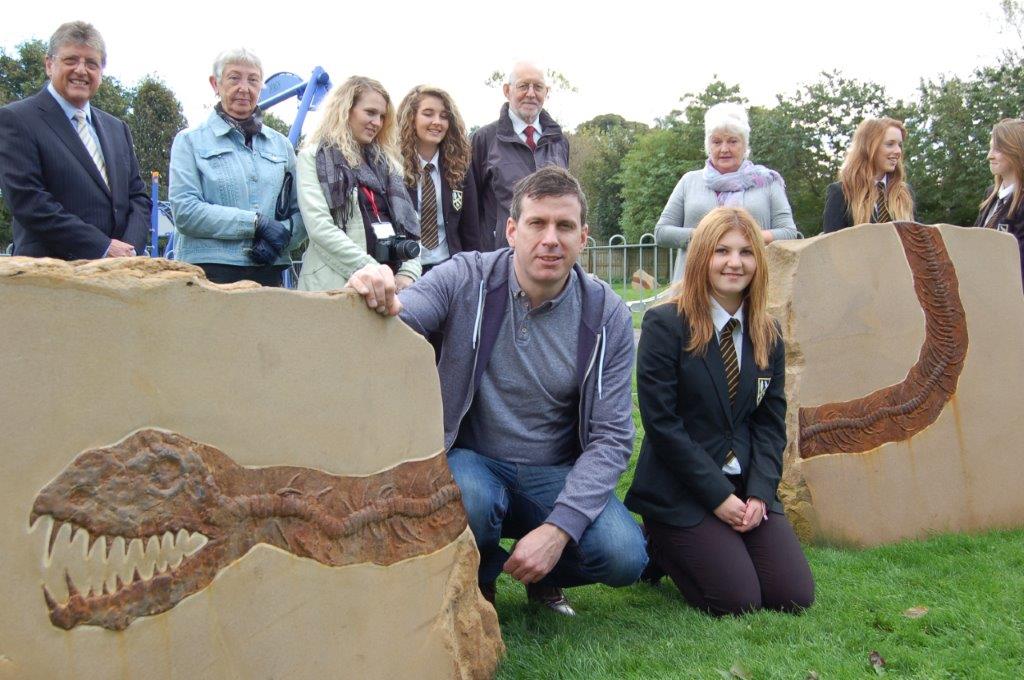
An interesting example of this approach can be seen in the sculpture ‘Breaking the Mould’ which takes the form of a giant seed which has emerged from an old industrial mould.

The mould is broken and no longer useful but the last cast to be made is a new natural life form. The symbolism creates a striking resonance with the former and future uses of many of the 21 regeneration sites across England and Wales called Changing Places.

The £60 million Changing Places program transformed 1,000 hectares of post-industrial derelict land into parks and open spaces.

Where did the idea come from ?

During dialogue with East Manchester Ladies knitting group, I distinctly remember writing some of the things they were saying to me, like ‘turning over a new leaf’, and ‘Breaking the Mould’ as we discussed their desire to move on and leave behind the scarred industrial landscape, changing it into an urban park and community facility through the Changing Places project.

What got you interested in art, was there a ‘wow’ moment when you saw something ?

Not really, my upbringing was probably the biggest influence on that. It was a very creative upbringing.

McKeown grew up in a working-class area of Middlesbrough, Teesside, UK, as the youngest in a family of four children….

We had a large garden where my father, a lifelong steelworker grew an abundance of fruit and veg. My mother was a primary school teacher and we were always building, making, cooking and exploring.

The family lived only a couple of miles away from the shipyards, coke ovens, blast furnaces and rolling mills of British Steel and the chemical plants of ICI…

If we were feeling energetic, we would walk or cycle to Redcar beach or Eston Hills where iron ore was mined to fuel the industrial revolution.

At school, art was always my favourite subject, and this inspired me to attend art college and then a Fine Art degree in sculpture at Coventry Polytechnic.

Following education, Andrew worked as a community artist delivering school and community-based workshops and small art projects…

These were low budget projects such as one-off workshop days and artist in residence projects. Gradually larger projects became available and I was able to create my own artwork with the involvement of local communities, rather than solely community generated art.

What inspires you ?

The industrial processes of casting and mould making influence my work in both a practical and conceptual way. I often create multiple cast sculptures in iron, steel, bronze, aluminium and stone – these are very durable materials for external artworks.

McKeown uses recurring themes within his work of growth, change and renewal….

I like to work within the environment, and this often means I have to build identity and add character to a space that has very little.

Often, I am working in empty fields or urban parks that only have a few shrubs and paths or working off landscape plans while looking at building sites and piles or earth.

Rather than creating one giant sculpture I often use the available budget to create a family of related sculptures that link to each other and draw your eye to the environment they are in.

Other times I create entrance features that hope to draw people into a space. I prefer that people can engage with my sculptures becoming almost part of them for a brief moment.

On average how long do you work on a project for a client ?

This is very hard to answer but the larger projects can be spread out over years to plan and develop. Then when it comes to manufacturing this can take as little as two months or if I am making patterns and moulds for casting this might take six to eight months.

Is there a satisfying moment during the art process ?

I think the most satisfying time is when I have the right idea for a project. One that I know that I like and know the client and the community are going to like and buy into.

This can often be the most draining and difficult process and it can take a lot of research and community work similar to the Breaking the Mould idea which came after maybe eight months of research and community engagement.

What else are you working on ?

I am currently finalizing designs for a Teeside Retail Park called ‘Rolled into One’. For this project I am engaging the local community to provide colloquial job or occupation names from the local iron and steel industry.

Up to one hundred of these names will be applied to the outsides of the steel box section arms of the sculpture.

There are many unique and interesting names such as Welder, Plater, Catcher, Striker, Roller, Breaker, Burner that will be used and many more. I am currently consulting the local community including my family and friends.

I’m also working on a few other projects, one called ‘Crossing Points’ for Groundwork North East River Tees Rediscovered project, another project is for Middlesbrough Council within its Creative Factory artistic interventions project – my pieces are called ‘Endless Convenience’.

Andrew lives and works in the North East of England and is available for public and private commissions throughout the U.K. and internationally.

For more information and images for previous artwork visit:

www.andrewmckeown.com

https://www.facebook.com/andrewmckeownsculptor/

Interview by Alikivi  June 2020.

TALL STORIES – painting with L. S. Lowry (1887-1976)

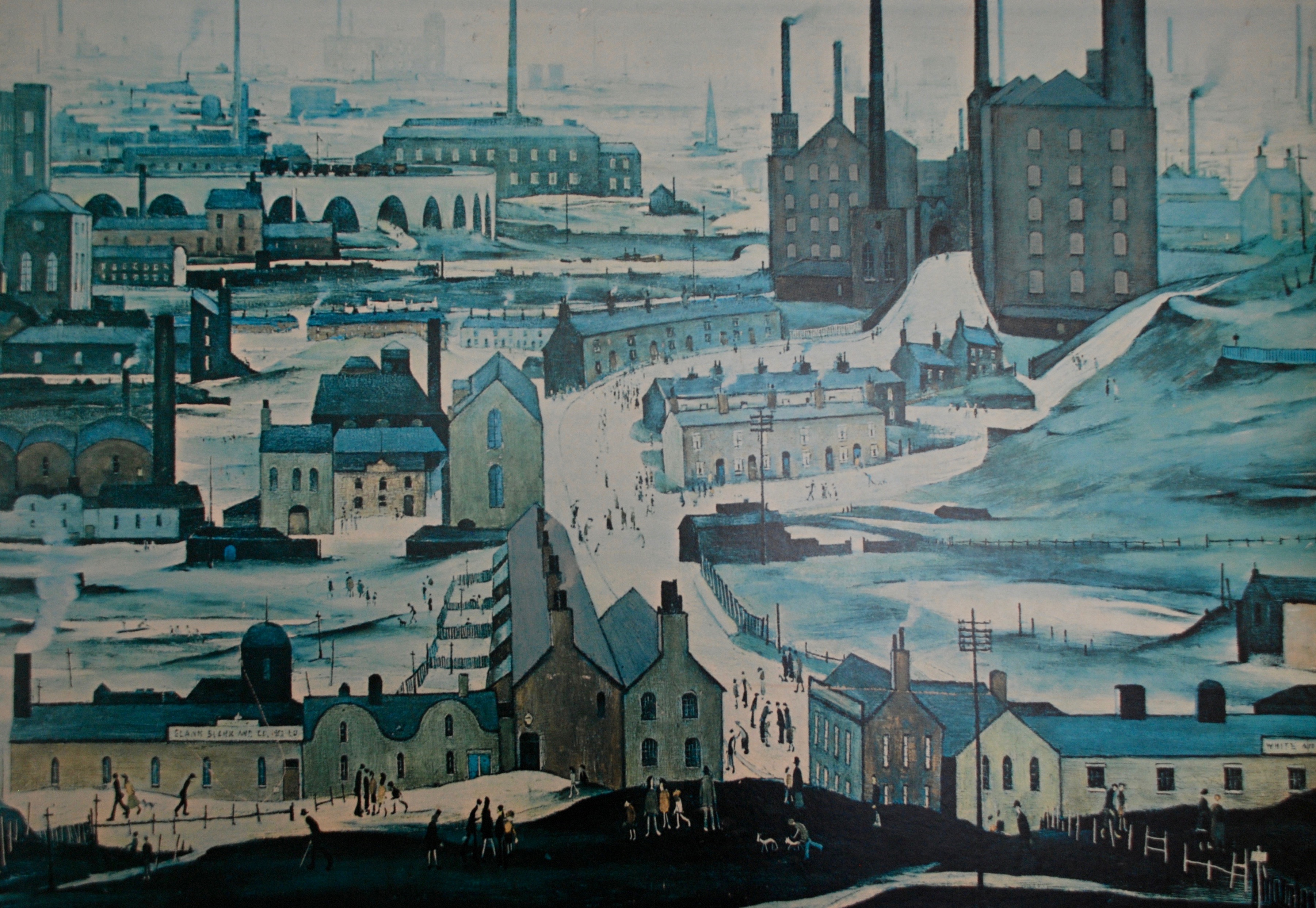
Hanging on my wall is a fairly large (27 x 22inch) painting printed on wood – Industrial Landscape, Ashton under Lyme 1952 by L. S. Lowry. The original is in Bradford Art Gallery and Museum.

I bought it in a charity shop a couple of years ago, the colours are faded as the previous owner must have placed it in direct sunlight, but still a bargain at £7.

When I first saw it I recognised the style as a Lowry – I like how he stretches everything – chimneys, buildings and people, the flat look with no shadows and how the factories fade in the background – capturing the heart and scale of industry.

Industrial Landscape by L.S. Lowry (1952).

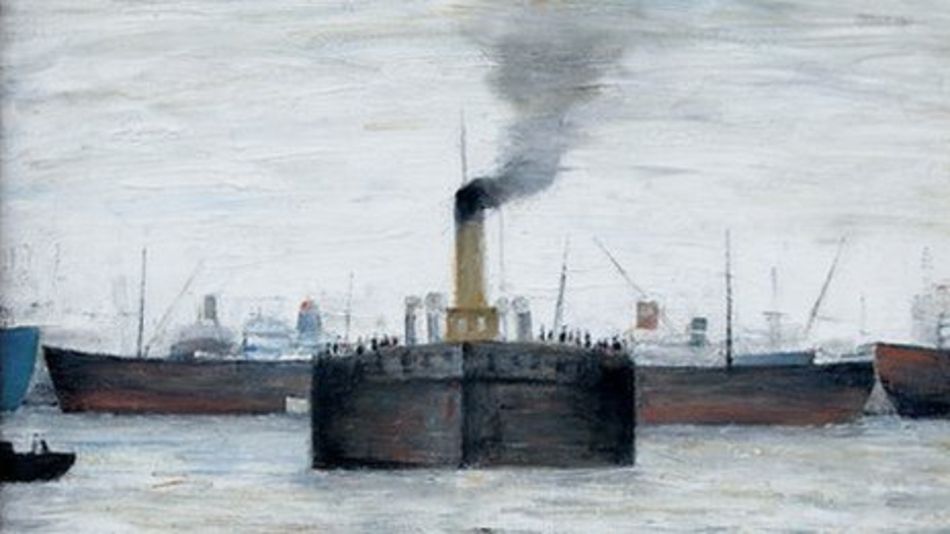
During the ‘60s Lowry visited Sunderland and surrounding areas where he produced a number of oil paintings and sketches. In South Shields he produced The Ferry in 1967. After his visit the painting went on display in the art gallery in Sunderland.

Bill Clark, owner of the Clark Art gallery in Cheshire, bought the painting in 2010. He said: ‘Lowry was entranced by the North East and particularly by South Shields. ’The Ferry’ is one of the stand-out pieces he produced of the area in the 1960s’.

The Ferry by L.S. Lowry (1967).

Lowry used to spend short breaks at the Seaburn Hotel near Sunderland, painting and sketching scenes of the beach and nearby ports.

The River Wear would be the closest to his hotel but in one sketch Tanker Entering the Tyne is a ship sailing around what could be the view from Comical Corner on the riverside near the boat builder’s yards on Wapping Street, South Shields.

If Lowry was in Shields, is there a record of his visit ?

Born on 1st November 1887 Lawrence Stephen Lowry is on the 1911 census living at 119a Station Road, Pendlebury, Lancashire with his parents Robert, an estate agents’ clerk, and Elizabeth.

Lucy England, and a few years later 23-year-old Alice Powell were employed by the family as domestic servants to help around the house as his mother Elizabeth had become bed ridden and dependent on her son. His father Robert died in 1932.

Lawrence worked through the day as a rent collector, then when he got home cared for his mother, only leaving time to paint through the night.

Lowry painted everyday scenes that he saw around him in England’s industrial North. ‘I never worked in a mill, it wasn’t a job I would of liked. Starting at 6 in the morning and finishing half past 5 at night. But I wanted to put the industrial scene on the map’ he said in a BBC interview in 1975.

He spent about ten years in Art schools in Salford learning classical techniques, and though he focused on industrial scenes he produced a number of seascapes and portraits using simple materials and colours.

He had small exhibitions, and his work was being noticed, but it wasn’t until aged 52 that his work was acclaimed. His mother never saw his success as she died in 1939, it deeply affected him and his work.

The scenes he painted where full of people haunted with anger and pain.

Due to class snobbery his work wasn’t recognised by the self-appointed art elite in the south. The Tate Gallery held some of his work in their basement for decades, but it wasn’t until 2013 when they eventually held a Lowry exhibition.

Lowry turned down honours, O.B.E, C.B.E and a knighthood – ‘meaningless in the absence of mother’. He retired from being a rent collector at 65 and during this time visited the North East still making sketches of what he could see around him.

On 23rd February 1976 Lowry died of pneumonia at the age of 88. He had produced over 1,000 paintings and drawings and today there is an art gallery in Salford named after him housing the largest collection of his work.

The world record sale for one of his paintings was for over £5 million paid for The Football Match.

Sources: Ancestry family search.

BBC News 2012 & 2013.

L.S.Lowry BBC film The Industrial Artist 1975.

 Alikivi  May 2020.

HELLO TOMORROW: Changing Face of South Shields in photographs (4)

For the past 10 years I’ve set myself a documentary project capturing the changing face of South Shields. Included are a small selection of the photographs.

This is the seafront harbour where the river Tyne meets the North Sea. The new Littlehaven Promenade replacing an old path and car park. Previous posts feature other area’s of the town.

In 2013 South Tyneside Council proposed a very bold £100 million regeneration project for the town, and public consultations were held. Progress on different phases of the regeneration is ongoing as more developments are planned.

So far the council have delivered – Hello Tomorrow is not just a slogan on the posters.

Gary Alikivi  April 2020.

HELLO TOMORROW: Changing Face of South Shields in photographs (3)

For the past 10 years I’ve set myself a documentary project capturing the changing face of South Shields. Included are a small selection of the photographs.

This is Harton Quay next to the river Tyne, the ferry landing, the BT building and The Customs House theatre & arts venue. It’s also next to The Word and the Market, two area’s that have benefited from the 365 Town Centre Vision regeneration. Following posts will feature other area’s of the town.

In 2013 South Tyneside Council proposed a very bold £100 million regeneration project for the town, and public consultations were held. Progress on different phases of the regeneration is ongoing as more developments are planned.

So far the council have delivered – Hello Tomorrow is not just a slogan on the posters.

Gary Alikivi  April 2020.

HELLO TOMORROW: Changing Face of South Shields in photographs (2)

For the past 10 years I’ve set myself a documentary project capturing the changing face of South Shields. Included are a small selection of the photographs. This is the 250 year old market at the top of King Street and next to The Word featured on the last post. Following posts will include other area’s of the town.

In 2013 South Tyneside Council proposed a very bold £100 million regeneration project for the town, and public consultations were held. Progress on different phases of the regeneration is ongoing as more developments are planned.

So far the council have delivered – Hello Tomorrow is not just a slogan on the posters.

Gary Alikivi  April 2020.

HELLO TOMORROW: Changing Face of South Shields in photographs (1)

For the past 10 years I’ve set myself a documentary project capturing the changing face of South Shields. Included are a small selection of the photographs. These are from The Word which replaced the town centre public library. Following posts will feature other area’s of the town.

In 2013 South Tyneside Council proposed a very bold £100 million regeneration project for the town, the 365 Town Centre Vision, and public consultations were held. Progress on different phases of the regeneration is ongoing as more developments are planned.

So far the council have delivered – Hello Tomorrow is not just a slogan on the posters.

The Word, National Centre for the Written Word. October 2016

Alikivi  April 2020.