HELLO TOMORROW: Changing Face of South Shields in photographs (2)

For the past 10 years I’ve set myself a documentary project capturing the changing face of South Shields. Included are a small selection of the photographs. This is the 250 year old market at the top of King Street and next to The Word featured on the last post. Following posts will include other area’s of the town.

In 2013 South Tyneside Council proposed a very bold £100 million regeneration project for the town, and public consultations were held. Progress on different phases of the regeneration is ongoing as more developments are planned.

So far the council have delivered – Hello Tomorrow is not just a slogan on the posters.

Gary Alikivi  April 2020.

HELLO TOMORROW: Changing Face of South Shields in photographs (1)

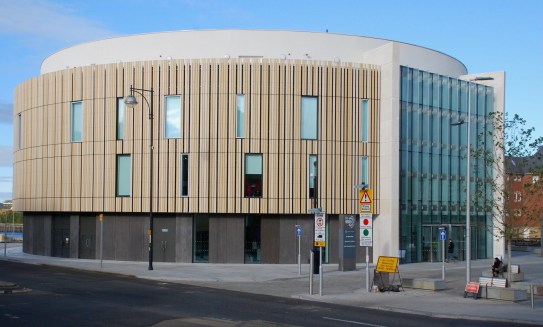
For the past 10 years I’ve set myself a documentary project capturing the changing face of South Shields. Included are a small selection of the photographs. These are from The Word which replaced the town centre public library. Following posts will feature other area’s of the town.

In 2013 South Tyneside Council proposed a very bold £100 million regeneration project for the town, the 365 Town Centre Vision, and public consultations were held. Progress on different phases of the regeneration is ongoing as more developments are planned.

So far the council have delivered – Hello Tomorrow is not just a slogan on the posters.

The Word, National Centre for the Written Word. October 2016

Alikivi  April 2020.

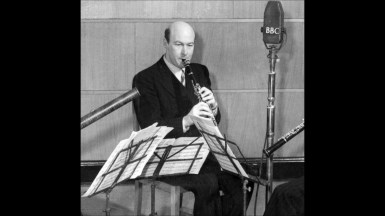
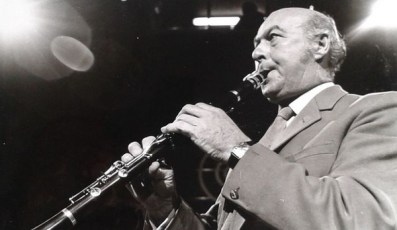
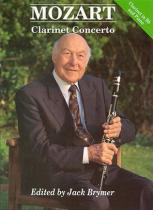
BLOWIN’ IN THE WIND – snapshot of musician & teacher Jack Brymer (1915–2003)

A post last summer featured professional jazz musician Kathy Stobart (link below).

The post highlighted her link from being born in South Shields to playing residencies in London, New York and Los Angeles to sharing a bill with Radiohead. But what about a link from South Shields to The Beatles via Dracula ?

A few weeks ago, I received a message from a friend ‘Have you heard of Jack Brymer ? He used to live in South Shields. He was a famous musician’.

I hadn’t come across the name so checked him out and was surprised to find he was a session musician who played on Hammer horror movie soundtracks starring Christopher Lee and Peter Cushing.

I got a bigger surprise to find he appeared on The Beatles track A Day in the Life.

Unfortunately, due to the Coronavirus pandemic the Local History library in South Shields is closed, and I would usually check details there, but this is what I’ve found using Ancestry, Musicians Gallery, and various BBC interviews and video clips on You Tube. Facts were checked as much as possible.

In 1911 John and Mary Brymer lived at 92 South Woodbine Street, South Shields. They had two children, then on 27th January 1915, John was born, later to be known as Jack.

John senior was a house builder who played clarinet, and with no formal instruction, his young son attempted to play the wind instrument.

Throughout his young life Jack appreciated listening to a wide range of musical styles from jazz to brass-bands. He later insisted that all these genres had been of great value to him professionally.

In a BBC interview he saidPlaying the clarinet was a natural thing because after all I can’t remember not playing it. From the age of 5 I can’t remember life without the clarinet’.

maxresdefault

Jack trained as a teacher and joined the teaching staff at a school in Croydon. He taught the odd combination of physical education and musical appreciation. In his spare time, he played in amateur musical ensembles.

During the Second World War Jack served in the Royal Air Force. After basic training he was promoted to corporal as a physical training instructor.

After the war he returned to his teaching post, and in 1947 on the recommendation of professional musicians, Jack received a surprise telephone call from the Royal Philharmonic Orchestra inviting him to audition.

At first Jack thought it was one of his friends winding him up. But he went along and after playing, badly he recalled, a call came in next day – and a contract.

Throughout his career Jack enjoyed an interest in mainstream jazz and performed as a soloist with many of the leading British and American jazz players.

A-267768-1471122392-3984.jpeg

He said I don’t think musicians should just be musicians. I’m quite sure having a university degree in Physics is going to make you a better musician. You know more about life, it must make you a better musician. Admittedly academic knowledge is not the be all and end all, but it must have a reflection on your whole outlook on life’.

He was a frequent broadcaster, both as a player and presenter, and made recordings of solo works with orchestras.

He also played in both BBC and London Symphony Orchestra and was professor at the Royal Academy of Music, Guildhall School of Music and Drama and the Royal Military School of Music.

Now to the recording of A Day in the Life by The Beatles during January and February 1967. The song appeared on Sgt Pepper’s Lonely Hearts Club Band and was recorded in Abbey Road Studio.

I watched the music video for the song and there he was, at 13 seconds in, laughing with a colleague while putting his coat over a chair.

The song crescendo features forty musicians selected from the London and Royal Philharmonic Orchestras. Producer George Martin said that Lennon requestedA tremendous build-up, from nothing up to something like the end of the world’.

Martin addedWhen I went into the studio the sight was unbelievable. The orchestra leader, David McCallum, was sitting there in a bright red false nose. He looked up at me through paper glasses. Every member of the orchestra had a funny hat on above the evening dress, and the total effect was completely weird’.

The recording for Jack was surely a highlight from a very distinguished career, did he think it would be one of The Beatles greatest songs and still listened to over 50 years later ?

To celebrate his 70th birthday the LSO paid Brymer tribute with a special concert, and another to mark his 75th at the Barbican Hall, London. He published two volumes of memoirs and a book about the clarinet. Sadly, Jack died at the age of 88 in Redhill, Surrey.

He didn’t do too bad for a builder’s son from South Shields, who had many day’s in his life to remember.

 Link to Kathy Stobart feature:

https://garyalikivi.com/2019/06/25/all-that-jazz-snapshot-of-the-life-of-professional-musician-kathy-stobart-1925-2014/

 Alikivi   March 2020

HUMANITY & COURAGE – South Shields Historian & Photographer Amy Flagg (1893–1965)

The previous post was a snapshot of the life of Victorian photographer Frank Meadow Sutcliffe. Another photographer featured on the blog is South Shields Historian Amy Flagg (links below).

This post highlights the photograph’s Amy produced during the Second World War. She took some of the most devastating images of South Shields in the 20th century. When the bombs dropped, she captured the scars with her camera.

IMG_0979

Page from inside the pamphlet.

When researching a documentary about Amy (Westoe Rose, 2016) I came across detailed records that she had made of German air raids that revealed the amount of suffering the town endured. 

The Ministry of Information and the Chief Press Officer gave permission to produce Humanity & Courage, pamphlets featuring some photographs that Flagg had taken of war damage to her town.

IMG_0760

Detailed record of air raids over South Shields.

More images are available on the South Tyneside Library website

https://southtynesidehistory.co.uk/

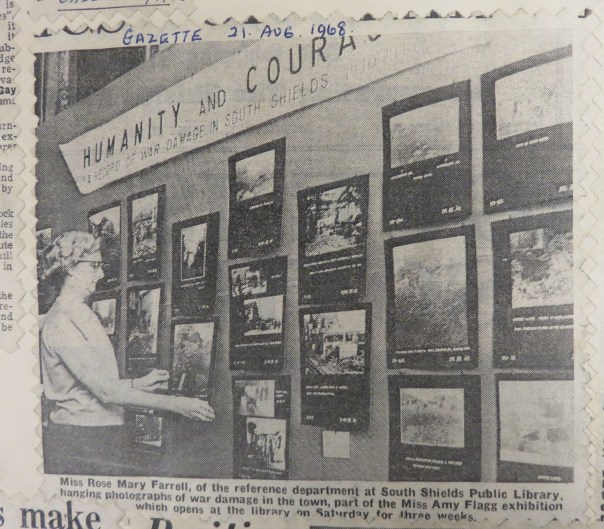
Included here is a picture story from The Shields Gazette showing her friend and Librarian Rose Mary Farrell standing next to a display of Amy’s photographs.

They were shown in an exhibition at South Shields Library. The report is dated August 1968, three years after Amy died.

IMG_0693

Links to previous Amy Flagg posts:

https://garyalikivi.com/2018/07/19/westoe-rose-making-the-documentary-about-historian-and-photographer-amy-flagg/

https://garyalikivi.com/2019/07/11/westoe-rose-the-story-of-amy-flagg-south-shields-historian-photographer-1893-1965/

https://garyalikivi.com/2019/12/21/history-lives-amy-c-flagg-south-shields-historian-photographer-1893-1965/

https://garyalikivi.com/2019/12/28/amy-flagg-holborn-the-mill-dam-valley/

Alikivi   March 2020

THE MAN WHO FELL TO SHIELDS – from Tinwhistler.

Stories were recently posted about Billy Roberts who was homeless in South Shields during the ‘70s and ‘80s. (Billy’s Story Dec.13th 2019).

I remember Billy hanging around the town centre and judging by the high number of readers a lot of other folk in Shields remember him – for good or bad.

The memories were from a Shields resident going by the name Tinwhistler, recently they got in touch again telling me about another character from Shields, this guy I can’t recall, but this is Tinwhistlers story of Arthur -The Man Who Fell To Shields.

The developing crazy world of Arthur was to most of us, intriguing, humorous and somewhat bizarre. He could disappear for months then return with more tales beyond the belief of mortal man.

Many of us gathered to play football on a Sunday morning on the Marine College field, then Arthur would show up.

No, he hadn’t turned up after being in London playing football for Spurs then coming to sign up for his beloved Sunderland, it now looked like his soccer career had come to an end and he decided his future lay in coal, briefly at Westoe pit.

There were other characters present at these games such as Fig Roll, Hat, Egg man and a particularly good player called Wavis. Away from football, music was a passion for most of us, Arthur expressing his taste in a variety of bands and acts varying from Elvis, Stones and Conway Twitty.

Wavis had the beginnings of something that developed later but he started a combo that was a non-musical affair – The Borestiffers. It consisted of him, me and Fig Roll.

Frequent rehearsals culminated with a gig at Bolingbroke Hall in Shields. Wavis had written some good songs which were put to a non-musical backing and performed in front of a more than expected turn out, who had each paid a nominal sum for a ticket but could only gain entry if it was presented with a slice of bread as this was a charity gig for the ducks of South Marine Park.

After the gig Fig Roll left due to non-musical indifferences in order to follow a career with the Royal Mail which his mother said would keep him off the streets.

Wavis’ ideas were novel, and I was put on percussion involving moving most of my mother’s kitchen – pots, pans, two wooden spoons, tin trays, roasting trays etc.

A young person called Tube was strumming a Bullworker physical exercise apparatus and the coup de grace, Arthur.

This was where we could maybe turn the world upside down because if Arthur now told people he had been up on stage in front of an audience and they didn’t believe him, it could now be proven otherwise.

Arthur was there purely as ambience and to play a board game with Tube called Mad Hats on the stage floor while I held a steady rhythm on the kitchen kit and Wavis held the front stage.

Three rolls of the dice later and Arthur wanted the mic and the crowd went wild.

It is now circa 1977 and as I am working, earning and drinking, Arthur tags along buying a round every thi​rd​ or four​th​ time. He tells me again of his prowess singing in some of the bars of Shields and he took me on my first visit to the Turks Head on the Lawe Top.

The atmosphere was warm, welcoming and we could hear the sound of people enjoying their Saturday evening. A chant started We want Arthur, we want Arthur.

That was it, he motioned me to follow him through, ‘Ha’way son, I’ll have to get up they want ‘is’. Arthur referred to each of us as son and we all reciprocated by calling him Fatha!

A couple of years later Wavis had entered the music business and mentioned more than once about his fatha who was able to destroy any standards and classics. A stage name was sought and as Adam Ant was prominent Arthur settled on Teddy Anteater.

He sang along to a recorded tape, songs he knew wearing headphones. The guitar was left-handed turned upside down, a Jimi Hendrix of the antimatter world.

He got a couple of gigs supporting local band The Letters and then got the opportunity to hit the big time.

Wavis had contacts with a label called Anti Pop and one of their acts was Arthur 2 Stroke & The Chart Commandos. They became aware of him and had heard some of the Teddy Anteater that Wavis had played them.

I arranged an introduction and accepted title of road manager. His next gig was to be with them at Newcastle University. Their manager, Andy Inman visited me at work, and I got the necessary details.

The acts on the bill were formidable consisting of a talented jazz quartet, a geordie poet called Nog, a hunched back illusionist/magician who went under the name Johnny Neptune and a scantily dressed Hot Gossip type dance troupe.

Teddy’s set was filmed and is now on YouTube under ‘Teddy Anteater – Newcastle University 1981’.

The brothers Viz, that is Chris and Simon Donald, were there, this before their mag went corporate. Simon was the on-stage compere and Chris was selling the Viz to enthusiastic students.

Both were amazed at the Teddy Anteater act, so much so that he was featured in their next issue under a heading Not many rock stars can claim to take penalties with their heads but Teddy Anteater is not many rock stars.

This was a reference to one of his many fibs regarding his footballing prowess, along with his claim that he could take a corner, get into the middle to head it and then get on the goal line to save it.

The Student Union magazine reviewed the whole show and decided that Teddy was the best act of the night. The Teddy Anteater experience really ended shortly after not before the surfacing of another bizarre act known as Jarrow Elvis.

This became a road show involving names like Hebburn Cliff and Pelaw Pitney. I suggested maybe Arthur might want to join this and to do so he could learn some Roxy Music songs. He didn’t care for Roxy so that was the end of him appearing as Shields Ferry!

Another story brought to you by Tinwhistler.

Edited by Alikivi     February 2020.

FILL YER BOOTS – It’s no mean feat for a Tyneside charity champion

The blog is read in countries around the world including USA, Brazil, Japan and Russia, along with ex pats checking in from Australia, France and Spain – the stories travel far and wide.

But closer to home a number of Tyneside residents have sent in stories about working class characters they remember.

Geordie Pantsman, Tinwhistler and Dan Green have contributed, and this memory from Archive the Noo is the latest.  At their request I am posting it today as it’s the anniversary of the death of the big man who is featured.

My memory of him was when drinking in South Shields pubs in the ‘80s you would often come across this guy – believe me you couldn’t miss him.

It was on a hot sweaty Friday night we piled into a packed Scotia pub and saw he was at the bar for last orders.

With his big white bucket at his feet he had been collecting for the miner’s strike. I could see he was getting frustrated and angry as the barmaids refused to serve him shouting ‘Time’s up’ as they rang the bell.

He was sweating heavily, gritting his teeth and with tears in his eyes, he gripped tightly on the handrails of the bar, stamped his feet, let out an almighty roar and led his fellow drinkers to… ‘Sing yer hearts out, Sing yer hearts out, Sing yer hearts out for the lads’.

Hollered out like a defiant last breath – he only wanted a pint man.

So who was he ?

Featured today is a story from Archive the Noo and his memories of one of Tyneside’s Charity Champions, Big Hec…..

If you were approached by a 6 foot 8 inch 20 stone Geordie, lurching from side to side, asking you for money with that characteristic gap between his front teeth, I wager you’d most likely think about handing it over.

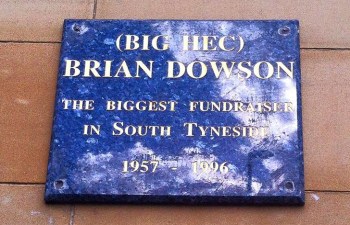
You might be a bit confused by the sight of him carrying a bucket and wearing gold painted boots (size 18). But in time you would realise you’d just had a close encounter with Tyneside resident Brian Dowson, known as Big Hec.

Throughout the ‘80s and ‘90s Big Hec, raised in approximation of £1million pounds in the name of charity, walking around Tyneside pubs, shops, metro trains and collecting donations in his bucket, taped over at the top with a slit.

He also made a cover version of Nancy Sinatra’s song ‘These Boots are Made for Walking’….

Recorded in 1990 at Brian Johnsons  (AC/DC) Lynx Studios in Newcastle, ex-Angelic Upstart Mond Cowie was studio manager and let Big Hec have the studio for nothing because it was for a charity record.

There are many endearing stories surrounding Hec. In the mid ‘70s he worked as a glass collector at the Kismet Club in Laygate and after a few beers would take to the dance floor producing incredible shapes and moves, a wondrous sight to behold.

I recall being a tad bit envious when he managed to meet his very own hero, the Dynasty starlet Stephanie Beacham, at a charity presentation.

Apart from the fact that Hec was for me a true character beyond criticism and a charitable legend worth a movie about (one of his favourite charities was the NSPCC), the essence of Big Hec is contained in my fondest story.

He once set out to beat the existing world pie eating record, held at the local Hintons supermarket store. Local TV were there and when the cameras began to roll, he was presented with a tray of pies.

He complained that they were too hot, so filming stopped and restarted after a period of cooling.

Commencing, he ate only a few and then gave up, blaming it on the big tea he had before coming out. He then burst into singing Elvis songs.

Brian had a short and colourful life, passing away from natural causes, some say a heart attack. He was born in 1957 and sadly died on 13th March 1996. May he, buried in his boots, rest in a well-earned peace.

Brought to you by Archive the Noo.

Today if you go to the Laygate area of South Shields there is a plaque on the wall of Lloyds Bank – a memorial to Big Hec’s charity work. (pic. Kennie Chow)

 Edited by  Alikivi  2020.

OUR LAYGATE – in conversation with Ann Ahmed

In research I came across an article which said Laygate was the best example of integration in Britain. And it was. It is one of our best examples, so why haven’t people heard about it ?

I would just like to do it justice and spread the word about the unique area where we lived. I would like other theatres to see it and try and play it to a wider audience. I’ll push it as much as I can. The story deserves to be told. said Ann.

I met Ann at The Word in South Shields just down river from Laygate, an area where she grew up…..

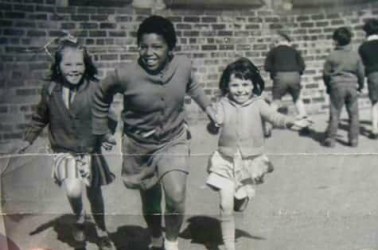
I was raised in the community of Laygate after the Second World War and seamen settled in the area after the war. It had Arabs, Africans, Somali’s, Malaysians, it was a very tight community. The area wasn’t looked upon fondly by some people outside that community.

My grandfather and step grandfather where from the Yemen, so my dad was really dark. My mam was from Scotland, she had a terrible time from her family because she was married to a black man. She was ostracised from them.

He was a seaman who was away for two year stretches and the money wasn’t there. No Social Security or Health Service then.

Not long ago somebody asked me ‘Did you really live in Laygate ?’…I said ‘Well I wouldn’t lie about it would I’. It had, and sometimes still has, for whatever reason, a bad reputation, but it was the friendliest, welcoming, community spirited place you could ever go.

Nothing has been written about the community from this angle. Most stories are about the Arab riots, but I wanted to show what a great place it was to grow up in.

I’ve been thinking about it for a long time and I still see most of the people that lived there. I bumped into one of the girls I know and we got talking about Laygate, and she said ‘All of that will be lost, all those stories, those memories, you should write it down’. So I went away, thought about it and started writing things down.

My friend’s dad had a Somali cafe, well it was a sitting room with chairs and tables in. He would get a chicken, kill it in the backyard, and we would pluck it’s feathers out.

Once I remember coming from the shops with some bread and I was walking up our back lane when Hanratty was there with his horse. He would collect scrap or old clothes with a cart and horse.  He often gave out balloons to kid’s who got him scrap.

Well, I was desperate for a balloon, so I gave the horse the bread. When I got in the house, my mam went mad, she nearly killed me, because she had four kids to feed.

So, with more stories like these I rang Ray Spencer, Director at The Customs House and asked him would he be interested, could he see it playing at The Customs House ? We met up and after reading through them he said a definite yes.

What is the play about ?

It’s about how we got on, the relationships we had, the abuse we suffered sometimes from outsiders, and it’s mostly based in our back lane, Laygate Place, with other scenes in our sitting room and Holy Trinity School.

I wanted to show how we lived together in that community, you could say from a woman and child’s perspective. Not just my family, but the Arabs at the top of the street, the Somali’s down the road, the Arab cafe just along the way.

We may have had our fights and arguments as kids, but at the end of the day we are all still lifelong friends. Some I’ve known for 60 years.

How long did it take to write the play ?

About five to six months, but with re-writing and editing, it has taken nearly two years. I got together with Susan Evans, she wrote a play for The Customs House, and she showed me the format she uses, which was a great help.

How many characters are there ?

We’re looking for actors for the play. We need 14 in all with seven of them being able to play children so they should be about 16-18. It’s hard trying to get a Somali actor locally, so if anyone feels like auditioning, contact me via Facebook.

Because of cost’s involved I’ll be fundraising for the production. If people would like to donate I’ve got a GoFundMe page  gf.me/u/wz89xz   or they can contact me through Laygate Play Customs House on Facebook.

We’ve also got a fundraising Batty Bingo night at Armstrong Hall on 18th April 2020.  The last one we did had a great turnout, great tributes and the tickets for this one are selling fast as well. It’s £10 a ticket but well worth the money !

‘When the Boat Comes In’ written by Peter Mitchell has recently played at The Customs House, will it have a similar look ?

It is the same as being set in the North East and we all have Geordie accents but that play dealt with unemployment, strikes and an affair. This won’t, it’s centred on a small community.

What is your family background ?

My mam had a really tough time bringing us up. We had to rely on family and friends. But, during the ‘50s and ‘60s nobody had anything, so it didn’t bother you as much as today when they want the latest games or trainers.

Having nowt we did feel it, but you just got on with it. We eventually had to leave Laygate when the Housing Act came in because it was classed as a slum. That is where the story finishes, 1968.
Where you sad to leave Laygate ?

Yes and no. I think if our house had an indoor bath and toilet I would have liked to have stayed, but it was classed as a slum. If you wanted to go to the loo you had to go down the backstairs and into the yard.

We had the blackest backsides known to man because of the newspaper we used as loo roll (laughs). We were moving to a house that had an indoor toilet and a bathroom. It was like a palace to us!!

While I was writing the story, I organised a reunion at Trimmers bar with all my friends and people from Laygate. I told them what I was doing and that I wanted to include some stories about what they did as kid’s.

We finished by asking what was Laygate like for them growing up, and they all said it was the best time, it was lovely, it really was. We’re all proud to be from Laygate.  It was great bringing back all those memories.

It’s called ‘Our Laygate’ because to us, the kids of the ‘50s and ‘60s, when it was mostly an integrated community, it is ours. I know it’s still integrated today and it’s still a great, vibrant community – but to us, that era is ours.

Our Laygate is on at The Customs House 14th & 15th July 2020. Tickets £12.50

Interview by Alikivi   September 2018.

WHAT’S COOKIN’ with Les Tones and Arthur Ramm former guitarists with North East band Beckett.

I first interviewed former Beckett guitarists Les Tones and Arthur Ramm in April 2018. Recently, Arthur and Les got back in touch with more stories from their days in Beckett….
As we all know time passes so very quickly. It’s been 50 years since the conception of Beckett and all the experiences of the Beckett years now tend to fade from memory.

Every Sunday evening if we are not gigging, Les and I usually meet with friends at the Vigilant Inn, South Shields where we can watch a local band perform and enjoy a good natter over a beer.

When you’re in good company, sometimes these stories and experiences return. The next stories which we have submitted to you are an example. Who knows, there may be more that come to light. Let’s hope so.

Where did you rehearse Les ?

We used to practice in Porchester Street, South Shields in a prefabricated hut. We’d start about 11am and finish around 4pm. Sometimes I’d go to Arthur’s parent’s house in Fulwell Avenue, South Shields, and the two of us would rehearse.

What can you remember about playing live Arthur ?

We used to play regularly at nightclubs in the North East. The stage area was usually upstairs and extra help was appreciated. At one particular nightclub as the band were setting up the gear on stage, a friend of the band wandered into the restaurant kitchen and noticed some uncooked beef steaks on a plate.

He realised there were no staff present in the kitchen and removed some from the plate and hid them inside his coat. In the dressing room he revealed the steaks to the band, and they told him to return them to the kitchen immediately.

He decided otherwise, and wrapped the steaks up in paper towels. Well the band used to use Vox AC30 amplification, which were designed with an open compartment in the back of the cabinets.

The culprit decided to hide the steaks in the backs of the amplifiers so that he could retrieve them after the gig.

However, during the performance when the amplifiers started to get hot, the band members on the stage could smell the aroma of cooking meat. Thinking this was coming from the kitchen, they thought nothing of it.

All was revealed when the amplifiers were put back in the van. The consequences for the band would have been quite severe if found out! He was never invited to any gig again. Who got the steaks? We don’t know.

It put a new meaning to the expression ‘The band was cooking’!

What are your memories Les ?

Beckett had an afternoon gig at Jarrow ex-Servicemen’s Club during the miners strike, playing to a mainly male audience – all the blokes in their duffel coats.

We were also booked to play at the club in the evening to a mixed audience, and we went to Wetheralls nightclub in Sunderland after that to play another gig.

Between ‘69 and ‘71 a guy called David Walker worked for the BBC and arranged for us to play live on Radio 1. We hadn’t played on radio before. When we arrived at Hartlepool Town Hall for the gig, the place was crammed.

The strange thing was that they told us to turn our backs to the audience, and turn our amplifiers and speakers round as well so the audience were behind the band.

We asked why we needed to do that and the BBC sound engineer said ‘Forget about the audience, we’re only interested in the 12 million listeners on the radio’, which made us panic!

The DJ Stuart Henry introduced us and the gig went surprisingly well. David Walker had a professional recording made of the whole gig, and passed a copy on to us.

Are you still playing Arthur ?

I am privileged now to front a band with Val Hansen, called Justuzfor. The band played it’s first gig on 24th March 2013. Since then, some of our musicians have changed. Val joined the band in 2015 and the band is still going strong.

We always try to play every week and upcoming gigs can be found on our Facebook page.

We have videos on You Tube and on Twitter https://twitter.com/justuzfor.

Read the first interview on the blog with Arthur Ramm & Les Tones in April 2018.

Edited by Alikivi   March 2020.
ALL MY ROCK STARS WERE POLITICIANS in conversation with South Shields MP Emma Lewell-Buck

I never had a musical awakening, all my rock stars were politicians (laughs). I was a weird kid, I was always into politics, sitting in front of the telly watching the news, my nana once said to my mam ‘There’s something not right about that bairn, you need to keep an eye on her’. Yeah I think I was destined to do this.

I met Terry Waite a few years ago, I remember watching on telly his situation as a prisoner years ago, he is Patron of a national homeless charity with a place in South Shields so he came and done a talk, I was sitting listening, fascinated, My god it’s Terry Waite (whispers). I was stuck to his side all night (laughs).

I’d watch documentaries where they had discovered new communities in far flung places of the world, always fascinated by the world around me, the planet and people – I just love people.

I always had a dream from when I was young to be in politics but shelved it because I never thought it could happen to kids like me.

My Great Uncle Richard Ewart was MP for Sunderland after the Second World War, before that he was Union Organiser and local councillor in South Shields, when he left school he worked in Whitburn Pit, this was a time of working class politicians. I looked to find a similar voice so dropped in to Emma’s office on Westoe Road, South Shields….

I originally got involved in local politics, became a local councillor and thought I’d never get to be an MP, so I will work to change my little part of the world. It came from there because I don’t come from a political family at all, I’m the only one in the family that’s interested in politics.

I believe in public service, that you can change things. Every single day people are in and out of this office and my amazing team here change things for them purely because I have two letters after my name.

People can come in here and be rock bottom about being evicted, all kinds of mess and we can sort them out within hours or quicker, and that’s good isn’t it.

A lot of people get into modern politics because they like being on telly or they like being famous. I just want to be a really good public servant, give something back and do some good for the people that I’ve grown up with, my neighbours, friends, family, the town.

Within the last 10 years or so pop music entertainers from South Shields like David Ducasse, Joe McElderry and Little Mix have been successful, is there any reason behind this ?

Firstly, representing your country at anything is a big deal, like David in Eurovision. Shields has talented people, it’s a creative place we have lots of artists and musicians.

I think that is because of the environment here, you look out to the River Tyne and North Sea with their wide-open spaces and you can just relax and think. That outward looking creativity and the impact of the people which makes the culture unique, that gets translated into art and music.

But I think in the past opportunities to get your stuff out there, get known or make a name for yourself have been limited and hard, but now with social media, 24/7 outlets and new avenues they are making it easier.

You can put a song on twitter or you tube and there is constant exposure if you do it right.

In the past singers or bands could of spent years going from club to club looking to get noticed, now with the resurgence of talent shows it gives people the opportunity to go on X Factor and the whole country could see you.

What music did you listen to when you were young ? (Emma was born in 1978)

I listened to my dad’s music mainly, my ma used to work nights in the pub, so I used to sit with my dad listening to Jethro Tull, Eric Clapton, Bob Dylan, I’d also like some Eurythmics and Madness. I never really followed any musical trends or fashion.

Did you play a musical instrument ?

Once as a kid I tried to teach myself how to play flute. I went to Woolworths in Jarrow with my pocket money and bought a little plastic flute. I’ve a lot of friends who are musical, but not me (laughs).

The Customs House in the past 20 years has been very successful with Ray Spencer at the wheel, is there still a place for it with all the changes happening in South Shields ?

Ray has been great nurturing the talent like we’ve talked about earlier. Arts and culture are an escape for people and we’ll always need it from the stresses of our daily life, so there’ll always be something like it in the town.

Going back to an earlier point the world is so in your face now, people get overwhelmed and there’s a rise in mental health problems. That’s because everything is at you all the time, the world just doesn’t seem as big as it used to because you’re getting stuff thrown at you all the time.

You need something comforting and nice like music and arts as opposed to being exposed to the horrors of the world. Listening or watching some things can move you in ways that some things just can’t.

With the austerity and cuts, arts and culture are the first to be hit because they are not seen as an essential service. People getting care is an essential service, do you cut money from a service which has a care package that people need to live, or do you cut it from arts and culture ?

That’s the problem austerity has brought, people have had to make those decisions, which can lead to the enrichment of the area suffering.

Have you had to make those decisions ?

When I was on the council I did because I had a budget but not now as I’m an MP in opposition. (Emma was lead member for social care) I have a lot more clout to help people but in terms of getting funding for things I have to fight twice as hard being in opposition.

Like the money for the new Metro cars, I fought for that for three years in opposition, if we were in Government and I asked it probably would have been just given – that’s the difference.

What is the difference between being an MP living in the North East compared to living closer to the capital ? 

First time I set foot in parliament was the day I was MP for Shields, never set foot in it before in my life. There are other people who were in and out of there every day looking for work, and one day they become an MP.

It depends how you’ve grown up, if you’ve spent your whole life working in places and networking to become an MP it’s not that big of a deal, if you’ve come from a normal job like me it is a big deal.

I imagine politics to be a hard profession, why do it ?

I’ve had hard jobs before, this is hard but not harder than any other jobs I’ve done before. I’ve just grew up wanting to make a difference and politics is the way you can do that.

I would look around and see my mam and dad, hard-working members of the family not being treated the same as others, they didn’t have much, just trying to get by and that massive level of inequality – it all used to make me angry.

How some people are treated wrongly and have all the chances in the world but others don’t, there should be a level playing field.

 Interview by Alikivi   January 2020.


TRADING PLACES – 250 years of South Shields Market

In September 2018 I made a short documentary about South Shields market with former Shields Gazette award winning journalist Janis Blower.

Janis has a wide knowledge of local history through producing the Cookson Country feature in The Shields Gazette and working on the books ‘Aall T’githor Like Folk O’ Shields’. An interview with Janis talking about her work featured in the blog ‘Have You Heard the News’  (27th January 2020).

We had previously worked together in 2016 on a film about South Shields Photographer and Historian Amy Flagg. Janis added the voice of Amy in the short film ‘Westoe Rose’.

Included here is the full script that Janis wrote about the 250 year old South Shields market, a link to the film is at the end.

Trading Places

Author Joseph Conrad is said to have refreshed himself in its ample public houses on his voyage from life before the mast to The Heart of Darkness. It has rung to the strident tones of politics and religion. Marked the coronations and deaths of monarchs; been a centre of commerce and conviviality.

A public forum one day, a fairground the next. War almost did for it. Peace would prove no less transformative.

Over the 250 years of its existence, the fortunes of South Shields’s historic Market Place have fluctuated with those of the wider town. Both have had to adjust to social and economic change. Within the lifetime of many townsfolk, that has included the decline of the market itself.

The rise of the discount retailer has seen a corresponding fall in the numbers of bargain hunters. Gone too is the tradition for Shields folk to put on their glad rags on a Saturday afternoon and go ‘down-street,’ to stroll up one side of King Street to the Market, and down the other.

For a post-war generation, this was the era of stalls piled high with crockery, pans and nylons – to be sifted through to find a matching pair, of reconditioned boiler suits and other stalls selling goldfish and rabbits. In winter the lamps would flare in the chilly dusk.

By then, the market was no longer open until 10 o’ clock at night, as it had been before the war when, the later the hour, the more the cost of Sunday’s joint fell.

In those days visitors would also have found Harry Randall’s toffee stand where homemade toffee, with a free bag of horehound candy, could be bought for sixpence.

Also, the stall piled high with assorted tripe into which the stall holder would shove his hands, shouting: “Come on, get amongst it!”

And there was the painless dentist, who guaranteed to pull a tooth with his finger and thumb for a shilling: This was the market as part-public service, part-spectacle, like the stocks that a century earlier had once stood opposite St Hilda’s Church.

Or the fairs that would visit, in spring and autumn, with their prancing horses and shuggy boat rides or, likewise, the travelling menageries that would also descend at regular intervals.

The Friday flea market has in recent years returned the square to aspects of what it was then, at least commercially, though the old clothes stalls are no longer confined to the side nearest the church. South Shields-born poet James Kirkup immortalised these in a poem, writing:

“The old jackets rub shoulders on the rack of life and death, the crumpled trousers all undone swing in a driving wind, a boneless abandon, soft-shoe shuffle in the sands of time. Laid away, the painter’s dungarees are dingy white, stained with forgotten schemes for houses decorated out of sight…”

Gone, though, is the fresh fish market: also, the groups of men who, hands cupped round their Woodbines or Capstan Full Strength, would gather around the Old Town Hall in the hope of being tapped for work on the river.

An old Shieldsman, writing of his Victorian childhood, remembered each trade having its own beat. “While the Church side was common to most parties”.

Men milled in this way, albeit in ever-decreasing numbers, until as late as the 1960s, before the skyline increasingly ceased to be criss-crossed by cranes.

The Market Place pulsed with life, not only in the numerous pubs – of which there were at least six before the First World War and as many again in the surrounding streets – but also in the shops.

Marks and Spencer started out in the town with a Penny Bazaar here. Barbour’s with a shop on the west side of the square, specialised in weatherproof clothes that would evolve into the garb of aristocrats.

Crofton’s, the legendary department store on the corner of King Street, would survive one disastrous fire early in its existence but not a second.

That catastrophe was visited one autumn night in 1941 when the town suffered the biggest air raid of the war. In a matter of hours two sides of the square had been reduced to smoking ruins.

The then-170-year-old Town Hall – miraculously stood firm, albeit not undamaged. The ‘Old Cross,’ as it was affectionately known was left looking out over a sea of devastation.

Over the next 20 years, new buildings would grow-up around it. There would be no attempt to reconstruct a square which had once been likened to the marketplace at Bruges.

Post-war modernity won the day, in keeping with a town which, under Borough Engineer John Reid, was sweeping away much of its Victorian housing and redrawing its commercial heart.

Concrete took the place of brick, with new pubs going up on the site of the old and the building of a new tax office, Wouldhave House, with shops adjacent.

Small thoroughfares which had run in and out of the square for much of its existence, like Thrift Street and little West Street, disappeared. East Street and Union Alley, became backwaters.

Today the square continues to evolve. Words remain its currency, – not those of the fairground barker, or the radical anymore, but as the home of the town’s main library, housed within an award-winning building dedicated to writing and creativity.

The Market Place own story, meanwhile, continues to unfold….

Alikivi   January 2020