South Shields born Vinny Edwards has featured on this site a few times. Type his name in the search bar for previous write ups about his time in the music biz including international chart hit Back Where We Started From which reached #2 in the USA and #8 in the UK. Recently he got in touch and told me another story about one of his songs.
I was living in a flat in Wandsworth in London when I wrote and recorded I Can’t Turn Back Time in 1967. It was my second solo single for United Artists after The Answers broke up. We recorded the A and B side The Lively One at Olympic studios within three hours can you believe!
The B side was used for a commercial for Texaco petrol in the UK and USA. I Can’t Turn Back Time was played mostly on the pirate radio stations London and Caroline. I believe it charted on both stations it also broke into some Northern Soul charts.
In America it was released under the name Tim Love on the Ascot label so I would not be confused with the American actor Vince Edwards who played Dr Ben Casey in the TV series. It was just after this I changed my name to J Vincent Edwards. The ‘J’ I took from Jarra or Jarrow if you were posh.
Later there were two more records on United Artists – County Durham Dream and Aquarius then along came the musical ‘Hair’ and a new record company CBS. They were crazy happy days for a 22year old lad from South Shields’ Ocean Road school.
Link to the American release on the Ascot record label of‘I Can’t Turn Back Time’
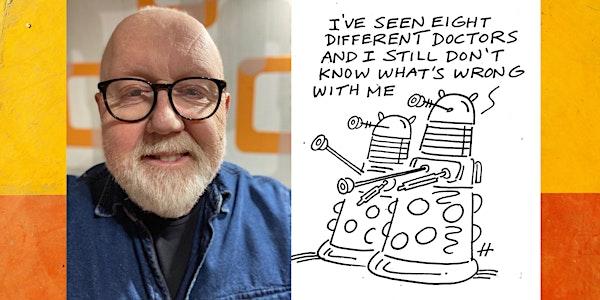
Former Shields Gazette graphic artist David Haldane established himself as one of the top cartoonists in the world. Blyth born David, now 70, worked for the Gazette from 1977 to 1983, he currently creates cartoons for The Observer and Private Eye and had his work regularly produced in Punch, The Express, Mirror, Guardian, Telegraph, Daily Mail and the Sunday Times. He also contributed sketches to the original TV series Spitting Image.
However, it is for producing cartoons for The Times from 2005 until 2017 that David made his mark, transforming him into one of the best cartoonists in the world.
South Shields playwright Ed Waugh has been asked to host an evening in conversation with David at The Word in South Shields on Wednesday September 24th at 1pm. He said: “I’ve known David for 20 years or so and he’s both very sharp and very funny. You have to be to create top-class satirical cartoons every day, often at very short notice, for national newspaper front pages.”
He added: “David’s career stories are both deep and hilarious. It will be a fantastic event for people who want a laugh and those who want to find out about some of the stories behind the many thousands of tremendous cartoons David has created and had published.”
The event follows his sold-out illustrated talks at the prestigious Lit & Phil in Newcastle and Blyth Library.The talk on Wednesday, September 24 at 1pm is part of The Word’s WRITE Festival.
Jamie in ‘Hadaway Harry’. Photo credit Von Fox Promotions
Meeting up with contributors I’ve asked the usual questions of who, where, what, why and when. For a band you might not listen to their music, but we still want to know if they were signed? What venues did they play? Did they release any records? And yes, some did appear on Top of the Pops and the legendary live music show The Tube broadcast from Newcastle.
However, occasionally I throw in a question that is relevant for working class people in a creative business. How many times do you hear working class voices on stage or TV?
Wisecrack Productions, a North East based theatre company, have produced a number of plays documenting working class history – helping in their own little way. Earlier this year I met up with actor Jamie Brown who has starred in some of the plays and asked him – how do you survive in the arts?
I work with two theatre companies. I’m company director for Theatre Space North East based in Sunderland. It’s about cultivating creativity within the community. We do theatre tours and plays in the parks through summer seasons.
Also work with 1623 Theatre Company. 1623 was the year the Shakespeare plays were published. The work centres around taking inspiration from Shakespeare and people’s everyday lives and making new work from it.
When I came back to the North East as a professional actor I was cast in The Machine Gunners at The Customs House, South Shields with an actor called Donald McBride who was a few decades my senior. He said with a twinkle in his eye and a wink ”You’ll be around a long time you will, just keep your head down and be nae botha”.
There is something in just doing your job, doing it well and knowing your role within that room. As a younger actor there is a lot to be said for that.
As I’ve plied my trade in the area for the best part of 20 years one of the things I tell students when I go to do talks at project days is there are two types of people in the world. There are those that plant seeds and there are those that just go around picking flowers.
There are two types of actor, some pick flowers while others like to get their hands dirty and plant seeds. I think you need to be doing both. But you’ve got no insurance that anything is gonna grow if you’re not the person starting it off. So, you’ve got to rely on yourself to put things in place and bring things to life.
There are some actors who want to travel the country or travel the world but for me it was about having a sense of place, a sense of community, bringing stories to life about that place, for the people from that place.
There’s a lot to be said about shared experience and shared history and values you have around you. Also, you can’t just wait for people to knock on your door, you’ve got to be doing stuff in the meantime.
There is or was a perception that when I came out of drama school someone would put out a casting call, you’d apply, go for an audition but it wouldn’t always happen. There’s a lot of in house casting, a lot of casting people who they know because it’s a high risk business and they want to take as few as risks as possible. They would prefer employing people who they can work with and who will do a good job. As a young up and coming artist sometimes that’s not you because you haven’t had the opportunity to work.
Being on the other side of the table I completely understand it but as a young actor seeing the same people get cast in the same sort of things it is frustrating and you think if that was only my chance. But don’t give up, chances do come and you’ve got to be ready to take them and not kicking up a fuss or overstepping your role.
An actor who has a creative brain has aspirations to direct, but are you the right director in that room and in that moment? Overstepping can be a bit fractious as well. You have to know your role within the room and its boundaries.
You might want to be an established theatre director in the future but if you are being employed as an actor by all means contribute your ideas when it is appropriate or when they are asked for, they are welcomed, but if you overstep you are going to realise very quickly you are not somebody who understands that particular hat you need to wear in that room. It can rub people up the wrong way.
What projects have I been working on? Well last year we done As You LikeIt outside Durham Cathedral on the green then St Peters Church, Sunderland and the Anglo Saxon farm at Bede’s World in Jarrow. This year we are planning more inside and out doors shows at places relevant to the story we are doing. We’re really excited about it.
Meeting up with contributors to this site I’ve asked how they survive in the arts. Some talk of persistence and others simply being obsessed by it. I think to give yourself a good chance you’ve got to be prepared to work on it day in day out basically 24/7/365 days a year.
85 year old Sheila featured on this site in June 2018 where she talked about spending her life in art – so she was the perfect person to ask.
Surviving in the arts is for me going with the flow. I believe in my Mam’s saying ‘Every day in every way in everyday I’m getting better and better’ particularly when you are feeling crap or when things have gone wrong. In the arts you need this saying because there are times when things just don’t happen for you. Tempered with that my Dad used to say ‘worse things happen at sea’! So never, never, give up. Keep positive and keep going.
After attending Art College Sheila then went to Birmingham School for Training Art Teachers in 1961.
That was the best thing to happen to me. I was shown that everyone is an artist in their own way and it’s your job as an art teacher to bring it out. It’s about giving something positive to people in their lives.
I first taught art in comprehensive schools in South Shields and by 1970 I was divorced and had time to play so bought a super 8 cine camera. Play is very important plus having a messy room or studio where no one tidies up after you!
My first messy place was at home in South Shields working at a desk looking out onto our little garden. Later it was a studio in the Pilot Office overlooking the river Tyne. Then by the mid 70s I got a break in animation.
I was contacted by an agent for World TV who sold the short films I made globally. She later commissioned me to animate 10×10 minute ‘Just So Stories’. The actual process of animation can take a long time to produce minutes on video so the only way I could produce this was to give up teaching – which I did in 1980.
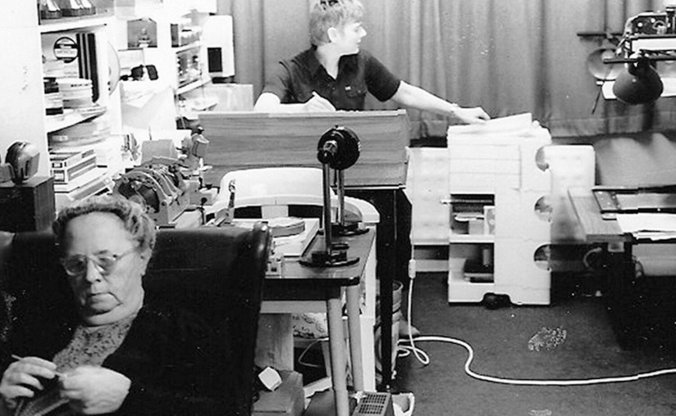
Sheila animating Frame by Frame for World TV and her Mam crocheting for a local shop – a true cottage industry.
Sheila also works with various charities, the last post features Anna Malia and North East Animal Rights, how did you get involved with them?
When I lived in Ireland I saw an incident, not to go into it here too much as it’s really upsetting, but there was a field of cows and a calf that broke free from the herd. It was about how it was dealt with by the farmer that really affected me. I thought if I get the chance I would do something for you – for that calf.
I heard a song by North East musician Jen Stevens, loved it, and thought that would really work with images. I asked Jen if I could use it and she said yes. We put it out and Anna Malia from North East Animal Rights got in touch and we took it from there.
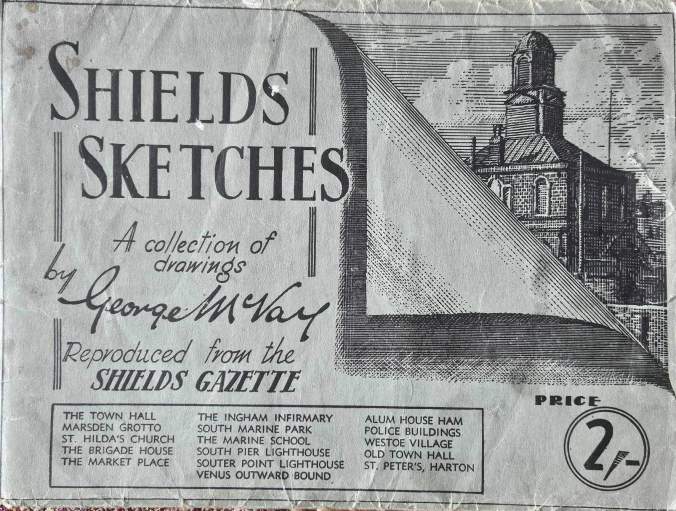
Sheila is currently working on a book about George McVay, a little known artist who lived from 1902-1967. Former Shields Gazette journalist Janis Blower is in the process of editing it.
George was a very good photographer which accounts for the very large detail in his pictures. His style of painting was very photographic. When I was 8 my mam bought a set of his prints that the Gazette had commissioned and I loved looking at them like kids look at ipads now. For a long time I done plasticene models of them.
All his life he drew some amazing illustrations of Shields and surrounding areas. Some people may recognise his black and white drawings, very clear, very precise everything from the old Town Hall to the piers, the river and the Groyne. In the book Janis Blower will be adding underneath a description and history of George’s picture.
In his early days I gather he worked at Readhead Shipyard, he was studying planning, design and engineering. His Dad was mayors secretary at South Shields Town Hall and was a good photographer. It’s thought he said to his son that he should work in the Town Hall and he eventually did, he was employed in the ratings department.
Out of the goodness of his heart he’s done drawings for presentations at the town hall. There are some amazing manuscripts, whatever was required he could do it even when people leave. He also done commissions for the Shields Gazette.
The Shields museum have some in their store. He has stuff in the Hancock and Discovery museum, Newcastle. He did a showing at the Laing Art Gallery and down in London but all track of that is lost. Unfortunately, nobody has given him the recognition that he deserves.
What I’ve found over the years is that he and I have followed parallel tracks. We have both done a lot of work for charity and both drawn the most popular buildings and views in Shields because we love the place.
To contact Sheila check out her official site at >>>
The title of this post is taken from the song and album by The Smiths released in 1985. In the title track songwriter and vocalist Morrisey delivers some powerful lyrics –
‘Kitchen aromas aren’t very homely. It’s not comforting, cheery or kind.
It’s sizzling blood and the unholy stench
Of murder
It’s not natural, normal or kind. The flesh you so fancifully fry
The meat in your mouth. As you savour the flavour
Of murder’.
In interviews Morrisey is outspoken about a number of topics including politics, royalty and animal rights.
‘Yes I’m aware of the song and Morrisey but I’m not a Smiths fan.’
saidSouth Shields born Anna who worked in education for 32 years and in a secondary school for over 20.
‘I was lucky to be able to leave my paid work a few years ago and now do this full time. No one day is the same, I can be in the middle of typing up an article when a call comes in and have to drop everything. I wouldn’t have it any other way as I feel fulfilled with my work – but wish we didn’t have to do it as that would mean a world where animals are not used.’
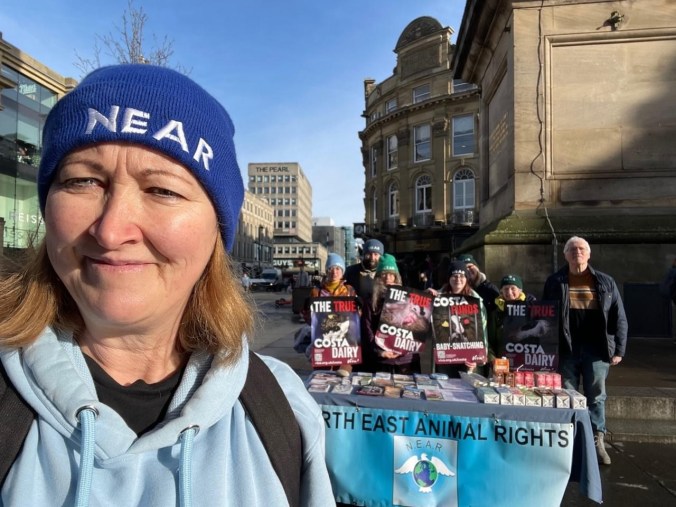
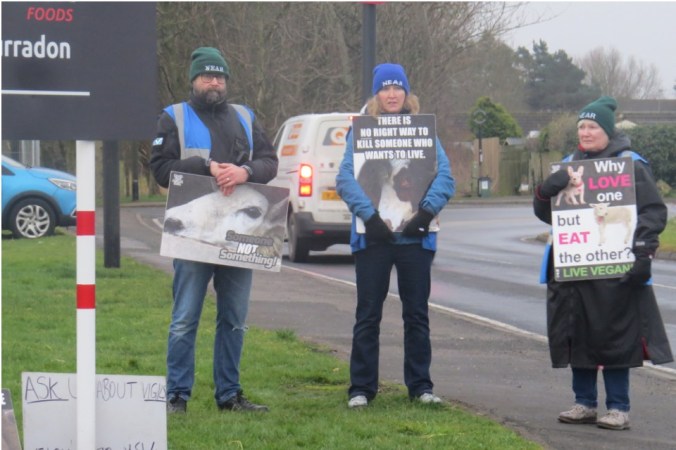
Anna set up North East Animal Rights who campaign and educate about veganism and animal rights. They have around 30 members with branches in Newcastle and Teesside.
‘It’s quite large for an independent regional Animal Rights group. Some of the group also volunteer for a local wildlife rescue. It’s hard to work out how much of a difference you actually make. But when you rescue an animal, that animal becomes the most important person in front of you and you know you definitely have made a difference.’
When did you become aware of how we treat animals?
‘I was 14 in a biology lesson in school when I was expected to dissect fertilised eggs with chickens at different stages of development. I was absolutely horrified seeing these dead baby chicks who had been deliberately bred and then killed. My parents were equally horrified when I told them I wanted to be vegetarian. I hadn’t even heard of veganism then and didn’t understand that I was still contributing to the suffering of cows and hens.’
‘I was already considered different in school before I went vegetarian so just made my school life a whole lot worse. I didn’t know what else I could do to help animals. Then I saw an article in a newspaper about people trying to stop a bull run in Spain. So, I sent a postcard and letter to the Mayor of Pamplona where the bull run takes place.’
What is the hardest part of being a vegan?
‘One of the hardest things is other people, the lifestyle is easy – it just becomes something which everyone seems to have an opinion on regardless of whether we want it or not. And families and close friends are the worst!’
‘It’s all water off a duck’s back now, but it’s amazing how many people suddenly become obsessed with your health when they didn’t care before you told them you are vegan!’
‘A lot of people think being vegan is just about the food, but it’s about so much more – it’s a whole lifestyle – and you look at things in a different light when you become vegan.’
‘You walk down a street you see adverts for meat – we see the process and the animal. You look forward to Christmas – we dread it because we see an increase in animal slaughter. You see an advert for a reindeer event and don’t flicker – we see captive animals who shouldn’t be there. You look forward to Easter and we see rabbits and chickens used. You see cute chicks in egg hatching programmes, we see and deal with what happens and the casual disregard for them.’
‘We got told to stop ‘forcing our views on others’ but others views are constantly forced on us in most aspects of our lives. You look forward to going on holiday, we do too, but we are always conscious of how vegans are perceived abroad and also have to deal with cultural issues where animals are used differently to in the UK.
‘For most of my adult life I thought being vegetarian was enough then I came across some graphic footage on TV and photos in a magazine of what happens in an average UK farm – I realised I was still part of the problem. I essentially went vegan overnight and signed up to Animal Aid’s November vegan pledge and never went back.’
What are the group currently working on?
‘We get a lot of contacts about animal related issues and it’s great to be able to help. We rely on the public quite a lot to be our eyes and ears.’
‘We get people asking about who to speak to about dog cruelty or breeding animals. They contact us in relation to mobile zoos in schools or about their vegan child in school. A lot of issues are those which the RSPCA should investigate but cannot always due to lack of resources and having to prioritise.’
‘At any one time we have two or three investigations going on. They are complex and time consuming but we learn a lot from them. One of the biggest pieces of ongoing work is the South Tyneside Councils Animal Protection Charter.’
‘This came about because of a local issue we had with camels being used in a Christmas parade along King Street, South Shields. It had been going for around 6 years. After meeting with the leadership we eventually convinced them to drop the camels in 2020.’
‘We continued working with them afterwards and created a charter which is available for use in other councils across the UK. The council do an amazing job promoting the work within it and really work hard to engage residents with local animal-related issues, like those around seabirds.’
What does the future hold for North East Animal Rights?
‘I speak at a variety of schools and events and this year I’ve been invited to speak at the National Animal Rights March in London and a local event in Saltburn. I don’t find public speaking easy but it’s easier when you are passionate about your subject.’
‘I’m a deputy co-ordinator for North East Animal Save who are a group who run vigils at slaughterhouses – yes, it is as grim as it sounds, but unfortunately while people continue to eat animals it’s a necessary part of our work.’
‘My work is very full on my poor husband sees me fleetingly most days but understands the importance of what I do and is very supportive – he’s also a member of NEAR.’
‘But I’m a positive person – rather than looking at how far we still have to go, I look at how far we have come. When I was a child I had no idea what being vegan meant but I know from going into schools not only do children know what it means now but there are also vegan children there – that’s progress.’
In April this year the work of hunt saboteurs featured on this site, this latest post again looks at tackling illegal foxhunting but this time using a different approach.
‘First time I witnessed a hunt I was shocked by its enormity. It was a deeply emotional experience nothing could have prepared me for it. The following week I witnessed a fox killed by hounds. That day I made a promise – I vowed to get justice for that fox. It’s his memory that drives me on.’
To find out more about the work of the Northumberland Hunt Watch I sat down with Lynne in the Littlehaven Hotel, South Shields where she started off by telling me she has always loved animals.
‘Since I was a child. My earliest memory, of being anti-hunt, dates back to school I was 10 year old. During an English class debate the teacher asked me to argue in favour of foxhunting. I was horrified and refused point-blank. Despite never having witnessed a hunt in my life I always felt an empathy for the hunted fox.’
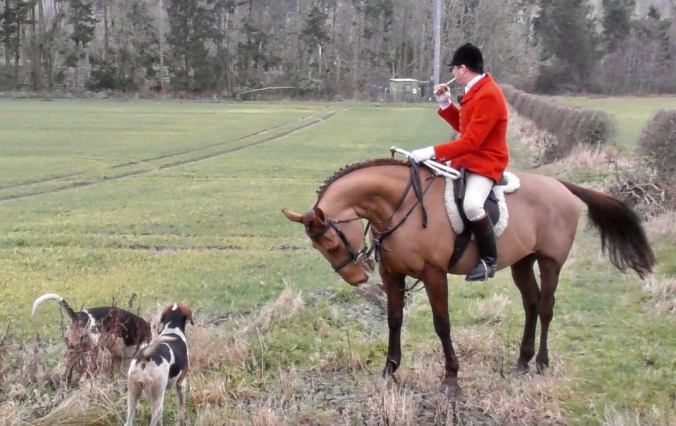
Tynedale hunt near Corbridge, Northumberland.
In 2002 Scotland banned foxhunting, England and Wales followed in 2004.
‘I thought that was the end of it. However, just because an activity is criminalised doesn’t mean it ceases to exist. Through social media I realised it was still happening on a massive scale. I was aware of the foxes out there alone with nobody to help them. I felt compelled to take action.’
‘I founded Northumberland Hunt Watch in 2020. Prior to this, I already had 5 years experience monitoring hunts. There wasn’t an anti-hunt presence in Northumberland at that time, leaving all the hunts in the area unchecked. There are some pockets of deeply engrained hunt culture in Northumberland, operating in some very rural and isolated locations.’
‘For these hunts it’s very much a way of life. They have a cultural pride in hunting, and strongly resist any attempts at criminalisation. The hunt community is a very tight community. They hunt together, socialise together, conduct business together and support one another.’
‘There are many different reasons why people foxhunt. Foxhunting has nothing to do with pest control or managing fox numbers. The hunts want foxes in the area to hunt which conflicts with the pest control argument. For some hunters it’s for the thrill of the hunt or the thrill of the kill. That is very difficult to understand.’
‘There are farmers and landowners involved in the hunt, who grant permission to access the land. Without this land there would be no foxhunting. For the riders who subscribe to the hunt, following hounds provides the freedom to ride over land that would otherwise be out of bounds. The fox is not restricted to boundary lines, so the hounds and riders are free to ride where the fox goes.’
‘The car support who follow the hunt mainly consist of elderly men. To them it’s a day out to socialise. They turn up with their binoculars, sandwiches and flasks having a good natter, they enjoy watching the hound’s work. I often talk to the members of the hunt to gain a better understanding of why they do what they do. We can’t expect to change something unless we fully understand it.’
‘We’ve talked about what we call ‘clean boot hunting’ a humane and lawful activity, which follows the scent of a human runner rather than a fox. With clean boot hunting they can still have everything they have now. The jobs will still be there, they can still have their socials and get together, their balls, their meets so they can still have their sherry and a bit hokey cokey, just don’t kill a fox. I think they fear their way of life will fall apart without hunting the fox.’
‘But humane hunting would be far more sustainable. Currently hunts claim to be trail hunting, which would involve hounds following a trail of artificial scent instead of a live fox. Unfortunately, trail hunting in my experience is just a cover for foxhunting.’
Have you a vision of what you want the group to be?
‘Yes, when I set the group up I thought I’m going to do this my way, I’m not going to war with them. I’m going to win hearts and minds. For me it was all about a love of wildlife, and a hatred of foxhunting and not a hatred of the people. I strive to end foxhunting for good so I knew that we needed to be taken seriously by the hunts and the police.’
‘I aimed to create a professional group with a credible image, as far removed from the negative stereotype as possible. We refer to ourselves as volunteers or wildlife guardians, rather than sabs, protesters, or activists. We don’t wear masks and we have a dress code. We’re conscious of how we come across to all the people we meet.’
‘Some people are just out for a dog walk in the countryside, families with kids, older people. Last thing we want to do is scare people, we want to be approachable. We’re always polite and respectful and get on with the farmers.’
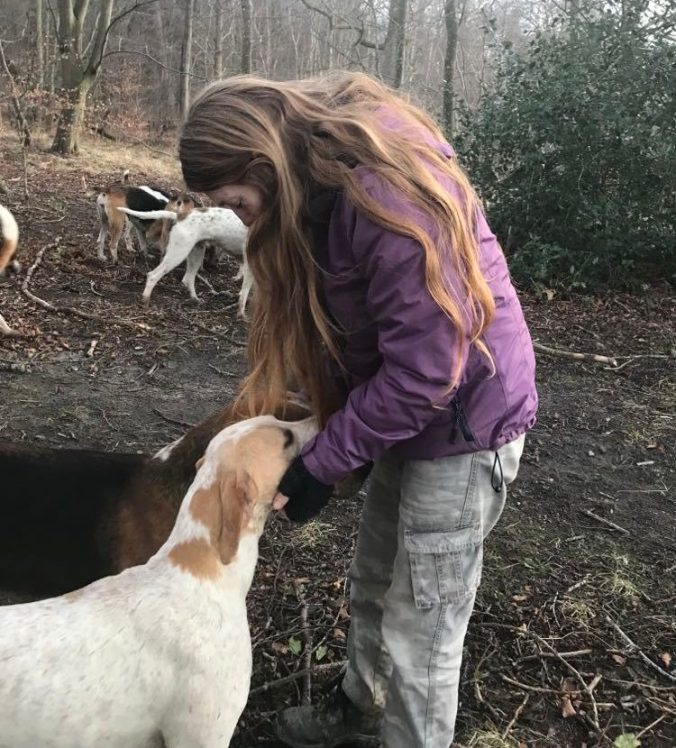
Lynn with the West Percy hounds.
‘We absolutely love the hounds they are such lovely sweet animals, we would never do anything to put them at risk, and our hunts know that. We often pop along to their hound shows in the summer some we are made more welcome than others.’
‘We aimed to build relationships and establish trust in the community and we have. All of our hunts know who we are and they know our names. We engage in polite conversations, some team members live in hunt areas, so it’s not uncommon to exchange waves. Our approach has earnt us respect and fear in equal measures!’
‘Our overall aim is to make the countryside a safer place for wildlife. On a day to day basis we aim to be a visible deterrent, to prevent hunting and on most occasions we are. We rarely need to intervene as our presence is often enough of a deterrent. Our hunts will often try to avoid hunting when we are there, and certainly avoid hunting in front of us.’
‘Last year at a hunt I was filming when the hounds picked up a scent and chased a fox toward me. The whip panicked and stopped them all “Lynne, can you see me stopping the hounds? Have you got it on video that I’m stopping the hounds?” I replied, “Yes, I have, thank you.” The fox made his way to safety.’
‘In the long term we aim for prosecutions as this is the only way to end foxhunting for good. To achieve prosecutions then we need to be professional and credible.’
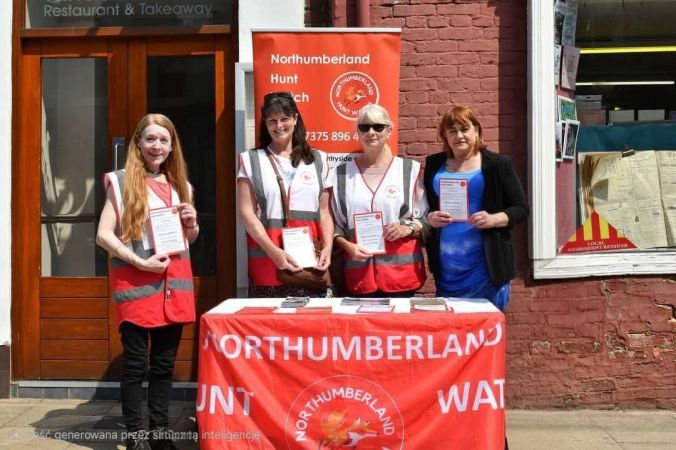
Outreach stall in Morpeth with Lynn, Judy, Amanda & Lynne
How much work is involved in the group?
‘A lot. We work very hard and put a lot of work in. I take this very seriously and am very committed to what I do. During the season we are out 2-3 times a week, despite working and other commitments. I would be out every day if I could. The fieldwork we do is just the tip of the iceberg. We do much more behind the scenes. Personally, I work on foxhunting every day of the week.’
‘I have taught myself a great deal over the years and always have my nose in a foxhunting book. I am also concluding a PhD in Criminology specialising in foxhunting with hounds. I have invested significant effort into this because I want to bring the issue of foxhunting criminality to a wider audience.’
Lynne & Judy leaving a successful Tynedale meet.
‘The lady who assists me in running the group, Judy, is a former police officer, so between us we have an in-depth knowledge of hunting and the law. We both work very hard on this, preparing cases and evidence for the police especially.’
‘Out of season we hold outreach stalls in hunt towns where we talk to the local community about our work. This has enabled us to lay the foundations for a positive brand identity while building up good relationships, trust, and respect within the community. We want the community to feel comfortable having us in their area trusting us to perform our job professionally.’
Have you experienced any threatening situations?
‘Violence and aggression from any of our hunts is exceptionally rare. We have had very few minor incidents in 5 years, most of which were dealt with swiftly, either by the police or the hunt themselves.’
‘Following one minor incident at one of our hunts I reported it to the chairman, he dealt with it, and we received an apology, so it was resolved sensibly and that was the end of it. There were no more incidents.’
‘We cover all the Northumberland Hunts from the Scottish border down to the Durham border, although Tynedale is our main hunt who we monitor regularly and have done for 5 years. They were a bit of a nightmare at first but they soon leant that it didn’t get them anywhere. They are very polite towards us now and we have built a good relationship with them. We are there to do a job which we do well and without getting into altercations.’
‘With all of our hunts we established clear expectations for behaviour from the outset ensuring that our conduct was respectful and polite. Over the years we have built a good rapport with most of them exchanging polite greetings “good morning, gentlemen” and in return “good morning, ladies.”
‘We never engage in name-calling or squabbles because throwing insults is not a stepping stone to positive change. This means that we can focus on what is truly important—the foxes. It might make someone feel better after calling someone names but it doesn’t achieve anything for the fox.’
‘The hunts also have a code of conduct regarding their behaviour towards us too. We have an unwritten rule between us we don’t call them ‘hunt scum’ and they don’t ride their horses at us, so this works well. This mutual respect means any of our team can be monitoring a hunt alone, in some isolated locations without any problems. Our approach saves lives.’
‘At one of our hunts we intervened between the fox and hounds, rating the hounds back so the fox could escape. This was in front of the hunt master and he said “thank you for helping” so we replied “no problem we’ll come back and help again next week.”
‘When we monitor hunts we focus on listening and observing, avoiding verbal confrontations is for creating a safe environment for the foxes allowing them a safe passage to escape. Foxes don’t know we are there to help them so we need to create a safe environment otherwise they would just see us as part of the pack. If there is chaos they could easily be scared back toward the hounds, we are very conscious of that. We often see foxes fleeing past us to safety. Silence is golden. It saves lives.’
How frustrating is it knowing fox hunting is illegal and it still goes on?
‘Very frustrating but there is a wide range of reasons why it continues. Weaknesses in the Hunting Act is a key issue, and also how it has been interpreted. This has provided loopholes for foxhunts to circumnavigate the law. There are so many issues that we will need an entire article to discus that alone. In a nutshell trail hunting has ensured that it is extremely difficult to prove them guilty and beyond all reasonable doubt. Consequently, trail hunting operates exactly as it was intended.’
‘We are committed to ensure that we have the best chance possible. Our behaviour will also come into question so we always act lawfully. Foxhunting is a low-level offence so if we break the law we lose the moral high ground and cannot expect the police to enforce one law while ignoring another. We have to be seen to be credible witnesses to make any progress.’
‘Because of how we operate we have built a good relationship with the rural crime team who we submit our footage to. We have had several incidents sent to the Crown Prosecution Service for review, and the police have acted swiftly in gathering the evidence.‘
Drone footage was captured of the Tyndale Hunt hunting a fox on 3 October 2024. This was submitted to the police. More information about this case can be found on the Northumberland Hunt Watch Facebook and You Tube pages.
‘There are some excellent groups across the country that have worked hard to end foxhunting, bring hunts in court or raise awareness, such as Beds and Bucks Sabs, 3 Counties Sabs, Cheshire Monitors, and West Midlands Sabs, to name a few.’
‘However, not everyone who joins a cause has genuine motivations, and the less credible groups can undermine the work of those who are genuinely committed and doing good work. It’s about quality rather than quantity, so finding people with the right attitude can be difficult.’
Lynne recording West Percy Hunt at Ingram Valley.
What have you found out about yourself since starting this group five years ago?
‘I have found that I am stronger and more resilient than I ever thought possible. If you have genuine intentions and committed to doing your best job for wildlife then you can make a difference. A middle-aged woman with a vision took on ten hunts, most of which were untouched and located in some of the most isolated rural areas of the country. I was subsequently joined by other middle-aged women to create a hardworking and professional group that has made a significant impact on hunting in this area. Never underestimate the power of middle-aged women on a mission!’
If you are interested in the work of NHW or would like to volunteer contact >>>
Since 2012 I’ve been researching the life of this fascinating character who was originally named Theophile Lucifer Gardini. He spent his last years living in a terraced house round the corner from where I live in South Shields.
In 2018 I produced a short documentary ‘Secrets & Lies’ based on what I found about his life so far, a link is at the end of the post.
I often mention him to neighbours and hear the odd story about Avro and his wife Anne. Recently an old friend got in touch and remembers the couple who lived at 45 Henry Nelson Street.
‘We moved into 32 Henry Nelson first week of June 1990, I think Avro died in the November so it was only a short time. I remember his wife used to have a little furry dog. She used to walk it out all the time.’ Recalled 60 year old Jeff Anderson now living in Washington, County Durham.
Jeff Anderson
‘I’d see them in the street. Always well dressed. Always smiling. I don’t think local people were aware of who he was to be honest.’
‘Actually, very first time I came across him and his wife was prior to moving into the same street. I saw them on the corner of King Street in the town centre. They really stood out, there was a real glow about them. They had a big smile on their faces. You couldn’t help but notice them’.
‘What they were wearing was very classy – not the type of clothes the everyday person of Shields would wear on a Saturday afternoon. They really stood out of the crowd just by their whole demeanour.’
‘But when Avro died I remember his wife was absolutely devastated. From the initial sighting in King Street and other times in Henry Nelson they had this glow about them but after Avro died that seemed to vanish from her. From what I can remember she was never quite the same’.
‘A strange thing happened to me on the night he died. I went to pick my wife up from work in the town centre but there was nowhere to park so I had to go back round the block. I went past St Hilda’s Church and as I went round the corner I had like a paranormal occurrence – the only way to describe it. I actually saw a vision of Avro on the ground reaching up to me. I was shocked, I thought what’s going on. This is a bit weird.’
‘I continued on and as I came back round the block again there was no sign of him. Gone. It really freaked me out as you can imagine. It wasn’t until a few days later that I learned he had died that night. So, you know what was going on there?’
‘I didn’t know anything about him having any health problems. He died at 76 you say? Doesn’t seem that old now does it?’
If you have any information about Italian born author & artist Baron Avro Manhattan (1914-90) please don’t hesitate to get in touch.
Musicians, writers and actors have contributed stories to the site for over 8 years now resulting in world wide views totalling over 430,000. A big thank you to all the readers – much appreciated.
The site also has local and social history posts. A contributor who goes under the pseudonym Tinwhistler sends in his recollections of characters in South Shields. The likes of Big Hec, Billy Meths and Wavis O’Shave have already featured and the number of views prove there is a thirst for these stories.
In his latest post he talks about how a myth can be cultivated to the point of belief.
‘Our heroes are due to legend created from what is said or written about them, however, they can become exaggerated when tales are passed down. The negative aspects are usually omitted so you might be left with a ‘Robin Hood’ tale bearing little resemblance to reality’.
‘Controversial characters become larger than life courtesy of Chinese whispers elevating the likes of small time hoodlum to status of master criminal.’
‘We have heard of individuals such as this with their names and gang titles posted via graffiti. Never in a position to place a face to any of the names sprayed out there, I often wondered if these characters did exist?’
‘What if they were simply the imaginings of a furtive mind creating a band of disciples who followed a not so large Mr. Big? Back in the 1980s in South Shields there was indeed a case of this.’
‘This originated in the realm of dreams that belonged to Wavis O’Shave and the title bestowed was ‘The Hard’ showcased by Tyne Tees television on their nationally networked UK live music show The Tube.’
‘The Hard was tough, a shaven headed individual with a pumped up upper torso (a little padding), wearing Dr Marten boots on hands as well as feet.’
‘The Hard was filmed completing stunts such as spreading out one of his hands on a brick wall and banging several digits with a claw hammer, his mantra was an unforgettable “Felt Nowt!”
‘So where and how did the Hard originate? The North East of England has had more than its fair share of this type over the years, some individuals, some gangs usually involved in some kind of turf war.’
‘Spotting them wouldn’t be too difficult, in fact take three or four and morph their assorted traits, qualities and characteristics and hey presto!’
‘Going back to the 1970s O’Shave was solely involved and directly responsible for the Hard’s precursor. Back in those days we would read the writings on the walls to see if we might discern who these characters were, what they might be about and wonder if they actually existed at all.’
‘And so it came to pass. Wavis cunningly wove a mental tapestry involving the adventures and exploits of one of these types, creating a legend that would expand over a period of time. A title was bestowed on the non-existent extra hard tyrant and it was ‘Big Moss’.
‘The somewhat susceptible youths who we spotted in our neighbourhoods were fair game to test out the believability of his creation. Several of us in the know would be dispatched to where they would assemble – street football, outside the chip shop or leaving a youth club.’
‘The message was that Big Moss had been seen in the area and he was big trouble, keep out of the way and avoid at all costs. We answered questions as best we could but there were inevitable distortions as a precise script had not been devised.’
‘If asked as to his South Shields origins one reply might be the notorious old Deans Estate, another might be Horsley Hill or possibly one of the town’s outlying estates such as Biddick Hall or Whiteleas.’
‘The general description given was – bigger than you can imagine, a mop of ginger red hair, Dr Marten boots, 60s style evaprest trousers that were worn too short for his long legs which left exposed ginger shin fur. An additional warning was issued, “whatever you do, do not laugh!”
‘The Big Moss wardrobe was somewhat random from charity shops and jumble sales married up with home made turtle neck knitwear topped off with a blazer or suit jacket as the pockets were useful for carrying tapes of preferred music.’
‘If you were stopped by Big Moss and asked what music you liked and your answer wasn’t what he happened to like then it was likely a case of seeing stars. If he motioned to place his cassette recorder (the size of a small suitcase) on the ground, then it was best to run as it meant he was going to fight you.’
‘As previously described, Big Moss wore a jacket with pockets where he kept tapes by Black Sabbath and Budgie who were a Welsh hard rocking trio.‘
‘He also carried cigarettes – unfiltered Capstan Full strength, a Ronson Varaflame lighter and in his inside pocket held close to his heart more tapes. These were of American band The Carpenters. It was strongly rumoured that Big Moss was secretly in love with Karen Carpenter.’
‘There were some agnostics who would only believe in him if they actually saw him and this was when the sightings were confirmed – up close and threateningly personal.’
‘The role of Big Moss was played by a Wavis acquaintance known as ‘HAT.’ Hat fitted the bill perfectly as Wavis had fashioned his mental prototype largely on his colleague, just a few tweaks were needed here and there.’
‘His hair was a natural ginger combed forward creating a fringe curling up at his forehead. His hairstyle was commented on by a local barber who asked “who the hell cuts his hair cos it looks like he’s wearing a cap or a hat”.
‘Hat’s wardrobe was what Big Moss’s apparel was based on and the crowning glory was an auburn curly wig was taken from the wardrobe of somebody’s mother (possibly mine) and though worn reluctantly it achieved the desired image.’
‘So, Hat played the role of Big Moss, the personification of mixed up violence/ hardness married to dodgy dressing. He was let loose during December 1977 until February 1978 and new believers arrived after a successful campaign.’
‘They were accosted several times, stared at, made to listen to his music via the cassette. One track enforced upon the poor unfortunates was self penned by Big Moss, rap in nature maybe pre dating what came out of the States. In fact, he may have been the first possessor of a ghetto blaster, who knows.’
‘His self penned ditty was played repeatedly to these new believers frightened to look at their companions as it may lead to triggering an unwanted reaction. Expressionless faces secured their safety. They were now believers, converts and fearful of the spectre that had descended upon their once safe neighbourhood.’
‘Wavis fielded their questions as best he could. One question was “is he called Big Moss because of his size?” Wavis replied that this was partially correct, it was also because there was another of that family, Little Moss. The new believers were told that if they thought Big Moss was hard then never ever get in the way of Little Moss.’
‘Twice as bad but only half the size. The new believers were told of the exploits of Little Moss such as how he had toppled opponents twice his size, taking them on frequently in pairs and sometimes their fathers as well.’
‘Little Moss was the absolute rock, the hardest individual in these parts. But this was wrong. Wavis informed them of another even more ferocious member of that clan. This individual was said to fight opponents in threes with their Staffordshire Bull Terriers as well. This was none other than Medium Moss. A new legend was born.’
These recollections are from two former pupils who attended Westoe County Secondary School over 50 years ago. The South Shields school was on Iolanthe Terrace and closed down in the 1980s. It had a fearsome reputation amongst schools in the town.
MJ: You could walk past the outdoor toilets, get nabbed and have your head stuffed down the bog with the chain flushed. Plumes of smoke rose from the roofless toilets – I made a Prefect report on the smokers. I knew if I did, they’d kick my head in.
New boys could be thrown over the 6ft wall into the girls school next door. They were unable to climb back over as the girls would de-bag (pull trousers down) them and threaten them with used sanitary products.
Our most dreaded teacher had a bald head onto which he applied some strange lotion that left him wafting carpet cleaner as he went by. Pupils hidden at a distance would shout his nickname whenever he went by in the playground and he’d produce a little note book and jot in it pretending that he knew the culprit to be dealt with later.
He was once seen kneeling in front of his desk as if it were a sacred shrine. He told the kids he had his hair pulled out in a Japanese prisoner of war camp during the second world war. Other teachers told us to ignore him.
IT: There was obvious staff room conflict regarding his sadistic attitude to the kids and over use of the cane. I recall our English teacher deriding him to us a few times. I remember teachers rowing with him in the dinner hall on a couple of occasions.
MJ: We had an equally dread teacher, when you went into his classroom you’d stay absolutely silent throughout. Although sober he was like an inebriated Oliver Reed on a live chat show, you were on edge from the start fearing his unpredictable behaviour as he’d make it clear from the start, behave or he’d ‘crease you’ or ‘ruddy do you’.
IT: He was a terrifying man, well built with little patience, and there’d be a sudden burst of anger to any pupil he perceived to be play acting – as if anyone would dare – or gave the wrong answer during the lesson.
He kicked my desk on one occasion and it lifted a couple of feet in the air. I was terrified when he started walking towards me and feared he would lay into me.
MJ: Then there was another teacher who’d top up his earnings as a taxi driver. After handing out maths books he’d write out 10 sums on the board complete with answers and get us to copy them out then tell us to do the next 10 on our own.
We couldn’t do any to save our life so when we handed our books in for marking he’d mark the first 10 as correct and the other 10 with a cross. If you dared go to his desk and ask for help in doing one of the remaining sums he’d look up from his newspaper and say ‘Go away – you’re barmy.’
IT: I don’t remember him ever smiling. He was a humourless man. Seemed to me to be just waiting for retirement.
MJ: We only ever went on one school trip early one Saturday morning, a coach trip to Fountains Abbey. From the moment we left we were rowdy and when someone threw a shoe out the window after 20 minutes the teacher had the coach turn round and that was that.
Whenever rumours went round in an afternoon that nearby school Ocean Road were coming round at home time to scrap with us we’d break legs off wooden chairs in preparation but they never once turned up. The teachers never understood why in the morning they’d find all the chairs broken.
We once got involved in an inter-schools quiz – a posh lot turned up as challengers. We thought we’d have no chance but they weren’t all that hot and somehow we had equal scores right up to the last and potential winning question.
‘What sport is played at St Andrews?’ An arm shot up from one of ours. ‘Football’. ‘Incorrect’ came back the answer, they answered ‘Golf’.
We didn’t know about golf at St Andrews only that Birmingham City’s ground was another St Andrews. We wanted our hands on the winners but they received a hurried escort out the building.
IT: The fact that there are no Westoe School class photos spoke of the low value attached to schooling and futures of those in the lower education system. I reckon there must have been a Caning League mentality amongst some of the staff and a culture in which status was earned based on flair or disciplinary prowess. Maybe some had a City & Guilds qualification in caning. Perhaps the staff room walls were plastered with framed certificates.
MJ: When the school closed down I wonder if they left all their canes behind in a cupboard?
A post on this site back in December 2019 featured memories of Billy Roberts, known locally as Billy Meths (link below). They were written by a 63 year old South Shields resident operating under the pseudonym Tinwhistler.
Recently he got in touch about another well known character from the town somebody who could be in the Guinness book of records.
79 year old Vernon Gray lives in Washington, Tyne & Wear and for four days a week works as a barber at Westoe Bridges in South Shields.
Vernon Gray in his barber shop, South Shields.
‘According to research on the Internet I’m the joint longest surviving barber in the UK! The other fella is 3 years my junior so I’m at least the longest surviving senior barber in the land!’
‘I left school at 15 year old and started as an apprentice way back in 1961. My mother was a hairdresser so that gave me the motivation. I learnt my trade at Melvins on Dean Road, South Shields. Neighbouring businesses were Quigleys, Robertsons who were both fruit and veg and Tissemans the watchmakers and jewellers.’
‘I was at Melvins for a year and a half and then did about a year with Norman Craig at my current Westoe Bridges address. Then went on to do a further two years or so with Ross Neal who had two shops – one at Gaskell Avenue and the other at Whiteleas Way. When Norman Craig retired, he offered me first refusal on the Westoe Bridges business. That was in November 1968’.
‘My favourite part of being a barber is meeting and chatting to customers and members of the public. The hardest part is often having to stand for up to 4 hours per shift without a break. If yer wondering, it’s my sister who cuts my hair!’
Having a bad start to the day or dealing with some awkward customers has brought challenging moments, Verne remembers a couple of incidents.
‘I recall a situation during a Christmas period, the last customer of the day. ‘What are we having?’ I asked. ‘You tell me’ he replied. ‘It doesn’t work like that’ I stated. His reply was that he didn’t like my attitude. I then removed my gown and told him to fuck off! ‘You’re losing money’ was his response and he left the shop’.
‘On tidying up I noticed he’d left an XXL sweater behind, so, hoping he’d return for it I held onto it. I would have asked for a description of it so as to confirm ownership. He never returned but I had a response prepared to say that it wasn’t an XXL but an FB – Fat Bastard.’
‘One morning I turned up possibly not quite alert. I opened the shop up and when I went over to the chair, I suddenly kicked a brick on the floor. ‘That’s funny’ I thought, ‘I don’t remember putting that there.’ Turns out some likely pissed lout had thrown it though the shop window during the night and I hadn’t noticed the massive hole in the window.’
One customer of Verne’s didn’t want a haircut he requested a singing barber.
‘That would be when local town celeb and friend Wavis O’Shave had a non-musical troupe called The Borestiffers. He talked me into being recorded singing ‘Obladi Oblada’ in the shop after hours. Under his instruction I played the scissors, clippers and hair drier. He put it on a cassette album!’
‘Wavis would call me ‘Sweeney’ for fun and when I once went to Malta I saw a barbers there actually called ‘Sweeneys’ which I found amusing.’
The scorching heat during summer 1976 brought some unwanted guests to the shop.
‘Three whopping great rats had come out of Hornsby’s bike shop garage next door to my shop. They hid under a parked car so I’m told and then trooped into my packed out shop which emptied in a second. Two blokes tried to hit them with rolled up newspapers and I came out armed with scissors and a trimmer. I saw two fellas who I knew sitting on the nearby wall and asked if they’d sent them in!’
Verne talked about today’s barbers and his plans for the future.
‘Modern day barbers have their place and seem to suit people. I’m not interested in offering advice to them as this is a totally different era. For me, I never thought of quitting. The job suits my personality.’













 ALIKIVI UK : NORTH EAST MUSIC & CULTURE