In April this year the work of hunt saboteurs featured on this site, this latest post again looks at tackling illegal foxhunting but this time using a different approach.
‘First time I witnessed a hunt I was shocked by its enormity. It was a deeply emotional experience nothing could have prepared me for it. The following week I witnessed a fox killed by hounds. That day I made a promise – I vowed to get justice for that fox. It’s his memory that drives me on.’
To find out more about the work of the Northumberland Hunt Watch I sat down with Lynne in the Littlehaven Hotel, South Shields where she started off by telling me she has always loved animals.
‘Since I was a child. My earliest memory, of being anti-hunt, dates back to school I was 10 year old. During an English class debate the teacher asked me to argue in favour of foxhunting. I was horrified and refused point-blank. Despite never having witnessed a hunt in my life I always felt an empathy for the hunted fox.’

In 2002 Scotland banned foxhunting, England and Wales followed in 2004.
‘I thought that was the end of it. However, just because an activity is criminalised doesn’t mean it ceases to exist. Through social media I realised it was still happening on a massive scale. I was aware of the foxes out there alone with nobody to help them. I felt compelled to take action.’
‘I founded Northumberland Hunt Watch in 2020. Prior to this, I already had 5 years experience monitoring hunts. There wasn’t an anti-hunt presence in Northumberland at that time, leaving all the hunts in the area unchecked. There are some pockets of deeply engrained hunt culture in Northumberland, operating in some very rural and isolated locations.’
‘For these hunts it’s very much a way of life. They have a cultural pride in hunting, and strongly resist any attempts at criminalisation. The hunt community is a very tight community. They hunt together, socialise together, conduct business together and support one another.’
‘There are many different reasons why people foxhunt. Foxhunting has nothing to do with pest control or managing fox numbers. The hunts want foxes in the area to hunt which conflicts with the pest control argument. For some hunters it’s for the thrill of the hunt or the thrill of the kill. That is very difficult to understand.’
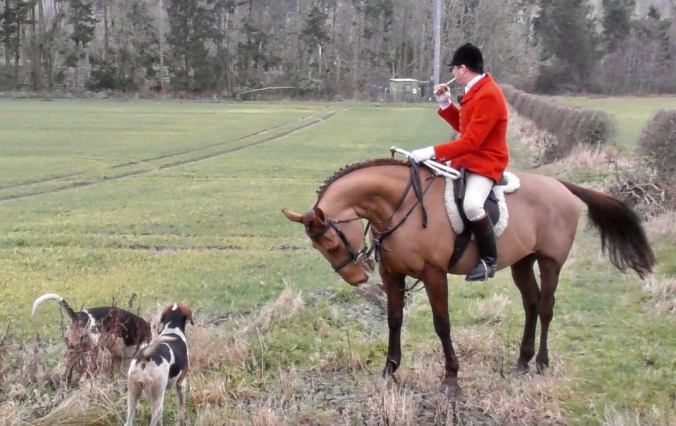
‘There are farmers and landowners involved in the hunt, who grant permission to access the land. Without this land there would be no foxhunting. For the riders who subscribe to the hunt, following hounds provides the freedom to ride over land that would otherwise be out of bounds. The fox is not restricted to boundary lines, so the hounds and riders are free to ride where the fox goes.’
‘The car support who follow the hunt mainly consist of elderly men. To them it’s a day out to socialise. They turn up with their binoculars, sandwiches and flasks having a good natter, they enjoy watching the hound’s work. I often talk to the members of the hunt to gain a better understanding of why they do what they do. We can’t expect to change something unless we fully understand it.’
‘We’ve talked about what we call ‘clean boot hunting’ a humane and lawful activity, which follows the scent of a human runner rather than a fox. With clean boot hunting they can still have everything they have now. The jobs will still be there, they can still have their socials and get together, their balls, their meets so they can still have their sherry and a bit hokey cokey, just don’t kill a fox. I think they fear their way of life will fall apart without hunting the fox.’
‘But humane hunting would be far more sustainable. Currently hunts claim to be trail hunting, which would involve hounds following a trail of artificial scent instead of a live fox. Unfortunately, trail hunting in my experience is just a cover for foxhunting.’

Have you a vision of what you want the group to be?
‘Yes, when I set the group up I thought I’m going to do this my way, I’m not going to war with them. I’m going to win hearts and minds. For me it was all about a love of wildlife, and a hatred of foxhunting and not a hatred of the people. I strive to end foxhunting for good so I knew that we needed to be taken seriously by the hunts and the police.’
‘I aimed to create a professional group with a credible image, as far removed from the negative stereotype as possible. We refer to ourselves as volunteers or wildlife guardians, rather than sabs, protesters, or activists. We don’t wear masks and we have a dress code. We’re conscious of how we come across to all the people we meet.’
‘Some people are just out for a dog walk in the countryside, families with kids, older people. Last thing we want to do is scare people, we want to be approachable. We’re always polite and respectful and get on with the farmers.’
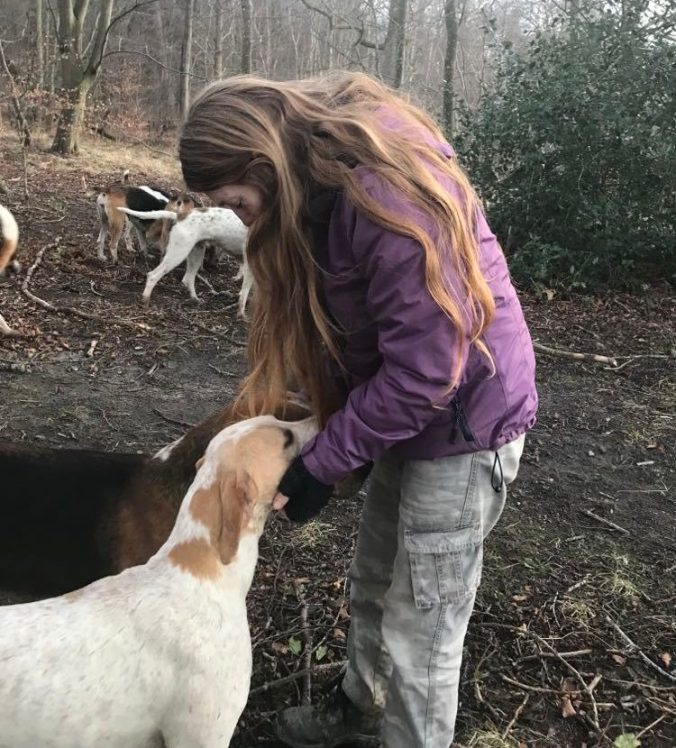
‘We absolutely love the hounds they are such lovely sweet animals, we would never do anything to put them at risk, and our hunts know that. We often pop along to their hound shows in the summer some we are made more welcome than others.’
‘We aimed to build relationships and establish trust in the community and we have. All of our hunts know who we are and they know our names. We engage in polite conversations, some team members live in hunt areas, so it’s not uncommon to exchange waves. Our approach has earnt us respect and fear in equal measures!’
‘Our overall aim is to make the countryside a safer place for wildlife. On a day to day basis we aim to be a visible deterrent, to prevent hunting and on most occasions we are. We rarely need to intervene as our presence is often enough of a deterrent. Our hunts will often try to avoid hunting when we are there, and certainly avoid hunting in front of us.’
‘Last year at a hunt I was filming when the hounds picked up a scent and chased a fox toward me. The whip panicked and stopped them all “Lynne, can you see me stopping the hounds? Have you got it on video that I’m stopping the hounds?” I replied, “Yes, I have, thank you.” The fox made his way to safety.’
‘In the long term we aim for prosecutions as this is the only way to end foxhunting for good. To achieve prosecutions then we need to be professional and credible.’
How much work is involved in the group?
‘A lot. We work very hard and put a lot of work in. I take this very seriously and am very committed to what I do. During the season we are out 2-3 times a week, despite working and other commitments. I would be out every day if I could. The fieldwork we do is just the tip of the iceberg. We do much more behind the scenes. Personally, I work on foxhunting every day of the week.’
‘I have taught myself a great deal over the years and always have my nose in a foxhunting book. I am also concluding a PhD in Criminology specialising in foxhunting with hounds. I have invested significant effort into this because I want to bring the issue of foxhunting criminality to a wider audience.’

‘The lady who assists me in running the group, Judy, is a former police officer, so between us we have an in-depth knowledge of hunting and the law. We both work very hard on this, preparing cases and evidence for the police especially.’
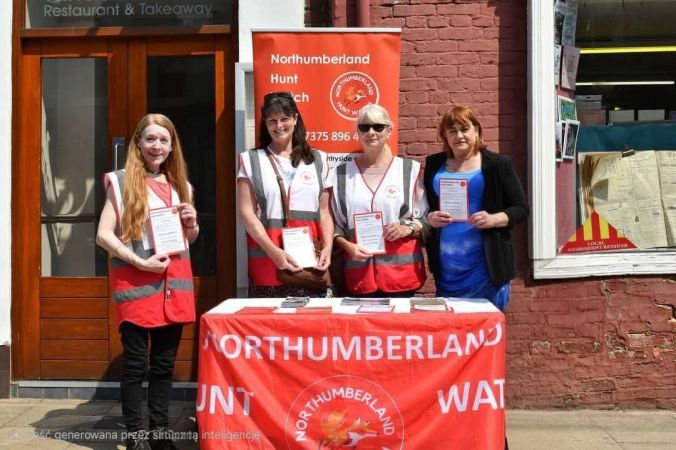
‘Out of season we hold outreach stalls in hunt towns where we talk to the local community about our work. This has enabled us to lay the foundations for a positive brand identity while building up good relationships, trust, and respect within the community. We want the community to feel comfortable having us in their area trusting us to perform our job professionally.’

Have you experienced any threatening situations?
‘Violence and aggression from any of our hunts is exceptionally rare. We have had very few minor incidents in 5 years, most of which were dealt with swiftly, either by the police or the hunt themselves.’
‘Following one minor incident at one of our hunts I reported it to the chairman, he dealt with it, and we received an apology, so it was resolved sensibly and that was the end of it. There were no more incidents.’
‘We cover all the Northumberland Hunts from the Scottish border down to the Durham border, although Tynedale is our main hunt who we monitor regularly and have done for 5 years. They were a bit of a nightmare at first but they soon leant that it didn’t get them anywhere. They are very polite towards us now and we have built a good relationship with them. We are there to do a job which we do well and without getting into altercations.’
‘With all of our hunts we established clear expectations for behaviour from the outset ensuring that our conduct was respectful and polite. Over the years we have built a good rapport with most of them exchanging polite greetings “good morning, gentlemen” and in return “good morning, ladies.”
‘We never engage in name-calling or squabbles because throwing insults is not a stepping stone to positive change. This means that we can focus on what is truly important—the foxes. It might make someone feel better after calling someone names but it doesn’t achieve anything for the fox.’
‘The hunts also have a code of conduct regarding their behaviour towards us too. We have an unwritten rule between us we don’t call them ‘hunt scum’ and they don’t ride their horses at us, so this works well. This mutual respect means any of our team can be monitoring a hunt alone, in some isolated locations without any problems. Our approach saves lives.’
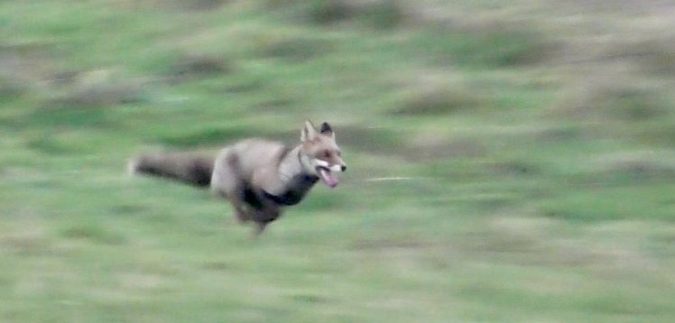
‘At one of our hunts we intervened between the fox and hounds, rating the hounds back so the fox could escape. This was in front of the hunt master and he said “thank you for helping” so we replied “no problem we’ll come back and help again next week.”
‘When we monitor hunts we focus on listening and observing, avoiding verbal confrontations is for creating a safe environment for the foxes allowing them a safe passage to escape. Foxes don’t know we are there to help them so we need to create a safe environment otherwise they would just see us as part of the pack. If there is chaos they could easily be scared back toward the hounds, we are very conscious of that. We often see foxes fleeing past us to safety. Silence is golden. It saves lives.’
How frustrating is it knowing fox hunting is illegal and it still goes on?
‘Very frustrating but there is a wide range of reasons why it continues. Weaknesses in the Hunting Act is a key issue, and also how it has been interpreted. This has provided loopholes for foxhunts to circumnavigate the law. There are so many issues that we will need an entire article to discus that alone. In a nutshell trail hunting has ensured that it is extremely difficult to prove them guilty and beyond all reasonable doubt. Consequently, trail hunting operates exactly as it was intended.’
‘We are committed to ensure that we have the best chance possible. Our behaviour will also come into question so we always act lawfully. Foxhunting is a low-level offence so if we break the law we lose the moral high ground and cannot expect the police to enforce one law while ignoring another. We have to be seen to be credible witnesses to make any progress.’
‘Because of how we operate we have built a good relationship with the rural crime team who we submit our footage to. We have had several incidents sent to the Crown Prosecution Service for review, and the police have acted swiftly in gathering the evidence.‘
Drone footage was captured of the Tyndale Hunt hunting a fox on 3 October 2024. This was submitted to the police. More information about this case can be found on the Northumberland Hunt Watch Facebook and You Tube pages.
TYNEDALE DRONE FOOTAGE 3RD OCTOBER 2024
How important are anti-hunt groups?
‘There are some excellent groups across the country that have worked hard to end foxhunting, bring hunts in court or raise awareness, such as Beds and Bucks Sabs, 3 Counties Sabs, Cheshire Monitors, and West Midlands Sabs, to name a few.’
‘However, not everyone who joins a cause has genuine motivations, and the less credible groups can undermine the work of those who are genuinely committed and doing good work. It’s about quality rather than quantity, so finding people with the right attitude can be difficult.’

What have you found out about yourself since starting this group five years ago?
‘I have found that I am stronger and more resilient than I ever thought possible. If you have genuine intentions and committed to doing your best job for wildlife then you can make a difference. A middle-aged woman with a vision took on ten hunts, most of which were untouched and located in some of the most isolated rural areas of the country. I was subsequently joined by other middle-aged women to create a hardworking and professional group that has made a significant impact on hunting in this area. Never underestimate the power of middle-aged women on a mission!’
If you are interested in the work of NHW or would like to volunteer contact >>>
Tel: 07375 896 463
Northumberlandhuntwatch@gmail.com
Facebook : Northumberland Hunt Watch
www.northumberlandhuntwatch.co.uk
Alikivi June 2025
 ALIKIVI UK : NORTH EAST MUSIC & CULTURE