TALL STORIES – painting with L. S. Lowry (1887-1976)

Hanging on my wall is a fairly large (27 x 22inch) painting printed on wood – Industrial Landscape, Ashton under Lyme 1952 by L. S. Lowry. The original is in Bradford Art Gallery and Museum.

I bought it in a charity shop a couple of years ago, the colours are faded as the previous owner must have placed it in direct sunlight, but still a bargain at £7.

When I first saw it I recognised the style as a Lowry – I like how he stretches everything – chimneys, buildings and people, the flat look with no shadows and how the factories fade in the background – capturing the heart and scale of industry.

Industrial Landscape by L.S. Lowry (1952).

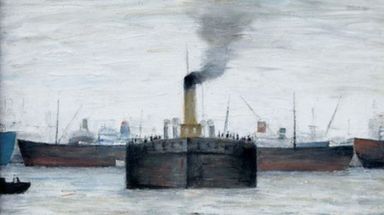
During the ‘60s Lowry visited Sunderland and surrounding areas where he produced a number of oil paintings and sketches. In South Shields he produced The Ferry in 1967. After his visit the painting went on display in the art gallery in Sunderland.

Bill Clark, owner of the Clark Art gallery in Cheshire, bought the painting in 2010. He said: ‘Lowry was entranced by the North East and particularly by South Shields. ’The Ferry’ is one of the stand-out pieces he produced of the area in the 1960s’.

The Ferry by L.S. Lowry (1967).

Lowry used to spend short breaks at the Seaburn Hotel near Sunderland, painting and sketching scenes of the beach and nearby ports.

The River Wear would be the closest to his hotel but in one sketch Tanker Entering the Tyne is a ship sailing around what could be the view from Comical Corner on the riverside near the boat builder’s yards on Wapping Street, South Shields.

If Lowry was in Shields, is there a record of his visit ?

Born on 1st November 1887 Lawrence Stephen Lowry is on the 1911 census living at 119a Station Road, Pendlebury, Lancashire with his parents Robert, an estate agents’ clerk, and Elizabeth.

Lucy England, and a few years later 23-year-old Alice Powell were employed by the family as domestic servants to help around the house as his mother Elizabeth had become bed ridden and dependent on her son. His father Robert died in 1932.

Lawrence worked through the day as a rent collector, then when he got home cared for his mother, only leaving time to paint through the night.

Lowry painted everyday scenes that he saw around him in England’s industrial North. ‘I never worked in a mill, it wasn’t a job I would of liked. Starting at 6 in the morning and finishing half past 5 at night. But I wanted to put the industrial scene on the map’ he said in a BBC interview in 1975.

He spent about ten years in Art schools in Salford learning classical techniques, and though he focused on industrial scenes he produced a number of seascapes and portraits using simple materials and colours.

He had small exhibitions, and his work was being noticed, but it wasn’t until aged 52 that his work was acclaimed. His mother never saw his success as she died in 1939, it deeply affected him and his work.

The scenes he painted where full of people haunted with anger and pain.

Due to class snobbery his work wasn’t recognised by the self-appointed art elite in the south. The Tate Gallery held some of his work in their basement for decades, but it wasn’t until 2013 when they eventually held a Lowry exhibition.

Lowry turned down honours, O.B.E, C.B.E and a knighthood – ‘meaningless in the absence of mother’. He retired from being a rent collector at 65 and during this time visited the North East still making sketches of what he could see around him.

On 23rd February 1976 Lowry died of pneumonia at the age of 88. He had produced over 1,000 paintings and drawings and today there is an art gallery in Salford named after him housing the largest collection of his work.

The world record sale for one of his paintings was for over £5 million paid for The Football Match.

Sources: Ancestry family search.

BBC News 2012 & 2013.

L.S.Lowry BBC film The Industrial Artist 1975.

 Alikivi  May 2020.

SONGS OF ISOLATION – Emma ‘Velvet Tones of Teesside’ Wilson contributes track.

Noted members of the UK Blues and Roots community have come together to produce Songs of Isolation. A fabulous one-off 17 track compilation in aid of NHS Charity + Heroes.

Mike Rivers, promoter at The Crawdaddy Club, Richmond, London, famous for its connection to early gigs by the Rolling Stones and the Yardbirds…

Everyone involved has generously donated their songs in aid of the charity, + Heroes. A small charity set up by NHS staff helping them obtain much needed PPE, childcare, food, financial and emotional support.

In the early days of Covid 19 and the lockdown I had the idea inspired by musician Adam Norsworthy for our musician friends to create a virtual album. We asked contacts in our music community to write and record a song related to the lockdown.

To work his mastering magic, we asked music producer/engineer Jon Astley (The Who, Eric Clapton, The Rolling Stones, Tom Jones, Jools Holland) who kindly volunteered his time. The result is an album that digs deep in the sadness that we all face during these uncertain times’.

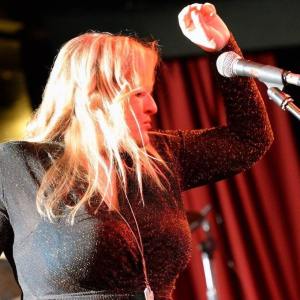
UK Blues siren Emma Wilson.

UK blues and soul siren, Emma Wilson from Teeside who has featured twice on this blog, has contributed to the album

‘I performed at The Crawdaddy a few times and promoter Mike Rivers invited me to add one of my songs. I wrote ‘Hold On’ especially for this compilation – it’s about missing my band and friends.

The musicians recorded from home and the lyrics mention all the names of Club promoters where I gig, like Mike Pendergrast from Darlington, Saltburn Blues Club Harry Simpson, Pete Rafferty from Eaglescliffe and from Guisborough, Kathleen Whinyates.

The collective has zero costs so every penny will go to the charity, + Heroes. Mike explains…

‘We ask for a minimum donation of £8.00 but hope that those of you who can afford it will give more generously. The music mirrors the feelings that only excellent musicians and songwriters can express in song. It is a present-day history of our times’.

The album is officially released on Friday 12th June 2020, and will be available to purchase via bandcamp HERE. A limited-edition physical CD version is also planned.

Featured artists on the album are:
The Della Grants , Ash Wilson, Georgia Van Etten, Adam Norsworthy, Rick Cassman,
Frank Collins, Emma Wilson, Peter Harris, Sonja Allen, Ben Hemming, Mike Ross, Marcus Lazarus, Grange McKenna, Ian McHugh, Staff & Stew, Gareth Huggett and The Surreal Lockdown Experience. 

Alikivi   June 2020

PIT CHORUS – interview with County Durham singer & songwriter Peter Lee Hammond.

The Queen, Margaret Thatcher and Paul McCartney walk into a bar in Easington mining town in the North East – sounds like an opening line of a joke but it’s a link to a song from deep down in the coal pits of the North East.

I asked the songwriter and ex-miner of 11 years, Pete Hammond, how did the single Living in a Mining Town come about ?

Easington in County Durham used to hold a carnival every year to commemorate the mining community and I was asked to write a song in 1989.

A lot of people got on board when they heard the rough version of the song, and the Easington council committee wanted it to be made into a single for the town.

The song was originally recorded in The Studio in Hartlepool then mixed at Abbey Road studios in London. I went down and met Paul and Linda McCartney and was given a tour around the studio by Paul. He also showed me an easy way to play his song Blackbird.

Metro Radio, Radio Tees, Radio One and many others played the song and I done a few interviews for them.

The proceeds were to raise money for a local handicapped school, so they could get a hydro pool for the residents. The money from the song also went towards launching a music collective in the area for musicians.

Many businesses donated money and it was supported by celebrities like Prince Charles, Her Royal Highness the Queen, Neil Kinnock MP and the Prime Minister Maggie Thatcher.

The Queen asked for a copy of the single to be sent to her and Maggie Thatcher sent me a signed photo of herself to auction and raise money. But no-one wanted to bid given the feelings the miners had for her, so I still have the photo at home.

Were you in a band then ?

Yes, at the time I was in a band called Just Us. I have won many song writing contests and awards over the years and cut album and cd’s.

One prize for winning a contest was song writing lessons from the lead singer of the Strawbs, Dave Cousins, and guitarist Brian Willoughby.

What studios did you record in ?

I recorded at Guardian Studios in Durham run by Terry Gavaghan. The studio was just in a normal street, it was two houses knocked together with no big sign saying recording studio, I thought I was at the wrong place at first until Terry answered the door.

What were your memories of the studio ?

Terry was a great, down to earth kind of guy always made you feel at ease, which was good as it was my first time in a studio or recording a song for that matter.

I remember the mixing room being very cramped full of equipment and a large mixing desk. But the session went smooth and the songs sounded great, Terry really knew what he was doing. We recorded three tracks there, Name on a Stone, Thomas Watson and I’m a Loner.

Terry was full of jokes and stories, one was that the studio was haunted by the ghost of a child that had been run over on the road outside the house. He also showed me a fur coat belonging to John Lennon,

Terry said when he first started out, he worked at Abbey Road studios, he let me take a piece of the lining and a clip of the fur as a keepsake. I have them in a frame at home.

Looking back what does the song mean to you ?

The song gave the community a sense of pride when the single came out, I was very proud and honoured to have been asked to do this for the place where I was born and raised.

What are you doing now ?

I still write songs and have over 1,000 up to now and record them on my own home studio. They can be heard on YouTube and my song writing Facebook page, you can find it by putting Hammy in the search bar.

Interview by Alikivi  June 2020

BROTHERS IN ARMS with North East songwriter Phil Caffrey

I have been so fortunate to play with not only great musicians but great people. The icing on my musical cake has been sharing the stage with my two brothers Pete and Paul said Phil.

Newcastle based The Caffreys create an original mix of rock, roots and folk. They have earned a formidable reputation based on uplifting original songs and great musicianship.

The full band or the smaller acoustic set up consist of some of the North East’s most respected musicians.

Recent live performances include Newcastle’s Live Theatre, The Mouth of The Tyne Festival, Durham Gala Theatre, The Pickering Engine Rally and The Sage in Gateshead.

I caught up with Phil who looked back on his early days in music….

We had many high points on stage, playing Newcastle City Hall was always great, gigs in Paris, Domefest in Durham and many great UK theatres.

In the early ‘70s we were trying to get a recording deal and in those days you had to gig in London to get record companies to come and see you. They would write to let you know if they were interested or not.

We had a wooden partition in the van and we would pin up the refusals from record companies on it, this made us more determined to get a deal which we did in 1975 with DJM. We released two albums and 4 singles over the next three years, but not much success to be honest.

When did you first get interested in music ?

We used to listen to our older brothers records in the late ‘50s early ‘60s – Buddy Holly, Fats Domino, Little Richard and many others.

My maiden performance was when I was 7 in 1959. It was in our parent’s front garden with my two brothers Pete 10, and Paul who was 5. Pete strummed the guitar and we all sang, we loved singing in harmony.

Our older brother Gerard who also played helped us. Other children would come and watch us and that gave us a good grounding and enhanced our childhood.

On 17th December 1964 we did a 30 minute performance at school and I still have the letter the headmaster sent our parents congratulating us on our performance. I have been so fortunate to make music with my brothers, this is my 8th decade making music from the late 1950’s to 2020.

What was your experience of being in a band in the beginning and when was your first time in a recording studio ?

I was in local bands and school bands until we formed Arbre in 1971. We played a gig on July 11th 1971 at Change night club in Newcastle. We invited loads of friends and made £25, this allowed us to go into Impulse Studio to record an album of original songs.

It was a sunny Sunday in August, we rehearsed the songs to the point that we recorded everything in one take. It was our first experience in a studio and we really enjoyed it. I still have the only copy of that album, it’s where it all started.

Another time in the studio was in 1980 where Pete, Paul and myself had a single released on Phonogram records. The song was written by local song writer Steve Thompson and produced by the late great Gus Dudgeon (Elton John).

Some great local musicians played on it including Alan Clark, Barry Spence and Paul Smith.

Did you support any name bands ?

In 1972 we played in Tynemouth Priory with another North East band, Prelude, on a rainy July day, we all got on well. Then we supported Fairport Convention and Jim Capaldi on nationwide UK tours playing in Scotland right down to Brighton.

We also supported Martha Reeves and the Vandellas at Blackpool Tiffanys, Sutherland Brothers and Quiver at Liverpool boxing stadium, where the ring was the actual stage. From ‘75 to ‘78 we played mainly colleges and universities as well as City Halls.

The Caffrey Brothers played the Mouth of the Tyne festival in Tynemouth Priory and Bents Park in South Shields where we supported The Hollies and Lindisfarne.

What other musicians have you worked with ?

In 1985 local musician and great friend George Lamb and I signed a publishing deal with Axis Music. Over the next three years we wrote songs with Keith Emerson and for Kiki Dee.

We also sang backing vocals on Saxon’s Destiny album. I also sang backing vocals on albums by Vow Wow and Onslaught.

In 1987 George and I sang backing vocals for a Steve Thompson song called I Want You. This was one of ten songs entered into a competition to see which one would represent the UK in the Eurovision Song Contest.

Sadly we didn’t win but it was another episode in my musical journey.

In 1989 I went to Miami to work with Yngwie Malmsteen (Swedish guitarist/song writer). We worked on some songs but nothing came of them.

Have you any road stories ?

We went to Paris in ‘77 and played the Nashville Rooms. Steve Marriott of The Small Faces came along on two nights, we chatted with him and he seemed to like the band. One of the nights was the day Elvis died, I will never forget it.

On one occasion we were going on a tour to Germany and set off to drive for the ferry. We stopped on our way for a cuppa and Roger our lead guitarist made a quick phone call to make sure everything was ok.

He came back to the van to tell us the tour was off, there was a problem with the tour organiser, that was a bit of a downer to say the least.

What are you doing now ?

Now to 2020 the journey continues. I am still in a band called The Caffreys and we still perform original songs. We only play gigs we want to, we don’t play many gigs as there are not many opportunities out there at the moment.

In 2016 we entered UK’s Best Part Time band competition. It was great fun and out of 1200 bands we made the final six in Manchester.

What does music mean to you ?

Music means more than I can put into words to be honest. The fact that I am still teaching and playing is testament to that. I never get tired of it and I feel really fortunate to still be part of it after all these years.

My son said that I live in a musical bubble, I think he’s right, how lucky I am.

 The Caffreys line up:

Phil Caffrey: vocals, guitar
Michael Bailey: bass, vocals
Rachael Bailey: violin, accordion, vocals
Mark Anderson: guitar, vocals.

Interview by Alikivi  May 2020  

‘IN 1971 WE SIGNED TO THE BEATLES COMPANY, APPLE RECORDS’ – interview with former Halfbreed guitarist Pete Dodds

I first picked up a guitar when I was twelve years old. My influences were Lonnie Donegan, Buddy Holly, Beatles, Bob Dylan and Leonard Cohen.

My first gig was in 1964 at The Portland Hotel in Ashington, Northumberland. After that it was gigs in clubs, pubs and village halls.

What band were you playing in then ?

Played in a band called Halfbreed and the line-up was Bill Elliot, Colin Mason, Les Connolly, Tom Farrier and Bob Purvis – who was a non- playing songwriter.

I was a member of the band until 1974 when things happened, but unfortunately the group split. Bob and Billy went on to become Splinter who were famous for the single Costafine Town that was on George Harrison’s label Dark Horse Records.

What was your experiences in a recording studio ?

In 1971 we had signed to Apple records and the first time in a studio we recorded demos for The Beatles company. We did an eight track demo with George Martin and Mal Evans as producers. I have a copy of the tracks, they have been cleaned up ready for further work.

My first album was recorded in 1987, that was Full Circle. The studio was Baker Street in Jarrow. It was run by Howard Baker who used to be vocalist with Warbeck.

I’ve recorded a couple more albums in various North East studio’s since then, like The Cluny. The latest was in 2016.

Have you any road stories ?

I was playing a gig when my guitar touched the mic stand, next thing I knew I woke up in the hospital. There was a fault in the electrical system – I must have lit up like a Christmas tree.

We were rehearsing for a gig at the Marquee club in London when my amp blew up. The Beatles roadie Mal Evans sent our roadies round to Apple to pick up an amp. They came back with John Lennon’s gear – a 200 watt Marshal amp and two Sunn cabinets. One of the cabinets had a revolving speaker, that was an insight into John’s sound.

What are you doing now ?

After my mother’s death I came out to Spain to clear my head, write a book and record a new album which I have now finished. My book is finished and is now being proofread and checked for grammar plus just waiting on the artwork.

What does music mean to you ?

Music has been with me most of my life I hope it will still be there after everything and everyone has gone.

 Interview by  Alikivi  April 2020.

‘ROCK AT THE SHARP END’ – highlights from the book by Sunderland author Geoff Docherty.

Docherty talks about his life from being doorman, club promoter and band manager. He remembers some of the big names that he attracted to Sunderland’s Bay Hotel

’The door leading to Marc Bolan’s dressing room was jammed with female admirers desperate to meet him. Some were crying with emotion. Others waited to meet their new heroes, Free, especially Paul Rodgers.

I’d never experienced female adulation of this intensity and found it impossible to empty The Bay that night’.

Docherty fills the book with stories about bands on their way to making it, and groups already there, but next he needed a bigger venue….

’During negotiations involved in moving to The Locarno, there were important hurdles to overcome. The first was the name. Over in the States were two highly respected venues called Filmore West and East.

I unashamedly plagiarised the name by renaming the Sunderland Locarno, The Fillmore North, on the night I hired it. Whether I could persuade the best groups to appear was in the lap of the Gods’.

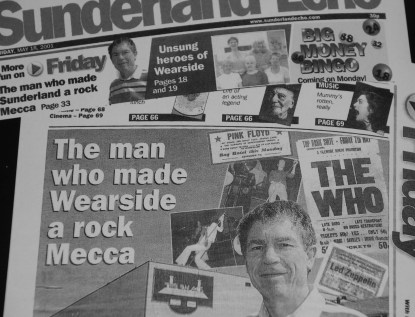
He did – and the book contains a chronology of gigs that Geoff promoted from the Bay Hotel – Pink Floyd, Black Sabbath and The Who – to the Locarno – T.Rex, Mott the Hoople, Kinks and Bowie – admission and price paid for the act are included in the details, £150 for Bowie and 10 shilling to get in.

After a visit to a local nightclub, Annabels, he spotted a band who were playing and ended up being their manager…

’In the three years I managed them, Beckett did two John Peel radio shows, 33 dates supporting The Sensational Alex Harvey Band, 19 dates supporting Captain Beefheart, 22 dates supporting Slade, five supporting Wizzard, three supporting Ten Years After and countless University and College gigs. They also made an appearance on The Old Grey Whistle Test’.

Docherty gives great detail of the meeting with Peter Grant and the subsequent Newcastle Mayfair booking of Led Zeppelin on the 18th March 1971.

Not short on anecdotes and how the music world affected his personal life, Rock at the Sharp End is a must read for any fan of North East music.

Alikivi  May 2020

LETTERS FROM JARROW (1) – The IRA on Tyneside

Recently I completed a DNA ancestry test which came back 14% Scottish and 86% Irish, a bigger percentage than I thought but not a surprise as in 2008 I had already researched the family tree through census’, birth, marriage and death records, plus visiting Ireland a few times.

My Irish family came to Tyneside in the North East of England around the late 1880’s and settled here – a long way from County Galway, Derry and Antrim.

Amongst old certificates, photos and letters, my grandfather wrote down memories of his mother and her family, plus describing where he used to live and play as a kid in Jarrow at the time of the First World War.

‘My mother’s family originated in Galway in the west of Ireland. She came from a big family, her brothers, uncles and cousins were all fishermen. I remember my mother as being a very hard-working woman.

She worked as a Stoker in the chemical works over the bridge in East Jarrow.  She worked there all through the 1914-18 war.

She was a very kind woman, strict but fair, and was very religious. The family were also involved with the IRA and Sinn Fein’.

These last remarks were very interesting because when researching my family history, I came across Donmouth, a North East local history website by Patrick Brennan (link at the bottom of the page).

In one of the sections, he covers the IRA in Jarrow which I have condensed here.

After being cruelly treated by England over the centuries – for example the Great Famine 1845-50 – Irish people were looking to create an Independent Irish Republic.

A British Volunteer force, known as ‘the Black and Tans’ landed in Dublin. The IRA operated a guerrilla campaign attacking small groups of Black and Tans and murdering informers. Out of control Tans went on an orgy of looting and arson.

By 1919 the Irish Self Determination League (ISDL) was formed, the purpose was to raise funds for Sinn Fein but some members decided to take direct action. Mainland Britain had its first arson attack in Liverpool Docks, days later, a large explosion near London Bridge.

On Tyneside, many men and women of Irish birth gave support to the Irish republican cause through membership of the ISDL or Irish Volunteers – better known as the IRA.

Since the 1880’s Jarrow had an active political organisation in the Irish National League and held an important role in the ISDL. They held political meetings, fund raisers and ceilidhs in Lockharts Cocoa Rooms and the Co Op Guild Hall in Jarrow. 

More direct action was called for resulting in more volunteers being recruited and by the end of 1920 six companies with a total of 160 men had been established:

A Company – Jarrow. B – Hebburn. C – Newcastle D – Wallsend. E – Bedlington. F – Consett.

Within a few months a further four companies were set up: Stockton, Chester-Le-Street, Thornley and Sunderland bringing the total to 480 men.

Arms, guns and explosives were either stolen from Army Drill Halls or obtained from foreign sailors. In Jarrow, baby’s prams were used as cover to transport weapons to and from an arms dump in St Pauls Road in East Jarrow.

March 1921 saw the first incendiary attack on a Newcastle warehouse and oil refinery, plus a timber yard at Tyne Dock. Largely unsuccessful, the second attack was more ambitious, 38 fires at 20 different farms were co-ordinated to be lit at 8pm throughout Durham and Northumberland. This demonstrated the extent of the I.R.A throughout the region. (Reports from the Evening Chronicle 1921).

A number of operations were planned and executed around Tyneside. Farm fires and attacks on oil works in Kenton, Wallsend, South Shields, and an aircraft shed in Gosforth was destroyed.

Also, the daring attack in Jarrow – a gas main blown up on the old Don Bridge (pics below).

This story featured in my documentary ‘Little Ireland’ (link at the bottom of the page).

Con Sheils speaking in the film said ‘They were just trying to make a point, that’s all they were trying to do. Not harm anybody, just trying to make a point that they wanted home rule for Ireland’.  

THE SINN FEIN OUTRAGES: GAS MAIN BLOWN UP  (report from the Evening Chronicle 23rd May 1921).

At 11.15pm on Saturday night there was a heavy explosion at the west end of the town, and it was discovered that a hole 18 inches by 18 had been made in the lower of two gas mains carried across the Don bridge at East Jarrow. The gas company’s workmen were soon on the spot, and the main was temporarily repaired.

The IRA on Tyneside were severely damaged when two of their top men were arrested in connection with the theft of explosives from a colliery in Blyth on the Northumberland coast.

They were sentenced to prison but released in 1922 as part of Truce arrangements made a year earlier.

But more trouble was on the horizon with pit strikes, mass unemployment and extreme poverty meant the Irish had another fight on their hands – by 1936 Jarrow was about to march onto London.

For further information:

https://garyalikivi.com/2018/08/22/little-ireland-documentary-on-irish-immigration-into-jarrow-uk/

http://www.donmouth.co.uk/

Alikivi   May 2020 

FIGHT AMONGST YOURSELVES – interview with Neil Thompson from The Carpettes

When did you first get interested in music ?

When I was a kid, I loved listening to records and watching singers like Billy Fury and Joe Brown on TV. I had my first single when I was two.

I also saw my first gig when I was two, which was Billy Fury at Sunderland Odeon in March 1962. By the time I was eleven I had about 150 singles in my collection.

I saw The Kinks at Sunderland Empire in 1969 and that was the start of me going to gigs in the North East – Led Zep at Newcastle City Hall, Queen at Sunderland Locarno, Sabbath, Genesis, Lizzy, Budgie, Nazareth, absolutely loved them all.

When was your first gig in a band ?

My first gig playing in a band was as a drummer. We were called Brown Sugar and it was on the 22nd November 1974 at Newbottle Church Hall, County Durham.

We played Chuck Berry and Rolling Stones songs to kids that wanted Led Zeppelin and Black Sabbath – we went down terrible. When we finished the vicar locked us in the back room cos they were banging on the door wanting to beat us up.

I played drums in that band for another four gigs and in the meantime started playing guitar/vocals in another band. We were doing Status Quo/Thin Lizzy covers and I played nine gigs with that band.

The last one was my first pub gig at the Sunderland Royalty in March ‘77.

By this time I was getting into the punk scene and one night I was in The White Lion in Houghton, County Durham and George was there – bassist from Brown Sugar.

We hadn’t seen each other for a good while and first thing he said was ‘Have you got the Ramones album’. I said I did, so he said ‘Well do you wanna be in a punk band then’.

The problem was that I was a drummer, but he’d seen one of the gigs where I played guitar and sang and thought I was good enough. We did our first gig as The Carpettes in June 1977.

What was your first experience in a recording studio ?

We did our first recording at Impulse in Wallsend that was in the summer of ‘77.  The demo is available on The Early Years, a CD released in 1997 on Overground Records.

Did you support any name bands ?

While we were living in the North East we gigged with Penetration, Punishment of Luxury and Angelic Upstarts. We also supported The Vibrators at Redcar Coatham Bowl.

Among all this we played one gig in London at Leytonstone Red Lion in March ‘78 supporting The Leyton Buzzards. This was the only time, thank goodness, that I was spat at during a gig.

The Carpettes released six singles and two albums from 1977 to 1980 including a 4 track EP in 1977 & ‘Small Wonder’ 7” both on the Small Wonder label.

Two albums, Frustration Paradise & Fight Amongst Yourselves on Beggars Banquet.

How did signing with those labels come about ?

We were on the Small Wonder label while we were living in the North East. That came about when we answered an advert in the Sounds music weekly for new bands and they liked us.

Me and the bassist, George, moved down to London in October 1978 and found a new drummer. But it was like starting from scratch when we moved down there but we signed to Beggar’s Banquet in June 1979.

We stayed there until 1981 then moved back up North.

Did you appear on TV or radio ?

We were on tour with The Inmates at the time and had to cancel one of the gigs at London to travel up to Manchester to record The Old Grey Whistle Test. They’d already played a track from the album on a previous show. The other band that was on was The Blues Band.

Did you have any high points in the band ?

I don’t know about high or low points – all I know is that we got better and better as we gigged. Our new drummer, Tim Wilder, was a really solid drummer, he was from Oxford but he’d been a student at Newcastle University and was the drummer in The Young Bucks while living up North.

I loved going to The Marquee to watch bands, but I didn’t really enjoy playing there to be honest. We did six supports there and they were hard work – there was always a ‘Come on then, impress us’ in the air !

We played four nights in November ‘79 with The Lurkers during their residency there. Each gig would have punks sitting on the stage with their backs to us and every now and then one would look around and stare at you – and then turn back around.

I much preferred London gigs like The Hope ‘n’ Anchor and The Nashville.

By the very last gig for The Carpettes in June 1981 we were a really tight live act with four years gigging experience – you can’t beat live experience for getting better on stage. It’s no good sitting in the bedroom playing guitar – not gonna get you anywhere.

One story to tell is that one of our first gigs was supporting Penetration at Newcastle University in November ‘77 – and we were terrible !

It was far too early to be playing gigs like that, but we supported them again at Middlesbrough Rock Garden in August ‘78 and went down a storm.

Have you any road stories ?

In 1980 we went to Italy three times and Holland once, and we also did a short UK tour supporting The Inmates. That UK tour was probably the best two weeks of my life.

I was twenty years old, travelling around the country playing music and when we arrived at the venue all the equipment would already be set up by the roadies – heaven!

What are you doing now ?

Well I’ve spent most of my life down London. I was in my own band called The Only Alternative – all my ideas and songs which was a bit selfish.

But we had some laughs for a couple of years between the summer of ‘84 to the summer of ’86. We released an album in 1985 on the Midnight Music label.

Then with the 20th anniversary of punk happening in 1996 I got both bands back together, well sort of with different line-ups. Both bands gigged on and off until the end of 2003.

During this time The Only Alternative recorded two more albums and two singles. I played drums on all of these recordings – as well as being the singer. The Carpettes released a single in 2002 and an album in 2003.

At the moment I have a three-piece band called The Alternative Carpettes which play some of my songs from The Carpettes with some Only Alternative ones thrown in.

What does music mean to you ?

Music means everything to me. All my life has revolved around music. I love all sorts of music. I love orchestral music like Tchaikovsky and Prokofiev.

Love the ‘30s and ‘40s swing bands like Basie and Ellington. Rock ‘n’ roll, country, rhythm and blues of the ‘50s. I have a radio show playing ‘50s music every day.

I also love punk, metal, indie, 78’s, cassettes, records, CD’s.  I love it all. I don’t like TV or read books – my whole life is music!

Check out The Carpettes from this 1980 episode of the Old Grey Whistle Test.

https://youtu.be/LvUt7yeAepw

Interview by Alikivi  May 2020.

‘I TOOK MY BASS OFF & SWUNG IT AROUND. NOT SURE IF IT HIT HIM BUT HE DONE A RUNNER’ with Bri Smith from North East punks The Fauves

The Fauves reformed in 2016 but they first got together in South Shields in 1978. Bassist, and original member Bri Smith looks back on some gigs they played in the late ‘70s….

Out of all the gigs back then we played a gig in Hebburn. I’ve got no posters for this one, but this was something else. About 20 of us turned up from (South) Shields and we met in a pub near Hebburn town centre.

The gig was at a youth club and I can remember it being like a church hall, the atmosphere was unreal.

About the third song in this lad came right up to me and spat in my face. I remember taking my bass off and swinging it around. I’m not sure if it hit him or not but he done a runner. A few scuffles broke out, but it settled down.

We couldn’t get out there quick enough even though we went down well!  Happy days (laughs).

The North Eastern gig organised by Rebel music was upstairs on a Friday night. It was quite small, 40p to get in, the place was full, and we went on early.

The Condemned were on last but our mates the Whiteleas Estate Aggro Boys (The WEAB) turned up late and shouted for us to go back on – so we did. It ended up a great night for us.

Another gig organised by Rebel music was at The Neptune in South Shields. It was 40p to get in and we had a great turn out. Hodge our singer had left the band by then, so we drafted in Abbo (Carl Abernethy). He only had a couple of days to learn the songs.

Murder the Disturbed played really well that night but when we went on, I thought we played shite but managed to get through it. To our surprise we went down great.

We played twice at the West Park gig in South Shields. This poster is from the second gig, it was 35p to get in. We organised this gig so what money we made on the door was ours.

It was another great turn out and just before Christmas. I can remember the police turning up at this gig as there was quite a bit of bother, but we managed to calm things down.

This was the first gig our mate Micky Warkcup who bought himself a double turntable put on a punk disco and got everyone in the mood. He used to travel around with us back then.

The Gosforth Park Hotel gig was 50p to get in and put on by Anti Pop from Newcastle. We supported The Noise Toys and Arthur 2 Stroke, it was a cracking night and always a good crowd there.

We went down well and met some good contacts through Gosforth. Ended up playing there on many occasions, we were always welcome.

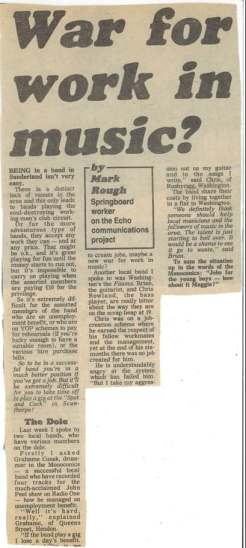
This Sunderland Echo newspaper cutting is from the War for Work interview around 1980. Me, Bob and Chris shared a place in Washington around this time. Ski and Abbo had left the band.

A journalist called Mark Rough was interviewing local bands about the punk scene and came round to our place after watching us live. He had been in a band himself on vocals called Disorder.

After the interview we said we were looking for a singer he said he was looking for a band ‘I’m your man’. He joined us, it was as simple as that.

The Upstarts contacted us as they were living down London, and they asked if they could borrow our gear – drums and amps. It was a Saturday afternoon, and they were supposed to play on the roof of the shop but the police put a stop to it, so we set the gear up inside. The place was packed and the Upstarts were brilliant that day.

After the gig we ended up on the drink with Decca, Mensi and Mond. Then Decca took us through to Sunderland for more – it was a class day from what I can remember.

Leon (Ski) made a lot of the early posters. We used to sit in his bedroom with the guitars working on new songs and planning gigs. We photocopied the posters then drove around the North East or wherever we were playing and stuck them all over.

We also used to spray paint The Fauves name all over the town. Once it was even mentioned on the local news and in the Shields Gazette about the graffiti. They were trying to find out who was writing The Fauves all over the town. Hey it wasn’t us (laughs). Great days.

The band had lined up some gigs for May but Bri told me the dates have been cancelled due to the virus pandemic, and are being re-scheduled for later in the year. Check their Facebook page for more details.

Link to ‘Ground Zero’ my first interview with The Fauves:

https://garyalikivi.com/2019/10/03/ground-zero-in-conversation-with-bri-smith-bob-rowland-from-tyneside-punks-the-fauves/

 Interview by  Alikivi  May 2020.

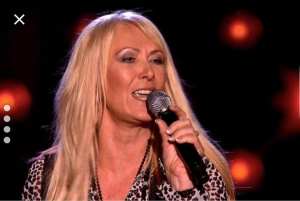
NORTHERN DIAMOND in conversation with performer Lorraine Crosby

‘Through Thick and Thin’ is the new single released today by Bonnie Tyler and Lorraine Crosby in aid of Teenage Cancer Trust…By releasing the record and helping to raise money we hope it makes a huge difference to teenagers with cancer.

I worked with Bonnie on another recording a few years ago in a studio down in Battle where Def Leppard recorded Hysteria. We get on really well, she’s fantastic, one day I went to her house and we had the same clothes on! She’s another one in the business who really works her socks off.  

The North East has a pedigree for strong woman, do you think you fit into that ?

We had a hard upbringing living in sheer poverty, so there was a fight to get out of that. My father died when I was only two so my mother was a young widow with four kids to bring up.

On a Friday we’d have a box of food arrive from the shop and that would have to last a week, when all that was gone, and we were starving literally we went in the garden as we had a rhubarb patch at the bottom.

I used to break off sticks of it and dip them in a bag of sugar…..diarrhea for the weekend (laughs).

We’re laughing about this but really, I used to walk into the kitchen and clap my hands to scare the mice off. That was my youth. We had absolutely nothing.

Yes, they were hard times, and you had to be strong to get through it, but through sheer determination I dragged myself out of it, it makes you very resilient.

What does music mean to you ?

I think music saved my life. It was pure escapism. I remember being at school and sneaking off to the hall to put classical music on the record player then dancing around like Margo Fonteyn,

I got caught and given the belt. These days they would suggest drama class or dance class to embrace the passion not reprimand you !

I played clarinet and violin but got bullied because of it so I bullied back as a form of self-protection, I only realise that now and how wrong it was but when you’re young and don’t really have any parental guidance you just survive the best you can.

Was music in your family ?

No don’t think so, New Year’s Eve you’d have the family and friends getting out the banjos and accordion, singing along and it was a magical time I so looked forward to going there and singing

I was in the church choir at Walker school, so I think my desire to be a singer came from there. I’ve been told that I was an outgoing kid and at my dad’s funeral I got up singing and dancing to cheer everyone up because they were all crying, so yeah something triggered in me then at just two years old !

When I left school in Newcastle I trained as a hairdresser, but when I found the stage I didn’t stay for long, yeah always been a performer.

Lorraine on stage with Spike from The Quireboys.

Is that where you feel most comfortable ?

Yes, and as long as people are coming to see me, I won’t retire. I’m still rockin’, Tina Turner did till she was 77 so why can’t I ? I’ve even done panto.

Five year ago I was asked and told them ‘Yes but don’t let me make a fool of myself’. Only a small role they told me, turned out to be the Queen in Snow White (laughs). But I embraced it and loved my time there.

I thank my mentor Leah Bell for turning me into a West End Wendy.

We’ve supported Status Quo many times and I’ve been on stage with Spike from The Quireboys. I’ve just been on an album with Elton John, Rod Stewart, Paul Carrack, Willie Nelson to name a few.

I’ve sang on cruise ships and have done shows on American Military bases when I lived out in Japan in the early ‘80s, that was a real culture shock. We did four 45-minute sets, on a weekend it was six shows, I retain thousands of songs up here (points to head).

Japan was hard going but the alcohol afterwards might not have helped as we drank the local hooch, it was wild. After Japan I came back to the UK that’s when I met my husband Stu Emerson, formed a band and ended up in America recording with Meatloaf.

First time I saw Lorraine Crosby was on a Meatloaf documentary I watched a few weeks ago. Meatloaf and musician Jim Steinman told stories about the first album Bat Out of Hell but it was the second album where Lorraine appeared.

A single ‘I’d Do Anything for Love’ was released in 1993 and was a massive hit, would you say that was a magic moment in your career ?

Just getting to do the Meatloaf song was great. What happened was Stu my husband and songwriter, knew a guy called Dan Priest in London and he sent our tape to Jim Steinman – he loved us and wanted to be our manager, so we moved to New York to work with him.

Jim was recording Bat Out of Hell 2 and one day he called me up ‘Lorraine can you come along to the studio and sing this part?’

Well Meatloaf is like a method actor he wanted to hear the female voice so he can react off it, so originally, I sang on just a demo of the song that’s why I wasn’t credited on the track.

We recorded some more songs and he played it to the record company who gave me a deal off the back of them.

Then a phone call came in saying what I’d recorded on the demo they were putting on the record and releasing it as a single. Originally, they were going to get someone else in to sing the part, but yeah that was a defining moment for me.

Not long after, we were driving down to Venice Beach and the song came on the radio it was just like, wow, crazy ! We knew it was gonna be big.

Then walking on stage at Whitley Bay Ice Rink singing it live with Meatloaf was a great moment, like scoring a goal at St James’ Park. I also appeared on Broadway with him, so yeah, a couple of really big moments. Great memories.

Does that story follow you around ?

Number 1 in 28 countries, sold 15 million records, won a Grammy…It’s a hell of a claim to fame isn’t it ? You gotta shout about it. As I said when we were in America we signed as a song writing duo Emerson/Crosby and Jim Steinman got us a big deal with MCA.

We went in Power Station studio in New York city with Bernard Edwards from Chic, there was the Bon Jovi bass player, keyboard player with Bowie, you know they were all in there when recording our album.

My husband Stu has always been my backbone, he has supported me and is a great songwriter.

His early band back on Tyneside were called Emerson, they were part of the New Wave of British Heavy Metal and recorded a single on Neat records and were on the brink of getting somewhere but split as some of the band joined Samson just before their big break.

We thought we were really getting on and putting things together over there. Steinman was mentoring and helping us with our writing and as he was based in Los Angeles we ended up moving to L.A. living in his house in the Hollywood Hills at first and recording in Ocean Way studio.

The record company then paid for apartments in Hollywood and San Fernando valley, that house had a studio in it where Earth, Wind and Fire recorded, Harry Neilson had been there, it was a real old ‘70s studio.

Jim is one of the most incredible genius’ I’ve ever met. I remember we didn’t see him much during the day, he was very nocturnal with his silver foil at the windows to stop the light coming in.

But he had his own career and it had really taken off so he couldn’t devote the time to us.

Meanwhile the second Meatloaf album which I sang on, went over budget so the record company sacked the guy who we were dealing with, and every band on his roster including us, went with him.

So, no manager, being dropped by the label and no money left, we reluctantly moved back to the UK. We heard three month later the last house we were in was destroyed in an earthquake.

What state of mind were you in when you returned to the North East ?

I was gutted, there was a number One album I was on and everyone thinking I was earning millions!

So, looking for a new manager I found Smallwood and Taylor, Rod Smallwood was Iron Maiden’s manager. I was with him for a couple of years, and he got me a couple of development deals with Chrysalis, Hansa and some others but unfortunately nothing seemed to gel with the songwriters I worked with.

I was based in the North East and travelling down to London to try and get things going.

One time I went out to L.A and worked with Andy Taylor from Duran Duran, we recorded a few songs, but they weren’t pop enough for the label, I’m more rock and blues.

So that time with Rod Smallwood ran out, no hard feelings involved, he had exhausted all the avenues and we parted.

Looking back, it was a daft decision to start back in cabaret and clubland, but you know you live an’ learn. Thing was I needed to pay the bills because I didn’t have anything then, but I’ve never stopped working, my voice gets better and my range has gone through the roof.
Did you have a wow moment listening to a song when you said ‘I want to do that’ ?

Yeah Lene Lovich. I heard her song Lucky Number on the radio and thought it was so bad anybody can be a singer. My mam said ‘Well why don’t ya’.

There was a music shop in town called Rock City and it had a notice board with adverts on for bands looking for singers. Me and a friend chose a country and western band first then left them to join a group called Time Out.

We played the working men’s club circuit for a year, but I was only backing and not developing my voice so with a couple of other guys I formed my own band, Foxy.

This was the early ‘80s and with a few agents working for us we did American Military bases all over the world.

Who else have you worked with ?

I’ve sang on albums featuring Rod Stewart, Kid Rock, done some backing vocals on the new album by John Parr, he’s a lovely man. I’ve worked with great musicians who have retained their skill, they aren’t like a lot in the charts now who just want to be famous, they have music in them and they still love what they do.

What’s next Lorraine ?

I was at the same charity event as Producer Geoff Wonfor and we got chatting and he said why not do Sunday for Sammy ?

This year it’s the 20th Anniversary of the popular live entertainment show featuring North East actors and performers.

Not long after I got a call asking me to do a duet with Tim Healey (Benidorm, Auf Weidersehen Pet) and we did Anything for Love. So that was my first time, then I became a member of the house band and I love it.

Where else would you see a show that’s had AC/DC’s Brian Johnson (He was in a sketch rebuilding the roman wall when I was at the show at Newcastle City Hall 2004) or Brenda Blethyn (Vera) Johnny Vegas, Trevor Horn, Joe McElderry all these people who wouldn’t normally perform together, it’s just magical.

The show is a charity that helps people in the arts and it’s very important now as funding for the arts is being cut. So yeah, it’s really special and the whole show has adapted to the size of the Arena, it hasn’t lost its feel from the City Hall.

After Sunday for Sammy, we are recording my new album, very rock and blues stuff I’m sounding Jimmy Barnes meets Bonnie Tyler. It’s very rocky and a bit like Vintage Trouble who I’m a huge fan of.

I was also asked by Spotlight TV to present a music video show called On Demand Country, people request songs from artists like Dolly Parton and we play the video.

The studio is Jam Jar Studios in Gateshead where we film it with a green screen behind me so we can project the video onto that. The techies do a great job behind the camera.

First time I’ve done it and really love it, so looking forward to doing more shows.

 Interview by Alikivi  2020.